
Note: This article contains affiliate links. If you click on these links and make a purchase, we may earn a small commission at no extra cost to you. This helps support our research and content. Read our full affiliate disclosure here.
Picking the right RV air conditioner with heat matters because your rig needs comfortable temperatures in summer heat and chilly mornings without juggling separate systems. A combined AC and heat unit saves roof space, reduces installation complexity, and simplifies power management while making it easier to maintain a consistent cabin climate. This guide shortlists the top options for RV use, emphasizing real-world factors like energy draw, heating capacity, noise, and installation fit. Below you'll find our top picks and the criteria we used to evaluate them, followed by practical buying guidance to help you choose the best unit for your RV and travel style.
Top Picks at a Glance
| Best Overall The best all-around choice for most situations | FOGATTI InstaCool Ultra 16K BTU |  |
| Best Value The sweet spot between price and what you get | iRooVee 12V Rooftop AC |  |
| Best Budget The cheapest option that still gets the job done reliably | hiberry 12V Rooftop Air Conditioner EAC002 |  |
| Top Rated A top-rated pick with lots of positive feedback | RecPro RV Air Conditioner 15K |  |
| Most Popular A crowd favorite that many people choose with confidence | Furrion Chill Cube 18K |  |
| Best Seller A high-volume bestseller chosen again and again | outequip Summit 2 OEP2500 |  |
FOGATTI InstaCool Ultra 16K BTU

| Cooling Power | 16000 BTU |
|---|---|
| Heating Capacity | 12,500 BTU |
| Noise | 43 db |
| Refrigerant | R-32 |
| Control Method | App, Remote, Touch |
The FOGATTI InstaCool Ultra 16K is a low-profile rooftop RV air conditioner that combines cooling and a 12,500 BTU heat pump for year-round climate control. It is designed for non-ducted installations and fits a standard 14.25" x 14.25" rooftop opening, making installation straightforward on many trailers and campers. Key features include app, remote, and touch controls plus WiFi for remote adjustment, a dual-motor triple-fan layout that delivers fast airflow for quicker temperature changes, and an EER/SEER rating of 11.8 for relatively efficient operation. Noise is rated at about 43 dB, so it runs quietly compared with larger rooftop units. Practical benefits include faster cooling/heating cycles, versatile control options, and a slim profile that helps clear low bridges. Limitations are that it is non-ducted only, so it is not suitable for RVs with factory ductwork, and it uses R-32 refrigerant with no inverter, which may affect off-grid or variable-speed efficiency compared with inverter models. Installation still requires electrical capacity (15 or 20 A circuit) and roof compatibility checks.
Best for: Buyers who want a compact, quiet rooftop unit that provides both cooling and heat for all-season RV use and value straightforward installation and smart controls.
Less Ideal for: Owners of RVs with factory ducted air distribution or those seeking an inverter-driven, variable-speed unit for the highest off-grid efficiency should consider other options.
- Combined 16,000 BTU cooling and 12,500 BTU heat pump for seasonal use
- App, remote, and touch controls with WiFi for flexible temperature management
- Low-profile rooftop form factor that clears low bridges and fits standard RV openings
- Relatively quiet operation at about 43 dB and faster airflow for quicker temperature changes
- EER/SEER 11.8 delivers reasonable energy efficiency for its class
- Non-ducted design makes it unsuitable for RVs with internal ductwork
- No inverter compressor, so it lacks variable-speed efficiency found on some competitors
- Requires proper 15/20 A circuit and roof compatibility verification before purchase
Verdict: A compact, low-profile rooftop unit that delivers fast, quiet 16K BTU cooling plus heat and smart controls for balanced all-season RV comfort.
iRooVee 12V Rooftop AC
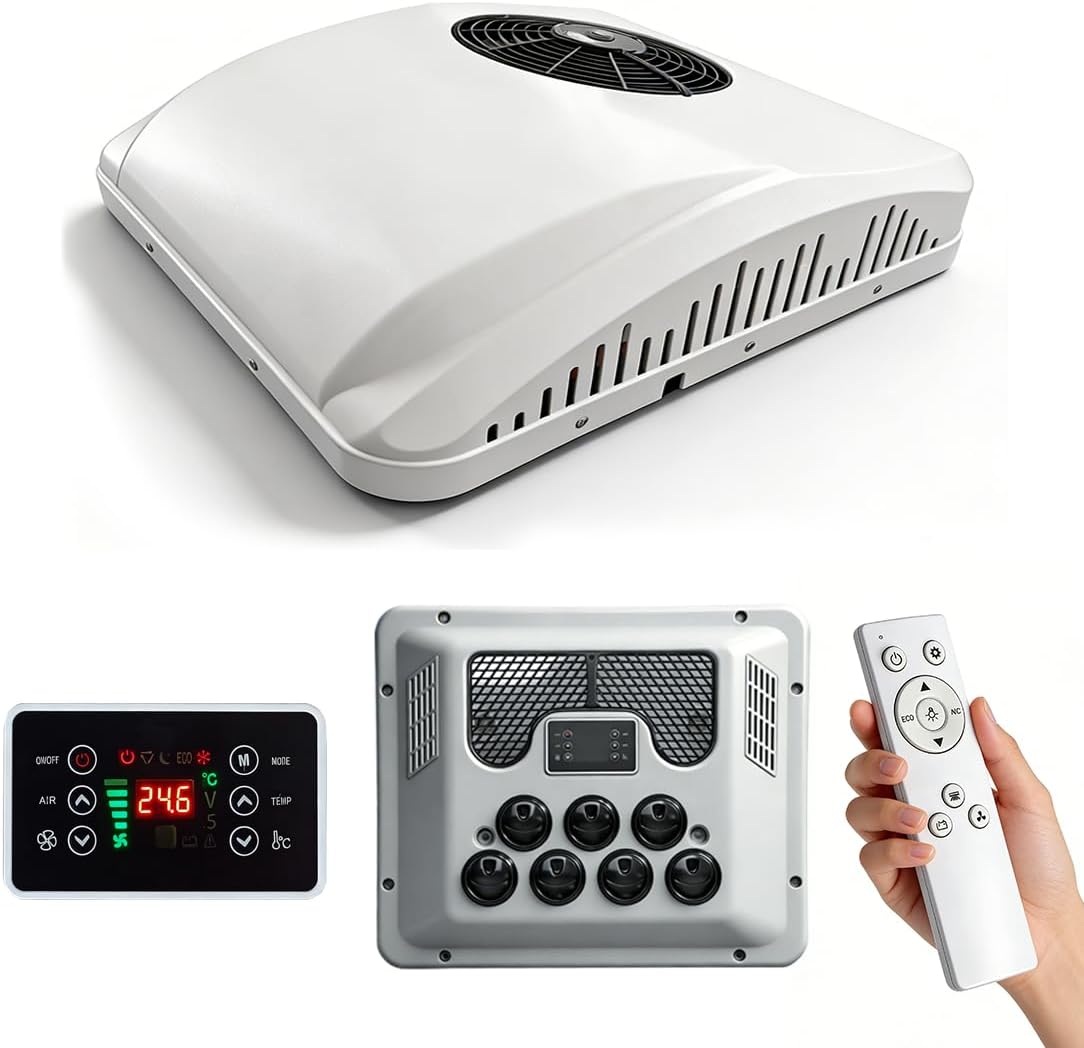
| Cooling power | 11000 BTU |
|---|---|
| Heating power | 3500 BTU |
| Voltage | 12V |
| Noise | 45 db |
| Annual energy consumption | 360 watt-hours |
This rooftop unit combines 11,000 BTU cooling with 3,500 BTU heating in a low-profile package designed for RVs, vans, boats, and other mobile applications. It runs on 12V DC power so you can use it off-grid with solar and battery systems, and the listing claims multi-hour runtime on large capacity batteries. The unit is marketed as quiet at around 45 dB thanks to an upgraded compressor and aerodynamic fan blades, which helps preserve sleep in campgrounds. Installation is presented as plug-and-play for standard 14×14 inch roof openings, removing the need for specialized installation for many users. Practical safety features include multi-layer electrical protection against overvoltage, undervoltage, overcurrent, and short circuits—useful when tying into a battery bank. Trade-offs to note are the modest heating output compared with dedicated propane or electric furnaces and the 12V power requirement that depends on sufficient battery capacity or a compatible solar setup. For buyers who need a combined cooling and heating rooftop solution that works without shore power, this unit is a pragmatic choice.
Best for: Buyers who prioritize practical, independent climate control for RVs or vans and want a single rooftop unit that cools and provides light heat without relying on shore power.
Less Ideal for: People who need strong, sustained heating in cold climates or who do not have sufficient battery or solar capacity to support a 12V rooftop air conditioner.
- Runs on 12V DC for off-grid and solar-powered operation
- Combined cooling (11,000 BTU) and heating (3,500 BTU) in one rooftop unit
- Low-profile rooftop design that fits standard 14×14 inch openings
- Reported quiet operation around 45 dB with upgraded compressor and fan
- Built-in protections for overvoltage, undervoltage, overcurrent, and short circuit
- Heating capacity is limited compared with dedicated RV furnaces
- Effective runtime depends heavily on battery capacity and solar setup
Verdict: A practical off-grid rooftop unit that delivers strong 12V cooling plus modest heating for RV travelers who want reliable climate control without shore power.
hiberry 12V Rooftop Air Conditioner EAC002

| Cooling Power | 10000 BTU |
|---|---|
| Heating Capacity | 5000 BTU |
| Voltage | 12V |
| Wattage | 1000 watts |
| Noise | 50 db |
This rooftop unit is built for RVs, campervans, trucks and similar vehicles that need both cooling and heat without relying on shore power. It delivers 10,000 BTU of cooling and a 5,000 BTU heating mode from a 12V DC system, and includes a three-speed fan, digital temperature control and a remote for convenient operation. The weatherproof ABS housing and multi-layer circuit protection are aimed at durability in outdoor mobile use, and the unit is sized to fit standard roof openings for relatively straightforward installation. Reported noise is around 50 dB, so it is reasonably quiet for a rooftop unit but not silent. Power draw is listed broadly (300W–2200W) which means runtime will depend heavily on battery capacity and whether a vehicle alternator or solar is used, so off-grid use may require planning. The unit is a practical choice for budget buyers who want a combined heat and cooling rooftop solution without aftermarket generator dependency, but expect to confirm roof fitment and power setup before purchase.
Best for: Buyers prioritizing an affordable, self-contained rooftop A/C with heat for campers, vans, or truck cabs who plan to run the unit from a 12V system and value simple installation and durability.
Less Ideal for: People who need long unattended off-grid runtime without upgrading batteries or adding a generator, or those who require the quietest possible cabin environment.
- Dual heating and cooling in one rooftop unit (10,000 BTU cooling, 5,000 BTU heating).
- Operates on 12V DC for off-grid and vehicle-powered use without requiring 120V service.
- Three fan speeds with digital temperature control and remote for easy comfort adjustments.
- Weatherproof ABS exterior and multi-layer circuit protection designed for mobile conditions.
- Wide reported power draw range means actual runtime varies and may demand significant battery/alternator capacity.
- Listed noise around 50 dB may be noticeable in small cabins at higher fan speeds.
Verdict: An affordable rooftop heat-and-cool 12V unit that gives campers and truck drivers dependable seasonal climate control without needing 120V power.
RecPro RV Air Conditioner 15K

| Cooling Power | 15000 BTU |
|---|---|
| Voltage | 115 volts |
| Wattage | 1500 watts |
| Refrigerant | R410A |
| SEER (Non-Ducted) | 8.57 |
The RecPro RV Air Conditioner 15K is a rooftop packaged unit designed to cool and provide supplemental heat for RV living spaces. It delivers 15,000 BTU cooling and uses a built-in heat pump for heating, while offering both ducted and non-ducted installation options to fit most rigs. The unit runs on 115V with a rated cooling input of 1500W and includes a wireless remote plus an LED touch panel for straightforward control of cooling, dehumidifier, fan, sleep, and timer modes. Practical benefits include a low amp draw that helps when running other RV appliances from shore, generator, or solar, a rugged aerodynamic shroud built for travel, and a quiet operation suitable for sleeping or relaxing. Important limitations are that the auxiliary heat is supplemental and not a primary heater below about 30°F and the unit will not operate above very high outdoor temperatures; it also draws up to 16 amps at startup so electrical planning is required. Installation requires a roof opening around 14 3/16" square and basic rooftop mounting components are included.
Best for: Buyers who prioritize dependable, travel-ready climate control and need an RV rooftop unit that balances cooling power with conservative electrical draw for shore, generator, or limited solar systems.
Less Ideal for: Do not choose this if you need primary space heating in cold climates or if you routinely camp in extreme heat where the unit may stop functioning.
- Built-in heat pump provides supplemental heating for shoulder seasons
- Low amp draw suitable for RV power systems, generators, and some solar setups
- Compatible with both ducted and non-ducted RV installations
- Includes remote control and LED touch panel for easy operation
- Rugged, aerodynamic rooftop design made for travel
- Supplementary heat is not a primary heater below about 30°F
- Will not operate above very high outdoor temperatures (around 122°F)
Verdict: A travel-ready 15,000 BTU rooftop unit that gives reliable cooling plus supplemental heat while minimizing amp draw for RV electrical systems.
Furrion Chill Cube 18K

| Cooling Power | 18000 BTU |
|---|---|
| Compressor Type | Variable-speed rotary_scroll |
| Noise | 50 db |
| Wattage | 5275.28 watts |
| SEER | 14 |
The Furrion Chill Cube 18K is a rooftop, non-ducted RV air conditioner built around a variable-speed compressor and inverter to provide steady, efficient cooling without the frequent on/off cycling of single-speed units. It installs via a bolt-on ceiling mount and is typically used as a head unit for camper and motorhome rooftops (an air distribution box is sold separately). Notable features include continuous compressor operation for improved dehumidification, a turbo cool mode for faster cooldown, battery-saver readiness for off-grid use, and a compact low-profile design that reduces drag. In practice you get strong cooling capacity that can handle high ambient temperatures while drawing less power than many conventional RV ACs, and the quieter operation makes it easier to sleep or relax. Important limitations are that this listing is the head unit only and requires a compatible outdoor unit/ADB for full ducted setups, and installation hardware for the ADB is not included with the head only option.
Best for: Buyers who prioritize quieter, energy-efficient cooling and want a modern rooftop head unit that improves off-grid runtime and performance in very hot climates.
Less Ideal for: People seeking a complete, drop-in packaged rooftop system ready to cool immediately without sourcing additional ducting or outdoor components should consider fully packaged alternatives.
- Variable-speed compressor for steady temperature control and better dehumidification
- High 18,000 BTU capacity suitable for very hot conditions
- Designed to be generator/inverter ready for off-grid or battery-saver use
- Low-profile, lighter head unit reduces rooftop drag and helps with installation
- Sold as head unit only so buyers must purchase compatible ADB/outdoor components separately
- Requires a new outdoor unit compatibility which may complicate some replacements
Verdict: Choose the Furrion Chill Cube 18K if you want a quieter, energy-conscious rooftop head unit that delivers strong cooling and better dehumidification for hot, off-grid RV use.
outequip Summit 2 OEP2500

| Rated cooling capacity | 10,000 BTU |
|---|---|
| Rated heat capacity | 4,500 BTU |
| Voltage | 12 volts |
| SEER | 15 |
| Sound pressure level | 53/48/40 dB |
The outequip Summit 2 is a low-profile rooftop air conditioner designed for vans, campers, trucks and small RVs that need both cooling and light heating. It delivers 10,000 BTU of cooling with a copper evaporator and a brushless fan that pushes up to 450 m3/h, and includes a 4,500 BTU PTC heater for mild warming. The unit is built for rooftop installation into a standard 14.1 x 14.1 inch opening and aims to be compact and wind-resistant to preserve roof space and fuel efficiency. Controls come via remote and an app with eco, sleep and turbo modes, and the unit includes safeguards for low-voltage, overcurrent and overtemperature protection to help when running from batteries. Noise is quoted at 53/48/40 dB depending on mode, and the manufacturer rates SEER at 15. Important limits are that the heater is supplemental rather than a full winter heating solution and the listed power draw and required wiring (6 AWG cord, 100A overcurrent protection) means professional installation and correct electrical provisioning are recommended for safe, reliable operation.
Best for: Buyers who prioritize a compact, factory-style rooftop unit that cools quickly, offers basic heating and includes protective electronics for safer off-grid or battery-assisted use.
Less Ideal for: Those who need full winter heating for large RVs or who want a unit that runs from lightweight household wiring without electrical upgrades should look elsewhere.
- Low 6.3 inch profile saves roof space and reduces wind resistance.
- 10,000 BTU cooling with copper evaporator for efficient heat transfer.
- Brushless motor fan with 450 m3/h airflow for strong circulation.
- Built-in electrical protections for low-voltage, overcurrent and overtemperature when used off-grid.
- Remote and app control with Eco, Sleep and Turbo modes for flexible operation.
- Heater is a 4,500 BTU supplemental unit and not intended as a primary heat source in cold climates.
- Requires substantial electrical capacity and proper 6 AWG wiring plus 100A protection, which may need professional installation.
- No inverter version specified, which can limit integration with some power systems.
Verdict: A compact, low-profile rooftop air conditioner that provides strong 10,000 BTU cooling plus supplemental heat and built-in electrical protections for buyers who want reliable, off-grid-capable comfort.
Choosing the Right RV Air Conditioner with Heat: Key Factors to Consider
Heating Capacity and Output
Heating capacity describes how much warm air the unit can deliver, usually expressed in BTUs or equivalent. For RVs, effective heating depends on both output and how well that heat is distributed inside the living space. A unit with higher BTUs can warm a larger floor plan or recover temperature faster after doors open.
Consider how well the unit's heat mode maintains a stable interior temperature during cold nights. In smaller RVs, an overpowered unit can short-cycle and reduce efficiency, while an underpowered unit will struggle to keep occupants comfortable. Think about insulation, typical campsite temperatures, and whether you often camp in shoulder or winter seasons when higher sustained output matters.
Cooling Performance and Seasonal Efficiency
Cooling performance is measured by the unit's cooling capacity relative to its energy consumption. In RVs, efficient cooling minimizes generator run time, battery drain, and shorepower bills. Look at published cooling capacity and the electrical input to estimate running costs for long stays or boondocking.
Seasonal efficiency also matters if you use the RV across summer and milder months. Units with better heat-exchange designs and variable-speed fans tend to deliver more even cooling and reduced runtime. Consider whether the RV layout allows for effective airflow from a rooftop unit to living and sleeping areas.
Electrical Load and Power Compatibility
RV electrical systems often run on limited 30A or 50A shore power, inverter capacity, and generator output. Electrical load describes how much current the AC/heat unit draws at startup and during steady operation. High startup draw can trip breakers or require soft-start accessories. Steady-state amperage affects how long you can run the unit on inverter power or a smaller generator.
Match the unit's voltage and amperage requirements to your RV's service. If you frequently boondock, prioritize units with lower continuous draw or those that are compatible with energy-saving modes. Also account for cumulative load from other appliances when sizing your electrical provisioning.
Roof Fit, Weight, and Installation
Rooftop units must fit the RV's existing cutout or be installed with acceptable modifications. Roof fit covers footprint, mounting pattern, and clearance for rooftop components like vents or antennas. Weight matters because excessive mass can affect roof sealing, structural supports, and center of gravity.
Check the height of the unit above the roofline and whether it interferes with low-clearance routes. Installation complexity affects cost and downtime; some units are drop-in replacements for common cutouts while others require new ducting or structural changes. Consider the availability of professional installation or whether you can handle a retrofit yourself.
Noise and Overnight Comfort
Noise level is an important comfort factor in confined RV spaces. Measured in decibels, operating noise depends on compressor design, fan speed, and vibration isolation. Quieter units improve sleep quality and make conversations easier in the living area.
Consider both interior and exterior noise. Exterior noise matters at campsites where loud compressors can be disruptive, while interior noise influences how low you can set fan speeds overnight. Look for features like variable-speed compressors or multiple fan settings that let you balance comfort and quiet operation.
Controls, Thermostat, and User Features
How you control temperature affects convenience and energy use. Integrated thermostats, remote controls, programmable schedules, and multiple fan modes let you tailor the system to your travel habits. Some units offer heat-focused modes or defrost cycles that improve winter performance.
Check how intuitive the controls are and whether the unit interfaces with common RV control panels. Features like automatic fan speed adjustment, sleep modes, or compatibility with external thermostats can simplify operation and improve overall efficiency.
Sizing Your Unit For Your RV Layout
Proper sizing balances capacity against the RV's interior volume and insulation. Too much capacity leads to short cycles that reduce dehumidification and can feel inconsistent. Too little capacity forces the unit to run constantly and may fail to maintain set temperatures.
Start by estimating the living area cubic footage and adjust for insulation quality, window area, and typical climate. Consider whether you need stronger heating performance for overnight lows or more cooling for hot daytime conditions. If you plan to use the RV for mixed-season travel, choose a unit that performs acceptably for both heating and cooling rather than one optimized for only one mode.
- Account for interior layout: slide-outs and open floor plans change airflow.
- Increase capacity estimate for poorly insulated or older RVs.
- Avoid oversized units that short-cycle in small rigs.
Power Strategies: Running on Shore, Generator, or Inverter
Decide how you intend to power the unit most often. Shore power provides the most consistent supply, but if you boondock, generator or inverter performance becomes critical. Units with lower continuous draw extend runtime on limited power sources.
If you rely on an inverter, check both continuous and surge ratings. Consider soft-start options that reduce compressor startup current and make it easier to run the unit on smaller generators or limited shore circuits.
- Verify startup surge amperage versus your breaker and generator capabilities.
- Consider energy-saving fan modes for overnight use on limited power.
- Plan power budgets including other appliances when sizing inverter/generator.
Installation Tips and Roof Prep
Prepare the roof surface and surrounding hardware before installation. Inspect roof seals, reinforcing struts, and clearance around vents and antennas. Make sure any existing cutouts are compatible with the new unit's mounting pattern to minimize sealing work.
If a full replacement requires strut relocation or additional reinforcements, factor that into planning. Use proper sealants and torque patterns on mounting fasteners to avoid leaks, and consider professional installation when structural work or electrical rewiring is necessary.
- Confirm roof cutout dimensions and mounting bolt pattern first.
- Replace old seals and check roof structure for water damage.
- Plan conduit routing for thermostat wiring and power connections.
Maintaining Efficient Year-Round Operation
Regular maintenance keeps both the cooling and heat functions operating efficiently. Clean or replace filters per manufacturer guidance, clear debris from rooftop coils, and check condensate drains to prevent backups. For heat modes that rely on heat pumps, keep outdoor coils free of ice or heavy dirt.
Seasonal checks before winter and after high-summer use can prevent surprises. Inspect electrical connections for corrosion and test the thermostat and safety controls to ensure reliable operation when temperatures dip.
- Clean filters monthly during heavy use seasons.
- Inspect rooftop coils and fins for blockage or damage.
- Test startup sequences and defrost cycles before cold-weather trips.
Noise-Reduction and Comfort Strategies
To lower perceived noise, use fan speed and thermostat settings that allow the compressor to run longer at lower output instead of frequent hard starts. Add soft pads or vibration isolators at mounting points if excessive vibration transmits into the coach.
Inside the RV, soft furnishings, rugs, and window coverings can help dampen airborne noise. For overnight comfort, combine low fan settings with programmed temperature setbacks to reduce cycling and maintain quieter operation.
- Use programmable setback schedules for night to minimize cycling.
- Consider vibration-damping mounts for rooftop units.
- Choose ducting layouts that reduce turbulent airflow into living spaces.
How We Chose the Best RV Air Conditioner with Heat
We evaluated units based on tangible, owner-focused performance and installation realities that matter for RV living. First, we prioritized heating output relative to the unit's size and power draw, because effective heat at low electrical demand is essential for overnight comfort in cold conditions. Second, cooling efficiency and seasonal energy use were measured by published capacity and input watts to estimate runtime on typical RV power sources. Third, we assessed installation and roof-fit considerations, including footprint, ducting or direct-blow options, and weight, since those factors determine whether a unit is practical for a given RV roof and support structure. Fourth, we judged noise levels in decibels and fan/compessor design notes; quieter systems improve overnight comfort in small spaces. Fifth, we considered controls and user convenience, such as integrated thermostats, heat mode controls, and compatibility with common RV electrical setups. We excluded units that require major structural modifications, non-ducted residential conversions, or continuous 240V service that is uncommon in RVs. Units that lack published performance data or clear installation specifications were not considered. The criteria here map directly to the scorecard metrics used in each product entry.
Our full evaluation process is outlined in our review methodology.
FAQ
Can an RV air conditioner with heat run on a 30A RV electrical system?
It depends on the unit's amperage requirements and startup surge. Some combined units are designed to operate on 30A service with careful power management, while others may need 50A or a generator. Check both steady-state draw and surge currents and account for other simultaneous loads.
Will the heat mode work when temperatures drop below freezing?
Many heat modes are designed to operate in cold conditions, but performance can drop as outdoor temperatures fall. Heat pump modes are less effective near or below freezing and may rely on supplemental electric heaters or defrost cycles to maintain output.
How loud are rooftop units typically inside the RV?
Noise varies by design, but most rooftop units produce some background noise from fans and compressors. Variable-speed compressors and multiple fan settings help reduce interior sound. Expect quieter operation at lower fan speeds and when the compressor runs steadily rather than short-cycling.
Do I need a professional to install a rooftop HVAC unit?
Professional installation is recommended if you are not experienced with roof sealing, structural reinforcement, or RV electrical systems. A pro can ensure proper mounting, safe wiring, and effective sealing to prevent leaks and electrical issues.
How often should filters and coils be serviced?
Filters should be checked and cleaned or replaced monthly during active seasons. Rooftop coils and fins should be inspected and cleaned at least once per season, with more frequent checks if you travel in dusty or salty environments.
Final Verdict
Choosing an RV air conditioner with heat means balancing heating output, cooling efficiency, and electrical compatibility with your RV's power system. Prioritize units that match your typical campsite conditions and your vehicle's roof and electrical limits. Remember that quieter operation and user-friendly controls improve everyday comfort while proper installation and routine maintenance keep performance reliable. Focus first on heating and electrical fit, then refine your choice based on noise, installation complexity, and control features. With the right priorities, you can select a combined AC and heat unit that keeps your RV comfortable across seasons.