
Note: This article contains affiliate links. If you click on these links and make a purchase, we may earn a small commission at no extra cost to you. This helps support our research and content. Read our full affiliate disclosure here.
If you make cold brew at home, the grinder you use matters more than you might think. A single-dose coffee grinder for cold brew lets you grind just what you need, limiting stale grounds and giving you better control over coarse particle size. That precision translates into cleaner extraction, fewer fines, and a smoother finished brew. This guide shortlists seven top single-dose grinders optimized for cold brew, and evaluates them on the practical criteria that matter to home brewers. Read on to compare features like grind consistency, adjustment range, build quality, and ease of cleaning before you decide which unit fits your brewing routine.
Top Picks at a Glance
| Best Overall The best all-around choice for most situations | beanglass T64 Single Dose Grinder |  |
| Best Quality Built to a higher standard if you want something more solid | Fellow Ode Gen 2 Grinder |  |
| Best Value The sweet spot between price and what you get | SHARDOR Single-Dose Burr Grinder |  |
| Best Budget The cheapest option that still gets the job done reliably | FORLIM Portable Burr Grinder CM-002 |  |
| Top Rated A top-rated pick with lots of positive feedback | Wirsh Geimori GU38 Coffee Grinder |  |
| Most Popular A crowd favorite that many people choose with confidence | AMZCHEF Single Dose Grinder 8306A |  |
| Best Seller A high-volume bestseller chosen again and again | Tuni G3 Flat Burr Grinder |  |
beanglass T64 Single Dose Grinder

| Burr size | 64 mm |
|---|---|
| Burr type | Titanium-plated flat stainless steel |
| Motor power | 300 watts |
| Capacity | 50 g |
| Power source | AC adapter |
The beanglass T64 is a single-dose electric grinder built around 64mm titanium-plated flat burrs, a stepless grind dial, and a removable chute for easy cleaning. It is used by dosing beans directly into the included 58mm aluminum cup or a portafilter, dialing in a precise grind size and grinding quickly with a 300W motor. The large burrs and stepless adjustment make it easy to dial fine settings and achieve consistent, low-retention grinds ideal for concentrated extractions. The magnetic removable chute and included bellow reduce mess and speed cleanup after each dose. Limitations to note: the unit is relatively heavy and solidly built, and it is optimized for single-dose espresso-style grinding rather than high-volume batch grinding for large cold brew batches. The manufacturer recommends espresso-range settings for best performance and warns against ultra-fine settings that can clog. For someone looking to grind small, precise doses with low retention and fast throughput, the T64 delivers a practical, no-frills experience.
Best for: Buyers who want precise, low-retention single-dose grinding and prioritize grind consistency and easy cleanup for small-batch brewing.
Less Ideal for: People who need to grind large volumes at once for batch cold brew or who prefer an ultra-light portable grinder.
- Large 64mm titanium-plated flat burrs for fast, consistent grinding
- Stepless adjustment dial for fine-grain control
- Low retention (about 0.1g) preserves freshness between doses
- Removable magnetic chute and bellow make single-dose cleanup easier
- Includes 58mm aluminum dosing cup that fits portafilters
- Designed for single-dose and espresso-range grinds rather than bulk cold brew volumes
- Relatively heavy cast-aluminum build may be less convenient to move or store
Verdict: Choose the T64 if you want a fast, low-retention single-dose grinder that delivers consistent, dialed-in grinds for small-batch cold brew and concentrated extractions.
Fellow Ode Gen 2 Grinder

| Burr size | 64 mm flat |
|---|---|
| Grind settings | 31 settings |
| Capacity | 100 g |
| Wattage | 140 watts |
| Voltage | 120 volts |
The Fellow Ode Gen 2 is a single-dose electric burr grinder built specifically for brewed coffee methods like pour-over, French press, and cold brew. It uses professional-grade 64 mm flat burrs and a two-stage grinding geometry to produce consistent particle size across its 31 grind settings, which helps clarify flavor and extraction for larger-brew methods. The 100 g single-dose bin, magnetic catch cup, anti-static tech, and a built-in knocker reduce retention and mess so you can dose precisely for each batch — a real advantage when dialing in coarse cold brew grinds. It runs relatively quietly and has an automatic stop so you can press the button and walk away. The compact footprint fits easily on a counter and routine cleaning is straightforward. Limitations: it is designed for brewed coffee rather than true espresso, and the single-dose design means it is optimized for precision and freshness over high-volume continuous grinding. The Ode Gen 2 is a focused tool for home brewers who prioritize grind consistency and low retention for repeatable cold brew and other brewed methods.
Best for: Home brewers who chase consistent, low-retention grinds to dial in larger-batch brewed methods like cold brew and want repeatable results from single-dose dosing.
Less Ideal for: People who need a grinder for espresso on a regular basis or who grind large volumes continuously without pausing between doses.
- Professional 64 mm flat burrs for consistent particle size
- 31 grind settings tailored to brewed methods including coarse cold brew
- Anti-static tech, built-in knocker, and optimized path minimize grind retention and mess
- 100 g single-dose bin and magnetic catch cup enable precise, fresh dosing
- Quiet operation with automatic shutoff for convenience
- Not intended for espresso; limited fine-range performance for espresso extraction
- Single-dose design is less convenient for high-volume continuous grinding
Verdict: Buy the Ode Gen 2 if you want a single-dose grinder that delivers consistent, low-retention coarse grinds for repeatable cold brew and other brewed coffee methods.
SHARDOR Single-Dose Burr Grinder

| Wattage | 20 |
|---|---|
| Material Type | Stainless Steel |
| Power Source | DC power supply |
| Included Components | 1 BOWL |
This SHARDOR grinder is built for single-dose, everyday home grinding and covers a wide range of brew styles with 80 adjustable settings from ultra-fine to coarse. It uses a conical burr design driven by a low-noise DC motor, so you can dial in grind size for espresso, pour-over, or coarser cold brew without waking others. One-touch operation and a compact stainless steel body make it easy to use and store on small counters, while the LED power display gives simple status feedback. The single-bowl, single-dose approach minimizes leftover grounds and keeps beans fresher between brews, but it also means you grind small batches each time rather than larger volumes. Power is DC-supplied and the unit is lightweight, so it fits a basic home setup but lacks professional-grade build and advanced dosing features found on pricier models. For someone prioritizing freshness, quiet operation, and space savings, this grinder gives useful versatility for multiple brewing methods including cold brew when set to a coarser setting.
Best for: Home brewers who value peak freshness and a compact, quiet grinder for dialing in single batches for cold brew and other methods.
Less Ideal for: People who need to grind large volumes at once or require commercial-grade durability and advanced dosing controls.
- Single-dose bowl preserves freshness and prevents wasted beans
- Wide 80-step grind range supports espresso to coarse cold brew
- Quiet DC motor suitable for early-morning or shared-space use
- Compact stainless steel body that is easy to store
- Simple one-touch operation and LED power display for straightforward use
- Single-dose design is slower for brewing larger batches
- Not intended as a commercial or heavy-duty grinder
Verdict: A compact, quiet single-dose burr grinder that lets practical home brewers preserve freshness and precisely dial in coarse grinds for cold brew.
FORLIM Portable Burr Grinder CM-002

| Capacity | 15 g |
|---|---|
| Burr material | SUS420 stainless steel conical burrs |
| Grind settings | 80 steps |
| Power | 25 watts |
| Voltage | 7.4 volts |
The FORLIM Portable Burr Grinder is a cordless, single-dose grinder built for travel and small-batch brewing. It grinds up to 15 g per cycle using hardened SUS420 stainless steel conical burrs and an 80-step grind dial that maps settings for espresso, moka pot, pour-over, and French press. The unit charges by USB-C (about 70 minutes) and the battery life is advertised for roughly two weeks of typical daily use, which makes it handy for mornings away from a kitchen. Practical touches include a magnetic grounds cup, an auto-reverse function to clear stuck beans, and a double-click safe-start to avoid accidental activation in a bag. The aluminum-alloy body and burr hardness rating suggest decent durability for regular use, but the small capacity limits it to single cups or testing beans rather than making larger cold brew batches. Cleaning requires removing the bean chamber and grounds cup for hand washing while avoiding the motor body. Expect grinding times around a minute for a single 15 g dose and noise below roughly 65 dB on coarser settings. For cold brew use you will need multiple short batches because the grinder is optimized for small single-dose work rather than larger coarse-volume grinding.
Best for: Buyers prioritizing a low-cost, portable single-dose grinder who want café-style grind control for travel, office, or testing beans one cup at a time.
Less Ideal for: Those who regularly grind larger volumes for batch cold brew, groups, or full pots should choose a higher-capacity grinder built for bulk coarse grinding.
- True conical stainless steel burrs for more uniform grind compared with blade grinders
- 80 grind settings give fine control for multiple brew methods including coarse grinds
- USB-C rechargeable and cordless for portable, off-counter use
- Magnetic grounds cup and included brush/spoon reduce mess and simplify single-dose workflow
- 15 g capacity restricts use to one cup at a time, requiring repeated batches for cold brew or larger servings
- Not dishwasher-safe and motor body must not be rinsed, so cleaning needs care
Verdict: A compact, rechargeable single-dose conical burr grinder that delivers café-style grind control at a budget-friendly, travel-ready package.
Wirsh Geimori GU38 Coffee Grinder
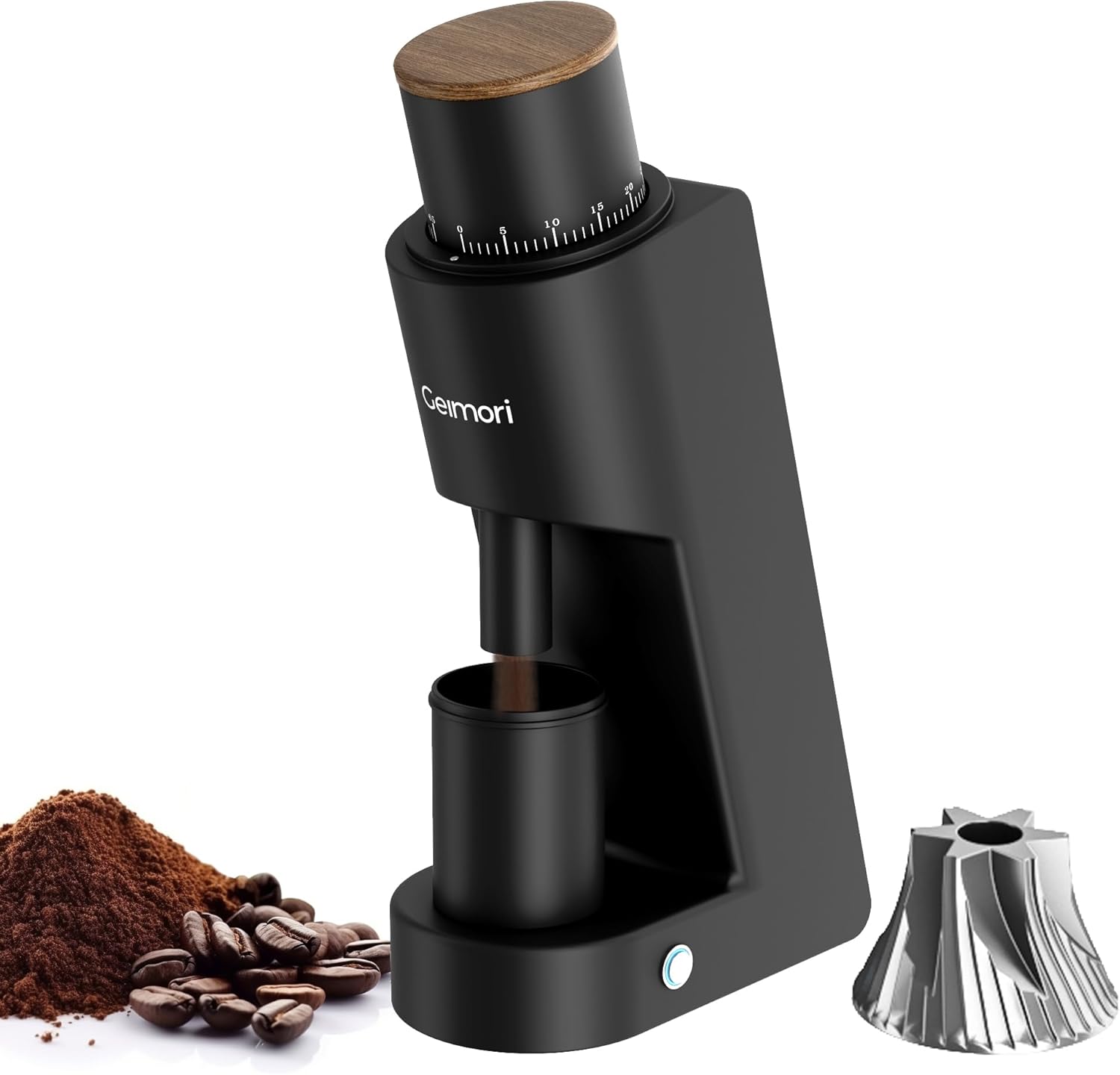
| Capacity | 35 g |
|---|---|
| Wattage | 96 watts |
| Voltage | 120 volts, 230 volts |
| Burr Type | 38mm 6-core stainless steel conical burrs |
The Wirsh Geimori GU38 is a single-dose conical burr grinder built for home baristas who want precise control and minimal retention. It uses 38mm 6-core CNC stainless steel burrs and a stepless 0.01mm adjustment, so you can dial settings from espresso fines to coarser cold brew with fine-grain repeatability. The straight-through design plus included bellows and magnetic dosing cup keeps retention extremely low, which is important when switching beans or preparing single-dose cold brew. A 96W DC motor runs at a low RPM for quieter operation, and the all-metal body with removable burrs and tool-free access makes cleaning straightforward. Practical limits include a 35 g capacity suited to single doses rather than large-batch grinding, and the stepless dial has a learning curve if you prefer click-stop presets. For cold brew specifically, the grinder's ability to produce consistent coarse particles and near-zero retention helps avoid old fines contaminating the next batch.
Best for: Buyers who prioritize consistent, repeatable grinds and near-zero retention for single-dose workflows, especially those making cold brew in small batches and swapping beans frequently.
Less Ideal for: Those who need to grind large volumes at once or prefer a stepped, grab-and-go dial with presets should consider a larger or stepped alternative.
- 38mm 6-core CNC stainless steel conical burrs for consistent particle distribution
- 0.01mm stepless adjustment for extremely fine tuning across grind sizes
- Straight-through low-retention design with bellows and magnetic dosing cup for single-dose workflow
- All-metal, plastic-free body and removable burrs for durable build and easy cleaning
- Quiet 96W DC motor suitable for early-morning use
- 35 g hopper capacity limits grinding to single doses rather than large batches
- Stepless adjustment requires time to learn ideal settings for each brew method
Verdict: Choose the GU38 if you want a durable, low-retention single-dose grinder that delivers café-quality coarse grinds ideal for cold brew.
AMZCHEF Single Dose Grinder 8306A

| Capacity | 120 g |
|---|---|
| Burr size | 40 mm |
| Grind settings | 75 stepless |
| Power source | DC power supply |
The AMZCHEF single-dose grinder is built for precision home brewing where low retention and fine control matter. It uses a 40mm forged burr and 75 stepless grind settings to dial in grind size for espresso through coarser methods like cold brew, and a timed 5–60 second control makes single-dose dosing straightforward. Practical features include a magnetic detachable spout for easier cleaning and a vacuum-sealed 120 g container to store grounds or beans, while anti-static design and a quiet DC motor reduce mess and noise during use. The package also adds dosing funnels and a knock-style tool that help transfer grounds to a brewing vessel without wasting coffee. Expect occasional overheating if you run long continuous sessions, and some users may find the plastic body feels less robust than higher-end metal housings. For cold brew specifically, the low retention and wide grind range let you measure single doses precisely, but large-batch cold brew needs repeated cycles rather than one big hopper run.
Best for: Buyers who want a low-retention, single-dose grinder for precise small-batch brewing and value social proof and measured performance when choosing gear.
Less Ideal for: People who need to grind very large volumes in one session or who prefer heavy-duty metal construction for commercial use should consider a different model.
- Very wide 75-step stepless grind adjustment for precise control
- 40mm forged burrs for uniform particle size across brew methods
- Anti-static design and magnetic outlet minimize mess and retention
- Timed 5–60s operation simplifies single-dose portioning
- Includes vacuum-sealed 120 g container and dosing accessories for tidy storage and transfer
- Plastic exterior may feel less durable than metal-bodied grinders
- Can overheat if run continuously for long periods
Verdict: If you want precise, low-retention single-dose grinding for cold brew and other methods, this grinder delivers wide grind control and tidy handling in a compact package.
Tuni G3 Flat Burr Grinder

| Burr type | 64mm flat stainless steel |
|---|---|
| Grind settings | 100 stepless settings |
| Capacity | 250 g (large hopper) / 50 g (single-dose hopper) |
| Wattage | 260 watts |
| Voltage | 120 volts |
The Tuni G3 is built around 64mm stainless steel flat burrs and a stepless 100-setting adjustment ring, so it grinds quickly and can be dialed in from espresso fine to coarse for cold brew. It offers an LED touch interface with programmable single-shot, double-shot and continuous timers in 0.5-second increments, which makes consistent single-dose dosing straightforward. The grinder includes a 250 g hopper for bulk use and a smaller single-dose hopper plus a portafilter holder and dosing cup, and an anti-static system keeps grounds from scattering during drop and dosing. In practice the G3 feels like a small commercial unit: fast, stable and suited to repeated single doses or larger batches when you need them. Expect some setup and dialing-in time to find the exact setting for cold brew coarseness, and the all-metal stainless body and heavier footprint mean it is less portable than compact single-dose models. For buyers who want dependable, consistent grinds and a mix of single-dose and higher-volume capability, the G3 performs well; casual users who only need occasional small batches may find it larger than necessary.
Best for: Buyers who want reliable, repeatable single-dose performance but also the option to grind larger batches, and who prefer a stable, near-commercial machine for consistent cold brew extraction.
Less Ideal for: People who need a lightweight, highly portable single-dose grinder for travel or very occasional home use should consider smaller, more compact models instead.
- Large 64mm flat burrs for fast, uniform grinding and reduced heat build-up
- Stepless 100-setting grind ring for fine control across brew methods including cold brew coarses
- Programmable LED touch dosing with 0.5-second increments for repeatable single-dose shots
- Anti-static system reduces mess and improves dosing accuracy
- Includes both a single-dose hopper and a larger 250 g hopper for flexibility between single batches and bulk grinding
- Relatively heavy and sizable compared with dedicated portable single-dose grinders
- Requires initial dialing in to find the right coarse setting for cold brew
Verdict: Choose the Tuni G3 if you want a commercial-style grinder that delivers fast, consistent single-dose grinds and the flexibility to do larger cold brew batches with minimal static mess.
Choosing the Right Single-Dose Coffee Grinder for Cold Brew: Key Factors to Consider
Grind Consistency at Coarse Settings
Cold brew relies on long steep times, so large, even particles are essential to avoid over-extraction and excessive sediment. Look for grinders that maintain a narrow particle distribution when set to coarse. A consistent grind reduces the amount of fines that can muddy the cup and helps the brew extract predictably across batches.
Differences in burr geometry, speed, and adjustment mechanism all affect coarse-range performance. When evaluating options, prioritize machines that explicitly demonstrate stable coarse settings rather than those that only excel at espresso or medium grinds.
Adjustment Range and Repeatability
You will likely experiment with coarse settings to dial in strength and mouthfeel. A useful grinder offers a wide coarse range plus clearly marked detents or a reliable continuous adjuster so you can return to a previously successful setting. Repeatability saves time and coffee by eliminating guesswork between batches.
Consider whether the adjustment mechanism locks or is easy to nudge during a grind. Fine, tactile control is more important for dialing coarse ranges than absolute number of notches, because small changes can have a large effect on extraction.
Retention and Single-Dose Workflow
Single-dose grinders are designed to minimize retained grounds that cling inside the grinder. Low retention reduces stale flavors, simplifies cleaning, and means you only grind what you will brew. For cold brew, where you often measure a single large dose, look for designs that either remove the hopper or funnel grounds directly into your container with minimal dead space.
High-retention machines require brushing and purging between batches, which slows down the process. A true single-dose workflow keeps the grind chamber accessible and minimizes nooks where grounds can accumulate.
Ease of Cleaning and Maintenance
Cold-brew beans are oily and can leave residues that affect later batches. A grinder that disassembles quickly for brushing and burr access reduces the time required for upkeep. Removable burrs, simple hopper removal, and straightforward brush access all make regular cleaning realistic.
Also consider whether parts that contact coffee are easy to wipe or rinse. Regular maintenance preserves flavor consistency and extends the life of the burrs, so prioritize ease of cleaning even if it means a slightly larger footprint.
Burr Material and Motor Durability
Long-term performance depends on burr quality and motor resilience. Hardened steel or ceramic burrs maintain edge geometry longer, especially when grinding oily dark roasts commonly used for cold brew. A stable motor that maintains speed under load helps produce uniform particle sizes.
Durable components also reduce the likelihood of drift in grind distribution over time. For home cold-brew workflows, you want a grinder that stays consistent for years with routine cleaning rather than one that degrades quickly with regular use.
Noise, Footprint, and Daily Convenience
Practical details such as how loud the grinder is, how much counter space it occupies, and whether it fits comfortably into your morning routine matter. A compact, quieter grinder makes single-dose cold-brew prep less disruptive, especially in small kitchens.
Also weigh the hopper and container sizes against how much coffee you typically brew. A unit optimized for single-dose use should be convenient to set up and store without demanding a large dedicated space.
Why Single-Dose Grinding Helps Cold Brew
Single-dose grinding means you grind exactly the beans you will use for one batch rather than storing ground coffee where it can stale. For cold brew, that immediacy preserves volatile aromas and prevents oxidation that changes flavor over the long steep.
Beyond freshness, single-dose workflows encourage better grind hygiene. With fewer retained grounds and easier cleaning, you are less likely to carry over oily residues that dark-roast cold brew beans can leave behind.
- Reduces stale flavors by eliminating pre-ground storage
- Minimizes retained grounds that can taint subsequent batches
- Encourages more frequent cleaning and consistent results
How Grind Size Affects Extraction and Mouthfeel
Coarse grind size slows extraction and reduces sediment and bitterness in cold brew. Too fine a grind increases fines that float free and cause a gritty texture and over-extraction. Conversely, too coarse a grind can under-extract, yielding weak flavor.
The goal is an even coarse distribution. That means fewer fines and a tight spread between the largest and smallest particles, which translates to a smoother, cleaner cup and predictable strength from batch to batch.
- Aim for coarse, uniform particles to balance extraction
- Small shifts in setting can meaningfully change strength and mouthfeel
- Consistent grind minimizes need to adjust steep time drastically
Practical Tips for Measuring and Dialing Cold Brew
Start by choosing a coarse setting and keeping your dose and water ratio constant while testing steep time variations. Use a scale to measure grounds and water for repeatability. Note the setting and steep time that yield the texture and strength you prefer.
When trying a new grind, purge a small amount and visually inspect the grounds for excessive fines. If you see lots of dust, back off to a coarser setting and re-test. Keep a simple brew log so you can reproduce successful results.
- Use a scale for grams of coffee and water every time
- Purge a small quantity before collecting your dose to clear residual fines
- Record grind setting, dose, water ratio, and steep time for repeatability
Maintenance Routines That Preserve Cold Brew Flavor
Establish a quick daily brush-out and a deeper weekly cleaning to remove oily residues. A short brush after each dose prevents buildup in the chute and burr area. For single-dose grinders, removing the hopper and wiping the grinding chamber should be straightforward.
Every few weeks, disassemble the burrs according to the manual and clean trapped oils with a soft brush. Avoid harsh detergents on metal parts; use a dry brush and a slightly damp cloth for non-electrical components when needed.
- Daily: brush out chute and wipe hopper surfaces
- Weekly: deeper clean of burrs and accessible crevices
- Monthly: inspect burr condition and tighten any loose fittings
Space and Sound Considerations for Small Kitchens
If counter space is limited, prioritize compact single-dose grinders with a small footprint. Measure the area where you plan to keep the grinder and consider storage if you do not want it on the counter full time. Some single-dose options are designed to be stored easily between uses.
Noise matters if you live with others or make coffee early. Look for grinders with lower RPM motors or sound-dampening housings. Remember that slower grinding speed can reduce heat transfer but may require more time to produce a single coarse dose.
- Measure intended storage space before choosing a unit
- Lower RPM grinders often run quieter but take longer
- Consider vibration and stability on small surfaces
How We Chose the Best Single-Dose Coffee Grinder for Cold Brew
We focused on attributes that directly affect cold brew quality and day-to-day convenience. Primary evaluation criteria included grind consistency across coarse settings, hopper-to-portafilter single-dose handling and retention, adjustment range and detents for repeatable coarse settings, motor and burr durability for long-term uniformity, and overall ease of cleaning to prevent stale-oil buildup. Products were screened for true single-dose workflows rather than grinders that require large hoppers to operate properly. We excluded units with poor coarse-range performance, inconsistent grind distributions, or designs that make cleaning difficult. We also prioritized grinders with robust burr materials and accessible adjustment mechanisms because those features keep coarse grind performance stable over time. Editorial judgment balanced measured grind metrics and practical user concerns such as noise, footprint, and maintenance. The final shortlist represents options that make single-dose cold-brew workflows simpler while delivering the coarse, even grounds cold extraction requires.
Our full evaluation process is outlined in our review methodology.
FAQ
Can I use a standard burr grinder set to coarse for cold brew?
Often yes, but not all grinders maintain consistent coarse distributions. Many standard grinders are designed around espresso and medium settings and may produce too many fines at coarse settings. A grinder optimized for single-dose coarse grinding will usually give more repeatable results.
How often should I clean the grinder when making cold brew regularly?
Do a quick brush-out after each grinding session and a deeper burr-area cleaning weekly if you brew several times a week. Oily beans used for cold brew leave residues that can affect flavor if not cleared routinely.
Is lower RPM better for cold brew grinding?
Lower RPM can reduce heat transfer and preserve volatile aromatics, but it does not guarantee better coarse consistency. The interaction of burr geometry, motor stability, and feed mechanism also determines particle distribution.
Do single-dose grinders waste coffee because of retention?
A true single-dose design minimizes retention and wastes very little. Some grinders still have dead space and require purging, so check retention behavior rather than assuming all small-form grinders are low-retention.
Will ceramic burrs or steel burrs be better for cold brew beans?
Both materials can work well. Hardened steel tends to hold a sharp edge under heavy use, while ceramic resists heat and wear differently. The key is burr geometry and maintenance rather than material alone.
Final Verdict
For cold brew, prioritize grinders that deliver consistent coarse grind distributions, low retention, and straightforward cleaning. Expect tradeoffs between noise, footprint, and speed; a quieter, lower-RPM grinder may be slower but gentler on flavor, while a compact high-speed unit can save time if it still controls fines. Focus on repeatability: choose a grinder with clear adjustment feedback and a workflow that matches how much you brew. That approach will give the most reliable cold-brew results over time.