
Note: This article contains affiliate links. If you click on these links and make a purchase, we may earn a small commission at no extra cost to you. This helps support our research and content. Read our full affiliate disclosure here.
If you make a lot of dressings, emulsions, or pan sauces, a small blender tailored to sauces can save time and improve consistency. You want a unit that handles small volumes without overheating, creates smooth emulsions, and is easy to clean between uses. This guide gathers the top shortlisted small blenders for sauces and explains why each made the cut. We evaluated machines for motor performance on small batches, blade and container design for emulsifying, thermal and splash control, and how easy each is to operate and maintain. Read on for concise buying guidance before the product list.
Top Picks at a Glance
| Best Overall The best all-around choice for most situations | Ninja Nutri-Plus BN301 |  |
| Best Quality Built to a higher standard if you want something more solid | Breville Control Grip BSB510XL |  |
| Best Budget The cheapest option that still gets the job done reliably | OVENTE HS560B Hand Blender |  |
| Top Rated A top-rated pick with lots of positive feedback | Ninja Fit Personal Blender QB3001SS |  |
| Most Popular A crowd favorite that many people choose with confidence | Magic Bullet MBR-1101 |  |
Ninja Nutri-Plus BN301

| Wattage | 900 watts |
|---|---|
| Number of Speeds | 3 |
| Power Source | Corded Electric |
| Material Type Free | BPA Free |
The Ninja Nutri-Plus BN301 is a single-serve countertop blender built around a 900-peak-watt push-to-blend motor and Pro Extractor blade assembly, designed for smoothies, frozen drinks, and small-batch purees. You blend directly in one of the included 20 oz to-go cups, then swap on a spout or storage lid for quick transport or fridge storage, which cuts cleanup and saves counter space. The extractor blades break down ice, whole fruits, and softer vegetables efficiently, so it will handle chickpea blends for hummus if you pre-soften beans or use canned chickpeas and add enough liquid and oil. Controls are simple push-to-blend pulses rather than variable speeds, which makes operation straightforward but limits fine speed control for very thick recipes. Most removable parts are top-rack dishwasher safe, easing maintenance. Because it is a personal blender, capacity is limited to single servings and heavy, continuous batching for large hummus quantities will require doing multiple cycles. For buyers wanting a reliable, compact machine that simplifies small-batch hummus and spreads, the BN301 delivers predictable, easy results.
Best for: Buyers who want a compact, easy-to-use personal blender for reliable small-batch hummus, smoothies, and on-the-go servings without complex controls.
Less Ideal for: Those who need to make large volumes of hummus or who want precise, multi-speed control for very thick recipes should consider a larger countertop blender.
- 900-peak-watt motor with Pro Extractor blades that crush ice and break down soft solids
- Includes three 20 oz to-go cups with spout and storage lids for blending, transport, and storage
- Push-to-blend pulses are simple and reduce risk of over-processing
- Top-rack dishwasher safe cups, lids, and blade assembly for easy cleaning
- Compact footprint that fits small kitchens, dorms, and limited counters
- Single-serve capacity requires multiple cycles for larger batches of hummus
- No adjustable speed settings for fine control on very thick or textured blends
Verdict: A compact, dependable single-serve blender that makes small batches of hummus and other spreads with minimal fuss and easy cleanup.
Breville Control Grip BSB510XL

| Wattage | 280 |
|---|---|
| Number of Speeds | 15 |
| Power Source | Corded Electric |
| Control Type | Variable Speed with Trigger Control |
The Breville Control Grip BSB510XL is a handheld immersion blender built for steady, controlled blending of soups, sauces, baby food, and smoothies. Its bell-shaped anti-suction base and internal ribbing reduce drag on liquids so the motor runs more efficiently and you get smoother results with less splashing while working directly in pots or the included 42 oz jug. The ergonomic trigger grip offers fine variable-speed control across 15 settings, which helps when you need to ramp up slowly for emulsions or to finish a velvety sauce. Stainless steel construction and a non-scratch base make it safe to use in cookware, and the compact storage design lets the jug house the chopping bowl when not in use. Limitations include a mid-range 280W motor that handles most home sauce work but may struggle with very heavy duty chopping or large batches, and a corded design that requires proximity to an outlet. For sauce-making the unit emphasizes control and a clean finish rather than raw high-power extraction.
Best for: Buyers who prioritize precise speed control and clean, splash-free blending for sauces and small-batch preparations will appreciate this tool's ergonomics and accessory set.
Less Ideal for: Those who need maximum motor power for heavy chopping, large-volume commercial prep, or cordless portability should consider a higher-power or cordless alternative.
- Anti-suction bell-shaped base reduces splatter and improves control when blending in pots
- Ergonomic trigger grip with 15 variable speeds for fine control over texture and emulsions
- Includes useful accessories: 42 oz jug, chopping bowl with mini blade, and whisk attachment
- Stainless steel shaft and non-scratch base safe for cookware
- Compact storage design nests chopping bowl in jug for tidier countertop storage
- 280W motor is adequate for sauces but not ideal for very heavy-duty chopping or large, dense batches
- Corded design limits reach compared with cordless models
Verdict: Choose the Breville Control Grip when you want precise, splash-minimized control for making smooth sauces and small-batch blends.
OVENTE HS560B Hand Blender

| Power Source | Corded Electric |
|---|---|
| Wattage | 300 watts |
| Number of Speeds | 2 |
| Blade Material | Stainless Steel |
The OVENTE HS560B is a simple, budget-friendly immersion blender aimed at everyday blending tasks like smoothies, purees, sauces and baby or elder-friendly soft foods. Its 300W motor and two-speed pulse control let you move between gentle stirring and more aggressive blending, while the slim stainless steel shaft fits into bowls, pots and beakers for one-pot pureeing. The detachable shaft uses a twist-lock for secure use and is dishwasher-safe, which makes cleanup straightforward after preparing mashed fruits, soups or soft vegetable purees for seniors. Practical limits are its basic two-speed control and corded design, which reduce flexibility compared with multi-speed or cordless models; the motor also requires short run intervals to avoid overheating. For straightforward pureeing needs where cost and easy cleaning matter most, the HS560B delivers reliable performance without unnecessary extras.
Best for: Buyers who need an affordable, easy-to-use immersion blender to make smooth purees and soft foods for elderly family members and prioritize simple controls and easy cleanup.
Less Ideal for: Users who need precise speed control, long continuous run times, or cordless portability should consider higher-end multi-speed or cordless appliances instead.
- 300-watt motor provides capable blending for soft foods and soups
- Detachable stainless steel shaft and blades are dishwasher-safe for easy cleaning
- Slim stick design reaches into pots and bowls for one-pot pureeing
- Simple two-speed pulse control is easy to operate
- Only two speed settings limit fine control over texture
- Corded design restricts range of motion compared with cordless models
Verdict: A straightforward, low-cost immersion blender that makes quick, easy purees and is simple to clean, ideal for preparing soft foods for the elderly.
Ninja Fit Personal Blender QB3001SS

| Wattage | 700 watts |
|---|---|
| Capacity | 16 fluid ounces |
| Power Source | Electric |
| Control Type | Push |
| Number of Speeds | 1 |
The Ninja Fit Personal Blender is a compact, single-serve machine built for quick smoothies, shakes, and frozen drinks. Its 700-watt push-to-blend motor and Pro Extractor blade assembly pulverize ice, whole fruits, and tougher ingredients so you get smooth results in the included 16-oz cups; the cups twist on spout lids for easy transport. Typical use is straightforward: load ingredients into a cup, press to blend, then swap on the lid to go. Top-rack dishwasher safe, BPA-free parts make cleanup fast. For sauce work, the powerful short bursts of Pulse Technology can emulsify dressings and puree small batches of cooked vegetables or tomato sauces, though the 16-oz capacity limits it to small portions and the plastic blade assembly may not handle very fibrous or heavy-duty simmered reductions as well as a full-size countertop blender. The single-button control keeps operation simple but offers no speed presets for fine tuning. If you need a reliable, space-saving blender for single-serve sauces and everyday blending, this unit is a practical choice; if you regularly process larger batches or very dense mixtures, a larger appliance will be better suited.
Best for: Buyers who prioritize a compact, dependable blender for daily single-serve sauces, dressings, and smoothies and want a low-fuss appliance that cleans up quickly.
Less Ideal for: Not a good fit for cooks who need to process larger batches, very thick reductions, or frequent heavy-duty blending tasks.
- 700-watt motor provides strong blending power for ice and frozen ingredients
- Includes two 16-oz to-go cups with spout lids for blending and serving in the same container
- Compact footprint saves counter space and stores easily
- BPA-free, top-rack dishwasher safe cups and lids simplify cleanup
- 16-oz capacity restricts use to small batches
- Single push-to-blend control lacks variable speed settings for fine control
Verdict: A reliable, space-saving personal blender that delivers strong single-serve performance for small sauces and smoothies.
Magic Bullet MBR-1101
| Wattage | 250 watts |
|---|---|
| Number of Speeds | 6 |
| Power Source | Corded Electric |
| Capacity | 22 fluid ounces |
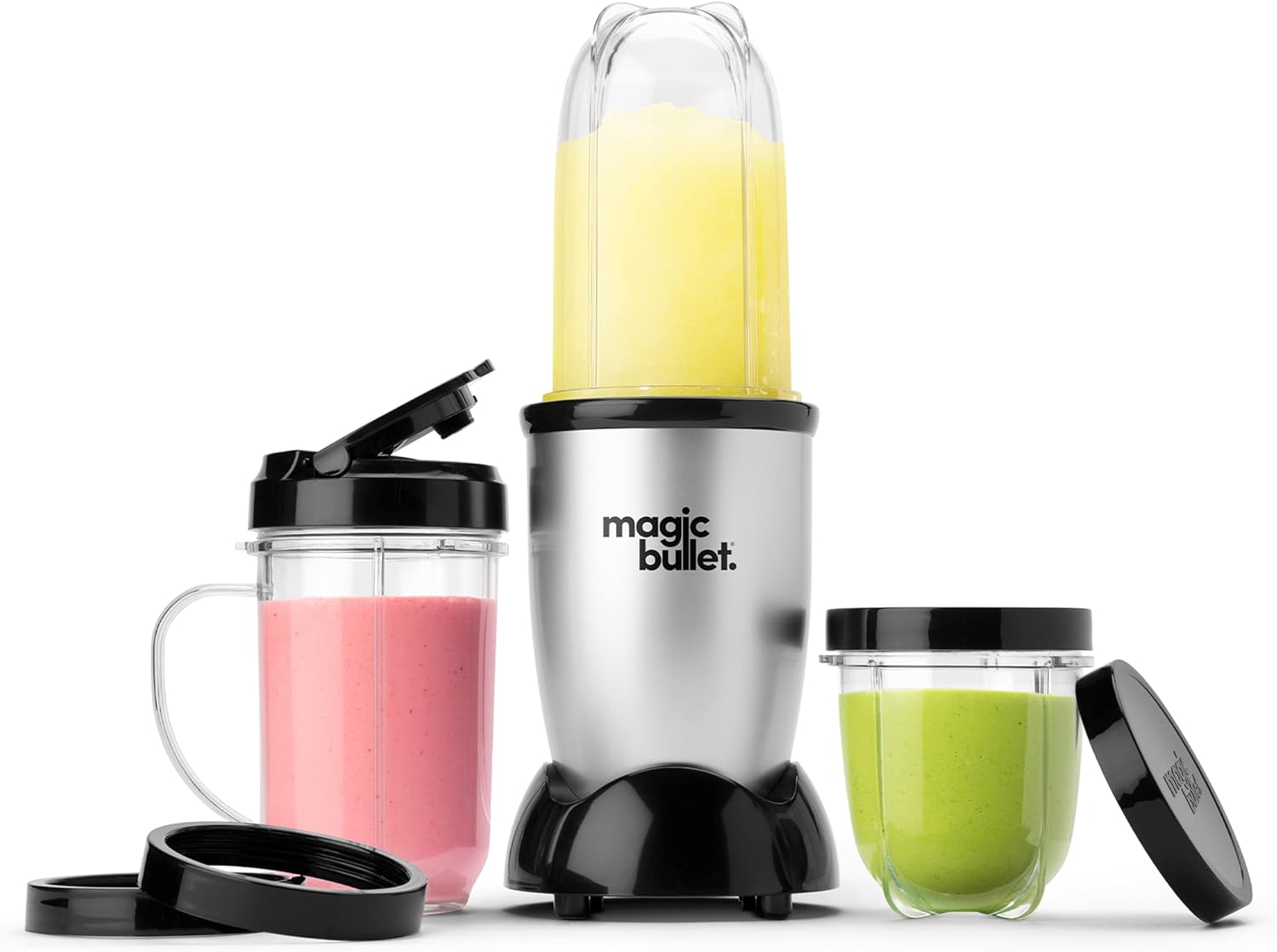
The Magic Bullet MBR-1101 is a compact personal blender that handles single-serve smoothies, sauces, dips, and small food‑prep tasks quickly. It uses a 250W corded motor with a cross blade and twist-on cups so you load ingredients, attach the blade, and press the base to run short bursts or continuous blends. The kit includes tall and short cups, a party mug, resealable lids, and a recipe guide, and most plastic parts are top-rack dishwasher safe which keeps cleanup simple. Its short run times and pulse-style operation make it good for soft fruits, leafy greens, nut butters in small batches, and chopping herbs or nuts. Limitations are predictable: the 250W motor is far less powerful than full‑size blenders, so it struggles with large frozen blocks, very fibrous roots, or continuous high-volume blending, and capacity is limited to the provided cups. If you want a space‑saving, easy daily blender for single servings and quick prep, it delivers consistent, no‑frills performance at a low footprint.
Best for: Buyers who prioritize compact, proven products with lots of user feedback and want a simple single‑serve blender for daily smoothies, sauces, and small prep tasks.
Less Ideal for: Those who need a high-power blender for frequent large batches, heavy-duty crushing of ice or hard roots, or family‑size blending should consider full‑size models instead.
- Compact footprint saves counter space and stores easily
- Includes multiple cups, lids, and a cross blade for versatile single‑serve prep
- Top-rack dishwasher safe parts simplify cleaning
- Simple push-button/twist operation is quick and easy for everyday use
- Low 250W motor limits ability to pulverize large frozen or very tough ingredients
- Small cup capacity restricts batch size for families or meal prep
Verdict: A compact, widely adopted single‑serve blender that reliably handles quick smoothies and small food‑prep tasks while saving counter space.
Choosing the Right Small Blender for Sauces: Key Factors to Consider
Motor Torque and Heat Management
A blender's motor needs enough torque to emulsify oils into vinegars or to break down dense ingredients while running at lower speeds and in small volumes. High RPM alone is not enough if the motor stalls under load. Effective heat management matters because blending small hot sauces can quickly raise internal component temperatures. Look for motors designed to sustain short bursts with thermal protection so the motor does not shut down mid-job or degrade over repeated use.
Choosing a unit with conservative duty-cycle recommendations and cooling design can prolong life and avoid interruptions when you are finishing a sauce during a meal service.
Container Shape and Blade Geometry
Container geometry determines how ingredients circulate. Tall, narrow jars tend to pull contents into the blade when volumes are small, which helps create smooth emulsions without air pockets. Conversely, wide, shallow containers can leave ingredients spreading around the blade and reduce efficiency for tiny batches.
Blade shape and angle are equally important. Blades that are optimized for shear and recirculation help incorporate oil into liquids and produce stable emulsions. Removable blade assemblies or ones with accessible seals also make cleaning and maintenance simpler.
Speed Control and Pulse Function
Fine speed control is crucial for sauces because you often need short bursts or low rpm to coax a stable emulsion without overprocessing. A reliable pulse function helps with manual control when incorporating delicate ingredients such as herbs or soft cheese. Multiple discreet speed settings are preferable to a single on/off switch, which can easily overwork a small batch and change texture unexpectedly.
Controls that are intuitive and responsive make it faster to achieve the desired consistency, especially during multi-step preparations where timing matters.
Splash and Thermal Safety
Sauces are sometimes hot or thin, increasing the risk of splatter during blending. Splash-resistant lids, secure locking mechanisms, and vents that direct steam away from the user are important safety features. A vented lid can let steam escape without creating a geyser when working with warm ingredients, while a locking mechanism prevents accidental activation if the jar is misaligned.
Consider how the blender handles steam and thin liquids to avoid kitchen messes and potential burns.
Ease of Cleaning and Maintenance
Because sauce-making often involves sticky oils and dairy, easy cleaning is essential. Look for parts that detach without tools, dishwasher-safe components, and blade housings that can be rinsed thoroughly. Seals and gaskets that are accessible reduce the chance of trapped food developing odors or mold.
Regular maintenance expectations should be realistic for the intended frequency of use; a unit that requires excessive disassembly for basic cleaning will see less consistent use in a busy kitchen.
Capacity and Storage Footprint
A blender intended for sauces should match the batch sizes you typically prepare. Very small pitchers reduce waste and improve emulsion control, while slightly larger jars give flexibility for dressings and small soups. Balance capacity with countertop or cupboard space because a compact footprint encourages frequent use and easier storage.
Also consider whether the jar doubles as a serving container or fits under your cabinets for convenient placement when not in use.
Why a Dedicated Small Blender Beats Larger Units for Sauces
Large countertop blenders can be overkill for sauce work. They are designed to move higher volumes and rely on larger blades and greater liquid head to recirculate ingredients. For small emulsions, this often results in poor incorporation or the need to add more liquid than the recipe calls for.
A dedicated small blender is optimized for low-volume performance, giving you more control, less waste, and faster cleanup. Many are also designed with safer lids and venting for hot liquids, which makes them better suited to sauce prep.
- Better low-volume recirculation
- Less wasted product when recipes call for tablespoons
- Usually simpler cleaning and storage
Techniques to Get Smooth Emulsions
Start with the liquid phase in the jar and add oil slowly or use a chilled oil pour to help the emulsion form. Low-speed starts with brief pulses then a gradual increase can create a stable emulsion without splitting.
If your blender struggles with small oil additions, try adding a teaspoon of mustard or an egg yolk to stabilize the emulsion, then blend while steadily streaming in the oil. Stop periodically to scrape the jar walls to incorporate any ingredients clinging above the blade.
- Begin with the aqueous phase first
- Use pulse to initiate emulsion, then blend steadily
- Add stabilizers like mustard or egg yolk when appropriate
Working with Hot Ingredients Safely
When blending hot sauces, let steam vent safely. Use a lid with a designated steam vent or leave a small offset in the lid while holding it with a towel to direct steam away. Start at low speed to minimize pressure build-up and splashing.
Avoid overfilling the jar; hot liquids expand and can spatter. Allow the blender to cool between multiple hot batches to prevent thermal stress on seals and the motor.
- Use vented lids or controlled offsets for steam
- Do not overfill when blending hot liquids
- Allow cool-down periods between hot batches
Maintaining Blades and Seals for Longevity
Inspect blade assemblies regularly for dulling or damage. Blades that lose their edge reduce shear and make emulsions harder to form, which can make you run the motor longer and increase wear.
Replace or thoroughly clean worn seals and gaskets to prevent leaks and odors. Regularly hand-clean crevices where oils accumulate if parts are not dishwasher-safe.
- Check blades for nicks and dulling
- Clean or replace gaskets as needed
- Rinse immediately after use to prevent residue buildup
Accessories That Add Real Value
Useful accessories include small measurement-marked jars, splash lids with pour spouts, and dedicated scraping tools that reach the blade area. A jar sized for 8 to 16 ounces is often ideal for dressings and small sauces.
Magnetic or locking bases that hold the jar steady while blending reduce user error and spills. Also consider whether replacement jars and seals are readily available for future upkeep.
- Look for measurement markings on jars
- Splash lids and pour spouts improve control
- Replacement parts availability aids long-term use
How We Chose the Best Small Blender for Sauces
We selected small blenders for sauces by focusing on attributes that directly affect everyday sauce making rather than general blending tasks. First, we prioritized motor torque and speed control that maintain smooth emulsions at low volumes without overheating. Second, container geometry and blade configuration were evaluated for how well they pull small quantities toward the blades and how effectively they create uniform textures. Third, we assessed splash resistance and lid design to prevent messes when blending hot or thin sauces. Fourth, ease of cleaning and dishwasher-safe components were weighed heavily because frequent small-batch use demands simple upkeep. Finally, build quality and user controls were considered to ensure reliable, repeatable results. We excluded full-size countertop blenders and immersion-only tools that cannot reliably handle tight small-batch emulsions. Units lacking basic safety features or with poor customer-reported durability were also removed from consideration. The result is a shortlist of compact blenders that balance low-volume performance, thermal handling, and everyday usability.
Our full evaluation process is outlined in our review methodology.
FAQ
Can a small blender emulsify oil into vinegar for vinaigrette?
Yes, small blenders designed for low-volume work can create stable vinaigrettes if you add the oil slowly and use short pulses. Using an emulsifier like mustard helps the mixture hold together.
Is it safe to blend hot sauces in a small blender?
It can be safe if the blender has a vented lid and you avoid overfilling. Start at low speed to release steam gradually and allow cool-down periods between hot batches to protect seals and the motor.
How do I avoid a split or broken emulsion?
To avoid splitting, begin blending with the aqueous ingredients, add oil slowly in a steady stream or pulses, and keep speeds moderate. If separation occurs, blend in a small amount of warm water or an emulsifier to help rebind the mixture.
How often should I replace seals and gaskets?
Replace seals and gaskets as soon as you notice stiffness, cracks, or persistent odors. Frequency depends on use, but checking them every few months with regular use is a good habit.
Can I use a small blender for thicker sauces or purees?
Many small blenders handle thicker textures but may require more motor effort and pulsing. For dense purees, work in small batches and add a little liquid to help circulation, and monitor motor temperature to avoid overheating.
Final Verdict
When choosing a small blender for sauces, prioritize motor torque and thermal handling, container and blade design for low-volume recirculation, and ease of cleaning. Speed control, splash-safe lids, and accessible seals are practical tradeoffs that affect daily usability. Focus on the features that match the kinds of sauces you make most often—if you regularly blend hot or dairy-based sauces, venting and easy disassembly become more important; if you mostly make dressings, precise speed control and small jars matter more. Pick a compact unit that balances these priorities and you will get more consistent results with less waste and faster prep. That clear alignment between features and typical sauce workflows is the best way to choose confidently.