
Note: This article contains affiliate links. If you click on these links and make a purchase, we may earn a small commission at no extra cost to you. This helps support our research and content. Read our full affiliate disclosure here.
If you brew with a French press, a compact grinder that produces even, coarse grounds can make a dramatic difference in flavor and extraction. You want a unit small enough to fit on a counter or tuck into a cabinet, yet capable of delivering uniform particle size and quick cleanup. This guide shortlists the top small coffee grinders for French press brewing, each chosen for its ability to produce the coarse, consistent grinds that press brewing requires. We evaluated candidates for grind consistency, retention, adjustability, and ease of cleaning, so you can pick a compact grinder that suits your daily routine.
Top Picks at a Glance
| Best Overall The best all-around choice for most situations | KRUPS Electric Coffee Grinder |  |
| Best Quality Built to a higher standard if you want something more solid | Fellow Ode Gen 2 Grinder |  |
| Best Value The sweet spot between price and what you get | JavaPresse Manual Coffee Grinder |  |
| Best Budget The cheapest option that still gets the job done reliably | Rsoilch Manual Coffee Grinder COGR001 |  |
| Top Rated A top-rated pick with lots of positive feedback | OXO Brew Conical Burr Grinder | 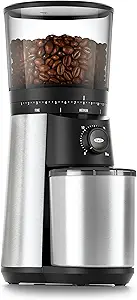 |
| Most Popular A crowd favorite that many people choose with confidence | KRUPS F203 3‑oz Coffee Grinder |  |
| Best Seller A high-volume bestseller chosen again and again | CEVING Mini Manual Coffee Grinder MCG-01 | 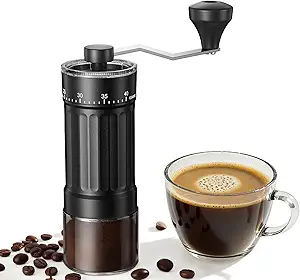 |
KRUPS Electric Coffee Grinder

| Capacity | 3 ounces |
|---|---|
| Wattage | 200 watts |
| Voltage | 120 |
| Power Source | AC adapter |
The KRUPS Electric Coffee Grinder is a small, straightforward blade grinder built for everyday use and light entertaining. Its 200-watt motor and stainless steel blades grind beans quickly and can handle spices, nuts, and grains, making it useful beyond just coffee. One-touch operation and a clear lid let you monitor grind time so you can approximate coarse settings for French press or go finer for other methods, but it does not offer stepped settings for precise repeatable grinds. The 3 oz bowl is large enough to prepare beans for multiple cups at once, and the lid doubles as a measuring cup for convenience. Safety is addressed with a lid-activated switch and the stainless steel bowl wipes clean easily, though blade grinders naturally produce uneven particle sizes compared with burr grinders which matters for French press extraction. For a small kitchen counter appliance this is reliable, versatile, and easy to use, but buyers seeking the most consistent coarse grind should consider a burr model instead.
Best for: Buyers who want an affordable, compact grinder that handles coffee and other pantry items and value speed and versatility over ultra-precise grind control.
Less Ideal for: Those who prioritize the most consistent coarse grind for full-immersion brewing or who want micrometer-level grind adjustments should look at burr grinders instead.
- Compact 200-watt motor provides quick, powerful grinding for beans and spices
- Versatile use for coffee, spices, nuts, and grains
- One-touch operation and clear lid make it easy to monitor grind progress
- 3 oz capacity is enough to grind beans for multiple cups and the lid doubles as a measuring cup
- Blade grinder produces uneven particle sizes compared with burr grinders
- No adjustable grind settings for consistent, repeatable coarse grinds
Verdict: A compact, versatile blade grinder that delivers quick everyday grinds and multi-use functionality for buyers who want speed and convenience rather than precision burr performance.
Fellow Ode Gen 2 Grinder

| Capacity | 100 g |
|---|---|
| Wattage | 140 watts |
| Voltage | 120 volts |
| Burr size | 64 mm |
| Grind settings | 31 settings |
The Fellow Ode Gen 2 is a single-dose electric burr grinder built specifically for brewed coffee styles like pour-over, drip, French press, and cold brew. It uses professional-grade 64 mm flat burrs and a two-stage grinding geometry to produce consistent particle size across 31 settings, which helps extract sweeter, clearer flavor from coarser brew methods such as French press. The 100 g single-dose bin, magnetic catch cup, and anti-static features minimize retention and mess, while a built-in knocker and optimized grind path make cleanup easier. It runs relatively quietly and has an auto-stop function so you can dose and walk away without timing. Trade-offs for the performance-focused buyer are its single-dose design—there is no large hopper for brewing multiple pots at once—and the grinder is tuned for brewed coffee rather than espresso, so it will not reach very fine espresso settings. For home brewers who prioritize grind consistency and minimal retention for batch-by-batch brewing, the Ode Gen 2 delivers precise, repeatable results in a compact footprint.
Best for: A performance-minded home brewer who grinds fresh beans for single-batch brewed methods and values consistent, low-retention grounds for better French press and pour-over cups.
Less Ideal for: People who need to grind large volumes at once or who require fine espresso grinds should consider a different grinder built for those workflows.
- Professional-grade 64 mm flat burrs for consistent particle size
- Wide 31-step grind range optimized for brewed methods including French press
- Anti-static tech, built-in knocker, and magnetic catch cup reduce retention and mess
- Quiet operation and auto-stop make single-dose grinding convenient
- Single-dose 100 g bin limits large-batch or continuous grinding
- Not designed for espresso-level fine grinding
Verdict: If you want precise, low-retention grind quality for single-batch French press and other brewed methods, the Ode Gen 2 is a compact, performance-focused choice.
JavaPresse Manual Coffee Grinder

| Power Source | Manual |
|---|---|
| Material Type | Stainless Steel |
| Included Components | Grinder |
The JavaPresse Manual Coffee Grinder is a compact hand-crank burr grinder built for low-noise, travel-friendly use and everyday brewing. It uses a ceramic conical burr with an adjustable mechanism offering 18 grind settings so you can dial in coarseness for French press, pour over, drip, and espresso. The manual crank eliminates electric motor noise and power needs, making it convenient for camping or small kitchens, and the stainless steel body feels durable for regular use. Ceramic burrs resist heat and retain sharpness longer than many steel burrs, producing a consistent grind that helps extract better flavor from coarser methods like French press. The trade-offs are obvious: hand grinding takes more time and effort than an electric grinder, and capacity is limited to single-serve or small-batch grinding. It is best for buyers who value portability, quiet operation, and control over grind size rather than speed or large-volume convenience.
Best for: Buyers who prioritize precise grind control, quiet operation, and portability for single-serve or small-batch French press brewing.
Less Ideal for: People who need to grind large quantities quickly or prefer the convenience and speed of an electric grinder.
- Adjustable ceramic conical burr with 18 grind settings for precise control
- Manual crank eliminates electric noise and does not require power
- Compact, portable stainless steel build suitable for travel and camping
- Ceramic burrs are durable and stay sharp longer than many steel burrs
- Slow manual operation limits throughput for larger batches
- Small capacity requires multiple passes for several cups
Verdict: If you want a portable, quiet grinder that gives precise, coarser settings for better French press extraction, this manual JavaPresse model is a practical choice.
Rsoilch Manual Coffee Grinder COGR001

| Material Type | Ceramic, Stainless Steel |
|---|---|
| Power Source | Manual |
| Number of Items | 1 |
| Included Components | Body |
This hand crank grinder uses ceramic burrs inside a stainless steel body to produce consistent grounds for methods from French press to espresso. You set grind size with five adjustable steps and turn the removable crank to grind beans by hand, which makes it quiet and portable for use at home or while camping. The compact form disassembles for cleaning and the built-in burr keeps parts aligned without needing tools. Because it is manual, it is slow compared with electric grinders and requires elbow grease for larger batches, but that also gives you fine control over coarseness and avoids heat buildup that can affect flavor. The simple construction and small footprint make it easy to store on a kitchen counter or toss in luggage. Overall this is a practical budget-friendly choice if you want fresher grounds without buying an electric grinder.
Best for: Buyers who want a low-cost, portable grinder to make freshly ground coffee for French press and similar brews without needing electricity.
Less Ideal for: People who regularly grind large volumes of beans or need fast, hands-free grinding should choose an electric grinder instead.
- Ceramic burrs provide even, heat-free grinding for better flavor.
- Five adjustable grind settings cover French press through espresso coarseness.
- Stainless steel body and removable crank make it durable and easy to clean.
- Compact and lightweight for travel or small kitchens.
- Manual operation is slower and requires physical effort for larger amounts.
- Limited to one-piece included body; no additional containers or carrying case included.
Verdict: A small, affordable manual grinder that delivers consistent coarse-to-fine grounds for French press drinkers who value portability and flavor.
OXO Brew Conical Burr Grinder
| Burr size | 40 mm |
|---|---|
| Grind settings | 15 plus micro-adjustments |
| Bean hopper capacity | 12 oz (0.34 kg) |
| Wattage | 100 watts |
| Voltage | 120 volts |
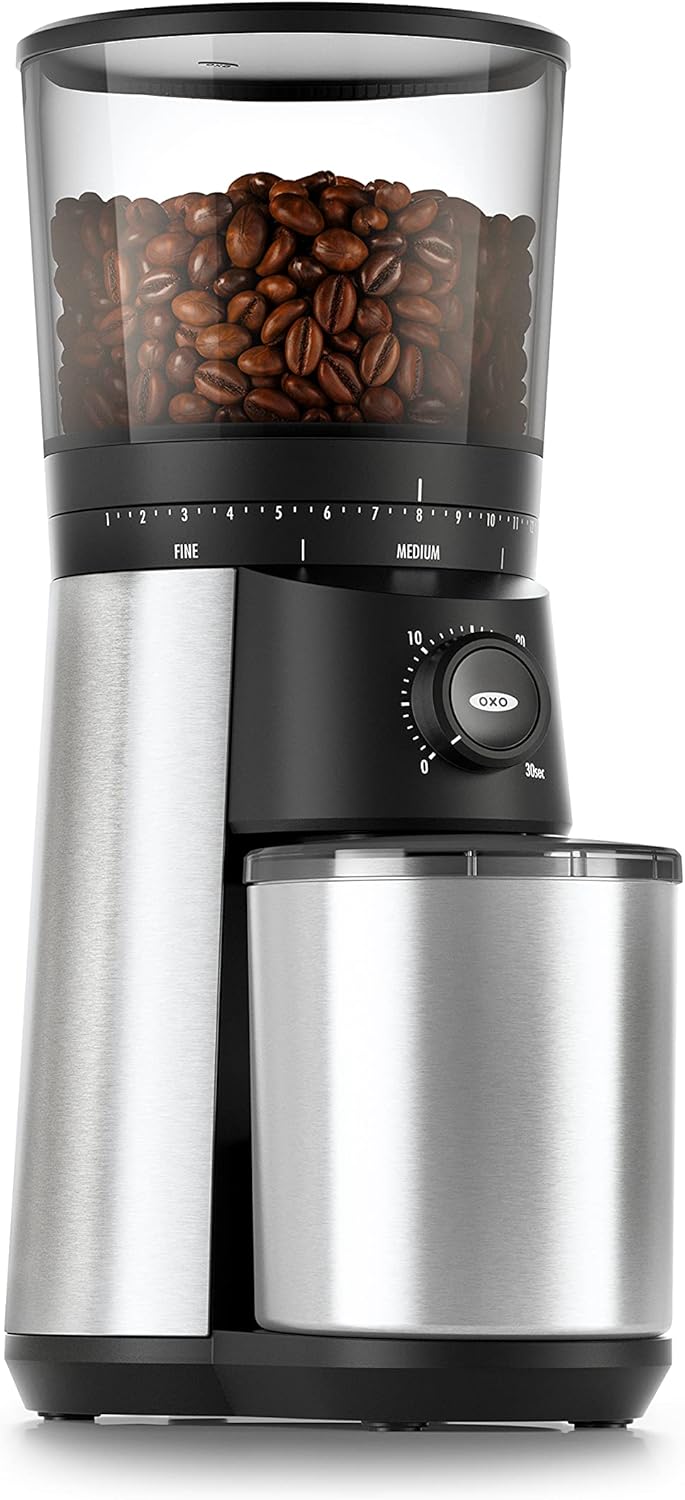
The OXO Brew Conical Burr Grinder is a user-friendly electric grinder built around 40mm stainless steel conical burrs and a timed one-touch operation. It grinds whole beans into uniform particles with 15 main settings and finer micro-adjustments, so you can dial in coarser grinds appropriate for French press without much guesswork. The large removable hopper holds up to 12 ounces and has a UV-tinted finish to help protect beans stored on the counter, and the motor is tuned for low vibration to keep noise and static down during early-morning use. Practical touches include a grounds container that reduces static and a memory for the last grind time so repeated use is quick. Watch for limits: it is not a commercial machine so heavy daily use will wear parts faster than a prosumer unit, and the 15 settings require patience to learn the exact micro-adjustments you prefer for coarse French press grinds. For home users wanting consistent, low-effort coarse grinds, it performs well.
Best for: Home brewers who prioritize consistent, reliable coarse grinds for manual methods like French press and want a low-noise, easy-to-use grinder that delivers repeatable results.
Less Ideal for: Users who need an industrial-strength grinder for heavy daily commercial use or those who want a plug-and-play espresso-specific grinder without dialing settings.
- Stainless steel 40mm conical burrs deliver uniform grounds for even extraction.
- 15 grind settings with micro-adjustments enable coarse French press settings.
- One-touch timer that remembers last setting for fast repeatable grinding.
- Large removable UV-tinted hopper holds up to 12 ounces for fewer refills.
- Motor engineered for low vibration to reduce noise and static.
- Not intended for commercial or very heavy daily use where industrial durability is needed.
- Learning exact micro-adjustments takes time to perfect coarse French press results.
Verdict: A compact, dependable conical burr grinder that reliably produces consistent coarse grounds ideal for French press at home.
KRUPS F203 3‑oz Coffee Grinder

| Capacity | 85 g |
|---|---|
| Wattage | 200 watts |
| Voltage | 240 volts |
| Power Source | Electric |
The KRUPS F203 is a simple, one-touch blade grinder built for quick small-batch grinding. Add beans or spices to the removable 3-ounce (85 g) hopper, press and hold the single button, and grind time controls the result from coarse to fine. Its 200W motor and stainless steel blades deliver consistent, fast results suitable for French press and other manual methods when you need enough grounds for several cups. The lid doubles as a measuring cup and a lid-activated safety switch prevents the blades from running unless closed. Its compact footprint makes it easy to store or keep on the counter, and cleanup is straightforward — wipe the lid and brush out the chamber. Because this is a blade grinder, you will not get the precise, uniform particle distribution of a burr unit, which can affect extraction consistency for delicate brews, and there is some retention and heat from extended runs. Still, for buyers who value speed, small batches, and multiuse capability (spices, nuts, herbs), it is a practical, low-effort choice.
Best for: Buyers who want a reliable, no-frills grinder that makes fresh grounds quickly for French press and occasional coffee brewing and who prefer proven products with strong user feedback.
Less Ideal for: Serious home baristas seeking the most consistent particle size and fine-tuned extraction control should choose a burr grinder instead.
- Compact 3 oz hopper fits small batches and stores easily
- 200W motor with stainless steel blades for quick, efficient grinding
- One-touch operation and lid-measuring cup simplify use
- Lid-activated safety switch prevents accidental operation
- Versatile for coffee, spices, herbs and nuts
- Blade grinder delivers less uniform grind size than burr grinders, which can affect extraction
- Small capacity requires multiple batches for larger servings
Verdict: A fast, compact grinder that delivers fresh grounds for French press and versatile kitchen use when you want simplicity and proven reliability.
CEVING Mini Manual Coffee Grinder MCG-01

| Capacity | 30 g |
|---|---|
| Material Type | Ceramic |
| Power Source | manual winding |
| Adjustable Settings | 40 |
The CEVING Mini Manual Coffee Grinder is a small hand mill designed for travelers and single-cup brewers who want consistent grinds without electricity. It uses a ceramic conical burr and an external adjustment ring with 40 settings, so you can dial in coarser grinds suitable for French press or finer settings for pour-over. Its 30g capacity fits one to two cups and the detachable three-part design makes it easy to disassemble and dry-clean with the included brush. Because it is manual, you get quiet operation and better heat control than many blade or motorized grinders, but grinding takes physical effort and is slower than electric models. The ceramic burrs promote uniform particle size and reduced heat transfer, which helps preserve flavor for immersion brews. Practical limits are the small capacity and manual effort required, so it is best for solo use, travel, or occasional French press brewing rather than daily large-batch grinding.
Best for: Buyers who want a dependable, low-noise grinder for single-cup or travel use and who prioritize precise grind control and flavor preservation over speed.
Less Ideal for: People who routinely grind large quantities for multiple cups or who need fast, effortless electric grinding every day should consider a countertop electric grinder instead.
- Wide 40-step external grind adjustment for precise control between coarse and fine settings
- Ceramic conical burrs give a uniform grind with low heat buildup
- Compact, lightweight and fully manual for quiet, portable use
- Detachable three-part construction is easy to clean and maintain
- 30g capacity limits batch size to one or two cups
- Manual operation requires physical effort and is slower than electric grinders
Verdict: Choose this compact manual grinder if you want precise, low-heat grinds for French press or travel-sized brewing without relying on electricity.
Choosing the Right Small Coffee Grinder for French Press: Key Factors to Consider
Grind Consistency at Coarse Settings
Uniform particle size is critical for French press brewing because it controls extraction rate during the long steep. Coarse, evenly ground coffee minimizes fines that cause over-extraction and silt in the cup. When evaluating small grinders, pay attention to burr type and alignment since these determine how separated the coarse particles will be. Small grinders that maintain consistent burr spacing at larger settings will produce a cleaner, fuller-bodied cup with less sediment.
Also watch for any chatter or wobble in the grinding mechanism that can create a mix of fines and large fragments. Even if a grinder is compact, well-built burrs and stable mounting make a measurable difference in cup clarity and repeatability.
Grind-Size Adjustability and Stops
Being able to dial in a reliable coarse setting matters for repeatable French press results. Look for grinders with clear markings, indexed steps, or positive detents so you can return to the same setting each time. Micro-adjustments are less critical for French press than for espresso, but having a predictable coarse range lets you tweak extraction for roast level and dose.
Some compact grinders include coarse-specific settings or wide-range dials that compress useful settings near the coarser end. These features reduce trial-and-error and let you lock in a setting that matches your usual coffee-to-water ratio.
Retention and Dose Accuracy
Retention is the amount of coffee that remains trapped inside the grinder after a dose. High retention means inconsistent doses and more waste, which is especially noticeable when brewing small amounts in a French press. For a small grinder, low retention preserves flavor and reduces the need to flush grounds between grinds.
Consider whether the grinder's chamber geometry or removable catch cup allows easy transfer of grounds into the press. Models that minimize dead space or provide a clear pathway for grounds deliver more accurate dosing and less cleanup.
Ease of Cleaning and Maintenance
Coarse grinds for French press can be oily or crumbly depending on roast level, so grinders that are easy to disassemble and brush out will stay consistent over time. Check whether burrs are removable without tools, how accessible the grind chute is, and if there are crevices that trap grounds. The fewer tight spots, the faster you can clean between grinders and the less likely stale residue will taint fresh batches.
Regular cleaning also preserves grind performance. Even compact grinders benefit from a simple routine: emptying the hopper, brushing burrs, and wiping the collection area after use.
Size, Weight, and Storage
A primary reason to pick a small grinder is space. Measure the counter footprint and consider if you need a model light enough to move or compact enough to store in a cabinet. Weight also affects portability; heavier small grinders may feel more stable but are less convenient to stow.
Think about how you will use the grinder daily. If you keep it on the counter, stability and easy access matter more. If you store it between uses, quick plug-in setup and simple reassembly are priorities.
Noise and Motor Behavior
Small grinders vary widely in noise output and how the motor handles coarse loads. Excessive noise can be disruptive in small living spaces, and motors that strain at coarse settings may produce inconsistent grinds or shorten component life. Look for units designed to handle coarse settings without prolonged motor stress.
Noise considerations also affect early-morning routines or shared living situations. A quieter grinder with a deliberate, low-revving motor often yields steadier burr engagement and fewer vibration-related inconsistencies.
Why Coarse Grind Size Changes French Press Flavor
Coarse particles extract more slowly and reduce the surface area exposed to water during the steep. This produces a fuller body and less bitterness when done correctly. If the grind is too fine or uneven, the brew will be over-extracted and cloudy, with more sediment in the cup.
A grinder that reliably produces larger, uniform particles helps preserve the bright and sweet notes in lighter roasts and accentuates chocolate or nutty characteristics in darker roasts. Consistency at coarse settings is the single biggest contributor to repeatable French press results.
- Coarse, uniform grounds limit fines that cause over-extraction.
- Even particle size improves filtration and reduces excessive sediment.
- Grind consistency makes it easier to develop a repeatable brewing routine.
Manual Vs Electric Small Grinders
Manual hand grinders are often compact, portable, and mechanically simple. Many deliver excellent coarse grind uniformity when equipped with larger burrs and rigid shafts. They also run silently and require no power source, which can be useful for small kitchens or travel. The tradeoffs are the physical effort needed and slower throughput for multiple cups.
Electric grinders offer speed and convenience, reducing preparation time for daily French press brewing. In small electric models, look for motors designed to handle coarse settings without bogging down. Some compact electrics match manual grinders for grind quality at coarse settings, while providing faster, hands-off operation.
- Manual: quiet, compact, precise control, needs physical effort.
- Electric: faster, convenient, may require attention to motor stress and retention.
How to Dial In Your Grind for French Press
Start with a coarse setting that produces particles roughly the size of coarse sea salt. Use a consistent dose and water temperature, and time the steep for about four minutes to judge extraction. If the brew tastes sour, try a finer setting; if it tastes bitter or overly astringent, make the grind coarser.
Adjust in small steps and record settings once you find the balance you like. Because French press tolerates a wider particle distribution than espresso, small grinders with repeatable coarse stops let you refine taste without large jumps in extraction. Also account for roast level and bean freshness when dialing in grind size.
- Aim for coarse, salt-sized particles as a starting point.
- Make small adjustments and keep notes on dose and steep time.
- Account for roast and freshness when changing settings.
Maintaining Your Grinder for Long-Term Performance
Set up a simple cleaning schedule based on how often you grind. For daily use, a light brush of burrs and an occasional full disassembly to remove retained grounds is a good baseline. This prevents stale oils and crumbs from accumulating and affecting flavor.
Replace or service worn components if you notice wobble, inconsistent particles, or new noises. Proper lubrication and correct reassembly maintain burr alignment and the consistent spacing required for reliable coarse grinds. Small preventative steps preserve both performance and the life of the grinder.
- Brush burrs weekly for daily users; deep clean monthly or as needed.
- Check for wobble or loose parts and address promptly.
- Store in a dry place to avoid moisture affecting beans and components.
Practical Tips for Small Kitchens
If counter space is limited, consider a grinder with vertical storage or a slim footprint that fits beside common appliances. Look for models that can be disassembled quickly and stored in a cabinet without taking up much shelf depth. Cord length and plug orientation can also influence where the grinder lives on a countertop.
Also think about how you transfer grounds into your French press. A grinder that dispenses directly into a dosing cup or has a removable grounds container will simplify the process and reduce mess in tight spaces.
- Measure where the grinder will sit before buying.
- Prefer removable grounds containers for tidy transfers.
- Short cords or cordless options aid flexible placement.
How We Chose the Best Small Coffee Grinder for French Press
We prioritized attributes that directly affect French press brewing and everyday usability. First, grind consistency at coarse settings was a primary filter because uneven particles cause over- or under-extraction in steeped methods. Second, hopper and chamber design plus burr geometry were considered for how they impact retention and uniformity. Third, we assessed grind-size adjustability and detents or stops that help repeatable dosing for a given brew yield. Fourth, compact footprint and storage-friendly form factors were required to ensure suitability for small kitchens. Fifth, cleaning and maintenance were evaluated since oily, coarse grounds can build up and affect flavor over time. We excluded larger, commercial-style grinders and single-use blade models that cannot reliably produce uniform coarse grinds. Also removed were units lacking any coarse-setting range or those with poor build quality reports. The resulting shortlist balances grind quality, compact size, ease of cleaning, and simple repeatable adjustments—criteria that matter most to French press users.
Our full evaluation process is outlined in our review methodology.
FAQ
How coarse should I grind for French press?
Aim for particles about the size of coarse sea salt. This range extracts evenly during a 3.5 to 4.5 minute steep and limits excessive fines that cause bitterness and sediment.
Can a small grinder make good French press grounds?
Yes. Many compact grinders with proper burrs and solid construction can produce uniform coarse grounds suitable for French press. Focus on build quality, burr stability, and a reliable coarse adjustment rather than sheer size.
How often should I clean my grinder when using French press grinds?
For daily use, a light brush after each use and a more thorough disassembly and cleaning monthly is a practical routine. Oily beans or darker roasts may require more frequent deep cleaning.
Do manual grinders produce better coarse grinds than electric ones?
Manual grinders can produce excellent coarse grinds and are often quieter and more compact. However, some small electric grinders match or exceed manual quality at coarse settings while offering faster throughput. The best choice depends on your priorities for effort, noise, and speed.
Will grind retention affect my French press brew?
High retention can lead to inconsistent doses and stale flavors if grounds from previous batches mix with fresh ones. Choose a grinder with low retention or an easy-to-empty collection system to keep dosing accurate.
Final Verdict
Prioritize a grinder that delivers consistent coarse particles, low retention, and straightforward adjustment when choosing for French press. Compact size and easy cleaning make daily use simpler, while stable burr mounting and clear coarse settings give more repeatable results. Balance the tradeoffs between manual and electric options based on your routine: choose manual if you want quiet precision and portability, or a compact electric for speed and convenience. Focus on the criteria outlined above to pick a small grinder that helps you brew better French press coffee consistently.