
Note: This article contains affiliate links. If you click on these links and make a purchase, we may earn a small commission at no extra cost to you. This helps support our research and content. Read our full affiliate disclosure here.
If you brew pour-over coffee, grinder size and grind consistency have a direct effect on extraction and cup clarity. A small coffee grinder for pour over saves counter space while giving you the precise grind-size control needed to dial in brew time and flavor. This guide narrows the field to the top compact models that perform well for single-cup and small-batch pour-over routines. We shortlisted grinders that balance footprint, grind uniformity, and adjustability. Below you will find the best compact options, along with the evaluation criteria we used and practical advice for using and maintaining a small grinder for pour over.
Top Picks at a Glance
| Best Overall The best all-around choice for most situations | KRUPS Precision Burr Grinder GX550850 |  |
| Best Quality Built to a higher standard if you want something more solid | Fellow Ode Gen 2 Grinder |  |
| Best Value The sweet spot between price and what you get | CEVING Mini Manual Coffee Grinder | 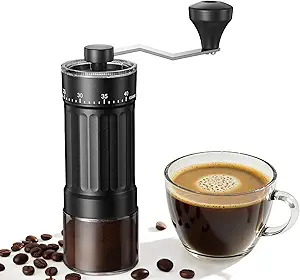 |
| Best Budget The cheapest option that still gets the job done reliably | HZBSGZR Hand Coffee Grinder |  |
| Top Rated A top-rated pick with lots of positive feedback | TIMEMORE Chestnut C3S Manual Grinder | 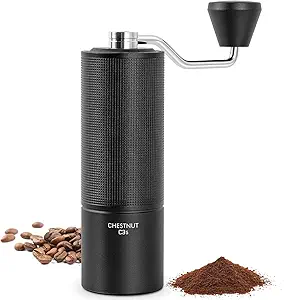 |
| Most Popular A crowd favorite that many people choose with confidence | JavaPresse Manual Coffee Grinder |  |
| Best Seller A high-volume bestseller chosen again and again | OXO Brew Compact Conical Burr Grinder |  |
KRUPS Precision Burr Grinder GX550850

| Wattage | 110 watts |
|---|---|
| Capacity | 8 ounces |
| Voltage | 110 volts |
| Grind settings | 12 settings |
The KRUPS Precision Burr Grinder is a compact burr grinder meant for home use, offering 12 grind settings that cover coarse to fine for methods like pour over, drip, French press, and espresso. You set the grind size, choose 2 to 12 cups with the built-in selector and press start; the grinder stops automatically when the selected amount is reached. It uses flat metallic burrs driven by a 110 W motor, which helps deliver relatively uniform particle size while limiting heat build-up, and the removable top burr and grounds container make cleanup straightforward. Practical benefits for pour over brewers include a fine-to-medium grind range and repeatable settings so you can dial in extraction, plus a small footprint that fits most countertops. Limitations are its 8 oz hopper and cup selector that are oriented to batch counts rather than weight-based dosing, so precise micro-adjustments for specialty pour over recipes may require measuring grounds separately. Noise and static can appear with some beans, so expect a bit of cleanup after use.
Best for: Buyers who want a compact, consistent burr grinder that makes dialing in everyday pour over and drip routines simple without a steep learning curve.
Less Ideal for: Those who need laboratory-level dosing accuracy or grind-by-weight control for advanced specialty brewing should consider a scale-equipped or commercial-style grinder instead.
- 12 grind settings cover a wide range from coarse to fine for different brew methods
- Flat metallic burrs and 110 W motor aim for uniform grinding with reduced heat
- Auto-stop cup selector (2–12 cups) makes portioning fast and repeatable
- Removable burr and included brush simplify cleaning and maintenance
- Portioning is based on cup counts not weight, limiting precision for exact pour over dosing
- 8 oz hopper is modest for users who grind larger batches at once
Verdict: A compact, easy-to-use burr grinder that delivers consistent grinds across pour over and common home brewing styles, ideal for balanced everyday use.
Fellow Ode Gen 2 Grinder

| Burr size | 64 mm flat |
|---|---|
| Grind settings | 31 settings |
| Capacity | 100 g |
| Power | 140 watts |
| Voltage | 120 volts |
The Fellow Ode Gen 2 is a purpose-built single-dose burr grinder focused on brewed coffee methods like pour-over, drip, French press, and cold brew. It uses professional-grade 64 mm flat burrs and a two-stage grinding geometry to deliver consistent particle size across 31 settings, which helps extract clearer, sweeter flavors in pour-over brewing. The unit is intentionally compact and relatively quiet, with anti-static tech, a built-in knocker, and a magnetic catch cup that reduce mess and grind retention so you get a predictable yield from each dose. The 100 g single-dose bin encourages grinding only what you need and the grinder shuts off automatically when the job is done, making it easy to use in daily routines. Trade-offs include the single-dose design and 100 g capacity, which are ideal for small batches but not for high-volume households, and the grinder is not designed for dedicated espresso use. Overall, it is a precise, low-mess grinder that prioritizes flavor quality and countertop convenience for brewed coffee lovers.
Best for: Buyers who prioritize precise, consistent grind quality for pour-over and other brewed methods and want a compact, low-mess single-dose grinder for daily small-batch brewing.
Less Ideal for: Those who need a high-capacity or high-throughput grinder for large households or anyone seeking a grinder specifically optimized for espresso extraction.
- Professional-grade 64 mm flat burrs for consistent particle distribution
- 31 grind settings tuned for pour-over, drip, French press, and cold brew
- Anti-static tech, built-in knocker, and magnetic catch cup reduce grind retention and mess
- Quiet operation and compact footprint suitable for countertop use
- Automatic stop and single-dose bin simplify daily dosing
- Single-dose 100 g capacity is not suited for brewing large batches quickly
- Not designed for espresso grind performance
Verdict: If you want a compact, single-dose grinder that delivers precise, low-retention pour-over-ready grinds, the Fellow Ode Gen 2 is an excellent choice.
CEVING Mini Manual Coffee Grinder

| Capacity | 30 g |
|---|---|
| Material Type | Ceramic |
| Power Source | manual winding |
The CEVING Mini Manual Coffee Grinder is a portable hand mill built for precise, small-batch grinding. It uses ceramic conical burrs and an external adjustment ring with 40 settings so you can dial in anything from fine for espresso to coarse for French press, making it well suited for pour-over experiments on the go. The 30 g capacity covers one to two cups, and the grinder breaks down into a few pieces for quick cleaning with the included brush. Because it is manually operated there is no heat or electricity, which helps preserve flavor, but it does require a bit of arm effort when grinding denser roasts. The ceramic burrs offer uniform grounds and lower heat but are slower than motorized grinders and may wear differently over long use. Overall, this grinder is practical for travelers, campsite brewing, or anyone who wants precise control over grind size in a compact package.
Best for: Buyers who prioritize precise grind control and portability for single-cup pour-over brewing or travel, and who prefer a simple hand-powered tool over an electric grinder.
Less Ideal for: People who regularly brew multiple cups at once, those who want ultra-fast grinding, or users who prefer fully automated, electric grinders.
- 40 external grind settings let you fine-tune particle size for pour-over and other brew methods
- Ceramic conical burrs produce uniform grounds and minimize heat transfer
- Compact, lightweight design is easy to pack for travel or outdoor use
- Detachable construction simplifies cleaning and maintenance
- 30 g capacity is limited to one or two cups per grind, requiring multiple fills for larger servings
- Manual operation requires physical effort and is slower than electric grinders
Verdict: Choose this compact manual grinder if you want fine-grained, portable control for pour-over and small-batch brewing without relying on electricity.
HZBSGZR Hand Coffee Grinder
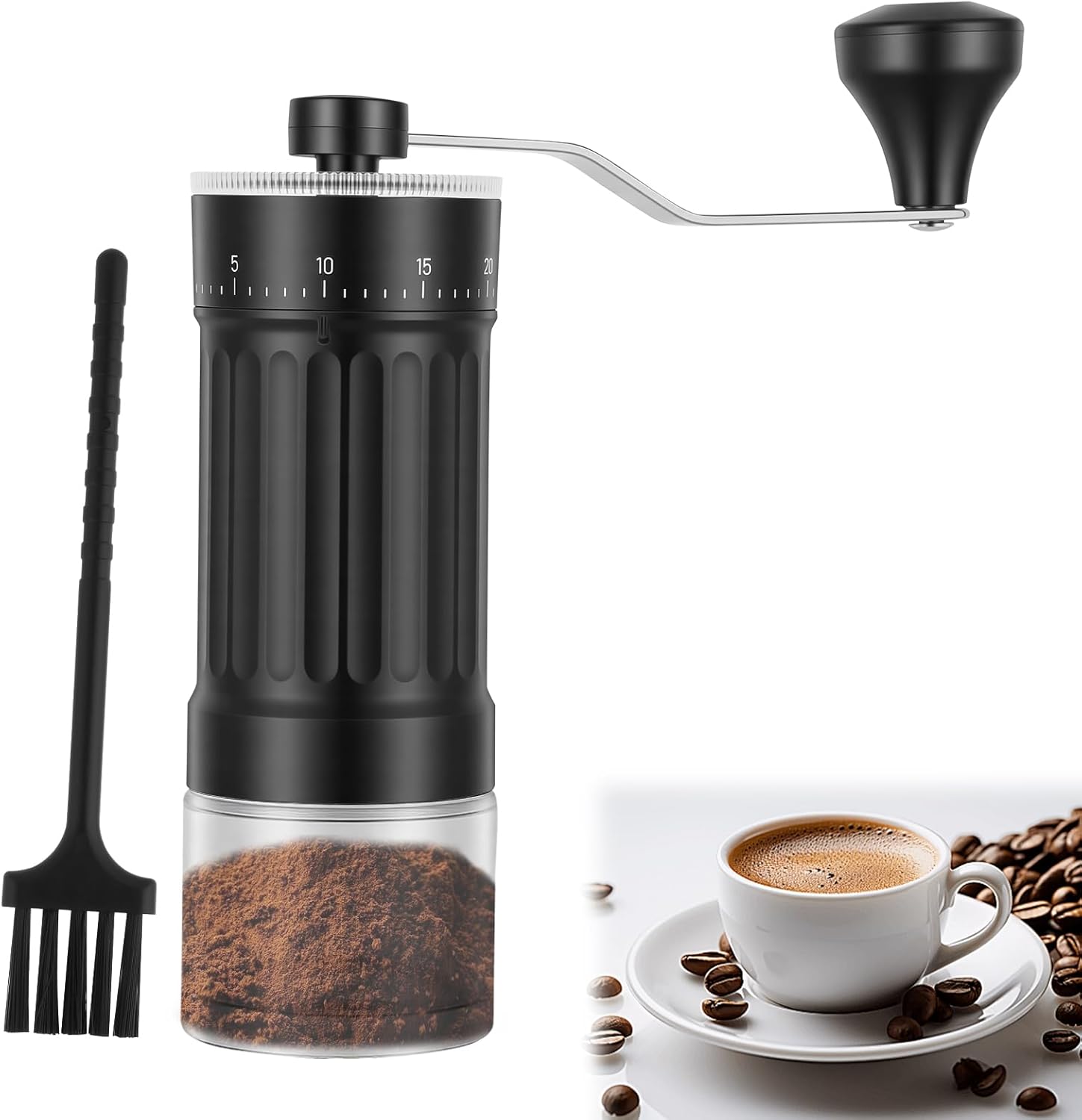
| Capacity | 30 g |
|---|---|
| Power Source | Manual |
| Material Type | ABS, Glass, Plastic |
| Grind Settings | 40 levels |
| Burr Type | Ceramic conical |
This compact hand grinder is built for fresh single-cup grinding on the go and at home for pour over brewing. It uses a ceramic conical burr and 40-step adjustment so you can dial in grind size from fine to coarse; the conical burr minimizes heat and helps preserve coffee oils for better flavor extraction. The removable glass jar gives clear visibility of grounds and reduces mess, while the ergonomic hand crank keeps grinding smooth without electricity, making it useful for travel, camping, or small-batch morning routines. The grinder is lightweight and easy to disassemble for cleaning, and it ships with a brush and manual to simplify upkeep. Expect modest capacity—about 30 g—so it is best for one to two cups at a time, and hand grinding takes longer than an electric grinder when making multiple servings. Build materials are mostly ABS plastic with glass parts, so it is sturdy for travel but not a heavy-duty workshop piece.
Best for: Buyers looking for an inexpensive, portable grinder to produce fresh, adjustable pour over grinds one cup at a time and who value simplicity and no-power operation.
Less Ideal for: People who need to grind large daily volumes, want a very heavy-duty metal grinder, or prefer the speed and convenience of an electric grinder.
- Ceramic conical burr for consistent grinds and low heat buildup
- 40 adjustable grind settings for precise pour over tuning
- Transparent glass jar lets you watch grind progress and reduces spills
- Compact, lightweight, and fully manual for travel or no-power situations
- 30 g capacity limits you to single-cup or two-cup batches
- Mostly ABS plastic construction is less rugged than all-metal models
Verdict: A budget-friendly, portable manual grinder that delivers precise pour over grinds without electricity, ideal for single-cup brewing and travel.
TIMEMORE Chestnut C3S Manual Grinder

| Capacity | 25 g |
|---|---|
| Material Type | Aluminum |
The TIMEMORE Chestnut C3S is a portable hand grinder built around a patented S2C steel conical burr and an all-aluminum body that emphasizes durability and consistent particle size. It is used by turning the removable crank to grind up to about 25 g of beans, making one to two cups for pour over, French press, or espresso depending on the setting. The stepless adjustment and dual-bearing design let you dial in a wide range of coarseness with fine control, which helps achieve even extraction for pour over brewing. Because the grinder has no plastic internals and a metal construction, it feels stable and resists wear compared with cheaper hand mills. Practical limits include the modest 25 g capacity—so you will refill for larger servings—and the recommended dry cleaning only, which means disassembly and brushing are needed for maintenance rather than quick rinses. For someone prioritizing reliability and consistent grind quality in a compact package, the C3S is a solid choice.
Best for: Buyers who want a reliable, well-built manual grinder that consistently produces even particles for pour over and other hand-brew methods and value durable metal construction over convenience features.
Less Ideal for: People who regularly grind larger quantities or want a low-maintenance, sink-washable grinder should consider larger or differently designed options.
- Patented S2C steel conical burr produces consistent, uniform grind particles
- All-metal aluminum body with dual-bearing design for long-term durability
- Stepless grind adjustment supports precise dialing for pour over grind sizes
- Compact and portable size suitable for travel or small-batch daily use
- Small 25 g capacity requires multiple refills for more than two cups
- Manufacturer recommends dry cleaning only, no water washing
Verdict: Choose the Chestnut C3S if you want a compact, durable manual grinder that reliably delivers consistent pour over-ready grinds.
JavaPresse Manual Coffee Grinder

| Grind settings | 18 |
|---|---|
| Material type | Stainless Steel |
| Power source | Manual |
The JavaPresse Manual Coffee Grinder is a compact hand-crank conical burr grinder aimed at fresh, precise grinding for pour over, drip, French press and espresso. It uses a ceramic burr assembly with 18 grind settings so you can dial in grind size from fine to coarse, and the manual crank eliminates most electric noise and removes the need for batteries or power. Its stainless steel build and tested ceramic burrs are marketed as durable and consistent, which helps preserve coffee flavor when brewing single cups or small batches on the go. The grinder is lightweight and small enough for travel or camping, and cleaning and adjustment are straightforward for daily use. Limitations are inherent to manual grinders: it takes more time and effort than an electric model, and capacity is best suited for one to two cups rather than brewing for a group. For home pour over routines where control, quiet operation, and portability matter, this grinder delivers precise, repeatable results without electricity.
Best for: Buyers who prioritize quiet, precise control and portability for single-cup pour over brewing and want a proven, well-reviewed manual grinder backed by social proof.
Less Ideal for: People who regularly grind large amounts at once or who need very fast, hands-free grinding should choose a compact electric grinder instead.
- Ceramic conical burr with 18 adjustable settings for precise grind control
- Manual crank significantly reduces noise compared with electric grinders
- Compact, lightweight stainless steel design that is travel and camping friendly
- No power required so it works anywhere and is simple to maintain
- Manual operation is slower and more effortful than electric grinders
- Small capacity makes it impractical for brewing large batches
Verdict: If you want a quiet, portable burr grinder for precise pour over grinds and prefer a well-reviewed manual tool, this JavaPresse model is an excellent choice.
OXO Brew Compact Conical Burr Grinder

| Capacity | 50 g |
|---|---|
| Voltage | 120 volts_of_alternating_current |
| Burr Type | Stainless Steel Conical Burrs |
| Settings | 15 settings, 29 micro-adjustments |
The OXO Brew Compact Conical Burr Grinder brings conical stainless steel burrs and a range of grind adjustments into a slim countertop package aimed at home pour-over brewers. It offers 15 coarse-to-fine settings with 29 micro-adjustments so you can dial in grind size for pourover recipes, and the 50 g hopper holds enough beans to make roughly six cups. The grinder's removable upper and lower burrs simplify cleaning and the chuteless design plus an integrated spout on the grounds container make it easy to transfer grounds into a dripper or filter without mess. Tritan Renew parts use recycled content for the hopper and grounds container, and the cord wraps neatly for compact storage. Because it is small and designed for household use, it grinds modest batch sizes and is not intended for heavy daily commercial workload, and the plastic exterior means it is lighter than metal-bodied models. For home pour-over users who prioritize consistent grind and easy cleanup in a space-saving footprint, it performs well; users needing large batch grinding or a heavier-duty build should consider larger models instead.
Best for: Home pour-over brewers who want a compact, easy-to-use grinder that delivers consistent grind size and straightforward cleanup without taking much counter space.
Less Ideal for: People who need to grind large volumes of beans at once or who want a heavy-duty, all-metal commercial-style grinder.
- Stainless steel conical burrs for consistent grind quality
- 15 settings with 29 micro-adjustments for precise pour-over tuning
- Compact footprint suitable for small counters and storage
- Removable upper and lower burrs for easier cleaning
- Integrated spout on grounds container reduces mess when transferring grounds
- 50 g hopper limits batch size for larger households or frequent grinding
- Plastic exterior is lighter but less robust than metal-bodied grinders
Verdict: A space-saving conical burr grinder that gives pour-over enthusiasts precise, consistent grinds and easy cleanup in a small countertop package.
Choosing the Right Small Coffee Grinder for Pour Over: Key Factors to Consider
Grind Consistency and Particle Distribution
Uniform particle size is the foundation of good pour-over extraction. A grinder that produces a narrow distribution of particle sizes helps the water extract soluble compounds evenly, reducing over-extraction of fines and under-extraction of larger particles. This matters more for pour over than for some other brew methods because pour over relies on a controlled flow rate and steeping time.
When shopping for a small grinder, look for models with burrs designed to minimize fines and produce even flakes or particles rather than dust. Consistency affects the repeatability of recipes and how easy it is to hit the intended brew time and taste profile.
Adjustment Precision and Range
Precise, repeatable grind adjustments let you fine-tune extraction. For pour over you often need medium to medium-fine settings, and smaller adjustment steps make it easier to change brew time without altering dose or water temperature. A wide coarse-to-fine range is useful, but for compact grinders the most important aspect is the granularity of adjustment around pour-over settings.
Check whether the grinder has stepless or clearly indexed steps, how it holds setting under vibration, and whether markings are intuitive. Fine control reduces the need for workarounds like adjusting dose or grind time to compensate for coarse steps.
Single-Dose Handling and Retention
Small-batch pour-over workflows typically rely on single dosing a few grams to a couple dozen grams. Low retention and consistent dosing are crucial so you get the same grounds every time and waste less coffee. High retention can also lead to stale grounds mixing with fresh ones and unpredictable flows.
A good small grinder will be easy to load with a single dose, have a short throat and minimal dead space, and either dump grounds directly into a brewing vessel or into a shallow catch that is simple to empty. Consider how simple it is to weigh beans before and after grinding if precise dosing is important to you.
Burr Type, Size, and Material
Burr design affects both consistency and longevity. Conical and flat burrs each have tradeoffs: conical burrs often excel at low-speed, compact designs with good retention behavior, while flat burrs can provide excellent uniformity at larger diameters. For small grinders the burr diameter and whether they are stainless steel or hardened steel will influence heat, wear, and lifespan.
If you plan to grind frequently, prioritize robust burr materials and replaceable burr sets where possible. Burr size matters less than quality for small-batch pour over, but larger burrs tend to be more consistent at a given speed.
Noise, Speed, and Heat Generation
Noise level matters in small kitchens or early-morning routines. Higher-speed motors can be louder and generate more heat, which may slightly alter volatile aroma compounds in fine grinds. For pour over, heat from grinding is less critical than for espresso, but cooler operation helps preserve aromatic oils.
Consider grinders with lower RPM motors or gear reduction that maintain torque without excessive noise. Also think about how long a typical small grind takes; slower, controlled grinding is usually preferable to fast but noisy bursts.
Ease of Cleaning and Maintenance
Regular cleaning prevents oil buildup and preserves taste clarity. Small grinders should be simple to disassemble for periodic burr cleaning and quick removal of trapped grounds. Accessibility of the burrs and whether parts are user-serviceable affects how likely you are to keep the grinder maintained.
Look for models with removable hoppers or magnetic catches that make emptying and brushing straightforward. Ease of reassembly is also important so you do not misalign burrs or lose adjustment markers.
Why Size and Footprint Matter
A smaller grinder fits better on limited counter space and is easier to store between uses. Compact units also tend to be lighter and simpler to maneuver when you need to single-dose for a manual pour-over.
However, smaller physical size can mean compromises in hopper capacity and burr diameter. Understand how often you brew and whether you want a grinder permanently on the counter or stored away after each use.
- Ideal for single-cup or two-cup routines
- Easier to keep near a kettle and pour-over station
- May have smaller hoppers requiring frequent refills
Single-Dosing Workflow Tips
Single dosing improves freshness and reduces stale beans in the hopper. For pour over, weigh your beans first, then pull the exact dose directly into the grinder. This minimizes retention issues and keeps flavors consistent.
If your grinder has notable retention, perform a quick purge or grind a small extra amount for discard before brewing. Use a funnel or dosing cup to reduce mess when transferring grounds to the brewer.
- Weigh beans before grinding for repeatability
- Purge retained grounds if the grinder holds residue
- Use a catch cup or funnel to avoid spills
Grind Settings to Start With
As a baseline for medium pour-over filters, start with a grind slightly coarser than espresso and finer than drip. Expect to adjust a few notches coarser or finer depending on filter type, dose, and pour technique. Track setting changes so you can reproduce preferred results.
If your grinder has indexed steps, note the step number that yielded the best extraction time. For stepless grinders, mark the adjustment position with tape or a reference notch to return to it quickly.
- Use medium-fine starting points for most pour-over recipes
- Adjust in small increments to change brew time 15 to 30 seconds
- Record settings and outcomes for consistency
Cleaning Routine for Flavor Clarity
Establish a weekly quick clean where you brush the burrs and empty the catch area. Perform a deeper monthly clean that removes burrs if the design allows, and use a dry brush or recommended cleaning tool to remove oils and fines.
Avoid water on burrs unless the manufacturer explicitly allows it. After reassembly, run a quick grind of a few grams and discard to clear any disturbed residue before brewing.
- Brush and empty grounds after each use when possible
- Deep-clean burrs monthly for daily users
- Avoid introducing moisture to metal burrs
Common Tradeoffs When Downsizing
Choosing a compact grinder often means accepting smaller bean capacity and sometimes a narrower burr diameter. That can limit throughput and slightly affect consistency on higher-volume grinds but is usually acceptable for small-batch pour-over routines.
Also weigh the importance of adjustment precision versus portability. A super-compact model that sacrifices micro-adjustment steps may be convenient for travel but harder to dial in at home.
- Smaller size boosts portability but may reduce burr diameter
- Some compact grinders sacrifice fine adjustment resolution
- Consider how often you grind and whether speed or precision matters more
How We Chose the Best Small Coffee Grinder for Pour Over
We prioritized attributes that most directly affect pour-over brewing with a compact footprint. Primary considerations were grind consistency for medium-fine settings, range and fineness adjustment steps, burr type and size, and how well each grinder handles small single-dose quantities. We also evaluated build quality, noise level during operation, and ease of cleaning since small grinders are often used daily and stored in tight kitchen spaces. Our selection excluded blade grinders and large-capacity models that are inconsistent at pour-over grind sizes or impractical for small-batch use. We focused on conical and flat burr designs sized for compact housings, precise micro-adjustments, and reliable dosing for one to three cups. Usability tests focused on repeatability of settings, how simple it is to empty and clean grounds, and stability during grinding. Durability and serviceability were considered by checking materials, burr accessibility, and user-serviceable parts. Models that compromised the core variables above or were clearly optimized for espresso or bulk grinding were left off the list.
Our full evaluation process is outlined in our review methodology.
FAQ
How fine should I set a grinder for pour over?
Pour-over settings are usually medium to medium-fine. The ideal setting depends on filter type, dose, and pour rate. Start slightly coarser than espresso and adjust finer if brew time is too fast or coarser if it is too slow.
Is a small grinder good for daily pour-over use?
Yes, a small grinder is well suited to daily single-cup or two-cup pour-over routines. Make sure the model offers consistent grind results at pour-over settings and is easy to clean to maintain flavor clarity.
Does burr type matter for pour over?
Burr type affects particle distribution and longevity. Conical and flat burrs can both produce excellent pour-over results. In small grinders, burr quality and size are often more important than the general burr shape.
How often should I clean a small grinder?
Brush out loose grounds after each use and perform a deeper clean monthly for daily users. Regular maintenance prevents oil buildup that can mute delicate pour-over flavors.
Can I use a small grinder for other brew methods?
Often yes, many compact grinders cover a range of settings from pour-over to coarser methods. However, if you need very fine espresso settings or large-batch grinding, a small grinder may be less ideal.
Final Verdict
When choosing a small coffee grinder for pour over, prioritize consistent particle distribution and precise adjustment around medium-fine settings. Low retention and easy single-dosing make daily routines simpler, while durable burrs and approachable maintenance keep flavor consistent over time. Balance the need for compactness with the level of control you want. If you prioritize repeatable pour-over recipes and minimal countertop real estate, choose a model that emphasizes grind consistency and adjustment precision over extra features or large capacity.