
Note: This article contains affiliate links. If you click on these links and make a purchase, we may earn a small commission at no extra cost to you. This helps support our research and content. Read our full affiliate disclosure here.
Picking the right small coffee grinder makes a big difference in the quality of your daily brew while saving counter space. Whether you need a compact unit for espresso shots or a tidy grinder for pour-over and drip, the grinder you choose affects extraction, flavor consistency, and cleanup time. This guide shortlists the top small coffee grinders available for home use and evaluates them against core factors like grind consistency, build and footprint, and ease of cleaning. Read on to see which compact options best match your brewing routine and countertop constraints.
Top Picks at a Glance
| Best Overall The best all-around choice for most situations | KitchenAid Blade Coffee Grinder BCG111OB |  |
| Best Quality Built to a higher standard if you want something more solid | OXO Brew Compact Conical Burr Grinder |  |
| Best Value The sweet spot between price and what you get | KRUPS F203 Coffee Grinder |  |
| Best Budget The cheapest option that still gets the job done reliably | Wancle Electric Coffee Grinder P00273 |  |
| Top Rated A top-rated pick with lots of positive feedback | BLACK+DECKER Coffee Grinder CBG110S |  |
| Most Popular A crowd favorite that many people choose with confidence | Hamilton Beach Fresh Grind 80335R |  |
| Best Seller A high-volume bestseller chosen again and again | CEVING Mini Manual Coffee Grinder | 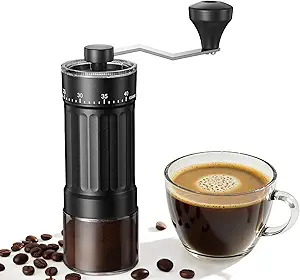 |
KitchenAid Blade Coffee Grinder BCG111OB

| Capacity | 4 ounces |
|---|---|
| Wattage | 160 watts |
| Voltage | 120 volts |
The KitchenAid BCG111OB is a simple, compact blade coffee grinder built for quick everyday grinding. You operate it with one-touch control by pressing the clear cover, which lets you watch beans as they grind so you can stop at your preferred consistency. Its stainless steel blade and a 4-ounce removable grind bowl with measurement markings make it easy to portion beans for 4, 8, 10 or 12 cups and then transfer grounds to a brewer. At 160 watts the motor handles short grinding jobs fast, and the polycarbonate cover and bowl are straightforward to clean. Because this is a blade grinder, grind particle size is less uniform than a burr grinder, so it is best suited to drip or French press rather than precise espresso use. Its small capacity and basic controls favor convenience and speed over fine grind control, but for anyone wanting an affordable, no-frills grinder for daily brewed coffee the KitchenAid does the job well.
Best for: Buyers who want a compact, easy-to-use grinder for daily brewed coffee and who prioritize speed and simple portioning over grind precision.
Less Ideal for: Those seeking consistent, espresso-grade fineness or professional-level grind control should choose a dedicated burr grinder instead.
- One-touch press-to-grind operation with clear cover for visual control
- Removable 4 oz stainless steel bowl with measurement markings for easy portioning
- Stainless steel blade and 160-watt motor deliver quick grinding for small batches
- Compact footprint saves counter space and transfers grounds easily
- Blade grinder produces less consistent particle size compared with burr grinders
- Small 4 oz capacity requires multiple batches for larger servings
Verdict: A compact, no-frills blade grinder that delivers fast, simple daily grinding and easy portioning for brewed coffee.
OXO Brew Compact Conical Burr Grinder

| Capacity | 50 g |
|---|---|
| Burr type | Stainless steel conical burrs |
| Grind settings | 15 settings, 29 micro-adjustments |
| Power source | AC adapter |
| Voltage | 120 volts |
The OXO Brew Compact Conical Burr Grinder packs stainless steel conical burrs and a range of grind adjustments into a slim countertop unit built for small-batch brewing. It offers 15 main settings with 29 micro-adjustments so you can dial in grind size from fine to coarse, and the 50 g hopper is sized for about six cups, making the grinder convenient for single-serve or small pot routines. Removable upper and lower burrs and a chuteless design make cleaning straightforward, and the integrated spout and cord-wrap help keep counters tidy. Because it is designed to be compact, it does not hold large volumes of beans and is best for daily small-batch use rather than high-volume grinding. The plastic body keeps weight and footprint low while the burrs deliver consistent particle size for better extraction compared with blade grinders. If you want a precise, space-saving grinder that fits a performance-focused home setup, this model balances grind control and countertop practicality.
Best for: Buyers who prioritize precise grind control and space savings for daily small-batch home brewing and want a grinder that fits a compact countertop without sacrificing consistency.
Less Ideal for: Not a good fit for users who regularly grind large amounts or need a commercial‑scale capacity for entertaining or batch roasting.
- Consistent stainless steel conical burrs for even grind distribution
- Fine control with 15 settings and 29 micro-adjustments
- Removable burrs and chuteless design simplify cleaning
- Compact, narrow footprint and cord-wrap for easy countertop storage
- 50 g hopper limits capacity for larger brews or entertaining
- Plastic exterior may feel less premium than all-metal alternatives
Verdict: A space-saving grinder that delivers true conical-burr performance and fine grind control for performance-minded small-batch home brewers.
KRUPS F203 Coffee Grinder

| Wattage | 200 watts |
|---|---|
| Capacity | 85 g |
| Voltage | 240 volts |
| Power Source | Electric |
The KRUPS F203 is a straightforward, no-frills blade grinder built for everyday use. It grinds coffee beans, spices, herbs, and nuts with a 200W motor and stainless steel blades; grind time controls coarseness, so you achieve anything from coarse for French press to finer grounds for drip. The removable lid doubles as a measuring cup and there is a lid-activated safety switch that prevents the blades from running unless the lid is secured. Its 3-ounce hopper can grind about 12 cups worth of beans in a single batch, making it useful for households and small offices. The unit is compact and easy to store, and cleaning is simple — wipe the lid and brush out the chamber. Expect the usual limitations of blade grinders: particle size is less uniform than a burr grinder and heat from extended runs can affect delicate beans, so it is best for general home brewing and spice prep rather than precision espresso work.
Best for: Buyers who want a compact, easy-to-use grinder for daily coffee and kitchen spice prep and prioritize speed and simplicity over precision grind uniformity.
Less Ideal for: Specialists seeking precise, repeatable grind settings for espresso or those who prioritize the finest, most uniform grind consistency should consider a burr grinder instead.
- Powerful 200W motor with stainless steel blades for quick grinding
- One-touch operation with lid-activated safety for simple, safe use
- 3 oz (85 g) capacity can grind enough beans for roughly 12 cups
- Compact footprint that stores easily on counters or in cabinets
- Blade design produces less uniform particle size compared with burr grinders
- Extended grinding can generate heat that may slightly affect delicate bean flavors
Verdict: A compact, powerful blade grinder that delivers quick, one-touch grinding for everyday coffee and spice needs.
Wancle Electric Coffee Grinder P00273

| Wattage | 150 |
|---|---|
| Capacity | 60 g |
| Voltage | 120 volts |
| Power Source | AC adapter |
The Wancle Electric Coffee Grinder is a no-frills, countertop grinder that uses a 150W copper motor and stainless steel blades to pulverize beans and spices in seconds. You load up to the 60 g capacity cup, close the transparent lid, and hold the single on/off button until you reach the desired grind — shorter for coarse, longer for fine. Its small footprint and included cleaning brush make it easy to store and maintain, and the transparent lid helps monitor progress without opening. Because it is a blade grinder, grind fineness is controlled by time rather than precise settings, so it is best for drip or French press brewing and general spice chopping rather than espresso-level dosing. The plastic housing keeps weight and cost down but feels less robust than metal-bodied grinders. For buyers who want a fast, inexpensive way to grind fresh beans or process spices in small batches, this model delivers straightforward performance; those needing very consistent, repeatable micro-grinds should consider a burr grinder instead.
Best for: Buyers looking for a low-cost, compact grinder to quickly produce fresh grounds for daily drip coffee, French press, or occasional spice chopping.
Less Ideal for: People seeking precise, repeatable grind settings for espresso or large-volume grinding should choose a dedicated burr grinder or higher-capacity model.
- Compact footprint saves counter space and stores easily
- Powerful 150W pure copper motor for quick grinding
- Transparent lid lets you watch grind progress
- One-touch operation is simple and intuitive
- Includes cleaning brush for easy cleanup
- Blade design yields less uniform grind compared with burr grinders
- Small 60 g capacity requires multiple batches for larger servings
Verdict: A budget-friendly, space-saving grinder that delivers fast, simple fresh grounds for everyday coffee and spice use.
BLACK+DECKER Coffee Grinder CBG110S

| Capacity | 56.6 g |
|---|---|
| Wattage | 130 |
| Voltage | 110 volts |
The BLACK+DECKER CBG110S is a small one-touch blade grinder built for quick everyday grinding of coffee beans, spices, herbs, and grains. You load beans into the stainless steel bowl, press the single push-button and the 130-watt motor runs until you release it, which makes it simple to dial in coarse to fine results by eye. A lid-lock safety mechanism prevents the blades from spinning unless the top is secured, and the stainless steel blade and bowl resist staining and odor transfer better than plastic. Its 56.6 g capacity suits one to two cups at a time, so it is best used for single-serve brewing or small-batch spice prep rather than large pots. Because this is a blade-style grinder, grind size can be less uniform than a burr grinder for specialty coffee, but for drip, French press in small amounts, and general kitchen use it delivers fast, durable performance. The machine is compact and easy to store or travel with, and disassembly for cleaning is straightforward but takes care to avoid the sharp blades.
Best for: Buyers who prioritize a reliable, no-frills grinder for daily single-serve coffee and occasional spice or grain grinding will appreciate its straightforward operation and durable stainless-steel construction.
Less Ideal for: Those seeking very uniform, specialty-level grind consistency or needing to grind large quantities at once should consider a burr grinder or a larger-capacity unit instead.
- Stainless steel blades and bowl resist staining and provide durable grinding.
- Simple one-touch push-button operation makes grinding fast and intuitive.
- Lid-lock safety feature prevents accidental operation.
- Compact footprint is easy to store or pack for travel.
- Blade-style grinding yields less consistent particle size than a burr grinder.
- Small 56.6 g capacity requires multiple batches for larger servings.
Verdict: A dependable, compact blade grinder that delivers fast, durable everyday grinding for single-serve coffee and kitchen use.
Hamilton Beach Fresh Grind 80335R

| Capacity | 4.5 ounces |
|---|---|
| Wattage | 125 watts |
| Power Source | AC |
The Hamilton Beach Fresh Grind is a small, straightforward blade grinder aimed at everyday coffee drinkers who want fresh grounds without fuss. It uses stainless steel blades and a removable grinding bowl to grind beans, spices, seeds and herbs; the bowl lifts out for easy filling, pouring and dishwasher-safe cleanup. Its single-button press-and-hold operation makes it simple to use for quick single-cup grinds or enough ground coffee for a full 12-cup pot. Practical touches include hidden cord storage to keep your counter tidy and a compact footprint that fits small kitchens. Because it is a blade grinder, grind size is imprecise compared with burr models, so it is best for drip, French press, and general kitchen grinding tasks rather than precise espresso dosing. Wattage and capacity suit typical home use but expect some noise and occasional need to pulse for uniformity. For the price and convenience, it does a reliable job for everyday home brewing and general spice or seed grinding.
Best for: Buyers who want a low-cost, no-frills grinder for fresh daily coffee and occasional spice or seed grinding and who prioritize simplicity and easy cleanup backed by many positive user experiences.
Less Ideal for: Those who need precise, uniform grind size for espresso or specialty brewing methods should choose a burr grinder instead.
- Removable stainless steel grinding bowl that is dishwasher-safe for easy cleanup
- Compact footprint with hidden cord storage keeps counters tidy
- Simple one-button operation is quick and intuitive for daily use
- Can grind coffee, spices, seeds and herbs for multiuse kitchen tasks
- Blade grinder yields less consistent grind size compared with burr grinders
- Can be noisy during operation
Verdict: A compact, easy-to-clean blade grinder that reliably produces fresh grounds for everyday drip or French press coffee and general kitchen use.
CEVING Mini Manual Coffee Grinder

| Capacity | 30 g |
|---|---|
| Material Type | Ceramic |
| Power Source | manual winding |
| Adjustable Settings | 40 |
The CEVING Mini Manual Coffee Grinder is a travel-friendly hand mill built around a ceramic conical burr and an external 40-step adjustment ring for precise grind control. You use it by loading up to 30 g of beans, turning the removable crank, and adjusting the ring to move from fine to coarse grinds for espresso, pour-over, French press and similar methods. The ceramic burrs cut cleanly with minimal heat transfer, which helps preserve flavor, and the grinder disassembles into a few parts for straightforward cleaning with the included brush. Its small footprint and lightweight construction make it convenient for camping, office use, or daily travel. Limitations are its modest 30 g capacity and manual operation, which means more effort and slower throughput than an electric grinder and fewer beans per cycle than larger models, so it is best for single cups or small batches rather than household brewing for several people.
Best for: Buyers who want a reliable, low-tech grinder for single-cup or travel use and who prioritize consistent grind quality and simple maintenance over speed.
Less Ideal for: People who need to grind large batches regularly, want hands-free electric operation, or prefer a higher-capacity grinder for multiple cups at once.
- 40 external grind settings allow precise adjustment across brew methods
- Ceramic conical burrs provide uniform grind with less heat buildup
- Compact, lightweight design ideal for travel and small spaces
- Simple disassembly and included brush make cleaning easy
- 30 g capacity limits use to single cups or very small batches
- Manual winding is slower and requires physical effort compared with electric grinders
Verdict: A precise, travel-ready manual grinder that delivers consistent, low-heat grinds for single cups or small-batch brewing.
Choosing the Right Small Coffee Grinder: Key Factors to Consider
Grind Consistency and Particle Distribution
How even the particle sizes are from a grinder dramatically affects extraction and flavor. A compact grinder that produces a narrow particle distribution will yield better-tasting espresso shots and cleaner-filtered brews. Consider whether the grinder uses burrs rather than blades and whether the burr geometry is optimized for espresso, drip, or both.
For small grinders, achieving consistent particle size is harder because of design constraints, so review available data or manufacturer guidance on grind steps and adjustments. Consistency matters most when you are dialing in espresso or using precise pour-over recipes where slight changes in particle size change brew time and strength.
Burr Type and Serviceability
The material and design of the burrs influence longevity and how often parts need replacement. Ceramic burrs resist rust and can stay sharp for many cycles, while steel burrs often offer stronger cutting edges and faster cleanup. Check whether the grinder's burrs are replaceable and how straightforward removal is for maintenance.
Serviceability matters especially for smaller units because overheating or wear in confined housings can accelerate dulling. A compact grinder with accessible burrs and clear replacement instructions will save money and extend usable life compared with sealed, non-serviceable designs.
Footprint and Countertop Fit
Small grinders are chosen for limited spaces, so physical dimensions and storage profile are key. Measure height and diameter relative to where you plan to place the grinder so it fits under cabinets or in a small appliance nook. Also consider whether the hopper is removable, which eases storage and keeps the unit tucked away when not in use.
A smaller footprint sometimes reduces hopper capacity or motor size, so weigh how much coffee you typically grind per session versus the convenience of a compact unit. If you make multiple daily servings, a slightly larger but still compact grinder with a bigger catch cup may be a better fit.
Noise and Vibration
Noise matters in open kitchens or early-morning routines. Compact grinders can be louder because small motors often operate at higher RPMs. Look for published decibel levels or user feedback on perceived loudness, and verify whether the grinder has vibration-damping feet or a well-balanced burr assembly.
Vibration not only affects comfort but can influence grind consistency over time if components shift. Consider whether the grinder's design includes stabilizing features and whether noise reduction compromises power or grind quality.
Ease of Cleaning and Maintenance
Coffee oils and fines build up quickly and degrade flavor if not cleaned regularly. A small grinder that disassembles easily makes regular maintenance practical. Check if the hopper, burrs, and catch cup are tool-free to remove and whether the interior surfaces are accessible for brushing or vacuuming.
Maintenance also includes how simple it is to recalibrate or reassemble parts after cleaning. Some compact designs hide screws or require special tools, which discourages frequent cleaning and can worsen performance over time.
Adjustment Range and Precision
The available grind settings and how precisely they adjust determine whether a small grinder suits multiple brew methods. Some compact grinders offer coarse increments suitable for French press and drip, while others provide fine stepping for espresso. Evaluate how many distinct settings are offered and whether adjustments feel tactile and repeatable.
Precision affects your ability to reproduce a favored setting day after day. If you switch between brew methods, a grinder with finer increments and a clear index system will save time and reduce wasted beans.
Why Compact Burr Grinders Outperform Blade Models
Burr grinders crush beans between two surfaces producing more even particles than blade models that chop inconsistently. Even in a small form factor, burr designs offer more predictable extraction and better flavor clarity across brew methods.
Compact burr grinders are engineered to prioritize grind uniformity while minimizing size. That often means slightly lower hopper capacity and tuned motor power, but the payoff is a cleaner cup and more consistent shot times for espresso and brew recipes for filter coffee.
- Burrs deliver a narrower particle distribution than blades
- Adjustable settings on burr grinders give real control over brew outcomes
- Smaller burr grinders reduce static and mess when designed with enclosed catch cups
Setting Up a Small Grinder for Espresso
When using a compact grinder for espresso, start with the recommended fine setting and make small adjustments. Pull several test shots and note extraction time, crema quality, and flavor. Small grinders can be sensitive to tamp pressure and dose, so dial doses carefully.
Ensure the portafilter or dosing cup seats well against the grinder's outlet to minimize retention. If the grinder has fewer fine increments, focus on consistent dose and tamping technique to compensate for coarser adjustment steps.
- Use small incremental changes when dialing in
- Weigh doses to keep consistency between shots
- Reduce static by grinding into a chilled portafilter or lightly tapping the catch cup
Maintaining Performance in a Small Footprint
Routine maintenance keeps a small grinder working reliably. Brush or vacuum out grounds daily and fully disassemble the burr assembly for deeper cleaning on a monthly schedule, depending on usage. Removing oils and fines prevents rancid flavors and helps the burrs cut cleanly.
Storage also matters. If space constraints force you to keep beans in the hopper, consider how bean oils will accumulate. For longer storage, transfer beans to an airtight container and leave the hopper empty between uses to reduce buildup.
- Daily brushing reduces cross-contamination of flavors
- Monthly deep clean prevents oily buildup and preserves burr sharpness
- Store beans separately if you do not use the hopper daily
Optimizing Dose and Extraction with Limited Capacity
Small grinders often have smaller catch cups or single-serve capacity, so you may need to grind in multiple short bursts for more cups. Plan your workflow to minimize waiting and avoid regrinding old grounds. For multiple servings, grind consecutive doses and hold them briefly in a sealed container to preserve freshness.
Weighing doses and using consistent tamping or brew ratios helps offset the limitations of a small hopper. Precision in dosing is more impactful than grinding larger quantities at once when working with compact equipment.
- Grind in short batches for multiple servings
- Use a scale to reproduce doses
- Avoid letting ground coffee sit exposed for long periods
Noise Mitigation and Placement Tips
To reduce perceived noise, place the grinder on a rubber mat or silicone pad and keep it away from cabinet overhangs that amplify sound. Some small grinders are designed with quieter motors and damping feet; check for those features if early-morning noise is a concern.
Also consider where the grinder sits relative to living spaces. A short move to another nook or a simple isolation pad can significantly reduce disturbance without sacrificing convenience.
- Use an isolation pad to cut vibration noise
- Avoid placing under cabinets that amplify sound
- Keep the grinder on a stable, level surface to prevent noise from wobble
How We Chose the Best Small Coffee Grinder
We focused on compact grinders that deliver consistently sized grounds without dominating counter space. Evaluation prioritized measurable grind quality for espresso and filter methods, the durability of burrs and drive systems, and how simple routine maintenance and cleaning are. We also weighed footprint and noise because many buyers use these grinders in small kitchens or open spaces, plus hopper and catch-cup capacity relative to single-serve and daily-batch needs. Products were excluded if they lacked burr-style grinding, were clearly built only for whole-bean storage without easy cleaning, or had unverified claims about grind consistency. We tested specifications and technical documentation where available and prioritized models with serviceable burrs and clear instructions for disassembly. Final selections balance compact size with repeatable grind distribution, reasonable noise levels, and straightforward maintenance procedures.
Our full evaluation process is outlined in our review methodology.
FAQ
Can a small coffee grinder produce consistent espresso-level fines?
Often, yes. Many compact burr grinders are engineered for fine settings suitable for espresso, though they may have fewer precise steps. Consistency improves with regular maintenance and careful dosing.
How often should I deep-clean a small grinder?
Typically, perform a deep clean every 4 to 8 weeks depending on usage and bean oiliness. Daily brushing of the hopper and catch area helps extend intervals between deep cleans.
Will a smaller grinder heat the beans more during grinding?
Smaller motors can run at higher RPMs, which may slightly raise temperatures over long runs. Grinding in short bursts and allowing brief cool-downs minimizes heat-related flavor changes.
Is bean retention a bigger problem with compact grinders?
It can be. Limited internal volume and short chutes sometimes trap grounds. Look for designs with easy-access outlets or those that let you grind directly into a portafilter to reduce retention.
Are ceramic burrs better for small grinders?
Ceramic burrs resist corrosion and can remain sharp for a long time, but they may be more brittle. Steel burrs cut efficiently and are common in compact units. The right choice depends on your priorities for longevity and maintenance.
Final Verdict
Choose a small coffee grinder that matches your dominant brew method and kitchen constraints. Prioritize grind consistency and burr serviceability if you pull espresso or value precise pour-over control. If counter space or noise is the main concern, favor compact designs with low footprints and sound-damping features. Balance adjustment precision, ease of cleaning, and hopper capacity against the size limitations. With the right tradeoffs, a compact grinder can deliver reliable, repeatable results and fit neatly into a small kitchen routine.