
Note: This article contains affiliate links. If you click on these links and make a purchase, we may earn a small commission at no extra cost to you. This helps support our research and content. Read our full affiliate disclosure here.
If you cook basmati often, a small rice cooker tuned for long-grain aromatic rice saves time and improves consistency. You want a unit that reliably produces separate, fluffy grains rather than sticky clumps, and that fits compact kitchens and small households. This guide highlights five shortlisted small rice cookers chosen for their basmati-friendly features, such as precise water-to-rice controls, gentle heat profiles, and simple maintenance. Below we summarize why each makes the cut and outline the evaluation points you should weigh when choosing a small rice cooker for basmati rice.
Top Picks at a Glance
| Best Value The sweet spot between price and what you get | Dash Mini Rice Cooker DRCM20003 |  |
| Best Budget The cheapest option that still gets the job done reliably | Elite Gourmet ERC-003X Rice Cooker |  |
| Top Rated A top-rated pick with lots of positive feedback | Zojirushi Micom Rice Cooker NS-LGC05XB | 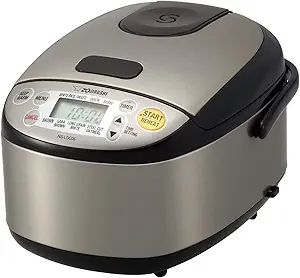 |
| Most Popular A crowd favorite that many people choose with confidence | AROMA Digital Rice Cooker ARC-914SBD |  |
| Best Seller A high-volume bestseller chosen again and again | AROMA ARC-743 3-Cup Rice Cooker |  |
Dash Mini Rice Cooker DRCM20003

| Capacity | 2 cups |
|---|---|
| Power Source | Corded Electric |
| Material | Aluminum |
| Lid Material | Ceramic |
The Dash Mini Rice Cooker is a small, single‑serve cooker designed for hands-off grain cooking in tiny kitchens, dorms, RVs, or for a solo meal. You measure, add water and rice, flip the single switch, and the cooker brings rice to done automatically, then switches to keep warm so your serving stays usable without overcooking. The removable ceramic-coated pot and glass lid simplify cleanup and are advertised as dishwasher safe, while cool-touch handles and the included paddle and measuring cup make portioning and serving easy. Beyond white rice it can handle oatmeal, quinoa, and simple one-pot meals, though there is no multi-program interface or precise temperature controls. Its 2-cup capacity is ideal for individual portions but too small for family meals, and the basic indicator-light control means you should expect straightforward, reliable results rather than advanced customization. For someone wanting an uncomplicated, space-saving cooker that consistently produces fluffy rice, this model fits the bill.
Best for: Buyers who prioritize a compact, fuss-free cooker for single portions or small kitchens and want predictable, low-effort results without advanced controls.
Less Ideal for: Households that need to cook larger batches of rice or users who want programmable settings and precise temperature control for specialty rice techniques.
- Compact 2-cup capacity suits solo cooks and small counters
- Removable ceramic nonstick pot cleans easily and is dishwasher safe
- Automatic cook-to-warm operation yields consistent, fluffy rice with minimal input
- Includes measuring cup and paddle so you can start cooking right away
- Only a single basic cook setting with indicator light, no program customization
- Small capacity not suitable for cooking for multiple people at once
Verdict: Choose this tiny, no-frills cooker if you want a space-saving, reliable way to make single servings of basmati and other grains with minimal effort.
Elite Gourmet ERC-003X Rice Cooker

| Capacity | 3 cups |
|---|---|
| Power Source | Corded Electric |
| Wattage | 300 watts |
| Lid Material | Glass |
| Material | Stainless Steel |
The Elite Gourmet ERC-003X is a simple, budget-friendly rice cooker designed for small households that want hands-off results. You add the measured rice and water, flip the control, and the unit cooks evenly before automatically switching to a keep-warm mode so rice stays ready for serving. It includes a removable nonstick inner pot, tempered glass lid, measuring cup, and serving spatula which make portioning and cleanup straightforward, and the cool-touch handles help with safe carrying. At 300 watts it is energy efficient and compact enough for small counters or dorms. Limitations are its single basic cook function with no programmable settings and a modest 3-cup uncooked capacity, so it is not suited to larger gatherings or advanced rice cooking techniques that need precise timing or texture controls. The stainless steel exterior and glass lid feel durable for the price, and the cooker handles common varieties like basmati and jasmine reliably if you stick to the included measuring cup ratios.
Best for: Buyers who want an affordable, no-frills cooker that reliably prepares everyday basmati and other long-grain rice for one to a few people and values simplicity and small size.
Less Ideal for: Those who regularly cook for large groups, need advanced timing or texture controls, or prefer multifunction countertop appliances should look elsewhere.
- Compact footprint fits small kitchens and dorm rooms
- Automatic keep-warm keeps cooked rice ready without monitoring
- Removable nonstick inner pot, measuring cup, and spatula simplify serving and cleanup
- Tempered glass lid lets you check doneness without opening the cooker
- Low 300-watt power draw is energy efficient for everyday use
- Only a single basic cook mode with no programmable or texture settings
- 3-cup uncooked capacity may be too small for larger families or batch cooking
Verdict: A low-cost, compact rice cooker that reliably cooks small batches of basmati rice with a simple set-and-forget workflow.
Zojirushi Micom Rice Cooker NS-LGC05XB

| Capacity | 3 cups |
|---|---|
| Wattage | 450 watts |
| Power Source | Corded Electric |
| Material | Stainless Steel |
The Zojirushi Micom 3-cup rice cooker is a compact, reliability-focused cooker that handles small batches of rice and grains with simple one-button operation and dedicated menu settings. It includes special programs for long-grain white rice, brown/GABA brown rice, steel-cut oatmeal, and porridge, so it can be tuned for drier, fluffier basmati and firmer brown rice without guesswork. The stainless steel body, nonstick inner pan, and fold-down handle make it easy to move and store, and the built-in retractable cord keeps counters tidy. Typical use is straightforward: measure rice and water, pick the appropriate menu, and let the Micom fuzzy-logic controls finish the job and keep rice warm after cooking. Practical benefits include consistent results for small households, a compact footprint for small kitchens, and low power draw at 450 watts. Limitations are its 3-cup cooked capacity, which is too small for larger families, and the lack of advanced induction heating or pressure features found on higher-end models.
Best for: Buyers who want a compact, dependable cooker that produces consistent small batches of long-grain rice and is easy to store and operate.
Less Ideal for: People who regularly cook for larger households or want high-end induction or pressure features for professional-level rice texture control.
- Multiple menu settings including long-grain white and brown rice for better basmati results
- Compact 3-cup capacity fits small kitchens and households
- Stainless steel exterior with fold-down handle and retractable cord for easy transport and storage
- Nonstick inner pan and keep-warm function for convenient serving after cooking
- 3-cup capacity is too small for larger families or batch cooking
- No advanced IH or pressure cooking that can improve texture on some rice types
Verdict: A small, reliable cooker that consistently delivers good results for basmati and other long-grain rice in single- to two-person households.
AROMA Digital Rice Cooker ARC-914SBD

| Capacity | 2 quarts |
|---|---|
| Wattage | 350 watts |
| Power Source | Corded Electric |
| Voltage | 120 volts |
| Special Feature | Automatic Keep Warm |
The Aroma ARC-914SBD is a compact digital rice cooker and food steamer designed for everyday home use. It cooks white and brown rice plus other grains with Sensor Logic that monitors temperature for consistent texture, and a Flash Rice function that shortens cook time when you need rice fast. The unit includes a removable steam tray so you can steam vegetables or proteins while rice cooks below, and a 15-hour delay timer for scheduling meals. Controls are simple and programmable, and the cooker switches automatically to Keep Warm after a cycle to avoid overcooking. At 350 watts and a 2-quart capacity (2 to 8 cups cooked), it is best suited to small households or side-dish portions; the inner pot and included accessories make portioning straightforward. Limitations are its modest capacity for larger families and basic stainless-steel exterior with hand-wash care instructions rather than dishwasher-safe external parts, so it is not a heavy-duty multi-course cooker but a reliable, space-saving option for regular basmati and other grains.
Best for: Buyers seeking a compact, reliable cooker that consistently produces fluffy basmati and other grains and who value programmable convenience and hands-off steaming for small households.
Less Ideal for: People who need to cook large batches for gatherings or want a high-capacity, heavy-duty multi-course multicooker should consider larger models.
- Sensor Logic temperature control for consistent rice texture
- Flash Rice function reduces cooking time when needed
- Includes steam tray for steaming vegetables or meat while rice cooks
- Programmable digital controls with 15-hour delay timer and automatic Keep Warm
- Compact, countertop-friendly 2-quart capacity suitable for small households
- 2-quart capacity limits large batch cooking
- Requires hand washing of some parts rather than full dishwasher-safe cleaning
Verdict: A compact, programmable rice cooker that reliably makes fluffy basmati and steams a small meal while saving counter space.
AROMA ARC-743 3-Cup Rice Cooker

| Power Source | Corded Electric |
|---|---|
| Wattage | 300 watts |
| Voltage | 120 volts |
| Capacity | 3 cups |
| Lid Material | Tempered Glass |
The Aroma ARC-743 is a simple, compact rice cooker designed for everyday home use and small households. It cooks 2 to 6 cups of cooked rice with a nonstick inner pot and a full-view tempered glass lid so you can monitor progress without lifting the lid. Operation is foolproof thanks to one-touch controls that cook rice and then automatically switch to keep-warm, and the included steam tray lets you steam vegetables or seafood at the same time. Accessories such as a rice measuring cup and serving spatula are included and many parts are dishwasher safe, which cuts cleanup time. At 300 watts this is not a high-power model, so it is best for standard white and aromatic rices like basmati rather than large commercial batches or specialty high-heat techniques. The cooker's compact capacity and uncomplicated controls make it a reliable, no-frills choice if you want consistent results with minimal monitoring, but those needing advanced programmable cycles or larger capacity should look elsewhere.
Best for: Buyers who want a reliable, easy-to-use compact cooker for everyday rice and simple one-pot meals and value hands-off operation and easy cleanup.
Less Ideal for: Those who regularly cook large quantities, need advanced programmable settings, or want faster high-heat cooking performance should consider larger or feature-rich models.
- One-touch operation with automatic keep-warm simplifies cooking and serving.
- Includes steam tray to steam vegetables or seafood while rice cooks.
- Nonstick inner pot and dishwasher-safe accessories make cleanup easy.
- Tempered glass lid lets you monitor cooking without releasing heat.
- Small 3-cup uncooked capacity limits batch size for larger families or meal prep.
- 300-watt power is modest, so it may take longer to cook than higher-watt models.
Verdict: A straightforward, compact rice cooker that reliably cooks small batches of basmati and other everyday rices with minimal fuss.
Choosing the Right Small Rice Cooker for Basmati Rice: Key Factors to Consider
Cooking Profile and Temperature Control
Basmati benefits from a gentle, steady absorption cook rather than a rapid boil. A cooker that offers a slow-simmer phase or an induction-like, even heat profile helps the grains expand fully and stay separate. Look for units with reliable thermostats and presets labeled for long-grain or white rice, or that allow a manual adjustment to extend the simmer period.
Poor temperature control can cause the outer layer of rice to overcook while the center remains underdone, which results in uneven texture and stickiness. For frequent basmati cooks, prioritize consistent heat over flashy extra functions.
Water-to-Rice Measurement System
Correct water ratio is critical for basmati; even small deviations change whether the rice is fluffy or gummy. Some small cookers include printed measurement marks inside the pot calibrated to cup counts, while others provide clear cups and a simple ratio chart. Choose a system you will actually use—clear interior markings are preferable for repeatable results.
If you prefer rinsing basmati before cooking, remember that rinsing reduces surface starch and slightly alters absorption. That makes consistent measurement markings and the ability to add small water adjustments especially useful.
Inner Pot Material and Surface
The inner pot affects both heat transfer and cleanup. Thicker aluminum or anodized pots distribute heat more evenly and resist warping on repeated cycles, while high-quality nonstick coatings make scooping and washing easier. Some finishes also brown or stick less when you allow a short steam rest at the end of cooking.
Consider durability: nonstick surfaces wear over time, and scratched coatings can affect performance and cleaning. If you plan to use utensils in the pot, choose a finish that tolerates gentle use or opt for a replaceable inner pot.
Steam Management and Lid Design
How a cooker handles steam has a direct effect on basmati texture. Excess condensation dripping back into the pot makes rice soggy. A tight-fitting lid with a central steam vent or a condensation-catch feature helps keep moisture balanced. Some lids are removable for easy wiping; others have integrated seals that trap steam more effectively.
If you often mix-in ingredients after cooking, a lid that opens easily and sits securely is useful for finishing rice without heat loss. Also consider whether the lid and vent are easy to clean to avoid buildup.
Capacity and Counter Footprint
Small rice cookers are intended to fit limited spaces and smaller households. Check the rated cooked rice yield against how much you eat in a typical meal. A cooker that makes one to three cups of uncooked rice is often ideal for singles or couples, while still keeping the unit compact for storage.
Also consider where you will store the cooker. Even small units can have awkward shapes; those with flat lids or compact handles are easier to tuck into cabinets when not in use.
User Interface and Maintenance
A clear, simple control layout reduces mistakes with water ratios and cooking modes. Basic one-touch cook and keep-warm functions are often the most reliable. Look for a removable inner pot, dishwasher-safe parts, and an accessible steam vent for easy cleaning.
Maintenance matters because basmati cooks frequently and small inconveniences add up. Choose a model whose routine cleaning tasks match how much effort you are willing to put in after every use.
Why Basmati Needs Different Handling Than Short-Grain Rice
Basmati is a long-grain, low-starch rice that separates into distinct grains when cooked correctly. That behavior requires a gentler absorption method and careful water measurement to avoid clumping.
Short-grain and sticky varieties use different heat and moisture dynamics. A small rice cooker chosen for basmati will therefore emphasize stable simmering, controlled steam release, and measurement guides to preserve the rice's natural loft and aroma.
- Avoid high initial boil that agitates grains
- Prefer slow absorption phases and brief steam rests
- Rinse basmati to remove surface starch for better separation
How to Measure Water for Fluffy Basmati
Standard water ratios vary with rice age and whether you rinse it. For consistent results, use the internal markings or the provided measuring cup, and note adjustments after your first test cook with a new unit.
If you rinse and drain, start with slightly less water than an unrinsed method and adjust by 1 to 2 tablespoons per cup on future cooks until texture is right. Keep a simple log of your preferred ratio and any soak time so you can repeat it.
- Rinse rice until water runs clear to reduce stickiness
- Use provided cup and pot markings for repeatability
- Adjust water in small increments after tasting
Cleaning and Upkeep Tips for Small Cookers
Regular cleaning keeps steam vents and lids functioning properly and prevents odor transfer between batches. Remove and wash inner pots after each use and wipe the outer housing with a damp cloth.
Check the steam vent area for trapped grains or residue and clean it with a soft brush. For nonstick pots, avoid abrasive scrubbers to preserve the coating and prolong even heat transfer.
- Wipe exterior and cord area to remove starch dust
- Clean steam vent after every few uses
- Replace inner pot if coating shows significant wear
Using the Keep-Warm Function Without Drying Basmati
Keep-warm is useful for short holds, but extended times can dry the rice or change texture. If you need to hold rice for more than an hour, add a few drops of water and stir gently to redistribute moisture before switching to keep-warm.
Some small cookers cycle heat more aggressively on keep-warm than others. If you regularly hold rice for serving, choose a model with a proven gentle hold profile or plan to re-steam briefly before serving.
- Add small water and cover to prevent drying during long holds
- Stir gently before serving to restore grain separation
- Use keep-warm for up to one hour for best texture
Maximizing Aroma and Flavor
Basmati's aroma is part of its appeal. Rinsing, short soaking, and finishing with a brief steam rest under the closed lid preserves volatile aromatics. Adding a small pat of butter or a few whole spices at the start can deepen flavor without affecting texture if water ratios are accurate.
Avoid over-stirring after cooking, which can break grains and release starch. Let the rice rest undisturbed for a few minutes after the cooker signals done to let residual steam finish the process.
- Soak rinsed basmati 15 to 30 minutes for extra elongation
- Finish with a 5-minute steam rest under the closed lid
- Add whole spices at the start for subtle aroma
How We Chose the Best Small Rice Cooker for Basmati Rice
We focused on features and performance characteristics that consistently matter when cooking basmati in a compact cooker. Our evaluation prioritized temperature control and cooking profiles that favor low-and-slow absorption styles, accurate water-to-rice measurement systems or clear markings, and lid and steam-vent designs that reduce condensation and sogginess. We also considered inner-pot material and finish because nonstick or anodized surfaces affect both heat transfer and cleanup. Compact footprint and capacity were required to suit single cooks or couples, and we favored straightforward controls and useful presets over complex interfaces. We excluded bulky, multi-cooker appliances and units intended mainly for sticky rice or paella-style dishes because their heating and moisture dynamics differ from long-grain basmati cooking needs. We also excluded units that lack clear measurement guides or that have poor user feedback on texture consistency. The final short list balances heat control, measurement accuracy, maintenance effort, and physical size.
Our full evaluation process is outlined in our review methodology.
FAQ
Can I cook soaked basmati in a small rice cooker?
Yes. Soaking reduces required cooking time and can produce longer grains. Reduce the water slightly and monitor the first cook to establish the ideal soak-and-water combination for your cooker.
How much uncooked basmati does a small cooker typically hold?
Small cookers commonly handle one to three cups of uncooked rice, which yields about two to six cups cooked. Check the capacity against your typical serving needs before choosing.
Should I rinse basmati before using a rice cooker?
Rinsing removes surface starch and helps keep grains separate. Most basmati cooks benefit from rinsing until the rinse water is mostly clear, then draining thoroughly before cooking.
Will the keep-warm setting ruin basmati texture?
Keep-warm can dry rice if used for many hours. For short holds it is fine; for longer holds add a little water and stir occasionally or re-steam briefly to refresh texture.
Does the inner pot material change cooking results?
Yes. Thicker, well-finished pots distribute heat more evenly and reduce hot spots that can overcook parts of the batch. Nonstick surfaces ease serving and cleaning but can wear with metal utensils.
Final Verdict
For basmati, prioritize a small rice cooker that delivers steady, even heat and offers clear water-measurement guidance. Balance capacity and footprint against how much cooked rice you serve regularly, and choose an inner pot material and lid design that fit your cleaning preferences. Ultimately, opt for a compact cooker that makes reproducible fluffy rice with minimal fuss. Focus on texture control, measurement accuracy, and easy upkeep to get consistent basmati results meal after meal.