
Note: This article contains affiliate links. If you click on these links and make a purchase, we may earn a small commission at no extra cost to you. This helps support our research and content. Read our full affiliate disclosure here.
If you want an oven that shortens cook times, improves consistency, and integrates with your kitchen routines, a smart oven can deliver meaningful convenience. Choosing the right Smart Oven matters because these devices combine traditional baking and roasting with networked controls, sensors, and automation that change how you plan meals and use kitchen space. This guide covers our top shortlisted Smart Ovens across common home use cases. We evaluated units for real-world cooking performance, connectivity and app features, control ergonomics, and reliability. Read on for the decision factors that matter and what to prioritize for your kitchen before you pick a model.
Top Picks at a Glance
| Best Overall The best all-around choice for most situations | Tovala Smart Oven Pro |  |
| Best Quality Built to a higher standard if you want something more solid | Breville Joule Oven Air Fryer Pro |  |
| Best Value The sweet spot between price and what you get | Ninja Double Oven Pro DCT801 |  |
| Best Budget The cheapest option that still gets the job done reliably | Typhur Sync Oven CV03 |  |
| Top Rated A top-rated pick with lots of positive feedback | Breville Smart Oven Air Fryer Pro BOV900BSS |  |
Tovala Smart Oven Pro

| Wattage | 1525 watts |
|---|---|
| Control Type | Touch Control |
| Power Source | AC adapter |
| Other Features | Barcode Scanner, Programmable, WiFi Connected |
| Number of Shelves | 1 |
The Tovala Smart Oven Pro is a 6-in-1 countertop convection oven that pairs steam and air-fry capabilities with app-driven presets and barcode scanning for hands-off cooking. You control the oven from a smartphone app that offers hundreds of presets, the ability to chain cooking modes, and direct support for Tovala meal kits, while the included air fry basket and sheet pan make it useful for everyday meals. The steam mode helps retain moisture in proteins and breads, while air fry and convection baking deliver crisp textures with less oil. Practical touches include touch controls, a barcode scanner for compatible groceries, and Wi-Fi connectivity for remote start and notifications. Trade-offs are its relatively high wattage and the need to use the app for many advanced features, which may add complexity for users who prefer simple manual controls, and it occupies a moderate amount of counter space. For buyers who want app automation, steam plus air-fry versatility, and meal-kit convenience, it makes cooking quicker and more consistent than a basic toaster oven.
Best for: Buyers who want a single countertop appliance that automates a wide range of meals and values app-driven presets and steam plus air-fry versatility to simplify weekday cooking.
Less Ideal for: People who prefer wholly manual controls, minimal smart features, or the smallest possible countertop footprint should consider a simpler toaster oven instead.
- Six cooking modes including steam and air fry for versatile results
- Smartphone app with hundreds of presets and barcode scanning for automated cooking
- Includes air fry basket and sheet tray for everyday use
- Touch controls and Wi-Fi connectivity enable remote notifications and control
- Many advanced features depend on the app and Wi-Fi connectivity
- Relatively high power draw compared with basic toaster ovens
Verdict: If you want a smart, app-controlled countertop oven that pairs steam with air-fry and automates cooking, the Tovala Smart Oven Pro is a practical all-in-one choice.
Breville Joule Oven Air Fryer Pro

| Wattage | 1800 watts |
|---|---|
| Control Method | App, Voice |
| Min Temperature Setting | 100 °F |
| Air Frying Technology | Air Fry |
| Capacity | 6 quarts |
The Breville Joule Oven Air Fryer Pro is a high-performance countertop smart oven that combines convection baking, air frying, dehydrating and guided recipe automation in one unit. It uses Breville's Element iQ system with five independently controlled quartz elements and smart algorithms to concentrate heat where needed, which produces consistent browning and crisping across the oven cavity. The oven connects to the Breville+ app for guided recipes, progress monitoring and automated multi-step cooking, and it supports voice control for hands-free operation. Included accessories and a reversible rack system make it flexible for roasting, baking 13-inch pizzas or air frying family-size batches. The practical gains are precision cooking, fewer missed timings thanks to app notifications, and elimination of separate appliances for air frying and dehydrating. Trade-offs are its large countertop footprint and substantial weight, and the price and complexity may be more than casual users need compared with a simple toaster oven or single-purpose air fryer.
Best for: Buyers who prioritize precision, repeatable results and smart automation for a full range of cooking tasks and want app-guided recipes and voice control to simplify multi-step dishes.
Less Ideal for: People with very limited countertop space or those who prefer a simple, low-cost toaster oven or single-function air fryer without connected features.
- Element iQ system with five independently controlled elements for even, precise cooking
- Connected features including Breville+ guided recipes, progress monitoring, and automated multi-event cooking
- App and voice control for hands-free operation and remote monitoring
- Large interior fits up to a 13-inch pizza and multiple rack positions for versatile cooking
- Includes useful accessories such as reversible racks, roasting pan, pizza pan, and air fry/dehydrate basket
- Large footprint and heavy weight make it less suitable for small kitchens or frequent countertop moves
- Higher cost and advanced features add complexity compared with basic ovens or single-purpose air fryers
Verdict: Choose the Joule Oven Air Fryer Pro if you want a connected, high-precision countertop oven that delivers consistent, restaurant-quality results and guided smart cooking features.
Ninja Double Oven Pro DCT801

| Capacity | 28 liters |
|---|---|
| Wattage | 1800 watts |
| Control Type | Button Control |
| Included Components | Air Fry Basket, Baking Pan, Crumb Tray, Wire Rack, Guides |
The Ninja Double Oven Pro DCT801 is a 12-in-1 countertop oven that pairs a fast-heating QUARTZHEAT top cavity with a bottom air-fry cavity so you can cook two different dishes at once or sync them to finish together using Smart Finish and DualZone technology. Typical use is family meal prep—toast or reheat in the top oven while air frying or roasting in the bottom, or run both ovens at different temperatures for a full sheet-pan dinner and a crisped protein. Notable features include a large XL capacity that fits a 4.5 lb chicken or multiple salmon fillets, 12 cooking programs, and a set of included accessories like wire racks, sheet pans, and an air fry basket. Practically, it speeds meal turnaround and reduces the need for a second appliance by combining convection baking and air frying in one footprint. Important limitations are its 1800-watt power draw and substantial countertop footprint, which may challenge smaller kitchens, and the learning curve of coordinating two cavities for some recipes.
Best for: Buyers who prioritize speeding weekday family meals and want a single countertop appliance that can air fry and bake two dishes at once with coordinated finish timing.
Less Ideal for: People with very limited counter space or those who need a lightweight, portable toaster oven should consider smaller single-cavity units instead.
- Dual independent ovens let you cook two dishes simultaneously and sync finish times.
- Top QUARTZHEAT element for fast, even heating and bottom cavity optimized for air frying.
- XL capacity handles family-size items like a 4.5 lb chicken or multiple fillets.
- Includes practical accessories: two sheet pans, two wire racks, air fry basket, and crumb tray.
- Large footprint and weight make it less suitable for very small kitchens or frequent moving.
- Higher power draw (1800 watts) requires appropriate circuit capacity.
Verdict: Choose this if you want a smart double-cavity countertop oven that reliably cooks two different dishes at once and finishes them together for faster family meals.
Typhur Sync Oven CV03
| Capacity | 27 quarts |
|---|---|
| Wattage | 1750 watts |
| Control Type | App Control |
| Temperature Range | 85-450°F |
| Number of Shelves | 3 |
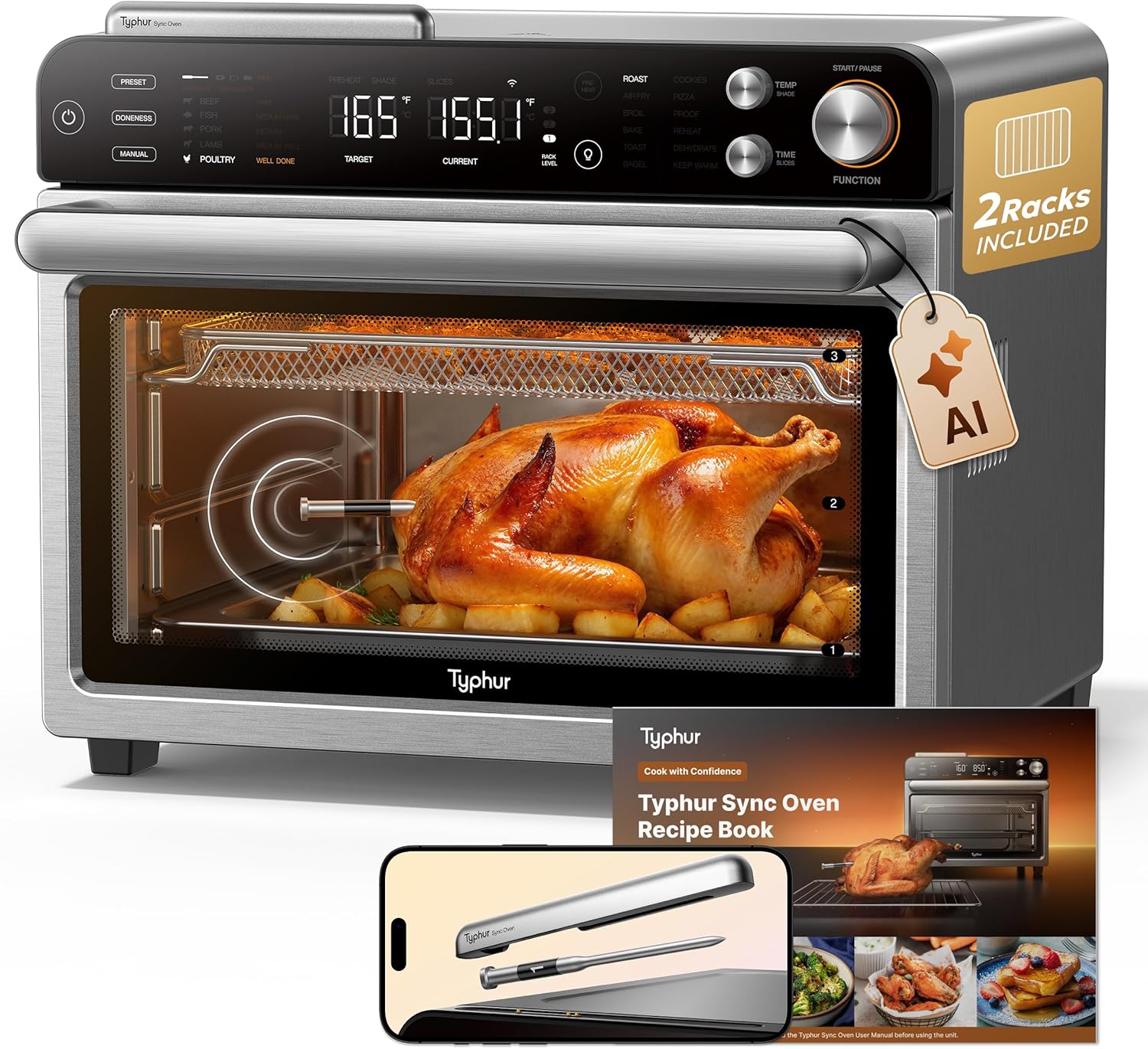
The Typhur Sync Oven is a smart 12-in-1 countertop oven that combines air frying, convection roasting, dehydrating and probe-controlled precision cooking in a single 27‑quart unit. It is typically used for weeknight meals and small-batch roasting where you want consistent doneness without babysitting a thermometer — the built-in wireless probe monitors core temperature and can automatically stop the cook at a target temp while the app displays remaining time and presets. Notable features include 360° turbo convection with dual heating elements and three fan speeds for faster, more even browning, app control with recipe guidance, and a generous accessory set that includes two wire racks, an air-fry basket and a baking pan. Practical benefits are accurate, probe-driven results for meats, reduced oil air-frying, and the convenience of remote monitoring and automated shutoff. Important limitations are its 1750W power draw which may be high for some kitchen circuits and the unit's countertop footprint and weight that make it less suitable for very small kitchens or frequent storage; users should also expect a learning curve to get the most from app recipes and probe presets.
Best for: Buyers who want a single smart appliance that reliably cooks meats to exact doneness and reduces hands-on time, and who prioritize app-driven presets and recipe guidance over the lowest upfront cost.
Less Ideal for: People with very limited counter space, a need to frequently move or store the appliance, or those who cannot accommodate a higher-wattage oven on their kitchen circuit.
- Built-in wireless meat probe for precise, hands-off doneness control
- 360° turbo convection with dual heating elements for faster, even cooking
- App control with presets and step-by-step recipes for repeatable results
- Large 27‑quart capacity and multiple accessories included
- Versatile 12-in-1 cooking modes including air fry, roast, dehydrate and proof
- High 1750W power draw may be restrictive on weaker circuits or shared outlets
- Relatively large and heavy for countertop appliances, limiting portability
Verdict: If you want smart, probe-driven precision and versatile 12-in-1 cooking in one countertop oven, the Typhur Sync Oven delivers reliable results and recipe guidance that simplify everyday cooking.
Breville Smart Oven Air Fryer Pro BOV900BSS

| Wattage | 1800 watts |
|---|---|
| Control Type | Knob Control |
| Power Source | Corded Electric |
| Temperature Range | 80-480 °F |
| Capacity | 1 cubic feet |
The Breville Smart Oven Air Fryer Pro is a countertop convection oven that combines a large interior with dedicated air-fry and dehydrate modes for versatile cooking. It uses the Element iQ system with five quartz heating elements and a two-speed convection fan to direct heat precisely, which helps reduce cook times and deliver more even browning. Typical uses include toasting, roasting a whole turkey, baking cookies or pizza, air frying fries, and dehydrating multiple trays at once; the oven accepts 9×13 pans and can hold up to four dehydration trays. Controls are a mix of knobs and an LCD display, and the oven includes useful accessories such as racks, a roasting pan, pizza pan, and a mesh basket. Practical benefits are consistent results from the smart heating algorithm, large capacity that replaces several appliances, and versatile presets that simplify common tasks. Trade-offs are the unit's substantial countertop footprint and 1800 W power draw, which require ample space and a dedicated outlet, and the learning curve for dialing in custom times and temperatures compared with simpler toaster ovens.
Best for: Buyers who prioritize high-performance cooking and want one countertop appliance to handle roasting, baking, air frying, and dehydrating for family-sized meals.
Less Ideal for: Those with very small kitchens, limited counter space, or who need a lightweight travel-friendly toaster oven should consider smaller models instead.
- Element iQ system with 5 quartz elements for even, targeted heating
- Super convection fan with two speeds for faster, crispier air frying
- Large 1 cubic foot interior fits 9 slices of toast, a 14 lb turkey, or 9×13 pans
- Includes multiple accessories: pizza pan, roasting pan, racks, and mesh basket for dehydrating/air frying
- 13 preset cooking functions plus LCD for easy selection and monitoring
- Large footprint and heavy unit that requires significant counter space
- High power draw (1800 W) may limit simultaneous use with other heavy appliances
Verdict: Choose this oven if you want a high-performance, large-capacity countertop unit that reliably air fries, roasts, bakes, and dehydrates with precise, convection-driven results.
Choosing the Right Smart Oven: Key Factors to Consider
Cooking Performance and Evenness
How evenly an oven distributes heat affects everything from cookies to casseroles. Look for features that improve air circulation and precise temperature regulation. Convection modes, fan placement, and heating-element layout all influence whether foods brown evenly or develop hot and cold spots.
Testing and user reports about how a unit handles multi-rack baking or large roasts are useful. Tight temperature control also reduces the need for repeated checking and adjustments, saving time and reducing overcooked or undercooked outcomes.
Smart Controls and Connectivity
Connectivity should add convenience, not complexity. Useful capabilities include responsive mobile apps, reliable Wi-Fi or local network control, and straightforward voice-assistant integration when desired. Check whether the oven can operate in a local mode if cloud services are unavailable.
Security and update practices matter because networked appliances require ongoing firmware support. Prefer implementations that offer clear settings for network access, guest accounts, and software updates without requiring constant reconfiguration.
User Interface and Daily Usability
An oven's interface affects how quickly you can start cooking and make adjustments under pressure. Look for clear displays, tactile or well-labeled touch controls, and logical menu structures. Preset programs should match common tasks and be easy to modify.
Ergonomics like knob feel, door handle height, and interior lighting also shape daily satisfaction. Controls that are unintuitive or buried in an app can slow prep and discourage using smart features.
Size, Capacity, and Installation
Choose an oven size that fits your household's typical batch sizes and kitchen layout. Interior capacity and rack configurations determine whether you can fit sheet pans, baking dishes, or large roasts without overcrowding.
Consider installation needs such as dedicated circuits, clearance for ventilation, and built-in versus freestanding mounting. Proper placement influences airflow and sensor accuracy, which both affect cooking results.
Maintenance, Cleaning, and Longevity
Cleaning features and access to replaceable parts cut lifetime cost and bother. Look for interiors with easy-to-clean finishes, removable racks and trays, and accessible heating elements. Self-clean or steam-clean modes can help but check how aggressive those modes are and whether they require special cycles.
Availability of service information, simple user-replaceable parts, and clear diagnostics for common faults are signs of longer useful life and easier ownership.
Energy Use and Operating Costs
Smart features can save time but may also add standby energy draw. Consider how efficient the oven is during typical cycles and whether convection and fast-heat modes meaningfully reduce runtime. Energy-efficient designs can lower utility costs and heat output into the kitchen.
Look for good insulation, rapid preheat, and modes that complete jobs more quickly without sacrificing results. Factor in any additional power requirements for integrated smart features or accessories.
How Smart Features Change Everyday Cooking
Smart automation can streamline common tasks like preheating, timed roast completion, and multi-stage cooking. Features that automatically adjust temperature based on sensors help reduce vigilance and free you to focus on meal prep rather than babysitting the oven.
Not all smart features are equally useful. Practical implementations provide clear status updates, allow local manual override, and integrate predictable scheduling without complex setup.
- Automatic preheat with remote start
- Cook timers tied to internal temperature sensors
- Recipe-driven programs that adjust time and temperature
Integrating a Smart Oven Into a Connected Kitchen
Think about how the oven will interact with other devices and routines in the kitchen. Reliable on-premises networking and consistent firmware updates reduce friction when connecting to voice assistants or companion apps.
Plan for scenarios where the network is down. The best smart ovens let you operate core cooking functions locally so the network increases convenience rather than being required for basic use.
- Network fallback for local control
- Scheduling and remote monitoring
- Interoperability with timers and kitchen sensors
Practical Maintenance Tips
Regular maintenance keeps the oven performing predictably. Wipe spills promptly, use appropriate cleaning cycles sparingly, and inspect seals and gaskets to maintain heat retention.
Keep firmware up to date for both security and feature stability, and note how the manufacturer communicates updates. Maintain simple records of service activities and replace consumables like light bulbs and door seals when recommended.
- Clean interior after major spills
- Schedule periodic checks of door seals and hinges
- Apply firmware updates when available
Safety Considerations for Networked Appliances
Smart ovens combine high heat with network access, so safety and access control are important. Lock or restrict remote-control features when children are present, and use secure network settings to limit unintended access.
Check for clear safety interlocks and reliable door latching. Understand how the oven indicates faults so you can quickly respond to heating anomalies.
- Use secure Wi-Fi and change default passwords
- Enable child locks and restricted remote commands
- Monitor fault codes and error indicators promptly
When to Prioritize Size Over Connectivity
If you regularly prepare large batches or entertain, interior capacity and flexible rack options can be more important than advanced smart features. Larger interiors allow more versatility with sheet pans and multiple dishes but may take longer to preheat.
Balance your need for physical capacity with connectivity. A mid-size oven with strong temperature control may outperform a larger unit with unreliable smart features for everyday cooking.
- Assess typical batch sizes before choosing capacity
- Consider adjustable racks for flexible layouts
- Weigh preheat time against total cook-time savings
How We Chose the Best Smart Oven
We shortlisted Smart Ovens that demonstrate reliable cooking performance and practical smart features for everyday home use. Selection emphasized measurable cooking results, such as evenness of heat and consistent bake/roast outcomes, because accurate temperature control directly affects food quality. Connectivity mattered too; we favored ovens that offer secure, well-documented network options and responsive mobile or voice controls that actually simplify workflows. Ease of use was another filter. Models with intuitive interfaces, clear status feedback, and sensible presets scored higher because smart features are only useful if they are accessible under time pressure. We also considered durability and serviceability indicators like straightforward maintenance access and replaceable parts. Safety and energy use were weighed as part of real-world operating costs and household risk mitigation. Excluded from consideration were niche commercial units and ovens that rely on proprietary, unsupported cloud systems. We did not include models lacking basic local-control fallback or those with inconsistent software updates. The final list balances cooking capability, connectivity, user experience, and practical upkeep.
Our full evaluation process is outlined in our review methodology.
FAQ
Do smart ovens save time compared with conventional ovens?
Often they do for specific tasks. Features like rapid preheat, sensor-driven cook completion, and recipe automation can reduce active monitoring and overall cook time. Savings depend on how much you use those automated modes.
Will my smart oven work if my home Wi-Fi goes down?
Usually core cooking functions still work locally, but remote control and app-based monitoring may be unavailable. Choose an oven that explicitly supports local manual control so you are not dependent on cloud services.
Are smart oven apps difficult to set up and maintain?
Setup complexity varies. Some apps provide guided onboarding and stable connectivity, while others can require repeated pairing. Look for units that document pairing steps clearly and offer firmware updates to address bugs.
How do I keep a smart oven secure on my home network?
Use a strong, unique Wi-Fi password and keep your router firmware updated. Disable unnecessary remote-access features, create guest network access for IoT devices, and install device updates when provided to reduce vulnerabilities.
Do smart features improve baking accuracy?
They can. Internal temperature probes and automated adjustments compensate for typical oven variance and reduce guesswork. However, fundamental factors like rack position and pan type still influence results.
Final Verdict
Prioritize the features that match how you cook. If you plan meals that benefit from automation and remote control, favor Smart Ovens with reliable connectivity, clear user interfaces, and strong sensor-driven cook modes. If you bake large batches, give more weight to interior capacity and even heat distribution. Accept tradeoffs between advanced connectivity and straightforward, rugged design. A competent balance of cooking consistency, usability, and maintainability will serve most kitchens best and make day-to-day cooking both easier and more predictable.