
Note: This article contains affiliate links. If you click on these links and make a purchase, we may earn a small commission at no extra cost to you. This helps support our research and content. Read our full affiliate disclosure here.
Running service in a professional kitchen demands equipment that produces repeatable results, holds tight tolerances, and survives heavy daily use. A restaurant-focused sous vide cooker must deliver precise temperature control, strong water circulation, and reliable uptime so cooks can schedule batches, scale recipes, and maintain food safety without constant babysitting. This guide presents seven shortlisted sous vide cookers selected for commercial settings, with a clear focus on performance, durability, and ease of integration into busy workflows. Below you will find the top contenders and the criteria we used to evaluate them, plus practical advice for putting sous vide into regular restaurant service.
Top Picks at a Glance
| Best Overall The best all-around choice for most situations | Breville Commercial HydroPro CSV700PSS |  |
| Best Quality Built to a higher standard if you want something more solid | Breville Commercial CRC-5AC1B Sous Vide |  |
| Best Value The sweet spot between price and what you get | Inkbird ISV-100W Sous Vide Cooker |  |
| Best Budget The cheapest option that still gets the job done reliably | Wancle Sous Vide Cooker M820 |  |
| Top Rated A top-rated pick with lots of positive feedback | Greater Goods Sous Vide Cooker 1100W |  |
| Most Popular A crowd favorite that many people choose with confidence | Anova Precision Cooker Nano |  |
| Best Seller A high-volume bestseller chosen again and again | Anova Precision Cooker 3.0 |  |
Breville Commercial HydroPro CSV700PSS

| Wattage | 1450 watts |
|---|---|
| Voltage | 120 |
| Control Method | Touch |
| Upper Temperature Rating | 194 °F |
| Lower Temperature Rating | 68 °F |
The HydroPro CSV700PSS is a professional sous-vide immersion circulator built for high-repeatability cooks in busy kitchens. It uses a 1450 W heater and a high-flow pump to heat water quickly and maintain stable temps, and the large touch screen hosts the Sous Vide Toolbox which guides time-to-temperature and pasteurization for many foods. Programmable My Presets, a waterproof housing, quick-release clamp, magnetic impeller and tool-less removable parts make it easy to set up, clean and keep consistent results across multiple batches. The unit is designed for commercial use with NSF and CUL certifications and dishwasher-safe removable components for fast turnover. Trade-offs are that the unit is a single-circulator solution intended for pots up to its stated capacity rather than a multi-bath system, and its professional features and size put it beyond what casual home cooks need.
Best for: Professional cooks and restaurant kitchens that need fast heat-up, precise temperature control, and repeatable, food-safety‑focused sous-vide workflows.
Less Ideal for: Casual home cooks who rarely sous-vide or need a compact, budget-oriented device should consider simpler consumer models instead.
- High 1450 W heater and strong 17 L/min pump for fast heat-up and stable temperature control
- On-board Sous Vide Toolbox with guided cook settings and My Presets for repeatable results
- Waterproof, touch-screen interface and robust stainless steel construction for commercial durability
- Tool-less disassembly, magnetic impeller and dishwasher-safe removable parts simplify cleaning and maintenance
- Designed as a single immersion circulator rather than a multi-bath commercial controller
- Commercial feature set and size may exceed needs for casual home cooks
Verdict: Choose the HydroPro when you need a rugged, fast-heating commercial immersion circulator that delivers repeatable, food-safe sous‑vide results.
Breville Commercial CRC-5AC1B Sous Vide

| Wattage | 1100 watts |
|---|---|
| Voltage | 120 volts |
| Control Method | Touch |
| Upper Temperature Rating | 210 °F |
| Capacity | 6 liters |
The Breville Commercial CRC-5AC1B is an immersion circulator built to deliver restaurant-style sous vide precision in a home or small professional kitchen. It clamps to pots and larger containers and circulates water to maintain a set temperature up to 210°F, driven by an 1100W heater and touch controls for straightforward operation. Its 6-liter capacity and robust clamp make it easy to run long cooks for proteins, vegetables, and reheating prepped components without temperature swings, and the plastic housing keeps it lightweight and easy to move between stations. Practical benefits include repeatable, low-effort results for consistent doneness and the ability to reheat prepared sides without drying. Limitations are that it lacks advanced connectivity or programmable presets found on newer units and the plastic exterior may feel less heavy-duty than all-metal commercial models, so operators seeking full stainless commercial gear or networked scheduling may want a different circulator.
Best for: Chefs and cooks who prioritize precise, repeatable temperature control and reliable performance for high-volume or professional-style sous vide cooking without requiring networked features.
Less Ideal for: Kitchens that require fully stainless, heavy-duty commercial hardware or integrated network scheduling should consider purpose-built commercial models instead.
- 1100W heater provides strong, responsive temperature control for stable sous vide baths
- Touch controls make temperature and timer adjustments quick and intuitive
- Clamp design fits pots and larger containers for flexible batch sizes
- Up to 210°F rating covers the full range needed for most professional sous vide recipes
- No Wi‑Fi or app connectivity for remote monitoring or scheduling
- Plastic exterior and consumer-oriented finish are less rugged than full commercial stainless designs
Verdict: Choose this circulator when you need strong, dependable temperature accuracy for restaurant-caliber sous vide results without relying on networked features.
Inkbird ISV-100W Sous Vide Cooker

| Wattage | 1000 |
|---|---|
| Voltage | 120 volts |
| Control Method | App |
| Temperature range | 77–212 °F |
| Capacity | 15 liters |
The Inkbird ISV-100W is an immersion circulator that brings remote control and restaurant-style precision to home or small commercial kitchens. It clamps to any pot and uses a 1000W heater and circulation pump to heat up to 15 liters of water and hold temperature within 0.1C accuracy, with a touchscreen for direct control and a companion app for 2.4GHz Wi‑Fi control and monitoring. The unit includes a calibration function, long 99‑hour timer, and presets that make repeatable results easy for steaks, poultry, and fish. It runs quietly under 40 dB and has water protection and shortage safeguards for continuous cooks. For a restaurant setting where consistent doneness and unattended cooks matter, the fast heat-up, tight temperature control, and app monitoring are practical benefits. Limitations are typical for immersion units: you need suitable pots or containers for larger batches and the clamp design may require attention on very crowded racks or commercial sinks; the 15‑liter capacity and pump flow suit small to medium batch work rather than high-volume service.
Best for: Professional cooks or kitchen managers who need precise, repeatable doneness for small-to-medium batch sous vide prep and value remote monitoring and calibration.
Less Ideal for: Large-scale commercial kitchens that require high-throughput combi or dedicated water baths for continuous, high-volume production should look elsewhere.
- 1000W heater for faster heat‑up and stable temperature hold
- Wi‑Fi and app control for remote monitoring and adjustments
- High temperature accuracy with calibration for repeatable results
- Quiet operation under 40 dB suitable for overnight or back‑of‑house use
- Large 15‑liter usable capacity for small to medium batch cooks
- Clamp-style mounting and 15 L capacity limit throughput for high-volume restaurant service
- Requires a 2.4 GHz Wi‑Fi network for remote features
Verdict: Choose the Inkbird ISV-100W when you need app-controlled, restaurant-grade temperature accuracy and reliable repeatability for small to medium batch sous vide cooking.
Wancle Sous Vide Cooker M820

| Wattage | 1100 watts |
|---|---|
| Control Method | Touch |
| Temperature range | 25–90 °C |
| Capacity | 20 liters |
The Wancle M820 is an 1100W immersion circulator designed to bring restaurant-style sous vide cooking to a compact footprint. It clamps to pots and circulates water at about 7–8 L/min to keep food evenly heated while the touch panel and tilted display make setting temperature and time straightforward. The cooker supports a wide temperature range (25–90°C) with claimed accuracy to ±0.1°C and runs quietly thanks to its 3D circulation design. Safety features include IPX7 waterproofing and protections for overheat and current, and the 1100W heater brings water up to temperature faster than lower-power models. Practical limits include a maximum stated capacity of 20 liters and a minimum water depth requirement, so large commercial baths or very heavy service loads would exceed its intended use. For kitchens that need a portable, accurate sous vide unit for precise cook control without a large footprint, this delivers the core functions well; for continuous high-volume restaurant duty you may prefer a unit rated specifically for commercial use.
Best for: Restaurant cooks or small commercial kitchens seeking a compact, accurate sous vide circulator for prep tasks and small-batch precision cooking who prioritize portability and temperature control over continuous heavy-duty throughput.
Less Ideal for: Large-scale restaurants or high-volume continuous service where a commercial-grade, high-capacity or certified sous vide system is required for nonstop operation.
- High 1100W power for faster warm-up times compared with lower-watt home models
- Precise temperature control to ±0.1°C across 25–90°C for consistent results
- Quiet 3D water circulation that promotes even heating
- IPX7 waterproof rating and multiple safety protections for durability
- Compact, lightweight design with adjustable clip for different pots
- Maximum recommended capacity is 20 liters, limiting continuous high-volume bath use
- Not specified or certified for commercial/NSF continuous-duty restaurant operation
Verdict: A portable, high‑power sous vide circulator that delivers precise, quiet temperature control for small-batch restaurant prep and accurate cook consistency.
Greater Goods Sous Vide Cooker 1100W

| Wattage | 1100 watts |
|---|---|
| Voltage | 120 volts |
| Control Method | Touch |
| Upper Temperature Rating | 203 °F |
| Lower Temperature Rating | 68 °F |
The Greater Goods sous vide cooker is a countertop immersion circulator built for steady, repeatable low-temperature cooking in larger home or small professional kitchens. It uses a 1100 watt heater and brushless motor to heat baths quickly and maintain a consistent temperature between 68 and 203°F, while an easy-to-read LED and intuitive dial let you set temperature and time without a smartphone. The unit includes manual temperature calibration, a negative timer to track overruns, and a removable stainless steel cover that is dishwasher-safe for easier cleanup. An adjustable clip fits pots and containers at recommended depths and the strong water circulation helps even heat distribution for reliably uniform results across multiple bags. Downsides are that it is a single-piece immersion cooker so you still need a suitable container and rack for busy service, and the control method is not app-connected which limits remote monitoring and multi-device integration in a high-volume kitchen.
Best for: Chefs and kitchens that prioritize consistent, repeatable results and robust, simple hardware over smart features, especially where reliability and quiet operation matter during service.
Less Ideal for: Teams that need integrated remote control, cloud logging, or multi-unit networked management should consider networked models instead.
- Powerful 1100W heater brings large water baths up to temperature quickly
- Quiet brushless motor with strong circulation for even heat distribution
- Simple, reliable dial and LED controls with manual calibration for precision
- Removable stainless steel cover is dishwasher-safe for easier cleaning
- No Wi‑Fi or app for remote monitoring or logging
Verdict: A reliable, high-power immersion cooker that delivers precise, quiet temperature control for kitchens that need consistent sous vide performance without relying on apps.
Anova Precision Cooker Nano

| Wattage | 800 watts |
|---|---|
| Voltage | 120 volts |
| Control Method | App |
| Upper Temperature Rating | 197 °F |
| Lower Temperature Rating | 32 °F |
The Anova Precision Cooker Nano is an entry-level immersion circulator that clips to a pot and circulates water to precise temperatures for consistent sous vide results. You set time and temperature either on the unit or through the Anova app, which also provides recipes and remote notifications; the Nano is rated to reach up to 197°F and supports long cooks up to 99 hours. Its compact plastic body and fixed clamp make it easy to store and simple to attach to stockpots, and 800 watts of power is enough for small to medium batches that serve about four people. Practical benefits include precise temperature control for edge-to-edge doneness and moisture retention, app-driven convenience for hands-off cooking, and a small footprint that keeps counters uncluttered. Limitations are its fixed clamp and lower flow rate compared with higher-power pro models, which means longer ramp-up times and smaller effective water volumes for larger cooks. For cooks who want restaurant-style precision at modest scale, the Nano delivers a straightforward, reliable sous vide experience without professional-level throughput.
Best for: Home cooks seeking restaurant-style precision in small-batch cooking who value app convenience and a compact, easy-to-store unit.
Less Ideal for: Commercial kitchens or home cooks who regularly need to sous vide large volumes or run back-to-back high-throughput cooks should choose a higher-power professional model.
- Accurate temperature control up to 197°F for consistent sous vide doneness.
- App connectivity with recipes and remote notifications for hands-off cooking.
- Compact, lightweight design that stows easily in a drawer.
- 800-watt power sufficient for small to medium pots and family-sized meals.
- Fixed clamp and lower flow compared with pro models limits large-volume or high-throughput cooks.
- Plastic construction is less rugged than metal-bodied professional units.
Verdict: Buy this if you want an affordable, app-connected sous vide that delivers precise, restaurant-quality results for small to medium home cooks.
Anova Precision Cooker 3.0
| Wattage | 1100 watts |
|---|---|
| Control Method | Touch |
| Upper Temperature Rating | 197 °F |
| Lower Temperature Rating | 32 °F |
| Capacity | 16 liters |
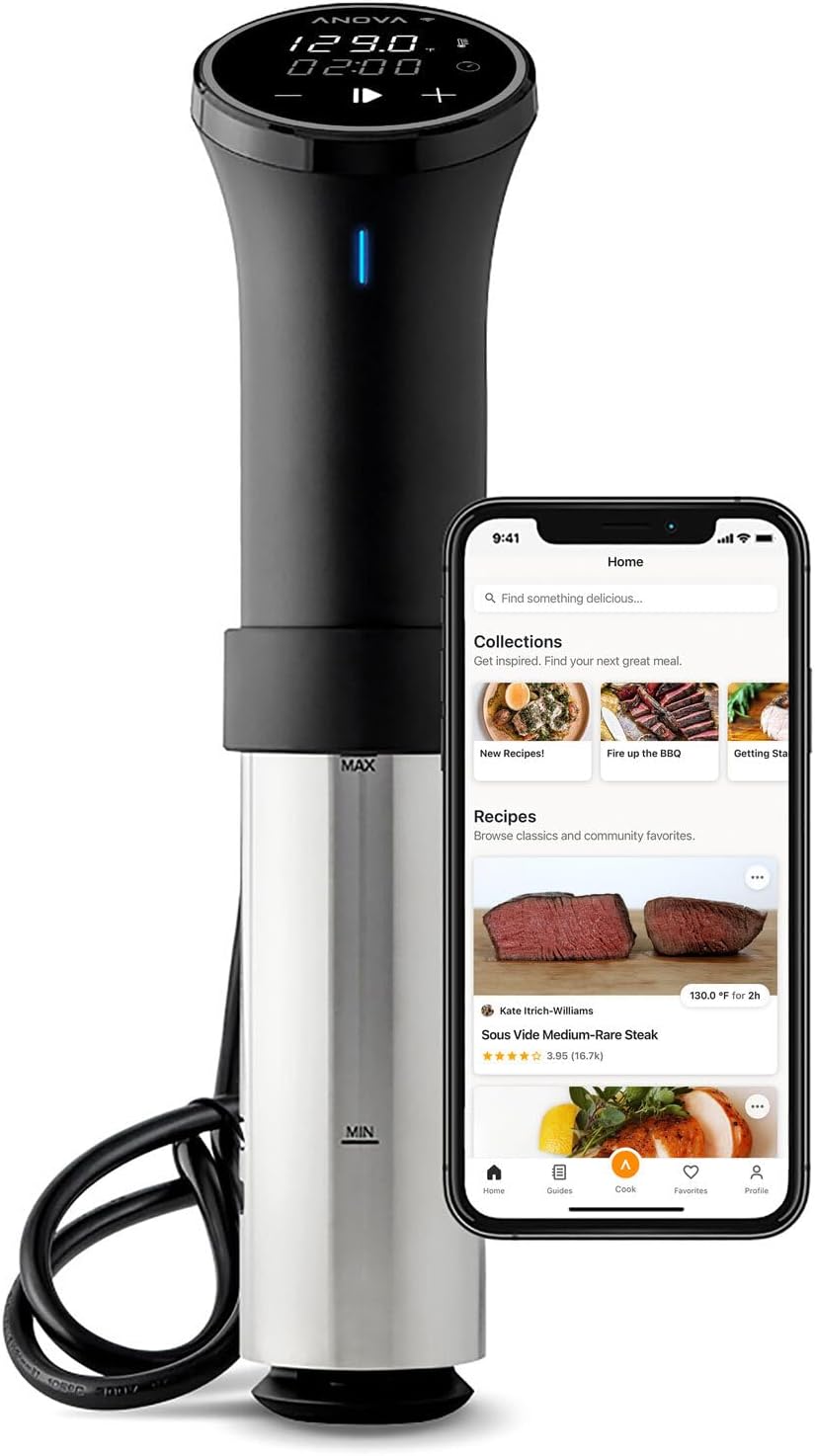
The Anova Precision Cooker 3.0 is a third-generation sous vide circulator built for reliable, repeatable results in both home and light-commercial kitchens. It clamps to any suitably deep pot and circulates water with an 8 L/min flow while delivering 1100 watts to reach target temperatures quickly. The two-line touch display shows time and temperature at a glance and you can control and monitor cooks remotely via dual-band WiFi and the Anova app. The removable stainless steel skirt makes the lower unit easier to clean, and the unit is rated to hold temperatures between 32 and 197°F with factory-grade precision. Practical benefits include fast heat-up for batch or multiple portions, consistent edge-to-edge doneness that reduces overcooking risk, and app recipes for standardized procedures. Limitations to consider are that it still requires a suitable vessel and adequate water depth, not a sealed tank, and for heavy commercial throughput you may need higher flow or a dedicated immersion circulator meant for continuous restaurant use.
Best for: Chefs and kitchen managers who prioritize consistent, precise doneness and want a reliable, connected circulator that simplifies recipe control and monitoring.
Less Ideal for: Large-scale commercial kitchens that require continuous, industrial-grade immersion units or integrated sealed water baths should look at heavy-duty commercial models instead.
- Dual-band WiFi and app control let you set, monitor, and adjust cooks remotely
- 1100-watt heater and 8 L/min flow rate bring water to temperature quickly for batch cooks
- Two-line touch display shows time and temperature simultaneously for easy onsite control
- Removable stainless steel skirt and adjustable clamp make cleaning and mounting simple
- Not a sealed water bath so it depends on an external pot and adequate water depth
- May be undersized for continuous, high-volume restaurant lines compared with commercial circulators
Verdict: Choose the Anova Precision Cooker 3.0 when you need a reliable, app-connected circulator that delivers precise, repeatable sous vide results for controlled restaurant-style cooking.
Choosing the Right Sous Vide Cooker for Restaurant: Key Factors to Consider
Temperature Accuracy and Stability
Sous vide cooking is fundamentally about holding food at a precise temperature for an extended period. Small deviations can change texture, doneness, or safety margins. In a restaurant, accuracy matters not just for a single plate but for entire batches that must match front-of-house expectations. Look for units with tight stated tolerances, reliable PID or equivalent control algorithms, and documented stability under load.
Stability under load is a different metric than brief calibration numbers. In practice, a unit should recover quickly after opening a bath, loading multiple bags, or when placed in a large volume of cooler starting water. That resilience preserves yield and reduces the need for retesting or compensating recipe adjustments during service.
Circulation and Flow Rate
Even temperature distribution requires adequate water movement. In a restaurant setting you will often cook many bags at once or use large containers, so pump power and circulation pattern are critical. Low flow can create thermal gradients, meaning some bags finish early while others lag.
Consider the pump's liters-per-minute (or gallons-per-minute) rating and how the unit directs flow. Higher flow rates help when using tall cambros or full-size hotel pans. Also assess whether the unit can maintain circulation when filled to a commercial container's typical volume without cavitation or noise that interferes with the kitchen.
Continuous Run Durability
Professional kitchens run equipment for hours or days with little downtime. A restaurant sous vide cooker must tolerate long continuous runs and frequent on/off cycles without premature wear. Durable motor and pump assemblies, corrosion-resistant materials, and thermal protection all contribute to longevity.
Maintenance intervals and serviceability matter too. Units designed for commercial use often have replaceable wear parts and clearer service documentation. Assess whether the design keeps electrical components isolated from moisture and allows easy access for routine checks and repairs.
Commercial Capacity and Scalability
Capacity is not just about the maximum bath size but how the unit scales with kitchen needs. Can it handle multiple bags and large-volume containers? Does it allow mounting to full-size cambros or hotel pans? Some units are designed to be linked or run multiple units in tandem for higher throughput.
Think about your typical production runs. If you batch-cook proteins for service, you need a setup that minimizes the number of cycles and staff time. A cooker that fits standard commercial foodservice containers and can maintain performance at those volumes will reduce labor and improve consistency.
Cleaning, Sanitation, and Maintenance
Back-of-house sanitation is strictly enforced, so units must be easy to clean and resist bacterial buildup. Smooth, sealed housings and removable components reduce cleaning time. Consider whether the unit's exposed materials tolerate common sanitizers and whether any small crevices trap food particles or water.
Also evaluate how simple routine maintenance tasks are. Filters, impellers, and seals should be accessible for inspection and replacement with minimal downtime. Clear maintenance schedules and serviceability reduce the risk of mid-shift failures and keep the unit in safe operating condition.
Integrating Sous Vide Into a Restaurant Workflow
Successful adoption of sous vide in a restaurant depends on workflow adjustments as much as equipment choice. Schedule batch cooking during off-peak prep times to build a reserve of portioned, chilled, and vacuum-sealed items that can be quickly finished during service. Use standardized portion sizes and labeled bags to keep production consistent.
Train line cooks on safe handling, correct vacuum sealing, and rapid chilling protocols. Implement a labeling system with cook time, target temperature, and date to avoid confusion. Assign responsibility for bath monitoring so temperature excursions are caught early and corrective steps are predictable.
- Batch during low-demand shifts to maximize oven and grill availability.
- Standardize bag weights and portion counts to simplify cook times.
- Use dated labeling and a simple cooldown checklist for food-safety compliance.
Selecting Containers and Racks for Commercial Use
Container choice influences heat-up time and circulation. Insulated cambros reduce energy use and help maintain steady temperatures during long holds. Shallow full-size pans heat faster but may require more frequent topping up to keep bags submerged. Racks and dividers let you organize large batches and prevent bags from blocking flow.
Choose containers that match the unit's mounting style and ensure the circulation path is not obstructed. Consider lids or insulated covers to reduce evaporation and temperature drift, especially for multi-hour holds.
- Insulated containers help with energy efficiency and stability.
- Racks maximize usable volume and keep bags from clumping.
- Covers reduce evaporation and minimize monitoring intervals.
Food Safety and HACCP Considerations
Sous vide introduces specific food-safety workflows around time and temperature. Restaurants should integrate sous vide steps into existing HACCP plans, documenting holding temperatures, critical limits, and corrective actions. Rapid chilling and proper storage after cooking are essential to prevent bacterial growth when items are held cold for later service.
Ensure staff follow validated pasteurization times at the chosen temperatures and maintain clear records. Where required, consult local health codes about acceptable holding methods and documentation practices for sous vide-prepared foods.
- Record critical temperatures and holding durations for each batch.
- Implement rapid chill procedures to bring cooked items to safe storage temperatures.
- Train staff on corrective actions if temperatures drift outside critical limits.
Power, Mounting, and Kitchen Placement
Plan for power access and stable mounting locations. Some commercial units require dedicated circuits or have specific electrical ratings that must be respected. Mounting on cambros, rails, or custom brackets should allow airflow around the unit and easy access for cleaning.
Avoid placing units where steam, intense heat, or splashing liquids could shorten component life. Position baths near prep stations but away from direct heat sources to maintain temperature stability and crew ergonomics.
- Check electrical load and avoid overloading shared circuits.
- Mount units where they are easy to service and clean.
- Keep baths away from direct heat and splash zones to extend longevity.
Recipe Scaling and Timing Strategies
Scaling recipes for volume requires more than multiplying time and temperature. Thicker pieces need longer times regardless of quantity, and overcrowding a bath can slow heat recovery. Stagger start times or use multiple baths to keep finish windows aligned with service.
Develop timing charts for common proteins and portion sizes so cooks can stage finishing steps predictably. Consider partial cooking and rapid chilling for bulk prep, then final sous vide finishing for consistent service temperature and texture.
- Create a timing matrix for common cuts and portion sizes.
- Use multiple baths or staggered starts for large-service runs.
- Employ rapid chill plus reheating protocols to improve throughput.
How We Chose the Best Sous Vide Cooker for Restaurant
We built this list by prioritizing attributes that matter in commercial kitchens and excluding consumer-grade units that cannot sustain heavy daily cycles. Core evaluation criteria included temperature accuracy and stability, flow rate and water circulation, continuous run durability, capacity and scalability for batch cooking, and cleaning plus maintenance needs in a professional environment. Temperature accuracy and stability were weighted heavily because consistent holding temperatures directly affect food safety and repeatability. Flow rate and pump robustness determined how well a unit can maintain even heat distribution in large-volume containers. Continuous run durability covered motor and pump life under long daily operation and resistance to heat and humidity in back-of-house conditions. Capacity and scalability addressed how easily a unit supports multiple bags or large-volume baths, and whether it can be linked or mounted for brigade workflows. Cleaning and maintenance considered user-accessible parts, sanitation, and routine replacement intervals. We excluded devices intended strictly for home use or those without clear commercial-duty specifications. The resulting shortlist focuses on units whose spec sheets and design features align with professional kitchen demands, and that offer measurable advantages in the evaluation dimensions listed above.
Our full evaluation process is outlined in our review methodology.
FAQ
Can a sous vide cooker run continuously during a full service day?
Often yes, provided the unit is designed for commercial duty and is properly maintained. Continuous operation stresses pumps and motors, so choose units rated for long runs and follow recommended maintenance schedules to avoid mid-shift failures.
How do I scale sous vide recipes for a high-volume kitchen?
Scale by matching bath capacity to portion counts, using racks to organize bags, and avoiding overcrowding. Thicker items still need the same time at temperature, so use multiple baths or staggered starts to meet service windows.
What sanitation steps are most important for restaurant sous vide gear?
Regularly clean and sanitize the exterior housing and any removable parts, inspect and replace seals and impellers as needed, and use lids or covers to limit evaporation and contamination. Follow your HACCP plan for documentation and verification.
Is there a risk of uneven cooking in large-volume baths?
Yes. Uneven cooking can occur if flow is insufficient or if bags block circulation. Use higher-flow units, arrange bags with racks, and verify temperature stability at multiple points in the container to ensure even results.
Should I use insulated containers or shallow pans for sous vide?
Insulated containers help maintain stable temperatures and are energy efficient for long holds. Shallow pans heat faster but may require more attention to evaporation and topping up. Choose based on your batch size and typical cook durations.
Final Verdict
For restaurant kitchens, prioritize temperature accuracy, robust circulation, and continuous-run durability when choosing a sous vide cooker. Capacity and serviceability determine how well a unit fits into daily production, while container selection and workflow integration dictate real-world efficiency. Balance the tradeoffs between heat-up speed and holding stability to match your menu and prep rhythms. With clear standards for maintenance and documentation, sous vide can become a reliable backbone of consistent, high-quality service.