
Note: This article contains affiliate links. If you click on these links and make a purchase, we may earn a small commission at no extra cost to you. This helps support our research and content. Read our full affiliate disclosure here.
Picking the right space heater for home use matters when you need reliable warmth, lower energy draw, and safe operation around family and pets. The right heater can cut cold spots, reduce dependence on whole-house heating, and give you precise control over comfort in individual rooms. This guide shortlists the top-performing options for typical home spaces and evaluates them across the most important real-world criteria. You will see how each pick performs for heating speed, efficiency, noise, and built-in safety features. Read on to find a heater suited to your room size and daily routine.
Top Picks at a Glance
| Best Overall The best all-around choice for most situations | Lasko Ceramic Tower Heater 751320 |  |
| Best Quality Built to a higher standard if you want something more solid | De'Longhi EW7707CM Radiant Heater |  |
| Best Value The sweet spot between price and what you get | JIBUFI PTC-903A Portable Heater |  |
| Best Budget The cheapest option that still gets the job done reliably | Amazon Basics Ceramic Space Heater |  |
| Top Rated A top-rated pick with lots of positive feedback | DREO Space Heater HSH006 |  |
| Most Popular A crowd favorite that many people choose with confidence | GiveBest Portable Space Heater PTC-905 |  |
| Best Seller A high-volume bestseller chosen again and again | DREO Atom One Space Heater |  |
Lasko Ceramic Tower Heater 751320

| Heat Output | 1500 watts |
|---|---|
| Heating Element | Ceramic |
| Special Features | Adjustable Thermostat, Auto-Off Timer, Widespread Oscillation, Remote Control |
| Power Source | Corded Electric |
| Indoor Outdoor Usage | Indoor |
The Lasko Ceramic Tower Heater (model 751320) is a compact 1500W tower heater designed to warm small to medium rooms with a ceramic heating element and widespread oscillation. It offers two heat settings plus an automatic thermostat mode, an electronic programmable seven-hour timer, and a multi-function remote with onboard storage so you can adjust temperature, oscillation, and the timer from across the room. Safety features include overheat protection and cool-touch housing, and the slim footprint with a built-in handle makes it easy to move between bedrooms, home offices, and living rooms. In practice the heater produces steady, directional warmth and the oscillation helps distribute heat more evenly than a stationary unit, though it is best suited for targeted room heating rather than whole-house use. Controls are straightforward but the unit only has two manual heat levels, so users who want finer heat adjustment or quieter ultra-low modes may look elsewhere. For everyday home use this is a practical, easy-to-operate option that balances performance, portability, and basic safety features.
Best for: Buyers who want a simple, portable room heater that provides reliable, quick warmth with easy electronic controls and remote operation for everyday home use.
Less Ideal for: People who need precise temperature tuning, ultra-quiet low-power modes, or a unit capable of heating very large rooms should consider more powerful or feature-rich alternatives.
- 1500-watt ceramic element delivers quick, effective warmth for small to medium rooms
- Widespread oscillation helps circulate heat for more even coverage
- Programmable 7-hour timer and electronic thermostat enable hands-off temperature control
- Includes multi-function remote with onboard storage for convenient adjustments
- Slim, portable tower design with built-in handle for easy repositioning and storage
- Only two manual heat settings limit granular temperature control
- Not intended for heating large open-plan areas or whole-house use
Verdict: A straightforward, portable 1500W ceramic tower heater that delivers dependable, room-focused warmth with remote and timer controls.
De'Longhi EW7707CM Radiant Heater

| Heat Output | 1500 watts |
|---|---|
| Heating Method | Radiant |
| Number of Speeds | 3 |
| Power Source | Corded Electric |
| Min Temperature Setting | 44 °F |
The De'Longhi EW7707CM is an oil-filled radiant radiator meant to heat small to medium rooms quietly and with low maintenance. It runs at 1500 watts and uses an exclusive thermal slot design to push heat into the room while keeping surfaces relatively cool, which makes it well suited for bedrooms, home offices, or studies. Controls are straightforward: a thermostat, three heat settings, and a ComfortTemp function that automatically manages power to maintain the set temperature for better efficiency. Because it is oil-filled there is no fan, so it does not stir dust and operates silently, and the sealed reservoir never needs refilling. Safety features include a thermal cut-off and fully enclosed heating elements plus a low-surface design and anti-freeze mode that kicks on below about 44 degrees F. The unit is heavier than fan heaters and is intended as a stationary room heater rather than a fast-blast solution, so it takes a bit longer to warm a space but provides stable, draft-free warmth and modest energy savings when ComfortTemp is used.
Best for: Buyers who prioritize steady, low-noise room heating and efficient temperature maintenance for bedrooms or home offices and want a rugged, low-maintenance unit.
Less Ideal for: People who need very fast spot heating, an ultra-light portable heater, or a model that provides forced-air circulation for quick warm-up.
- Silent radiant heating with no fan to circulate dust or allergens
- ComfortTemp feature that auto-adjusts power for up to 20% better efficiency
- Multiple heat settings and adjustable thermostat for precise room comfort
- Sealed oil reservoir requires no refilling and low maintenance
- Built-in safety features including thermal cut-off and low surface temperature
- Slower to warm a room compared with fan-forced heaters
- Relatively heavy and less portable than lightweight ceramic heaters
Verdict: Choose this De'Longhi radiator when you want quiet, efficient full-room heat with low maintenance and built-in safety for home use.
JIBUFI PTC-903A Portable Heater

| Heat Output | 1500 watts |
|---|---|
| Heating Coverage | 200Sqft |
| Number of Speeds | 4 |
| Voltage | 120 volts |
| Oscillation | 70° |
The JIBUFI PTC-903A is a small 1500W PTC electric heater designed to warm single rooms up to about 200 sq ft. It offers four power settings plus an ECO mode and a fan-only option, and 70 degree oscillation spreads heat across a work area or bedroom. The unit is compact and portable so you can move it from under a desk to beside a bed or a small living space, and the included remote and 12-hour timer make it convenient for hands-off control. Safety is emphasized with ETL certification, tip-over protection, an enhanced safety plug and flame-retardant materials, which is reassuring for overnight use. On the downside the compact desktop form limits airflow compared with larger tower heaters, and the stated temperature range may be more about internal settings than room thermostats. For buyers who want quick spot heating with straightforward controls and built-in protections, it delivers practical, efficient warmth in small to medium rooms.
Best for: Buyers who want a portable, safety-focused heater to quickly warm a bedroom, office, or single living area while keeping energy use manageable.
Less Ideal for: Rooms much larger than 200 square feet or buyers who need whole-house or very high-output heating should choose a larger heater or a different heating solution.
- 1500W PTC element provides rapid, effective spot heating
- 70° oscillation spreads warmth across a room instead of a narrow stream
- Multiple modes including ECO and fan-only for energy-conscious use
- ETL certification and tip-over/protection features for safer overnight operation
- Compact desktop form limits overall airflow and range compared with larger floor or tower heaters
- Remote requires batteries which are not included
Verdict: A compact, safety-minded 1500W heater that delivers quick, focused warmth for single rooms while offering energy-saving and remote-control convenience.
Amazon Basics Ceramic Space Heater

| Heat Output | 1500 watts |
|---|---|
| Number of Speeds | 3 |
| Power Source | Corded Electric |
| Heating Method | Convection |
| Max Temperature Setting | 130 °F |
This Amazon Basics ceramic heater is a small, no-frills indoor heater designed for quick spot heating in bedrooms, home offices, or other personal spaces. It offers three modes — 1500W high, 900W low, and a fan-only setting — and a basic adjustable thermostat so you can dial back output once the room is comfortable. Ceramic element convection heat warms a limited area rapidly and the unit is light and portable for moving between rooms. Safety is covered with tip-over and overheat protection plus a power indicator light, though the heater does not oscillate and is not rated for humid areas such as bathrooms. Noise is modest at about 43 dB on heat, and the corded design keeps operation simple with no app or remote. The main limitations are its small coverage area appropriate only for personal or small-room use and a basic control layout without precise digital temperature control.
Best for: Buyers who need an inexpensive, portable heater for quickly warming a small room or workspace and prefer straightforward controls over smart features.
Less Ideal for: People looking to heat large living rooms, open-plan spaces, or bathrooms should choose a higher-capacity or moisture-rated heater instead.
- 1500W ceramic heating for fast spot warming
- Three settings including fan-only for air circulation
- Built-in tip-over and overheat protection for safer use
- Lightweight and compact for easy room-to-room portability
- Not intended for use in high-humidity rooms like bathrooms
- No oscillation or advanced digital controls for precise temperature management
Verdict: A budget-friendly, portable ceramic heater that reliably delivers quick spot warmth for small rooms with basic safety features.
DREO Space Heater HSH006

| Heat Output | 1500 watts |
|---|---|
| Heating Element | PTC Ceramic |
| Heating Coverage | 200 sq.ft |
| Sound Level | 34 dB |
| Timer | 1-12 H |
The DREO HSH006 is a small tower heater designed to deliver quick, targeted warmth for bedrooms, offices, and similar indoor spaces. It uses a 1500W PTC ceramic element and a brushless DC motor to produce forced-air heat that reaches farther than many small heaters while keeping noise low (about 34 dB). Controls include a precise thermostat (41 to 95°F in 1°F increments), multiple heat modes including ECO and fan-only, a 12-hour timer, child lock and memory functions, plus a handheld remote for convenience. Safety features are thorough: tip-over detection, overheat protection, ETL listing, V0 flame-retardant materials and a grounded safety plug. The compact footprint and carry handle make it easy to move between rooms, but its 200 sq ft coverage and 1500W limit mean it is best for single rooms rather than whole-house heating, and tower-style forced-air warmth can feel less even than oil-filled radiators. For buyers prioritizing quiet daily use and built-in safety, this heater is a practical, reliable option.
Best for: Buyers who want a compact, safety-focused room heater that runs quietly and provides precise temperature control for single rooms like bedrooms or home offices.
Less Ideal for: People who need to heat large open areas or want long-lasting radiant warmth from a convection/oil-filled heater should consider other heater types.
- Fast-warming PTC ceramic element with 1500W output for quick heat.
- Precise digital thermostat with 1°F increments for accurate temperature control.
- Multiple safety protections including tip-over sensor, overheat protection, and ETL listing.
- Quiet operation (around 34 dB) suitable for bedrooms and offices.
- Handheld remote and 12-hour timer add convenience for daily use.
- Designed for single-room coverage around 200 sq ft and not for whole-home heating.
- Forced-air tower design can produce less even residual warmth compared with oil-filled heaters.
Verdict: A quiet, safety-minded 1500W room heater that gives precise thermostat control and reliable protection for single-room home use.
GiveBest Portable Space Heater PTC-905

| Heat Output | 1500 watts |
|---|---|
| Heating Coverage | 200 sq.ft |
| Number of Speeds | 2 |
| Power Source | Corded Electric |
| Max Temperature Setting | 158 °F |
The GiveBest PTC-905 is a compact ceramic space heater meant for small to medium rooms where quick, localized warmth is needed. It offers two heat settings (1500W and 750W) plus a cool-air fan, and an adjustable thermostat that cycles the unit to hold a set temperature without constant manual control. The heater uses PTC ceramic elements and a high-speed fan to warm up to about 200 sq ft quickly while running quieter than many comparable models, so it works well on desks, in bedrooms, or home offices. Safety is a focus: flame-retardant housing, overheat shutoff and tip-over protection add reassurance for everyday use. The unit is lightweight and has a carry handle for moving between rooms, and the simple controls make it easy to operate. Trade-offs include a two-speed fan instead of variable power levels and the limited output suited to single rooms rather than whole-house heating, so it is best as a supplemental heater rather than a primary heating source.
Best for: Buyers who want a reliable, well-protected supplemental heater for individual rooms and value quiet, simple operation backed by a strong customer track record.
Less Ideal for: People seeking a whole-house heating solution or very fine-grained power control should choose a larger or more feature-rich heater instead.
- 1500W max output and 750W low setting for flexible supplemental heating
- Adjustable thermostat that cycles to maintain a preset temperature
- Multiple safety protections including overheat shutoff and tip-over automatic shutoff
- Quiet operation suitable for bedrooms and home offices
- Portable, lightweight design with built-in carry handle
- Only two fan/speed settings rather than variable heat control
- Designed for single-room use and not sufficient for heating large open spaces
Verdict: A compact, safety-focused ceramic heater that delivers quiet, effective supplemental warmth for single rooms.
DREO Atom One Space Heater
| Heat Output | 1500 watts |
|---|---|
| Heating Coverage | 200 sq.ft |
| Heating Element | PTC Ceramic |
| Number of Speeds | 5 |
| Min/Max Temperature Setting | 41 °F – 95 °F |
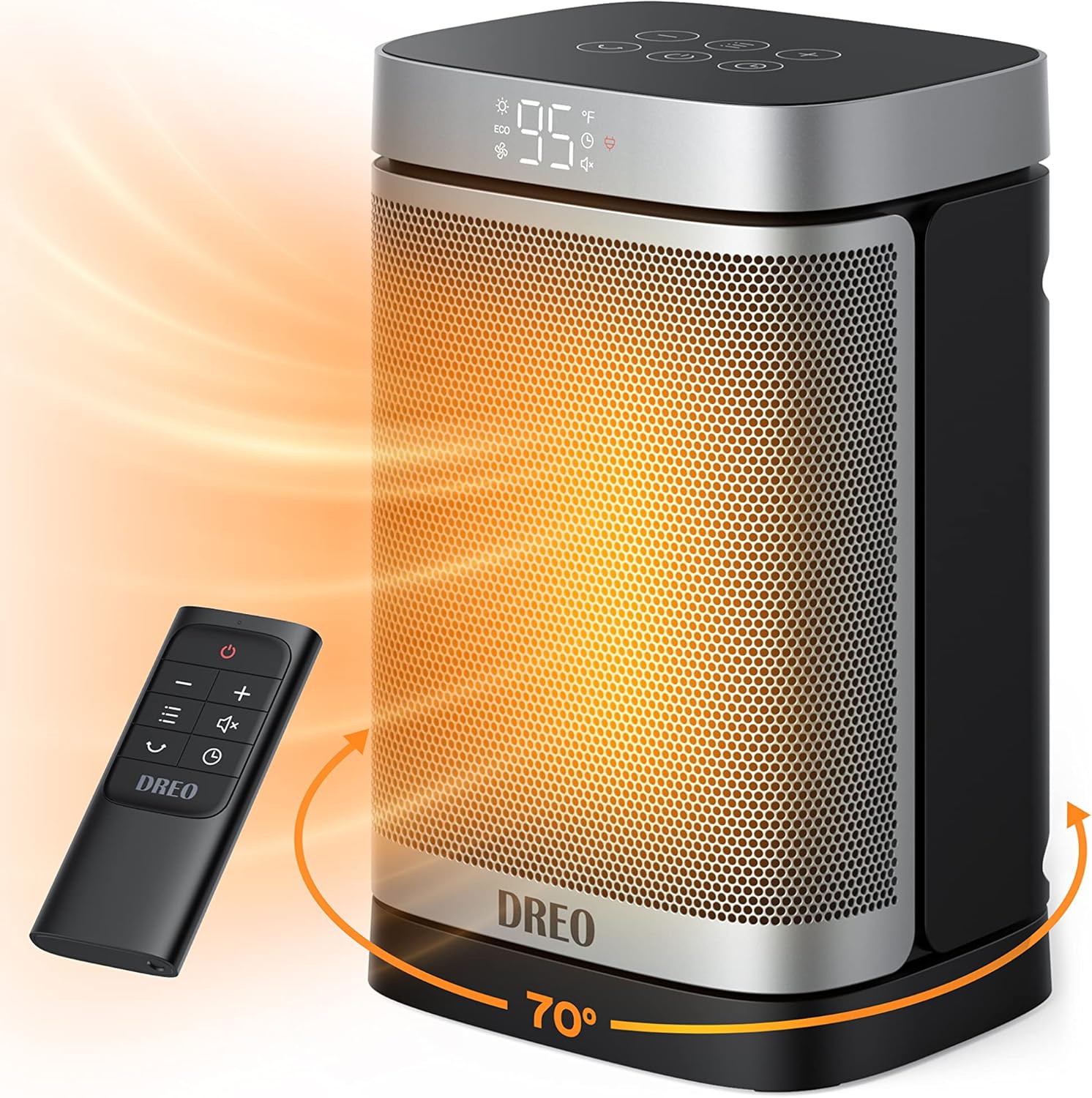
The DREO Atom One is a small tower PTC ceramic heater designed to warm single rooms quickly and quietly. It runs up to 1500 watts and uses a programmable digital thermostat (41 to 95 °F in 1°F steps) so you can set and hold a target temperature without constant adjustment. The unit offers 70° oscillation to spread heat across a room, five fan speeds and an ECO mode that modulates output to save energy. Controls are available on the LED display and via the included remote, and a 1–12 hour timer helps automate runtime. Safety features include tip-over and overheat protection, an enhanced safety plug and flame-retardant materials, plus a detachable filter for basic dust control. It is compact and portable for desks, bedrooms, or small living areas, and the brushless DC motor keeps noise low for nighttime use. The main limitations are its room-size scope—rated for about 200 sq ft—so it is not intended to heat large open areas, and as a 1500W electric heater it will add to running costs during extended use.
Best for: Buyers who prioritize reliable, easy-to-use indoor heating with programmable temperature control and built-in safety features for bedrooms, home offices, or small living spaces.
Less Ideal for: Homes needing to heat large open-plan areas or people seeking a cost‑effective solution for whole-house heating should consider higher-capacity or whole-home options.
- Fast PTC ceramic heating with up to 1500W output for quick warm-up
- Programmable digital thermostat with 1°F increments for precise temperature control
- 70° oscillation and multiple fan speeds to distribute heat across a room
- Built-in safety features including tip-over and overheat protection and flame-retardant materials
- Quiet operation thanks to brushless DC motor and aerodynamic blade design
- Designed for rooms up to about 200 sq ft, so it is not suitable for large or open floor plans
- As a 1500W electric heater it increases energy use during long runtimes
Verdict: A compact, safety‑focused 1500W tower heater that delivers precise, quiet warmth for bedrooms and small rooms.
Choosing the Right Space Heater for Home Use: Key Factors to Consider
Room Size and Heat Output
Match heater wattage and stated coverage to the room you plan to warm. Heaters specify output in watts and often suggest square-foot coverage. In practice, insulation quality, ceiling height, and window area alter how much heat you need. A small bedroom needs far less output than an open-plan living area, so choose a unit whose effective coverage aligns with your typical conditions.
Choosing a heater that is undersized means long run times and limited comfort. Oversized units cycle on and off frequently, which can reduce comfort and may increase wear on controls. Estimate room heat loss roughly and pick a heater that provides a comfortable margin without being oversized for the space.
Safety Features and Certifications
Prioritize heaters with automatic safety cutoffs such as tip-over shutoff and overheat protection. These systems reduce the risk of fire or damage if a heater is knocked over or blocked by curtains or furniture. Look for cool-touch exteriors and stable bases to minimize accidental burns and tipping.
Also check for recognized safety certifications from independent testing organizations. Certified units have undergone basic electrical and fire-safety assessments. Avoid heaters that lack explicit safety mechanisms or that depend solely on external thermostats for protection.
Energy Consumption and Running Cost
Electric heaters convert most input power to heat, but their operating cost depends on wattage and how long they run. Consider variable heat settings, programmable timers, and accurate thermostats to avoid wasting energy. Lower-wattage models can be economical for short-term spot heating, while higher-wattage units are better for quickly warming large rooms but will cost more to run continuously.
Factor in your local electricity rates and typical usage pattern. Using a heater to supplement whole-house heating for targeted times is often more efficient than running a central system at higher temperatures.
Control Options and Thermostat Accuracy
Good controls let you set comfortable temperatures without guesswork. Look for precise digital thermostats, clear temperature readouts, and reliable sensors. Mechanical dials can be fine for simple use but often lack consistent regulation, causing temperature swings.
Additional control features such as programmable timers, eco-modes, and remote control or app integration add convenience and can reduce runtime. If you plan to leave a heater unattended for periods, choose one with secure, tamper-resistant controls and predictable cycling behavior.
Noise and Placement Flexibility
Noise matters when a heater will operate in a bedroom, office, or living area. Fan-forced models can produce a noticeable hum while ceramic and infrared designs are typically quieter. Check expected noise levels if sound sensitivity is important for your household.
Also consider placement constraints. Taller or floor-standing units may need clearances, while compact tabletop models are easier to place but may have lower coverage. Ensure the heater can be positioned safely away from curtains, bedding, and high-traffic areas.
Portability and Storage
If you plan to move the heater between rooms, choose lightweight models with handles and a compact footprint. Portability affects how often you will realistically reposition a unit to target different spaces. Some heaters include caster wheels or integrated handles that make movement effortless.
Also think about storage when the heater is not in use. Slim or stackable designs are easier to stow in a closet. Units with detachable cords or built-in cord wraps reduce clutter and make seasonal storage neater.
Best Heater Types for Different Rooms
Different heater technologies suit different rooms and routines. Convection and fan-forced heaters warm the air quickly and work well in living spaces where you want rapid temperature rise. Infrared models heat objects and people directly and are efficient for spot heating in seating areas. Ceramic heaters often combine quick warm-up with moderate noise and good safety profiles.
When choosing by room, balance how fast you need warmth against noise tolerance and the heater footprint. Bedrooms benefit from quieter models, while bathrooms require units designed for moisture-prone environments and appropriate clearances.
- Convection: steady, whole-room warming
- Fan-forced: fast heat distribution
- Infrared: direct, quiet spot heating
- Ceramic: balanced speed, safety, and size
Placing a Space Heater Safely
Placement directly affects both effectiveness and safety. Position a heater on a flat, stable surface away from flammable materials and high-traffic paths. Maintain the recommended clearances on all sides and avoid placing units under shelves or near curtains.
Do not operate heaters on soft surfaces such as beds or couches, and keep cords tucked to avoid tripping. If you have children or pets, select models with cool-touch surfaces and tip-over shutoffs and place them out of reach when possible.
- Keep at least three feet clearance from combustibles
- Place on solid, level flooring rather than soft surfaces
- Avoid extension cords unless the unit is rated for them
- Unplug when not in use
Maintaining Efficiency and Longevity
Regular maintenance helps a heater perform at peak efficiency and reduces safety risks. Clean dust from vents and grills according to the manufacturer instructions to prevent airflow restriction. Avoid storing the heater in damp or dusty conditions during off-season months.
Inspect the power cord for damage before each season and test safety features periodically. Replacing filters or clearing lint in models that include intake screens will help preserve airflow and heating performance over time.
- Vacuum vents gently to remove dust
- Check cord insulation for cracks or frays
- Store indoors in a dry, clean area
- Test safety cutoffs annually
Using Timers and Thermostats to Cut Cost
Timers and thermostats reduce runtime and energy waste by matching heater operation to your schedule. Program a heater to warm the room before you wake or return home, then drop back to a lower setting while you sleep or are away. Thermostats that hold temperature within a tight range prevent long unnecessary run cycles.
If a heater lacks a built-in timer, consider pairing it with a certified external programmable timer compatible with the unit. Avoid leaving heaters running unattended for long periods even with timers engaged.
- Set schedules to align with daily occupancy patterns
- Use setback temperatures when rooms are unoccupied
- Combine with smart plugs only if the heater and plug are rated for continuous load
Common Mistakes Buyers Make
A frequent mistake is choosing a compact, low-wattage heater for spaces that need sustained output. This leads to chronic underheating and frustration. Another common error is overlooking thermostat accuracy; cheap thermostats can overshoot or undershoot comfort setpoints, wasting energy.
Buyers also sometimes ignore safety certifications or attempt to use extension cords not rated for the heater's current draw. Finally, neglecting noise considerations can make an otherwise adequate heater unsuitable for bedrooms or quiet home offices.
- Do not rely on visual wattage labels alone for coverage estimates
- Avoid non-rated extension cords
- Consider noise ratings for sleep and work areas
How We Chose the Best Space Heater for Home Use
We prioritized devices that deliver safe, consistent heat for typical home rooms and that offer practical controls and manageable running costs. Key evaluation criteria included measured heat output and coverage, verified safety systems such as tip-over and overheat shutoff, thermostat accuracy and control options, energy efficiency during typical use patterns, and noise levels during operation. We also considered build quality, ease of placement and portability, and user-facing features like timers and adjustable thermostats. We excluded models designed only for industrial, outdoor, or workshop use and any units lacking basic safety cutoff features. We filtered out heaters that require specialized installation or that rely on unregulated fuel sources. Final selections emphasize dependable electric heaters that match common home power constraints and produce usable heat quickly while minimizing risk and ongoing operating expense.
Our full evaluation process is outlined in our review methodology.
FAQ
Are electric space heaters safe to leave on overnight?
It depends on the model and safety features. Units with tip-over and overheat shutoffs and cool-touch exteriors are safer, but it is still best practice to use timers or thermostats and avoid leaving any heater unattended for extended periods.
How do I size a heater for my room?
Estimate your room square footage and consider insulation and ceiling height. A general rule is to pick a heater whose output matches the room's heat loss—higher-wattage units for larger or poorly insulated rooms and lower-wattage units for small, well-insulated spaces.
Can I use a space heater in a bathroom?
Only use heaters rated for bathroom or damp locations. These models include protections against moisture and have placement guidelines. Avoid using standard room heaters where they may be exposed to splashes or very high humidity.
Do infrared heaters save energy compared with fan heaters?
Infrared heaters can be more efficient for spot heating since they warm objects directly, reducing the need to heat the entire room. For whole-room heating, fan or convection units may distribute warmth more evenly, depending on the space.
Is it okay to run a space heater on a power strip?
No. Most manufacturers advise plugging heaters directly into a wall outlet because power strips and extension cords can overheat under high current draw. If you must use an extension, choose one rated for the heater's amperage and follow safety guidance.
Final Verdict
When choosing a space heater for home use, prioritize proven safety features, appropriate heat output for your room, and accurate control options that prevent wasted runtime. Balance speed of heat delivery against noise tolerance and portability needs. Focus on models that match your daily schedule and placement constraints to get reliable comfort without unnecessary cost or risk. The best choice depends on where and how you will use the heater. Use the factors outlined here to narrow options and pick a unit that delivers safe, efficient warmth for your living spaces.