
Note: This article contains affiliate links. If you click on these links and make a purchase, we may earn a small commission at no extra cost to you. This helps support our research and content. Read our full affiliate disclosure here.
If you need dependable heating for a tall, open room, a standard portable heater may not cut it. Rooms with high ceilings lose warm air upward and require devices that deliver higher sustained output, good vertical and horizontal distribution, and sensible safety features. This guide shortlists six top space heaters for large rooms with high ceilings and explains why each type can work in that use case. We evaluated candidate heaters for steady heat output, airflow and coverage, safety, and running cost to help you pick an option suited to your room layout and usage patterns. Below are our top picks followed by practical buying guidance and answers to common questions.
Top Picks at a Glance
| Best Overall The best all-around choice for most situations | Lasko Ceramic Tower Heater 751320 |  |
| Best Quality Built to a higher standard if you want something more solid | EdenPURE CopperPLUS Infrared Heater 1500W |  |
| Best Budget The cheapest option that still gets the job done reliably | WINHL PTC-SL1703 Tower Heater |  |
| Top Rated A top-rated pick with lots of positive feedback | Dr. Infrared Heater DR-968 |  |
| Most Popular A crowd favorite that many people choose with confidence | DREO Solaris Max 25" Tower Heater | 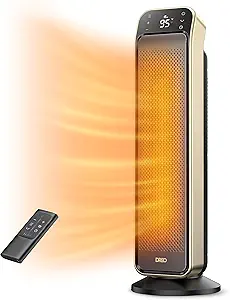 |
| Best Seller A high-volume bestseller chosen again and again | DREO Heater 319 |  |
Lasko Ceramic Tower Heater 751320

| Heat Output | 1500 watts |
|---|---|
| Heating Coverage | 150 |
| Heating Element | Ceramic |
| Power Source | Corded Electric |
| Voltage | 110 volts |
The Lasko Ceramic Tower Heater 751320 uses a 1500-watt ceramic element and widespread oscillation to move warm air through small to medium rooms. It runs from a digital control panel or the included multi-function remote and offers two heat settings plus an adjustable electronic thermostat and a programmable auto-off timer for set-and-forget comfort. The slim, upright tower and built-in carry handle make it easy to position on the floor where you need targeted warmth, and safety features such as overheat protection and cool-touch housing add peace of mind during longer runs. In practice it provides quick, focused warmth and the oscillation helps smooth temperature across a room, but a 1500-watt ceramic heater is limited when trying to heat very large spaces or rooms with very high ceilings, so you may need supplemental heat for those conditions. Controls are straightforward and the remote stores on-board, though advanced features like child lock or tip-over switch are not present on this model.
Best for: Buyers who want a straightforward, portable tower heater for spot heating or improving comfort in small to medium rooms and who value simple controls and safety features.
Less Ideal for: Those needing primary heat for very large open rooms or rooms with high ceilings should consider higher-capacity or whole-room heating solutions instead.
- 1500W ceramic element provides fast, direct warmth
- Widespread oscillation helps distribute heat more evenly across a room
- Electronic thermostat and 7-hour timer allow simple temperature scheduling
- Includes multi-function remote with on-board storage for easy control
- Slim portable tower with built-in handle fits into tight floor space
- 1500 watts may be insufficient alone for very large rooms with high ceilings
- Only two heat settings limits fine-grained power control compared with multi-stage heaters
Verdict: A reliable, easy-to-use 1500W ceramic tower that’s a solid choice for targeted heating in small to medium rooms.
EdenPURE CopperPLUS Infrared Heater 1500W

| Power modes | 1000W/1500W |
|---|---|
| Heating coverage | 1000 square feet |
| Heat output | 5000 BTU |
| Number of settings | 24 |
| Temperature range | 40 °F to 90 °F |
The EdenPURE CopperPLUS is a portable infrared zone heater built to heat large living spaces without ductwork. It uses a copper PTC element and claims improved heat transfer to deliver steady radiant warmth across rooms up to about 1,000 sq ft while drawing up to 1500 watts on high. Controls are flexible: a wireless remote plus 24 preset heat levels and a wide temperature range let you fine tune comfort from 40 to 90°F, and an auto memory restores your last setting. Practical design touches include a washable lifetime filter, rolling casters for room-to-room mobility, a 6-foot cord with wrap, and whisper-quiet operation for bedrooms or offices. Safety is emphasized with cETL approval, dual overheat sensors, tip-over shutoff, and a cool-touch grill. Expect the best performance when used as a zone heater for large open areas or high-ceiling rooms where radiant heat can be directed at occupied zones; it is less effective as a whole-house replacement and consumes full-line power at high output. The unit balances strong heating performance and safety with the convenience features buyers expect for extended indoor use.
Best for: Buyers who need a high-performance zone heater to warm large rooms or high-ceiling spaces efficiently and value precise temperature control and safety features.
Less Ideal for: People seeking a low-power supplemental heater for very small rooms or those wanting a permanent whole-house heating solution should consider other options.
- Copper PTC element designed for efficient radiant heat transfer
- 1500W high mode with 24 precise heat settings and wide 40–90°F setpoint range
- Comprehensive safety features including dual overheat sensors and tip-over shutoff
- Washable lifetime filter eliminates replacement costs and reduces maintenance
- Portable cabinet with rolling casters and a wireless remote for easy zone heating
- 1500W power draw means high energy use when run on top setting
- Not intended to replace whole-home heating systems for consistent central warmth
Verdict: Choose this unit if you want a powerful, safety-focused infrared zone heater that delivers adjustable, efficient warmth for large rooms and high ceilings.
WINHL PTC-SL1703 Tower Heater
| Heat Output | 1500 watts |
|---|---|
| Power Levels | 700W / 1000W / 1500W |
| Number of Speeds | 3 |
| Voltage | 120 volts |
| Max Temperature Setting | 40 °C |
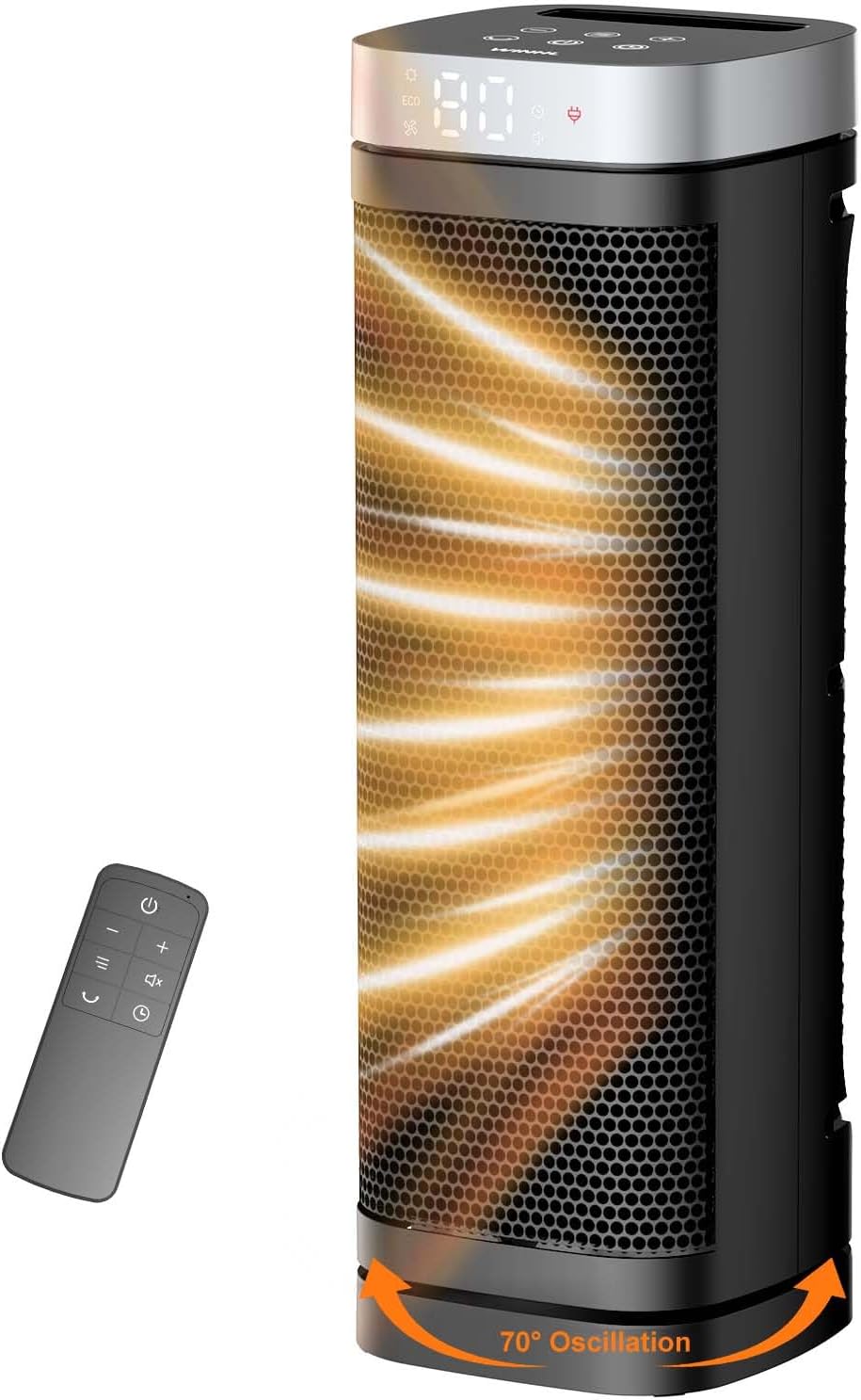
This compact WINHL tower heater uses PTC ceramic elements and a built-in fan to deliver quick, even heat for small to medium indoor spaces. It offers three power settings (700W, 1000W, 1500W), a smart thermostat that modulates output to match room temperature, 70 degree oscillation to spread warmth, and a 12 hour timer plus remote control for convenient operation. Safety features include tip-over protection, overheat auto shutoff, V0 flame-retardant materials and an ETL-style safety claim, which make it suitable for bedroom or office use where space and safety matter. In practice the unit heats up fast and the oscillation helps distribute air, but at 1500W a single unit struggles to maintain comfortable temperatures in very large rooms or rooms with high ceilings; it is best used as a supplemental or primary heater for smaller zones. The plastic tower design is lightweight and easy to move, though buyers looking for whole-room heating in open, high-ceiling spaces should expect to need multiple units or a higher-capacity system.
Best for: Buyers seeking an affordable, portable heater to warm bedrooms, offices, or small-to-medium zones who prioritize quick heat, safety features and simple remote/timer control.
Less Ideal for: Homes that need a single heater to warm large open rooms or spaces with high ceilings, or buyers wanting whole-room heating without using additional units.
- Fast PTC ceramic heating with fan speeds for quick warmth
- Three power levels (700W, 1000W, 1500W) to match comfort and energy use
- Remote control and 12-hour timer for convenient, hands-off operation
- Multiple safety protections including tip-over and overheat shutoff
- 1500W output is modest for very large rooms or spaces with high ceilings
- Compact tower form may not move as much warm air as larger fan-forced heaters
Verdict: A budget-friendly portable ceramic tower that delivers quick, safe heat for small to medium spaces but is best used as supplemental heating in very large rooms.
Dr. Infrared Heater DR-968

| Power | 1500 Watts |
|---|---|
| Heating Coverage | 576 square feet |
| Number of Speeds | 3 |
| Voltage | 120 |
| Thermostat Range | 50–85 °F |
The Dr. Infrared Heater DR-968 combines an infrared quartz tube with a PTC element and a high-velocity low-noise blower to warm large rooms quickly while using a standard 1500-watt input. Typical use is freestanding in living rooms, home offices, or bedrooms where you need fast, radiated warmth; the electronic thermostat and Auto mode let the unit cycle between high and low power to hold a set temperature without constant adjustments. It includes caster wheels, a remote, a 12-hour timer, tip-over and overheat protection, and a lifetime filter, which all make day-to-day operation simple and low-effort. The unit is UL certified and claims wider heat spread than many simple convection heaters because it heats objects as well as air, so rooms feel comfortable faster and with less dry heat. Trade-offs are the standard 1500W power limit, which constrains absolute output in very large or high-ceiling spaces, and the heater's 19-pound weight which makes repositioning less convenient despite wheels.
Best for: Buyers who prioritize a reliable, safety-certified heater that delivers fast, even warmth and minimal fuss for large indoor rooms where steady, controllable heat matters more than maximum raw output.
Less Ideal for: People needing to heat very large open spaces or rooms with very high ceilings where multiple higher-wattage units or permanent HVAC solutions are more appropriate.
- Dual heating system (infrared quartz + PTC) for faster, more even warmth
- Electronic thermostat with Auto mode and timer for hands-off temperature control
- UL certified safety features including tip-over and overheat protection
- Remote control and caster wheels for convenient operation and placement
- High-velocity low-noise blower for broader heat distribution with minimal sound
- 1500-watt maximum limits raw output for very large rooms or high ceilings
- Relatively heavy at 19 pounds, so moving without rolling can be awkward
Verdict: A dependable, safety-focused 1500W infrared heater that heats large rooms quickly and maintains set temperatures with hands-off Auto mode.
DREO Solaris Max 25" Tower Heater

| Heat Output | 1500 watts |
|---|---|
| Heating Element | PTC Ceramic |
| Heating Coverage | 100-270 sq.ft. |
| Oscillation | 70° |
| Temperature Range | 41-95 °F |
The DREO Solaris Max is a tower-style electric space heater built to move heat across larger rooms. It uses a PTC ceramic element and an extended impeller to deliver up to 1500 watts of forced-air heat and a claimed effective coverage of roughly 100 to 270 square feet, with 70 degree oscillation to spread warmth. Controls include a digital thermostat adjustable in 1°F increments from 41 to 95°F, three manual heat speeds plus ECO mode, a 1–12 hour timer, and a remote for convenient adjustments from across the room. The unit emphasizes quiet operation, with a reported sound level as low as 25 dB, and multiple built-in safety measures including tip-over and overheat protection, reinforced plug, and a child lock. Practical benefits are precise temperature control, broad room coverage via oscillation, and a low-noise profile suited for bedrooms or home offices. Note that it is a plug-in electric heater limited to wall outlet power and the effectiveness in very large or tall rooms will depend on room volume and insulation rather than the heater alone.
Best for: Buyers who prioritize proven performance and safety when heating larger indoor rooms and who want a quiet, thermostat-controlled heater with remote and oscillation for even warmth.
Less Ideal for: Those needing whole-house or high-volume heating for very large open spaces or garages should consider higher-capacity or hardwired systems instead.
- PTC ceramic element with forced-air design for fast, even heating
- 70° oscillation and extended impeller to distribute heat across larger floor plans
- Digital thermostat with 1°F increments and ECO mode for precise temperature control and energy-conscious operation
- Quiet operation down to ~25 dB, suitable for bedrooms or offices
- Multiple safety features including ETL-listed overheat protection, tip-over protection, reinforced plug, and child lock
- Performance is constrained by being a single 1500W plug-in heater, so very large or high-ceilinged rooms may need supplemental heating
- Corded outlet power limits placement options around the room
Verdict: A quiet, safety-focused 1500W tower heater that gives precise thermostat control and wide oscillation to heat large rooms effectively.
DREO Heater 319

| Heat Output | 1500 watts |
|---|---|
| Heating Coverage | 200 sq.ft. |
| Heating Element | PTC FAN Heater |
| Number of Speeds | 5 |
| Min-Max Temp | 41 °F – 95 °F |
The DREO Heater 319 is a portable 1500W PTC forced-air tower heater aimed at quickly warming indoor rooms and improving air circulation with a 70° oscillation mode. It is typically used on a tabletop or floor to heat living rooms, bedrooms, or home offices and offers five fan speeds, an adjustable thermostat (41 to 95°F in 1°F increments), and a 12-hour timer for scheduled use. Notable features include a brushless DC motor and winglet fan for quieter operation (reported as low as 34 dB), an included remote control, and multiple built-in safety protections such as tip-over cutoff, overheat protection, child lock, flame-retardant material, and an ETL-listed safety plug. In practice it delivers fast, directed warmth and the oscillation helps spread heat across a room; the precise thermostat can reduce cycling and energy waste. Important limitations are its stated 200 sq ft coverage, which means it may struggle to fully heat very large rooms with high ceilings, and as a forced-air heater it moves air rather than providing long-lasting radiant warmth like oil-filled units.
Best for: Buyers who prioritize fast, controllable heating and multiple safety protections for everyday indoor spaces and want a quiet, programmable unit for bedrooms or home offices.
Less Ideal for: Homes that need a primary heater for very large open rooms with high ceilings or for users who prefer slow, radiant heat that retains warmth after shutdown.
- 1500W PTC fan delivers quick, forced-air heat for fast warm-up
- 70° oscillation helps distribute heat across a room
- Quiet brushless DC motor design suitable for bedrooms and offices
- Comprehensive safety package including tip-over and overheat protection and child lock
- Precise thermostat with 1°F increments and 12-hour timer for controlled comfort
- Coverage listed at about 200 sq ft, so not ideal as the sole heater for very large rooms with high ceilings
- Forced-air design provides active airflow rather than steady radiant heat
Verdict: Choose the DREO Heater 319 if you want a quiet, safety-focused 1500W heater that heats quickly and offers precise thermostat control for medium-sized rooms.
Choosing the Right Space Heater for Large Rooms with High Ceilings: Key Factors to Consider
Heat Output and Continuous Power
Large rooms with high ceilings require heaters rated to deliver higher continuous output than a small-space unit. Check the heater's maximum wattage and whether it supports multi-stage operation or thermostatic control to maintain steady room temperature without running flat-out.
Pay attention to the sustained output rather than short bursts. A higher continuous rating helps offset the upward migration of warm air in tall spaces and reduces the time the unit must run at full power, which can prolong service life and reduce strain on internal components.
Airflow Design and Heat Distribution
How a heater moves air is as important as how much heat it produces. Fan-assisted convection, directional ceramic elements, or built-in oscillation help mix warm air down from the ceiling level and spread heat laterally across the room.
A unit that concentrates heat in a narrow beam may feel warm nearby but will not solve temperature stratification in a large, tall room. Look for adjustable louvers, oscillation, or compatibility with your room's existing circulation patterns to improve overall comfort.
Thermostatic Control and Zoning
Precise temperature control reduces wasted energy and avoids overheating zones near the heater. A reliable thermostat lets the device cycle at lower power levels once the set temperature is reached, which is more efficient in large-volume spaces.
Consider whether you need programmable schedules or remote control to manage heating during occupied and unoccupied periods. In open-plan rooms, combining a heater with localized zoning strategies—close doors, use ceiling fans on low reverse to push heat down—can improve effectiveness.
Safety Features for Prolonged Use
Long run times and placement in busy living spaces raise the importance of robust safety features. Look for tip-over shutoff, overheat protection, cool-touch housing, and clear instructions about clearance from combustibles.
If the heater will be used overnight or in family areas, additional safeguards like child-resistant controls and automatic shutoff timers add peace of mind. Durable build quality and reliable electrical connections reduce fire risk during extended operation.
Efficiency and Operating Cost
Higher output heaters generally draw more power, so compare effectiveness per watt rather than raw wattage alone. A model with staged heat settings or an efficient convection process may reach comfort with lower average energy use.
Factor in how often you will run the heater, the thermostat setpoint you expect to maintain, and whether supplemental strategies such as insulating windows and using rugs will reduce runtime and operating cost.
Placement, Portability, and Noise
Where you place the heater affects performance in a high-ceiling room. Elevating a fan-assisted unit or positioning it near seating and traffic patterns helps distribute warmth. Portability makes it easier to move the heater to the zone you occupy most.
Noise matters in living rooms and bedrooms. Fan-driven units typically produce more sound than radiant or oil-filled convectors. Balance the need for airflow with acceptable noise levels for your intended use.
How Ceiling Height Changes Heating Needs
Ceiling height increases room volume and creates a greater vertical temperature gradient. Warm air naturally rises, so without adequate mixing a heater may warm the upper layers while the occupied zone remains cool. That means a higher-capacity heater or one designed to promote downward circulation is often required.
Strategies to address this include selecting units with strong airflow, using oscillation to spread heat, or combining the heater with ceiling fans set on low reverse to push warm air downward. Understanding how heat stratifies in your space will help you position and choose a heater that actually raises comfort where you sit or sleep.
- High ceilings increase the effective cubic feet to heat.
- Vertical stratification makes local heat distribution essential.
- Circulation strategies reduce runtime and improve comfort.
Types of Heaters That Work Best in Tall Rooms
Fan-assisted convection heaters and units with directional ceramic elements are often more effective at moving warm air downward and across the room. Radiant heaters can be useful for spot heating but may not maintain ambient temperature in large volumes unless paired with circulation.
Oil-filled convectors provide gentle, long-lasting heat with low noise, but they rely on room circulation to distribute warmth. If you choose a convector for a high-ceiling room, combine it with fans or pick a model with a higher rated coverage area.
- Fan-assisted heaters: better mixing and faster warm-up.
- Radiant spot heaters: immediate warmth for occupied zones.
- Oil-filled convectors: quiet, steady heat but slower distribution.
Placement Tips for Maximum Effectiveness
Place the heater where it can circulate air toward the occupied area rather than tucked away by a wall. Angling a directional unit slightly upward can help the airstream reach higher layers where it will then descend into the living zone. Avoid placing heaters directly under shelves or against drapery that could block airflow.
Consider the relationship with existing HVAC and ventilation. Using a heater in concert with a low-speed ceiling fan set to pull warm air down can dramatically improve perceived warmth and reduce the heater's runtime.
- Position for unobstructed airflow toward seating areas.
- Combine with low-speed ceiling fan to reduce stratification.
- Keep required clearances from combustibles and follow safety guidance.
Managing Noise, Aesthetics, and Living Comfort
Noise level and the unit's visual presence can affect where you are willing to run it for extended periods. Fan units provide performance but can be audible, so choose quieter models or run them intermittently in noise-sensitive situations such as evening TV or sleep.
Aesthetics and footprint matter in open-plan living areas. Slim-profile convectors or portable units with integrated handles are easier to tuck away when not in use. Think about cord length and whether the unit's location will require an extension that could introduce a trip hazard.
- Balance airflow needs against acceptable noise levels.
- Think about visual integration and footprint in open rooms.
- Verify cord placement and avoid extension-cord hazards.
Seasonal Use and Maintenance
Regular maintenance keeps a heater operating safely and efficiently. Clean intake and outlet grilles to prevent dust buildup that reduces airflow and can cause overheating. For fan-assisted models, occasional dusting of blades or mesh will sustain performance.
Plan for seasonal storage if you do not run the heater year-round. Ensure it is cooled, cleaned, and stored in a dry place. Follow manufacturer guidelines for filter replacement or professional service for longer-lived units.
- Keep grilles and fans free of dust for efficient airflow.
- Inspect cords and plugs for wear before each season.
- Store in a dry, ventilated area when not in use.
How We Chose the Best Space Heater for Large Rooms with High Ceilings
We focused on concrete, measurable attributes that matter for heating large, tall rooms. Primary evaluation criteria included continuous heat output and effective coverage area to ensure a heater can maintain comfortable temperatures despite heat stratification. We checked airflow design and heat distribution features such as oscillation, fan-assisted convection, or directional elements because tall rooms need vertical and horizontal circulation. Safety and reliability were weighed heavily, including tip-over protection, overheat cutoff, and durable construction suitable for extended use. Energy efficiency and operating cost were considered by looking at power draw, available thermostatic control, and multi-stage heating to avoid wasteful full-power operation. Noise and usability factors such as controls, programmability, and portability were also evaluated for real-world living environments. Products that lacked adequate continuous output for rooms larger than standard living spaces, or that offered no means to improve circulation, were excluded. We prioritized units that balance raw heating ability with features that address heat loss to ceiling height and open volume.
Our full evaluation process is outlined in our review methodology.
FAQ
How do I estimate the heater size needed for a room with high ceilings?
Estimate based on cubic footage rather than square footage. Multiply room length by width by ceiling height to get cubic feet, then choose a heater rated for the larger volume or use a unit with higher continuous output and good airflow. Manufacturers sometimes provide coverage guidance for standard ceiling heights, so increase capacity for taller rooms.
Will a ceiling fan help my space heater be more effective?
Yes. Running a ceiling fan on low with the blade direction set to push warm air down helps break up stratification. This lowers the heater workload and can make the occupied zone noticeably warmer without increasing the heater's power draw.
Are radiant heaters effective in rooms with high ceilings?
Radiant heaters provide immediate warmth to people and objects in their line of sight but do not heat air volume efficiently. They are best used for targeted spot heating in conjunction with a circulation strategy if you need to maintain ambient temperature across a tall room.
How can I keep operating costs down when heating a large, tall room?
Use a heater with a reliable thermostat and staged heat settings so it does not run at full power continuously. Improve room insulation, use rugs and curtains to reduce heat loss, and employ fans to improve distribution so the heater reaches comfort sooner and cycles less frequently.
What safety precautions should I follow when using a heater for long periods?
Give the heater proper clearance from furniture and drapery, use units with tip-over and overheat protection, avoid running extension cords, and regularly inspect the cord and plug. If you plan overnight use, prefer models with proven automatic shutoff features and cool-touch exteriors.
Final Verdict
For large rooms with high ceilings, prioritize heaters that combine strong continuous output with features that improve air distribution. A unit that moves warm air effectively, offers reliable thermostatic control, and includes solid safety protections will perform better than a higher-wattage device that does not circulate heat. Balance noise, placement, and operating cost against required coverage. With the right combination of capacity and airflow strategy, you can achieve comfortable, even warmth in tall spaces without unnecessary runtime or safety compromises.