
Note: This article contains affiliate links. If you click on these links and make a purchase, we may earn a small commission at no extra cost to you. This helps support our research and content. Read our full affiliate disclosure here.
If you want one appliance that can toast, roast, and also dry fruit or make jerky, a toaster oven with a dehydrator function can save counter space and expand what you cook at home. Choosing the right model matters because dehydration needs low, steady heat and reliable airflow to produce safe, uniformly dried results without overheating or long waits. This guide shortlists the top toaster ovens that include a dehydrator setting and evaluates them on temperature control, airflow, and usable capacity. Read on for the practical criteria we used and clear pointers to help you pick the best fit for your kitchen and drying projects.
Top Picks at a Glance
| Best Overall The best all-around choice for most situations | Ninja Flip Toaster Oven & Air Fryer SP151 |  |
| Best Quality Built to a higher standard if you want something more solid | Breville Smart Oven Air Fryer Pro BOV900BSS |  |
| Best Value The sweet spot between price and what you get | TOSHIBA ChefFry Toaster Oven 25L |  |
| Best Budget The cheapest option that still gets the job done reliably | Chefman Digital Air Fryer 10-Quart | 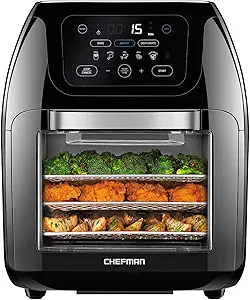 |
| Top Rated A top-rated pick with lots of positive feedback | Typhur Sync Oven CV03 |  |
| Most Popular A crowd favorite that many people choose with confidence | Emeril 26QT French Door Air Fryer Oven |  |
Ninja Flip Toaster Oven & Air Fryer SP151
| Wattage | 1800 watts |
|---|---|
| Temperature Range | 85-450 °F |
| Control Type | Button Control |
| Power Source | Corded Electric |
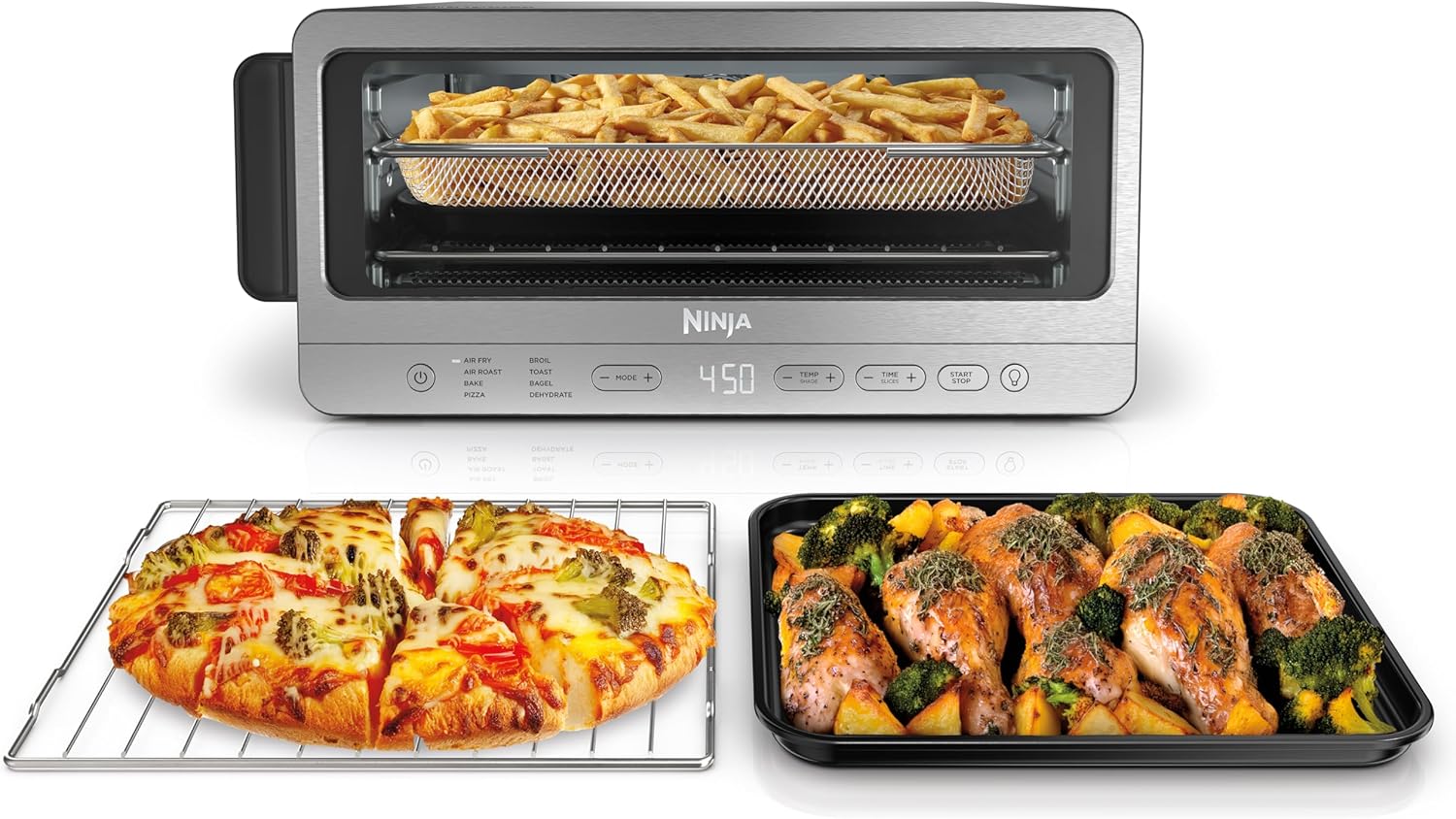
The Ninja Flip SP151 combines an air fryer and toaster oven in one unit that flips up for vertical storage to free counter space. It covers eight functions including air fry, roast, bake, broil, toast, bagel, pizza, and dehydrate, and uses infrared plus rapid circulating air for quicker, more even results. The extra-large interior handles family-size meals or a 12-inch pizza, while included accessories like the air fry basket, sheet pan, and wire rack make it ready to use out of the box. Controls are button-based and the oven runs at up to 1800 watts with a wide 85 to 450 F temperature range for flexible cooking. The flip-up design is especially helpful in small kitchens because the unit stores vertically against a backsplash when not in use. Trade-offs are typical for multifunction countertop ovens: it is larger than a single-purpose air fryer and draws significant power during use, and the stainless steel exterior will show fingerprints. For buyers who value versatility and reclaiming counter space without sacrificing performance, the Ninja Flip is a practical, well-equipped option.
Best for: Buyers who want a reliable all-in-one countertop oven that saves counter space and replaces several appliances with a single, easy-to-use unit.
Less Ideal for: People who need an ultra-compact, low-power single-serving air fryer or those who prioritize the smallest possible footprint over multifunction capability.
- Flip-up design stores vertically to free up countertop space
- Eight cooking functions combine multiple appliances into one
- OvenCrisp infrared plus convection circulation for faster, even cooking
- Includes air fry basket, sheet pan, wire rack, and removable crumb tray
- Higher power draw at 1800 watts compared with smaller single-purpose air fryers
- Larger footprint and capacity may be more than needed for a single person
Verdict: A versatile, space-saving air fryer toaster oven that replaces multiple appliances while tucking away vertically for smaller kitchens.
Breville Smart Oven Air Fryer Pro BOV900BSS

| Wattage | 1800 watts |
|---|---|
| Control Type | Knob Control |
| Power Source | Corded Electric |
| Temperature Range | 80-480 °F |
| Capacity | 1 cubic feet |
The Breville Smart Oven Air Fryer Pro is a countertop convection oven that combines a large interior with dedicated air-fry and dehydrate modes for versatile cooking. It uses the Element iQ system with five quartz heating elements and a two-speed convection fan to direct heat precisely, which helps reduce cook times and deliver more even browning. Typical uses include toasting, roasting a whole turkey, baking cookies or pizza, air frying fries, and dehydrating multiple trays at once; the oven accepts 9×13 pans and can hold up to four dehydration trays. Controls are a mix of knobs and an LCD display, and the oven includes useful accessories such as racks, a roasting pan, pizza pan, and a mesh basket. Practical benefits are consistent results from the smart heating algorithm, large capacity that replaces several appliances, and versatile presets that simplify common tasks. Trade-offs are the unit's substantial countertop footprint and 1800 W power draw, which require ample space and a dedicated outlet, and the learning curve for dialing in custom times and temperatures compared with simpler toaster ovens.
Best for: Buyers who prioritize high-performance cooking and want one countertop appliance to handle roasting, baking, air frying, and dehydrating for family-sized meals.
Less Ideal for: Those with very small kitchens, limited counter space, or who need a lightweight travel-friendly toaster oven should consider smaller models instead.
- Element iQ system with 5 quartz elements for even, targeted heating
- Super convection fan with two speeds for faster, crispier air frying
- Large 1 cubic foot interior fits 9 slices of toast, a 14 lb turkey, or 9×13 pans
- Includes multiple accessories: pizza pan, roasting pan, racks, and mesh basket for dehydrating/air frying
- 13 preset cooking functions plus LCD for easy selection and monitoring
- Large footprint and heavy unit that requires significant counter space
- High power draw (1800 W) may limit simultaneous use with other heavy appliances
Verdict: Choose this oven if you want a high-performance, large-capacity countertop unit that reliably air fries, roasts, bakes, and dehydrates with precise, convection-driven results.
TOSHIBA ChefFry Toaster Oven 25L

| Capacity | 26.4 liters |
|---|---|
| Wattage | 1500 watts |
| Temperature Range | 150-450 °F |
| Control Type | Button Control |
| Number of Shelves | 2 |
The TOSHIBA ChefFry is a versatile countertop oven that combines air frying, baking, toasting and dehydrating in one unit. You use the digital controls to set temperature in 5°F steps and time in 1‑minute increments across a 150–450°F range, which makes it straightforward to dry herbs or fruit on the dehydrate setting or crisp wings with little oil on air fry. The 26.4‑quart cavity fits six slices of toast, a 12‑inch pizza or a small whole chicken and includes a baking tray, rack, air‑fry basket and crumb tray so you can switch between modes without extra purchases. A nonstick interior and removable crumb tray simplify cleanup after sticky dehydrated batches, and two shelf positions add layout flexibility. At 1500 watts it heats quickly but will draw significant power compared with smaller toaster ovens, and the footprint is still substantial for very tight counters. Controls are button based rather than a full touchscreen, which keeps operation simple but less modern than some higher end models.
Best for: Buyers who want one appliance to replace an air fryer, toaster oven and dehydrator for everyday family cooking and value precise temperature control and included accessories.
Less Ideal for: Those with very limited counter space or who prioritize touchscreen or smart home connectivity should look elsewhere.
- Multiple cooking modes including a dedicated dehydrate function for herbs and fruit
- Digital precision controls with 5°F temperature and 1‑minute time increments
- Includes air fry basket, baking tray, rack and removable crumb tray for easy setup and cleanup
- Large 26.4‑quart interior fits a 12‑inch pizza or a whole small chicken
- 1500W power draw may be high for some kitchens or circuits
- Button control interface is basic compared with some touch or app‑enabled ovens
Verdict: Choose this ChefFry oven if you want a single, family‑sized countertop unit that reliably air fries and dehydrates with precise temperature control.
Chefman Digital Air Fryer 10-Quart
| Capacity | 10 quarts |
|---|---|
| Wattage | 1700 watts |
| Max Temperature | 400 °F |
| Control Method | Touch |
| Material | Stainless Steel |
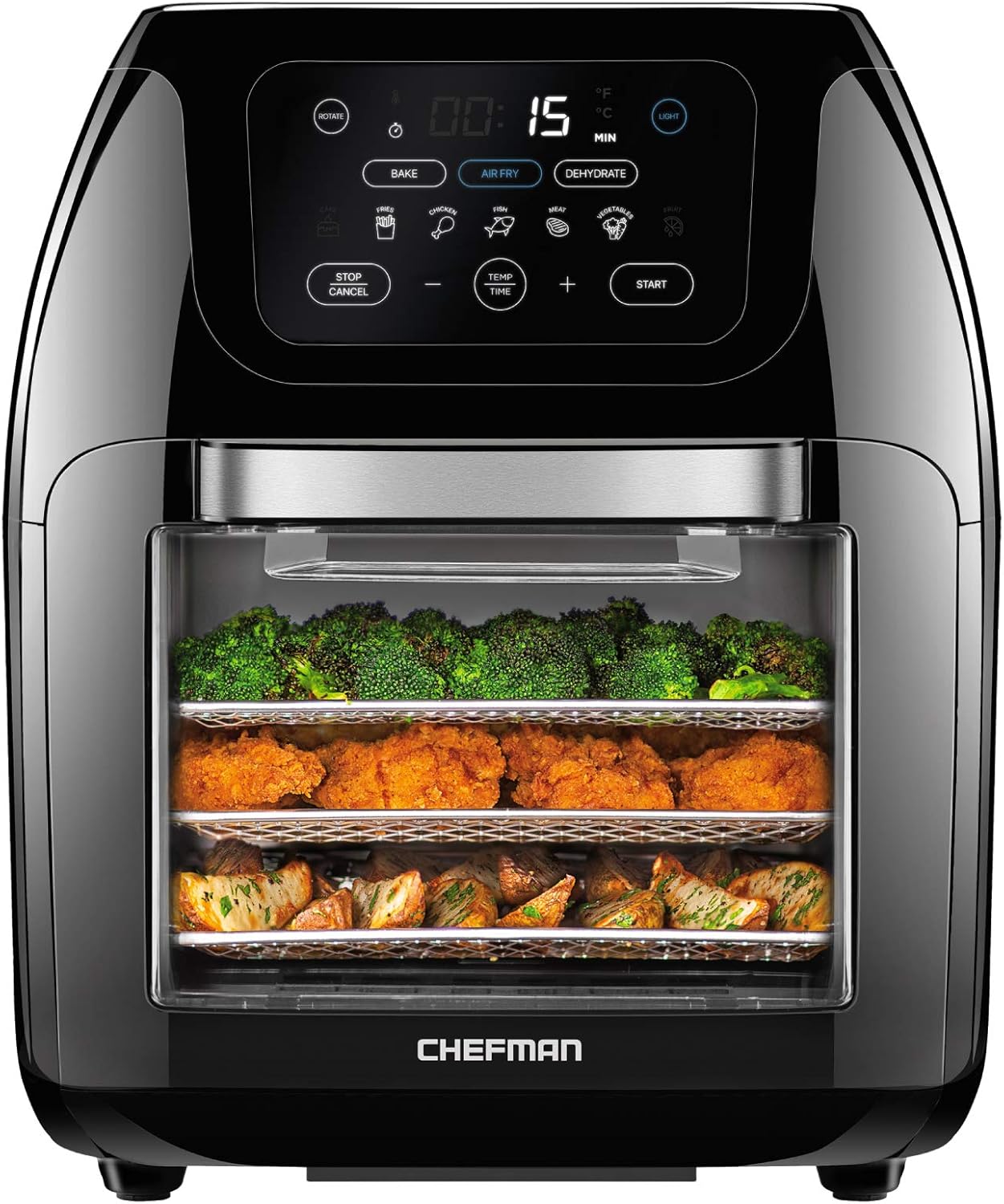
The Chefman Digital Air Fryer is an all-in-one countertop oven that combines air frying, rotisserie, dehydrating and convection baking in a single unit designed for family-size cooking. It uses a 1700-watt rapid air heating system and a capacitive touch control panel with 17 presets to simplify common tasks like fries, roast and dehydrate, and its interior light plus large viewing window make it easy to check progress without opening the door. The unit ships with three airflow racks, a stainless steel rotisserie spit and a drip tray, and many removable parts are dishwasher-safe for easier cleanup. Because it reaches up to 400°F and omits long preheats, it cooks faster than a conventional oven for many recipes, but its 14.2 pound weight and 12 by 15 inch footprint mean it needs a dedicated counter spot. The sizable capacity and included rotisserie hardware make it useful for feeding multiple people or batch meal prep, while buyers who need a compact or lightweight travel option should consider slimmer models instead.
Best for: Buyers on a budget who want a single appliance that replaces several countertop ovens and can handle family-size meals and rotisserie cooking without extra accessories.
Less Ideal for: Those with very limited counter space or who prioritize a compact, lightweight travel-friendly air fryer should look at smaller models.
- Multifunction design combines air fry, roast, rotisserie and dehydrate in one appliance
- 1700-watt rapid air system for faster cooking and high 400°F max temperature
- Includes rotisserie spit, three airflow racks and drip tray for versatile cooking setups
- Capacitive touch controls with 17 presets simplify common recipes
- Removable parts are dishwasher-safe for easier cleanup
- Relatively large footprint and weight require permanent counter space
- Not the best choice if you need a lightweight or very compact unit for small kitchens
Verdict: If you want an affordable, family-size air fryer with built-in rotisserie and many presets, this Chefman unit delivers strong multifunction value.
Typhur Sync Oven CV03
| Capacity | 27 quarts |
|---|---|
| Wattage | 1750 watts |
| Control Type | App Control |
| Temperature Range | 85-450°F |
| Number of Shelves | 3 |
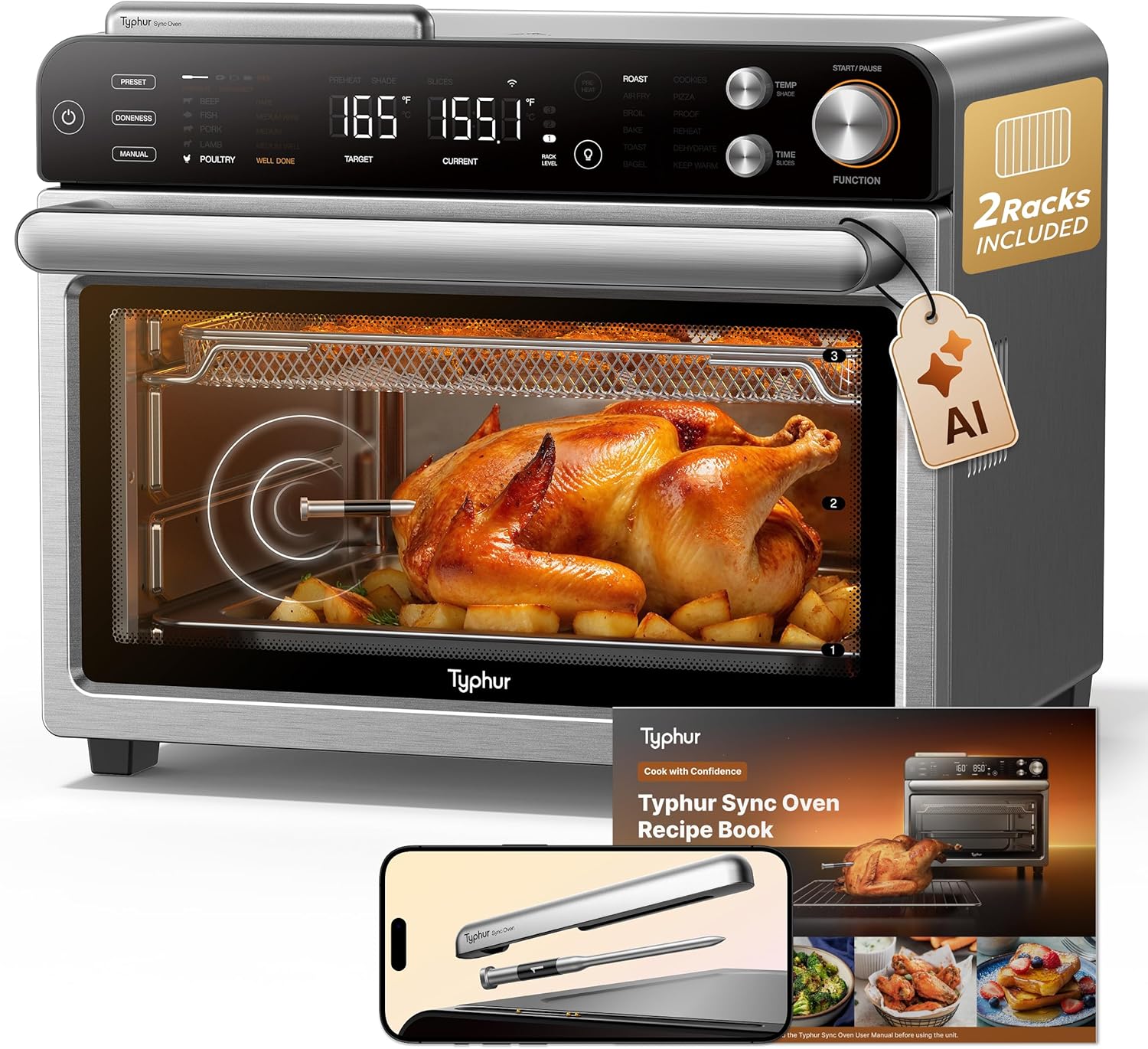
The Typhur Sync Oven CV03 combines a large 27‑quart cavity with 12 cooking modes and a built-in wireless meat probe to deliver precise, hands-off cooking. It functions as an air fryer, toaster oven, roaster and dehydrator, using a 360° turbo convection fan and dual heating elements to speed cooking and promote even browning. The integrated wireless probe tracks core temperature in real time and can auto-stop at your target doneness, which is useful for roast meats and long dehydrating cycles that benefit from monitored internal temps. App control unlocks presets, probe monitoring, and step‑by‑step recipes, while included accessories like an air fry basket, baking pan and extra racks expand what you can cook. Practical limits are its 1750W power draw and relatively large footprint, so it needs a dedicated counter spot and a proper outlet; busy kitchens with limited space should measure first. The unit is feature-rich for home cooks who want reliable, repeatable results and a true dehydrator mode alongside standard oven tasks.
Best for: Home cooks who prioritize reliable, precision results and want a single countertop appliance that handles air frying, roasting and dehydrating with probe‑based temperature control.
Less Ideal for: Casual users who only need a compact toaster oven or those with very limited counter space or low‑capacity electrical circuits.
- Built-in wireless meat probe with real-time temperature tracking and auto-shutoff for precise doneness
- 360° turbo convection with dual heating elements for faster, more even cooking
- 12 cooking modes including a dedicated dehydrate function
- Large 27‑quart capacity with three shelf positions and included accessories
- App control with presets and recipe guidance for repeatable results
- High power draw (1750 watts) requires a suitable outlet and increases energy use during long cycles
- Large physical footprint may not fit small countertops
Verdict: Choose the Typhur Sync Oven if you want a large, feature-rich countertop oven with built-in wireless probe and a reliable dehydrator mode for precision cooking.
Emeril 26QT French Door Air Fryer Oven

| Capacity | 24.6 liters |
|---|---|
| Wattage | 1700 watts |
| Voltage | 120 volts |
| Control Method | Touch |
| Max Temperature Setting | 500 °F |
This Emeril 26 QT French door air fryer toaster oven is built to replace several appliances and handle family-sized meals. It uses 360° hot air circulation and a 1700W dual-speed fan to air fry, roast, bake, broil, dehydrate and slow cook, and the rotisserie and included spit make it easy to roast whole chickens. The touchscreen control and 24 one-touch presets simplify common tasks, while French doors and an interior light make loading and monitoring food straightforward. The extra-large 26 QT cavity fits 12-inch pizzas or a full sheet of cookies, and the seven included accessories (air fry basket, bake pan, drip tray, crisper basket, rotisserie spit and tools) let you use it for many recipes out of the box. Practical limits are countertop footprint and power draw from the 1700W heater, and like many all-in-one ovens it takes some experimenting to dial in times for specific recipes compared with a conventional oven. Noise from the fan is noticeable at high speeds. For families who want one versatile unit for everyday meals and entertaining, it covers most bases well.
Best for: Buyers who need a single, versatile countertop appliance to prepare full family meals and want presets and accessories that simplify a range of cooking tasks.
Less Ideal for: Those with very limited counter space or who prefer using separate full-size ovens and stovetops for high-volume cooking should consider alternatives.
- Very large 26 QT capacity fits whole chickens and 12-inch pizzas
- Wide function set with 24 presets including air fry, roast, dehydrate and rotisserie
- Includes seven useful accessories so you can start cooking right away
- Touchscreen controls and French doors make loading and control intuitive
- 1700W power draw requires a dedicated outlet in some kitchens
- Takes countertop space and may be bulky for small counters
- Fan can be somewhat loud on high-speed settings
Verdict: A family-focused, all-in-one countertop oven that combines large capacity, rotisserie and many presets to replace multiple appliances for everyday family cooking.
Choosing the Right Toaster Oven with a Dehydrator Function: Key Factors to Consider
Temperature Range and Stability
Dehydration requires low, steady temperatures typically between roughly 90°F and 165°F. A toaster oven with a dehydrator function should hold set temperatures accurately for many hours without wide swings.
If the appliance cannot maintain low temperatures reliably, food may cook unevenly or lose flavor and nutrients. Temperature stability affects drying time and food safety, especially when preparing items like jerky that need consistent heat to reduce bacterial risk.
Airflow Design and Convection
Effective dehydration depends on moving moist air away from the food so evaporation can continue. Models with built-in convection fans or deliberate airflow channels promote even drying across trays.
Poor circulation forces you to rotate trays and extend drying time. Look for adjustable or directional airflow when possible, and designs that keep trays from blocking vents so every layer receives a similar airflow pattern.
Tray Count, Size, and Spacing
A usable drying setup includes multiple trays or racks with enough surface area for slices and enough spacing to allow airflow between layers. Wide shallow trays are better than deep trays that trap moisture.
Consider how many trays you can realistically stack while still maintaining decent circulation. Removable, dishwasher-safe trays simplify cleanup and make the appliance more practical for frequent dehydration use.
Controls, Timers, and Presets
Precise control interfaces let you set low temperatures and long timers needed for dehydration. Digital controls and programmable timers reduce the need to babysit long drying cycles.
Manual dials can work but may lack the fine adjustments or long-duration timers that simplify multi-hour drying. Preset dehydrator functions can be helpful, but the ability to customize time and temperature is critical for different foods and thicknesses.
Interior Volume Vs Footprint
Countertop space is often limited, so you want the largest interior capacity possible for the footprint you can accommodate. A deeper or taller interior increases tray area and stack height without expanding the overall appliance size.
Measure door swing and clearances too. A compact exterior that provides roomy interior space is more versatile for both dehydration and everyday baking or toasting tasks.
Ease of Maintenance and Durability
Frequent dehydration can leave sticky sugars and concentrated residues that are harder to clean. Trays and crumb pans that are nonstick and removable or dishwasher-safe make upkeep simpler.
Durable heating elements, sturdy rack supports, and corrosion-resistant finishes extend the appliance lifespan. Consider how easy it is to access interior corners and whether seals and gaskets appear serviceable for long-term use.
How Dehydration Works in a Toaster Oven
A dehydrator function in a toaster oven lowers the heat and often pairs it with a gentle fan or convection action to remove moisture. The goal is to keep food below temperatures that cook it while encouraging steady evaporation, which concentrates flavors and extends shelf life.
Understanding these basics helps you choose models with appropriate features. Look for units that separate the drying mode from standard baking so you can set the low temperatures and long timers needed for fruits, herbs, and meat.
- Low temperature setting to avoid cooking or browning too fast
- Air movement to carry moisture away from food surfaces
- Multiple flat trays to increase drying capacity
Best Practices for Home Dehydration
Slice foods uniformly to ensure consistent drying times. Thinner, even pieces dry faster and reduce the risk of pockets of under-dried product. Pre-treatments such as light blanching for some fruits can preserve color and speed drying, depending on the recipe.
Arrange items in single layers without overlapping and rotate trays periodically if your toaster oven has limited circulation. Monitor progress periodically and test dryness by cooling a sample piece to see if moisture reappears.
- Use low humidity days when possible or run a kitchen exhaust fan to reduce ambient moisture
- Dry similar-thickness items together to avoid over- or under-drying mixed loads
Safety and Food-Handling Tips
Always follow safe-temperature guidance for items like jerky which require higher dehydration temperatures or a brief pre-cook step to reduce bacterial risks. Maintain cleanliness of trays and interior surfaces to prevent cross-contamination.
Avoid leaving very long cycles completely unattended in poorly ventilated spaces. Ensure the appliance sits on a stable, heat-resistant surface and that vents are not obstructed during operation.
- Use a food thermometer when making meat products to confirm target temperatures
- Cool and store dried foods properly in airtight containers away from direct light
Maximizing Capacity Without Sacrificing Airflow
Stacking many trays increases throughput but can reduce airflow and lead to uneven drying. Stagger trays or leave small gaps if possible to preserve circulation. If the toaster oven includes a small fan, prioritize evenly spaced trays over sheer quantity.
Consider drying in batches tuned to the appliance capacity. For frequent large-volume drying, a dedicated dehydrator may still be more efficient, but for occasional or small-batch use a toaster oven with a dehydrator function is often sufficient.
- Arrange trays to avoid direct overlap of vents
- Test a first batch to learn how many trays work well in your unit
Cleaning and Maintenance Tips
Clean trays and crumb pans promptly after drying sticky or sugary items to avoid baked-on residue. Nonstick or stainless trays that are removable simplify the process. Wipe the interior with a mild detergent and dry thoroughly before the next use.
Periodically inspect heating elements and fans for buildup and consult the manual about safe removal or cleaning steps. Proper maintenance keeps temperature performance consistent and extends appliance life.
- Use warm soapy water for trays and a soft brush for mesh surfaces
- Avoid harsh abrasives on nonstick finishes to preserve longevity
How We Chose the Best Toaster Oven with a Dehydrator Function
We focused on toaster ovens that integrate a true dehydrator mode rather than a nominal low-heat setting. Our selection prioritized units with precise temperature control down to typical dehydration ranges, consistent airflow or convection features that move moisture away from food, and rack or tray configurations that let you dry multiple layers without blocking circulation. We also considered usable interior capacity relative to external footprint, as buyers often need to balance drying batch size with limited counter space. Ease of cleaning and durability of cooking surfaces were factored in because dried food can leave sticky residues that require access and wipeability. Safety features such as cool-touch exteriors, reliable timers, and automatic shutoffs were required for inclusion. We excluded units that only advertised low temperatures without verified control or that offered a single tiny tray unsuitable for practical dehydration. Models that lacked clear airflow or convection assistance were deprioritized. The final list reflects a balance of thermal accuracy, airflow design, tray capacity, user controls, and real-world usability for home food drying and everyday oven tasks.
Our full evaluation process is outlined in our review methodology.
FAQ
Can a toaster oven with a dehydrator function safely make jerky?
Often yes, but it depends on the oven's ability to hold steady, sufficiently high dehydration temperatures and on following safe handling. Some jerky methods require a brief pre-cook or higher temperature step to reduce bacterial load before the long drying period.
How many trays can I run at once without affecting results?
It usually depends on the airflow design and the oven's interior volume. Start with one full rack plus another and check for even drying. Trays stacked too tightly will slow drying and may require more rotation or longer times.
Do I need special trays for dehydrating in a toaster oven?
Mesh or perforated trays help airflow around small pieces, and nonstick surfaces make cleanup easier. Removable, dishwasher-safe trays are convenient but any flat, heatproof tray that allows air movement will work.
Will using the dehydrator function affect other oven uses?
Not usually. The dehydrator mode typically operates at lower temperatures and can be used independently of baking or broiling settings. Regular maintenance after drying sticky foods keeps the oven ready for other cooking tasks.
How long does dehydration take in a toaster oven?
Drying times vary widely based on food type, slice thickness, and humidity. Small herbs may dry in a few hours, while fruit or jerky can take several hours to more than a day. Expect longer cycles at lower temperatures.
Final Verdict
When choosing a toaster oven with a dehydrator function, prioritize temperature control and airflow design because these directly determine drying quality and safety. Balance tray capacity and interior volume against the counter footprint you can accommodate, and favor easy-to-clean trays and reliable controls for long, unattended cycles. For most home users who dry occasional batches of fruit, herbs, or jerky, a model that combines stable low temperatures, good circulation, and sensible tray layouts will deliver the best results. Use the evaluation criteria in this guide to weigh tradeoffs and pick the option that fits your drying frequency and kitchen space.