
Note: This article contains affiliate links. If you click on these links and make a purchase, we may earn a small commission at no extra cost to you. This helps support our research and content. Read our full affiliate disclosure here.
If you regularly toast thick-cut artisanal loaves, bagels, or homemade sandwich bread, a standard narrow toaster can leave you frustrated. A toaster for big bread needs wider, deeper slots, consistent heating across larger slices, and controls that let you dial in the right level of browning without burning the exterior. This guide shortlists the top options built for larger slices and evaluates them using real buyer-focused criteria like slot capacity, browning consistency, ease of cleaning, and long-term durability. Read on to see which toasters made the cut and why they suit bigger bread better.
Top Picks at a Glance
| Best Overall The best all-around choice for most situations | Cuisinart 4-Slice Toaster CPT-180P1 |  |
| Best Quality Built to a higher standard if you want something more solid | Breville Die-Cast Smart Toaster BTA820XL |  |
| Best Value The sweet spot between price and what you get | Amazon Basics 2-Slice Toaster |  |
| Best Budget The cheapest option that still gets the job done reliably | Elite Gourmet 2-Slice Toaster ECT1027B |  |
| Top Rated A top-rated pick with lots of positive feedback | LAINSTEN 4-Slice Toaster T-438 |  |
| Most Popular A crowd favorite that many people choose with confidence | Elite Gourmet 4-Slice Long Slot Toaster |  |
| Best Seller A high-volume bestseller chosen again and again | bella 4-Slice Slim Toaster |  |
Cuisinart 4-Slice Toaster CPT-180P1
| Wattage | 1800 watts |
|---|---|
| Slot Count | 4 |
| Number of settings | 6 |
| Number of Programs | 4 |
| Voltage | 120 volts |
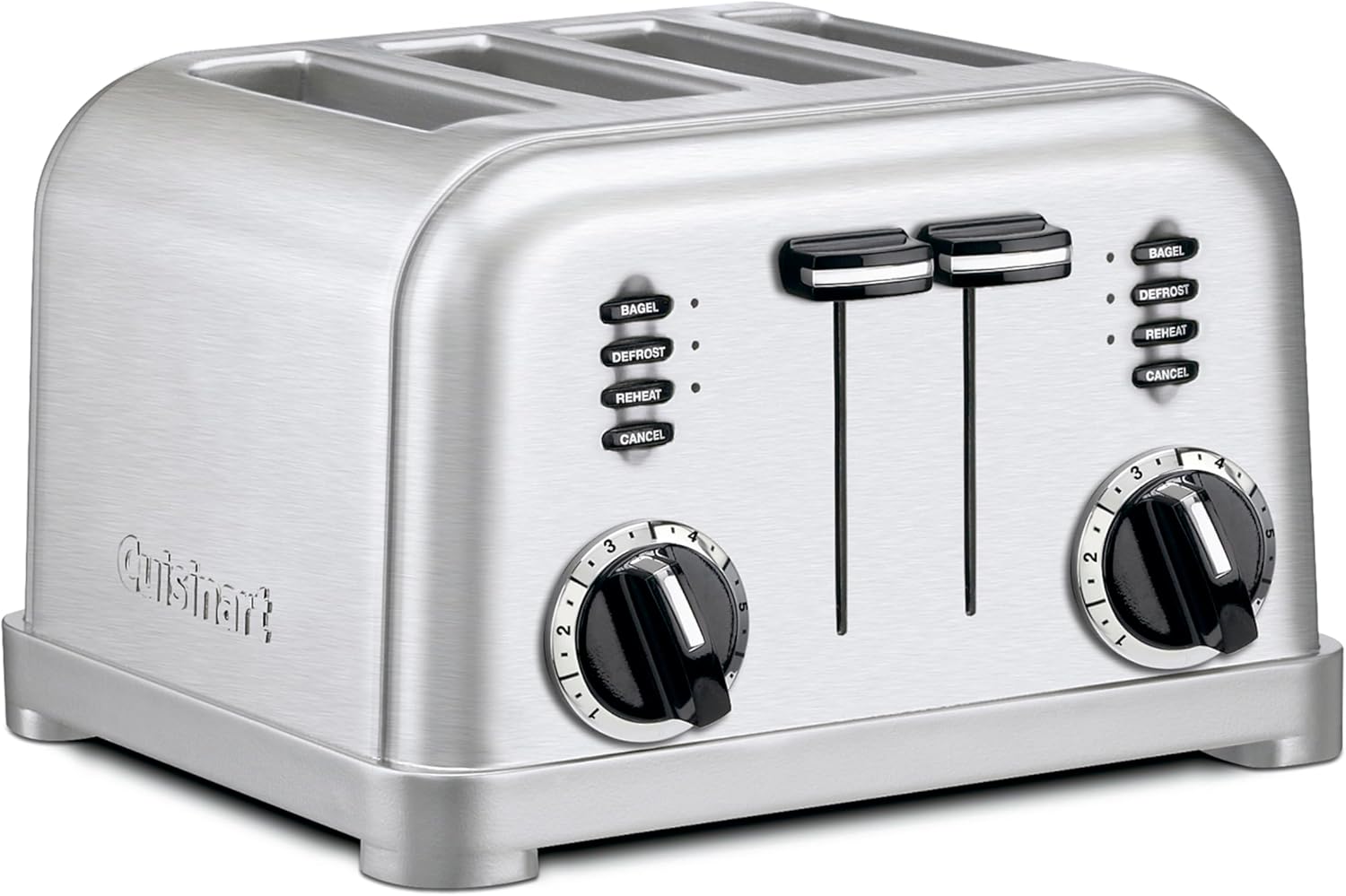
The Cuisinart CPT-180P1 is a countertop 4-slice toaster built for everyday versatility and forgiving performance with thick or oversized breads. It has two control panels with dual 6-setting browning dials and dedicated buttons for bagel, defrost, reheat, and cancel, so you can toast different items concurrently and still get consistent results. The extra-wide 1.5-inch slots accept bagels, thick-sliced bread, and toaster pastries, and the high-lift lever plus slide-out crumb tray make loading and cleanup straightforward. LED indicators make the selected program clear and the brushed stainless housing is durable and easy to wipe down. At 1800 watts it heats quickly, which is handy for busy mornings, though the unit is compact so it does not have a full commercial footprint. It lacks advanced smart features or precision sensors for exact shade replication, so repeatability depends on dialing in preferred settings by trial. For most households looking to toast larger slices and bagels reliably, this toaster balances capacity, controls, and simple maintenance well.
Best for: Buyers who want a reliable, easy-to-use toaster that handles oversized slices and bagels while offering independent controls for two users.
Less Ideal for: If you need precise automated shade matching, app control, or a heavy-duty commercial toaster for very high-volume toasting, choose a different model.
- Extra-wide 1.5-inch slots accommodate thick slices and bagels.
- Dual control panels with 6 shade settings let two people toast different items simultaneously.
- Dedicated bagel, defrost, and reheat buttons simplify common tasks.
- Slide-out crumb tray and high-lift lever make cleanup and retrieval easy.
- No smart connectivity or automated shade calibration for perfectly repeatable results.
- Compact footprint limits interior capacity compared with some larger commercial-style toasters.
Verdict: A practical 4-slice toaster that reliably handles big bread and bagels with independent controls and straightforward maintenance.
Breville Die-Cast Smart Toaster BTA820XL

| Wattage | 900 watts |
|---|---|
| Slot Count | 2 |
| Number of settings | 5 |
| Display Type | LED |
The Breville Die-Cast Smart Toaster BTA820XL is a compact 2-slice toaster built for precise, consistent toasting of thicker breads and bagels. It uses one-touch automated lowering and an LED progress indicator so you can monitor cycles with the Lift & Look feature and add time with the A Bit More button without restarting the toast cycle. Wider slots accommodate artisanal slices and dense pastries while dedicated Bagel and Defrost programs adjust heating for those specific tasks. Practical touches include an easy-access front crumb tray for quick cleanup and five browning settings for repeatable results. At 900 watts it heats quickly but stays compact on the countertop. The main limitations are the two-slice capacity if you frequently need to toast for several people at once and the lack of advanced controls like custom presets or four-slice throughput, so larger households may want a bigger model.
Best for: Buyers who prioritize precise, repeatable toasting and want a compact toaster that handles thick slices and bagels well while offering simple automated controls.
Less Ideal for: Those who need to toast for multiple people at once or require four-slice capacity and advanced programmable settings.
- Automated one-touch lowering and Lift & Look let you check progress without cancelling the cycle
- Wider slots handle thick artisanal bread and dense bagels
- Dedicated Bagel and Defrost programs tailor heat for common use cases
- Front crumb tray simplifies cleaning and keeps counters tidy
- Only two-slice capacity limits throughput for larger households
- No customizable presets or advanced control options for power users
Verdict: Choose this Breville if you want compact, accurate toasting for thick artisan bread and bagels with convenient one-touch automation.
Amazon Basics 2-Slice Toaster

| Wattage | 900 watts |
|---|---|
| Slot Count | 2 |
| Number of settings | 6 |
| Voltage | 120 volts |
This Amazon Basics two-slice toaster is designed for straightforward everyday use, focusing on reliable toasting rather than frills. It has extra-wide slots that accommodate bagels and thicker slices of bread, and six shade settings let you dial in preferred browning. Dedicated Bagel and Frozen programs plus a Cancel button make common tasks quick and obvious, and an extra-lift lever helps remove smaller pieces safely. The toaster runs at 900 watts and includes a removable crumb tray and cord wrap for easier cleanup and storage. Expect consistent results for standard slices and bulky items like bagels or artisan bread, though it lacks advanced features such as smart controls or multi-stage toasting. Its compact footprint fits most countertops, but power and feature sets are kept basic to hit a low-cost, practical sweet spot.
Best for: Buyers who want a straightforward, no-nonsense toaster that reliably handles thicker bread and bagels and prioritizes practical features and easy maintenance.
Less Ideal for: If you want smart features, multi-slice capacity, or a premium appliance to match high-end kitchen decor, consider a different model.
- Extra-wide slots fit bagels and thicker artisan slices
- Six browning settings for predictable toast darkness
- Bagel and Frozen programs plus a Cancel button for common tasks
- Removable crumb tray and cord wrap for simple cleanup and storage
- No advanced features like smart connectivity or memory settings
- Basic construction and controls without premium finishing
Verdict: A simple, practical two-slice toaster that reliably handles big bread and bagels for buyers focused on function and low fuss.
Elite Gourmet 2-Slice Toaster ECT1027B

| Wattage | 750 watts |
|---|---|
| Slot Count | 2 |
| Special Features | Cool Touch Exterior |
| Number of settings | 6 |
| Voltage | 120 |
The Elite Gourmet 2-Slice Toaster is a straightforward countertop toaster built for simple, dependable use. It toasts two slices at a time with 1.25-inch extra-wide slots that accommodate bagels, English muffins, waffles, and thicker artisan slices without frequent jams. Six adjustable browning settings and self-centering guides make it easy to dial in consistent results from lightly golden to well done. Controls are knob-based for quick changes and a cancel function stops cycles when needed. Practical touches include a cool-touch exterior for safer handling, non-slip feet for stability, and a slide-out crumb tray that speeds cleanup. At 750 watts it heats quickly but may be less powerful than higher-wattage models, so very thick slices can require an extra cycle to reach darker browning. Its compact footprint and glossy black finish suit small kitchens, dorms, or RVs where space and cost matter more than premium features like digital displays or multi-function modes.
Best for: Buyers prioritizing a low-cost, space-saving toaster that reliably handles bagels and thicker artisanal slices in small kitchens, dorms, or RVs.
Less Ideal for: Those who need to toast four or more slices at once or want a higher-wattage, feature-rich toaster with digital controls and specialty programs.
- Extra-wide 1.25" slots fit bagels and thick-cut bread without jamming
- Six browning settings and self-centering guides for more consistent toast
- Cool-touch exterior and non-slip feet improve countertop safety
- Slide-out crumb tray simplifies cleaning and maintenance
- Lower 750-watt power can need extra cycles for very thick or dense bread
- Limited to two slices at a time, not ideal for larger households
Verdict: A compact, budget-friendly two-slice toaster that reliably handles big or thick bread thanks to its extra-wide slots and simple browning controls.
LAINSTEN 4-Slice Toaster T-438

| Wattage | 1500 watts |
|---|---|
| Slot Count | 4 |
| Special Features | Removable Crumb Tray |
| Number of settings | 9 |
This LAINSTEN four-slice toaster is designed to handle larger or thicker bread while keeping a slim countertop footprint. It offers wide slots and a dedicated bagel function that concentrate heat on one side for crisping bagel cut sides, plus a defrost option for frozen slices and a cancel button to stop a cycle mid-toast. Nine browning levels give fine control from light to dark, and the high-lift lever makes it easy to remove small items safely. Practical touches include a removable crumb tray for faster cleaning and integrated cord storage to keep the counter tidy. At 1500 watts it heats quickly and browns consistently for everyday family use, though the compact width means very long artisan loaves may need to be toasted one slice at a time. Overall it suits routine breakfast tasks and occasional bagel or muffin toasting while keeping cleanup simple.
Best for: Buyers who prioritize a dependable, no-frills toaster that browns consistently and handles thicker slices or bagels in a space-saving design.
Less Ideal for: Those who need to toast very long artisan loaves, want digital controls or smart features, or plan heavy commercial use.
- Wide slots and bagel function accommodate thicker bread and bagels
- Nine browning settings allow precise control over toast darkness
- Removable crumb tray simplifies cleaning
- Slim footprint fits small kitchens while toasting four slices
- Compact width may not fit very long artisan or oversized bread slices without toasting individually
- No advanced features like digital timers or memory presets
Verdict: A reliable, compact four-slice toaster that consistently handles thicker bread and bagels while saving countertop space.
Elite Gourmet 4-Slice Long Slot Toaster

| Wattage | 1300 watts |
|---|---|
| Slot Count | 4 |
| Number of settings | 6 |
| Display Type | Digital |
| Voltage | 120 |
This Elite Gourmet 4-slice long-slot toaster is built to handle oversized and specialty breads that standard toasters struggle with. Its two extra-long slots accept thick sourdough, bagel halves, Texas Toast, and waffles so you can toast four full slices at once without squishing. The unit runs all four heating elements simultaneously for even heat, and six browning settings let you dial from very light to deep golden. Useful one-touch functions include reheat, defrost for frozen items, and cancel to stop a cycle immediately, and the built-in warming rack lets you warm pastries while bread toasts. Cleanup is simple thanks to two slide-out crumb trays and cord storage keeps counters tidy. Expect the toaster to run slightly faster when fewer slices are loaded because all elements remain active, so you may need to lower the browning setting for smaller loads. The metal exterior wipes clean but the warming rack should only be used with dry items. For buyers focused on consistent results with large bread, this toaster balances capacity and straightforward controls without complicated programming.
Best for: Buyers who want a reliable toaster that handles oversized and artisanal breads and prefer a proven, easy-to-use design backed by strong customer feedback.
Less Ideal for: People who need programmable or smart features, or who primarily toast single thin slices and want a toaster optimized for very small loads.
- Extra-long, wide slots fit thick slices, bagel halves, and waffles without squashing
- Six browning settings provide fine control from light to dark
- Reheat, defrost, and cancel one-touch functions add convenient versatility
- Built-in warming rack lets you warm pastries while toasting
- Two slide-out crumb trays and cord storage simplify cleaning and storage
- All heating elements run together, so toasting fewer slices can require lowering the browning level to avoid over-toasting
- Warming rack is only suitable for dry items, not buttered or filled pastries
Verdict: If you eat thick or oversized breads, this long-slot four-slice toaster delivers even, consistent toasting and useful one-touch functions in a simple, dependable package.
bella 4-Slice Slim Toaster

| Wattage | 1400 watts |
|---|---|
| Slot Count | 4 |
| Number of settings | 6 |
| Special Features | Anti-Jam Protection, Automatic Shut-Off, Cancel Function, Cool Touch Exterior, Removable Crumb Tray |
The bella 4-Slice Slim Toaster is built for households that need to toast larger breads without sacrificing counter space. It uses two 10-inch long slots and a high-lift lever so you can fit two slices side-by-side — useful for bagels, sourdough, baguettes, and Texas-style slices — and retrieve smaller items safely. Six shade settings plus Reheat and Cancel buttons give straightforward control for consistent results, while auto-centering guides help deliver even browning. Practical safety and cleanup features include anti-jam protection, automatic shut-off, a cool-touch exterior, and a removable slide-out crumb tray. The toaster claims a 900- to 1400-watt system in different spots of the listing which should provide quick toasting, though buyers looking for exact power performance may notice mixed information. Its slim 6.14-inch depth makes it one of the more space-efficient long-slot toasters, but if you regularly toast very heavy loaves or need variable slot dividers, a full-width conveyor or professional toaster would handle higher volumes better.
Best for: Buyers who want a space-saving toaster that reliably handles thick or artisanal bread and prioritize easy, safe everyday use over commercial throughput.
Less Ideal for: Those who toast very large volumes daily or need a commercial-grade toaster for continuous heavy use should consider higher-capacity or conveyor-style models.
- Extra-long 10-inch slots fit thick artisan bread, bagels, and oversized slices without trimming
- Slim 6.14-inch profile saves countertop space while offering four-slice capacity
- Six shade settings plus Reheat and Cancel controls for simple, repeatable browning
- Safety features include anti-jam protection and automatic shut-off
- Removable slide-out crumb tray and cord wrap make cleaning and storage tidy
- Listing shows inconsistent wattage details which may confuse expectations about toasting speed
- No specialized slot dividers or conveyor-style mechanism for very heavy or uneven loaves
Verdict: If you need a compact four-slice toaster that easily handles thick artisan and oversized bread while keeping countertop clutter low, this slim bella model is a practical, safe choice.
Choosing the Right Toaster for Big Bread: Key Factors to Consider
Slot Width and Depth
Slot size is the first practical constraint when you toast larger slices. Wider slots accommodate thick artisanal bread, bagels, and sandwich slabs without forcing you to fold or compress the slice. Depth matters too because tall slices need enough vertical clearance to avoid touching the heating elements or getting stuck.
Before buying, check published slot dimensions and compare them with the typical thickness and height of the bread you use. Remember that some toasters advertise "extra-wide" slots but still have limited depth, which can make tall slices problematic. Choosing a model with both generous width and depth reduces the risk of uneven toasting caused by poor contact with heating elements.
Browning Consistency
Consistent heat distribution determines whether thick slices toast evenly from edge to center. Uneven heating can leave dense centers underdone while edges get dark. Look for indications of multiple heating elements or designs that evenly surround the bread rather than focusing heat on just one side.
Control granularity plays into consistency as well. Models with incremental browning steps let you find the right setting for a particular loaf type. If you often toast different kinds of bread, reliable repeatability matters: you want the same setting to produce comparable results day after day.
Control Precision and Features
Precise controls help you adjust for slice thickness, moisture content, and crust density. Mechanical dials can be sturdy and simple, while digital controls may offer repeatable presets and timer readouts. Useful features for big bread include dedicated bagel settings that direct more heat to the cut side, reheat and cancel buttons, and a high-lift or pop-up feature to remove smaller slices safely.
Consider whether controls are intuitive and accessible during daily use. If multiple family members will operate the toaster, tactile, labeled controls reduce mistakes. Also think about whether you need a visual or audible cue when toasting is done, especially if you multitask in the kitchen.
Ease of Cleaning
Crumbs and drips collect quickly in any toaster and become a maintenance burden if not addressed. Removable crumb trays are the simplest and most important cleaning feature, allowing you to empty debris without turning the unit over. Look for trays that slide out smoothly and are sized to capture typical crumb loads from larger slices.
Consider accessibility to interior surfaces. Models that allow safe, limited access to heating areas for occasional brushing or that have fewer crevices will stay cleaner longer. Materials and finishes also influence cleaning: matte or brushed surfaces usually hide smudges better than glossy finishes, and stainless components are often easier to wipe down.
Build Quality and Durability
A toaster is a daily-use appliance, so mechanical reliability is important. Sturdy levers, solid knobs or buttons, and a stable base reduce wear and the likelihood of early failure. Metal construction around the slots can help maintain slot shape under repeated use and avoid warping from heat.
Durability also influences servicing and lifespan. Simple internal designs with replaceable parts are easier to maintain. Even if you do not plan to repair the unit, a well-built toaster will retain consistent performance longer, which matters when you rely on it for breakfast routines.
Safety and Energy Use
Toasters must manage heat safely around counters and kitchen surfaces. Look for heat-resistant exteriors, stable feet to prevent tipping, and automatic shutoff features that stop toasting if a jam occurs. These elements reduce the risk of accidents, especially in busy kitchens.
Energy use is less critical for a toaster than for larger appliances but still worth a thought. Efficient heating elements that reach the desired temperature quickly can shorten cycle times and reduce wasted energy. If you toast multiple slices every day, a model that performs reliably with short cycles will be more economical in the long run.
How Slot Design Affects Toasting Performance
Slot geometry goes beyond simple width measurements. The placement and orientation of heating elements relative to where the bread sits determine how much of the crust receives direct heat. Deeper slots are helpful for tall slices, while uniform interior clearance prevents uneven contact and scorching on the surface that touches the element.
Some designs use staggered or multiple elements to create a more even heat pattern. Others rely on reflective interior surfaces to distribute heat. Understanding these differences helps you predict whether a particular toaster will handle dense or moist bread without leaving a soggy center.
- Wider slots accommodate thicker slices and halves of bagels.
- Deeper slots prevent tall slices from touching heating elements.
- Multiple element layouts generally give more uniform browning.
Practical Controls for Everyday Use
Controls should match how you toast. If you change settings based on bread type, look for incremental browning steps or labelled presets. A reliable cancel button and a reheat setting can save you from burning when experimenting with thickness.
High-lift levers and clear indicators reduce the chance of burning fingers or pulling the bread out mid-cycle. For households with multiple users, tactile dials and obvious markings minimize confusion.
- Digital presets offer repeatability.
- Mechanical dials are often more durable.
- High-lift makes removing small pieces safer.
Maintenance Tips to Keep Results Consistent
Regular cleaning of crumb trays prevents smoke and burnt smells that affect flavor. Empty the tray weekly or more often if you toast many slices. Use a soft brush to clear crumbs from slots when the unit is unplugged and cool.
Occasional exterior wiping keeps controls functioning smoothly. Avoid abrasive cleaners on painted surfaces. If the toaster shows signs of uneven heating over time, intermittent deep cleaning and checking for bent slot edges can restore better contact and performance.
- Empty crumb trays frequently.
- Brush slots gently when cool.
- Wipe exterior with a soft, damp cloth.
Sizing the Toaster to Your Kitchen
Think about counter space and how many slices you toast at once. A four-slice toaster with extra-wide slots offers more capacity but takes up more room. If you only ever toast one or two thick slices, a two-slice wide-slot model might be the better fit for a smaller kitchen.
Also consider storage if you do not leave the toaster out. A slimmer unit with tall slots may fit better under cabinets, while a wider base can feel more stable on the counter. Measure the space where the toaster will live and compare it to the unit's footprint before choosing.
- Four-slice units increase throughput for families.
- Two-slice wide-slot models are space-efficient.
- Measure counter clearance for tall slices.
Common Problems With Oversized Slices and How to Avoid Them
A frequent issue is uneven toasting where the center of a thick slice remains underdone. This often stems from insufficient interior depth or heating elements that favor the sides. Choosing a toaster with balanced heat distribution and confirming depth clearance prevents this problem.
Another common headache is jamming. Avoid pushing slices into slots; let gravity guide the bread and use a toaster designed for thicker items. If jamming occurs, unplug the toaster and allow it to cool before attempting removal to avoid damaging heating elements or causing injury.
- Do not force oversized slices into narrow slots.
- Start with a lower browning setting and increase as needed.
- Unplug and cool before attempting to clear a jam.
How We Chose the Best Toaster for Big Bread
We evaluated toasters built to handle oversized slices using criteria that matter to people who toast thick or irregularly shaped bread. Our selection process prioritized slot dimensions and internal clearance to ensure big slices fit without bending or jamming. Browning consistency was a key factor, with emphasis on heating element layout and the ability to produce uniform results from edge to center across multiple toasting cycles. We also assessed control precision and usability, looking for adjustable browning settings, defrost and reheat options, and easy-to-read indicators. Practical serviceability mattered: removable crumb trays, simple access to heating elements, and durable lever mechanisms were considered. Long-term durability and construction materials were reviewed to favor designs that stand up to daily use. We excluded compact, two-slice budget models that cannot accommodate wider or taller slices, and any units lacking clear slot measurements or adjustable browning. The final list reflects a balance of capacity, consistent results, simple operation, and build quality.
Our full evaluation process is outlined in our review methodology.
FAQ
How wide should slots be for thick artisanal bread?
Aim for slots at least 1.25 to 1.5 inches wide and deep enough to clear tall slices. Exact needs vary with loaf style, but those dimensions typically accommodate thick-cut artisan slices and bagel halves comfortably.
Can I toast frozen big slices without soggy centers?
Yes, but use the defrost or dedicated frozen setting if available. That setting typically runs a slightly longer cycle at a lower initial intensity to thaw the interior before browning, which helps avoid a soggy middle.
Are four-slice toasters better for families who eat big bread?
Four-slice units increase throughput, which is useful for families. However, they have a larger footprint. If counter space is limited, a two-slice wide-slot toaster may be a better compromise while still handling big slices.
How often should I clean the crumb tray?
Empty the crumb tray at least once a week with regular use, and more often if you toast many slices daily. Frequent cleaning prevents buildup that can cause smoke and affect flavor.
Why does my toast brown unevenly on thick slices?
Uneven browning usually points to slot depth or heating element layout issues. Dense or moist centers also take longer to heat. Try a slightly longer cycle or a different browning setting, and ensure the slice is not touching the elements.
Final Verdict
When choosing a toaster for big bread, prioritize slot width and depth first, then browning consistency and reliable controls. Those factors determine whether thick slices will fit and brown evenly without repeated guesswork. Balance capacity and footprint with how many slices you toast daily. Favor models with easy cleaning and solid construction to maintain consistent results over time. With those tradeoffs in mind, you can pick a toaster that delivers the dependable performance big slices require.