
Note: This article contains affiliate links. If you click on these links and make a purchase, we may earn a small commission at no extra cost to you. This helps support our research and content. Read our full affiliate disclosure here.
If tracking and cleanup from cat litter are wearing on your floors and patience, the right vacuum cleaner for kitty litter can make daily maintenance faster and less messy. Litter granules are abrasive, scatter easily, and can clog machines that are not designed for small, dense debris. Choosing a model that handles grit well, seals dust, and is simple to empty matters for both performance and the lifespan of the machine. This guide shortlists seven top-performing vacuums that handle kitty litter consistently. We evaluated machines on suction, filtration, debris handling, and ease of upkeep to spotlight options that reduce tracking, trap dust and odors, and stay reliable over time. Read on to see the features that matter and which attributes to prioritize for a cleaner home.
Top Picks at a Glance
| Best Overall The best all-around choice for most situations | Dyson V8 Cordless Vacuum V8 |  |
| Best Quality Built to a higher standard if you want something more solid | Miele Classic C1 Turbo Team |  |
| Best Value The sweet spot between price and what you get | Curvymoontech DB5 Stick Vacuum |  |
| Best Budget The cheapest option that still gets the job done reliably | BLACK+DECKER dustbuster HNVC215B10 |  |
| Top Rated A top-rated pick with lots of positive feedback | Bissell Pet Hair Eraser 2390A |  |
| Most Popular A crowd favorite that many people choose with confidence | Eureka Blaze NES210 |  |
| Best Seller A high-volume bestseller chosen again and again | EUREKA PowerSpeed Upright NEU181D |  |
Dyson V8 Cordless Vacuum V8

| Filter Type | HEPA Filter |
|---|---|
| Capacity | 0.14 gallons |
| Runtime | 40 minutes |
| Battery Charge Time | 5 hours |
The Dyson V8 is a lightweight cordless stick vacuum built for everyday home cleaning and pet messes like hair and tracked-in debris. It uses a Motorbar cleaner head with hair-removal vanes plus a dedicated Hair screw tool to pull long hair and pet fur into the bin without constant brushbar snags, and its whole-machine filtration captures fine dust and dander. The unit converts quickly to a handheld for stairs, upholstery, and car interiors, and it includes a crevice and combination tool for edges and quick dusting. Two power modes let you balance run time and suction, with up to 40 minutes on standard mode and about five minutes in Max for short intensive spots. Practical limitations are the modest 0.14 gallon bin that needs frequent emptying with litter or heavy debris, and battery runtime can fall with high-suction use, so larger homes or long continuous sessions may need recharge breaks. The V8 is simple to store on its wall dock and keeps maintenance straightforward with no-bag emptying.
Best for: Someone who wants a versatile, easy-to-handle cordless vacuum that handles pet hair and quick cleanups around litter areas and tight spaces without fuss.
Less Ideal for: Not the best choice for households that need to clear large volumes of kitty litter or clean very large homes in a single session without recharging.
- De-tangling Motorbar and Hair screw tool remove long hair and pet fur without frequent jams
- Whole-machine filtration captures fine dust and pet dander
- Converts to a handheld for stairs, upholstery and car interiors
- Two power modes balance suction and run time and a wall dock stores and charges neatly
- Small 0.14 gallon bin requires frequent emptying when picking up litter or large amounts of debris
- Run time drops noticeably on Max mode, limiting long continuous cleaning sessions
Verdict: A lightweight, pet-focused cordless stick that excels at hair and spot cleanup around litter zones while offering strong filtration and handheld versatility.
Miele Classic C1 Turbo Team

| Capacity | 4.5 quarts |
|---|---|
| Noise Level | 60 db |
| Wattage | 1200 watts |
| Operating Radius | 29.5 ft |
| Filter Type | Miele AirClean Filter |
The Miele Classic C1 Turbo Team is a compact bagged canister vacuum built for everyday deep cleaning on hard floors and low-to-medium pile carpets. It includes a TurboTeQ motorized floorhead for tackling hair and litter on carpets and a parquet twister for delicate hard floors, plus crevice, dusting and upholstery tools for spot cleaning around litter boxes. Suction is driven by a 1200 W motor with six power settings, letting you dial up performance for embedded particles like kitty litter or back it off for fragile surfaces. The AirClean three-stage filtration with genuine filterbag captures a high percentage of fine dust and keeps exhaust air cleaner after vacuuming, which helps when scooping litter disperses dust. Practical limits are its bagged design, which requires replacement bags and filter care, and a 29.5 ft operating radius may be more than enough for most homes but adds cord management. The unit is relatively lightweight for a canister and maneuvers well under furniture, making routine litter cleanup straightforward for owners who prioritize suction and filtration.
Best for: Buyers who want reliable suction and filtration to remove and contain gritty debris like kitty litter and who prioritize thorough cleaning performance over low ownership cost.
Less Ideal for: People who need a bagless, zero-maintenance machine or those who prefer cordless portability for quick spot cleanups should consider other designs.
- TurboTeQ motorized floorhead removes hair and litter from low- to medium-pile carpet
- Parquet twister floorhead for safe, effective hard floor cleaning
- Three-stage AirClean filtration with genuine filterbag reduces airborne dust during litter cleanup
- Six suction/power settings let you match performance to surface and mess size
- Includes multiple onboard tools for crevices, upholstery and dusting around litter areas
- Requires replacement AirClean filterbags and non-washable filter maintenance
- Bagged system adds ongoing consumable cost
Verdict: If you need strong, controllable suction and top-notch filtration to keep litter dust contained, this Miele canister is a performance-focused choice.
Curvymoontech DB5 Stick Vacuum

| Capacity | 1.5 liters |
|---|---|
| Filter Type | HEPA Filter & Sponge Filter |
| Battery Description | Lithium-Ion |
| Battery Charge Time | 4.5 hours |
| Maximum Suction | 45 Kpa |
The Curvymoontech DB5 is a cordless stick vacuum designed for everyday home use and quick cleanups, with a motorized anti-tangle brush and two suction modes for either longer run time or stronger pickup. It converts to a handheld and includes a long nozzle and 2-in-1 flat brush for reaching car interiors and tight corners, while the 1.5L dust cup and 5-layer filtration reduce how often you need to empty it. A smart LED display reports status and alerts you to brush obstructions so you can clear hair quickly, and the detachable lithium-ion battery charges in about 4.5 hours for up to 40 minutes in Eco mode or shorter runtime on Turbo. Practical extras include an extra HEPA filter, wall mount, and a small cleaning tool. Expect strong suction for litter and pet hair, but heavier debris or prolonged Turbo use will shorten runtime and require more frequent filter maintenance; the unit is aimed at regular spot cleaning rather than continuous whole-house heavy-duty jobs.
Best for: Buyers who want a practical, easy-to-store cordless vacuum for regular spot cleaning of pet hair and litter in homes, cars, and small apartments and who value convenience and low-maintenance features.
Less Ideal for: People who need a heavy-duty, continuous-run vacuum for large homes or industrial-strength cleaning should consider a corded or commercial unit instead.
- Strong maximum suction up to 45 Kpa suitable for pet hair and litter
- Large 1.5L dust cup reduces emptying frequency for frequent cleanups
- Smart LED display and anti-tangle brush help identify and prevent brush clogs
- Detachable battery and multiple attachments convert it to a handheld for cars and corners
- Includes extra HEPA filter and wall mount for easy storage and maintenance
- Turbo mode significantly reduces runtime compared with Eco mode
- Not intended for sustained heavy-duty cleaning sessions
Verdict: A versatile cordless stick that handles pet hair and kitty litter well while delivering convenient storage and low-maintenance features for everyday spot cleaning.
BLACK+DECKER dustbuster HNVC215B10

| Capacity | 0.09 gallons |
|---|---|
| Noise Level | 84 db |
| Voltage | 8 volts |
| Battery Description | Lithium-Ion |
| Runtime | 9 minutes |
The BLACK+DECKER dustbuster HNVC215B10 is a lightweight cordless handheld vacuum intended for quick cleanups of crumbs, dust, and small debris. It ships with an on-board crevice tool and a translucent dirt bowl so you can see when it needs emptying, and the washable cloth filter helps maintain suction over time. The unit runs on an 8V lithium-ion battery with roughly 9 to 10 minutes of runtime per charge and recharges in the provided wall-mount base, making it easy to keep handy for frequent spot cleaning. Noise is noticeable at about 84 dB, so it is best used for short bursts rather than long sessions. The small 0.09 gallon capacity and single-speed motor limit continuous use and are not suited for heavy volumes like large kitty litter spills, but the slim nozzle and crevice tool work well for getting into couch seams, edges, and car interiors. Build and accessories are straightforward and practical for buyers on a budget who want a reliable, no-frills handheld for everyday messes.
Best for: Buyers who prioritize a low-cost, easy-to-store handheld for frequent small messes and fast spot cleaning around litter boxes, furniture, and cars.
Less Ideal for: Those who need to clean large amounts of kitty litter, heavy spills, or extended sessions should choose a larger cordless stick or a canister vacuum with higher runtime and capacity.
- Lightweight and easy to grab for quick spot cleaning
- Built-in crevice tool and translucent dirt bowl for convenient use and emptying
- Washable cloth filter helps preserve suction and lowers maintenance cost
- Wall-mount charger keeps the vacuum accessible and charged between uses
- Short runtime and small dust bin limit handling of larger messes without frequent emptying or recharging
- Single speed and modest suction make it less effective on coarse or heavy debris
Verdict: An inexpensive, grab-and-go handheld that works well for quick litter-area touchups and everyday small messes.
Bissell Pet Hair Eraser 2390A

| Capacity | 0.18 gallons |
|---|---|
| Runtime | 17 minutes |
| Battery Description | Lithium-Ion |
| Voltage | 14 volts |
| Noise Level | 70 db |
The Bissell Pet Hair Eraser 2390A is a compact cordless handheld vacuum built for tackling pet hair and spot cleaning around the house and in vehicles. It uses a 14V lithium-ion battery and a motorized brush tool to lift embedded hair from upholstery, car seats, and stairs, and includes a crevice and upholstery tool for detail work. The bin is bagless and designed for quick emptying, while triple-level filtration helps trap dust and fine debris. In practice it is convenient for quick pickups and targeted cleaning sessions; the motorized brush noticeably improves hair removal compared with a basic handheld. The main limitation is runtime — about 17 minutes per charge — so it is best for short sessions rather than prolonged whole-room cleaning. Noise is moderate around 70 dB, and the single-speed control keeps operation simple but does not allow boosting for heavier debris. Overall it is a reliable, purpose-driven handheld for pet owners who need an easy grab-and-go tool for hair and small messes.
Best for: Buyers who prioritize a dependable, easy-to-use handheld for frequent spot cleanup of pet hair and small litter or debris in homes and cars.
Less Ideal for: People needing long runtime or a primary cleaner for whole-room or whole-house vacuuming should consider larger stick or upright models instead.
- Motorized brush tool designed to pull embedded pet hair from upholstery and stairs
- Includes crevice and upholstery tools for detailed cleaning in cars and tight spots
- 14V lithium-ion battery provides consistent cordless power and predictable runtime
- Bagless dirt bin with one-touch emptying for quick debris disposal
- Triple-level filtration helps contain fine dust and hair
- Short runtime of about 17 minutes limits use to quick spot cleaning sessions
- Single speed control offers no high-power boost for heavier debris
Verdict: A compact, pet-focused handheld that reliably removes embedded hair and small messes when you need fast, grab-and-go cleaning.
Eureka Blaze NES210

| Power Source | Corded Electric |
|---|---|
| Wattage | 240 watts |
| Amperage | 2 A |
| Capacity | 0.6 liters |
| Hose Length | 18 feet |
The Eureka Blaze NES210 is a budget-friendly corded stick vacuum that converts to a handheld for spot cleaning and stairs. It uses a 240-watt, 2-amp motor and a capture nozzle designed to pick up larger debris on hard floors and low-pile rugs, while swivel steering helps it navigate furniture. Onboard tools include a crevice attachment and an easy-empty dust cup with washable foam filter that keeps maintenance simple. The 18-foot cord and relatively large dust cup reduce the need to move outlets or empty frequently during quick cleanups. Practical limitations include a single power level and relatively high reported noise, so it is best suited for short sessions rather than heavy-duty deep cleaning or dense carpets. For litter cleanups on hard floors the capture nozzle and lightweight form factor make it quick to use, but expect less power on embedded messes and pet hair on thicker rugs.
Best for: Buyers who prioritize a lightweight, easy-to-use vacuum for frequent quick cleanups on hard floors and want a model with simple maintenance and visible real-world performance.
Less Ideal for: Homes that need a deep-cleaning machine for thick carpets, heavy pet hair, or large homes where cordless range and adjustable suction are important.
- Lightweight 4-pound design makes it easy to carry and convert to handheld for quick litter pickups
- Capture nozzle and swivel steering improve debris pickup and maneuverability on hard floors
- Washable foam filter and easy-empty dust cup simplify maintenance
- Long 18-foot power cord and large dust cup reduce interruptions during cleaning
- Single power level limits suction control for embedded dirt or thick carpets
- Noise level around 84 dB can be loud during use
Verdict: A lightweight, no-frills corded stick that makes fast hard-floor cleanups and litter pickup easy thanks to its capture nozzle and handheld versatility.
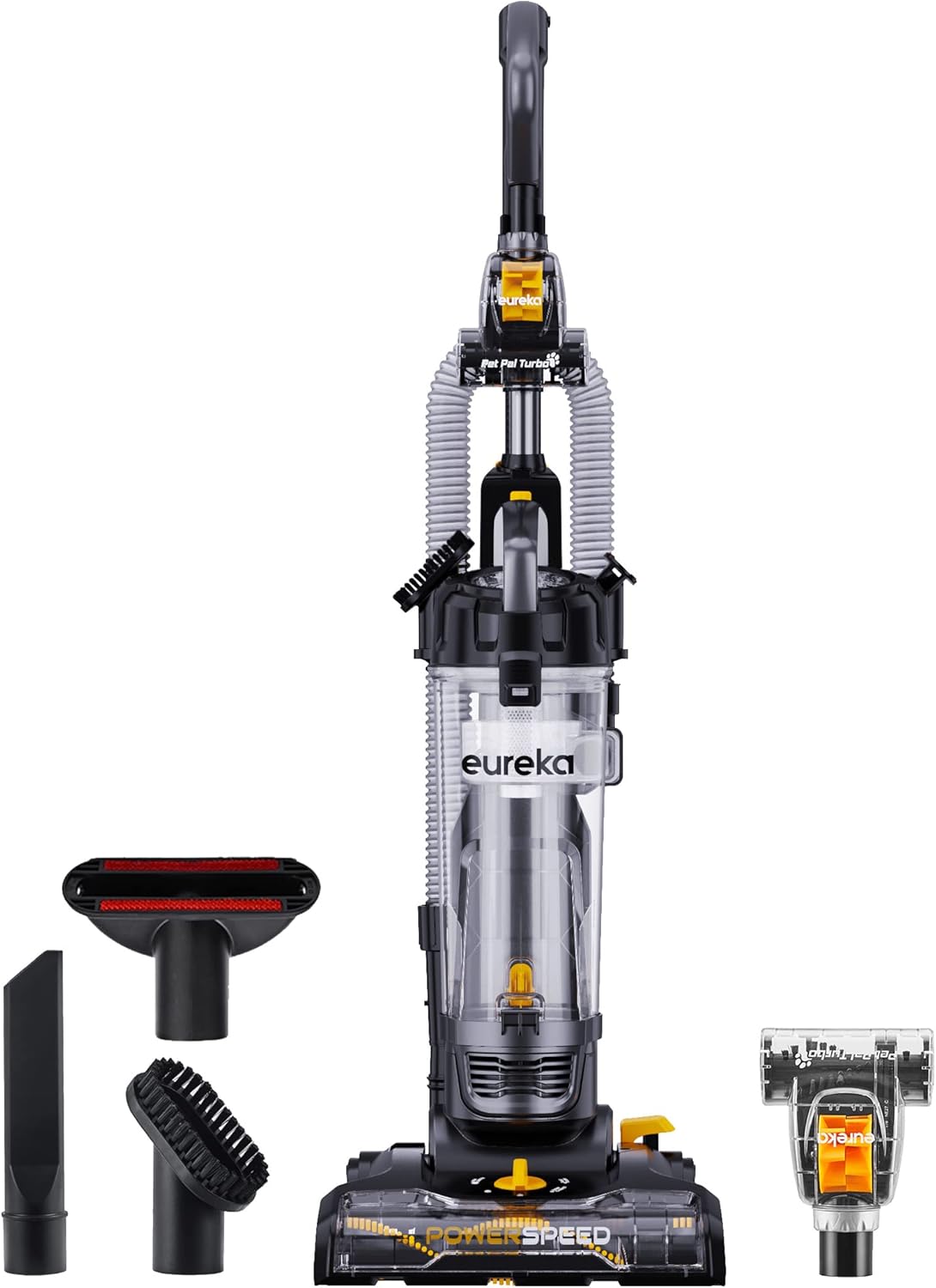
EUREKA PowerSpeed Upright NEU181D
| Capacity | 2.6 liters |
|---|---|
| Power source | Corded Electric |
| Wattage | 960 watts |
| Filter Type | Foam |
| Number of Speeds | 5 |
The Eureka PowerSpeed NEU181D is a budget-friendly upright that aims to make regular home cleaning quick and simple. It delivers straightforward corded suction for carpets and hard floors, with five height settings to adapt the brushroll to different pile heights. The large 2.6 liter easy-empty dust cup and washable foam filter reduce ongoing consumable costs, and onboard tools including a pet turbo brush, crevice tool and dusting brush help reach upholstery and corners where litter and pet hair collect. At about 10 pounds it is easy to move around and the 7-foot hose plus 25-foot cord give decent reach for most rooms. Expect audible operation near the listed 88 dB and manual maintenance: the roller and belt will need regular cleaning to handle hair and gritty debris like litter. It is not a cordless deep-clean system or a sealed HEPA allergen unit, so very fine dusty messes may require repeated passes or a dedicated filter upgrade. For everyday household litter pickup and light pet messes, it is a practical, low-cost option.
Best for: Buyers who prioritize a reliable, low-maintenance upright for routine home cleaning and pet-related messes and want a straightforward unit that minimizes ongoing costs and complexity.
Less Ideal for: People who need a cordless model, medical-grade allergen control, or a very quiet vacuum for noise-sensitive environments should consider other options.
- Large 2.6L easy-empty dust cup reduces how often you stop to empty
- Includes pet turbo tool and other onboard accessories for hair and edge cleaning
- Washable foam filter and bagless design lower ongoing supply costs
- Five height adjustment settings let you switch between hard floors and carpet
- No sealed HEPA filtration for trapping very fine dust or allergens
- Brushroll and belt require frequent cleaning when picking up pet hair or gritty litter
- Relatively loud operation around 88 dB
Verdict: A practical, low-cost upright that handles everyday kitty litter and pet hair with a large dust cup and onboard tools while keeping maintenance and consumable expenses low.
Choosing the Right Vacuum Cleaner for Kitty Litter: Key Factors to Consider
Suction Power and Airflow
Strong suction and consistent airflow are essential for lifting kitty litter from hard floors and low-pile rugs. Litter grains vary in size and density, so a vacuum must sustain intake pressure without bogging down when the bin fills or when brushing over textured surfaces.
Pay attention to quoted airflow or suction specifications, but focus on real-world performance reports and intake design. Machines with variable suction settings are helpful because you can reduce power for lightweight debris and increase it to extract embedded litter from carpet fibers.
Filtration and Dust Containment
Cat litter generates fine dust that can become airborne during vacuuming and when emptying a canister. Effective filtration, ideally with a HEPA or equivalent sealed system, reduces allergy triggers and helps control odors.
Also consider how the vacuum seals between the collection bin and the motor. A poor seal will leak dust back into the room even if the filter media is high quality. Look for washable pre-filters and simple filter-replacement procedures to maintain performance over time.
Debris Path Design and Clog Resistance
Gravel-like litter can accumulate and cause blockages in narrow hoses, brush rolls, or intake ports. A debris path that is wide, direct, and minimizes sharp bends reduces the chance of clogs and makes maintenance less frequent.
Some vacuums include quick-access ports for manually clearing obstructions or come with straight-through wands that resist packing. Consider models with brush-roll bypass or tools that allow you to isolate the motor from the collection bin when clearing blockages to avoid spreading dust.
Emptying Method and Maintenance Ease
How you empty the collector matters for both convenience and dust control. Top- or bottom-release canisters with controlled gates release contents quickly but can also scatter dust if not well sealed. Bagged systems isolate debris but require ongoing bag purchases and can be less convenient to inspect.
Maintenance also includes brush roll cleaning, filter washing or replacement, and hose unclogging. A design that makes these tasks tool-free and straightforward will reduce the time and mess involved in regular litter cleanup.
Tooling, Reach, and Maneuverability
Accessories like crevice tools, motorized mini-tools, and extended wands help reach litter tracked under furniture, along baseboards, and inside tight corners. A vacuum that balances a lightweight wand with a stable base offers the best of both worlds for quick cleanups.
Consider cord length or battery runtime for cordless models, and how easily tools stow on the unit. Maneuverability is also important because cats often track litter into cushions and around legs where precise tool control prevents missed spots.
Durability Against Abrasive Debris
Regularly vacuuming gritty litter can wear seals, brush bristles, and plastic parts faster than dust alone. Materials and construction quality influence how long a machine will perform reliably under those conditions.
Look for robust brush-roll bearings, reinforced hoses, and replaceable wear components. A warranty that covers motor and parts for a reasonable period can also signal a design built to withstand abrasive use.
Best Practices for Vacuuming Litter Without Making a Mess
Start by coralling loose litter with a broom or hand brush before vacuuming to minimize how much grit you force through the vacuum. Use a low-suction setting or a non-rotating floor tool for initial pickup on delicate surfaces to avoid scattering fine dust.
When vacuuming, move slowly and overlap passes to ensure you lift settled granules. For tight corners and under furniture, use a narrow crevice tool or an angled wand to dislodge trapped litter without having to reposition heavy furniture.
- Empty the bin outside or into a trash bag to limit indoor dust.
- Use a brush or compressed air to clear the intake after heavy litter pickup.
- Run a final quick pass with higher suction to capture lingering dust.
Maintenance Routine to Preserve Performance
Establish a short maintenance routine after heavy litter sessions. Empty the collection bin promptly, tap or wash washable filters per manufacturer guidance, and clear brush-roll hair and grit to prevent wear.
Inspect hoses and tool connections weekly during heavy use. A quick visual check for blockages and a wipe of seals reduces the chance of sudden suction loss and keeps the vacuum running efficiently.
- Washable filters: let them dry completely before reinstalling.
- Replace disposable filters on the schedule recommended by the manufacturer.
- Clean brush rolls to prevent abrasive grit from grinding bearings.
Choosing Between Bagged, Bagless, and Handheld Options
Bagged systems can contain dust better during disposal but require purchasing and storing replacement bags. Bagless canisters are convenient for sight-checking debris levels but demand careful emptying to avoid airborne dust.
Handheld vacuums and stick models are useful for quick spot cleanup and litter tracked on furniture, but they often have smaller filters and less robust motors. If litter cleanup is frequent, prioritize full-size or canister options that handle repeated heavy pickups without overheating.
- Bagged: better containment at disposal, ongoing consumables.
- Bagless: easier inspection, potentially dustier emptying.
- Handheld/stick: great for quick pickups, limited capacity and filtration.
Attachments That Make Litter Cleanup Easier
Look for a combination of a motorized mini-tool for upholstery, a stiff-bristled brush for carpet edges, and a narrow crevice tool for baseboards and litter tracked into corners. Brushes that are easy to remove speed cleaning of stuck granules.
Some vacuums include anti-tangle brush rolls and quick-release nozzles that shorten maintenance time and reduce exposure to dust during cleaning tasks.
- Motorized mini-tool for trapped litter on upholstery.
- Stiff-bristled brush for edge cleaning and textured mats.
- Crevice tool for baseboards and tight gaps.
How Surface Type Affects Your Choice
Hard floors, low-pile rugs, and textured mats all interact differently with litter. Hard floors let granules sit on the surface and are usually easier to clear, while fibers can shelter litter and require stronger suction or a motorized head to extract it.
If your home has a mix of surfaces, choose a vacuum with adjustable cleaning heads or a mode that optimizes airflow and brush action to avoid scattering while still removing embedded granules.
- Hard floors: use a non-rotating or turned-off brush roll to avoid scattering.
- Low-pile rugs: medium suction plus a direct intake path works best.
- High-pile or shag: vacuuming litter from these surfaces is difficult; frequent manual removal may be needed.
How We Chose the Best Vacuum Cleaner for Kitty Litter
We focused on features and real-world traits that matter when cleaning up cat litter. Primary evaluation criteria were suction capability on hard floors and low-pile carpet, intake design for small granules, filtration and dust containment, and durability against abrasive debris. We also weighed ease of emptying and brush-cleaning, filter replacement accessibility, hose and crevice tool usefulness, and noise levels during routine use. We excluded machines that lack sealed-path filtration or that rely solely on fabric bags without HEPA or similar capture systems, since fine dust and urine odors require better containment. Models that are purely decorative, handhelds with very limited capacity, or vacuums with documented poor debris pickup were not considered. The selected vacuums all demonstrate effective grit handling, maintain suction under load, and provide practical maintenance workflows for pet owners. Our scoring favored machines that pair strong airflow with accessible maintenance and filtration that reduces airborne litter dust.
Our full evaluation process is outlined in our review methodology.
FAQ
Can I vacuum kitty litter with any vacuum cleaner?
Often you can, but not all vacuums handle gritty litter well. Machines with narrow hoses, minimal filtration, or weak suction can clog or release fine dust. Choose a model with a wide debris path and good filtration for frequent litter cleanup.
Is it better to sweep first or vacuum litter directly?
Sweeping first reduces the amount of grit pushed through the vacuum and can limit wear. For quick spot cleanups on hard floors, vacuuming directly at a low setting may be acceptable, but sweeping helps with heavy scattering.
How do I avoid dust clouds when emptying the canister?
Empty the bin slowly over a trash bag and, if possible, do so outside. Use models with sealed-release gates or bagged disposal to minimize airborne dust. Wearing a simple dust mask while emptying can also reduce inhalation of fine particles.
Will kitty litter damage my vacuum brush roll?
Abrasive litter can accelerate wear on bristles and bearings over time. Regularly cleaning the brush roll and inspecting bearings will reduce wear. If you vacuum litter often, expect to replace wear parts more frequently than with dust-only use.
Should I use a special attachment for litter on upholstery?
Yes. A motorized mini-tool or stiff-bristle upholstery brush is effective at dislodging litter from cushions and fabric. These tools concentrate suction and agitation where needed without pulling too hard on fabrics.
Final Verdict
When choosing a vacuum cleaner for kitty litter, prioritize sustained suction, a sealed filtration system, and a debris path designed to resist clogs. Those three attributes most directly affect how much litter is picked up, how much dust is released during cleaning, and how often you must perform maintenance. Balance tooling and emptying method with durability. If you vacuum litter frequently, choose a design with easy-to-service wear parts and straightforward filter access. That approach will minimize downtime and keep litter cleanup quick and hygienic.