
Note: This article contains affiliate links. If you click on these links and make a purchase, we may earn a small commission at no extra cost to you. This helps support our research and content. Read our full affiliate disclosure here.
Running a professional kitchen means balancing speed, safety, and shelf life. A vacuum sealer for restaurants changes how you prep, portion, and preserve ingredients by removing air to slow spoilage and reduce waste. For restaurants, the right sealer must handle frequent use, larger bag sizes, and consistent, repeatable seals to protect food quality and simplify back-of-house processes. This guide covers seven top vacuum sealers chosen for busy foodservice environments. We shortlisted machines built for commercial rhythm and evaluated them on criteria that matter in real kitchens, including sealing speed, durability, bag flexibility, and maintenance. Read on to find the style of sealer that fits your service model and prep volume.
Top Picks at a Glance
| Best Overall The best all-around choice for most situations | VEVOR Chamber Vacuum Sealer DZ-260C |  |
| Best Quality Built to a higher standard if you want something more solid | Vacmaster VP230 Chamber Vacuum Sealer |  |
| Best Value The sweet spot between price and what you get | Bonsenkitchen Vacuum Sealer VS2100 |  |
| Best Budget The cheapest option that still gets the job done reliably | MZROT Vacuum Sealer 301E |  |
| Top Rated A top-rated pick with lots of positive feedback | Beelicious Pro CVS101 Chamber Vacuum Sealer |  |
| Most Popular A crowd favorite that many people choose with confidence | Potane Precision Vacuum Sealer VS5736 |  |
| Best Seller A high-volume bestseller chosen again and again | Gasbye VS5166 Vacuum Sealer |  |
VEVOR Chamber Vacuum Sealer DZ-260C

| Wattage | 320 watts |
|---|---|
| Voltage | 120 |
| Power Source | ac |
| Operation Mode | Automatic |
| Material | Stainless Steel |
This VEVOR chamber vacuum sealer is a workhorse built for frequent use in kitchens and small restaurants. It uses a chamber design to safely vacuum wet foods, marinades, and whole cuts of meat without liquid being sucked into the pump, and the 100KPa vacuum capability helps reduce oxidation for longer freezer life. The unit has a wide 12.6 inch sealing bar and a 320W heating element that produce strong, consistent seals, and the included pressure gauge and LED controls make it simple to avoid crushing delicate items. Construction is stainless steel, and the 180W pump is sized for steady duty so you can pack batches without overheating. The machine is compact relative to larger industrial models but still heavy, so it suits a back-of-house counter rather than frequent mobile use. Expect straightforward operation and reliable seals for sous-vide, portioning, and inventory prep, though the weight and footprint mean it requires a dedicated station and some lift help during installation.
Best for: Small restaurant kitchens, butcher shops, and serious home cooks who need reliable, repeatable vacuum packing for wet foods, bulk portioning, and sous-vide prep.
Less Ideal for: Pop-up vendors, mobile caterers, or buyers who need a lightweight, portable sealer for occasional home use.
- Chamber design handles wet and liquid-rich foods without damaging the pump
- Strong 12.6 inch seal bar and 320W heater create durable, leak-resistant seals
- Stainless steel construction for commercial durability and easier cleaning
- Built-in pressure gauge and LED controls let you monitor vacuum level to protect fragile items
- Heavy and bulky compared with countertop external vacuum sealers
- Requires dedicated counter space and at least two people to move safely
Verdict: A durable chamber sealer built to give small commercial kitchens reliable, professional-grade vacuum packing for wet and bulk foods.
Vacmaster VP230 Chamber Vacuum Sealer

| Wattage | 370 watts |
|---|---|
| Power Source | ac |
| Operation Mode | Automatic |
| Seal Bar Length | 12.25" |
| Maximum Bag Size | 12" x 15" |
The Vacmaster VP230 is a compact commercial-grade chamber vacuum sealer designed to handle continuous kitchen use. It uses a heavy-duty 1/2 HP oil pump and a 12.25-inch seal bar so you can process larger bags and vacuum liquids or sauces without messy spills. Controls are simple and one-touch with a pressure indicator and an automatic stop that makes sealing consistent and repeatable, which is useful during busy service or batch prep. The chamber design and double-seal protection produce leak-resistant seals suitable for freezer storage, portioning, and sous vide. Its stainless steel construction and included maintenance kit point to restaurant durability, though the unit is heavy and needs a stable countertop. Because it is a chamber model, it handles liquid-rich items and marinades far better than external strip sealers, but it is larger and heavier than consumer countertop units and requires occasional oil pump maintenance.
Best for: Restaurants and caterers that need a compact but robust chamber sealer to package large portions, vacuum liquids, and run frequent sealing cycles reliably.
Less Ideal for: Small kitchens with very limited space or occasional home users who prefer lighter, maintenance-free external vacuum sealers.
- Commercial-grade 1/2 HP oil pump for strong, consistent vacuuming
- Large 12.25" seal bar supports up to 12" x 15" bags for bigger portions
- Chamber design lets you vacuum package liquids, soups, and marinades without mess
- User-friendly one-touch controls with pressure indicator for repeatable seals
- Double-seal protection improves leak resistance for long-term storage
- Heavy and bulky, requiring a sturdy countertop and more floor space than consumer models
- Oil pump requires periodic maintenance and oil changes
Verdict: A heavy-duty countertop chamber sealer built for restaurants that need reliable, liquid-capable vacuuming and larger-bag capacity for frequent commercial use.
Bonsenkitchen Vacuum Sealer VS2100

| Power Source | ac |
|---|---|
| Operation Mode | Automatic |
| Wattage | 135 |
| Voltage | 120 volts |
The Bonsenkitchen VS2100 is a compact automatic vacuum sealer designed for frequent food prep and sous-vide use in small commercial kitchens or busy home setups. It offers four modes—Vac & Seal for standard one-touch sealing, Pulse Vac for controlled vacuuming of soft or moist items, Seal-only for bag closures, and an Accessory mode that works with the included air suction hose for jars or external packs. The unit claims fast throughput, able to seal many bags in a short period, and comes with five starter bags and two external interfaces so you can run continuous sealing during batch prep. At 135 watts and a slim footprint it stores easily and uses standard AC power. Limitations for a restaurant setting include its compact design and consumer-grade construction, which may not match the heavy-duty cycle or full-size capacity of commercial vacuum systems, and its ABS housing may not be as durable under constant high-volume use. Still, for small restaurants, prep stations, or catering operations needing a space-saving sealer for portioning, marinating, and sous-vide, it handles everyday tasks well.
Best for: Small restaurants, food trucks, or catering operators that need a space-saving sealer for portioning, sous-vide prep, and short-run batch sealing where countertop space is limited.
Less Ideal for: High-volume kitchens that require heavy-duty, commercial-grade vacuum systems built for continuous nonstop operation and wider bag capacities.
- Multiple operation modes (Vac & Seal, Pulse Vac, Seal, Accessory) for versatile food types
- Compact, lightweight design suitable for tight prep stations or drawer storage
- Includes starter kit with vacuum bags and an air suction hose for accessory vacuuming
- Fast continuous sealing capability suitable for batch prepping
- Consumer-grade build and ABS housing may not withstand very high-volume commercial use
- Smaller footprint limits bag width and throughput compared with commercial tabletop sealers
Verdict: A compact, multi-mode countertop sealer that fits small restaurant prep stations and handles regular sous-vide and batch sealing without taking much space.
MZROT Vacuum Sealer 301E

| Operation Mode | Automatic |
|---|---|
| Material | Acrylonitrile Butadiene Styrene (ABS) |
This MZROT 301E is a compact automatic vacuum sealer aimed at simple, everyday food preservation. It offers six functions — moist and dry modes, one-touch vac seal, external vacuum for jars and wine, quick seal only, and a stop/cancel — plus a built-in cutter to size bags. A digital countdown display and a claimed 75 kPa suction make it straightforward to watch and control the sealing cycle, and included starter bags, an extra gasket, and an external hose mean you can start sealing right away. Its small ABS body saves counter space and is easy to wipe clean, which helps in busy back-of-house areas with limited room. Limitations include modest suction relative to pro-grade commercial sealers and the compact design that may restrict continuous heavy use; the unit is best for light to moderate sealing tasks rather than high-volume restaurant throughput. For restaurants wanting a low-cost, space-saving unit to portion prep items, dressings, or mise en place, the 301E covers basic needs without advanced commercial durability.
Best for: Restaurant kitchens seeking an inexpensive, space-saving sealer for low- to moderate-volume tasks like portioning, marinating, and short-term prep storage will find this unit practical.
Less Ideal for: High-volume kitchens, catering operations, or restaurants that need continuous heavy-duty sealing and faster throughput should choose a commercial-grade sealer instead.
- Multiple modes including moist/dry and external vacuum increase versatility for different foods
- Digital countdown display helps monitor cycles and achieve consistent seals
- Built-in cutter and starter kit (bags, gasket, hose) lets you begin using it immediately
- Compact, easy-to-clean ABS body saves counter and storage space
- Suction level and build are geared toward home or light commercial use rather than continuous restaurant-grade sealing
- Compact size may limit speed and duty cycle during high-volume operations
Verdict: A budget-friendly, compact sealer that provides basic, ready-to-use vacuum packing for low- to moderate-volume restaurant prep.
Beelicious Pro CVS101 Chamber Vacuum Sealer

| Power Source | Corded Electric |
|---|---|
| Operation Mode | Automatic |
| Wattage | 220 watts |
| Voltage | 120 volts |
The Beelicious Pro CVS101 is a heavy-duty chamber vacuum sealer intended for regular use in kitchens that need to seal liquids, large bags, and jars reliably. It uses a roomy upper chamber (about 6 L) plus a lower out-of-chamber work area so you can handle both chamber bags and roll bags, and its 12-inch removable dual-seal bar produces wide, consistent seals. Power comes from a 230W dual-core system with four oil-free dry pumps, which delivers strong suction (advertised up to -100 kPa) and fast cycle times without oil maintenance. Controls let you adjust vacuum and seal time for delicate or dense foods, and practical touches like an angled control panel, built-in bag cutter, wide bag clamp, and soft-close hinge speed routine work. The unit includes an accessory hose and sample bags and integrates with an app for scan-and-log capabilities. It is sizable and built for steady throughput, so it fits kitchens that need dependable, continuous sealing rather than occasional home use.
Best for: Restaurants and food businesses that need a reliable, continuous-use sealer for liquids, batch prep, and sous vide portioning and prioritize robust vacuum strength and consistent seals.
Less Ideal for: Pop-up operations or vendors with very limited space and infrequent sealing needs should consider smaller, lighter models instead.
- Dual vacuum zones and a 6 L chamber handle liquids and large bags cleanly
- 230W dual-core system with four oil-free dry pumps for strong, maintenance-light suction
- 12-inch removable dual-seal bar provides wide, consistent seals for large-format packaging
- Adjustable vacuum and seal time plus external port for jars and marinating increase versatility
- Includes accessory hose and starter bag kit so you can begin sealing immediately
- Relatively large and heavy, so it requires a dedicated counter or cart
- Higher upfront size and capability may exceed needs for very small-scale operations
Verdict: Choose the CVS101 when you need a commercial-grade chamber sealer built for reliable, liquid-safe batch sealing and steady restaurant throughput.
Potane Precision Vacuum Sealer VS5736

| Power Source | Corded Electric |
|---|---|
| Operation Mode | Automatic, Manual, Dry, Moist |
| Wattage | 120 watts |
| Voltage | 110 volts |
The Potane VS5736 is a compact countertop vacuum sealer built for frequent home and light professional use, with one-handed C-type chamber access, integrated bag storage and a slide cutter for custom-length rolls. It offers automatic and manual vacuuming plus dry and moist presets so you can seal delicate items or liquids with minimal fuss, and the 8 mm sealing element aims to produce wider, more reliable seals than narrower household sealers. The unit includes two long bag rolls, an accessory hose for canisters, and a spare foam gasket which helps keep the machine working without immediate part purchases. Its construction mixes ABS and stainless accents and Potane rates the machine for long continuous runs, which is helpful when processing many portions. Limitations for restaurant use are its consumer-grade motor and 120 watt power rating, which make it better for light commercial tasks rather than nonstop heavy-duty packaging; very large-volume kitchens should look for a dedicated commercial sealer with higher duty cycle and serviceability options.
Best for: Restaurant owners or chefs who need a reliable, feature-rich countertop sealer for low to moderate batch prepping, test kitchens, or catering prep where proven operation and included supplies matter.
Less Ideal for: High-volume restaurants that require industrial-duty continuous sealing or a serviceable commercial unit designed for nonstop, heavy workloads should choose a commercial-grade sealer instead.
- One-handed C-type chamber and single pull-down handle for easier operation
- Built-in cutter and roll storage let you make custom bag lengths without extra tools
- Preprogrammed dry and moist modes simplify sealing different food types
- Includes accessory hose, spare foam gasket, and two bag rolls for out-of-the-box use
- Wider 8 mm sealing element aimed at stronger, mess-free seals
- 120W corded motor is consumer-grade and not intended for continuous heavy commercial use
- Compact size limits throughput compared with commercial vacuum sealers
Verdict: A compact, well-equipped countertop sealer that suits low- to mid-volume restaurant prep and catering thanks to its presets, cutter, and included supplies.
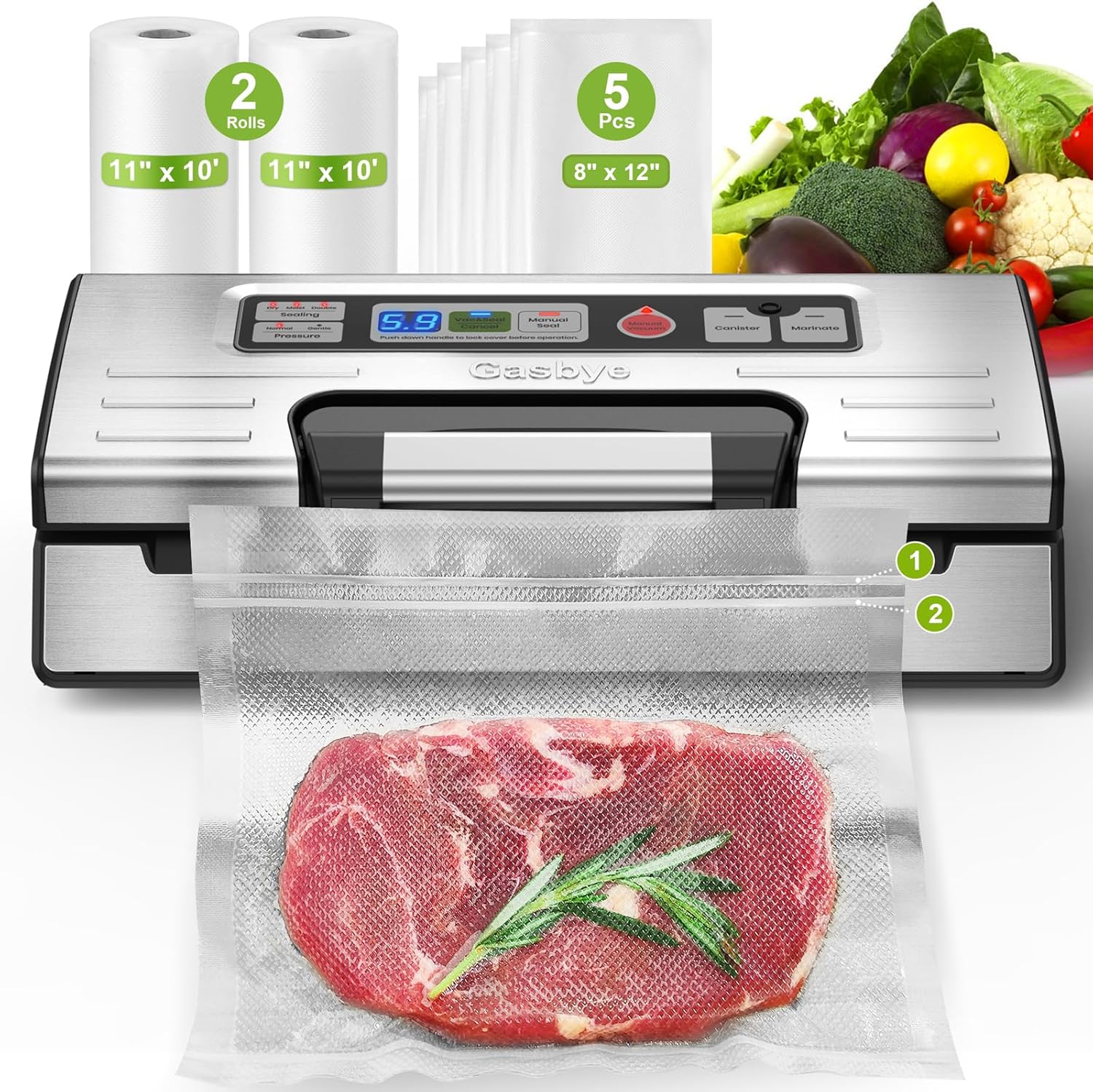
Gasbye VS5166 Vacuum Sealer
| Power Source | 95kPa Dual Pump |
|---|---|
| Operation Mode | Automatic |
| Wattage | 130 watts |
| Voltage | 120 volts |
The Gasbye VS5166 is a compact countertop vacuum sealer aimed at everyday kitchen use and light commercial tasks like portioning and storing restaurant ingredients. It uses a 95kPa dual-pump system for strong suction and offers Auto Vac & Seal plus a Pulse Mode for gentler, stepwise evacuation when you need to protect delicate foods or control liquids. The double heat-seal strips produce consistent, sous-vide-ready seals and the integrated roll storage with cutter reduces bag waste and speeds prep. Practical touches include a removable drip tray for messy items, metal handles, and a starter kit with rolls, pre-cut bags, foam gasket spares, and an external suction hose. Important limits: it is a countertop unit designed for sealed bags rather than heavy continuous commercial throughput, and while replacement parts are available, long runs in a busy restaurant kitchen may push a home-style sealer beyond intended duty cycle. For restaurants that need occasional vacuum sealing or prep-station capability, it balances performance and serviceability; high-volume kitchens should evaluate higher-duty commercial models.
Best for: Buyers who want a reliable, serviceable sealer for prep stations or lower-volume restaurant tasks and value parts availability and consistent seals.
Less Ideal for: High-volume commercial kitchens that require industrial-grade, continuous-duty vacuum sealers for nonstop sealing and large batch processing should look at dedicated commercial units instead.
- Strong 95kPa dual-pump suction for reliable air removal
- Double heat-seal strips create consistent, sous-vide-ready seals
- Pulse Mode preserves delicate or moist foods and reduces liquid draw
- Built-in roll storage and cutter reduce bag waste and speed prep
- Removable drip tray and replaceable gaskets make cleaning and maintenance easier
- Not engineered for continuous heavy commercial throughput typical of busy restaurants
- Starter kit included but additional bags and parts are required for sustained use
Verdict: A dependable, serviceable countertop sealer that delivers restaurant-quality seals and easy maintenance for low- to moderate-volume professional use.
Choosing the Right Vacuum Sealer for Restaurants: Key Factors to Consider
Sealing Speed and Cycle Time
High-volume kitchens need machines that complete vacuum and seal cycles quickly. Faster cycles mean less time per bag, which adds up across dozens or hundreds of portions. Consider both the vacuum pump speed and how fast the heating element reaches sealing temperature. A machine that handles continuous runs without requiring long cool-downs will reduce labor cost and keep prep lines moving.
Also factor in how many operations you run concurrently. If the sealer will be used on a production table during batch prep, a shorter cycle time reduces queuing. Speed matters less if the machine is for occasional sous-vide packaging, but for day-to-day portioning it becomes a primary selection metric.
Commercial Durability and Build Quality
Materials and construction determine whether a unit tolerates restaurant use. Metal housings, reinforced hinges, and heavy-duty controls resist wear better than thin plastics. Look for machines rated for extended duty cycles or specified commercial use to avoid premature failure.
Durability also influences where the unit can live. A more rugged sealer can sit on a busy prep counter or in a service area without protective handling. If you need mobility, check for stable feet and secure latch mechanisms that stand up to frequent opening and closing.
Vacuum Strength and Seal Integrity
Removing as much air as possible extends shelf life and prevents freezer burn. Strong vacuum strength yields tighter, more compact packaging and better heat transfer for sous-vide cooking. Equally important is consistent seal integrity; poorly aligned or weak seals lead to leaks and product loss.
Check specifications for maximum vacuum level and whether the sealer offers adjustable vacuum control or multiple seal passes. For liquids or delicate items, look for pulse vacuum or marinading modes that allow better control without crushing.
Bag and Roll Compatibility
Commercial kitchens use wider or heavier-gauge films and custom roll lengths to reduce per-item cost. Verify the maximum bag width and whether the unit accepts standard rolls or requires proprietary bags. Compatibility with thicker gauge material improves puncture resistance for bones and sharp-edged items.
Also consider accessories and extras such as external hose ports for jar sealing or vacuum canisters that expand functionality. The ability to use a range of bag sizes reduces waste and allows flexible portioning across menu items.
Serviceability and Maintenance
A sealer that is easy to clean and service minimizes downtime. Features like removable gaskets, accessible heating elements, and clear service panels make routine maintenance faster. Consider whether replacement parts are straightforward to swap and whether the design isolates wear parts from the rest of the unit.
Routine tasks like wiping sealing bars, changing oil in external pumps when applicable, and replacing Teflon tape should be quick. Machines that require complex disassembly for basic upkeep can lead to extended outages in a busy kitchen.
Controls and Workflow Features
User-friendly controls speed training and reduce operator errors during busy shifts. Look for tactile buttons or dials that let staff select preset cycles, adjust vacuum intensity, or choose multiple seal passes without digging through menus. Visual indicators and audible alerts help operators know when a cycle is complete or if a seal failed.
Workflow features such as an integrated cutter for rolls, automatic bag detection, or a drip tray to catch liquids can streamline common tasks and keep the workspace cleaner. Consider which convenience features will produce the most time savings in your specific kitchen setup.
Types of Vacuum Sealers Suited to Restaurants
There are a few sealer designs commonly used in foodservice. Chamber sealers enclose the bag and equalize pressure inside the chamber, which is ideal for sealing liquids, soups, and high-volume batches. External or suction sealers pull vacuum from outside the bag and are typically faster for dry goods and single-portion packaging.
Choosing the right type depends on what you package most. For sous-vide and liquid-heavy prep, a chamber machine reduces mess and ensures reliable seals. For portioning dry goods, an external sealer can be compact and quicker to operate.
- Chamber sealers: better for liquids and full trays
- External suction sealers: faster for dry items and single pouches
- Handheld or impulse sealers: limited use, not ideal for continuous commercial runs
How Vacuum Sealing Supports Food Safety and Inventory
Vacuum sealing reduces oxygen exposure, which slows aerobic spoilage and helps maintain color and texture. In a restaurant context, that translates to longer shelf life for prepped proteins, reduced trim waste, and more predictable inventory planning.
Sealed portions also make cross-contamination control easier during storage and transport. Pair vacuum sealing with proper labeling and rotation practices to ensure food safety and regulatory compliance.
- Reduces aerobic bacterial growth and oxidation
- Makes portion control and batch prep more consistent
- Supports FIFO rotation and clear labeling
Sizing and Placement in a Commercial Kitchen
Plan where the sealer will live relative to prep lines, refrigeration, and dishwash areas. A high-throughput machine should sit near production stations to avoid staff walking back and forth. Consider available counter depth and ventilation needs, especially for larger chamber machines.
If space is limited, choose a compact external sealer and use rolls to prepare multiple bag sizes. For central prep rooms that feed several stations, a larger chamber unit with higher duty cycle capacity may be a better investment.
- Place near prep or cooling areas to reduce handling time
- Allow clearance for bag loading and device ventilation
- Choose footprint based on daily bag volume
Maintenance Routines That Keep Machines Reliable
Establish a short daily checklist that includes wiping sealing bars, clearing food debris, and checking gaskets for wear. Weekly checks should verify seal bar alignment and test vacuum levels. If your unit uses an oil-lubricated pump, follow the manufacturer interval for oil changes.
Train multiple staff on basic maintenance so a single absence does not interrupt operation. Keep a small stock of common consumables such as Teflon tape, gaskets, and replacement seals to minimize downtime.
- Daily: wipe bars and clean drip trays
- Weekly: inspect gaskets and test vacuum
- Monthly: check pump oil or scheduled service items
Accessory Options That Add Value
Look for accessories that expand a sealer's usefulness. External hose kits let you vacuum-seal containers and jars. Extra-wide rollers and cutters reduce setup time when working from bulk rolls. Stackable trays and custom racks help manage batches after sealing.
Accessories are often more cost-effective than buying a second machine when you need occasional additional functionality. Choose items that integrate with your chosen sealer's attachment points and film widths.
- External hose kits for containers and canisters
- Integrated cutters for roll-based packaging
- Replacement gaskets and seal bars for quick swaps
How We Chose the Best Vacuum Sealer for Restaurants
We focused on criteria that directly affect performance in busy commercial kitchens. First, sealing speed and cycle time were prioritized because quicker cycles reduce labor bottlenecks during peak prep and support volume throughput. Second, commercial durability and build materials were a major filter, emphasizing machines with metal housings, reinforced seals, and designs rated for continuous operation. Third, vacuum strength and seal integrity were evaluated to ensure consistent oxygen removal and reliable seams that prevent leaks in refrigerated or frozen storage. Fourth, bag and roll compatibility were considered so the sealer can accommodate wide-format or heavy-gauge films commonly used in restaurants. Fifth, serviceability and ease of maintenance were included to minimize downtime, with attention to accessible gaskets and replaceable heating elements. We excluded light-duty home models that are not rated for frequent, repeated cycles or that rely on fragile plastic housings. Units lacking clear specification of cycle ratings, pump duty cycles, or commercial-grade components were not considered. The resulting shortlist reflects machines that meet commercial workload expectations and practical front-of-house or back-of-house needs.
Our full evaluation process is outlined in our review methodology.
FAQ
Can a restaurant sealer handle liquids like marinades or soups?
Yes, when you choose a chamber-style unit it handles liquids well because it equalizes pressure in the chamber and prevents liquid from being sucked out of the bag. External sealers can struggle with liquids unless you pre-freeze the contents or use a drip tray and careful technique.
How often should a commercial vacuum sealer be serviced?
Service frequency depends on usage, but routine daily cleaning and monthly inspections are common. For machines with oil-lubricated pumps, follow the service interval for oil changes. Heavy daily use may require more frequent part replacement and professional maintenance.
What bag material and thickness should restaurants use?
Restaurants usually select thicker, commercial-grade films for puncture resistance and longer-term storage. Gauge choice depends on the item packed; sharp bones need heavier gauge, while softer proteins can use mid-weight film. Compatibility with roll widths and weld length should guide selection.
Is a chamber sealer always better for sous-vide cooking?
Chamber sealers are generally better for sous-vide because they handle liquids and create uniform, reliable seals without crushing. However, for small batch or dry-only sous-vide work, an external sealer with careful technique can be adequate.
Do commercial sealers require special electrical or ventilation needs?
Some larger chamber machines have specific electrical requirements or need extra ventilation for continuous operation. Check a unit's duty cycle and installation specifications before purchase to ensure your kitchen can support the machine's operational demands.
Final Verdict
Choosing the right vacuum sealer for restaurants means balancing throughput, durability, and the types of items you package. Prioritize sealing speed and commercial build quality for high-volume operations, and favor chamber designs when liquids or sous-vide are common. Also consider ease of maintenance and bag compatibility to reduce downtime and operating cost. Decide which tradeoffs matter most for your service model: a rugged chamber unit for large-batch prep or a compact external sealer for quick portioning. Focus on the criteria above and you will select a machine that improves efficiency, reduces waste, and supports consistent food quality.