
Note: This article contains affiliate links. If you click on these links and make a purchase, we may earn a small commission at no extra cost to you. This helps support our research and content. Read our full affiliate disclosure here.
If you live in a compact apartment, tiny house, or want to add laundry to a small utility closet, a ventless washer dryer combo can be the most practical solution. These all-in-one units fit where a stacked pair or separate dryer cannot, require no external venting, and simplify installation. Choosing the right model matters because capacity, cycle length, and drying efficiency vary widely and affect how often you must run loads and how much space you need to reserve for unloading and maintenance. This guide shortlists the top ventless washer dryer combos for small spaces, focusing on compact footprint, usable capacity, and how well they dry without a vent. Below we explain the selection criteria and the features that matter so you can pick the unit that best matches your living situation and laundry habits.
Top Picks at a Glance
| Best Overall The best all-around choice for most situations | Smad All In One Washer and Dryer Combo |  |
| Best Quality Built to a higher standard if you want something more solid | LG WM3555HWA Washer/Dryer Combo |  |
| Best Value The sweet spot between price and what you get | Midea Washer Dryer Combo 2.7 cu ft |  |
| Best Budget The cheapest option that still gets the job done reliably | Nictemaw Portable Washer 17.8 lb |  |
| Top Rated A top-rated pick with lots of positive feedback | SMETA Ventless Washer Dryer Combo 2.8 cu ft |  |
| Most Popular A crowd favorite that many people choose with confidence | COMFEE' 2.7 cu.ft Washer Dryer Combo |  |
| Best Seller A high-volume bestseller chosen again and again | Hamilton Beach Washer Dryer Combo HBWD270 |  |
Smad All In One Washer and Dryer Combo

| Capacity | 2.7 cubic feet |
|---|---|
| Cycle Options | 16 cycles |
| Max Rotational Speed | 1400 rpm |
| Voltage | 120 volts |
| Installation Type | Freestanding |
The Smad All In One Washer and Dryer Combo packs a full washer and ventless dryer into a 24-inch footprint aimed at apartments, RVs, and small homes. It handles washing and drying in the same drum so you do not move loads between machines, and the LED push-button controls with 16 cycles plus delay start make scheduling simple. A 1400 RPM max spin helps remove moisture before drying, while the stainless steel drum and child lock add durability and safety for family use. Practical benefits include space savings, time savings from the integrated dry cycle, and the flexibility to set a delayed start to run laundry during off-peak hours. Expect standard ventless drying performance, which is convenient where ducting is unavailable but will generally take longer than a vented dryer and may not match the capacity or speed of full-size separate units. Installation needs 25 mm clearance and removal of transport bolts, and the unit is freestanding so it fits into compact laundry areas without special framing.
Best for: Buyers who need a space-saving, single-unit solution for apartments, tiny homes, or RVs and value convenience and scheduling flexibility over highest drying speed.
Less Ideal for: Households that routinely wash large loads, bulky bedding, or need fastest possible drying times should consider full-size separate washer and vented dryer setups instead.
- Combines washing and ventless drying in one compact footprint for small spaces
- 16 cycles and LED push-button controls offer flexibility for different fabrics
- 1400 RPM spin speed reduces drying time by extracting more water
- Stainless steel drum improves durability and resists corrosion
- Ventless drying is slower and less efficient than vented dryers
- Not ideal for very large or heavy bedding loads due to compact capacity
Verdict: If you need a true space-saving ventless washer-dryer that performs both wash and dry cycles reliably in tight laundry areas, this Smad combo is a practical all-in-one choice.
LG WM3555HWA Washer/Dryer Combo

| Capacity | 2.4 cubic feet |
|---|---|
| Number of Washing Cycles | 14 |
| Number of Drying Cycles | 1 |
| Maximum Rotational Speed | 1400 RPM |
| Operation Mode | Automatic |
The LG WM3555HWA combines a front-load washer and ventless dryer in a single 24-inch unit aimed at apartments and other tight laundry spaces. It offers 14 wash cycles plus a steam Allergiene option and sensor-driven drying that adapts run time to fabric moisture, which helps avoid over-drying in ventless setups. The stainless steel drum and TrueBalance design target quieter operation and longer life, while Wi‑Fi and the ThinQ app let you start and monitor loads remotely. Performance-wise the 2.4 cu ft capacity and 1400 rpm spin speed deliver good cleaning for small to medium loads, though the single drying cycle and ventless drying mean longer dry times compared with vented dryers. Installation is simplified by included water hoses and a power cord, but its compact capacity limits large bedding or bulky items. For buyers prioritizing space savings, smart controls, and strong wash performance in a ventless package, this unit does the job; for heavy frequent drying needs expect slower dry cycles.
Best for: Buyers who need a compact, space-saving washer/dryer combo that delivers reliable wash performance and smart connectivity for apartment or small‑home laundry routines.
Less Ideal for: Homes that regularly need to dry large batches, bulky bedding, or want fast vented-dryer speed should look at larger or vented dryer options instead.
- Space-saving all-in-one ventless design fits 24-inch laundry closets
- Wi‑Fi and ThinQ app allow remote start, monitoring, and notifications
- 14 wash cycles plus steam Allergiene cycle for allergen reduction
- Stainless steel drum and TrueBalance system for quieter, durable operation
- Single drying cycle and ventless drying produce longer dry times than vented dryers
- 2.4 cu ft capacity limits large or bulky loads
Verdict: Choose this LG combo when you need a compact ventless unit that maximizes wash performance and smart features for small-space living.
Midea Washer Dryer Combo 2.7 cu ft

| Capacity | 2.7 cubic feet |
|---|---|
| Maximum Rotational Speed | 1400 rpm |
| Number of Washing Cycles | 14 |
| Number of Drying Cycles | 2 |
| Voltage | 120 volts |
The Midea Washer Dryer Combo is a space-saving all-in-one front-load washer and ventless dryer aimed at apartments, RVs, or small households. It washes and dries in a single cycle so you do not need to move loads between machines, and offers 14 wash programs plus two drying cycles to handle delicate, heavy duty, steam care, quick wash, and overnight wash-and-dry needs. The unit runs on a standard 120V outlet and uses a BLDC inverter motor designed for quieter, more efficient operation; annual energy consumption is listed at 90 kWh. Controls are push-button style with a concise panel and practical options like add-garment and child lock. Because it is ventless, installation is simpler where external venting is not possible, though dryer times are longer than vented dryers and combined cycles can take several hours. The 2.7 cu ft drum suits small to medium loads but will be tight for bulky bedding. For buyers who prioritize convenience and minimal installation, this provides a capable, energy-conscious single-unit solution.
Best for: Buyers who need a simple, space-saving laundry solution for small homes or rentals and who prefer low-installation, energy-conscious appliances with versatile cycle options.
Less Ideal for: Large households that need frequent big loads, heavy bedding, or fast drying performance should consider separate washer and vented dryer setups instead.
- Washer and dryer in one unit eliminates transferring loads
- Ventless design works without external venting
- Wide range of programs including steam care and quick wash
- Runs on 120V outlet for easy installation
- BLDC inverter motor for efficient, quieter operation
- Combined wash-and-dry cycles and ventless drying take longer than separate vented machines
- 2.7 cu ft capacity may be small for bulky or large household loads
Verdict: A compact, easy-to-install all-in-one washer and ventless dryer that fits small spaces and eliminates moving loads while offering energy-conscious operation.
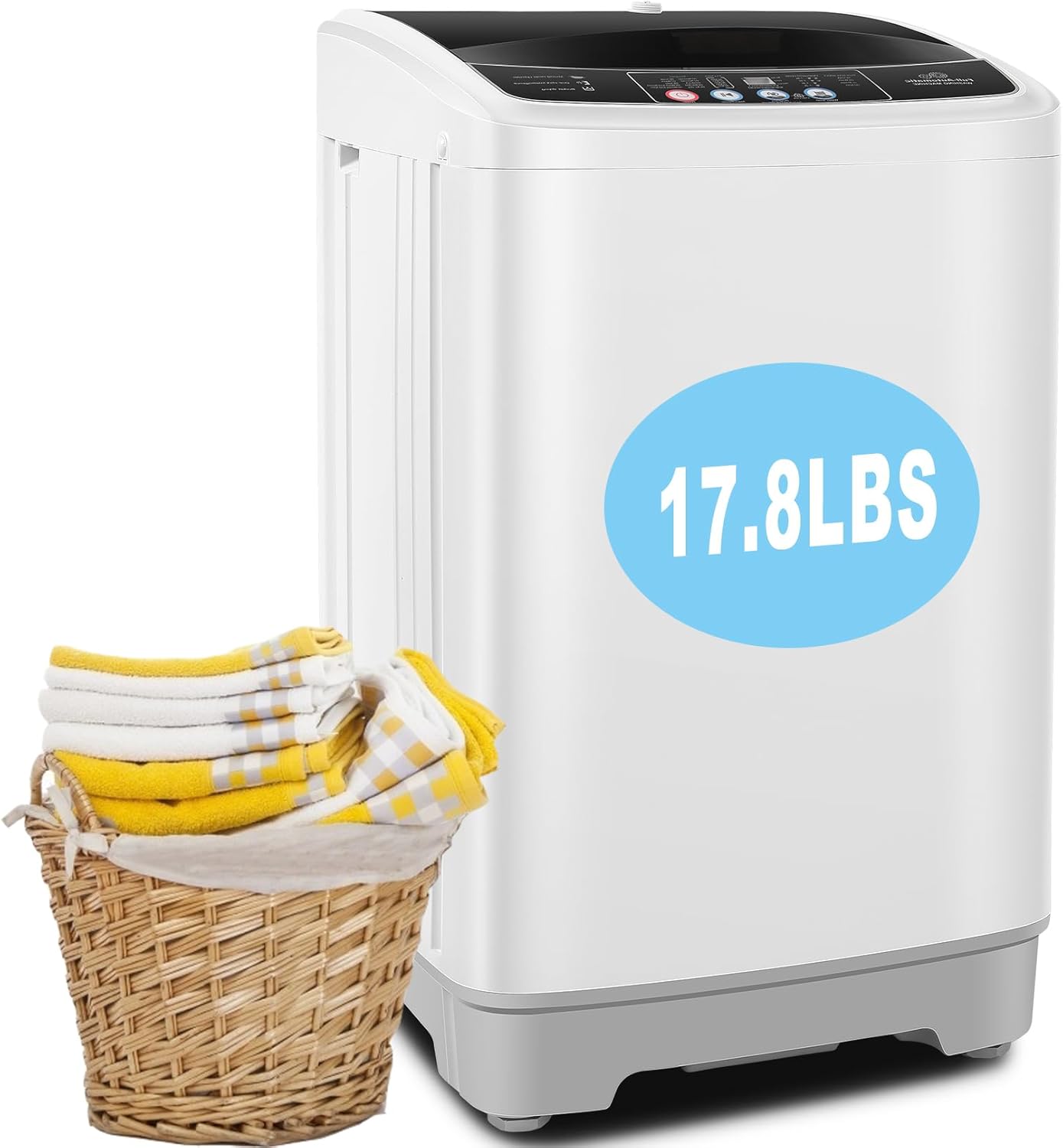
Nictemaw Portable Washer 17.8 lb
| Capacity | 17.8 pounds |
|---|---|
| Number of Programs | 10 |
| Display | LED |
| Operation Mode | Fully Automatic |
| Voltage | 110 volts |
The Nictemaw portable washer is a space-saving top-load machine that combines washing and spin-drying in a single unit for small homes, RVs, or apartments. You select one of 10 programs, pick from eight water levels and use the LED control panel to set delay or child-lock functions, then the machine fills, washes and drains automatically using the included faucet adapter and built-in drain pump. The stainless steel honeycomb drum and automatic unbalance detection help protect garments and reduce vibration during spin cycles, while the adjustable feet let you level the unit on imperfect floors. Practical conveniences include a transparent lid for monitoring, a 24-hour delay timer and a cover, drain hose and faucet adapter in the box. Because it is a compact portable washer rather than a full-size stacked ventless combo, expect longer cycle times and more limited simultaneous drying performance; heavy loads may require smaller batches and careful distribution to avoid extra vibration. For tight spaces that need a budget-friendly, no-install laundry solution, this unit covers the basics well.
Best for: Buyers needing an inexpensive, no-install laundry solution for small spaces like studios, dorms, RVs or apartments who prioritize compact footprint and basic wash-and-spin capability.
Less Ideal for: Households that need full dryer performance, large weekly loads, or faster cycle throughput should consider a larger washer or a true ventless washer-dryer instead.
- Full-automatic washer with separate wash and spin functions for basic drying
- Built-in drain pump and extended drain hose allow flexible drainage without special plumbing
- 10 programs, 8 water levels and LED controls give useful wash options for different fabrics
- Stainless steel drum and auto unbalance detection reduce wear and vibration during spin
- Spin-drying is limited compared with standalone dryers so items may come out damp
- Compact capacity means you need to do smaller loads or more frequent cycles
Verdict: A budget-friendly, compact washer with built-in pump and useful program options that fits tight spaces and handles small loads without installation.
SMETA Ventless Washer Dryer Combo 2.8 cu ft

| Capacity | 2.8 cubic feet |
|---|---|
| Voltage | 110 volts |
| Number of Washing Cycles | 16 |
| Number of Drying Cycles | 16 |
| Spin Speed | 1400 RPM |
This SMETA ventless washer dryer combo combines a front-load washer and dryer into a single 24" unit intended for apartments, RVs, and other tight spaces. It handles washing and drying without an external vent by using a constant-temperature drying system that is gentler on fabrics, and the stainless steel drum with 1400 RPM spin speed reduces drying time and improves extraction. Controls are manual with a knob interface and the machine offers flexible adjustments for rinse count, spin speed, and water temperature plus useful functions like child lock, add-a-garment, and quick wash. The unit is relatively easy to place thanks to its compact footprint and includes drain hose and power cord. Expect moderate noise and low vibration if the transport bolts are removed before use, and drying capacity is limited compared with full-size machines so multiple small loads may be needed for larger households. This is a practical, space-saving solution when you need standalone wash-and-dry capability where a vented dryer is not feasible.
Best for: Buyers who need a reliable, space-saving washer and dryer that can be installed without a vent and prefer a straightforward, manually controlled machine for everyday small-load laundry.
Less Ideal for: Large households that do many bulky loads or users who expect full-size dryer speed and capacity should look at larger vented or stacked units instead.
- Ventless all-in-one design fits tight spaces and does not require an external vent
- 2.8 cu ft stainless steel drum with 1400 RPM spin reduces drying time and improves cleaning
- Sixteen wash and sixteen dry programs cover delicate, bulky, baby, and quick cycles
- Constant-temperature drying helps prevent overheating and fabric damage
- Simple manual knob controls and adjustable rinse/spin/temperature settings for straightforward operation
- Drying capacity and speed are smaller than full-size vented dryers, so larger loads may require multiple cycles
- Requires removal of transport bolts to minimize vibration and noise before first use
Verdict: A practical ventless washer-dryer combo that delivers reliable, gentle wash-and-dry performance in very small spaces where a vented dryer is not an option.
COMFEE' 2.7 cu.ft Washer Dryer Combo

| Capacity | 26 pounds (wash), 13 pounds (dry) |
|---|---|
| Voltage | 120 volts |
| Maximum Rotational Speed | 1400 rpm |
| Annual Energy Consumption | 90 kilowatt hours per year |
| Number of Washing Cycles | 8 |
This COMFEE' combo combines a 2.7 cu.ft washer and integrated ventless dryer so you can wash and dry in one uninterrupted cycle, which is useful for small households or tight spaces. It offers 8 wash cycles plus a dedicated dry cycle, steam care to reduce allergens and wrinkles, a wool setting, quick 36-minute wash, delay start and a child lock for convenience. The inverter brushless motor is marketed for quieter, more energy-efficient operation and the machine supports adding garments mid-cycle. Practical features like overnight wash-and-dry and a timed dry option make it easy to set laundry before bed and have it ready by morning without moving loads. Limitations to consider are the moderate 26 lb wash / 13 lb dry capacity that makes it better suited to smaller or partial loads rather than a full family week of laundry, and the single drying cycle option limits flexibility for delicate or heavy items. Buyers should also note the unit is relatively heavy and requires proper installation and removal of transport bolts before use.
Best for: Practical buyers who need a space-saving, energy-conscious laundry solution that can handle frequent small to medium loads and streamline chores for a busy household.
Less Ideal for: Large families who need to dry large loads at once or users who require separate full-size washer and dryer cycles for heavy bedding or substantial weekly laundry volumes.
- All-in-one wash and ventless dry cycle eliminates moving clothes between machines
- Steam care reduces allergens and helps cut wrinkles and odors
- Brushless inverter motor for quieter, more energy-efficient operation
- Multiple programs including quick wash, wool care, delay start and add-garment function
- Drying capacity is smaller than washing capacity, limiting full-load drying
- Only one drying cycle choice reduces control over drying intensity and fabric-specific care
Verdict: Buy this if you want a compact, energy-conscious all-in-one that washes and dries small to medium loads overnight to simplify laundry for a busy household.
Hamilton Beach Washer Dryer Combo HBWD270

| Capacity | 2.7 cubic feet |
|---|---|
| Maximum Rotational Speed | 1300 rpm |
| Number of Washing Cycles | 16 |
| Number of Drying Cycles | 4 |
| Annual Energy Consumption | 22 kwh |
The Hamilton Beach HBWD270 combines a washer and dryer in a single 24-inch unit, offering a space-saving solution for small homes and apartments. It handles laundry with 16 wash cycles, 4 drying cycles, five temperature settings and a delay-start function controlled from a top LED display. The 2.7 cu ft stainless steel drum is relatively large for a compact combi and the motor supports an extra-wide spin up to 1300 rpm to reduce drying time. Practical benefits include programmable starts, a variety of cycle choices for delicates and heavy loads, and a front-load layout that fits tight laundry closets. Expect typical compact-combo limits: drying capacity and speed are constrained compared with separate full-size machines, and overall cycle times can be longer since drying follows washing in the same drum. Noise is claimed to be under 72 dB at spin, which helps for apartments, though real-world sound will vary by installation. For buyers prioritizing space savings and an all-in-one workflow, this unit delivers many convenience features, but those needing faster heavy-duty drying or higher throughput should consider separate appliances.
Best for: Buyers who need a compact, single-unit laundry solution for small living spaces and prioritize convenience and a range of cycle options over high-volume throughput.
Less Ideal for: Households that require fast turnaround for large loads or professional-level drying performance should choose separate full-size washer and dryer units instead.
- Space-saving all-in-one design suitable for small homes and apartments
- Relatively large 2.7 cu ft stainless steel drum for a 24-inch combo
- Multiple cycles and five temperature settings for flexible fabric care
- Delay-start and LED digital controls for convenient scheduling
- Drying performance is limited compared with separate full-size dryers
- Cycle times can be long since washing and drying share the same drum
Verdict: Choose this combo if you need a feature-rich, space-saving washer and dryer that handles varied cycles in one compact unit.
Choosing the Right Ventless Washer Dryer Combo for Small Spaces: Key Factors to Consider
Usable Capacity
Capacity determines how much laundry you can wash and dry in a single cycle, which is especially important when space limits how often you run machines. In small spaces, a nominal capacity number can be misleading because bulky fabrics take more volume. Consider both the manufacturer capacity and real-world load examples such as towels or bedding. Smaller tubs mean more frequent loads, so think about whether you need a model that handles medium-sized loads without excessive drum crowding.
Also factor in how drying works in a combo. Ventless drying typically uses heat and condensation or heat-pump technology, which reduces usable drying volume during the dry phase. That can extend cycle times or require partially drying loads then air-drying. Match capacity expectations to your laundry habits to avoid repeated cycles that offset the convenience of a compact unit.
Drying Efficiency and Cycle Time
Ventless machines dry without outside venting by condensing moisture or using a heat pump. Drying efficiency affects how long a load takes and whether garments come out fully dry. For small-space living, long dry cycles can be inconvenient if you have limited access to the appliance or shared space schedules. Prefer machines with efficient heat exchange or moisture-sensing cycles that stop when clothes are dry.
Also check for cycle options that let you prioritize faster partial dries for everyday wear versus longer full-dry cycles for towels. Understand that heat-pump style ventless dryers generally use less energy and may preserve fabrics better, but they sometimes come with longer dry times compared with high-heat condensing cycles.
Footprint and Installation Flexibility
Small spaces demand careful measurement. Footprint includes the unit's width, depth, height, and required clearance for doors and vents. Pay attention to door swing direction and whether the unit fits through hallways and stairwells at delivery time. Installation flexibility covers water hookup position, drain accessibility, and whether a condensate drain or pump is required. Some ventless combos need a dedicated floor drain or an elevated drain location to operate properly.
Also consider whether the unit can be stacked or recessed into a shallow alcove. Units with built-in pumps or compact condensers reduce installation constraints. If the machine will sit near living areas, check recommended clearances for ventless heat expulsion or condensate containers so routine maintenance is straightforward.
Energy and Water Consumption
Energy and water use influence ongoing operating costs and environmental impact, and they matter in apartments where utility allowances are limited. Ventless drying methods differ in efficiency. Heat-pump drying uses less electricity than resistance-based condensing dry cycles but may take longer. Washing efficiency is also critical since smaller units can use more water per pound if not optimized.
Look for machines with measured consumption figures for standard cycles and options like eco modes or load-sensing wash programs. For small-space dwellers who want to reduce laundry frequency, more efficient cycles help balance utility use with convenience. Also consider wash temperatures and whether cold-water cycles clean effectively to minimize energy use.
Noise and Vibration
Noise matters when the appliance shares walls with living or sleeping spaces. Washers with poor vibration control can transfer sound to floors and walls, making them unsuitable for apartments. Check for features like anti-vibration suspensions, balanced drums, and low-dB ratings for both wash and dry cycles. Consider the timing of cycle stages; spin cycles are usually the loudest and may be disruptive at night.
Vibration also affects long-term fitment in small installations. Machines that skid or rattle can damage cabinetry or cause misalignment in stacked installations. If possible, include vibration-dampening pads and verify the unit's leveling feet are accessible in the planned location.
Maintenance and Accessibility
Maintenance needs are amplified in tight spaces where accessing filters, lint traps, and service panels can be difficult. Ventless combos often have condensate filters, pumps, and lint traps that require regular cleaning. Units that offer easy front access to service points reduce downtime and the chance of issues developing.
Consider how often routine tasks like cleaning drain filters, emptying condensate tanks, or running descaling cycles are required. Choose a unit whose maintenance intervals and access match your willingness to perform upkeep in a confined spot, and make sure replacement parts are straightforward to reach if a service visit becomes necessary.
Space-Saving Installation Tips
Plan the installation as if it were a small appliance kitchen. Measure not only the machine but the path to the final location, including doorways, stairs, and the opening needed to pull laundry in and out. Reserve enough front clearance for door swing and access to controls. If space is very tight, look for units with reversible doors or doors that open flat to avoid bumping into nearby fixtures.
Consider whether a recessed cabinet or alcove can be built to house the unit. Allow for ventilation around a ventless condenser and access to the condensate container or drain. If stacking is necessary, confirm the manufacturer allows stacking and that stacking hardware fits within your cabinet depth.
- Measure intake and egress clearances before purchase
- Verify door swing and control accessibility
- Plan for condensate drain routing and pump placement
- Use anti-vibration pads for stacked or cabinet installations
Laundry Routines That Reduce Dry Time
Small-space users can often shorten dry cycles by adapting laundry habits. Start with a proper spin cycle to extract as much water as possible, and avoid overloading the drum which traps moisture. Switching to smaller, more frequent loads can reduce total drying time compared with infrequent oversized loads.
Using moisture-wicking fabrics and separating heavy items like towels from lightweight garments prevents uneven drying. For items that retain moisture, consider a short air-fluff or timed cool-down phase to reduce wrinkling rather than relying on prolonged heat cycles.
- Run a high-speed spin before drying
- Split heavy fabrics into separate loads
- Avoid overfilling to improve airflow
- Use moisture-sensing cycles when available
Ventless Drying Technologies Explained
There are two common ventless drying approaches used in combo units: condensate drying and heat-pump drying. Condensate dryers heat air and remove moisture by condensing it into a reservoir or drain. These systems are typically simpler and faster for some loads but can be less energy efficient.
Heat-pump drying recirculates heat and extracts moisture using a refrigerant cycle. These systems use less energy and operate at lower temperatures, which can be gentler on fabrics, but they often have longer cycle times. For small spaces where utility costs or fabric care are priorities, heat-pump options are worth considering despite potentially longer dries.
- Condensate drying: faster, often higher energy use
- Heat-pump drying: more efficient, gentler on clothes
- Moisture sensors can prevent over-drying
Noise Management in Tight Living Areas
Noise control starts with product placement. Place the unit on a solid, level surface and use vibration-dampening pads to reduce transmission. If the appliance sits near living areas, build a small sound-insulating enclosure that still allows access to filters and doors. Keep in mind that while some models advertise low dB numbers, actual perception depends on proximity and room acoustics.
Schedule heavy cycles for times when noise is less disruptive. For multiunit dwellings, communicate with neighbors if you expect to run loud spin cycles during quiet hours. Regular maintenance such as tightening bolts and cleaning drains can also reduce rattles and mechanical noise over time.
- Use anti-vibration pads under the machine
- Ensure the appliance is fully level
- Allow service access while insulating for sound
- Run noisy cycles during daytime hours
When a Ventless Combo Is Not the Right Choice
Although ventless combos are excellent for compact living, they are not ideal for every situation. If you do large loads frequently, have bulky bedding, or need very fast dry times, a separate vented dryer or a larger stacked configuration may be more practical. Ventless drying typically increases cycle time, which can add up if you do laundry daily.
Also consider installation constraints. If your space does not allow for routine access to condensate drains or requires complex plumbing changes, the simplicity advantage can be lost. Be honest about your typical laundry volume and whether the tradeoffs in drying time and capacity align with your expectations.
- Not suited for frequent large loads or bulky bedding
- Longer dry times can be impractical for daily heavy use
- Requires accessible condensate handling or drain
- Consider alternatives if installation would be complex
How We Chose the Best Ventless Washer Dryer Combo for Small Spaces
We focused on attributes that most directly affect how well a ventless washer dryer combo performs in tight quarters. Primary evaluation criteria included usable laundry capacity, drying efficiency for ventless systems, footprint and installation flexibility, energy and water use, and cycle variety and convenience features. We also considered noise levels for apartment living and ease of maintenance since hard-to-access components add friction in small spaces. Our shortlisting filtered out units that require an external vent or need extensive installation work that negates the space-saving benefits. We excluded specialty commercial machines and models with unacceptably long dry times for typical household loads. Final picks were chosen based on whether a unit balanced compact dimensions with enough capacity to be practical, delivered consistent ventless drying performance, offered sensible cycle options, and kept energy and water use reasonable for frequent use.
Our full evaluation process is outlined in our review methodology.
FAQ
How long do ventless dryer cycles usually take?
Dry times vary widely but are generally longer than vented dryers. Expect mixes of 60 to 150 minutes depending on load size, fabric type, and whether the unit uses a heat pump or a condensing method.
Do ventless washer dryer combos need a special drain?
Some ventless combos can use a standard drain, while others require an elevated drain or a condensate pump. Check the installation requirements for condensate routing before purchase and ensure the location allows easy access for maintenance.
Can I put a ventless combo inside a cabinet or closet?
Yes, many ventless units are designed for closet installations, but you must leave space for door swing, ventilation around the condenser, and access to filters or the condensate tank. Follow the manufacturer's clearance recommendations closely.
Are ventless combos more energy efficient than separate machines?
Not always. Modern heat-pump ventless combos can be more energy efficient for drying than resistance-based condensing systems, but overall efficiency depends on the wash cycle technology, load size, and how often you run the machine.
How do I reduce odors in a small-space washer dryer combo?
Prevent odors by leaving the door slightly ajar between uses to let the drum dry, clean the detergent drawer and seals regularly, and run a maintenance wash on a hot cycle periodically. Removing wet loads promptly after cycles also helps.
Final Verdict
Choose a ventless washer dryer combo by balancing usable capacity, drying performance, and installation practicality for your small space. Prioritize units that offer enough usable drum volume for your typical loads, efficient drying methods or moisture sensors to avoid repeat cycles, and straightforward condensate management that fits your layout. Accept tradeoffs such as longer dry times in exchange for space savings, and plan laundry routines that reduce drying duration. With careful measurement and attention to capacity and energy use, a ventless combo can provide convenient, compact laundry without sacrificing household workflow.