
Note: This article contains affiliate links. If you click on these links and make a purchase, we may earn a small commission at no extra cost to you. This helps support our research and content. Read our full affiliate disclosure here.
Choosing the right wall heater matters because it affects comfort, energy use, and how a room integrates with your home's layout. A properly sized and installed unit brings steady warmth to a specific space without taking floor space or requiring major remodeling. This guide covers the top shortlisted wall heaters available for typical residential rooms, focusing on dependable heat output, installation requirements, safety features, and operating efficiency. You will find practical notes on what makes each style suitable for different room sizes and installation situations. Read on for our top picks and the criteria we used to evaluate them.
Top Picks at a Glance
| Best Overall The best all-around choice for most situations | GiveBest Wall Heater UPH300M |  |
| Best Quality Built to a higher standard if you want something more solid | Cadet Energy Plus Wall Heater CEC163TW |  |
| Best Value The sweet spot between price and what you get | Dreo Smart Wall Heater WH719S |  |
| Best Budget The cheapest option that still gets the job done reliably | Ontel Handy Heater Turbo 800 |  |
| Top Rated A top-rated pick with lots of positive feedback | Lueptexx Wall Panel Heater |  |
| Most Popular A crowd favorite that many people choose with confidence | Heat Storm Phoenix HS-1500-PHX-WIFI |  |
| Best Seller A high-volume bestseller chosen again and again | DREO Smart Wall Heater DR-HSH017S |  |
GiveBest Wall Heater UPH300M

| Heat Output | 1500 watts |
|---|---|
| Heating Coverage | up to 200 square feet |
| Heating Element | PTC |
| Number of Speeds | 3 |
| Voltage | 120 volts_of_alternating_current |
The GiveBest UPH300M is a wall-mounted 1500W electric heater intended as a primary heater for well-insulated rooms up to roughly 200 square feet. It combines Wi‑Fi app control, a physical remote and a touch LED panel so you can preheat from your phone, change modes from the couch, or use on-unit controls. The heater uses a PTC element and offers three heat settings plus an ECO mode and a built-in thermostat to cycle power for steadier temperatures and lower energy use. Installation hangs on wall hooks for a clean, space-saving profile and the unit includes tip-over and overheat protections and flame-retardant materials for safety. Practical limits are its coverage cap—it is best for single rooms rather than open-plan or large spaces—and ECO mode may produce noticeable temperature cycling in poorly insulated spaces. For buyers who want a compact, connected wall heater that balances convenience, safety and efficient heat for a bedroom or office, this model is a solid option.
Best for: Buyers who want a compact, connected wall heater for a single room—bedroom, office, bathroom or garage—and value remote scheduling, multiple control methods and built-in safety.
Less Ideal for: People seeking to heat large open areas, poorly insulated spaces, or whole-floor coverage should choose a higher-capacity or central heating solution.
- Multiple control options: Wi‑Fi app, included remote and touch panel for flexible operation
- Space-saving wall-mounted design keeps floors clear and installs with included template and hooks
- Energy-saving ECO mode and built-in thermostat to reduce power consumption
- Safety features include ETL-listed protections, overheat and tip-over safeguards and flame-retardant materials
- Effective heating limited to rooms up to about 200 sq ft, so not suitable as a whole-house solution
Verdict: A compact, safety-minded 1500W wall heater with Wi‑Fi and remote control that is a strong choice for heating a single well-insulated room.
Cadet Energy Plus Wall Heater CEC163TW

| Heating Coverage | 30 square feet |
|---|---|
| Heat Output | 1500 watts |
| Heating Method | fan & forced air |
| Power Source | Electric |
| Special Features | Programmable Thermostat |
The Cadet Energy Plus is a hardwired wall heater aimed at keeping small rooms comfortable with efficient, controlled heat. It installs flush into a wall can and automatically senses 120, 208, or 240 V to deliver 1000, 1500, or 1600 watts respectively, so it works without manual voltage configuration. The large backlit digital thermostat and programmable modes let you set and hold temperature within about 1 degree, while the variable‑speed fan reduces loud cycling and provides a fan‑only option for year‑round air circulation. Practical benefits include a quieter motor than older wall heaters, tamperproof controls to limit settings, and a high‑temperature safety shutoff. The unit is intended for single rooms roughly matching the stated 30 square feet coverage and is best suited to a permanent, hardwired installation by an electrician. Limitations are that it is a dedicated wall heater so it requires compatible wall can mounting and wiring, and it is not portable or suitable for large open spaces.
Best for: Buyers who need a permanent, wall‑mounted heating solution for a small room and prioritize precise temperature control and energy efficiency.
Less Ideal for: People seeking a portable heater or a unit to warm large open areas should look at alternative heating options.
- Auto‑sensing multi‑volt design eliminates manual voltage setup and adapts to 120/208/240 V supplies
- Backlit digital thermostat with programmable modes for precise temperature control within 1 degree
- Variable‑speed, quiet fan reduces noisy cycling and includes fan‑only mode for air circulation
- Tamperproof settings and high‑temperature safety shutoff enhance safe long‑term use
- Requires hardwiring and compatible wall can for installation by a qualified electrician
- Rated heat output is intended for small rooms and will not efficiently heat larger spaces
Verdict: Choose the Cadet Energy Plus when you want a permanently mounted wall heater that holds temperature tightly and cuts energy use with an intelligent fan and digital thermostat.
Dreo Smart Wall Heater WH719S

| Heat Output | 1500 watts |
|---|---|
| Heating Method | Forced Air, PTC |
| Heating Coverage | 200-750 sq.ft. |
| Voltage | 120 volts |
| Min-Max Temp | 41 °F – 95 °F |
The Dreo WH719S is a wall-mounted 1500W ceramic (PTC) space heater designed to warm bedrooms and living spaces with targeted airflow. It uses a forced-air fan and 120° vertical oscillation to spread heat rather than concentrating it in one spot, and the adjustable electronic thermostat lets you set temperatures between 41 and 95°F in 1°F increments for precise control. Smart features include Wi‑Fi app control, Alexa/Google voice commands, a 24-hour timer and a handheld remote, which make scheduling and remote adjustments straightforward. Installation is intended for permanent wall mounting and the package includes an accessory kit and drilling guide to simplify setup. The heater also offers a reusable filter and a dimmable display for low-light bedrooms. Expect quick warm-up in smaller rooms and useful supplemental heat in larger spaces, but remember it is an electric 1500W unit so it is not a whole-house solution and requires a nearby 120V circuit; fan noise is low but present. Overall it balances efficient, controllable heat delivery with modern smart conveniences for room-level heating needs.
Best for: Buyers who want a reliable, room-focused wall heater with precise temperature control and smart scheduling to optimize comfort and energy use.
Less Ideal for: Homes needing whole-house heating or users who require a portable heater that can be moved between rooms.
- 120° vertical oscillation helps distribute heat more evenly across a room
- Precise electronic thermostat with 1°F increments for accurate temperature control
- Wi‑Fi, app control and voice assistant compatibility for remote scheduling and automation
- Includes remote, 24-hour timer and reusable filter for convenient everyday use
- Requires wall mounting and a permanent 120V installation, not portable
- 1500W output is strong for a room but not intended as a whole-house heating solution
Verdict: A smart, wall-mounted 1500W heater that gives precise, app-enabled room heating and wide oscillation for even warmth.
Ontel Handy Heater Turbo 800

| Heating Coverage | 250 sq ft |
|---|---|
| Heat Output | 800 watts |
| Number of Speeds | 3 |
| Min Temperature Setting | 60 °F |
| Max Temperature Setting | 90 °F |
The Ontel Handy Heater Turbo 800 is a plug-in ceramic space heater that delivers targeted warmth for small rooms up to about 250 sq ft. It mounts directly into a wall outlet so there are no trailing cords, and it offers three fan speeds, an adjustable thermostat (60 to 90°F) and a programmable 12-hour timer for scheduled run times. Ceramic heating provides fairly quick, quiet output and the unit includes auto shut-off and cool-touch housing for safety. Its 800-watt heat output makes it energy efficient for spot heating a bedroom, office, or bathroom rather than trying to heat an entire home. Trade-offs are the limited coverage and fixed plug form factor which blocks the outlet while installed and limits placement. For budget buyers who want simple, no-fuss supplemental heat in small spaces, this is a practical, space-saving option with useful controls and safety features.
Best for: Buyers seeking an inexpensive, low-maintenance supplemental heater for a single room who prioritize compactness and simple programmable controls.
Less Ideal for: Homes that need whole-room or whole-house heating, or users who require flexible placement and dual-outlet access where the plug would block the socket.
- Plugs directly into wall to eliminate cords and save floor space
- Adjustable thermostat and 12-hour programmable timer for personalized schedules
- Quiet ceramic heating suitable for bedrooms and offices
- Auto shut-off and cool-touch housing enhance safety
- Lightweight and portable for moving between rooms with an outlet
- 800-watt output limits effectiveness to small rooms and spot heating
- Built-in plug limits placement and blocks the outlet while in use
Verdict: A wallet-friendly, plug-in ceramic heater that delivers quiet, programmable spot heating for small rooms.
Lueptexx Wall Panel Heater

| Heat Output | 1500 watts |
|---|---|
| Heating Method | Convection |
| Heating Coverage | 150-300 sq.ft |
| Power Source | Electric |
| Voltage | 120 volts |
The Lueptexx Wall Panel Heater is a slim, 1500W convection unit built for steady, quiet room heating without a fan. It mounts to the wall or can be rolled on included wheels for temporary placement and uses convection to distribute heat across spaces of roughly 150 to 300 square feet. Controls include an LED touch display, a remote control, an ECO mode and a 24-hour timer for scheduled operation, and safety features include overheat and tip-over protection plus a child lock. The aluminum frame and fanless design make it unobtrusive in bedrooms or home offices and help keep operation silent. Because it is convection-based, it warms a room gradually rather than delivering instant blast heat, so it is best for maintaining steady comfort rather than quick spot heating. Expect standard 120V electrical compatibility and simple control rather than advanced smart-home integration.
Best for: Buyers who prioritize dependable, quiet room heating and want a simple, build-quality wall-mounted heater for daily use in living spaces or home offices.
Less Ideal for: People who need immediate, high-output spot heat or who require app-based smart controls should consider other heater types or models.
- Fanless convection design provides very quiet operation suitable for bedrooms and offices
- Digital LED controls plus remote and 24-hour timer for easy scheduling and adjustments
- Safety features including overheat and tip-over protection and child lock
- Wall-mountable with included wheels for occasional portability
- Convection heating warms spaces gradually and is not ideal for rapid spot heating
- No smart-home connectivity for remote control beyond the included remote
Verdict: A quiet, build-quality wall panel heater that reliably maintains comfortable temperatures in medium-sized rooms without fan noise.
Heat Storm Phoenix HS-1500-PHX-WIFI
| Power | 1500 watts |
|---|---|
| Voltage | 110 volts |
| Heating Coverage | 150 ft² primary, 750 ft² secondary |
| Heating Method | Infrared |
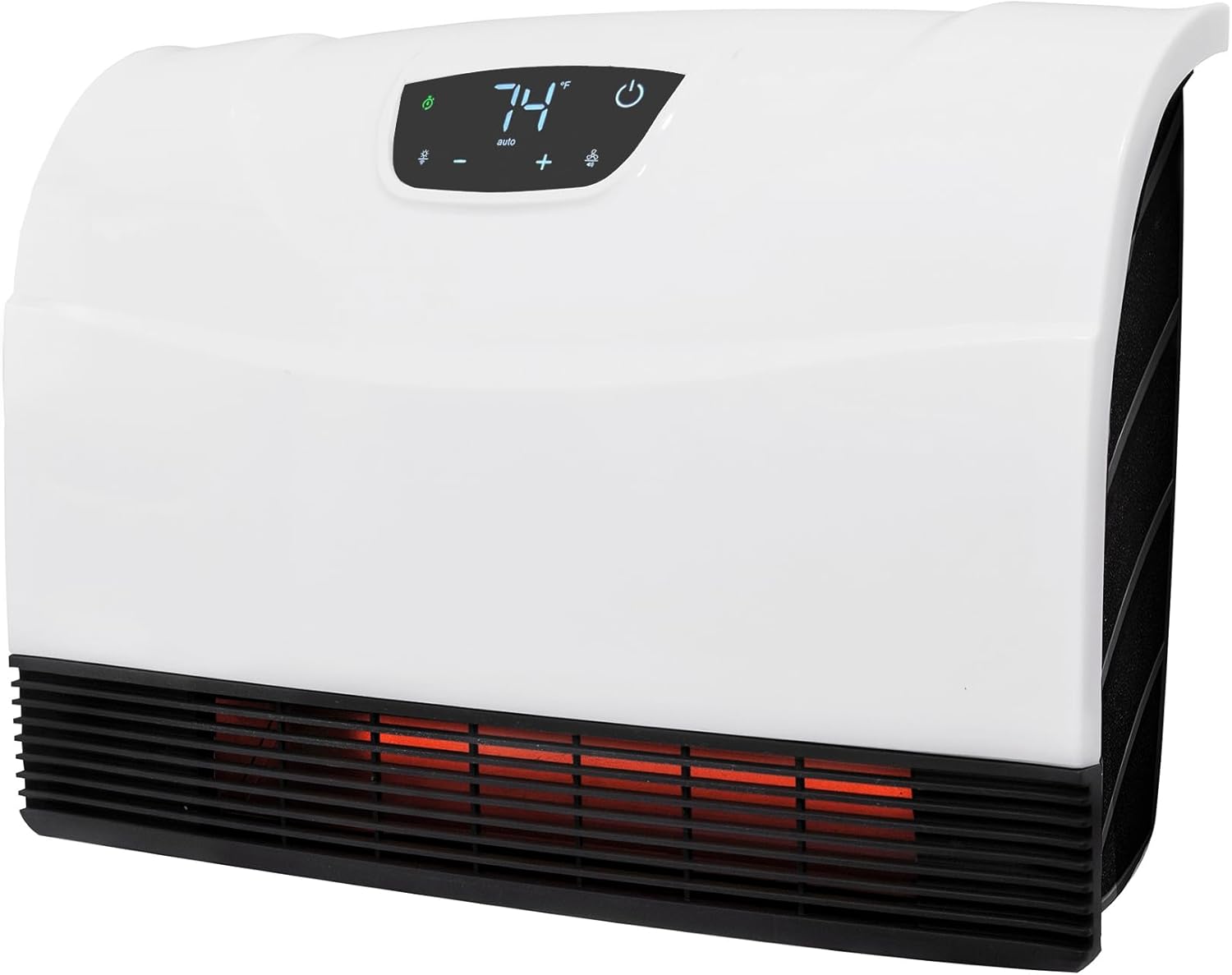
The Heat Storm Phoenix HS-1500-PHX-WIFI is a wall-mount infrared heater intended to provide zone heating for bathrooms, bedrooms, home offices, and small garages. It delivers 1500 watts of radiant heat and is designed to save floor space by mounting to the wall and plugging into a standard 110V outlet. Built-in Wi‑Fi and one-touch Bluetooth setup let you control temperature and schedules from a phone or use the included remote and touchscreen thermostat for local control. Safety features noted include tip-over protection for the freestanding config and a cool-to-the-touch grill for installed use. Practical benefits include straightforward wall mounting, washable filters, and the ability to heat a primary zone up to about 150 sq ft or supplement larger areas. Limitations are typical of compact infrared units: it is best for targeted zone heating rather than whole-home warmth, and maximum output is fixed to 1500 watts so very large or poorly insulated spaces may remain underheated.
Best for: Buyers who want an easy-to-install, wall-mounted heater to warm a single bedroom, bathroom, or home office and value remote scheduling plus proven user feedback.
Less Ideal for: People seeking a primary heating solution for large rooms or entire homes should choose a higher-capacity system or central heating upgrade.
- Wi‑Fi and Bluetooth setup for remote scheduling and control
- Wall‑mount design preserves floor space and hides cord when mounted over an outlet
- 1500W infrared element provides quick, directed radiant heat for small rooms
- Includes remote and touchscreen thermostat for convenient local control
- Washable filter and safety-forward design with cool-to-touch grill
- Not intended as a whole-house heater—best for single rooms or supplemental heating
- Fixed 1500W output limits performance in large or poorly insulated spaces
Verdict: Choose the Heat Storm Phoenix if you want a compact, Wi‑Fi controllable wall heater that reliably delivers targeted infrared heat to a single room.
DREO Smart Wall Heater DR-HSH017S

| Heat Output | 1500 watts |
|---|---|
| Heating Method | Forced Air, PTC |
| Heating Coverage | 150 square feet; 750 square feet |
| Number of Speeds | 3 |
| Min/Max Temp Setting | 41 °F to 95 °F |
The DREO Smart Wall Heater is a hardwired-style wall-mounted electric heater designed to provide quiet, controllable heat for bedrooms, home offices, and living areas. It uses a PTC forced-air element to deliver up to 1500 watts and an 11.5 ft/s airflow, while a 30° manual oscillation helps direct warm air across the room. Controls include a digital thermostat with 41 to 95°F range, a physical remote, and app and Alexa voice support so you can schedule or adjust temperature without touching the unit. ECO mode and a temperature calibration function aim to balance comfort and energy use, and safety features include overheat protection, flame-retardant materials, and an IP24 rating for extra reliability in indoor settings. Installation is wall-mounted with a mounting template and a long power cord is included for placement flexibility. Limitations to note are that it is intended for indoor fixed mounting rather than portable use and its 30° oscillation is manual rather than automatic, so it requires placement planning to heat larger or irregular spaces evenly.
Best for: Buyers who want a dependable, low-noise wall heater with smart remote and voice controls for regular indoor rooms and who prioritize safety and precise temperature control.
Less Ideal for: People who need a portable heater to move between rooms or who require wide automatic oscillation for very large or oddly shaped spaces.
- Smart controls: app, remote, and Alexa voice support for hands-free scheduling and adjustments
- Quiet operation at 28 dB suitable for bedroom or office use
- Precise digital thermostat with 1°F increments from 41 to 95°F for stable temperature control
- Built-in safety features including overheat protection, flame-retardant materials, and IP24 rating
- Designed for wall mounting only so it is not portable between rooms
- Manual 30° oscillation provides limited automatic coverage compared with wider motorized oscillation
Verdict: A quiet, safety-focused wall heater with smart app and voice controls that makes dependable, precise heating easy for bedrooms and home offices.
Choosing the Right Wall Heater: Key Factors to Consider
Room Size and Heat Output
Match the heater's rated output to the volume of the room. Wall heaters are specified in BTUs or watts and are most effective when their output aligns with the cubic footage and insulation level of the space. Undersized units will struggle to maintain set temperatures, causing long run times and higher energy use. Oversized units short-cycle or create hot spots and may not control humidity well.
Also consider ceiling height and large windows. Taller ceilings require more heat to warm the entire volume, while large glass areas increase heat loss. Measure the living area and consult general sizing guidance to choose a unit that provides steady, even warmth without excessive runtime.
Installation Requirements
Check whether the heater needs a dedicated electrical circuit, specific breaker amperage, or in-wall mounting framing. Some wall heaters work on standard 120V circuits and are simpler to retrofit, while higher-output models require 240V and a qualified electrician. Wall cavity depth and stud spacing affect whether a unit can be recessed or must sit on the wall surface.
Also plan for clearances, cutout dimensions, and whether the heater requires a grille or trim kit. If you are replacing an existing in-wall unit, verify that new units match the opening or that a modification is feasible. Installation complexity influences overall cost and how quickly you can get reliable heat.
Controls and Thermostat Accuracy
Look for models with precise thermostat control and clear user interfaces. Accurate temperature sensing reduces runtime and improves comfort, while simple, reliable controls make daily use easier. Some wall heaters include adaptive or digital thermostats that learn cycles, while others rely on basic mechanical thermostats.
Consider whether you want a built-in programmable schedule or compatibility with a wall-mounted remote thermostat. Thermostat placement and sensor location matter because a sensor near a draft or sunlit wall can misread room temperature and cause inappropriate cycling.
Energy Efficiency and Operating Cost
Energy efficiency influences long-term operating cost more than initial purchase price. Choose units with features that minimize wasted energy, such as well-sealed housings, variable heat settings, and precise thermostatic control. Models with lower standby power and efficient fan designs use less electricity while delivering the same perceived warmth.
Also evaluate insulation and room sealing as part of the total heating equation. A highly efficient heater in a poorly insulated room will still run more than a modest unit in an airtight space. Look for units with clear efficiency information and controls that let you match output to demand.
Safety and Regulatory Compliance
Safety features are essential for any fixed heating appliance mounted in living spaces. Important measures include overheat cutoffs, thermal fuses, cool-touch surfaces, and grille designs that prevent accidental contact with hot elements. Units should also be designed to limit dust ingress and allow safe clearances from combustibles.
Verify that the heater complies with local electrical and building codes and that it has undergone recognized safety testing. Accessible service panels and straightforward instructions for cleaning or filter replacement help maintain safe operation over time.
Sizing a Wall Heater for Different Rooms
Determine the heating load before selecting a unit. Start with the floor area, then factor in ceiling height, insulation quality, and window area. Use conservative assumptions for older homes with limited insulation.
For spot heating small areas like bathrooms or entryways, choose lower-output units that heat quickly without excessive cycling. For living rooms or open-plan areas, prioritize models with broader coverage and more precise thermostatic control to avoid temperature swings.
- Small rooms (up to 150 sq ft): lower wattage units with quick warm-up
- Medium rooms (150 to 300 sq ft): mid-range output and accurate thermostat
- Large rooms (300+ sq ft): higher output or supplemental heating strategy
Surface-Mounted Vs Recessed Options
Surface-mounted wall heaters are easier to install in retrofit scenarios because they require less modification to the wall cavity. They typically sit proud of the wall and can be positioned where wiring access is convenient.
Recessed models offer a cleaner look and slightly better heat dispersion, but they demand adequate wall depth, framing support, and more complex installation. Choose recessed units only when the wall structure and electrical setup accommodate the cutout and mounting requirements.
- Surface-mounted: simpler retrofit, visible profile
- Recessed: cleaner appearance, needs wall cavity space
Thermostat Placement and Room Sensing
Where the thermostat senses temperature affects comfort. Avoid placing sensors directly above the heater grille, near doors that open frequently, or in direct sunlight. If a unit's thermostat is not adjustable, consider pairing the heater with a separate wall thermostat when possible.
Digital thermostats and remote sensors can improve average comfort by measuring temperature where people spend time rather than next to a heat source. This reduces short-cycling and improves perceived warmth.
- Avoid drafts and direct sun for thermostat location
- Consider remote sensing for large or irregularly shaped rooms
Maintenance and Long-Term Reliability
Routine maintenance keeps a wall heater operating safely and efficiently. Periodic cleaning of grilles and accessible internal spaces reduces dust buildup that can impair airflow and create fire risks. Check and replace any filters if included.
Also inspect mounting hardware and electrical connections periodically. A unit with easy access to service panels shortens troubleshooting and reduces labor time for a technician. Durable construction and replaceable parts extend service life and preserve performance.
- Clean grilles regularly to maintain airflow
- Inspect electrical connections and mounting hardware
Noise and Fan Operation
Some wall heaters use fans to distribute warm air while others rely on convection. Fan-assisted models warm a room faster but can produce audible noise. Evaluate the acceptable noise level for bedrooms, home offices, or media rooms.
If quiet operation is important, look for models with low-RPM fans, vibration-dampening mounts, or pure convection designs. Be aware that pure convection may take longer to heat a space but often runs silently.
- Fan-assisted: quicker heat distribution, potential noise
- Convection: quiet operation, slower warm-up
How We Chose the Best Wall Heater
We evaluated wall heaters against concrete, buyer-focused criteria that matter for in-wall or wall-mounted space heating. Key factors included sustained heat output and coverage, which determines whether a unit can maintain a comfortable temperature in the room size it is rated for. We also assessed installation complexity and mounting options, because many buyers install these units during renovations or as retrofits and need clarity on electrical and wall-cut requirements. Energy efficiency and thermostat control were weighed to reflect operating cost and user convenience. Safety and compliance were evaluated by checking for built-in overheat protection, cool-touch faces, and compatibility with standard residential electrical circuits. Finally, durability and serviceability were considered, emphasizing robust construction and accessible parts for routine maintenance. We excluded portable, freestanding space heaters and whole-home HVAC systems to keep the list focused on fixed wall-mounted or in-wall units. The result is a selection that balances realistic installation expectations, steady heating performance, safe operation, and reasonable operating efficiency.
Our full evaluation process is outlined in our review methodology.
FAQ
How big of a wall heater do I need for a small bathroom?
For a small bathroom under about 100 square feet, a low- to mid-output wall heater is usually sufficient. Factor in higher ventilation and tile surfaces that lose heat quickly, and look for units with moisture-resistant components and appropriate clearances for wet areas.
Can I install a 240V wall heater on an existing 120V circuit?
A 240V unit cannot be safely connected to a 120V circuit. Higher-output heaters that require 240V need a dedicated circuit and correct breaker sizing. Have a licensed electrician assess the wiring and install the proper circuit if necessary.
Are fan-assisted wall heaters noisy?
Fan-assisted models are typically louder than convection-only units, but noise levels vary by design. Look for models specifying decibel ratings or user-oriented features like low-speed settings and vibration isolation when quiet operation matters.
What safety features should I expect on a wall heater?
Expect overheat protection, thermal cutoffs, and cool-touch grilles on modern wall heaters. Units intended for bathrooms or damp locations may include moisture-resistant controls. Ensure the heater meets local safety standards and has clear installation instructions.
How often should a wall heater be serviced or cleaned?
Inspect and clean accessible grilles and housings at least once a year, or more frequently in dusty environments. If the unit has filters, follow the manufacturer's schedule for cleaning or replacement. Professional electrical checks every few years help ensure safe connections.
Final Verdict
Prioritize a heater that matches the room size, installation constraints, and control preferences. Good choices balance adequate heat output, straightforward installation, and reliable thermostat control while incorporating essential safety features. Remember the tradeoffs: fan-assisted models heat faster but may be noisier, recessed units look neater but need more installation work, and higher-output units often require upgraded electrical service. Focus on sizing, control accuracy, and safety to pick a wall heater that fits your space and long-term needs.