
Note: This article contains affiliate links. If you click on these links and make a purchase, we may earn a small commission at no extra cost to you. This helps support our research and content. Read our full affiliate disclosure here.
If you wash blankets at home, the right washing machine makes all the difference for cleaning effectiveness and long-term fabric care. Blankets are bulky, heavy when wet, and often made of materials that need low-agitation cycles and careful spin speeds. Choosing the best washing machine for blankets helps you avoid uneven cleaning, damaged seams, and poor drying performance. This guide covers seven shortlisted washing machines that are well suited to blanket care. We focus on drum capacity, cycle options, water management, and gentle handling so you can pick a machine that fits your laundry habits. Read on to see the evaluation criteria we used and what to prioritize when shopping for a model that treats blankets gently and cleans them thoroughly.
Top Picks at a Glance
| Best Overall The best all-around choice for most situations | Panda Portable Washer PAN638MH1 |  |
| Best Quality Built to a higher standard if you want something more solid | Kenmore 4.5 cu. ft. Top Load Washer |  |
| Best Value The sweet spot between price and what you get | Erivess Mini Twin Tub Washing Machine WM032 |  |
| Best Budget The cheapest option that still gets the job done reliably | Erivess Twin Tub Washing Machine |  |
| Top Rated A top-rated pick with lots of positive feedback | BLACK+DECKER Portable Washer BPWM16W |  |
| Most Popular A crowd favorite that many people choose with confidence | Giantex Twin Tub Portable Washer |  |
| Best Seller A high-volume bestseller chosen again and again | Auertech Portable Twin Tub Washer |  |
Panda Portable Washer PAN638MH1

| Capacity | 1.38 cubic feet |
|---|---|
| Cycle Options | Bulky, Delicates, Heavy Duty, Normal, Spin |
| Operation Mode | Fully Automatic |
| Voltage | 110 volts |
| Number of Standard Cycles | 8 |
This Panda portable washer is a freestanding, fully automatic top-load machine sized for apartments, RVs, dorms, or as a second household washer. It offers eight standard cycles including bulky and delicates, three water-level settings, delay start and a child lock, and a stainless-steel drum that resists rust. The unit accepts both cold and hot water and includes inlet hoses plus a faucet adapter for temporary hookups, while a built-in drain pump simplifies placement where a floor drain is not available. In practice it handles small loads and single bulky items like blankets or throws reasonably well for its class, though its 1.38 cu ft capacity limits how large or how many blankets you can wash at once. Controls are push-button simple and the drum material and spin cycle help extract water efficiently, but users should plan multiple small loads for larger bedding and watch balance during spin cycles. This model is a solid space-saving option when you need portable, easy hookup washing for occasional bulky items.
Best for: Buyers who need a compact, easy-to-install washer for small living spaces or occasional blanket and bedding loads and who prioritize portability and simple controls.
Less Ideal for: Households that regularly wash large comforters, multiple blankets, or full bedding sets should choose a full-size washer instead.
- Fully automatic top-load operation with eight cycles including a Bulky setting
- Stainless-steel drum that resists rust and stands up to heavier fabrics
- Includes cold and hot inlet hoses plus a faucet adapter for flexible hookups
- Delay start and child lock add convenience and safety for shared spaces
- 1.38 cu ft capacity limits washing large blankets or multiple bedding items at once
- Not suitable as a full replacement for a standard home washer for frequent large loads
Verdict: Choose this Panda portable washer when you need a compact, easy-to-hook-up machine that can handle occasional blankets and bulky items without a permanent installation.
Kenmore 4.5 cu. ft. Top Load Washer

| Capacity | 4.5 cubic feet |
|---|---|
| Additional Features | Triple Action Impeller |
| Access Location | Top Load |
| Number of Standard Cycles | 10 |
| Display | LED |
This Kenmore top-load washer is built to handle large, heavy loads like blankets and bedding thanks to a 4.5 cubic foot stainless steel drum and a Triple Action Impeller that combines spraying, basket movement, and impeller circulation to loosen dirt. It offers performance-focused features such as Accela Wash to shorten full-load wash time and an Express Wash for small loads in about 30 minutes, plus 10 cycle options and selectable temperatures to tune cleaning for bulky items. Controls are a mix of knobs and touch with an LED display that shows cycle status and remaining time, and the soft-close tempered glass lid keeps heavy items from slamming. Practical trade-offs include its top-load format, which can be harder to load very large comforters compared with some front-loaders, and the machine is not ENERGY STAR certified in this listing. For buyers who need faster heavy-load cleaning and robust agitation, the Kenmore delivers strong cleaning action and time-saving cycles, but those prioritizing the highest energy efficiency or front-loading convenience may look elsewhere.
Best for: Buyers who prioritize strong cleaning performance and faster cycle times for heavy bedding and blankets and want an appliance that handles large loads reliably.
Less Ideal for: Shoppers seeking the most energy-efficient washer or those who prefer the loading and fabric-care benefits of front-load washers should consider alternatives.
- Large 4.5 cu. ft. stainless steel drum suitable for blankets and bedding
- Triple Action Impeller provides aggressive multi-directional cleaning for tough soils
- Accela Wash and Express Wash reduce cycle time for full and small loads
- Multiple cycle and temperature options let you customize cleaning for bulky fabrics
- Soft-close tempered glass lid and LED display make operation easier and safer
- Not listed as ENERGY STAR certified in the product details
- Top-load design may be less convenient for very large comforters compared with front-load machines
Verdict: If you need a top-load washer that tackles heavy blankets and bedding quickly, this Kenmore pairs a roomy drum with aggressive Triple Action cleaning to get loads done faster.
Erivess Mini Twin Tub Washing Machine WM032

| Capacity | 20 pounds |
|---|---|
| Spinner Capacity | 10 pounds |
| Maximum Rotational Speed | 1700 rpm |
| Wattage | 300 watts |
| Voltage | 230 volts |
The Erivess Mini Twin Tub WM032 is a compact, semi-automatic washer that combines a washing tub and a separate spinner to handle small laundry loads quickly. You fill the wash tub, set the timer with the simple knob controls, then transfer items to the spinner to remove excess water; cycles are short (wash up to 15 minutes, spin up to 5 minutes) so a few loads move fast. Notable features include dual water inlets for flexible hose placement, a stainless steel drum, a provided drying rack with 10 hangers, and a gravity drain hose for easy emptying. The unit runs on 230V and draws about 300 watts, which keeps energy use low compared with full-size machines. Limitations are the modest 20 lb rated wash capacity and 10 lb spin capacity, so bulkier blankets will require smaller or folded loads and multiple cycles; setup requires manual water filling and emptying since it relies on gravity drain. For apartments or dorms the machine saves space and utility costs, but it is best for lightweight blankets, throws, and regular clothing rather than very large heavy comforters.
Best for: Buyers who need a space-saving, energy-efficient washer that moves small loads quickly and want to optimize time and utility use in apartments or dorms.
Less Ideal for: Those who regularly wash oversized, heavy comforters, large blankets, or high-volume household laundry should choose a full-size washer with larger drum capacity and automatic plumbing.
- Dual-tub design lets you wash and spin at the same time to speed through multiple small loads.
- Compact footprint and lightweight construction fit tight spaces like dorms and small apartments.
- Stainless steel drum improves durability and resists rust compared with plastic tubs.
- Includes drying rack and 10 hangers so you can air-dry delicates without extra purchases.
- Requires manual water filling and gravity draining rather than automatic plumbing hookup.
- 20 lb wash capacity and 10 lb spin capacity limit handling of large, heavy blankets in one cycle.
Verdict: If you want a compact, low-energy washer that speeds through small loads and saves space, this twin-tub model is a practical pick for lightweight blankets and apartment living.
Erivess Twin Tub Washing Machine

| Capacity | 19 pounds |
|---|---|
| Wattage | 350 watts |
| Operation Mode | Semi Automatic |
| Cycle Options | Spin, Normal, Soft |
| Voltage | 120 volts |
This Erivess twin-tub is a compact, budget-oriented semi-automatic washer that separates washing and spinning into two tubs, making it useful for small loads or delicate items. You load the top-access washer for a normal, soft, or quick wash cycle and move items to the 7 lb spinner to extract water before hanging on the included drying rack and hangers. The stainless-steel drum and 1500 rpm motor provide reasonably strong agitation and spin for its class, and the simple knob controls keep operation straightforward. Because it is semi-automatic you must move laundry between tubs and manage water fill/drain manually, which reduces convenience compared with full automatic machines but keeps purchase and operating costs low. The unit is compact and light enough for dorms, apartments, or seasonal use, and the short wash and spin times speed up small loads. Limitations include modest per-load capacity that may not handle large blankets in a single cycle and the need for manual water handling and supervision during spin cycles.
Best for: Buyers prioritizing low cost and portability who need a compact washer for small loads, occasional laundry, or spaces without permanent hookups.
Less Ideal for: People who need to wash large blankets, bulky bedding, or want a fully automatic, hands-off laundry experience.
- Separate washer and spinner tubs for faster spin drying
- Stainless-steel drum resists rust and is durable for regular small loads
- Simple knob controls make operation easy for first-time users
- Includes drying rack and 10 hangers so you can dry items immediately
- Semi-automatic design requires manual water filling/draining and moving loads between tubs
- Limited capacity that may not fit large blankets in a single wash
Verdict: A low-cost, portable twin-tub washer that delivers basic, speedy cleaning and spin-drying for small loads and tight living spaces.
BLACK+DECKER Portable Washer BPWM16W

| Capacity | 1.7 cubic feet |
|---|---|
| Number of Programs | 6 |
| Max Rotational Speed | 850 rpm |
| Noise | 72 db |
| Operation Mode | Fully Automatic |
The BLACK+DECKER BPWM16W is a compact, fully automatic portable washer designed for small household loads and specialty items like blankets and delicates. It offers six program choices including Normal, Heavy, Delicate, Quick, Bulky, and Spin Only, plus hot/warm/cold temperature selection and three water level settings to match load size. The stainless steel impeller tub reduces tangling compared with agitator machines and is better suited to laundering bulky items gently. Practical features include a 24-hour delay start, child lock, auto unbalance detection, LED display, and a quick-connect sink adapter and drain hose for easy setup in apartments or locations without dedicated plumbing. At 1.7 cu. ft. and an 11 lb. capacity it handles small to medium blankets one at a time but will require careful loading and cycle selection to avoid overfilling. Noise is moderate at the listed 72 dB and the unit is fairly heavy for a portable model, which limits frequent relocation. For buyers wanting a reliable, feature-rich portable washer for occasional blanket washing and delicate care, this model covers the essentials without complex installation.
Best for: Buyers who prioritize a dependable, fully automatic portable washer that can gently handle blankets and delicates without permanent plumbing and value safety and convenience features.
Less Ideal for: Households that need to wash large comforters, king-size blankets, or frequent heavy loads should choose a larger capacity or full-size washer instead.
- Stainless steel impeller tub reduces tangling and resists rust
- Six wash cycles including Bulky and Delicate for blankets and sensitive items
- Includes quick-connect sink adapter and drain hose for tool-free setup
- Features like 24-hour delay start, child lock, and auto unbalance detection add convenience and safety
- 1.7 cu. ft. / 11 lb. capacity means larger blankets may need multiple loads
- Listed noise level around 72 dB can be noticeable in small living spaces
Verdict: A reliable portable washer with a stainless steel impeller tub and Bulky cycle that makes gentle, no-plumbing blanket washing practical for small homes.
Giantex Twin Tub Portable Washer
| Capacity | 20 pounds (12 lb wash, 8 lb spin) |
|---|---|
| Wash Power | 300W |
| Spin Power | 110W |
| Spinner RPM | 1350 rpm |
| Operation Mode | Semi Automatic |
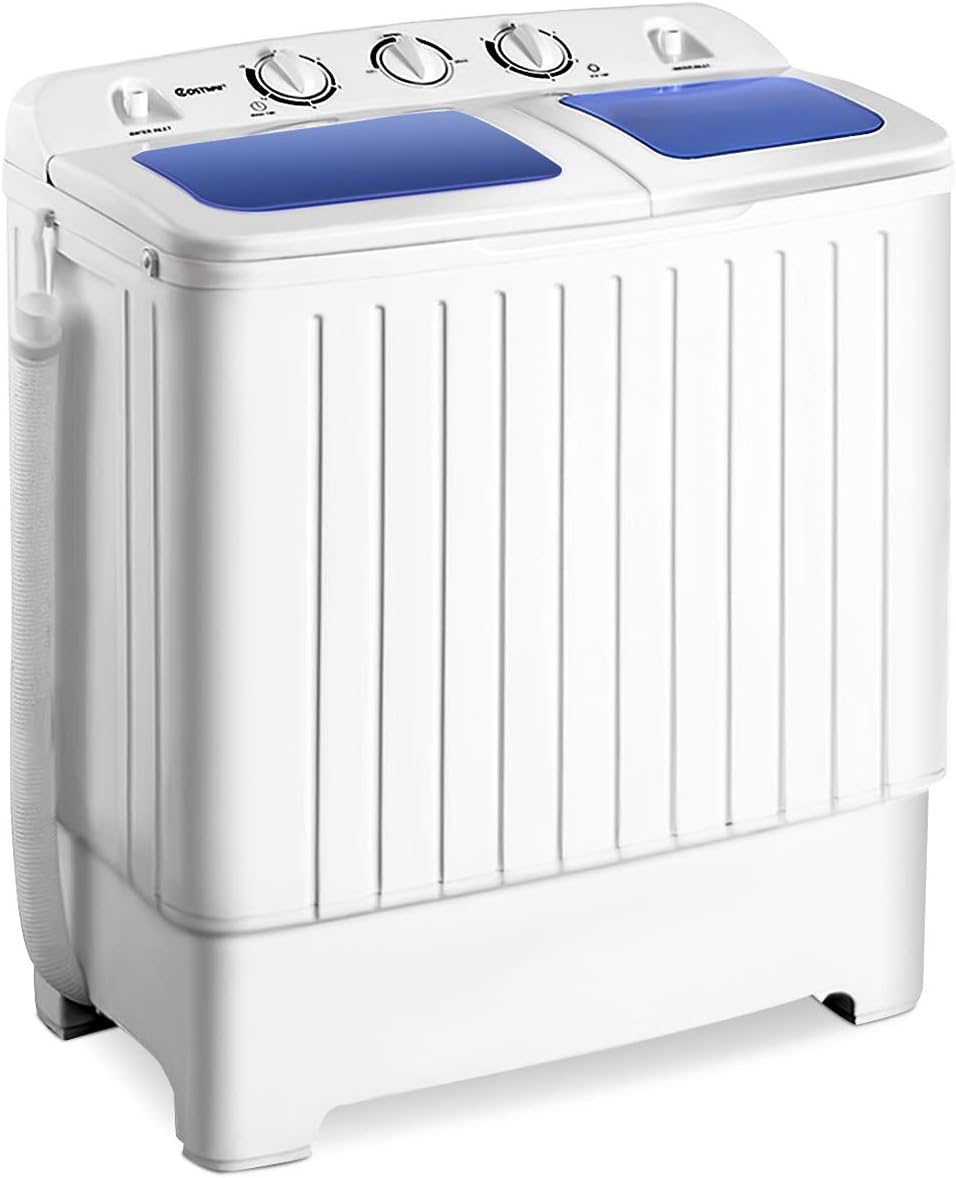
The Giantex twin-tub portable washer combines a 12 lb wash tub and an 8 lb spin tub in a semi-automatic top-load design that is useful for apartments, dorms, RVs, or occasional laundry tasks. It runs on 120V with a 300W wash motor and a 110W spin motor and offers simple knob controls for wash and spin timers (washer up to 15 minutes, spin up to 5 minutes). The twin-tub layout lets you wash and spin-dry separately, and features like a removable lint filter, two water inlet options, and a lid that helps stabilize spinning make everyday operation straightforward. Because the spinner only removes about 80 to 90 percent of moisture, items will still need air-drying, so it is most practical for smaller blankets, bedding pieces, or clothing rather than heavy full-size comforters. It is lightweight and portable, but capacity and spin performance limit throughput for bulky bedding, and the unit relies on gravity drain rather than a powered pump for drainage. For buyers wanting a simple, space-saving machine for small or infrequent blanket washes, it offers an economical, easy-to-use option.
Best for: Buyers who need a low-cost, portable washer for small bedding pieces, travel, or tight spaces and prioritize simple controls and easy storage over large capacity and heavy-duty drying.
Less Ideal for: People who regularly wash large blankets, heavy comforters, or frequent family loads should choose a higher-capacity or full-size washer with stronger spin and drying capability.
- Twin-tub design lets you wash and spin separately to speed small loads
- Knob controls with adjustable washer and spin timers for simple operation
- Removable lint filter and two inlet hose positions improve convenience
- Compact, lightweight freestanding unit suited to apartments, RVs, and dorms
- Rated wash and spin capacities (12 lb wash, 8 lb spin) are too small for full-size blankets
- Spinner only removes about 80–90% of moisture so items require additional drying
- Drainage depends on gravity rather than a built-in pump
Verdict: A portable, no-frills twin-tub washer that works well for small blankets and occasional bedding washes when you need a compact, easy-to-use solution.
Auertech Portable Twin Tub Washer

| Capacity | 28 pounds (18 lb wash, 10 lb spin) |
|---|---|
| Operation Mode | Semi Automatic |
| Max Rotational Speed | 1300 rpm |
| Installation Type | Portable |
| Voltage | 120 volts_of_alternating_current |
This twin-tub portable washer combines an 18 lb washing tub with a 10 lb spinner and is designed for small-space laundry tasks like dorms, apartments, and RVs. You manually connect the inlet hose to a faucet, fill to the recommended water level, and switch between timed wash and spin cycles using simple knobs and dials. The 1300 rpm motor provides strong spin force to remove excess water, while a transparent lid and built-in lint filter make monitoring and lint capture straightforward. The included drain pump and adjustable hose let you route wastewater to sinks or containers and the machine has motor overheat protection to stop operation if abused. For washing blankets, the compact dimensions and separate spin mean small to medium throws can be handled if you stay within the washer and spinner load limits and avoid overfilling; heavy or oversized blankets will strain the motor and trigger protection or imbalance in the spinner. The semi-automatic workflow requires hands-on switching between cycles and manual filling/draining, so it is best for users who need portability and occasional blanket washing rather than full-size blanket loads.
Best for: Buyers who prioritize a compact, portable washer for occasional blanket washes and who prefer a simple, hands-on machine rather than a full-size automatic washer.
Less Ideal for: Families or users who need to wash large, heavy blankets regularly or want fully automatic, push-button convenience should choose a full-size machine instead.
- Twin-tub design lets you wash and spin simultaneously to save time.
- 1300 rpm motor delivers strong spin extraction for faster drying.
- Built-in drain pump and adjustable inlet/drain hoses for flexible placement.
- Simple knob controls and transparent lid make operation and monitoring easy.
- Stainless steel drum resists rust and a lint filter captures fibers.
- Semi-automatic operation requires manual filling, switching cycles, and some supervision.
- Limited tub capacities mean large or heavy blankets may overload the machine.
- Spinner can become unbalanced with uneven or oversized loads, requiring rebalancing.
Verdict: Choose this compact twin-tub washer if you need a portable, hands-on machine that can handle small to medium blankets and speed drying with a powerful spinner.
Choosing the Right Washing Machine for Blankets: Key Factors to Consider
Drum Capacity and Geometry
Blankets need room to tumble. A larger drum capacity reduces compression of thick fabrics and allows the cleaning solution to circulate through the layers. Look for drums with a gently curved or hexagonal pattern that encourage even movement rather than aggressive paddles that can snag loops.
Capacity influences how many blankets you can wash in a single cycle and how well water and detergent reach all parts of the fabric. Overfilling a drum can produce poorly cleaned areas and excess wear. If you regularly launder large or multiple blankets, prioritize a higher liter or cubic-foot capacity and a drum design that avoids trapping fabric against the drum wall.
Bulky and Delicate Cycle Options
Specialized cycles matter because standard high-agitation programs can stress blanket seams and delicate fibers. Bulky or bedding cycles typically use lower agitation, longer soak periods, and gentler tumble patterns to clean without damaging loft or stitching.
Also check for customizable cycle parameters so you can reduce spin speed, extend soak time, or add extra rinses when needed. Machines that let you save custom cycles are helpful if you wash blankets frequently and want consistent gentle treatment without reconfiguring settings each time.
Spin Speed and Drain Control
High spin speeds remove more water, reducing drying time, but they also increase stress on seams and can compress lofted fillings. A machine with variable spin-speed control gives you the flexibility to choose a low-to-moderate spin for heavy blankets and higher spin for lighter loads.
Drain performance and programmable spin profiles are useful for preventing severe imbalance that can cause loud vibration cycles. Machines that ramp spin speed gradually or offer balance-detection routines tend to handle lumpy loads more reliably.
Water Fill, Soak, and Rinse Effectiveness
Blankets can be slow to absorb water, so adequate initial water fill and soak options ensure detergent reaches the inner layers. Look for models that allow extra water or have an enhanced soak or presoak setting to penetrate dense materials.
Rinse effectiveness matters because trapped detergent can reduce loft and irritate sensitive skin. Machines with robust rinse cycles or multiple rinse options help remove residue without excessive mechanical action. Efficient water management combined with selectable soak times gives you better control over cleaning outcomes.
Load Balance and Drum Suspension
Bulky loads often shift during a cycle, creating off-center weight that causes vibration and noisy operation. A machine with a strong suspension system, adaptive balancing technology, or built-in load-sensing will correct for uneven distribution and prevent excessive movement.
Reliable balancing reduces the chance of aborted cycles and protects both the machine and the blanket. If your laundry space is on an upper floor or the machine sits on an uneven surface, prioritize models known for stable operation with mixed or bulky loads.
Access, Maintenance, and Lint Management
Regular maintenance makes blanket washing sustainable. Easy-to-clean lint traps, accessible detergent dispensers, and simple door seals reduce the time you spend on upkeep. Lint and fiber accumulation can clog drains or reduce rinse efficiency, so a machine designed for straightforward cleaning is a practical choice.
Consider how easy it is to inspect and clean seals, filters, and the drum interior. Machines with clear maintenance indicators or removable panels help you keep performance consistent, especially when washing high-pile or shedding blankets that release more fibers.
Top Washing Machine Features for Blanket Care
Certain features specifically benefit blanket washing. Look for dedicated bedding or bulky-item cycles, low-torque tumble options, and the ability to adjust water level and soak duration. These features reduce mechanical stress on textiles while improving detergent penetration and soil removal.
Additional helpful features include drum paddles that are recessed or smooth to prevent snagging, interior lighting for load inspection, and a front or top load layout that fits your laundry room ergonomics. Each feature contributes to safer, more effective blanket cleaning over the long term.
- Dedicated bulky/bedding cycle
- Adjustable water fill and soak
- Variable spin speeds with gentle options
- Smooth drum interiors and recessed paddles
- Accessible lint traps and seals
Front-Load Versus Top-Load: What Works Best
Front-load machines often provide better tumble action and use less water, which can be gentler on blankets when paired with a low-agitation bedding cycle. Their horizontal axis promotes thorough rinsing and typically better spin extraction, which shortens drying time.
Top-load machines with an agitator can be harsher on delicate fibers, but newer impeller-style top-loaders that use a low-profile wash plate can handle bulky items more gently. Consider accessibility, the machine footprint, and how you prefer to load or unload heavy blankets when choosing between the two layouts.
- Front-load: generally better tumble, efficient rinsing
- Top-load (impeller): gentler than agitator models, easier to add mid-cycle
- Top-load (agitator): may be rougher on seams and loops
Managing Drying After Washing
How you dry a blanket after washing affects fabric loft, shrinkage, and longevity. High heat can damage natural fibers and synthetic fills, so low-heat tumble or air-dry is often safer. If you use a dryer, choose low-temperature settings and partial drying followed by air-drying to protect fill and seams.
For very large or dense blankets that retain a lot of water, consider spin-reducing cycles to remove excess moisture before transferring to a dryer or a drying line. Proper drying prevents mildew and reduces the chance of lingering odors that result from insufficient drying.
- Use low-heat or air-dry settings
- Partial machine drying then air-dry for thick fills
- Redistribute blanket mid-dry to even drying
Preventing Damage and Extending Blanket Life
Treat blankets with care to preserve loft and stitching. Close fastenings, remove loose accessories, and repair small tears before washing. Use liquid detergents that dissolve readily and avoid bleach unless the care label explicitly allows it.
Wash blankets separately or with similarly weighted items to avoid snagging or uneven wear. Regularly inspect seams and fabric after several cycles, and follow manufacturer care labels for water temperature and cycle recommendations to maximize service life.
- Secure closures and check for damage before washing
- Use gentle detergents and avoid harsh whitening agents
- Wash with like-weight items only
Energy, Water Use, and Practical Tradeoffs
Washing bulky items uses more water and energy per cycle than small loads, especially if you select extra-rinse or extended soak options. Machines with efficient water sensing and load-adaptive cycles can reduce waste while still delivering a thorough clean.
Weigh the convenience of larger-capacity machines against the higher space footprint and potential energy draw. If you wash blankets often, investing in a model that handles bulky loads efficiently can save time and reduce wear on your bedding.
- Load-sensing routines reduce unnecessary water use
- Higher capacity can mean fewer cycles but more energy per cycle
- Consider program timers and quick-dry options for scheduling laundry
How We Chose the Best Washing Machine for Blankets
We shortlisted machines based on criteria that matter specifically for laundering blankets and other bulky bedding. First, we prioritized drum capacity and tub shape because oversized or thick blankets require enough internal space to tumble freely and avoid compression during the wash. Second, we looked at available gentle or bedding-specific cycles and adjustable spin speeds to reduce stress on seams and delicate fibers. Third, water fill control and soak options were considered to ensure thorough wetting of dense textiles without excessive agitation. We also evaluated mechanical factors such as suspension and drum balancing, since machines with poor balance can struggle with off-center loads typical of blankets. Energy and water efficiency were considered because oversized loads can consume significantly more resources if not managed well. Finally, we checked practical usability elements like loading type and lint-filter access for ongoing maintenance. We excluded machines that lack any bulky-item or delicate-cycle capability, and we did not consider models designed exclusively for commercial or laundromat use. The result is a focused set of options that meet real-world blanket-washing needs across the criteria above.
Our full evaluation process is outlined in our review methodology.
FAQ
Can I wash all types of blankets in a standard home washing machine?
It depends on the blanket material and the machine's features. Many home machines can handle common blankets if you use a gentle or bulky cycle and avoid overfilling. Blankets with special fillings or delicate trims may require hand washing or professional cleaning.
How full should the drum be when washing a blanket?
Leave enough room for the blanket to tumble freely. A good rule is to fill the drum about half to two thirds for a single large blanket. Overpacking prevents water and detergent from circulating properly and increases wear on seams.
What spin speed should I use for thick or down-filled blankets?
Use a low to moderate spin speed to reduce compression of fill and stress on seams. If your machine offers variable spin control, choose a gentler setting and consider an extra spin or manual pressing after partial drying if more water removal is needed.
Will washing blankets cause more lint and how do I manage it?
Blankets, especially high-pile or wool types, can shed fibers. To manage lint, clean the lint trap or filter after each blanket wash, run an extra rinse cycle if needed, and occasionally clean the drum and seals to remove buildup.
Is it better to wash blankets at home or take them to a professional cleaner?
Home washing is fine for most durable and machine-care-labeled blankets when you follow gentle-cycle guidance. Professional cleaning is advisable for fragile fabrics, large down comforters, or items with complex finishes that could be damaged by home laundering.
Final Verdict
When choosing a washing machine for blankets, prioritize a drum that provides enough space to tumble bulky items, gentle bedding cycles, and flexible spin and water controls. Balance features like suspension and rinse effectiveness against the machine footprint and your laundry frequency. Focus on the tradeoffs that matter most to you: larger capacity for fewer loads, or advanced balance and soak options for the safest blanket care. With the right combination of capacity, cycle flexibility, and maintenance-friendly design, you can keep blankets clean while preserving loft and fabric life.