
Note: This article contains affiliate links. If you click on these links and make a purchase, we may earn a small commission at no extra cost to you. This helps support our research and content. Read our full affiliate disclosure here.
When you have a busy household, laundry can become a major time and energy sink. Choosing the right washing machine for large families means prioritizing load capacity, cycle versatility, and durability so you can wash more items in fewer loads and avoid constant upkeep. This guide covers the top shortlisted washing machines that balance roomy tubs with sensible wash programs and efficient water and energy use. Below we summarize how each pick performs against practical needs like large-load cleaning, frequent use, and long-term operating costs. Read on to find the style and features that fit your household routine.
Top Picks at a Glance
| Best Overall The best all-around choice for most situations | LG WM4200HWA 5.0 cu ft Washer |  |
| Best Quality Built to a higher standard if you want something more solid | Speed Queen Home Style Top Load Washer |  |
| Best Value The sweet spot between price and what you get | Kenmore Top Load Washer 4.5 cu. ft. |  |
| Best Budget The cheapest option that still gets the job done reliably | COSTWAY Twin Tub Portable Washer |  |
| Top Rated A top-rated pick with lots of positive feedback | BLACK+DECKER 4.5 Cu. Ft. Washer BFLW45M |  |
| Most Popular A crowd favorite that many people choose with confidence | Giantex Twin Tub Portable Washer |  |
| Best Seller A high-volume bestseller chosen again and again | Auertech Portable Twin Tub Washer |  |
LG WM4200HWA 5.0 cu ft Washer

| Capacity | 5 cubic feet |
|---|---|
| Controls Type | Touch |
| Maximum Rotational Speed | 1300 rpm |
| Annual Energy Consumption | 105 kilowatt hours per year |
| Washer Dispenser Options | 4 Tray Dispenser with Smart Grid |
The LG WM4200HWA is a high-capacity front-load washer built to handle bulky family loads while offering modern convenience features. It uses a 5.0 cu ft stainless-steel drum and TurboWash 360° to shorten cycle times, and Steam Wash plus an Allergiene cycle for deeper cleaning and allergen reduction. SmartThinQ Wi‑Fi lets you monitor and control cycles remotely and receive notifications, which is handy for busy households. The washer is ENERGY STAR certified and reports relatively low annual energy consumption, and its LoDecibel motor and vibration reduction keep operation quiet. Controls are touch-based and the dispenser includes a four-tray Smart Grid for easy dosing. Practical limitations include its large physical footprint and the need to plan for the door swing, and while it offers many cycles, highly specialized or commercial-grade laundry needs may call for different equipment. Overall it balances capacity, speed, and smart features in a family-friendly package.
Best for: Families and households that need a single, dependable washer to handle large or bulky loads while saving time and energy and who value smart controls for remote monitoring.
Less Ideal for: People needing a compact washer for very small spaces or commercial users who require industrial-capacity or specialized heavy-duty cycles.
- Large 5.0 cu ft drum fits king-size bedding and bulky loads to reduce cycle count
- TurboWash 360° and Steam Wash deliver faster cycles and improved stain and allergen removal
- ENERGY STAR certified for lower energy and water use
- SmartThinQ Wi‑Fi enables remote monitoring, cycle control, and notifications
- Quiet operation with LoDecibel motor and vibration reduction
- Large depth with door open requires planning for laundry-room layout
- Not tailored for commercial or ultra-heavy-duty use
Verdict: A roomy, energy-efficient front-load washer with fast cleaning cycles and smart Wi‑Fi features that suits busy large households.
Speed Queen Home Style Top Load Washer

| Capacity | 16 pounds |
|---|---|
| Access Location | Top Load |
| Finish Types | Stainless Steel |
| Cycle Options | Standard, Quick Wash, Spin |
| Display | digital |
The Speed Queen Home Style top-load washer is a straightforward, performance-focused machine that handles regular household laundry with durable components and simple electronic controls. It uses a curved 4-vane agitator and a stainless steel drum to deliver dependable cleaning for everyday loads, and the solid mount suspension helps reduce vibration during spin cycles. Controls are push-button with a digital display and the machine offers basic cycles including standard, quick wash, and spin plus dispensers for detergent, fabric softener, and bleach. Typical use is frequent family laundry where reliability and cleaning power matter more than smart features or many specialty cycles. The washer's portable classification and freestanding design make placement flexible, but its 16-pound capacity is more suited to moderate to large households rather than very large or bulky-item loads. There are no advanced connectivity or extensive cycle customization options, so buyers who want simple, heavy-duty washing performance and a long-lasting tub and suspension will appreciate this model.
Best for: Buyers who prioritize reliable, heavy-duty cleaning and long-term durability over smart features, and who need a straightforward washer that performs daily for a busy household.
Less Ideal for: Households that routinely wash very large loads, bulky items like comforters, or want extensive smart controls and dozens of specialty cycles should consider larger-capacity or feature-rich alternatives.
- Durable stainless steel tub for long life and gentle tumbling
- Solid mount suspension reduces vibration during spins
- Simple digital push-button controls that are easy to operate
- Curved 4-vane agitator provides effective mechanical cleaning
- Included dispensers for detergent, softener, and bleach for convenient dosing
- 16 lb capacity may be limiting for very large families or bulky items
- Limited cycle selection and no smart connectivity or advanced wash customization
Verdict: Choose this Speed Queen if you want a tough, no-frills top-load washer that emphasizes reliable cleaning and long-term durability for everyday family laundry.
Kenmore Top Load Washer 4.5 cu. ft.

| Capacity | 4.5 cubic feet |
|---|---|
| Additional Features | Triple Action Impeller |
| Access Location | Top Load |
| Number of Standard Cycles | 10 |
| Display | LED |
This Kenmore top-load washer is built to handle big household loads with a 4.5 cubic foot drum and a Triple Action Impeller that combines spraying, basket motion, and impeller movement to remove tough soils. It offers Accela Wash and Express Wash modes to speed up full-size and small loads respectively, plus 10 cycle selections and temperature options including a Cold Clean setting for energy-efficient washing. Controls mix knob and touch inputs with an LED display that shows time remaining and cycle status, and the soft-close tempered glass lid reduces slamming. For everyday use it cleans a variety of fabrics from delicates to heavy duty items and supports detergent and fabric softener dispensing. Important limitations are that it is a top-load, non-ENERGY STAR model in this listing and does not list steam or sanitizing on this specific variant, so energy-conscious buyers or those needing dedicated sanitize/steam cycles should check other models. Installation is freestanding and the stainless steel drum supports larger loads like bedding and towels.
Best for: Buyers who want a practical, high-capacity washer that speeds through frequent large loads and prioritizes straightforward controls and reliable cleaning performance.
Less Ideal for: People who prioritize peak energy efficiency or require factory-quality steam or sanitize cycles should consider other models tailored to those needs.
- Large 4.5 cu. ft. capacity suitable for bedding and large loads
- Triple Action Impeller targets stains with spray, basket movement, and impeller action
- Accela Wash and Express Wash shorten cycle times for full and small loads
- Intuitive knob and touch controls with LED display and soft-close lid
- Not listed as ENERGY STAR certified in this variant
- No dedicated steam or sanitize cycles noted for this specific model
Verdict: A roomy, no-nonsense top-load washer that speeds through large family laundry with an aggressive impeller system and time-saving wash modes.
COSTWAY Twin Tub Portable Washer

| Capacity | 26 pounds |
|---|---|
| Washer capacity | 18 pounds |
| Spinner capacity | 8 pounds |
| Operation mode | Semi Automatic |
| Max rotational speed | 1300 rpm |
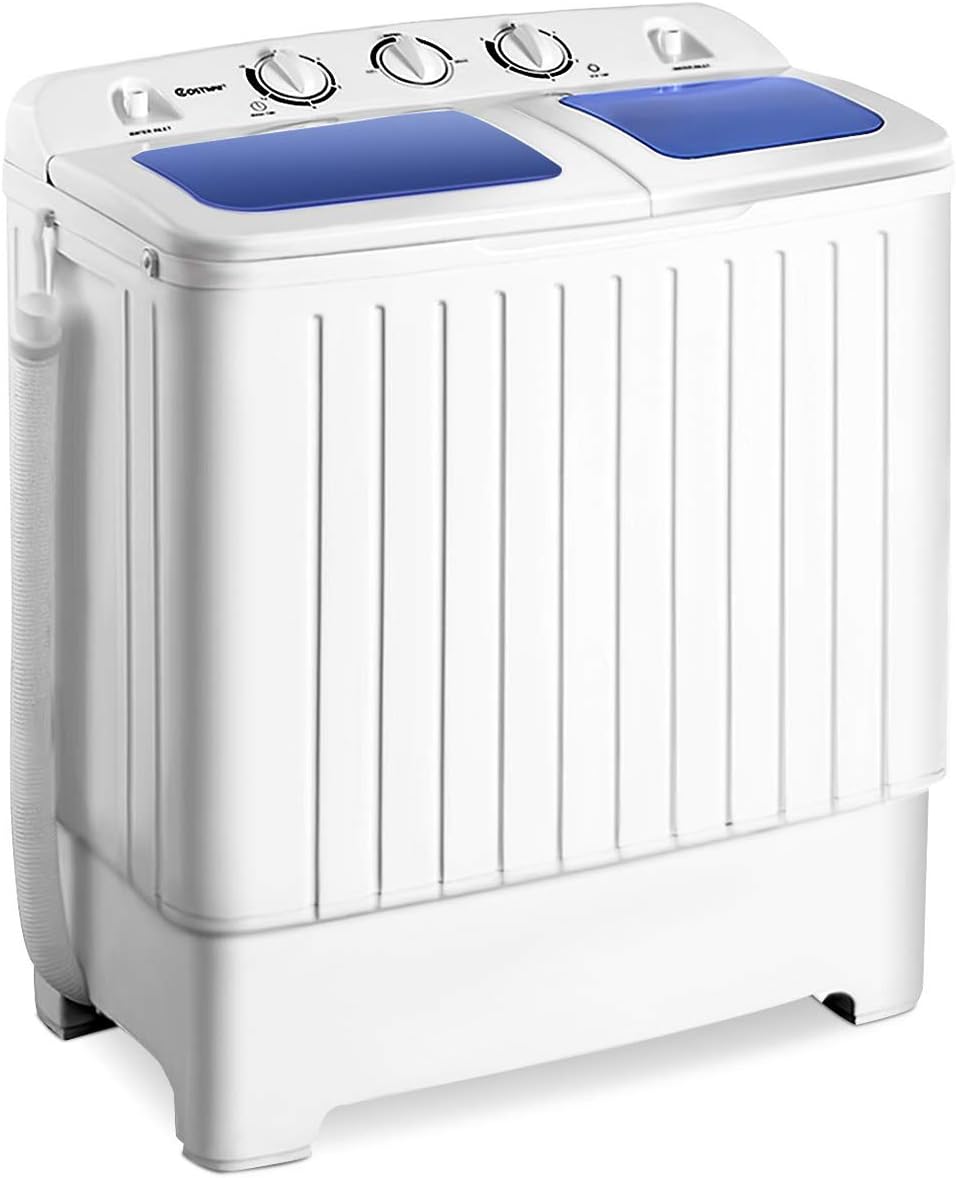
This COSTWAY twin-tub portable washer pairs an 18 lb wash tub with an 8 lb spin dryer so you can wash and spin in one compact unit without permanent installation. It is semi-automatic with simple knob controls and a timer, making it easy to run short wash and spin cycles for small loads, delicate items, or quick refreshes. A built-in drain pump and LED display simplify emptying water and monitoring the cycle, and the plastic drum and ABS body keep the unit rust-resistant and lightweight enough to move. The 280W wash motor and 1300 rpm max spin speed provide practical cleaning and fast extraction for everyday garments, but the separate tubs and modest capacities mean you must split very large family loads into multiple cycles. Noise is listed low and the compact footprint suits apartments, RVs, and laundry-limited homes, though the plastic construction and semi-automatic operation are less convenient than a full-size automatic machine for heavy family use.
Best for: Buyers on a tight budget who need a portable, no-install laundry solution for small-to-medium loads and value simplicity and space-saving design.
Less Ideal for: Homes that regularly wash large family loads or want a fully automatic, hands-off laundry workflow should consider full-size washers instead.
- Separate washer and spinner let you wash and dry items concurrently
- Built-in drain pump simplifies water removal without manual dumping
- Simple knob controls and timer make operation straightforward
- Rust-resistant plastic construction and compact footprint for tight spaces
- Modest per-cycle capacity requires multiple loads for large-family laundry
- Semi-automatic operation demands more user intervention than full automatics
Verdict: A budget-friendly, portable twin-tub washer that saves space and handles small-to-moderate loads when a full-size machine is not an option.
BLACK+DECKER 4.5 Cu. Ft. Washer BFLW45M

| Capacity | 4.5 cubic feet |
|---|---|
| Number of Cycles | 12 |
| Spin Speed | 1300 RPM max |
| Power | 120 volts |
This BLACK+DECKER front-load washer is built for full household loads, offering a 4.5 cubic foot stainless steel drum and 12 preset cycles that handle everything from delicates to heavy duty bedding. Typical use is family laundry day: the roomy tub accepts large loads and the 1300 RPM max spin reduces drying time. Practical features include an LED touch display, delay start up to 24 hours, five temperature and spin settings, and a MyCycle programming option to save your preferred cycle. The washer is ENERGY STAR certified and runs on standard 120V power, so it fits most home setups and aims to keep energy and water use lower on repeated weekly loads. Important limitations are its substantial weight and freestanding installation needs, which may require evaluating floor strength and delivery placement, and it requires HE detergent. For reliability-focused buyers, the machine's simple controls, stainless drum, and auto unbalance detection make it a sensible choice for heavy, regular use, though service access and the one-year limited warranty are worth considering.
Best for: Households that need a reliable, high-capacity washer for frequent large loads and value straightforward controls and energy efficiency.
Less Ideal for: Those who need a lightweight or compact washer for tight laundry spaces or renters who cannot accommodate freestanding appliance installation.
- Large 4.5 cu. ft. stainless steel drum handles full family loads
- ENERGY STAR certified for better energy and water efficiency
- 12 preset cycles plus MyCycle programmable shortcut for repeated routines
- 1300 RPM max spin reduces drying time and speeds laundry turnover
- Heavy, freestanding unit that may complicate delivery and placement
- Requires high-efficiency (HE) detergent and specific drain/water pressure setup
Verdict: A dependable, energy-efficient full-size washer built to handle frequent large-family loads with sensible controls and a roomy stainless drum.
Giantex Twin Tub Portable Washer
| Capacity | 20 pounds (12 lb wash, 8 lb spin) |
|---|---|
| Operation Mode | Semi Automatic |
| Wash Power | 300W |
| Spinner RPM | 1350 rpm |
| Voltage | 120 volts |
The Giantex Twin Tub Portable Washer is a compact semi-automatic unit that separates washing and spinning into two tubs so you can wash and spin in sequence without moving clothes between machines. It is typically used in small homes, apartments, RVs, or dorms where a full-size washer is impractical; you fill the wash tub, set the knob timers (up to 15 minutes wash, 5 minutes spin) and then move laundry to the spinner for high-speed extraction. Notable features include dual water inlet options for flexible hookup, a removable lint filter, an analog control panel with knobs, and a top lid that improves safety during spin cycles. The 300W wash motor and 1350 rpm spinner deliver decent agitation and extraction for lightweight loads, and the unit drains by gravity via a hanger-style hose. Important limitations are that rated washing capacity is 12 lbs with an 8 lb spinner capacity, so it is not suitable for large family loads, spin drying leaves clothes partly damp, and the unit requires manual setup and attention because it is semi-automatic and depends on gravity drainage. The design favors portability and low power usage over full automation and large-capacity throughput.
Best for: Buyers who prioritize a portable, low-power washer for small loads and flexible hookup options and who value proven customer feedback when choosing budget, space-saving laundry solutions.
Less Ideal for: Large households that need full-size, fully automatic washers for frequent heavy loads or users who want hands-off, built-in drain and drying performance.
- Separate wash and spin tubs let you run wash and spin cycles concurrently for small loads
- Two inlet holes provide flexible faucet placement
- Removable lint filter simplifies maintenance
- Lightweight, portable design suitable for apartments, RVs, and dorms
- Small rated capacities (12 lb wash, 8 lb spin) limit load size and require more frequent cycles for families
- Relies on gravity drain so placement relative to a drain point matters
- Spin cycle only removes 80–90% of water so clothes need additional drying
Verdict: Choose this portable twin-tub washer when you need a proven, space-saving semi-automatic machine for frequent small loads and flexible faucet hookups.
Auertech Portable Twin Tub Washer

| Capacity | 40 pounds |
|---|---|
| Operation Mode | Semi Automatic |
| Max Rotational Speed | 1300 rpm |
| Additional Features | drain pump |
This twin-tub portable washer pairs a washing tub and a spinner so you can wash and begin drying in one session, which saves time in small spaces. It is semi-automatic with three control knobs for setting wash time, spin time, and mode, and a 1300 rpm motor that provides strong agitation for faster cleaning. The unit includes a drain pump and inlet hose for flexible drainage and setup without complex plumbing, and the polypropylene body and transparent lids keep the machine lightweight and easy to move. Practical benefits include reduced water use versus full-size machines and the ability to run short 15-minute wash cycles and 5-minute spin cycles for quick loads. Important limitations are its semi-automatic workflow that requires manual transfer between tubs and a listed wash capacity that is smaller than standard family washers, so you will need to run multiple loads for large households. The compact footprint and no-install design make it a fit for apartments, dorms, and RVs but it is not a full replacement for a high-capacity, fully automatic family washer.
Best for: Buyers who need a compact, movable washer that can handle frequent small-to-medium loads in tight spaces and prioritize reliable, simple operation over full-size capacity.
Less Ideal for: Large families who want a single, full-capacity automatic washer that handles big loads without multiple cycles should consider a full-size model instead.
- Separate wash and spin tubs let you wash and spin nearly simultaneously to speed turnaround
- 1300 rpm motor delivers strong spin performance for improved moisture extraction
- Built-in drain pump and inlet hose allow flexible placement without hard plumbing
- Lightweight polypropylene body resists rust and is easy to move and store
- Semi-automatic operation requires manual transfer and monitoring between wash and spin tubs
- Capacity is lower than full-size family washers, so multiple loads are needed for large households
Verdict: Choose this portable twin-tub washer if you want a simple, transportable machine that speeds small loads with separate wash and spin tubs rather than a single full-size family washer.
Choosing the Right Washing Machine for Large Families: Key Factors to Consider
Drum Capacity and Tub Design
Large families benefit most from machines with higher drum capacity because each extra liter or cubic foot reduces the number of loads needed. Look beyond the headline capacity number to consider drum shape and how well it fits bulky items like comforters and large towels.
An oblong or specially contoured drum can pack more items without increasing tangling or uneven loads. Also consider front-load versus top-load geometries: front-loaders often offer superior packing efficiency, while some top-load designs let you add items mid-cycle. For heavy household use, prioritize a drum and suspension system that maintain balance with mixed-load sizes.
Cycle Selection and Wash Flexibility
A wide range of cycles matters when one machine must handle everything from delicate school uniforms to heavily soiled sports gear. Useful options include quick cycles for lightly soiled loads, heavy-duty or deep-clean cycles for mud and stains, bulky or bedding modes for large items, and sanitation or allergen settings when needed.
Customization options such as adjustable spin speed, soil-level settings, and soak times let you tune performance for different fabrics and load sizes. Machines with memory or favorite-cycle shortcuts save time for repetitive household routines.
Energy and Water Use
Because large families run more loads, energy and water efficiency significantly affect operating costs and environmental impact. Look for machines with efficient wash algorithms that minimize rinse cycles and optimize water fill based on load size.
High spin speeds reduce dryer time and total energy use, but check that the machine's spin profile suits common fabrics you wash. Consider whether eco cycles actually deliver acceptable cleaning for typical family stains; sometimes a slightly longer, efficient cycle is preferable to repeated short washes.
Durability and Serviceability
Frequent cycles accelerate wear, so mechanical robustness is essential. Metal tubs, reinforced bearings, and quality seals extend service life. Check for components that are known to be replaceable without major disassembly, such as easily accessible belts, pumps, and service panels.
Good manufacturer or installer documentation and clear access to filters and lint traps reduce routine maintenance time. For busy households, a machine that tolerates regular use without frequent repairs is usually the better long-term investment.
Noise, Vibration, and Installation
Laundry rooms adjacent to living spaces require machines with effective noise and vibration control. Anti-vibration designs, balanced drums, and quiet motors make daytime or evening loads less disruptive. Installation matters too: a properly leveled machine on a sturdy floor reduces vibration and extends component life.
If the laundry area has limited clearance or is on an upper floor, prioritize models with low vibration and clear guidance for correct installation to avoid noise transfer and structural stress.
Capacity for Large Items and Load Mixing
Large families often need to wash bulky items like comforters, rugs, and pet bedding alongside smaller garments. A machine that handles mixed loads without excessive tangling or imbalance saves time. Features that help include gentle drum motion options, larger door openings for easy loading, and wash modes that alternate agitation to prevent clumping.
Also consider whether frequent mixed loads will require specialized detergents or longer cycles. A washer that accommodates both bulky and mixed garments in the same cycle reduces the need to run separate loads.
Top Load Vs Front Load for Busy Households
Both top-load and front-load machines can serve large families well, but they differ in packing efficiency, cycle options, and ergonomics. Front-loaders typically offer better water economy and higher spin speeds, which shortens dryer time and suits households that want to minimize energy and water use. They also tend to pack more laundry per cycle because of their horizontal tubs.
Top-load machines are often easier to load without bending and can provide mid-cycle add features. Some newer top-load designs improve water use and cycle variety while preserving convenient access. Consider household mobility, typical load types, and whether stacking or under-counter installation will be needed when choosing between the two styles.
- Front-load: usually better packing and spin extraction
- Top-load: easier ergonomics and convenient mid-cycle access
- Installation constraints may sway the choice for small laundry rooms
Managing Large Loads and Bulky Items
Bulky items need a combination of space and wash motion that keeps them tumbling rather than clumping. Look for cycles specifically labeled for bedding or bulky loads and drums with gentle tumble patterns that prevent fabric twisting.
If you wash frequent large items, plan load rotation so heavy bedding is washed separately from small garments to avoid imbalance. Use larger-capacity machines to reduce the need for split loads and choose settings that carefully control water and spin action for full, heavy loads.
- Use bedding/bulky cycles for comforters and rugs
- Avoid overfilling to prevent imbalance and extra wear
- Consider professional cleaning for oversized or dense items
Cleaning Performance Vs Cycle Time
Faster cycles save time but can compromise stain removal on heavily soiled family laundry. Many machines offer an express or quick mode for lightly soiled items and longer intensive cycles for tougher stains. Decide whether you prefer faster turnarounds or deeper cleaning for typical household soils.
Some models use longer soak or targeted spray phases to improve cleaning without using more water. If your household frequently deals with mud, food stains, or heavily soiled children's gear, prioritize machines with effective heavy-duty cycles even if those runs take longer.
- Quick cycles are fine for lightly soiled loads
- Heavy-duty and soak options improve stain removal
- Balance time savings against repeat washing needs
Maintenance Tips for High-Use Machines
Regular maintenance keeps a busy washer running smoothly. Clean detergent drawers and seals periodically to prevent buildup and odors. Run an occasional machine-clean cycle or use a recommended cleaner to remove residue from the drum and plumbing.
Check hoses and connections every few months for leaks or wear. Keep the area around the washer clear to allow airflow and reduce moisture buildup. Address unusual noises or vibration promptly to prevent minor issues from becoming major repairs.
- Wipe door seals and detergent compartments monthly
- Inspect hoses and fittings for wear or leaks
- Level the machine and check mounting hardware annually
Optimizing Detergent and Cycle Settings
Using the correct detergent type and amount improves cleaning and reduces buildup. High-efficiency detergents are usually necessary for low-water machines; too much detergent causes residue and odors. Match detergent quantity to load size and soil level rather than always using the maximum.
Adjust spin speed and soil-level settings based on fabric type. Lower spin for delicates to reduce wear, and higher spin for heavy towels to cut drying time. Use pre-soak or stain-treatment functions for heavily soiled items to improve first-pass cleaning.
- Use HE detergent in low-water/high-efficiency cycles
- Reduce detergent for small or lightly soiled loads
- Pre-treat stains and use appropriate spin settings
How We Chose the Best Washing Machine for Large Families
To build this list we applied practical filters tuned to high-volume household use. We prioritized drum capacity and effective wash space since larger tubs directly reduce the number of loads for big families. Cycle selection and customization were evaluated to ensure machines can handle a wide range of fabrics, soil levels, and bulky items such as bedding and sports gear. Durability and build quality were weighted to reflect frequent, repeated use across months and years. We also measured energy and water efficiency features because long-term operating costs matter when machines run daily. Noise and vibration control were considered for homes where laundry areas are near living spaces. Finally, ease of use and maintenance—including accessible lint traps, clear controls, and straightforward serviceability—were factored in. Units that lacked sufficient capacity for large households, offered only basic cycles, or showed known reliability concerns were excluded. The selection focuses on models that strike a balance between roomy drums, flexible washing programs, durable construction, and efficient operation.
Our full evaluation process is outlined in our review methodology.
FAQ
How big of a capacity do I need for a family of five or more?
For a family of five or larger, aim for a washer with a larger drum capacity that accommodates bulky loads and bedding. Higher-capacity machines let you wash more items per load and reduce the number of cycles run each week.
Can I wash comforters and king-size bedding in a standard family washer?
It depends on the drum size and tub design. Look for explicit bulky or bedding cycles and wide door openings. If the comforter can tumble freely without being compressed, the machine can usually handle it; otherwise consider a larger-capacity unit or occasional professional cleaning.
Are front-load washers better for saving water and energy in large households?
Front-load washers often use less water and spin faster, which can reduce overall energy and drying time. However, some modern top-load designs have improved efficiency, so consider actual efficiency ratings and typical load types when deciding.
How often should I run maintenance on a high-use washer?
Perform basic maintenance monthly, such as wiping seals and cleaning dispensers, and inspect hoses quarterly. Run a dedicated machine-clean cycle every month or two if you have heavy usage to prevent residue and odors.
What noise level should I expect when running loads in the evening?
Noise varies by machine and installation. For evening use near living spaces, choose machines advertised with low vibration or quiet operation and ensure the unit is leveled and installed on a solid floor to minimize sound transmission.
Does a higher spin speed always mean clothes will dry faster?
Higher spin speeds remove more water, which generally reduces dryer time, but overly aggressive spins can stress some fabrics. Use adjustable spin settings to match fabric types to balance drying time with garment care.
Final Verdict
For large families, prioritize machines with ample drum capacity, durable construction, and flexible cycle options that handle both bulky items and daily garments. Balance energy and water efficiency against the cleaning power you need for heavy soils, and favor units with good serviceability to minimize downtime. Ultimately, choose a washer that fits your household's typical load mix and space constraints while delivering reliable performance under frequent use. Focus on capacity, useful cycles, and long-term durability to make a confident, practical choice.