
Note: This article contains affiliate links. If you click on these links and make a purchase, we may earn a small commission at no extra cost to you. This helps support our research and content. Read our full affiliate disclosure here.
Buying a washing machine on a tight budget means balancing cleaning performance, durability, and ongoing energy costs. A low sticker price is only worthwhile if the machine actually handles common loads, stains, and family-sized wash cycles without frequent repairs or excessive power and water use. This guide shortlists the top affordable washers that deliver strong cleaning, sensible features, and decent long-term running costs. Below are our recommended picks for washing machines under $500, with evaluation focused on cleaning effectiveness, cycle variety, build durability, and operating costs. Read on to see which features matter most for different laundry needs and why each shortlisted model made the cut.
Top Picks at a Glance
| Best Overall The best all-around choice for most situations | COMFEE' 1.6 Cu.ft Portable Washer |  |
| Best Quality Built to a higher standard if you want something more solid | Auertech 35 lbs Washing Machine |  |
| Best Value The sweet spot between price and what you get | Auertech Portable Twin Tub Washer |  |
| Best Budget The cheapest option that still gets the job done reliably | COSTWAY Portable Mini Washing Machine |  |
| Top Rated A top-rated pick with lots of positive feedback | COMFEE' Portable Washer CLV09N1AMG |  |
| Most Popular A crowd favorite that many people choose with confidence | Giantex Twin Tub Portable Washer |  |
| Best Seller A high-volume bestseller chosen again and again | BLACK+DECKER Portable Washer BPWM16W |  |
COMFEE' 1.6 Cu.ft Portable Washer

| Capacity | 1.6 cubic feet |
|---|---|
| Number of Programs | 6 |
| Max Rotational Speed | 840 rpm |
| Noise | 62 db |
| Operation Mode | Fully Automatic |
The COMFEE' 1.6 cu ft portable washer is a space-saving, fully automatic top-load machine designed for apartments, RVs, and dorms. It handles up to about 11 pounds per load in a stainless steel drum and offers six programs including Normal, Quick, Heavy, Bulky, Delicate, and Spin Only, plus three water temperatures and an extra rinse option. The LED display, see-through lid, child lock, delay start, and reload feature make it easy to operate and convenient for adding forgotten items mid-cycle. It sits on wheels for portability and includes a water inlet hose and converter for simple setup. Practical trade-offs are its compact footprint and modest spin speed compared with full-size washers, so very large laundry loads or heavy bedding will need multiple cycles, and noise at 62 dB is noticeable in small rooms. For buyers prioritizing a self-contained, energy-saving washer that fits tight spaces, this model covers everyday needs reliably but is not a replacement for a full-size home machine.
Best for: Buyers who need a reliable, self-contained washer for small living spaces and prioritize convenience features and energy savings over full-size capacity.
Less Ideal for: Households that routinely wash large loads, heavy bedding, or need the faster throughput of a full-size washer and dryer setup.
- Compact footprint and built-in wheels for easy placement and movement in small spaces
- Stainless steel inner tub and six program options for versatile everyday washing
- Convenience features like LED display, child lock, delay start, and reload function
- Energy-efficient motor claiming large savings versus similar models
- Limited 11 lb load capacity means larger items require multiple cycles
- 840 rpm max spin and 62 dB noise level can be less effective/quieter than full-size washers
Verdict: A compact, fully automatic portable washer that delivers convenient, energy-efficient laundry for small homes and on-the-go living.
Auertech 35 lbs Washing Machine

| Capacity | 35 pounds |
|---|---|
| Number of Standard Cycles | 12 |
| Max Rotational Speed | 1600 rpm |
| Operation Mode | Fully Automatic |
| Voltage | 120 volts |
This Auertech 35 lb portable washing machine is aimed at households that need a high-capacity, freestanding washer without a full laundry hookup. It offers 12 standard cycles and 8 water levels to tailor cleaning for everything from delicate baby clothing to bulky bedding, and a 420W motor with up to 1600 RPM spin helps extract water for shorter drying times. The unit is fully automatic with touch controls, LED display, a tempered glass soft-close lid, and a 24-hour delay start and child lock for convenience. Practical features include a built-in 4.5 ft drain pump and a faucet adapter for easy setup in apartments or laundry closets, plus a tub self-clean function to reduce residue buildup. Limitations are typical for large portable washers: it is relatively heavy for its class and will need a dedicated floor space, and performance will not match full-size, hard-plumbed machines for very large or heavily soiled commercial loads. For home buyers who need big capacity and flexible placement, it delivers strong cleaning and useful convenience features.
Best for: Buyers who prioritize strong washing performance and large capacity in a freestanding unit and need flexible installation in apartments or homes without dedicated plumbing.
Less Ideal for: Customers seeking compact, lightweight travel/RV washers or commercial users who run continuous, industrial-scale loads should look elsewhere.
- Large 35 lb capacity suitable for family-sized loads and bedding
- Multiple wash cycles and 8 water levels for fabric-specific care
- 1600 RPM spin helps reduce drying time
- Built-in drain pump and faucet adapter simplify installation without plumbing
- Tub self-clean and child lock add hygiene and safety
- Portable design is heavy and requires floor space similar to compact freestanding washers
- Performance and durability may not match full-size, permanently plumbed washers for heavy commercial use
Verdict: If you want near–family-size washing power in a freestanding portable machine under $500, this Auertech 35 lb washer delivers the capacity and cleaning features to get the job done.
Auertech Portable Twin Tub Washer

| Capacity | 28 pounds (18 lb wash / 10 lb spin) |
|---|---|
| Operation Mode | Semi Automatic |
| Max Rotational Speed | 1300 rpm |
| Installation Type | Portable |
| Voltage | 120 volts |
This twin-tub portable washer is designed for small-space laundry where a full-size machine is impractical. It uses two separate tubs so you can run a timed wash in the 18 lb washing tub and then move garments to the 10 lb spinner to remove excess water, which shortens drying time. Setup is manual: connect the inlet hose to a faucet, add water to the desired level, and switch between wash and spin cycles using the knob controls. The unit includes a drain pump and adjustable drain hose so you can send wastewater to a sink or container without needing elevated plumbing. A 1300 rpm motor and a transparent lid let you see progress while providing strong spin performance, and built-in overheat protection pauses the motor if it gets too hot. Expect straightforward operation and modest water and energy use, but plan for manual handling of fills and cycle changes and attention to load balance to avoid spinner imbalance. The compact footprint and included hoses make it an efficient choice for apartments, dorms, and RVs where convenience and small capacity matter.
Best for: Buyers who need a compact, no-frills laundry solution for tight spaces and prioritize efficient, manual control over automation.
Less Ideal for: Households that do frequent large loads, require fully automatic operation, or want a machine that handles full-family weekly laundry without splitting loads should look elsewhere.
- Separate wash and spin tubs let you wash and spin concurrently to save time
- Built-in drain pump and adjustable hose simplify draining without special plumbing
- 1300 rpm motor provides strong spin extraction to reduce drying time
- Compact, top-load design fits small spaces like dorms, apartments, and RVs
- Semi-automatic operation requires manual filling and switching between cycles
- Capacity is limited compared with full-size washers so it suits small loads only
Verdict: A compact twin-tub washer that delivers strong spin performance and simple, space-saving laundry for people who prefer practical manual control.
COSTWAY Portable Mini Washing Machine

| Capacity | 5.5 pounds |
|---|---|
| Access Location | Top Load |
| Cycle Options | Drain, Spin |
| Noise | 45 db |
| Voltage | 110 volts |
The COSTWAY Portable Mini Washing Machine is a semi-automatic twin-tub unit that combines a small washing tub and a spin dryer for quick laundry in dorms, apartments, RVs, or camping. You load clothes, add water manually, set the timer with the rotary knob and the washer runs up to 10 minutes while the spinner runs up to 5 minutes to remove excess water. Practical details include a clear lid for monitoring, a drain hose for easy emptying, and a lightweight plastic build that makes it easy to move and store. It runs on standard 110V power and produces about 45 dB of noise, so it is reasonably quiet for small spaces. Limitations are that water must be filled and monitored manually because the unit does not auto-stop filling, and the polypropylene construction and compact 5.5 lb capacity mean it is best for small loads rather than family-sized laundry. For buyers seeking a no-frills, low-energy solution to wash small loads, this is a straightforward option.
Best for: Buyers on a tight budget who need a simple, portable laundry solution for very small loads in dorms, RVs, or tiny apartments and prioritize space savings and low energy use.
Less Ideal for: Anyone who regularly needs to wash medium or large loads, wants fully automatic operation, or prefers heavier-duty, longer-lasting materials for daily family use.
- Very compact and lightweight for tight spaces and easy storage
- Includes both wash tub and spin dryer so clothes come out less wet
- Simple knob and timer controls that are easy to operate
- Clear lid and drain hose make monitoring and emptying straightforward
- Must be filled and monitored manually because it does not auto-stop filling
- Small 5.5 lb capacity limits load size to very small batches
Verdict: A low-cost, space-saving twin-tub washer with a spin dryer that makes small-load laundry easy for budget-minded renters and travelers.
COMFEE' Portable Washer CLV09N1AMG

| Capacity | 0.9 cubic feet |
|---|---|
| Number of Programs | 5 |
| Max Rotational Speed | 840 rpm |
| Noise | 62 db |
| Display | LED |
The COMFEE' CLV09N1AMG is a small, fully automatic top-load portable washer designed for tight spaces like dorms, RVs, and small apartments. It offers five programs—Heavy, Gentle, Normal, Rapid, and Soak—plus three water levels and customizable wash/rinse/spin times so you can tailor cycles to different fabrics. The stainless steel inner drum and 840 rpm max spin speed help remove more water than many mini washers, and the LED display with push-button controls makes operation straightforward. Practical touches include a transparent lid for monitoring, built-in lint filter, wheels and handles for relocation, and an auto unbalance detection system that attempts to correct uneven loads. Noise is listed around 62 dB, so it is noticeable but not overly loud for typical household use. Limitations are its small 0.9 cu ft capacity, which means more frequent loads for families, and the unit requires manual hookup for inlet and drain lines rather than a permanent hookup; buyers should also account for the listed noise level in small rooms. For under-$500 shoppers prioritizing a reliable, space-saving washer, this model delivers a durable drum and sensible protection features.
Best for: Buyers who need a dependable, compact washer for tight living spaces and value a durable drum and straightforward controls for regular, everyday laundry tasks.
Less Ideal for: Large households or users who want a fully plumbed, high-capacity machine that handles full-size loads in a single cycle.
- Stainless steel inner tub for durability and better longevity
- Five wash programs with adjustable wash, rinse, and spin times for flexible cleaning
- Auto unbalance detection helps prevent excessive vibration and potential leaks
- Wheels and handles make it easy to move and store in small spaces
- Small 0.9 cu ft capacity requires more frequent loads for larger households
- Requires manual inlet and drain setup rather than a permanent plumbed connection
- Noise around 62 dB may be noticeable in very small rooms
Verdict: A compact, reliable portable washer with a stainless steel drum and practical protection features that suits space‑limited buyers seeking a durable under-$500 laundry solution.
Giantex Twin Tub Portable Washer
| Capacity | 20 pounds |
|---|---|
| Rated Washing Capacity | 12 lbs |
| Rated Spinner Dryer Capacity | 8 lbs |
| Spinner RPM | 1350 rpm |
| Voltage | 120 volts |
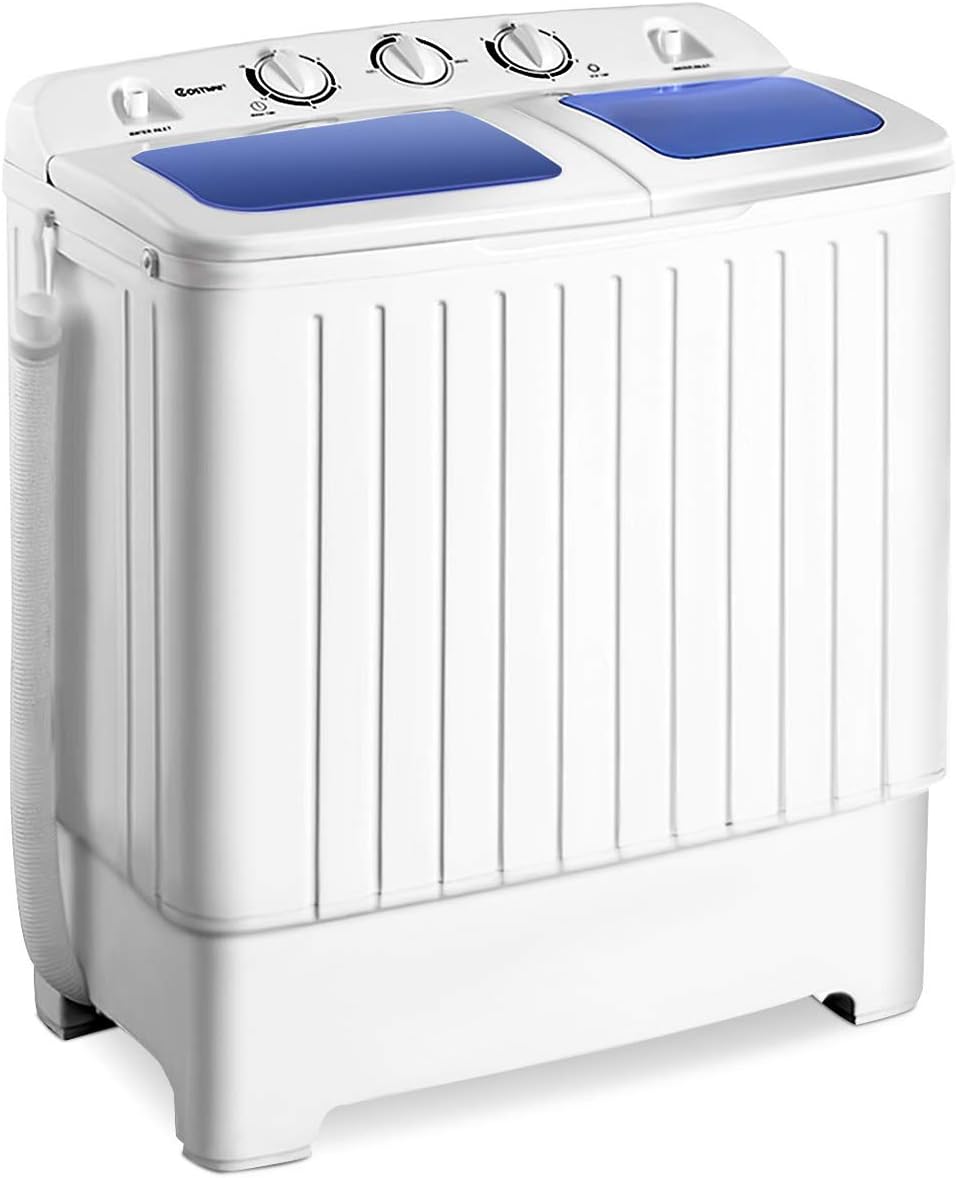
The Giantex twin-tub portable washer pairs a 12 lb wash tub with an 8 lb spin dryer to handle small loads for apartments, dorms, RVs, or occasional home use. It uses a 300W wash motor and a 110W spinner running up to 1350 RPM for faster spin-drying that removes most moisture before air-drying. Controls are simple mechanical knobs with a 15-minute wash timer and a 5-minute spin timer, and the top-load design plus a safety lid on the spinner keeps operation straightforward. Two inlet holes and a gravity drain hose let you position the unit near different faucets, and a removable lint filter makes cleaning easier. Expect semi-automatic operation though, which means manual water filling, draining, and some hands-on cycle management; the spinner leaves clothes about 80 to 90 percent dry so some air-drying is still required. The compact, lightweight build and freestanding installation make it easy to move and store, but it is best suited to small, frequent loads rather than family-size washing sessions.
Best for: Buyers who want an affordable, moveable washer for small, frequent loads and prioritize straightforward, mechanical controls and portability over full automation.
Less Ideal for: Large households that need to clean family-size loads or buyers who want a fully automatic washer with built-in pump drain and hands-off cycles.
- Separate wash and spin tubs allow washing and spinning at the same time for faster turnaround.
- Simple mechanical knobs and timers are easy to use and repair.
- Two inlet holes and a hangable drain hose increase installation flexibility.
- Removable lint/filter net simplifies maintenance.
- Requires manual water fill and gravity drain so it needs a nearby faucet and a place to drain.
- Semi-automatic operation means more hands-on attention than an automatic washer.
Verdict: A compact, budget-friendly twin-tub washer that delivers quick small-load cleaning and strong portability for apartments, dorms, and RVs.
BLACK+DECKER Portable Washer BPWM16W

| Capacity | 1.7 cubic feet |
|---|---|
| Number of Programs | 6 |
| Max Rotational Speed | 850 rpm |
| Voltage | 120 volts |
| Noise | 72 db |
The BLACK+DECKER BPWM16W is a compact, fully automatic portable washer designed for small household loads. It handles up to about 11 lb per load in a 1.7 cu ft stainless-steel tub and offers six cycle choices including Normal, Heavy, Delicate, Quick, Bulky, and Spin Only. Controls are simple push buttons with an LED display and useful features like 24-hour delay start, child lock, auto shutoff, and an unbalance detection system. Installation is straightforward for renters or small-space dwellers since it includes a quick-connect sink adapter, supply hose, and drain hose and sits freestanding on adjustable legs and transport rollers. Practical benefits include gentler impeller washing for delicates, a built-in lint filter, and hot/warm/cold water options for different fabrics. Trade-offs are its 72 dB reported noise level and the relatively modest capacity that makes it better suited to frequent small loads rather than large family laundry days. The unit is portable but still weighs over 70 pounds, so plan placement carefully.
Best for: Buyers who prioritize straightforward, reliable laundry for small households, apartments, or vacation homes and want a ready-to-run portable washer with simple controls and safety features.
Less Ideal for: Those who need to wash large family loads, bulky items regularly, or want the quietest possible operation should consider full-size or larger machines instead.
- Stainless-steel tub resists rust and is gentler on clothes
- Includes sink quick-connect adapter, supply hose, and drain hose for easy setup
- Six cycles plus delay start and child lock for flexible use
- Impeller design better for delicates and reduces tangling
- Adjustable legs and rollers make relocation and leveling easier
- Modest 1.7 cu ft / ~11 lb capacity not suited for large or bulky weekly loads
- Reported noise level around 72 dB can be loud in small spaces
- Unit weight is substantial for a portable washer at about 70.5 lb
Verdict: A compact, easy-to-install portable washer that delivers reliable small-load cleaning with practical safety and convenience features.
Choosing the Right Washing Machine: Key Factors to Consider
Cleaning Performance
How well a washing machine removes common stains and soils affects how often you must rewash items and whether you need pre-treatment. Machines with stronger agitation or more effective wash motion typically shorten laundry time and reduce detergent waste. For budget models, look for proven wash actions and cycle options aimed at heavy soils.
Cleaning performance also ties to drum design and water distribution. Even with lower-priced units, even water coverage and good rinsing are essential to avoid detergent residue and dingy fabric over time.
Energy and Water Efficiency
Operating costs are a major part of a washer's lifetime expense. Machines that use less water and power per load save money and reduce environmental impact over years of use. Efficiency matters more if you run many loads weekly or have large family laundry demands.
On budget models, compare typical cycle consumption and available eco modes. Some machines offset simpler engineering with shorter cycles or lower water fills that still achieve acceptable cleaning when paired with modern detergents.
Cycle Variety and Flexibility
Cycle options determine how well a washing machine adapts to different fabrics and soil levels. Basic but useful cycles include cottons, delicates, quick wash, and heavy-duty. Extra options like soak, extra rinse, or a sanitized cycle add value without huge complexity.
For budget shoppers, prioritize meaningful cycles over marketing-heavy features. A clear control layout and ability to adjust temperature and spin speed can expand a machine's usefulness across diverse wardrobes.
Durability and Build Quality
Durability influences long-term value more than initial cost. Inspect common longevity factors such as motor type, drum material, and the quality of suspension or bearings. Even affordable machines that use sturdier components or simpler, serviceable designs tend to outlast cheaper, highly plasticized alternatives.
Pay attention to warranty coverage and recommended maintenance, since accessible parts and straightforward servicing cut ownership headaches for lower-budget purchases.
Noise and Vibration
Noise and vibration affect where you can place the machine and how comfortable your living space will be during operation. Excessive vibration shortens component life and can cause noise complaints in shared housing. Budget machines vary widely in isolation and balancing technology.
Consider spin speeds, tub balancing features, and whether the unit is intended for floor mounting or more sensitive placements. Quieter machines allow for placement near living areas or on upper floors with less worry.
Ease of Use and Maintenance
Simple controls, clear cycle indicators, and easy-access lint traps or filters reduce day-to-day friction. Maintenance needs such as cleaning detergent dispensers, descaling, and checking hoses are easier on units with straightforward service points.
For budget washers, a user-friendly design can compensate for fewer fancy features. Less time spent troubleshooting means the machine feels more reliable in practice.
Top Features to Expect From Budget Washing Machines
Even under a tight budget, you can expect certain practical features that make a machine fit for regular home use. Look for basic but effective wash programs, adjustable spin speeds, and a sturdy drum that handles frequent loads without warping.
Additional conveniences to prioritize include a quick-wash option for small loads, a delayed start for off-peak energy use, and simple digital or mechanical controls that are easy to read and set.
- Quick wash cycles for lightly soiled loads
- Adjustable spin speed to reduce drying time
- Durable drum and bearings for longevity
- Straightforward control panel with clear labels
Installation and Space Planning
Budget washing machines are often compact but still require standard cold and hot water hookups and a drain. Measure the installation space carefully, including room for hose connections and lid or door clearance, especially in tight laundry closets.
Think about floor strength and leveling. Many lower-cost units have basic suspension systems that need proper leveling to minimize vibration. Leave clearance around the machine for airflow and maintenance access.
- Confirm water supply and drain locations before purchase
- Allow adequate front and side clearance for door opening
- Level the unit to reduce noise and wear
How Cycle Selection Affects Fabric Care
Choosing the right cycle extends garment life and improves cleaning. Delicate cycles use gentler agitation and lower spin speeds to protect fragile fabrics, while heavy-duty cycles apply more mechanical action for work clothes and heavily soiled items.
Understanding the interplay of temperature, agitation, and spin lets you match cycles to fabric labels and soil levels. On budget machines, modest temperature control and spin speed options can still give you the flexibility needed to care for varied wardrobes.
- Use cold or warm water for most everyday loads to save energy
- Reserve hot cycles for heavily soiled or sanitized needs
- Lower spin speeds reduce wear on delicate textiles
Common Maintenance Tasks to Keep Your Washer Running
Regular maintenance prevents odor, clogging, and mechanical issues. Simple tasks include leaving the door open after cycles to air the drum, wiping seals and dispensers to prevent residue buildup, and periodically checking hoses for leaks or cracks.
For top-load machines, balance testing and occasional drum cleaning help avoid excessive vibration and maintain performance. Following basic care routines extends service life and reduces the likelihood of midterm failures.
- Wipe gaskets and dispensers after use to prevent mold
- Run a monthly tub-clean or hot-water maintenance cycle if available
- Inspect hoses annually and replace if brittle or cracked
When to Consider a Repair Instead of Replacement
Minor issues such as a noisy bearing, a faulty lid switch, or a clogged pump can often be repaired cost-effectively. If the machine has a solid history of cleaning performance and the repair addresses a single mechanical fault, servicing can be a better option than replacing the whole unit.
However, repeated electronic failures, extensive rust, or issues that compromise drum integrity are signs that replacement may be more economical in the long run. Factor in repair costs, expected remaining life, and how essential uninterrupted laundry access is for your household.
- Consider repair for isolated mechanical faults with available parts
- Replace when multiple systems fail or drum damage is present
- Weigh repair cost against expected remaining lifespan
How We Chose the Best Washing Machine
We prioritized the practical qualities that matter to budget-minded laundry shoppers. Key evaluation criteria included cleaning effectiveness across common soil types, energy and water efficiency during typical cycles, cycle and feature variety for different fabrics, and expected durability based on materials and build. We also considered user-focused elements such as ease of use, noise and vibration control, and maintenance requirements that affect ownership experience. To keep the list focused and useful, we excluded premium-priced models, machines that require professional-only installations beyond standard hookups, and products with consistently poor service or reliability signals. Our selection favored machines that hit a balance of confidence-in-cleaning and low operating costs while keeping upfront purchase price under the stated budget. Each shortlisted unit demonstrates competence in at least three of the core criteria and avoids obvious tradeoffs that would make it a false economy for regular laundry use.
Our full evaluation process is outlined in our review methodology.
FAQ
Are washing machines under $500 reliable for everyday family use?
Often they can be, provided you choose models with robust drums and straightforward mechanics. Reliability depends on build quality and maintenance habits, so look for machines that prioritize durable components and easy service access.
How much should I expect to spend on energy and water per load with a budget washer?
It varies by cycle and local rates, but budget washers generally use slightly more water or energy than high-efficiency counterparts. Choosing eco or short cycles and cold-water washing reduces operating costs significantly.
Can a cheaper washing machine handle bulky items like comforters?
Some budget machines can manage small to medium bulky items, but capacity is often limited. For large comforters or oversized loads, check the machine's rated capacity and choose a larger tub size when possible.
Is a top-load or front-load design better at this price point?
Both designs have pros and cons. Top-loaders are usually simpler and may be cheaper to repair, while front-loaders often clean efficiently with less water. At this price range, prioritize the specific features and capacity that match your routine.
What maintenance keeps a budget washer performing well longer?
Regularly cleaning the drum and dispensers, leaving the door open to dry, inspecting hoses, and leveling the machine reduce wear and prevent common faults. Consistent care extends lifespan more than occasional deep fixes.
Final Verdict
When shopping for a washing machine under $500, focus on core performance and long-term operating costs rather than feature overload. Prioritize strong cleaning performance, acceptable energy and water use, durable basic construction, and a control set that matches your laundry habits. Expect tradeoffs in convenience features and advanced cycle precision, but sensible choices in the categories above will yield a reliable, economical machine that handles everyday laundry needs. Choose the model that best balances cleaning power and efficiency for your household size, and plan for routine maintenance to protect that investment over time.