
Note: This article contains affiliate links. If you click on these links and make a purchase, we may earn a small commission at no extra cost to you. This helps support our research and content. Read our full affiliate disclosure here.
If your home has a gas furnace, adding a whole-house humidifier can cut static, protect wood finishes, and make indoor air feel warmer without turning up the heat. Choosing the right unit matters because humidifier capacity, control compatibility, and installation approach affect performance across an entire HVAC system. This guide shortlists the top options for use with a gas furnace and explains the features that drive comfort, reliability, and maintenance needs. Read on for clear criteria we used to evaluate each candidate and a practical breakdown of installation and maintenance considerations before the product list.
Top Picks at a Glance
| Best Overall The best all-around choice for most situations | Aprilaire 500M Whole-House Humidifier |  |
| Best Quality Built to a higher standard if you want something more solid | Levoit Superior 6000S Humidifier |  |
| Best Budget The cheapest option that still gets the job done reliably | AIRCARE Space-Saver Humidifier |  |
| Top Rated A top-rated pick with lots of positive feedback | Aprilaire 600M Whole‑House Humidifier |  |
| Most Popular A crowd favorite that many people choose with confidence | AIRCARE MA Console Humidifier MA1201 |  |
Aprilaire 500M Whole-House Humidifier

| Capacity | 12 gallons_per_day |
|---|---|
| Floor Area | 3000 square_feet |
| Operation Mode | Evaporative |
| Voltage | 24 volts_of_alternating_current |
| Power Source | ac |
The Aprilaire 500M is a furnace-mounted evaporative humidifier that pipes water over a replaceable water panel while your HVAC system moves air through the panel to add moisture to the whole house. It is typically installed on the furnace return or supply and includes a manual humidistat, 24 VAC transformer, solenoid valve and installation components for straightforward pro or DIY installation. In use it offers quiet operation and adjustable humidity control with automatic shutoff when set levels are reached, and the unit covers large, tightly built homes up to roughly 3,600 square feet with a 12 gallons-per-day capacity. Maintenance is primarily replacing the AprilAire water panel each season and ensuring the valve and tray stay clear, so running costs are low but you will need to factor in periodic filter panels and occasional plumbing checks. The unit is robust and factory-quality but requires a floor drain or plumbing access for condensate and a furnace connection, so it is best suited to homes with central forced-air systems rather than window or portable humidification needs.
Best for: Buyers who want a durable, factory-quality humidifier that integrates with a gas furnace to humidify a whole, tightly built home and prioritize reliable, quiet operation over smart features.
Less Ideal for: People who need a portable or room-level humidifier or those without a central forced-air HVAC system should look elsewhere.
- Whole-house coverage up to about 3,600 sq. ft. with 12 GPD capacity
- Includes necessary installation components such as 24 VAC transformer, control, valves and water panel
- Manual humidistat and adjustable control for setting desired indoor relative humidity
- Evaporative design is quiet and low-energy while running with the furnace fan
- Simple seasonal maintenance consisting mainly of replacing the water panel
- Requires hard plumbing or floor drain access and integration with a forced-air furnace
- Manual control model lacks built-in automatic digital scheduling or Wi-Fi remote features
Verdict: Choose the Aprilaire 500M if you want a proven, furnace-mounted evaporative humidifier that reliably humidifies an entire gas-heated home up to about 3,600 sq. ft.
Levoit Superior 6000S Humidifier
| Capacity | 6 gallons |
|---|---|
| Floor Area | 3000 square_feet |
| Operation Mode | Evaporative |
| Runtime | 72 hours |
| Control Method | App |
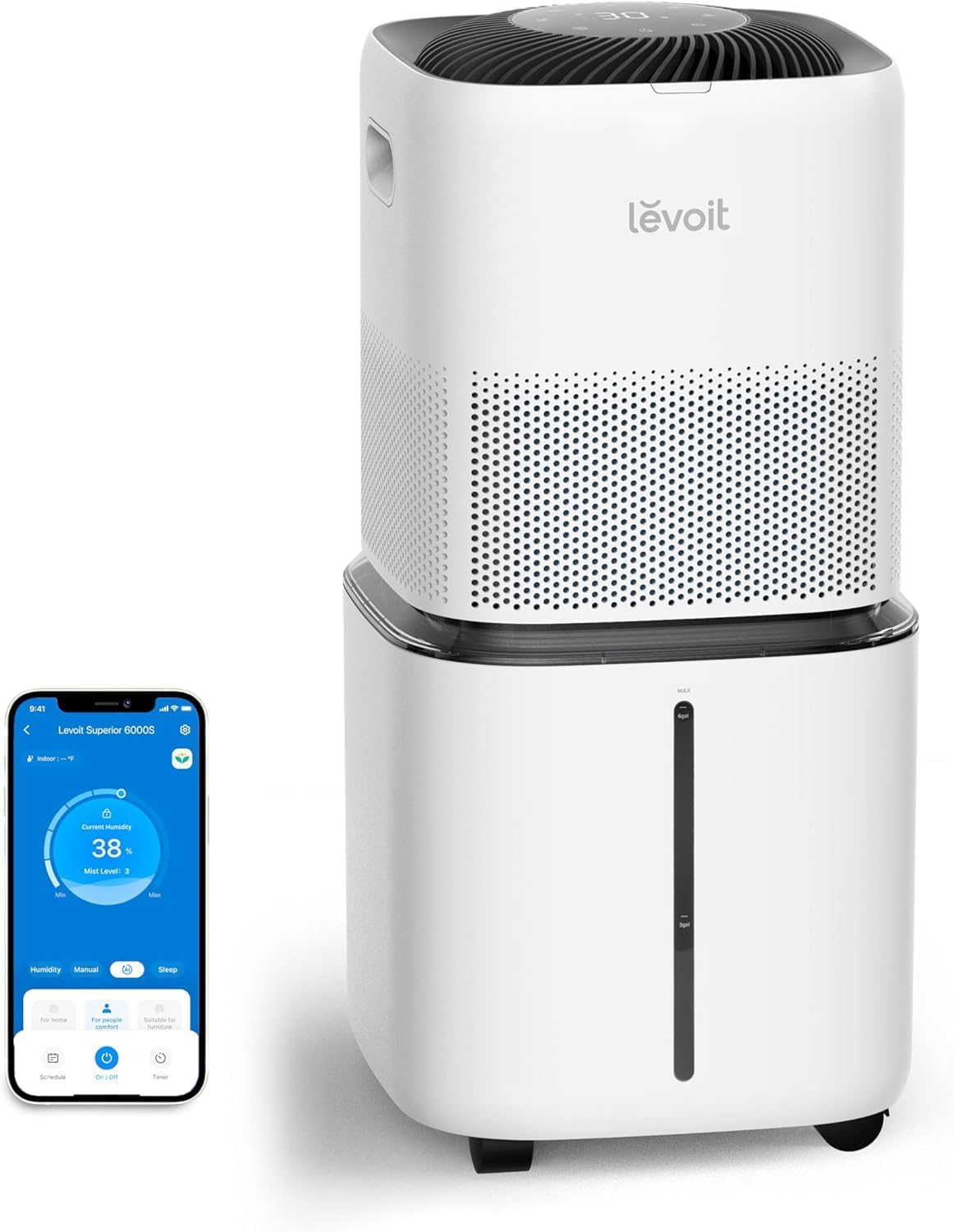
The Levoit Superior 6000S is an evaporative humidifier built to add moisture across large homes, offering a 6-gallon tank, a high-output evaporative fan system, and smart app control for hands-off operation. It is typically placed near a central living area or furnace return to help raise whole-house humidity; the built-in humidistat and Auto modes let the unit adjust fan speed to maintain target humidity without constant manual changes. Notable features include a wick filter design that traps mineral residue so the unit runs without white dust, a long low-setting runtime (up to 72 hours), and wheels plus a water-fill hose for easier handling and refills. Practical benefits are strong continuous output for rapid humidity increases, app-based control and preset Auto Home/Away modes for convenience, and ETL-certified AC power for safe, steady operation. Important limitations are that it is an evaporative unit, so it relies on a wick filter that needs periodic replacement and can show mineral buildup depending on water quality, and it lacks heated or steam humidification which some homes use with certain furnace setups.
Best for: Buyers who prioritize strong, measurable humidification performance for large homes and want automated, app-driven control to maintain target humidity with minimal intervention.
Less Ideal for: Homes that require steam humidification for HVAC integration or users who want a maintenance-free, filterless system should consider other humidifier types.
- Large 6-gallon tank supports extended runtime up to 72 hours on low settings
- Evaporative wick filter design reduces white dust and handles tap water
- Smart app control with Auto Home/Away modes and built-in humidistat for automated humidity management
- High airflow evaporative system disperses moisture broadly for large spaces
- Wheels and included water-fill hose make refills and placement easier
- Requires periodic wick filter replacement and may accumulate mineral residue depending on water quality
- Evaporative technology cannot produce warm steam, so it will not add heat or sterilize water like steam humidifiers
Verdict: If you need high-output, automated whole-house humidity control with long runtime and app management, the Superior 6000S delivers strong real-world performance.
AIRCARE Space-Saver Humidifier

| Capacity | 6 gallons |
|---|---|
| Floor Area | 2300 square_feet |
| Operation Mode | Evaporative |
| Runtime | 70 hours |
| Control Method | Remote |
The AIRCARE Space-Saver is an evaporative whole-house humidifier built for long runtime and simple operation. It uses a 6-gallon reservoir and wick filter to add moisture to spaces up to about 2,300 square feet, running up to 70 hours on a single fill depending on settings. Controls are straightforward: three fan speeds with analog knobs complemented by a digital display and a remote for basic adjustments. The unit is corded electric and relies on wick filtration, which makes maintenance predictable but does require periodic filter replacement. Practical benefits include long unattended runtime, a large capacity that reduces refill frequency, and user-friendly controls that suit household schedules. Limitations are typical of evaporative designs: it needs regular wick changes and does not offer humidistat-driven automated humidity control beyond manual settings, and the plastic body and weight mean it is not as compact as smaller room units. For many homes with gas furnaces this unit supplies steady whole-house moisture without complex installation or smart features.
Best for: Buyers who want a straightforward, high-capacity humidifier that runs long between fills and is easy to operate for whole-house moisture support alongside a gas furnace.
Less Ideal for: If you need automated humidity control, smart connectivity, or a lightweight portable unit for single-room use, this is not the best choice.
- Large 6-gallon tank supports extended runtime up to 70 hours between refills
- Rated coverage up to 2,300 sq ft suitable for whole-house use with a central furnace
- Simple three-speed fan with analog controls plus a digital display and remote for convenience
- Uses common wick filter design that is easy to source and replace
- No built-in automatic humidistat for precisely maintaining target humidity
- Requires periodic wick filter replacement and occasional cleaning to prevent buildup
- Plastic construction and unit weight make it less portable than smaller room humidifiers
Verdict: Choose this unit when you need a budget-friendly, high-capacity evaporative humidifier that reliably supports whole-house humidity without complicated setup.
Aprilaire 600M Whole‑House Humidifier
| Capacity | 17 gallons_per_day |
|---|---|
| Floor Area | 4000 square_feet |
| Operation Mode | Evaporative |
| Voltage | 24 volts_of_alternating_current |
| Control Method | Touch |
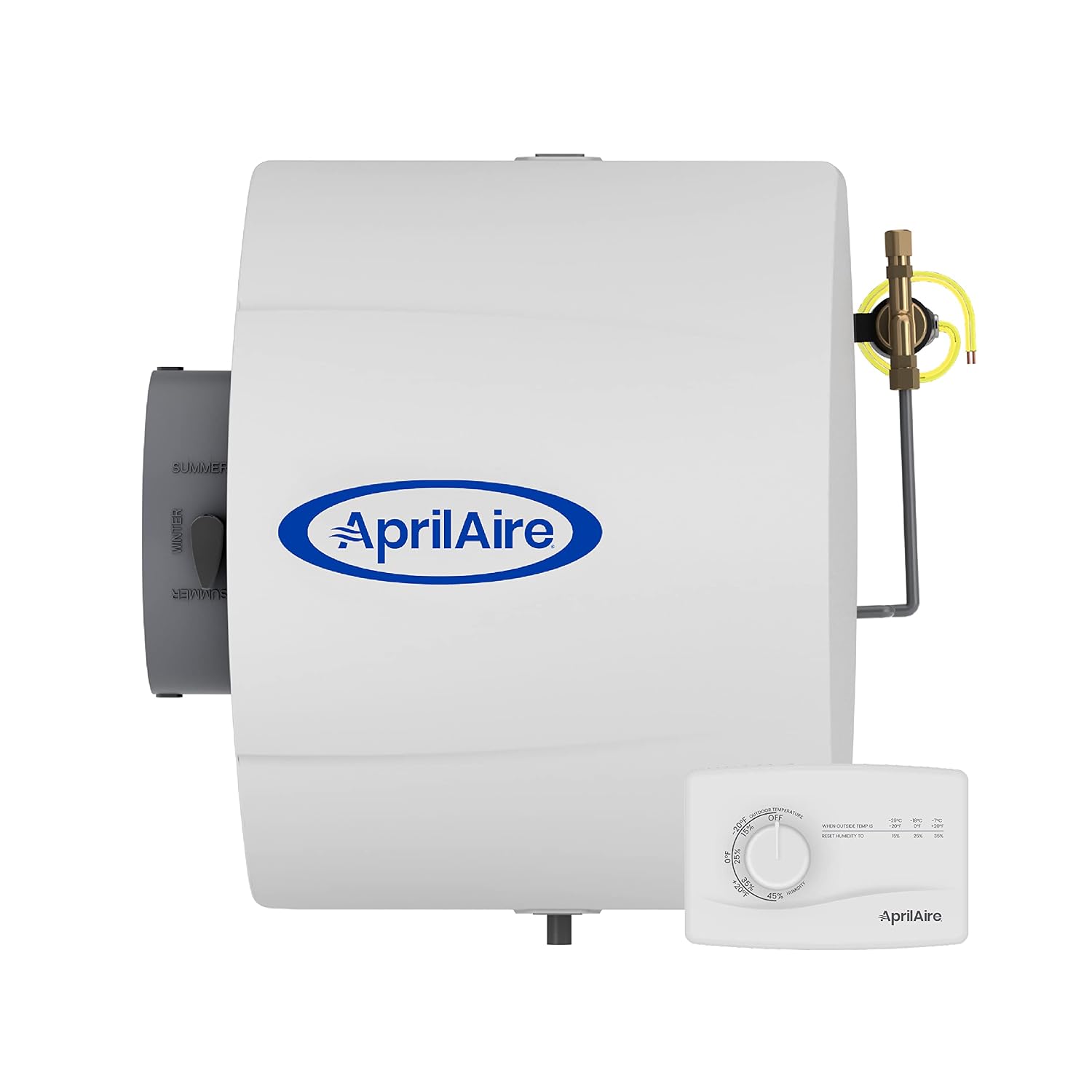
The Aprilaire 600M is a furnace-mounted bypass evaporative humidifier that uses a water panel to evaporate moisture into the HVAC airstream and distribute humidified air through your ducts. It is installed on the furnace and includes a built-in bypass damper, 24 VAC transformer, manual humidistat control with sensor, solenoid valve, and water panel so it is ready for professional or competent DIY installation. The unit is rated for very high output and is sized to cover large homes, so it handles cold, dry winters without constant refills or cycling. Its manual control and simple evaporative filter design mean minimal electronics to fail and easy, inexpensive seasonal maintenance when replacing the water panel. Limitations are that humidity is set and adjusted manually rather than through automatic smart control, and correct performance depends on proper installation with the furnace and ductwork. Expect routine replacement of the disposable water panel as the primary ongoing maintenance item.
Best for: Buyers who prioritize a proven, durable furnace-mounted humidifier that delivers high output and straightforward maintenance over smart features.
Less Ideal for: People who want automatic scheduling, smartphone control, or a plug-and-play portable humidifier should consider other options.
- High output capacity suitable for large homes up to several thousand square feet
- Includes necessary installation components: humidistat, transformer, valve, and water panel
- Bypass damper built in for simpler installation and seasonal labeling for summer/winter
- Evaporative water panel design keeps electronics minimal and maintenance straightforward
- Manual humidistat control only, no built-in automatic or smart connectivity
- Requires professional-grade installation for optimal performance in many furnace systems
Verdict: Choose the Aprilaire 600M when you need a high-capacity, reliable furnace-mounted humidifier with simple, serviceable evaporative technology for large homes.
AIRCARE MA Console Humidifier MA1201

| Capacity | 3.6 gallons |
|---|---|
| Floor Area | 3600 square_feet |
| Operation Mode | Evaporative |
| Runtime | 36 hours |
| Wattage | 1650 watts |
The AIRCARE MA1201 is a console evaporative humidifier intended to raise and maintain indoor humidity across large spaces such as whole houses served by a gas furnace. It uses a saturated wick filter and a fan with four speeds plus auto mode to move dry air through the wick, and a digital humidistat lets you set and hold a target humidity. A 3.6 gallon tank provides up to 36 hours of runtime and the unit has refill and check-filter indicators, auto shutoff when the tank is empty and casters for moving it between rooms. Because it is evaporative, it avoids producing visible mist and helps reduce static and protect wood instruments and electronics when set to 40 to 60% RH, but it does require periodic wick replacement and regular cleaning to prevent mineral buildup. At 1650 watts it needs a dedicated outlet and produces some operating noise on higher fan speeds, so placement and expectations around sound and maintenance matter for long-term satisfaction.
Best for: Buyers who prioritize measurable, whole‑house humidity control and want a console humidifier that can be set and left to maintain target humidity with visible indicators and mobility.
Less Ideal for: Anyone seeking a nearly silent, no‑maintenance ultrasonic unit or a plug‑and‑forget humidifier that does not require periodic wick replacement and cleaning should consider other types.
- Designed for large coverage up to 3,600 sq ft suitable for whole‑house humidification
- Digital humidistat and customizable humidity settings with auto mode for easier control
- Large 3.6 gallon tank giving up to 36 hours runtime between fills
- Auto shutoff, refill and filter indicators, and casters improve safety and mobility
- Requires regular wick replacement and cleaning to manage mineral deposits
- Evaporative operation produces airflow noise at higher fan speeds
- Higher power draw (1650 watts) requires appropriate outlet planning
Verdict: Choose the AIRCARE MA1201 when you need a controllable, whole‑house evaporative humidifier that can maintain set humidity across large spaces.
Choosing the Right Whole-House Humidifier for Gas Furnace: Key Factors to Consider
Output Capacity and Home Size
Humidifier output, usually listed in gallons per day, must match the conditioned volume of your home. Undersized units will fail to raise relative humidity adequately on cold dry days, while oversized units can cycle unnecessarily and risk condensation in ductwork.
Estimate required capacity by square footage, ceiling height, and local winter dryness. For gas furnace installations, also consider how often the furnace runs during the heating season because the humidifier typically operates when the blower is running. Choosing a unit with a slightly higher capacity than minimum calculations helps maintain set humidity during very cold periods.
Compatibility With Gas Furnace Ducting and Controls
A whole-house humidifier must physically fit into your furnace or ductwork layout and interface with the furnace blower and control wiring. Different mounting styles attach to the supply plenum, return plenum, or an adjacent duct; pick the style that matches available space and access.
Control compatibility matters too. Many gas furnaces use a humidistat or connect through the furnace control board so the humidifier only runs with the blower. Verify available control terminals and wiring access. If the humidifier supports automatic demand through a dedicated sensor, it will usually deliver more consistent indoor humidity without manual adjustment.
Water Supply and Drain Considerations
Whole-house units need a reliable cold-water feed and often a drain line or evaporative path. For plumbed models, check that you can provide a nearby cold-water valve and a safe route for condensate or drain water. Some designs minimize waste by recirculating or evaporating nearly all supplied water, while others use a bypass that discards excess water.
Hard water can cause mineral buildup on pads or in evaporative elements. Consider whether your home's water requires a sediment filter, softening, or a humidifier design that uses replaceable pads or cartridges to manage scale. Ease of accessing and replacing these parts affects long-term performance.
Control Accuracy and Humidity Sensing
Accurate sensing and control prevent over- or under-humidifying. A reliable humidistat or integrated digital control measures relative humidity and cycles the humidifier with the furnace blower. Some systems include remote or duct-mounted sensors to avoid false readings caused by localized humidity near the register or appliances.
Look for controls with clear setpoint adjustment and a readable display. Advanced models may offer automatic adjustment based on outdoor temperature to reduce condensation risk on cold windows and exterior surfaces. Good control behavior preserves comfort while protecting building components.
Maintenance Frequency and Consumables
Maintenance burden affects annual ownership cost and reliability. Common service items include evaporator pads, filters, and sometimes replaceable cartridges. Pad life varies with water quality and runtime; easy access and clear replacement intervals make routine care straightforward.
Assess how often you will need to change consumables and whether the unit has washable components. Units with modular parts and widely available replacements reduce downtime and simplify seasonal servicing.
Types of Whole-House Humidifiers and How They Work
There are several common whole-house humidifier designs: bypass, fan-powered, and steam. Bypass units route furnace air across a moisture media using the furnace blower, fan-powered units add their own fan to force air through the media, and steam humidifiers inject vapor directly into the duct or plenum.
For gas furnace installations, bypass and fan-powered units are often simpler to integrate because they use the furnace blower or a modest auxiliary fan. Steam units deliver the fastest response and greatest control but require a dedicated electrical supply and more precise installation to manage condensate and safety controls.
- Bypass: Uses furnace blower, quieter, lower electrical need.
- Fan-powered: Adds humidity regardless of furnace fan speed, stronger output.
- Steam: Fast, high-capacity, needs dedicated power and controls.
Planning the Installation With a Gas Furnace
Before purchasing, inspect the furnace area for space, available control terminals, and a nearby water line and drain. Note whether the humidifier will mount to the supply or return plenum and confirm there is room for service access.
If you are hiring a technician, share the furnace make and model details so they can confirm wiring compatibility and the appropriate mounting option. For DIYers, plan for basic plumbing to the unit and ensure the furnace manual permits the intended wiring or control hookup.
- Confirm mounting type: supply plenum, return plenum, or cabinet mount.
- Locate cold-water feed and plan a condensate/drain route.
- Check furnace control terminals for humidifier wiring.
Managing Mineral Buildup and Water Quality
Hard water causes mineral deposits that reduce humidifier efficiency and increase maintenance frequency. Choose a design with replaceable pads or an easy-clean evaporative surface if your water is high in minerals.
In areas with severe hardness, adding a small sediment filter or using a unit designed to handle mineral loads will extend pad life. Regularly inspect the water distribution tray and replace pads at the manufacturer-specified interval to maintain output and prevent odors.
- Inspect evaporative media seasonally.
- Consider a pre-filter for hard water.
- Flush trays and drain lines during service.
Control Strategies to Avoid Condensation
Over-humidifying during very cold weather can cause condensation on windows and in building assemblies. Use controls that either reduce setpoint automatically with falling outdoor temperatures or employ a conservative upper limit for indoor humidity on cold days.
Some systems pair a weather-compensated humidistat or allow manual adjustment based on outdoor readings. Avoid setting the humidistat too high in winter and monitor for any signs of surface condensation after installation.
- Use outdoor-compensated or adjustable controls when possible.
- Start with moderate setpoints and observe conditions for several days.
- Check windows and exterior walls for signs of condensation after adjustments.
Seasonal Use and Winter Best Practices
Whole-house humidifiers are most valuable during the heating season. Run the humidifier with the furnace blower and follow a seasonal maintenance checklist: replace pads, clean trays, test the humidistat, and verify water connections.
When the heating season ends, shut off water supplies and drain the unit if recommended. Proper off-season storage or preparation prevents mold growth and extends system life.
- Perform seasonal pad replacement and cleaning.
- Shut off water and drain the unit after winter.
- Test controls at the start of the season.
How We Chose the Best Whole-House Humidifier for Gas Furnace
We prioritized features and specifications that matter for whole-house humidifiers installed on gas furnaces in typical homes. Key evaluation criteria included humidification output relative to home size, integration with furnace ductwork and control systems, reliability of the water delivery and evaporation method, ease of installation for a professional or competent DIYer, and long-term maintenance needs including filter and pad replacement. We also considered control accuracy and sensor options that prevent over-humidification and protect the furnace and ductwork. Units that required complex or nonstandard furnace modifications were excluded, as were units with insufficient capacity for typical single-family home square footage. Our short list favors models with clear installation guidance, durable corrosion-resistant materials, accessible service parts, and reliable control logic to keep humidity in the recommended comfort range.
Our full evaluation process is outlined in our review methodology.
FAQ
Can a whole-house humidifier run with a gas furnace blower only?
Yes. Many whole-house humidifiers are designed to operate whenever the furnace blower runs. Proper wiring to the furnace control or a dedicated humidistat ensures the humidifier only adds moisture while warm air is circulating.
Will a humidifier damage my gas furnace?
When installed correctly and controlled properly, a humidifier should not harm a gas furnace. The key is preventing excessive humidity and ensuring the unit is mounted and wired per furnace guidelines to avoid interfering with combustion air or controls.
How often do I need to replace pads or filters?
Replacement intervals depend on water quality and runtime but typically range from one to two heating seasons. Inspect pads annually and replace sooner if you see mineral buildup, reduced output, or odors.
Do I need a drain line for a whole-house humidifier?
Some designs require a drain for excess water or for periodic flushing, while others evaporate most water and need only a water feed. Confirm the unit's water handling method and plan for an appropriate drain route if one is required.
Is a steam humidifier better for large homes with a gas furnace?
Steam humidifiers provide high output and fast response, which can be advantageous in large homes. They require a dedicated electrical supply and more precise installation, so weigh the higher installation complexity against the performance need.
Final Verdict
For gas furnace installations, prioritize a humidifier that matches your home's capacity needs, fits the available duct or cabinet space, and integrates cleanly with furnace controls. Balance ease of installation and maintenance against output requirements and water quality concerns. With sensible control strategies and regular servicing, a properly chosen whole-house humidifier will improve comfort and protect finishes without creating condensation problems.