
Note: This article contains affiliate links. If you click on these links and make a purchase, we may earn a small commission at no extra cost to you. This helps support our research and content. Read our full affiliate disclosure here.
Choosing the right window air conditioner for a small room matters because oversizing wastes energy while undersizing leaves you uncomfortable. In bedrooms, home offices, and small living spaces you need a unit that balances cooling capacity, noise, and installation simplicity. This guide shortlists five top picks that suit compact spaces and evaluates them across the most important buyer concerns like BTU sizing, efficiency, and sound level. Read on to find the practical tradeoffs and the features that matter most for keeping small rooms cool.
Top Picks at a Glance
| Best Overall The best all-around choice for most situations | LG LW5025R 5,000 BTU Window AC |  |
| Best Quality Built to a higher standard if you want something more solid | Frigidaire FFRA051WAE 5,000 BTU |  |
| Best Budget The cheapest option that still gets the job done reliably | Amazon Basics 5000-BTU Window AC |  |
| Top Rated A top-rated pick with lots of positive feedback | Midea EasyCool 5,000 BTU |  |
| Most Popular A crowd favorite that many people choose with confidence | GE 5,000 BTU Window Air Conditioner |  |
LG LW5025R 5,000 BTU Window AC

| Cooling Power | 5000 BTU |
|---|---|
| Floor Area | 150 square_feet |
| Wattage | 450 watts |
| Refrigerant | R-32 |
| Filter Type | Washable Filter |
The LG LW5025R is a compact window air conditioner intended for small rooms, offering 5,000 BTU cooling with two fan speeds and simple button and remote controls. It installs in a standard double-hung window using the included mounting kit and uses R-32 refrigerant with a washable dust filter for straightforward maintenance. Practical benefits include relatively quiet operation for its class, an energy-efficient SEER of 14 and basic energy-save modes, and a low-power draw around 450 watts that keeps running costs down in small spaces. Controls are uncomplicated, so adjusting temperature and fan speed from across the room is easy, and the unit includes an auto-restart feature after power interruptions. Limitations are inherent to its size: it is meant for single small rooms only and will struggle in larger open-plan areas, and it lacks inverter technology which can affect finer temperature control and longer-term efficiency compared with inverter models. If you need a simple, reliable window AC for a bedroom or office, this unit covers the essentials well.
Best for: Buyers seeking a straightforward, energy-conscious window air conditioner for a single small room who value easy installation, simple controls, and low maintenance.
Less Ideal for: People who need to cool large or open-plan areas, want the highest-precision temperature control or ultimate long-run efficiency from an inverter unit, or who require multi-room cooling.
- Compact 5,000 BTU unit suitable for cooling rooms up to about 150 sq ft
- Washable dust filter for easy maintenance and longer filter life
- Remote and touch/button controls for convenient operation
- Energy-conscious design with SEER 14 and an energy save function
- Not an inverter model, so it lacks the variable-speed efficiency and quieter long-run operation of inverter ACs
- Limited cooling capacity makes it unsuitable for larger rooms or open-plan spaces
Verdict: A no-frills, energy-conscious 5,000 BTU window AC that reliably cools a single small room with easy installation and low maintenance.
Frigidaire FFRA051WAE 5,000 BTU

| Cooling Power | 5000 BTU |
|---|---|
| Floor Area | 150 square_feet |
| Noise | 52 db |
| Wattage | 450 |
The Frigidaire FFRA051WAE is a straightforward window-mounted air conditioner aimed at cooling small rooms and bedrooms. It produces 5,000 BTU of cooling, runs on 115V/450W power, and offers two fan speeds plus effortless temperature control for maintaining set temperatures. The washable filter and adjustable side panels make upkeep and installation easy, and a long three-prong cord reduces the need for extensions. Noise is rated at 52 dBA, which is reasonably quiet for overnight use, and the unit includes Auto Restart so settings are restored after power interruptions. On the efficiency side it reports an SEER/efficiency value of 11 and modest annual energy consumption, which is typical for this capacity. Limitations are inherent to its size: it is built for spaces around 150 sq. ft. so it will struggle in larger rooms, and the basic controls are button/touch rather than advanced smart or inverter-driven variable-speed compressors. For buyers focused on simple, reliable cooling in a small room, it covers the essentials without frills.
Best for: Buyers who prioritize steady, no-nonsense cooling performance for a small bedroom or office and want easy installation and maintenance over advanced features.
Less Ideal for: Do not choose this unit if you need to cool larger rooms, want variable-speed inverter efficiency, or require smart-home integration and remote control.
- Suitable cooling capacity for small rooms up to ~150 sq. ft.
- Washable dust filter for easy maintenance
- Auto Restart restores previous settings after power outages
- Adjustable side panels and long power cord simplify installation
- Reasonably quiet operation at 52 dBA for bedroom use
- Limited to single-speed rotary compressor so less precise temperature control than inverter units
- Basic touch/button controls without smart connectivity options
Verdict: A dependable, easy-to-install 5,000 BTU window AC that delivers practical, quiet cooling for small rooms where solid performance matters.
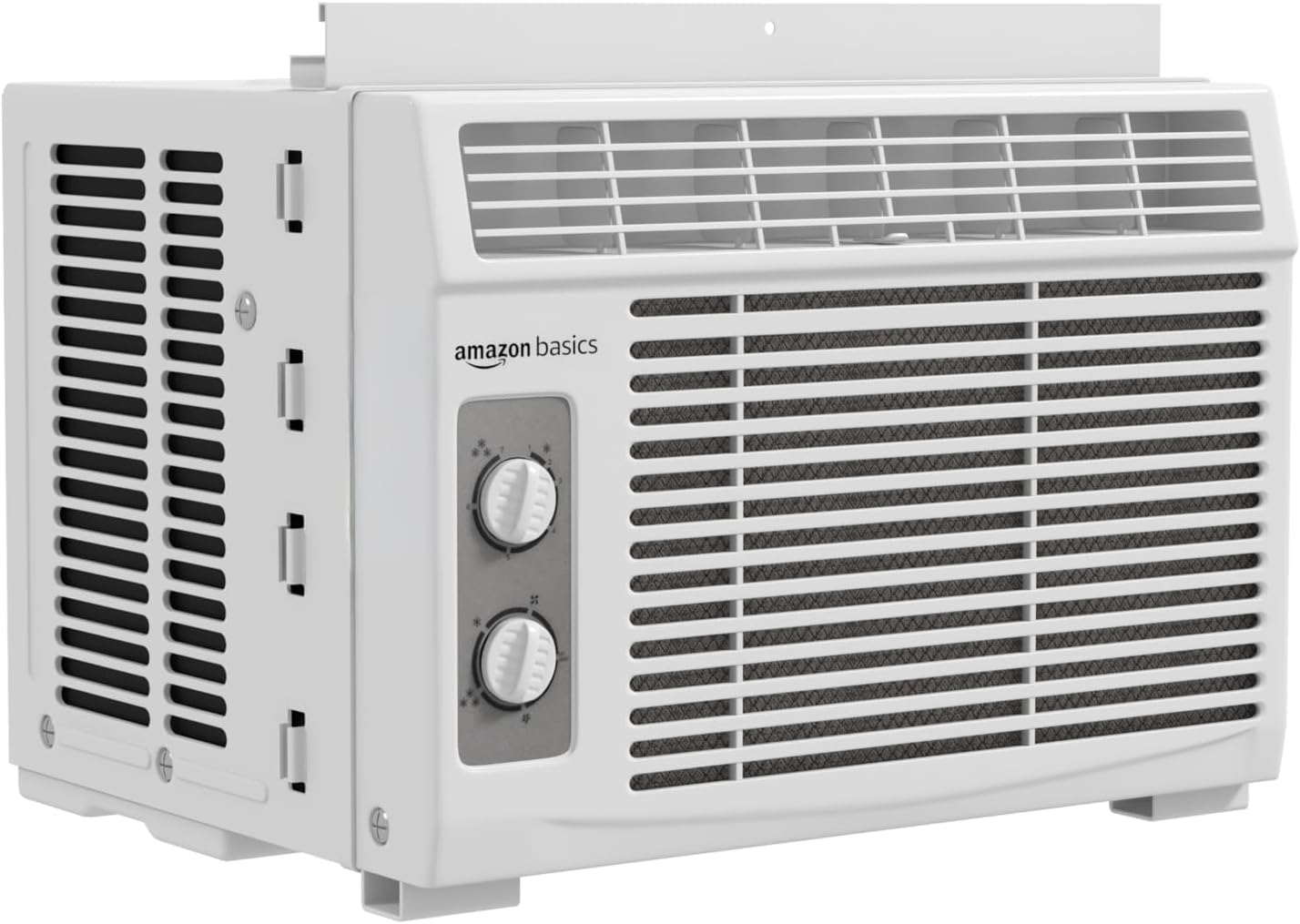
Amazon Basics 5000-BTU Window AC
| Cooling Power | 5000 BTU |
|---|---|
| Floor Area | 150 square_feet |
| Wattage | 450 watts |
| Noise | 56 db |
| Control Method | Touch / Button Control |
This Amazon Basics 5000-BTU window air conditioner provides straightforward cooling for small rooms such as bedrooms, dorms, or home offices. It offers cooling and fan-only modes, seven temperature/power levels, and two fan speeds to let you fine-tune airflow. Installation uses the included adjustable window kit and removable washable pre-filter makes maintenance simple. The unit runs on 115V and draws about 450 watts, so it is suitable for limited electrical circuits and modest energy use; SEER is listed at 14. Noise peaks around 56 dB, which is noticeable but acceptable for most daytime use and many sleeping situations. The design is basic with mechanical button/touch controls and a rotary-scroll compressor, so it lacks smart features or inverter efficiency found on pricier models. Overall, it delivers reliable, no-frills cooling for small spaces where budget and simplicity matter more than advanced efficiency or quietest operation.
Best for: Buyers seeking an affordable, easy-to-install window AC for a small room who prioritize straightforward cooling and low upfront cost over advanced features.
Less Ideal for: People who need the quietest operation, the highest energy efficiency, or smart/remote control integrations should consider higher-end inverter models instead.
- Sized for rooms up to about 150 sq ft, suitable for bedrooms or small offices
- Washable removable pre-filter simplifies cleaning and upkeep
- Adjustable window mounting kit fits standard windows for quick installation
- Multiple temperature settings and two fan speeds let you control comfort
- No inverter or advanced efficiency mode so it may cycle more and use more energy than inverter units
- Noise level around 56 dB is noticeable in very quiet spaces
- Controls are basic without Wi-Fi or remote app features
Verdict: A practical, budget-friendly window AC that reliably cools small rooms with simple controls and easy maintenance.
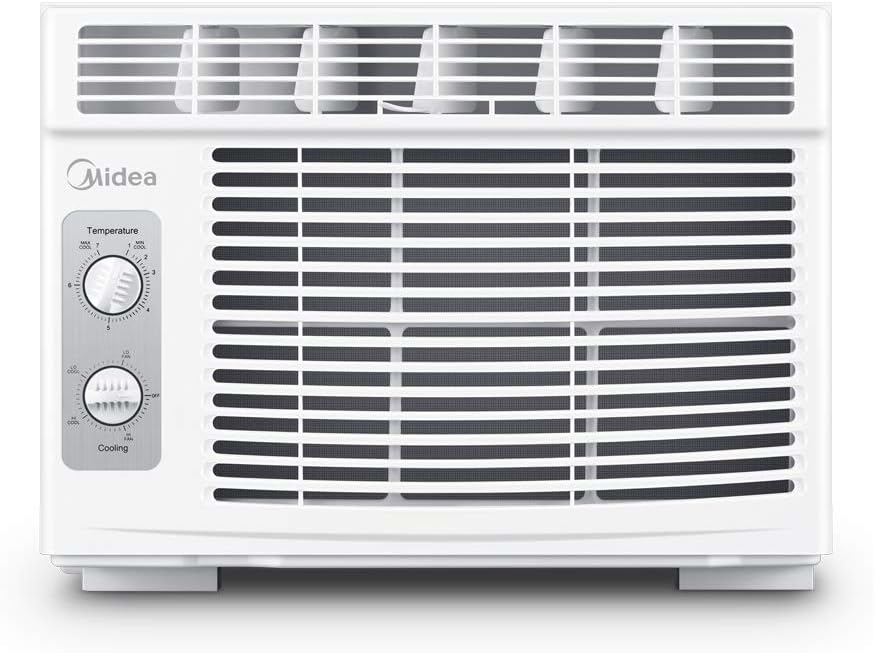
Midea EasyCool 5,000 BTU
| Cooling Power | 5000 BTU |
|---|---|
| Floor Area | 150 square_feet |
| Filter Type | Washable Filter |
| Refrigerant | R-32 |
| Control Method | Push Button |
The Midea EasyCool 5,000 BTU is a straightforward window air conditioner for small rooms and home offices. It delivers cooling for spaces up to about 150 square feet using a rotary compressor and mechanical push-button controls, so you can change modes and fan speeds without fuss. The unit includes a washable reusable filter for simple maintenance and a two-way outlet to direct airflow where you need it. It is relatively quiet for its class and runs on standard 110V power, with three power levels and multiple fan speeds to balance comfort and energy use. Practical buyers will appreciate the included window bracket and the absence of complicated smart features, which reduces potential failure points. The main limitations are modest cooling capacity suitable only for small rooms and a non-inverter compressor, so it will cycle more often than inverter models and may be less efficient under heavy load. For someone seeking a dependable, easy-to-use window AC with basic features and low-maintenance upkeep, this unit performs well.
Best for: Buyers who prioritize a reliable, no-frills window AC that is simple to operate and maintain for cooling single small rooms.
Less Ideal for: People who need high-efficiency inverter operation, smart controls, or cooling for larger rooms should consider other options.
- Simple mechanical push-button controls that are easy to operate and unlikely to fail
- Washable reusable filter for low-cost, straightforward maintenance
- Designed to cool rooms up to 150 sq. ft., suitable for small bedrooms or home offices
- Includes window bracket and installs on standard 110V household power
- Non-inverter rotary compressor can be less energy-efficient under sustained heavy use
- Cooling capacity is limited to small rooms and will struggle in larger or poorly insulated spaces
Verdict: A dependable, easy-to-use window AC that provides straightforward cooling for single small rooms with minimal maintenance required.
GE 5,000 BTU Window Air Conditioner

| Cooling Power | 5000 BTU |
|---|---|
| Floor Area | 150 square_feet |
| Wattage | 440 watts |
| Refrigerant | R-32 |
| Control Method | Push Button |
This GE 5,000 BTU window air conditioner is a no-frills unit built for small rooms, dorms, and apartments where space and simplicity matter. It delivers cooling for up to about 150 square feet using two cooling modes and two fan speeds controlled by straightforward push-button and dial controls, so there is no app or network setup to manage. The unit runs on standard 115V power with a relatively low 440W draw and uses an R-32 refrigerant; a washable filter reduces ongoing filter costs and the design claims no manual draining under normal conditions. Installation is intended to be DIY-friendly with an included EZ mount kit and side panels for narrow windows. Expect typical window AC noise in the mid-50 dB range, and efficiency rated at 11 SEER which is acceptable for budget-focused cooling but not top of class. If you want a simple, reliable cooler that is easy to install and maintain, this GE unit does the job, though it lacks smart features and advanced energy savings found on higher-end models.
Best for: Buyers who prioritize straightforward, proven cooling for a small room and want a model that is easy to install, operate, and maintain without relying on apps or extras.
Less Ideal for: Users who want Wi-Fi, remote control, or top-tier energy efficiency for continuous long-run savings should consider feature-rich or higher-SEER alternatives.
- Compact footprint fits narrow double-hung windows and small rooms
- Simple mechanical controls that are easy to operate without setup
- Washable, reusable filter reduces replacement costs
- Low 440W power draw for modest energy use
- Includes installation kit for mostly DIY setup
- No smart controls or remote control options
- Noise level is noticeable at higher fan setting (mid-50 dB)
- 11 SEER efficiency is modest compared with higher-end units
Verdict: A simple, easy-to-install window AC that reliably cools small rooms without smart bells and whistles, ideal when ease of use and low maintenance matter most.
Choosing the Right Window Air Conditioner for Small Rooms: Key Factors to Consider
Correct BTU Sizing
Matching the unit's BTU rating to room size is the single most important factor. Too little cooling leaves the room warm and forces the compressor to run constantly, shortening lifespan and increasing energy use.
For small rooms, a moderately low BTU rating delivers steady comfort without cycling excessively. Consider room dimensions, ceiling height, sun exposure, and heat-generating equipment. These variables change the effective cooling load so pick a unit sized for the measured conditions rather than guessing by feel.
Energy Efficiency and Operating Cost
Efficiency ratings translate directly into ongoing operating expense, especially in warm months when the unit may run many hours per day.
Look at the published efficiency number and estimated annual energy consumption. Higher efficiency reduces power draw and can offset a higher purchase cost over time. Also check for eco or low-power modes that scale back compressor activity during milder conditions to save energy.
Noise Output
In small rooms, the unit is physically close to occupants, so noise becomes more noticeable and can disturb sleep or concentration.
Compare measured decibel ratings for cooling modes and fan-only modes. Look for models with multiple fan speeds and quieter low-power settings for night use. Noise-reduction design features like insulated compressors and vibration-dampening mounts matter in practice.
Installation, Window Fit, and Weight
Small rooms often have older or nonstandard windows and limited space to support a heavy appliance. A unit that is easy to mount and fits common window widths simplifies installation and reduces the need for additional support.
Check extension kit ranges, mounting hardware requirements, and the physical weight of the unit. Lighter units or models that include simple accordion panels and felt seals are faster to install and reduce the risk of drafts or leaks.
Maintenance and Filter Access
Routine maintenance keeps a window air conditioner running efficiently and extends its service life. Filters that are easy to remove and clean encourage regular upkeep.
Consider how frequently filters must be cleaned or replaced, whether the front panel opens without tools, and if there are accessible drain channels for heavy condensation. Simpler maintenance is especially valuable in small living spaces where storage for spare parts and tools may be limited.
Control Features and Usability
Simple, reliable controls make daily operation less frustrating. In small rooms you often want quick access to timer functions, sleep modes, and fan speed adjustments.
Look for easily readable displays, responsive remotes, and basic scheduling. Smart features can be useful but should not complicate essential controls. Reliable physical buttons combined with optional remote or app control usually deliver the best user experience.
Sizing a Window Air Conditioner for Small Rooms
Start by measuring the room area in square feet and accounting for factors like high ceilings, large windows, or strong sun exposure. For many small rooms, a lower BTU range provides adequate cooling without short cycling, but bright sun or many occupants will raise the required capacity.
When in doubt, use a simple rule-of-thumb adjusted for conditions rather than guessing. Smaller rooms also benefit from models that offer multiple fan speeds and a reliable low-power setting so you can fine-tune comfort without overshooting on capacity.
- Measure floor area and ceiling height for accurate load estimation
- Add capacity for heavy sun exposure or many heat sources
- Prefer units with multiple fan speeds for fine control
Sound Considerations for Bedrooms and Home Offices
Noise is often the deciding factor for small-room installs. Look for units with published decibel levels and multiple operating modes. Night modes and low-speed fans can reduce audible distraction while maintaining comfort.
Placement in the window and secure mounting also influence perceived sound. A well-sealed installation reduces vibration and drafts that can make a quieter unit seem louder in practice.
- Compare decibel ratings for cooling and fan-only modes
- Use vibration-dampening mounts or foam seals to reduce rattle
- Night or sleep modes are valuable for overnight comfort
Practical Installation Tips
Prepare the window opening and nearby area before buying. Measure sash width, sill depth, and verify that the window can support the unit's weight. If access is tight, consider a lighter unit or professional help for safe installation.
Seal gaps with the included panels and weatherstripping to prevent drafts and moisture ingress. Ensure the exterior portion of the unit has proper airflow clearance and that the window can tilt or lock securely with the unit in place.
- Confirm window width, sill depth, and opening height before purchase
- Keep the exterior side clear for unobstructed airflow
- Seal all gaps to prevent drafts and reduce noise
Maintenance Routine to Keep Small Rooms Comfortable
Regular cleaning of the washable filter is the simplest maintenance task and preserves cooling efficiency. In dusty environments or near kitchens, check and clean the filter monthly during heavy use.
Inspect seals and drainage periodically and clean external fins gently with a soft brush to keep airflow efficient. Scheduling simple seasonal checks reduces the chance of premature performance loss and keeps energy use low.
- Clean or replace filters regularly, especially during heavy use
- Check window seals and mounting hardware each season
- Clear external fins of debris to maintain airflow
Controls, Scheduling, and Smart Features
Basic timers and sleep modes are often the most useful features in small rooms. They allow you to reduce cooling overnight or pre-cool a space before use without manual intervention.
Smart or remote control can add convenience but prioritize dependable physical controls. If the unit offers app control, ensure it supports basic scheduling and straightforward temperature setpoints rather than complex scenes that add no real benefit for single-room use.
- Use timers to lower runtime and save energy
- Prefer intuitive remotes and clearly labeled buttons
- Reserve smart features for reliable scheduling and simple adjustments
How We Chose the Best Window Air Conditioner for Small Rooms
We focused on selecting window air conditioners that perform well in compact rooms while minimizing energy waste and noise. Primary evaluation criteria included cooling capacity relative to room size, measured in BTUs per square foot; energy efficiency ratings and estimated seasonal operating cost; sound output measured in decibels for sleep-friendly operation; and installation and maintenance factors like window fit, weight, and filter access. We also considered control features relevant to small-room use, such as adjustable fan speeds, programmable timers, and basic smart or remote control options that simplify day-to-day operation. Units were excluded if they were designed only for large open-plan areas, required uncommon installation hardware, or lacked basic energy ratings. We also filtered out models without reasonable noise specifications or units that demand excessive clearance that small rooms typically cannot provide. The resulting shortlist emphasizes practical, easy-to-install window air conditioners that match cooling power to small-room needs, minimize operating cost, and offer straightforward upkeep.
Our full evaluation process is outlined in our review methodology.
FAQ
What BTU rating do I need for a small bedroom?
Small bedrooms typically need a low to mid-range BTU unit depending on area and conditions. Measure the room and account for sun exposure and ceiling height to pick a unit that cools steadily without short cycling.
How loud are window air conditioners in small rooms?
Noise varies by model and fan speed. Expect higher decibels on max cooling; look for published sound levels and a night mode or low-speed setting if quiet operation is important.
Can I install a window air conditioner myself in a small room?
Many window units are designed for DIY installation, but you should check weight, window type, and whether you can safely lift and support the unit. If access or weight is a concern, professional installation is a reasonable option.
How often should I clean the filter on a small-room unit?
In regular home use, clean a washable filter every one to three months and more frequently in dusty conditions. Regular cleaning preserves airflow and efficiency and improves indoor air quality.
Do smaller units cost less to operate?
Smaller units often use less power when properly sized, but efficiency ratings matter. An undersized unit that runs continuously can cost more than a correctly sized, higher-efficiency model.
Final Verdict
For small rooms, prioritize correct BTU sizing, low noise output, and good energy efficiency over extra features. A properly sized, efficient window air conditioner will cool reliably without excessive runtime or disruption. Focus on units that fit your window, offer quiet low-speed operation, and have easy-to-access filters to simplify upkeep. With these tradeoffs in mind, you can confidently choose a compact window air conditioner that keeps your small room comfortable and economical to run.