
Note: This article contains affiliate links. If you click on these links and make a purchase, we may earn a small commission at no extra cost to you. This helps support our research and content. Read our full affiliate disclosure here.
Choosing the right windowless air conditioner matters when you need effective cooling without a window-mounted unit or major installation. These systems are commonly used in apartments, rooms with restricted window access, or temporary living spaces where ductless solutions are preferred. This guide covers seven shortlisted Windowless Air Conditioners that excel in different use cases. We evaluated each option for cooling capacity, installation flexibility, noise levels, and energy efficiency to help you pick a unit that fits your room size and installation limits. Read on to see how the top contenders compare against practical homeowner needs.
Top Picks at a Glance
| Best Overall The best all-around choice for most situations | CENSTECH TS05 Windowless Air Cooler |  |
| Best Quality Built to a higher standard if you want something more solid | CENSTECH L242Y Swamp Cooler |  |
| Best Value The sweet spot between price and what you get | CENSTECH DL3 Windowless Air Cooler |  |
| Best Budget The cheapest option that still gets the job done reliably | OEARE Swamp Cooler 6L |  |
| Top Rated A top-rated pick with lots of positive feedback | fancole TS03Y Windowless Air Conditioner |  |
| Most Popular A crowd favorite that many people choose with confidence | SYUDTY GDS-820 Evaporative Cooler |  |
| Best Seller A high-volume bestseller chosen again and again | DREO Evaporative Air Cooler DR-HEC002S |  |
CENSTECH TS05 Windowless Air Cooler

| Cooling Power | 0.07 KW |
|---|---|
| Noise | 25 db |
| Wattage | 65 watts |
| Capacity | 4 liters |
| Controller Type | Remote Control |
The CENSTECH TS05 is a windowless evaporative air cooler intended to deliver portable cooling without installation. It works as a fan, humidifier, and evaporative cooler: add water and the included ice packs for stronger cooling or run it dry as a ventilating fan. The unit offers three fan speeds and four modes including a quiet sleep mode that the manufacturer rates at about 25 dB, and a 120 degree oscillation to spread airflow across a room. Controls include an LCD panel and a 20 ft remote for easy adjustments, plus a 12 hour timer and a visible water level indicator. Practical benefits are low energy use at 65 watts, a 4 liter tank for long runtime, and a bladeless design with UL and ETL safety certifications. Important limitations are inherent to evaporative coolers: performance depends on ambient humidity and it will not reach the temperatures of a refrigerant air conditioner in very humid climates, and the unit requires periodic refills and maintenance of the tank and ice packs.
Best for: Buyers who want a versatile, low-energy portable cooler that doubles as a humidifier and fan and who prioritize quiet operation and easy setup over true refrigerated cooling.
Less Ideal for: People in consistently humid climates or those who need strong, room-wide refrigerated air conditioning should consider a refrigerated portable AC instead.
- Three speeds and four modes including a quiet sleep mode for flexible comfort
- Large 4 L water tank with water level indicator for extended runtime up to 24 hours
- No window or installation required, making it easy to move between rooms
- Low power draw (65 W) for energy-efficient operation
- Evaporative cooling effectiveness drops in high-humidity conditions compared with refrigerant AC
- Requires periodic refilling and upkeep of the tank and ice packs
Verdict: Choose the TS05 if you want a quiet, energy-efficient portable swamp cooler that requires no installation and provides flexible fan, humidifier, and evaporative cooling modes.
CENSTECH L242Y Swamp Cooler

| Cooling Power | 100 KW |
|---|---|
| Noise | 40 db |
| Wattage | 100 |
| Capacity | 12 gallons |
| Controller Type | Remote Control |
The CENSTECH L242Y is a ventless evaporative air cooler that delivers fast, energy-efficient airflow for larger indoor spaces. It uses a 2026-generation motor and composite-reinforced fan blades to produce up to 3600 CFM and claims near-instant cooling response, while three high-density honeycomb panels and included ice packs boost evaporative cooling when needed. Typical use is simple: top-fill the tanks, choose one of three speeds and four modes, and let the unit oscillate across its 120 degree sweep to move cooled air through a room. Practical benefits include 24-hour runtime via dual tanks and reusable ice packs, remote and touch controls with a 7-hour timer, quiet operation under ~45 dB, and easy mobility on 360 degree swivel wheels. Important limitations are inherent to evaporative coolers: performance depends on ambient humidity so it cools best in dry climates, and it does not replace refrigerated air conditioning for aggressive temperature drops or dehumidification. Maintenance also requires periodic cleaning of the honeycomb pads and tanks to prevent buildup.
Best for: Buyers who need powerful, energy-efficient spot or whole-room cooling in dry climates and who prioritize fast airflow and long runtime without installing ducting or window kits.
Less Ideal for: Those who need strong temperature drops in humid regions or require true refrigerated dehumidification should choose a refrigerated air conditioner instead.
- High claimed airflow (up to 3600 CFM) with wide 120° oscillation for broad coverage
- Large dual 12-gallon tank system plus reusable ice packs for extended 24-hour runtime
- Low power draw (100W) and relatively quiet operation under 45 dB
- Remote and touch controls with a 7-hour timer and multiple modes for flexible use
- Tool-free top-fill design and swivel wheels for easy refilling and repositioning
- Evaporative cooling effectiveness drops in humid environments compared with refrigerated AC
- Requires regular cleaning of honeycomb pads and tanks to maintain performance
Verdict: If you want a high‑airflow, low‑power windowless cooler for large rooms in dry climates, the CENSTECH L242Y delivers broad coverage and long runtime without installation.
CENSTECH DL3 Windowless Air Cooler
| Wattage | 65 watts |
|---|---|
| Capacity | 3 gallons |
| Noise | 25 db |
| Cooling Coverage | Up to 600 sq.ft |
| Controller Type | Remote Control |
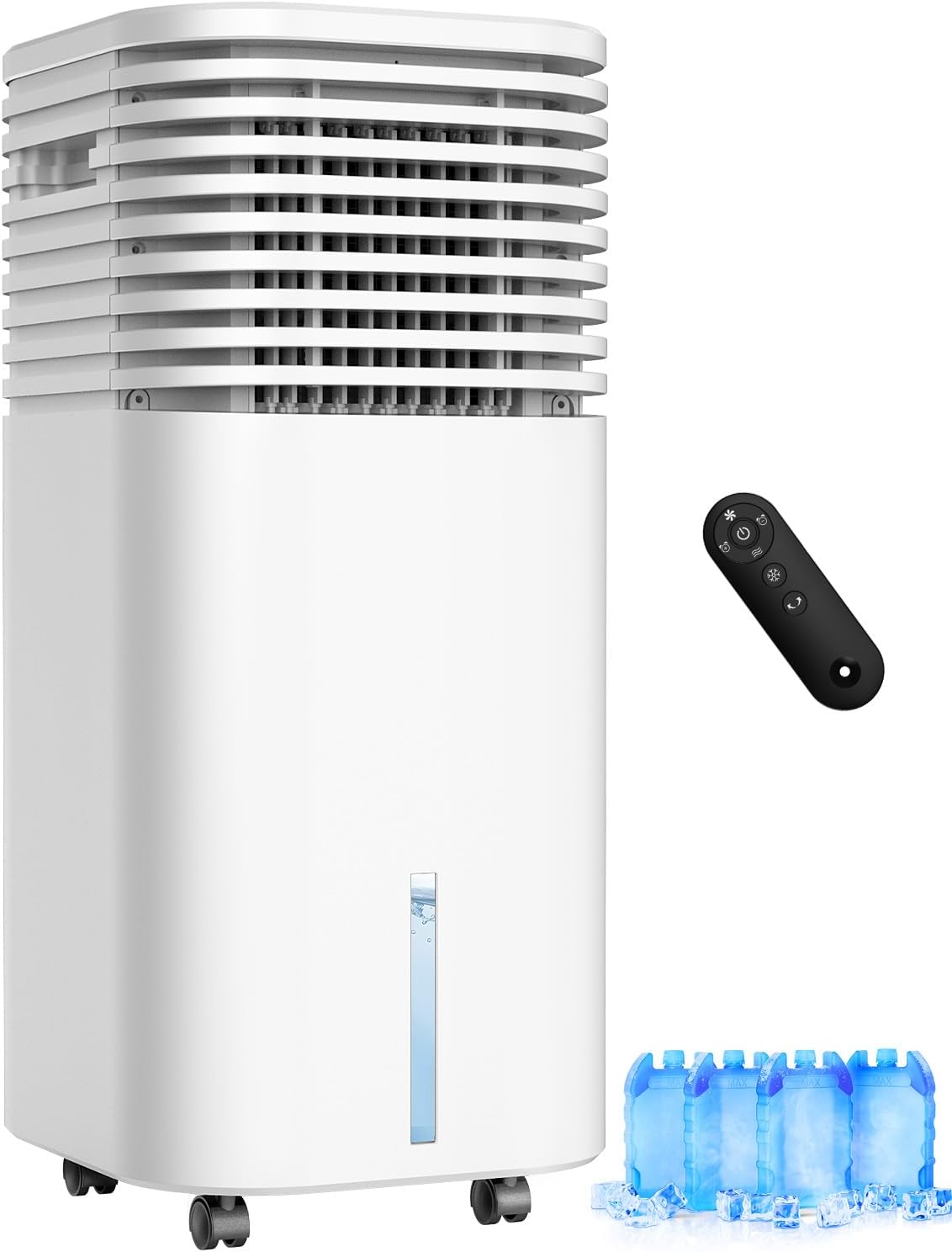
The CENSTECH DL3 is a windowless evaporative air cooler designed to provide fast, low-energy cooling without an exhaust hose or permanent installation. It combines a 3-gallon water tank with four reusable ice packs, a 65W motor and a high airflow design to push air across an upgraded honeycomb mesh and oscillate 120 degrees for broader room coverage. You control it from the unit or with the included remote using three fan speeds and four modes (including a quiet sleep mode rated under 25 dB) and a 15-hour timer for overnight use. The large tank and visible water level reduce refill frequency and the sealed ice packs simplify chilled operation without mess. Because it is an evaporative cooler, it works best in dry climates and adds humidity while delivering cooling, so it is not a direct refrigerant-based AC replacement in very humid areas. The unit is compact, rolls on silent casters for easy repositioning, and emphasizes energy efficiency, making it a practical, low-cost cooling option for bedrooms, home offices, garages, and rental spaces where window units are impractical.
Best for: Buyers who want a portable, low-energy cooling solution that is easy to move and set up in spaces where a window unit is impractical, especially in dry climates.
Less Ideal for: People needing powerful, dehumidifying compressor-style AC for very humid regions or for cooling large open areas should consider a conventional air conditioner instead.
- Windowless design requires no exhaust hose or installation and is easy to move on included 360° wheels
- Low power draw at 65 watts for energy-smart operation compared with compressor AC
- Large 3-gallon tank with visible level provides up to 24 hours of continuous cooling per fill
- Includes four leak-proof ice packs for extended chilled airflow without mess
- Quiet sleep mode operating under 25 dB and a 15-hour timer for overnight use
- Evaporative cooling increases room humidity and performs best in dry climates, so effectiveness drops in humid conditions
- Not a refrigerant-based air conditioner so it cannot reliably reach low temperatures in large or poorly ventilated spaces
Verdict: Choose the DL3 when you need a plug-and-play, energy-efficient windowless cooler that delivers quiet, mobile relief in dry climates without any installation.
OEARE Swamp Cooler 6L

| Reservoir Capacity | 6 liters |
|---|---|
| Number of Speeds | 3 |
| Controls Type | Remote |
| Operation Mode | automatic |
This OEARE swamp cooler is a windowless portable evaporative cooler designed for personal residential use. It combines a fan, humidifier, and water-plus-ice cooling in one freestanding unit with a 6-liter dual water tank, four included ice packs, a 12-hour timer, and remote control for convenient operation. Users can choose from three fan speeds and four modes (normal, natural, sleep, cooling) and enable auto-oscillation to spread airflow across a room; the top panel and front display give straightforward control and the display can be dimmed for night use. Practical benefits include long run times using the large tank, easy mobility on casters and a built-in handle, and quiet operation suitable for sleeping. Limitations are inherent to evaporative coolers: it cools most effectively in dry climates and does not provide compressor-style air conditioning or dehumidification, and performance depends on ambient humidity and ventilation. For budget-conscious buyers who want a simple, portable way to add cooling and humidity without installation, this is a useful option.
Best for: Buyers on a tight budget who need a low-cost, no-install personal cooler for dry climates or single rooms and value portability and simple controls.
Less Ideal for: People in hot, humid regions or those who need reliable room-temperature reduction like a true portable AC should consider compressor-based units instead.
- Combines fan, humidifier, and ice-assisted cooling in one compact unit
- Large 6 liter dual water tank with four ice packs for extended run time
- Three speeds and four modes including a quiet sleep mode and auto-oscillation
- Portable freestanding design with casters and built-in handle requires no installation
- Remote control and front display with dimming for nighttime use
- Not a compressor air conditioner so it will not lower temperature effectively in high-humidity environments
- Cooling effectiveness depends on ventilation and ambient dryness
Verdict: A budget-friendly, no-install swamp cooler that delivers portable, quiet evaporative cooling and added humidity for dry-room comfort.
fancole TS03Y Windowless Air Conditioner

| Wattage | 50 |
|---|---|
| Voltage | 120 |
| Capacity | 4 liters |
| Noise | 25 db |
The fancole TS03Y is a windowless evaporative air cooler designed to deliver targeted cooling without installation. It functions as a fan, humidifier, and evaporative cooler: run it as a fan on dry days, add water to humidify, or load the included ice packs for a stronger cooling effect. The unit offers three fan speeds and four modes including a quiet sleep setting, and a 120 degree oscillation to spread airflow across a room rated up to about 300 sq ft. Practical features include a 4 liter water tank with a level indicator for up to 24 hours of runtime, a 12 hour timer, touch and remote controls with a 20 ft range, and removable rear cover for cleaning. Noise is claimed at about 25 dB on low, and the unit draws roughly 50 to 65 watts so it is inexpensive to run. Limitations are inherent to evaporative coolers: performance drops in very humid climates and it will not reach the temperatures of compressor air conditioners, and the water tank requires occasional refills and maintenance. For renters or rooms where installing a window unit is not possible, it is a convenient, low-energy option.
Best for: Buyers who need a reliable, low-maintenance cooling solution for bedrooms or rental spaces where permanent installation is not allowed and who prioritize quiet, energy-efficient operation.
Less Ideal for: People in very humid climates or anyone who needs strong, room-wide temperature drops like a compressor air conditioner should consider other cooling technologies.
- No installation required so it can be moved between rooms easily
- Large 4L water tank with level indicator supports up to 24 hours of continuous use
- Multiple modes, 3 speeds, and 120° oscillation spread air across a larger area
- Includes four reusable ice packs and a remote for convenient cooling control
- Evaporative cooling effectiveness falls off in high-humidity environments compared with compressor ACs
- Requires periodic refilling of water and cleaning of the tank and filter
Verdict: Choose the fancole TS03Y if you want a quiet, plug-and-play windowless cooler that delivers low-energy, maintenance-light comfort for bedrooms and rented rooms.
SYUDTY GDS-820 Evaporative Cooler

| Air Flow Capacity | 3000 cfm |
|---|---|
| Reservoir Capacity | 6.87 gallons |
| Wattage | 150 watts |
| Noise | 52 db |
| Number of Speeds | 3 |
The SYUDTY GDS-820 is a windowless evaporative cooler intended to deliver fast, portable cooling in dry indoor spaces. It uses a high-density cooling pad, a large 6.87 gallon reservoir and a 2026-upgraded motor to push up to 3000 CFM of air, and it offers three fan speeds plus four modes (Normal, Natural, Sleep, Cooling). Controls are available on a top touch panel or via the included remote, and a 1–15 hour timer and 120° oscillation help distribute airflow across a room. Setup is simple: add water or ice packs to the tank, snap on the four 360° casters and plug it in, then adjust fan speed or mode. Practical benefits include added humidity in dry climates, lower energy draw compared with standard portable ACs, and easy mobility between rooms. Important limitations are that this is an evaporative cooler, so performance drops in high-humidity environments and it will not dehumidify or match the low temperatures of compressor-based air conditioners; it also produces noticeable noise at higher fan speeds.
Best for: Buyers who want an energy-efficient, mobile cooling option for dry climates and value easy setup and proven user feedback when choosing cooling gear.
Less Ideal for: People in humid regions or anyone who needs true refrigerated air conditioning or room dehumidification should consider compressor-based ACs instead.
- Very high airflow (3000 CFM) for fast air movement
- Large 6.87 gallon reservoir reduces refill frequency
- Multiple modes, 3 speeds and 120° oscillation improve distribution and comfort
- Remote and touch controls plus 1–15 hour timer add convenience
- Effectiveness decreases in high-humidity climates because it relies on evaporation
- Does not cool to same low temperatures as refrigerated portable air conditioners
- Noise can reach around 52 dB on higher settings
Verdict: Pick the SYUDTY GDS-820 if you need a high-airflow, energy-efficient windowless cooler that moves a lot of air and is easy to set up and move around in dry indoor spaces.
DREO Evaporative Air Cooler DR-HEC002S

| Air Flow Capacity | 1327 cfm |
|---|---|
| Controls Type | App |
| Reservoir Capacity | 6 liters |
| Floor Area | 500 square_feet |
| Wattage | 70 watts |
The DREO DR-HEC002S is a tower-style evaporative cooler that blows a strong, moisture-infused breeze rather than mechanically lowering room temperature. It uses a 6 liter reservoir and an IceWind-style cooling pad with a 35-blade turbine to boost evaporation and airflow (rated 1327 cfm), and it can oscillate and run on four speeds for targeted or room-wide circulation. Controls are available on the unit, with remote and app/voice support for scheduling and monitoring temperature and humidity, and caster wheels make it easy to move between rooms. Practical benefits include low power draw (70 watts) and very quiet operation (about 33 dB) compared with window air conditioners, plus added humidification that helps comfort in dry environments. Important limits are inherent to evaporative cooling: it is most effective in dry climates and will raise indoor humidity, and it will not achieve the same temperature drop as a refrigerated air conditioner in hot, humid conditions. The 6L tank requires refilling for extended use and regular pad maintenance for consistent performance.
Best for: Buyers who prioritize quiet, energy-efficient spot cooling in dry climates and want easy remote or app control for bedroom or small-room comfort.
Less Ideal for: People in hot, humid regions who need true temperature reduction like a refrigerated air conditioner or who prefer a maintenance-free sealed cooling solution.
- High airflow (1327 cfm) for strong, noticeable breeze
- App and voice control plus remote for convenient scheduling and monitoring
- Quiet operation around 33 dB suitable for bedrooms
- Low power consumption at 70 watts compared with compressor-based ACs
- Portable with caster wheels and oscillation for flexible coverage
- Evaporative cooling raises indoor humidity and performs poorly in already humid climates
- Requires regular refilling of the 6L reservoir and maintenance of the cooling pad
Verdict: Choose this unit if you want a quiet, low-power evaporative cooler with smart control for effective spot and small-room comfort in dry climates.
Choosing the Right Windowless Air Conditioner: Key Factors to Consider
Cooling Capacity and Room Size
Matching cooling capacity to the room is the single most important factor. Windowless air conditioners are rated in BTUs or by suggested room square footage; choosing a unit underpowered for the space will leave you with inadequate cooling and higher run times. Conversely, an oversized unit may cycle on and off, harming dehumidification and increasing wear.
Consider the room's square footage, ceiling height, sun exposure, and typical occupancy when estimating required capacity. For multi-room or open-plan spaces, account for airflow patterns and whether multiple units or a larger installation approach is more appropriate. Also think about peak summer temperatures in your area, since ratings assume certain ambient conditions.
Installation Flexibility and Venting Options
Windowless units rely on alternative exhaust or airflow arrangements rather than a standard window sleeve. Check what venting or adapter accessories a unit supports, such as through-the-wall panels, drop ceiling kits, or exhaust hose options for venting to a small exterior opening.
Installation flexibility affects where you can place the unit and whether you can DIY the setup. Look for clear installation guides, included mounting hardware, and the availability of optional kits for tight or unusual spaces. Also verify whether the unit requires cutting a hole in a wall or ceiling and whether that is permitted in your building or rental agreement.
Noise Level and Occupant Comfort
Noise output matters more for bedrooms, home offices, and living areas where quiet is important. Windowless systems can be quieter than some window units because of isolation or remote condenser placement, but internal blower speed and compressor design still determine perceived sound.
Compare published decibel ratings at different fan speeds and seek units with lower noise at typical operating settings. Consider the distance from the unit to sleeping or working areas and whether white-noise masking is acceptable. Lower noise often accompanies better insulation and more gradual fan curves, which can improve nighttime comfort.
Energy Efficiency and Operating Cost
Energy efficiency affects monthly operating cost and environmental impact. Look for units with clear EER or comparable efficiency ratings and reasonable power draw for the stated cooling capacity. More efficient units can cost more upfront but usually save money over a cooling season.
Consider whether the unit offers energy-saving modes, programmable timers, or thermostatic control to limit runtime. Energy efficiency also influences heat rejection needs and may reduce strain on building electrical circuits, which is important in older homes or shared panels.
Ease of Maintenance and Filter Access
Regular maintenance keeps a windowless air conditioner running efficiently. Easy access to washable or replaceable filters, clear drain options for condensation, and simple service points for coils and fans reduce long-term hassle.
Look for units with tool-free filter removal, visible condensate drain designs, and widely available replacement parts. Maintenance difficulty is especially important in installations where the unit is semi-permanently mounted or hard to reach, as neglected upkeep will reduce performance and lifespan.
Where Windowless Air Conditioners Work Best
Windowless air conditioners are ideal for rooms where a window unit is impractical, such as interior rooms, windowless basements, or spaces with security or aesthetic restrictions. They provide spot cooling without the bulk of full HVAC rework and can be a good temporary or semi-permanent solution when you cannot modify windows.
- Interior rooms and basements
- Temporary living spaces and short-term rentals
- Rooms with security or window limitations
Common Installation Paths
There are several practical ways to vent or install a windowless air conditioner depending on your space. Through-wall installations use a small exterior opening and a sleeve or panel to pass exhaust and intake. Drop ceiling or soffit installations route exhaust into a plenum or to an existing exterior vent. Portable-style venting through a small duct or flexible hose can work if there is an accessible exterior port.
- Through-wall sleeve or panel
- Drop ceiling or soffit venting
- Flexible hose to exterior port
Noise Mitigation Strategies
If noise is a concern, placement and mounting method make a bigger difference than raw decibel numbers. Mount units on vibration-damping brackets, add acoustic sealant around wall penetrations, and avoid installing the unit directly adjacent to bedrooms or recording spaces. Running the fan at a lower speed at night and using a programmable thermostat can keep comfort while reducing perceived sound.
- Use vibration-damping mounts
- Seal gaps to reduce rattles
- Lower fan speeds during quiet hours
Electrical and Permitting Considerations
Before installing a windowless unit, confirm the available circuit capacity and whether the unit requires a dedicated circuit. Many higher-capacity systems need a robust circuit to handle compressor startup currents. Check local building codes and rental rules for permitted wall penetrations and whether a permit or licensed installer is required for a through-wall cut.
bullets':['Verify circuit capacity and breaker size','Confirm local permitting rules','Plan for condensate drain routing']},{
paragraphs=[
How We Chose the Best Windowless Air Conditioner
We focused on practical, real-world criteria that matter to people choosing windowless air conditioners. Each candidate had to demonstrate reliable cooling performance for its rated room size and provide a feasible non-window installation path such as venting through a wall panel, drop ceiling, or dedicated exhaust port. We prioritized models that offered clear cooling capacity ratings, measured noise levels, and documented energy consumption so buyers can match performance to household constraints. Our filters excluded units that require major HVAC modifications, permanent ductwork, or professional refrigerant-line installation. We also excluded products lacking verified installation options for windowless setups or those without published cooling capacity and power use data. The editorial evaluation emphasized cooling capacity relative to room size, installation flexibility and accessories, measured noise in decibels, energy efficiency or EER ratings, and ease of maintenance and filter access. These dimensions formed the backbone of our scoring and informed which units made the list.
Our full evaluation process is outlined in our review methodology.
FAQ
Can a windowless air conditioner cool a whole apartment?
It depends on apartment size and layout. Single-room or studio apartments can often be cooled effectively by a well-sized windowless unit, but larger multi-room apartments usually need multiple units or a different cooling approach to maintain even temperatures.
Do windowless units need a drain for condensation?
Most units manage condensate internally with evaporation or a collection tray, but some installations require a drain line if humidity is high or the unit runs continuously. Check the unit's drainage options and plan routing if a permanent drain is necessary.
How noisy are these systems compared with window units?
Noise varies by model and installation. Properly isolated and installed windowless units can be comparable or quieter than many window units, especially if the compressor is located away from living areas. Published decibel ratings at different fan speeds are useful for comparison.
Can I install a windowless unit myself?
Many windowless units are designed for DIY installation with included mounting kits and clear instructions. However, through-wall cuts, electrical work, or complex venting may require professional help or permits.
Are replacement filters easy to find?
Replacement filters are generally available but vary by form factor. Choose units with generic or widely sold filter sizes and check whether filters are washable or disposable to match your maintenance preferences.
Final Verdict
Prioritize matching cooling capacity to your room size, choosing an installation path that fits your building, and balancing noise against performance. Energy efficiency and easy maintenance will reduce operating cost and headaches over time. By focusing on these tradeoffs you can select a windowless air conditioner that provides reliable, comfortable cooling without a window-mounted installation.