
Note: This article contains affiliate links. If you click on these links and make a purchase, we may earn a small commission at no extra cost to you. This helps support our research and content. Read our full affiliate disclosure here.
Outdoor security lighting paired with a camera changes how you protect a property. A Wireless Floodlight Security Camera combines powerful illumination with motion-triggered recording so you can deter intruders, capture events in color at night, and get timely alerts to your phone. Choosing the right unit matters because mounting, power source, detection range, and integration with your existing home network directly affect reliability and nightly coverage. This guide shortlists the top options across common installation scenarios and performance needs. We evaluated models for brightness, detection accuracy, video clarity after dark, and ease of installation. Read on for the features and tradeoffs to weigh before you buy.
Top Picks at a Glance
| Best Overall The best all-around choice for most situations | REOLINK Elite Floodlight WiFi |  |
| Best Quality Built to a higher standard if you want something more solid | Arlo Pro 3 Floodlight Camera |  |
| Best Value The sweet spot between price and what you get | WYZE Floodlight Camera v2 |  |
| Best Budget The cheapest option that still gets the job done reliably | CKK 2K PTZ Outdoor Camera |  |
| Most Popular A crowd favorite that many people choose with confidence | Blink Outdoor 4 Floodlight Camera |  |
| Best Seller A high-volume bestseller chosen again and again | Tapo C615F Floodlight Camera Kit |  |
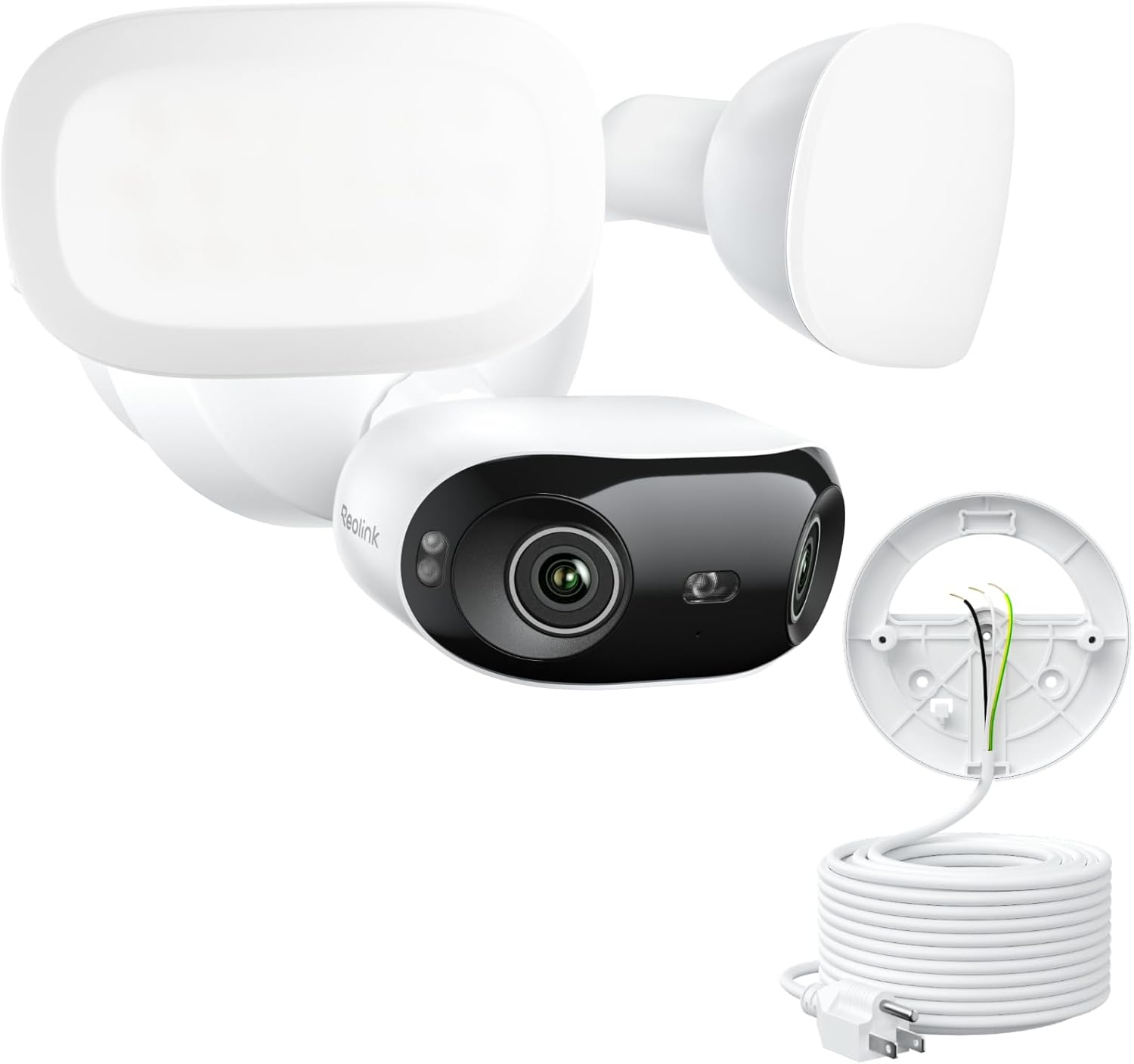
REOLINK Elite Floodlight WiFi
| Video Capture Resolution | 4k |
|---|---|
| Viewing Angle | 180 degrees |
| Connectivity Technology | 2.4/5GHz Dual-band Wi-Fi 6 |
| Power Source | Corded Electric (100V-240V AC Compatible) |
| Flash Memory Supported Size Maximum | 512 GB |
The REOLINK Elite Floodlight WiFi is an outdoor security camera built around a stitched dual-lens 4K system that delivers a true 180 degree panoramic view and continuous color recording at night thanks to a powerful 3000-lumen floodlight. It mounts to a wall or ceiling, supports plug-in power with a 20 ft cable option for flexible placement, and connects over 2.4/5 GHz Wi‑Fi 6 for steady streaming. The camera offers AI detection for people, vehicles, and animals plus customizable detection zones and on-demand siren or voice warnings for active deterrence. Local storage options include microSD (up to 512 GB), NVR, FTP/NAS and Reolink hubs so you can avoid subscription fees. Practical trade-offs: the unit is a visible, wired floodlight camera that needs AC power and a proper mount, and while Wi‑Fi 6 improves reliability, very remote locations may still prefer wired PoE. For a buyer seeking wide coverage and bright, full-color nighttime footage, it is a capable all-in-one option.
Best for: Homeowners who want a single, high-coverage outdoor unit that pairs ultra-wide 4K video and a bright floodlight for clear daytime and night monitoring without relying on cloud subscriptions.
Less Ideal for: People who need truly wireless battery placement or a low-profile, hidden camera should consider battery-powered or smaller form-factor alternatives instead.
- True 180° panoramic 4K (8MP) stitched dual-lens view eliminates large blind spots
- 3000-lumen dimmable floodlight provides color night footage and can deter intruders
- Dual-band Wi‑Fi 6 support for faster, more stable wireless streaming
- Flexible local storage up to 512 GB microSD plus NVR/FTP/NAS with no monthly fees
- Customizable AI detection zones with person/vehicle/animal alerts and configurable siren/voice deterrents
- Requires AC power and hard mounting which limits placement compared with battery models
- Large, conspicuous floodlight design may be too visible for users wanting discreet cameras
Verdict: Choose this if you want a single wired floodlight camera that delivers ultra-wide 4K coverage, bright color night lighting, and local storage without monthly fees.
Arlo Pro 3 Floodlight Camera

| Video Capture Resolution | 1440p |
|---|---|
| Frame Rate | 30 frames per second |
| Field Of View | 160 degrees |
| Night Vision Range | 25 feet |
| Memory Storage Capacity | 32 GB |
The Arlo Pro 3 Floodlight Camera pairs a 2K HDR security camera with a powerful motion-activated LED floodlight to cover driveways, yards, and entryways without running wires. It captures 1440p/2K video at 30 fps with a 160° field of view, offers color night vision, and supports 12x digital zoom and automatic tracking so you can follow activity across a wide scene. The unit is battery powered for flexible placement and can increase brightness to 2000 lumens (3000 lumens with an optional charging cable) to clearly illuminate people and vehicles at night. Smart detection and custom alerts help reduce false alarms by distinguishing people, vehicles, packages, and animals, and two-way audio plus a siren let you interact or deter visitors. The camera works with Alexa, Google Assistant, Apple Home (via hub), and common smart home platforms and records to MP4 with local or cloud storage. Important limits are that higher-tier AI features and extended cloud history require a paid Arlo subscription and the brightest output needs an extra accessory, so some advanced capabilities come at added cost.
Best for: Buyers who prioritize clear, professional-grade outdoor video and bright, motion-triggered lighting for wide-area coverage and want a flexible wireless installation.
Less Ideal for: People who need full-feature access without subscription fees or who require maximum brightness out of the box without buying extra accessories should consider other solutions.
- 2K HDR video with 160° field of view and color night vision for clear day and night footage
- Integrated motion-activated floodlight delivering up to 2000 lumens (3000 with optional cable) for strong scene illumination
- Smart detection that differentiates people, vehicles, packages, and animals to cut down false alerts
- Battery-powered wireless design enables flexible, DIY placement without hardwiring
- Works with major smart home platforms for voice control and automation
- Some advanced AI detections, long-term cloud storage, and emergency features require a paid subscription
- Maximum floodlight lumen output needs an additional Arlo charging cable accessory
Verdict: Choose this camera when you want a wireless floodlight camera that prioritizes high-quality 2K video and strong motion-activated illumination for broad outdoor coverage.
WYZE Floodlight Camera v2

| Video Capture Resolution | 2k |
|---|---|
| Light Output | 2800 lumen |
| Field Of View | 160 degrees |
| Power Source | Corded Electric |
| Waterproof Rating | IP65 |
The WYZE Floodlight Camera v2 pairs a 2K security camera with two 2800-lumen LED floodlights to provide bright, motion-activated illumination and continuous surveillance for outdoor areas. It mounts to a wall or ceiling and is powered by hardwiring to existing exterior wiring, which makes it a permanent solution for porches, driveways, and backyards. The camera offers a 160 degree wide field of view, color night vision, and customizable motion zones in the Wyze app so you can limit alerts to important areas, while two-way audio and a 105 dB siren let you communicate or scare off intruders. It records locally to a microSD card for 24/7 capture without a cloud subscription and supports 2.4 GHz Wi-Fi for remote viewing. Practical limitations include the need for wired power and lack of 5 GHz Wi-Fi support, and weather resistance is IP65 which is solid but not the highest rating for severe marine environments. For buyers who prioritize bright, app-controlled outdoor coverage with local storage, this is a strong, budget-focused option.
Best for: Buyers who want a permanently mounted, budget-friendly outdoor floodlight camera that prioritizes bright illumination, local recording, and app-based motion control to reduce false alerts.
Less Ideal for: People who need a wireless battery-powered option, require 5 GHz Wi-Fi connectivity, or who need the highest waterproofing for harsh coastal conditions should look elsewhere.
- Very bright 2800-lumen LEDs for clear nighttime illumination
- 2K video with 160° field of view and color night vision for broad, detailed coverage
- Local 24/7 recording to microSD card avoids mandatory cloud subscriptions
- Customizable motion zones and Wyze app control for targeted alerts and automation
- Built-in two-way audio and 105 dB siren for active deterrence
- Requires hardwired power; not a plug-and-play battery model
- Only 2.4 GHz Wi-Fi supported, so it will not connect to 5 GHz networks
- IP65 rating is weather resistant but not the highest level for extreme exposures
Verdict: A cost-conscious, permanently wired floodlight camera that delivers bright 2K video, color night vision, and local recording for dependable outdoor coverage.
CKK 2K PTZ Outdoor Camera

| Video Capture Resolution | 2k |
|---|---|
| Effective Still Resolution | 3 mp |
| Night Vision Range | 30 feet |
| Waterproof Rating | IP66 |
| Connectivity Technology | WiFi, Corded Electric |
This CKK PTZ outdoor camera is aimed at basic but capable home surveillance: it pans and tilts for near 360 degree coverage, uses an AI motion‑tracking algorithm to follow people, and records in 2K with both color and infrared night modes. Setup is done through a smartphone app and the camera supports dual‑band Wi‑Fi for smoother streaming, plus two‑way audio so you can speak through the built‑in speaker. For storing footage you can use an SD card up to 128GB or opt for cloud backup; H.265 encoding helps reduce file sizes. The IP66 rating and corded 5V power mean it will run reliably outdoors in rain or snow, and the built‑in floodlight and siren provide active deterrence when motion is detected. On the downside, it requires wired power, cloud video beyond snapshots may incur fees, and features like 4x digital zoom are limited compared with optical zoom. For the price it delivers a feature-packed outdoor camera that balances clarity, coverage, and deterrent tools for everyday home use.
Best for: Homeowners who want an affordable outdoor camera that combines wide PTZ coverage, color night vision, and active deterrence without complex enterprise setup.
Less Ideal for: Users who need battery‑powered or solar cameras, ultra long‑term free cloud storage, or cameras with optical zoom for distant detail.
- 2K resolution with full‑color night vision for clearer nighttime images
- 355° pan and 90° tilt plus AI tracking for near complete coverage
- IP66 waterproof rating suitable for outdoor exposure
- Dual‑band Wi‑Fi and H.265 video encoding for stable streaming and reduced file sizes
- Supports local microSD storage up to 128GB plus optional cloud backup
- Requires corded power so no built‑in battery or solar option
- Cloud video storage beyond free snapshots may require a subscription
- Zoom is digital only, not optical
Verdict: A budget‑friendly outdoor PTZ camera that delivers wide coverage, color night vision, and floodlight deterrence for everyday home security.
Blink Outdoor 4 Floodlight Camera

| Brightness | 700 lumens |
|---|---|
| Video resolution | 1080p HD |
| Battery | Two AA Energizer lithium batteries included |
| Includes | Sync Module Core |
The Blink Outdoor 4 Floodlight Camera combines motion-triggered LED lighting with 1080p HD live view and two-way audio for basic outdoor security without hardwiring. It mounts wire-free and runs on included AA Energizer lithium batteries plus a Sync Module Core for local coordination, which Blink says can deliver up to two years of battery life under typical use. The unit's 700-lumen floodlight illuminates motion events and works with dual-zone enhanced motion detection to reduce false alerts, while optional AI-powered person detection is available through a subscription. Setup is straightforward through the Blink app and the camera integrates with Alexa for voice-activated live view and arming. Limitations to consider are the reliance on Blink's cloud features for advanced smart detection and clip history unless you add local storage hardware, and image detail is limited to 1080p rather than higher-resolution options. For buyers looking for an easy-to-install, battery-powered floodlight camera that emphasizes long runtime and simple app control, this is a practical choice.
Best for: Buyers who prioritize a simple, battery-powered floodlight camera with long runtime and easy app/Alexa integration for straightforward outdoor monitoring and deterrence.
Less Ideal for: Users who need native high-resolution imaging, fully local video management out of the box, or advanced analytics without subscribing to cloud services should consider other models.
- 700-lumen motion-activated floodlight provides clear illumination for triggered events
- Battery-powered design with included AA Energizer lithium batteries and Sync Module Core enables wire-free installation
- 1080p HD live view with two-way audio for real-time monitoring and communication
- Dual-zone enhanced motion detection helps focus alerts on relevant areas
- Works with Alexa for voice control and live view
- Advanced person/vehicle detection requires a paid Blink subscription for AI-powered features
- Clip storage depends on cloud subscription unless you add optional local storage hardware
Verdict: A convenient, wire-free floodlight camera built for easy installation and long battery life, ideal for buyers who want straightforward outdoor monitoring with Alexa support.
Tapo C615F Floodlight Camera Kit

| Power Source | Solar/Battery Powered |
|---|---|
| Battery Capacity | 10400 milliamp_hours |
| Video Capture Resolution | 2K 3MP |
| Floodlight Output | 800 lumens |
| Waterproof Rating | IP65 |
The Tapo C615F KIT is a wire-free outdoor floodlight camera designed to cover large areas without running power. It pairs a rechargeable 10,400 mAh battery with the included solar panel so the unit can run long stretches between charges while delivering 2K (3MP) daytime and full-color night vision plus an IR mode for low-light. Mechanical pan and tilt with scheduled scans and automatic 360° AI tracking make it useful for driveways, yards, and porches, and the 800-lumen dimmable floodlight helps both deterrence and clearer nighttime footage. The camera supports two-way audio, an app with custom activity zones and smart alerts for people, pets, and vehicles, and local microSD or optional cloud storage. Important limits for a buyer: it needs a stable 2.4 GHz Wi-Fi connection and solar charging only works above 32°F, and claimed multi-month battery life depends heavily on activity and settings. Installation is basic wall mounting but does require a good sun-facing panel placement for reliable charging. For cautious buyers who prioritize continuous coverage without wiring, this kit balances visibility, smart alerts, and low-maintenance power.
Best for: Homeowners who want a low-maintenance, wire-free outdoor camera with wide-area coverage and easy app-based controls, and who value subscription-free local storage and solar charging to minimize upkeep.
Less Ideal for: Users who lack a stable 2.4 GHz Wi‑Fi signal at the installation spot or who need guaranteed continuous wired power in very cold climates or heavily shaded locations.
- Solar-assisted battery reduces or eliminates hardwiring and frequent recharging
- 2K (3MP) resolution with full-color night vision and IR mode for clearer footage day and night
- Pan/tilt mechanics plus 360° AI tracking and scheduled scans for broad area coverage
- Dimmable 800-lumen floodlight and 97 dB siren provide visible and audible deterrents
- Subscription-free AI detection and local microSD storage option
- Requires reliable 2.4 GHz Wi‑Fi for live view and alerts
- Solar charging effectiveness and battery life vary with placement, weather, and usage
Verdict: Choose the Tapo C615F KIT if you want a wireless, solar-assisted floodlight camera that delivers broad pan/tilt coverage, 2K video, and subscription-free AI alerts for low-maintenance outdoor security.
Choosing the Right Wireless Floodlight Security Camera: Key Factors to Consider
Brightness and Beam Pattern
Floodlight lumen output and the beam pattern determine how much of your yard or driveway is illuminated. Higher lumen counts deliver brighter, wider coverage, but beam shape matters more for eliminating dark corners and ensuring the camera can capture usable detail across the illuminated area.
Consider whether you need a narrow, long-throw beam for driveway coverage or a wide flood for a large yard. Adjustable heads let you fine-tune aim during installation so the camera and light illuminate the same zone. Excessively bright fixtures can cause glare and wash out close-range footage, so look for models with balanced output and shielding options.
Motion Detection and Smart Alerts
Detection range, sensor type, and software filtering determine how well the system distinguishes people, vehicles, and pets from harmless motion. Better motion algorithms reduce false alarms and ensure you only receive meaningful alerts.
Look for configurable motion zones and sensitivity settings so you can suppress activity near trees, roads, or busy sidewalks. Integration with on-device analytics or cloud-based person/vehicle detection improves relevance of notifications. Quick, reliable push alerts and customizable schedules help you avoid alert fatigue while still catching important events.
Low-Light Video Performance
A floodlight camera must deliver usable footage at night whether using the built-in light or the camera's low-light sensors. Cameras that rely solely on infrared produce monochrome images; those that use the floodlight can capture color video after dark, which helps identify clothing, vehicle colors, and license plates.
Check effective resolution and frame rate at low lux levels, and whether the camera supports automatic gain control or HDR in challenging lighting. Bandwidth and storage choices affect how long you keep high-resolution night clips, so confirm recording modes and retention options before committing.
Installation, Mounting, and Power Options
How a unit mounts and how it is powered affects feasibility for your location. Hardwired fixtures replace existing outdoor lights and provide continuous power, while true wireless battery or solar options simplify placement but require recharging or periodic battery swaps.
Assess mounting footprint, angle adjustment, and whether wall or eave installations are supported. Ensure wiring access if planning a hardwired install, or verify solar panel placement and battery life estimates for off-grid setups. Ease of setup also includes the quality of the mobile app, setup prompts, and any required network credentials.
Weather Resistance and Build Quality
Floodlight cameras are exposed to rain, wind, dust, and temperature swings, so IP rating and materials matter. A higher ingress protection rating means better sealing against moisture and particles, which reduces corrosion and electrical faults over time.
Consider temperature tolerance for extreme climates and the robustness of external connectors. Metal housings and UV-resistant plastics typically outlast cheaper materials. Warranty terms and documented longevity for outdoor fixtures are useful signals of expected durability.
Choosing Between Hardwired and Battery Options
Hardwired floodlight cameras draw continuous power from existing outdoor lighting circuits, which means constant readiness, no battery swaps, and steady illumination. They are ideal when you have accessible wiring and prefer a maintenance-free solution.
Battery or solar-assisted wireless options simplify installation and allow placement where wiring is impractical. The tradeoff is routine charging or decreased run time for the floodlight function. If you choose a battery-powered unit, check real-world battery life when lights and recording are active rather than relying on standby estimates.
- Hardwired: consistent power, higher installation complexity
- Battery: flexible placement, needs recharging or replacement
- Solar: good for sunny locations but requires optimal panel placement
Placement and Field of View Best Practices
Mount the camera and light at a height that balances wide coverage and facial-recognition angles. Typically, 8 to 12 feet above ground gives a good compromise between visibility and detail without exposing the unit to easy tampering. Ensure the beam covers likely approach paths and does not point into neighbors' windows.
Aim the sensor and camera so that the most important zones fall in the central portion of the image to reduce distortion and improve detection accuracy. Avoid mounting where frequent fog, sprinkler spray, or streetlights will trigger constant alerts.
- 8 to 12 feet is a practical mounting height
- Aim lights to avoid backlighting the camera
- Use multiple units for large or obstructed areas
Network and Storage Considerations
A reliable Wi-Fi link is essential for prompt alerts and high-quality uploads. Check the camera's supported wireless bands and whether it requires a 2.4 GHz network or also supports 5 GHz for better throughput. For distant mounting locations, consider a range extender or a mesh Wi-Fi node to avoid dropped connections.
Decide between local storage and cloud recording. Local microSD storage avoids ongoing subscription needs but may be vulnerable to theft. Cloud recording simplifies offsite retention and remote access but often requires a paid plan to keep longer archives. Factor in upload bandwidth because multiple high-resolution night clips can quickly consume upstream capacity.
- Prefer 5 GHz when available for higher-resolution uploads
- Local storage reduces subscriptions but can be physically removed
- Estimate monthly upload use based on expected event frequency
Lighting Behavior and Neighborhood Impact
Consider how the floodlight behavior affects neighbors and wildlife. Motion-triggered full-brightness events are effective deterrents, but frequent activations can be disruptive. Models with scheduling and adjustable intensity let you tailor behavior to nighttime routines and local ordinances.
Some jurisdictions restrict bright outdoor lighting or require shielding to prevent light trespass. Choose fixtures with cutoff angles or adjustable heads to direct light only where needed and reduce skyglow.
- Use adjustable intensity to manage nuisance activations
- Aim to minimize light spill onto neighboring properties
- Check local outdoor lighting rules before installation
Security and Privacy Considerations
Secure network setup and firmware updates are critical for any connected camera. Enable strong unique passwords for device accounts and use encrypted connections when supported. Regularly check for and apply firmware updates to reduce exposure to known vulnerabilities.
Respect privacy by adjusting detection zones away from private windows and public sidewalks where possible. If the camera supports data minimization features or on-device analytics, those can reduce unnecessary cloud processing of benign motion.
- Use strong, unique credentials and enable two-factor authentication if available
- Keep firmware current to address security fixes
- Limit recording zones to reduce privacy impacts
How We Chose the Best Wireless Floodlight Security Camera
We focused on criteria that matter for outdoor, mounted security fixtures and picked units that performed consistently across those dimensions. Our evaluation prioritized night-time illumination and camera sensitivity since floodlight cameras must both deter and document activity under low-light conditions. We also weighed motion detection accuracy and smart alerting to minimize nuisance notifications while capturing relevant events. Installation and power flexibility were important because many buyers need straightforward retrofits or solutions for sites without hardwired power. Durability and weather resistance were core filters, since units must withstand rain, heat, and freezing conditions over years of use. We excluded products that lack adequate lumen output, fail to offer configurable motion zones, or do not provide clear, timestamped video playback for night recordings. We also filtered out models with minimal connectivity options or poor security practices such as unencrypted streams. Final selections reflect units that balance strong illumination, dependable detection, clear low-light video, and practical installation options.
Our full evaluation process is outlined in our review methodology.
FAQ
How bright should a floodlight on a security camera be?
Brightness needs depend on the area size and detection distance. For small porches, modest lumen counts may suffice, while driveways and yards usually require higher output for clear color nighttime footage. Consider beam spread as much as raw lumens to avoid dark corners.
Can a wireless floodlight camera run on battery power alone?
Yes, some models are battery-operated or solar-assisted. They offer flexible placement but expect shorter run time when the light and camera are active. Review real-world battery life figures and charging options before choosing a battery model.
Will a floodlight camera work in heavy rain or snow?
Many outdoor units have weather-resistant enclosures with specific IP ratings. Higher-rated devices tolerate rain and dust better, but extreme conditions like heavy snow accumulation on the lens or prolonged subzero temperatures can still affect performance. Check the listed operating temperature range.
Do floodlight cameras require a subscription for alerts or recordings?
It depends on the vendor and chosen storage option. Some devices offer basic live viewing and on-device storage without a subscription, while cloud recording and advanced analytics often require a paid plan. Evaluate retention needs and budget when deciding.
How do I reduce false motion alerts from trees and cars?
Use configurable motion zones and sensitivity settings to exclude areas prone to benign movement. Position the camera to limit exposure to road traffic and aim the light to focus on likely approach paths. Devices with person or vehicle detection algorithms further reduce nuisance alerts.
Final Verdict
When choosing a Wireless Floodlight Security Camera, prioritize the factors that match where and how you plan to use it. If continuous readiness and no maintenance are important, a hardwired unit with strong night visibility and robust detection is the right focus. If placement flexibility matters most, a battery or solar option can work well but expect tradeoffs in run time and light usage. Balance lumen output, detection accuracy, weather resistance, and network reliability to get consistent, useful footage and alerts. By matching installation type and illumination needs to your property layout, you can confidently pick a floodlight camera that reduces nuisance activations while delivering clear nighttime evidence when it matters most.