
Note: This article contains affiliate links. If you click on these links and make a purchase, we may earn a small commission at no extra cost to you. This helps support our research and content. Read our full affiliate disclosure here.
If you need outdoor surveillance without running power cables, a wireless outdoor security camera with solar power can keep monitoring active for months with minimal upkeep. Choosing the right solar-equipped camera matters because panel placement, power management, and camera efficiency determine how long the system runs between interventions and how reliable recordings are in varied weather and light. This guide lists seven shortlisted options that cover different mounting situations and power budgets, and explains the evaluation criteria we used like daytime video clarity and battery longevity. Use the sections below to match features to the conditions at your home and decide which tradeoffs matter most before you inspect individual product details.
Top Picks at a Glance
| Best Overall The best all-around choice for most situations | eufy SoloCam S220 | 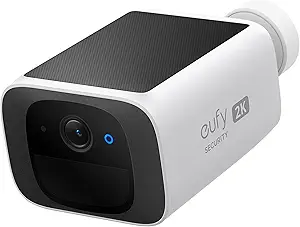 |
| Best Quality Built to a higher standard if you want something more solid | Swann MaxRanger4K Solar 2-Camera Kit |  |
| Best Value The sweet spot between price and what you get | Hiseeu 4MP Solar Security Camera (2-Pack) |  |
| Best Budget The cheapest option that still gets the job done reliably | VIRTAVO SolarFlask 2K Camera |  |
| Top Rated A top-rated pick with lots of positive feedback | Fociey 4K Solar Security Kit |  |
| Most Popular A crowd favorite that many people choose with confidence | eufy SoloCam S340 |  |
| Best Seller A high-volume bestseller chosen again and again | SEHMUA RBX-S73 Solar Security Camera |  |
eufy SoloCam S220

| Video Capture Resolution | 2k |
|---|---|
| Field Of View | 135 degrees |
| Power Source | Solar Powered |
| Flash Memory Installed Size | 8 GB |
| Waterproof Rating | IP67 |
The eufy SoloCam S220 is a small, solar-powered outdoor camera designed for simple set-and-forget monitoring. It records 2K video with a wide 135° field of view, uses an f/1.6 aperture and infrared LEDs for color-capable night vision, and includes built-in 8 GB storage so footage is saved locally without a subscription. The integrated solar panel keeps the battery topped up with roughly three hours of daily sun and the wire-free design lets you install the camera quickly with a single screw-mounted bracket. Smart features include AI human detection, two-way audio, app control, and compatibility with Alexa and Google Assistant, while connecting either directly to Wi-Fi or to HomeBase 3 for enhanced face recognition. Practical limits to note are the fixed small storage size and lack of cloud or NAS support, and it does not support HomeKit. For typical outdoor zones where continuous maintenance-free coverage and clear day/night footage are priorities, the S220 balances convenience and capable imaging in a compact package.
Best for: Buyers who want a low-maintenance, wire-free outdoor camera that delivers clear day and night video and smart motion alerts without ongoing subscription fees.
Less Ideal for: Users who need large cloud storage, HomeKit integration, or continuous 24/7 recording should consider alternatives with NAS/cloud support and broader smart home compatibility.
- Solar-powered design reduces need for recharging or wiring
- 2K resolution and 135° field of view capture wide, detailed footage
- Built-in 8 GB storage eliminates required cloud subscriptions
- AI human detection reduces false motion alerts
- Quick, single-hole installation and wireless setup
- No cloud or NAS storage options and limited on-board storage
- Not compatible with Apple HomeKit
Verdict: A compact, maintenance-free solar outdoor camera that delivers sharp 2K footage and smart human detection without subscription fees.
Swann MaxRanger4K Solar 2-Camera Kit

| Video Capture Resolution | 4k |
|---|---|
| Night Vision | Night Color |
| Power Source | Solar Powered |
| Connectivity Protocol | Wi-Fi HaLow |
| Memory Storage Capacity | 64 GB |
The Swann MaxRanger4K Solar kit pairs two wire-free 4K cameras with a hub that stores footage locally on a 64 GB card and supports optional cloud backup. These outdoor cameras use integrated solar panels and rechargeable batteries for continuous power, so you can place them away from outlets without running cables. They connect over 900 MHz Wi‑Fi HaLow for extended wireless range—Swann advertises up to 2,000 ft open-air and about 650 ft in typical conditions—making this a strong choice for large yards or rural properties. Image quality is sharp in daylight and the Night2Day color night vision plus spotlights and long-range infrared give usable color detail after dark. Smart True Detect+ AI separates people and vehicles from generic motion and can trigger alerts, sirens, spotlights, and two-way audio to actively deter intruders. The kit's strengths are long wireless reach, continuous solar operation, and on-device recording, while buyers should plan for the hub-based setup and confirm HaLow coverage in their environment before purchase.
Best for: Buyers who prioritize top-tier image quality and long wireless range for monitoring larger properties and want a solar, wire-free solution with local storage and smart detection.
Less Ideal for: Those who need a simple single-camera purchase or who cannot place a hub within range of the cameras should consider simpler or wired alternatives.
- True 4K video capture for crisp daytime detail
- Integrated solar panels with rechargeable batteries enable 100% wire-free placement
- Long-range Wi‑Fi HaLow connectivity designed for up to 2,000 ft open-air coverage
- Color night vision with spotlights and long-range IR improves nighttime identification
- Local recording on included 64 GB microSD (expandable) avoids mandatory subscription fees
- Relies on a hub-based system which adds a required central device and setup step
- Real-world wireless range will vary with structures and terrain, so performance may be lower than maximum advertised
Verdict: Choose this kit if you need solar-powered, long-range wireless 4K outdoor cameras with local storage and AI detection for larger yards or rural properties.
Hiseeu 4MP Solar Security Camera (2-Pack)

| Video Capture Resolution | 4 MP |
|---|---|
| Night Vision Range | 33 feet |
| Power Source | Solar Powered |
| Battery Power | 5200 milliampere_hour |
| Field Of View | 135 degrees |
These Hiseeu cameras are a self-contained solar surveillance option for homeowners who want wireless outdoor coverage without running power. Each kit includes a 4MP bullet camera and a solar panel; the built-in 5200 mAh battery plus solar recharge aims to keep the unit running through typical use and long stretches between manual charging. The cameras record 4MP video at up to 15 fps, offer full-color night vision with an LED spotlight, and a 135 degree field of view for wide coverage. PIR plus AI human detection reduces false alerts and the siren/LED alarm plus push notifications let you respond quickly, while two-way audio lets you communicate live. Setup is app-driven and the system supports local SD storage up to 256 GB or optional cloud plans. Expect practical limits: firmware and app experience vary across budget brands, frame rate is modest, and truly continuous 24/7 recording without a wired power source may require careful placement for reliable solar charging or occasional manual charging.
Best for: Buyers who want a low-maintenance, mostly wireless outdoor camera setup that minimizes wiring and electricity use while delivering higher-than-1080p image detail for everyday home security.
Less Ideal for: Users who need wired continuous 24/7 recording without relying on sunlight or those who require high-frame-rate video for forensic-level motion capture should consider hardwired or higher-end systems instead.
- Comes with solar panels and rechargeable 5200 mAh batteries for largely cable-free outdoor installation
- 4MP resolution and 135° field of view deliver clearer, wider images than 1080p units
- Full-color night vision with an LED spotlight improves nighttime identification compared with IR-only cameras
- PIR plus AI human detection and siren/LED alarm reduce false alerts and provide active deterrence
- Supports local SD storage up to 256 GB and optional cloud backup for flexible recording choices
- Connects on 2.4 GHz Wi‑Fi only and may not work with 5 GHz networks
- Recorded frame rate is limited to 15 fps, which can show less smooth motion during fast events
- App and firmware quality on budget systems can be inconsistent and may require updates or troubleshooting
Verdict: A practical solar-powered two-camera kit for homeowners who want clearer-than-1080p wireless outdoor monitoring with minimal wiring and flexible local or cloud storage.
VIRTAVO SolarFlask 2K Camera

| Power Source | Solar Powered |
|---|---|
| Battery Capacity | 4400 milliamp_hours |
| Video Capture Resolution | 1440p |
| Viewing Angle | 120 degrees |
| Night Vision Range | 30 feet |
The VIRTAVO SolarFlask is a self-contained outdoor security camera designed to run largely on its built-in battery topped up by the integrated solar panel, which reduces the need for frequent recharging or wiring. It captures 2K (1440p) video through a wide 120-degree lens and uses a starlight sensor plus two IR LEDs to deliver color night vision up to about 30 feet, making it useful for identifying faces and license plates in low light. Setup and daily control are handled through the Home V app over 2.4 GHz Wi-Fi, and the camera supports PIR motion detection with adjustable sensitivity, custom detection zones, scheduled monitoring, push alerts, and a siren. Two-way audio allows live interaction, and recordings can be kept locally on a microSD card up to 256 GB or stored in the cloud. Limitations to note: it only supports 2.4 GHz Wi-Fi and does not offer RTSP/ONVIF/NVR or FTP integration, so it is not suited for running on traditional third-party NVR systems or 5 GHz networks.
Best for: Buyers who want a low-maintenance solar-powered outdoor camera that delivers higher-than-1080p video and easy app-based monitoring without running wires or an NVR setup.
Less Ideal for: Users who need 5 GHz Wi-Fi support, RTSP/ONVIF or NVR integration for professional multi-camera systems should look elsewhere.
- Integrated solar panel with 5 ft extension cable for flexible, mostly maintenance-free power
- 2K QHD video and starlight color night vision for clearer low-light identification
- PIR motion detection with adjustable sensitivity, custom detection zones, and instant push alerts
- Two-way audio and built-in siren for real-time interaction and deterrence
- Supports local microSD storage up to 256 GB plus optional encrypted cloud backup
- Only works on 2.4 GHz Wi-Fi and is not compatible with RTSP/ONVIF/NVR/FTP systems
- Battery life varies with motion activity and environmental factors, so runtime can be shorter in high-traffic locations
Verdict: A budget-friendly solar outdoor camera that gives sharp 2K daytime and color night footage with app-first features and mostly maintenance-free power.
Fociey 4K Solar Security Kit

| Video Capture Resolution | 4k |
|---|---|
| Night Vision Range | 33 feet |
| Power Source | Solar Powered |
| Flash Memory Installed Size | 32 GB |
| Flash Memory Supported Size Maximum | 128 GB |
This Fociey kit pairs two weatherproof bullet cameras with a local storage base that records to a built-in 32 GB microSD and supports expansion to 128 GB, so you can keep footage without paying for a cloud subscription. The cameras offer 4K/8MP live view, digital zoom, and a motorized pan/tilt that automatically tracks movement and hands off tracking between cameras for continuous coverage. Setup is straightforward: the base connects to your router by Ethernet and the cameras arrive pre-paired, while the Koocam app handles live view, zone settings, and alerts. The system runs on detachable solar panels with an internal battery that can last several days without sun, and the base accepts both 2.4 GHz and 5 GHz networks for a more stable connection. Smart motion filtering reduces false alarms from wind or small animals. Limitations to note are reliance on the base for network bridging and local storage, and the marketing claims about multi-day battery life under heavy cloud cover may require occasional USB charging in prolonged bad weather.
Best for: Buyers who prioritize a self-contained, no-subscription security setup that keeps footage locally and favors reliable, continuous outdoor coverage with solar charging and automated tracking.
Less Ideal for: Users who need a purely cloud-based system or who cannot install the local base near their router should consider alternatives with native cloud recording or different network arrangements.
- True local recording with included 32 GB storage and expandable microSD support to 128 GB
- High-resolution 4K/8MP live view with digital zoom for clearer detail at distance
- Solar-powered cameras with detachable panels reduce wiring and maintenance for long-term outdoor use
- 360° pan/tilt with automatic tracking and cross-camera follow to cover blind spots
- Supports both 2.4 GHz and 5 GHz Wi‑Fi via the local base for a more reliable connection
- System depends on the local storage base for network bridging and recording rather than native cloud-only access
- Battery life can degrade during extended periods of poor sunlight and may require manual USB charging
Verdict: A reliable, subscription-free solar camera kit that prioritizes local recording, 4K clarity, and automated 360° tracking for long-term outdoor surveillance.
eufy SoloCam S340

| Video Capture Resolution | 3K |
|---|---|
| Effective Video Resolution | 2160 |
| Field Of View | 135 degrees |
| Power Source | Solar Powered, battery powered |
| Memory Storage Capacity | 128 GB |
The eufy SoloCam S340 is a wire-free outdoor dome camera designed for continuous perimeter monitoring without monthly fees. It combines a dual-camera system that records up to 3K resolution with an 8× hybrid zoom and a pan-and-tilt mechanism that can sweep a full 360 degrees when mounted vertically, which helps eliminate blind spots around porches, driveways, and yards. The removable solar panel and 10,000 mAh battery let the camera run for long periods on its own—eufy cites up to three months on battery alone depending on activity and weather—while built-in 8 GB of local storage avoids recurring cloud costs. The camera includes color night vision with two spotlights, motion detection with tracking, two-way audio, and Alexa control for basic smart-home integration. Important limits: it is a battery-first device so it does not support true 24/7 continuous recording on battery power, and advanced AI features are enhanced when paired with eufy HomeBase hardware. For buyers who want a self-contained solar option that minimizes upkeep and subscription fees, the S340 delivers strong image clarity and wide coverage, but homeowners needing nonstop recording or the fullest cloud/AI feature set may need additional eufy accessories.
Best for: Buyers who prioritize long-term, low-maintenance outdoor monitoring with strong image quality and want to avoid subscription fees while relying on solar charging and local storage for peace of mind.
Less Ideal for: Users who require true 24/7 continuous recording, extensive cloud AI features out of the box, or enterprise-scale surveillance should consider alternatives or adding eufy HomeBase accessories.
- High-resolution dual-lens video up to 3K with 8× hybrid zoom for clear detail at distance
- 360° pan and tilt capability removes blind spots when mounted vertically
- Removable solar panel plus 10,000 mAh battery enables long run times and low maintenance
- Built-in local storage (8 GB) and no monthly fee for basic recording and playback
- Includes color night vision, motion tracking, two-way audio, and Alexa compatibility
- Cannot record 24/7 on battery power without additional HomeBase hardware
- Limited night-vision range compared with some higher-end models (specified ~6 m)
Verdict: If you want a self-powered outdoor camera with high-resolution dual-lens video and 360° coverage without ongoing subscription costs, the SoloCam S340 is a strong solar-powered choice.
SEHMUA RBX-S73 Solar Security Camera

| Power Source | Solar Powered |
|---|---|
| Battery Power | 6000 milliamp_hours |
| Video Capture Resolution | 2k |
| Connectivity Technology | 2.4GHz Wi-Fi Only |
| Waterproof Rating | IP65 |
The SEHMUA RBX-S73 is an outdoor solar security camera designed for continuous, low-maintenance monitoring. It uses a removable solar panel and a 6000 mAh battery so the unit can stay powered long-term without wired power, and it connects to 2.4 GHz Wi‑Fi for live view and alerts through the app. The camera records in 2K capture with an effective 1080p video output, supports 360-degree pan/355-degree viewing plus 4x digital zoom, and offers color night vision using a built-in spotlight alongside IR LEDs. Practical features include PIR motion sensing to reduce false alarms, two-way audio to speak with visitors, IP65 weather resistance for outdoor use, and local storage up to 128 GB with optional cloud backup. Expect simple screw-in mounting and app control, but note it only supports 2.4 GHz Wi‑Fi and uses digital zoom rather than optical, so fine detail at distance can be limited. For buyers wanting low-touch, solar-powered outdoor coverage with smart alerts, this model provides a balance of performance and convenience.
Best for: Buyers who prioritize low-maintenance, always-on outdoor monitoring and want a solar-powered camera that minimizes wiring and frequent battery charging while delivering clear daytime and color night footage.
Less Ideal for: Users who require 5 GHz Wi‑Fi support or need long-range optical zoom for identifying distant details should consider different models.
- Solar-powered with removable panel and 6000 mAh battery for continuous, low-maintenance operation
- 2K capture with effective 1080p output and color night vision for clearer daytime and nighttime footage
- Pan/tilt coverage (360/355 degree view) and 4x digital zoom expand monitoring range without multiple cameras
- PIR motion sensor plus app alerts help cut down false alarms while enabling prompt notifications
- IP65 weatherproofing and local microSD storage support outdoor reliability and on-device recording up to 128 GB
- Supports only 2.4 GHz Wi‑Fi so it will not connect to 5 GHz networks
- Zoom is digital rather than optical, which limits image detail at long distances
Verdict: Choose this camera if you want a solar-powered, low-maintenance outdoor camera with wide pan/tilt coverage and color night vision for reliable everyday home monitoring.
Choosing the Right Wireless Outdoor Security Camera with Solar Power: Key Factors to Consider
Video Resolution and Low-Light Performance
Higher video resolution improves the ability to identify faces, license plates, and other important details. For outdoor use you also need a camera with good dynamic range to handle bright backgrounds and shaded foregrounds.
Low-light sensitivity and the quality of infrared or color-night modes matters because many incidents happen at dusk or under streetlights. A camera that outputs usable footage at lower lux levels reduces false negatives and makes captured events more actionable, especially when relying on a battery-backed system where you do not want frequent replays or repositions.
Battery Capacity and Power Management
Battery capacity determines how long a camera will function without solar input, and efficient power management software reduces drain during idle periods. Look for clear specs on battery mAh or Wh and whether the camera supports power-saving modes that throttle recording or motion sensitivity during low-charge conditions.
Smart scheduling, adjustable motion sensitivity, and configurable recording windows all reduce energy consumption. A camera with transparent power reporting helps you plan maintenance and decide if you need a larger panel or higher-capacity battery for your location.
Solar Panel Output and Mounting Options
Solar output rating and the quality of the PV hardware matter because panel orientation, angle, and shading change energy harvest dramatically. Choose panels with clear wattage and voltage specs and consider whether the panel can be mounted separately from the camera body to find optimal sun exposure.
Robust mounting hardware and weatherproof cable routing are important for long-term reliability. Panels that let you adjust angle seasonally or pivot to avoid shade will keep charge rates higher and reduce manual intervention.
Wireless Connectivity and Network Range
A camera's wireless reliability affects whether footage uploads, live view is responsive, and whether alerts arrive promptly. Check supported bands, typical range estimates, and whether the system handles reconnects gracefully after brief network outages.
Features like dual-band support, adaptive bitrate streaming, and local fallback recording can make the difference between intermittent alerts and consistent monitoring. Consider placement relative to your router and any obstacles that could reduce signal strength.
Weatherproofing and Durability
Outdoor systems need to endure rain, wind, heat, and cold for years. Look for clear IP or weather ratings and materials that resist corrosion where the camera and panel will be mounted.
Sealed ports, durable cable insulation, and corrosion-resistant fasteners reduce the chance of failure. Durability also affects maintenance frequency, which ties back into the utility of solar power for remote or hard-to-reach installations.
Storage Options and Data Access
Decide whether you prefer local storage, cloud retention, or a hybrid approach. Local microSD storage eliminates recurring costs and keeps footage available when the network is down, but it requires physical access to retrieve or clear clips.
Cloud options can simplify access but depend on stable connectivity and often involve subscription plans. Consider encryption, retention policies, and how motion-triggered clips are managed to ensure you capture and can retrieve important events reliably.
How Solar Charging Affects Real-World Uptime
Solar panels reduce the need for manual recharging, but expected uptime depends on panel wattage, local sun exposure, seasonal variation, and the camera's power draw. In practical terms, you should model worst-case cloudy weeks and verify whether the panel plus battery can sustain operation through extended low-irradiance periods.
Install panels where they get direct sun for the longest portion of the day, and consider mounting the panel separately from the camera so the sensor can face the monitoring zone while the panel faces the sun.
- Estimate daily energy use by accounting for motion events and active recording windows.
- Allow headroom in panel sizing to cover cloudy days and winter months.
- Place panels away from overhead shade caused by trees or gutters.
Placement and Angle Tips for Better Charging and Coverage
Position the camera to cover primary approach paths and avoid backlighting where possible. For solar panels, tilt toward the sun based on your latitude and season to maximize energy capture. Small adjustments in angle or moving a panel a few feet can have outsized effects on charging rates.
When mounting on eaves or walls, confirm that the chosen location does not create a shadow on the panel at critical times of day and ensure run of the cable does not create water ingress risk.
- Aim panels south in the northern hemisphere and north in the southern hemisphere when permanent mounts are used.
- Keep cameras above common obstruction levels to minimize tampering and false-motion from small animals.
Network Considerations for Remote Camera Locations
If your camera will be mounted far from the home Wi-Fi router, evaluate signal boosters, mesh extenders, or placing a dedicated bridge closer to the camera. The more reliable the wireless link, the fewer missed alerts and failed uploads you will see.
Also verify how the camera behaves when disconnected. Systems that store locally during outages and upload on reconnect are more robust than those that drop clips when the network is unavailable.
- Check for dual-band support and preferred channels to minimize interference.
- Look for explicit reconnection behavior in specs or documentation.
Maintenance Practices to Maximize Solar System Longevity
Routine checks extend the life of a solar-powered camera system. Clean panels periodically to remove dust, pollen, or bird droppings that reduce output. Inspect seals and cable grommets annually to prevent moisture ingress and corrosion.
Monitor battery health via any provided diagnostics. Replace batteries according to manufacturer guidelines or when capacity falls markedly to maintain consistent uptime.
- Wipe panels with a soft cloth and mild soap during dry spells.
- Verify mounting hardware remains tight after storms or freeze-thaw cycles.
Privacy and Local Storage Best Practices
Be mindful of local privacy rules and neighbor sightlines when aiming cameras. Configure motion zones and sensitivity to reduce recording of irrelevant areas and to protect bystanders.
If you store footage locally, ensure the storage is encrypted and that you have a process for transferring critical clips off-device for safekeeping.
- Use motion zoning to limit captures to property approaches.
- Set automatic overwriting intervals to prevent storage saturation.
How We Chose the Best Wireless Outdoor Security Camera with Solar Power
We shortlisted cameras by focusing on attributes that directly affect real-world reliability and usability for solar-powered wireless installations. Primary technical filters included video resolution and low-light performance, because image detail determines whether footage is useful for identification. Power efficiency and battery capacity were core metrics, with emphasis on how well cameras manage charge and discharge across cloudy and sun-rich conditions. Solar panel compatibility and mounting flexibility were checked next to ensure you can orient panels independently of the camera body. Connectivity robustness was evaluated, including wireless band support and reconnection behavior after outages. Finally, feature completeness such as motion detection accuracy, local storage or cloud options, and basic weather ratings were considered to ensure continuous operation outdoors. We excluded cameras that rely on optional accessory panels with unclear power ratings or systems that require frequent manual charging. Products with incomplete specifications for battery capacity, solar input, or wireless behavior were also removed. The resulting list prioritizes sustained off-grid operation, clear daytime imaging, reliable wireless performance, and low-maintenance power management.
Our full evaluation process is outlined in our review methodology.
FAQ
How much sun does a solar-powered camera need to stay charged?
It depends on panel wattage and camera consumption, but generally several hours of direct sun daily are ideal. In marginal conditions, a larger panel or higher-capacity battery helps bridge cloudy periods.
Can a solar camera record continuously or only on motion?
Many solar-equipped cameras can run continuous recording but doing so uses far more energy. Most users save power by enabling motion-triggered recording or scheduled recording windows.
Will cold or hot weather affect battery life?
Yes. Extreme temperatures reduce battery efficiency and capacity. Insulating mounts and locating batteries out of direct extreme exposure can mitigate some performance loss.
Is local storage safe if the network is unreliable?
Local storage keeps footage accessible during network outages, provided the camera supports on-device recording. Make sure the device uses encryption and has a plan for clip retrieval if the camera is inaccessible.
Do solar panels need regular cleaning?
Periodic cleaning helps maintain output, especially in dusty or pollen-prone areas. A light wipe a few times per year is usually sufficient unless heavy soiling occurs.
Final Verdict
Prioritize cameras that balance efficient power management, clear daytime imaging, and durable solar hardware when choosing a wireless outdoor security camera with solar power. Decide whether you need maximum autonomy or are willing to trade some uptime for smaller batteries and panels. Match panel placement and network planning to your property to minimize maintenance and ensure consistent recording. Focus on the combination of battery capacity, solar input rating, and wireless reliability to make a confident selection that fits your mounting constraints and monitoring goals.