
Note: This article contains affiliate links. If you click on these links and make a purchase, we may earn a small commission at no extra cost to you. This helps support our research and content. Read our full affiliate disclosure here.
If you want to reliably culture L. reuteri at home, the right yogurt maker matters. L. reuteri strains are sensitive to temperature swings and incubation time, so a machine that holds a steady, accurate heat profile will increase the chance of a successful, high‑count batch. You also need easy-to-clean parts and a sterile workflow to avoid contamination. This guide covers seven shortlisted yogurt makers that suit L. reuteri-focused home culturing. It explains the evaluation criteria we used and the practical features that make certain machines better for delicate probiotic strains. Read on to understand the tradeoffs and find a unit that fits your routine and kitchen setup.
Top Picks at a Glance
| Best Overall The best all-around choice for most situations | Bear Greek Yogurt Maker SNJ-C10T1 |  |
| Best Quality Built to a higher standard if you want something more solid | TANICA YOGURTiA YS02GW-U |  |
| Best Value The sweet spot between price and what you get | Mueller Ultra Yogurt Maker YL 470 |  |
| Best Budget The cheapest option that still gets the job done reliably | DiDimo Yogurt Maker ZCW-S09 |  |
| Top Rated A top-rated pick with lots of positive feedback | Euro Cuisine GY50 Greek Yogurt Maker |  |
| Most Popular A crowd favorite that many people choose with confidence | Euro Cuisine YM80 Yogurt Maker |  |
| Best Seller A high-volume bestseller chosen again and again | Ultimate Probiotic Yogurt Maker UYM |  |
Bear Greek Yogurt Maker SNJ-C10T1

| Capacity | 1 quarts |
|---|---|
| Unit Count | 2 Count |
| Material Type | Stainless Steel |
The Bear Greek Yogurt Maker is a compact countertop unit built around a 304 stainless inner pot, two 1-quart glass jars, and a 100-mesh strainer for turning plain yogurt into thicker Greek-style yogurt. It uses a microcomputer timer and LED display to hold steady, low fermentation temperatures and lets you set run times up to 14 hours, so you can tailor acidity and texture. The included strainer and latch-sealed glass lids make it easy to separate whey and to ferment different flavors at once. Beyond yogurt you can run programs for soft cheese and fermented fruit wine, which adds versatility for hobby fermenters. Expect straightforward cleanup since the jars and strainer are glass and claimed dishwasher-safe, but note the machine requires manual straining to make Greek yogurt and does not automatically control temperature profiles beyond the basic timer settings. The unit is small and suitable for single-family batches, though advanced home fermenters wanting precise, programmable temperature profiles for specific strains may find its controls basic.
Best for: Home cooks who want a simple, reliable countertop appliance to make small batches of plain or Greek-style yogurt and experiment with fermented recipes without complex controls.
Less Ideal for: Users seeking lab-precision temperature control for culturing specific probiotic strains or those who need large-volume commercial production should look elsewhere.
- 304 stainless steel inner pot for even heat transmission
- Two 1-qt high-borosilicate glass jars let you make different flavors simultaneously
- Microcomputer timer with LED display and up to 14-hour runtime for customization
- Includes 100-mesh strainer to produce thicker Greek-style yogurt
- Dishwasher-safe glass components simplify cleaning
- No fine-grained temperature programming or multi-step fermentation profiles
- Manual straining required to make Greek yogurt rather than an automatic separation process
Verdict: A compact, easy-to-use yogurt maker that reliably produces small batches of plain and Greek-style yogurt with simple timer control and included straining tools.
TANICA YOGURTiA YS02GW-U

| Pot Capacity | 1100 ml |
|---|---|
| Temperature Range | 25°C–70°C (77°F–158°F) |
| Temperature Increment | 1°C/1°F |
| Power Supply | AC100V–240V (50/60Hz) |
| Power Consumption | 36W |
The TANICA YOGURTiA is a compact Japanese-made fermenter built around precise temperature control for repeatable results. It lets you set temperature from 25°C to 70°C (77°F–158°F) in exact 1° increments and offers flexible timing from minutes to 48 hours, which makes it suitable for yogurt strains that need narrow temperature windows like L. reuteri. The unit stores the last three settings, has an optional completion buzzer, and runs on worldwide voltage so it is usable outside Japan with a plug adapter. It ships with two glass pots, a yogurt spoon, an onsen-egg stand and a recipe book so you can start experimenting right away. The glass containers resist odors and scratches and can be thermally disinfected, but glass makes the set more fragile during handling or transport. At 36W power consumption and a 1100 ml pot capacity, the machine is designed for countertop daily use rather than large-batch production. If you prioritize precise, stable incubation and want to culture delicate probiotic strains, this device delivers control and convenience in a small footprint.
Best for: Buyers who want laboratory-like temperature accuracy for culturing specific probiotic strains and who value small-batch experimentation and reproducible results.
Less Ideal for: People who need to produce large quantities regularly or who prefer shatterproof, travel-friendly containers should consider higher-capacity or plastic-bodied alternatives.
- Precise temperature control in 1°C/1°F increments for stable fermentation
- Two glass pots included for batch flexibility and easy chilling
- Flexible timer range from 10 minutes to 48 hours to support many recipes
- Stores last three settings and offers an optional completion buzzer for convenience
- Worldwide voltage (100–240V) makes it usable in different regions with a plug adapter
- Glass pots are fragile and more prone to shipping damage than plastic alternatives
- 1100 ml pot size and single main unit limit throughput for very large batches
Verdict: Choose the YOGURTiA when precise, repeatable temperature control is the priority for culturing delicate probiotics like L. reuteri.
Mueller Ultra Yogurt Maker YL 470
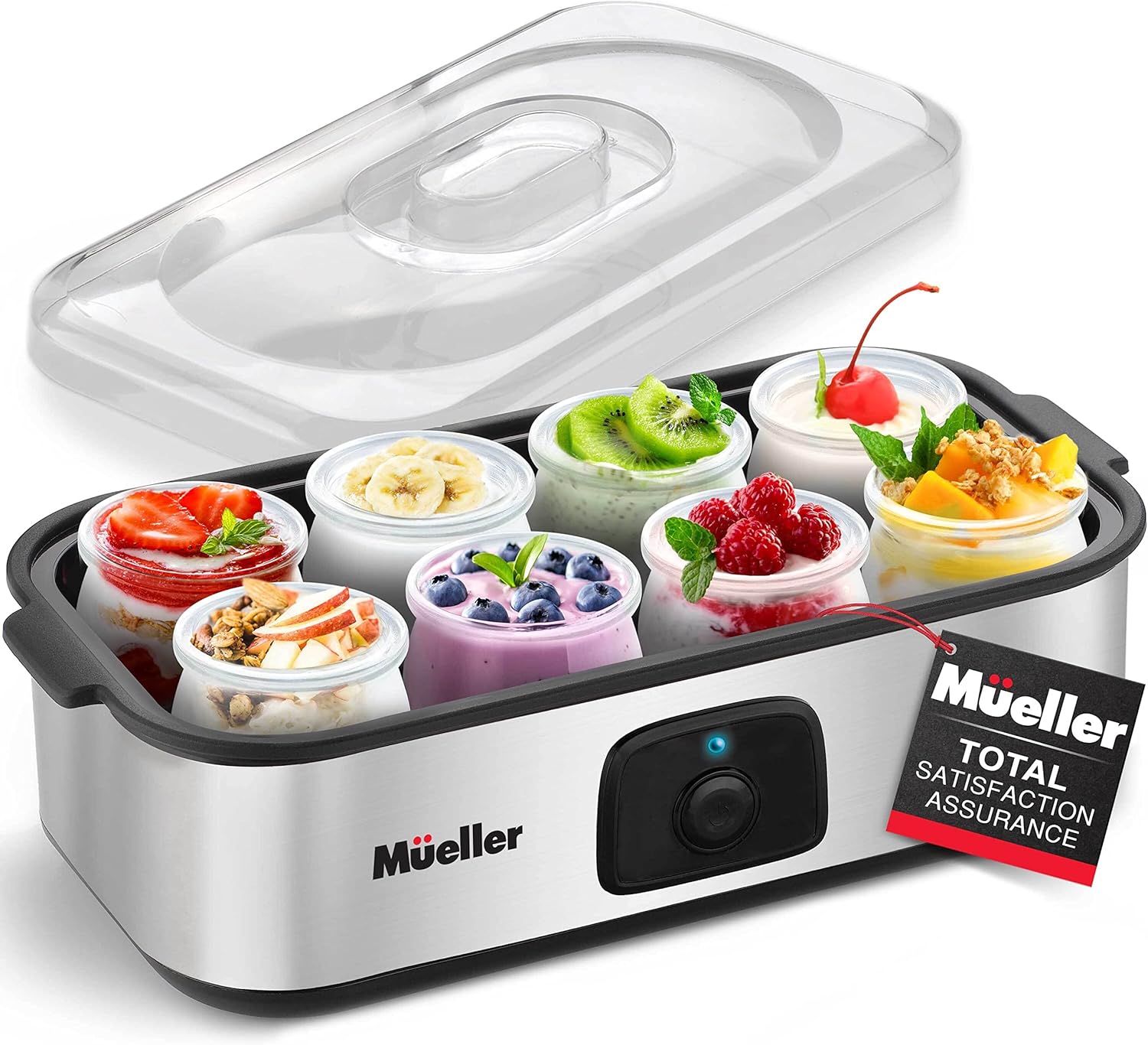
| Jar capacity | 6 oz each |
|---|---|
| Number of jars | 8 jars |
| Total batch volume | 48 oz |
| Housing material | Stainless steel |
The Mueller Ultra Yogurt Maker is a simple, user-friendly appliance for making homemade yogurt in individual 6 oz glass jars. It works by warming milk mixed with a yogurt starter for a set period (roughly 8–12 hours depending on milk fat) inside a stainless steel housing and removable fermenting pot, then chilling the jars once fermentation is complete. Notable features include eight dishwasher-safe glass jars with BPA-free lids, a transparent cover to check progress, and a one-touch control that makes operation straightforward for beginners. In practice it produces consistent cultures when you use good-quality starters and follow recommended times, and the individual jars are convenient for portioning flavored or probiotic varieties such as L. reuteri. Limitations are the single fixed program with no adjustable temperature or timer presets and the modest 48 oz batch capacity, which may require multiple runs for larger households. The stainless-steel exterior and glass jars clean well and keep the process largely hands-off, making this a practical tool for anyone wanting better ingredient control and daily yogurt portions.
Best for: Buyers who want a straightforward, low-effort way to make daily single-serve yogurts at home and who prioritize ease of use and portion control over advanced programming.
Less Ideal for: Those who need large-batch production, precise temperature control for experimenting with different cultures, or programmable cycles for specialty fermentations.
- Eight 6 oz glass jars for individual portions and easy portioning
- One-touch automatic operation simplifies the fermentation process
- Stainless steel housing and dishwasher-safe jars for easy cleaning
- Transparent cover lets you monitor fermentation without opening
- No adjustable temperature or multiple program settings for precise culture control
- Limited total yield (48 oz) may be small for larger families
Verdict: A practical, no-fuss yogurt maker that delivers consistent individual servings and makes it easy to produce probiotic-rich yogurts like L. reuteri at home.
DiDimo Yogurt Maker ZCW-S09

| Capacity | 1.3L (1.37 QT) |
|---|---|
| Inner bowl | Stainless steel |
| Power | 20W |
| Timer | 24-hour adjustable with auto shut-off |
This compact yogurt maker is a simple countertop fermenter that handles Greek yogurt, natto, and rice wine using a 360-degree constant temperature system and a 1.3L stainless steel inner bowl. You set the timer up to 24 hours and the unit maintains a steady low-power 20W heat for even fermentation, then auto shut-off finishes the cycle. The stainless liner is odor-resistant and easy to clean compared with plastic tubs, and the small footprint makes it easy to store or leave on the counter for regular batches. Practical features for everyday use include the adjustable timer and energy-efficient operation, which keeps running costs minimal. Limits to note are its small 1.3L capacity if you need large family-sized batches and the basic control set that lacks precise, display-driven temperature programming, so you may need to track times for specific cultures. For buyers focused on affordable, low-effort probiotic batches, it delivers predictable results without complexity.
Best for: Buyers seeking an inexpensive, no-frills fermenter to make small weekly batches of probiotic yogurt and other fermented foods with low energy use and easy cleanup.
Less Ideal for: Users who need large-capacity production, precise digital temperature control for specialized strains, or commercial-level throughput should consider higher-end units.
- Stainless steel 1.3L inner bowl is durable, odor-resistant, and easy to clean
- 360 constant temperature system promotes even fermentation
- Energy efficient 20W operation keeps running costs low
- 24-hour adjustable timer with auto shut-off for unattended cycles
- Relatively small capacity for larger households
- Basic controls without precise temperature display for fine-tuning cultures
Verdict: A budget-friendly, energy-efficient fermenter with a stainless steel liner that makes reliable small batches of probiotic yogurt and other ferments.
Euro Cuisine GY50 Greek Yogurt Maker

| Capacity | Up to 2 quarts |
|---|---|
| Included Components | Bowl, strainer, lid |
| Material Type | Plastic |
| Patent | USD731861 |
The Euro Cuisine GY50 is a fridge-friendly Greek yogurt strainer designed to finish homemade or store-bought yogurt into thicker, creamier Greek-style yogurt. You fill the included bowl with yogurt, place the ultra-fine mesh strainer basket inside, cover and refrigerate while the whey drains away, then lift out rich, concentrated yogurt ready for dips, tzatziki, or desserts. Notable features include a patented stackable design that saves refrigerator space, BPA-free plastic construction, and an included recipe booklet. Practical benefits are straightforward: it handles up to 2 quarts at once, produces a noticeably thicker texture than unstrained yogurt, and is easy to clean by rinsing the mesh. Limitations are its manual nature—there is no heating or culture control—so it is strictly a strainer rather than a full electric yogurt-making machine, and being plastic some buyers may prefer stainless options for long-term durability. For L. reuteri-specific uses, the GY50 works with any finished yogurt that already contains the strain, letting you thicken cultures without exposing them to heat or mechanical stress.
Best for: Buyers who prioritize a reliable, low-tech way to thicken already cultured yogurt and want a simple, no-electricity solution that fits in the refrigerator.
Less Ideal for: People seeking an all-in-one electric yogurt maker with incubation controls or those who want a metal construction for heavier-duty use.
- Ultra-fine mesh yields thick, smooth Greek-style yogurt by removing whey
- BPA-free components suitable for food contact
- Stackable, flat-top design fits easily in most refrigerators for compact storage
- Includes bowl, strainer basket, lid and a recipe booklet for basic guidance
- No temperature control or culturing function since it only strains finished yogurt
- Made of plastic rather than metal which may feel less durable to some users
Verdict: A dependable, refrigerator-safe strainer that reliably turns finished yogurt into thick Greek-style yogurt without electricity, ideal when you only need to concentrate cultured yogurt.
Euro Cuisine YM80 Yogurt Maker

| Unit Count | 7 Count |
|---|---|
| Capacity | 2 pounds |
| Material | Glass |
| Other Special Features of the Product | Built-In Timer |
| Operation Mode | Automatic |
The Euro Cuisine YM80 is a straightforward countertop yogurt maker designed to make small batches in seven 6-ounce glass jars. You mix milk and culture, pour into the jars, set the unit running with its simple on/off switch and timer, and the heater maintains the incubation long enough for cultures like L. reuteri to develop. The clear lid and indicator light let you monitor progress and the dishwasher-safe glass jars and BPA-free lids make cleanup and storage simple. Its automatic operation and multiple jars are great for trying different strains, flavors, or milk types at once. Limitations are its basic controls—there is no precise temperature readout or programmable incubations—so careful culture selection and attention to recommended incubation times are needed for more temperature-sensitive strains. For home users who want reliable, no-fuss batches and the ability to make several flavored portions at once, this is a practical, budget-friendly choice.
Best for: Buyers who want a low-risk, easy-to-use way to make multiple small yogurt portions at home for experimenting with probiotic strains and flavors without complex settings.
Less Ideal for: People who need exact temperature control or larger single-batch volumes for frequent, high-volume yogurt production should look at more advanced programmable units.
- Includes seven 6-oz glass jars with BPA-free lids for making multiple flavors simultaneously
- Built-in timer, indicator light, and simple on/off control make operation easy
- Dishwasher-safe glass jars simplify cleanup and refrigerator storage
- Clear lid allows visual monitoring during incubation
- No digital temperature display or fine temperature control for precision incubations
- Small single-jar size limits total batch volume per run
Verdict: A simple, dependable yogurt maker for making multiple small, flavored batches at home and testing probiotic cultures like L. reuteri without fuss.
Ultimate Probiotic Yogurt Maker UYM

| Capacity | Up to 2 quarts |
|---|---|
| Temperature range | 68-131°F |
| Max run time | 48 hours |
| Materials | Stainless-steel casing and glass containers |
The Ultimate Probiotic Yogurt Maker is designed for home fermentation of probiotic-rich yogurt and emphasizes precise temperature control and longer run times to support sensitive strains like L. reuteri. You set temperature between 68 and 131°F and program the timer for up to 48 hours, then place the starter and milk into the included glass containers and let the unit maintain an even environment. The stainless steel casing and glass vessels reduce flavor transfer and make cleaning straightforward, while BPA-free lids protect stored batches. Larger households will appreciate the ability to culture up to 2 quarts at once using the containers or about 1.5 quarts with the jars. The maker comes with recipe guidance and appears aimed at consistent results rather than complicated features. Limitations include its single-appliance capacity and reliance on users to source appropriate starters for specific strains, and the unit is not a multi-function cooker so it only handles fermentation tasks.
Best for: Home cooks who want a reliable, easy-to-use device to make consistent, probiotic-rich yogurt at home and who prioritize accurate temperature control and simple maintenance.
Less Ideal for: People seeking a multi-use kitchen appliance or those who prefer devices that include strain-specific starters and full turnkey kits.
- Adjustable temperature from 68 to 131°F supports culturing delicate probiotic strains
- Timer runs up to 48 hours for long ferments needed by some cultures
- Includes large glass containers for batches up to 2 quarts and BPA-free lids
- Stainless-steel exterior and glass vessels minimize flavor transfer and are easy to clean
- Only one appliance capacity so you can culture a limited number of batches at a time
- Does not include probiotic starters for specific strains, which must be purchased separately
Verdict: Choose this maker if you want precise, long-duration temperature control to culture L. reuteri and other delicate probiotic strains at home.
Choosing the Right Yogurt Maker for L. Reuteri: Key Factors to Consider
Temperature Accuracy
Precise temperature control is crucial for culturing L. reuteri because small deviations can reduce probiotic viability. Look for machines that specify an accurate operating range and that have thermostats or digital controls capable of holding the target temperature within about +/- 0.5 to 1.0 degrees Celsius.
When a unit overshoots or fluctuates regularly, cultured bacteria may experience stress that lowers counts or changes texture. If you plan to culture sensitive strains regularly, prioritize models with digital temperature readouts or verified calibration procedures rather than simple timer-only designs.
Incubation Stability
Stability over the full incubation period matters as much as initial accuracy. Some yogurt makers heat to the set point but then cycle widely, creating thermal stress for developing cultures. A stable heating element and good insulation minimize temperature cycling and protect long, low-temperature incubations.
Consider the machine's ability to run for extended periods without significant drift. Check whether the design circulates heat evenly across jars or bottles, since hot spots or cold zones will cause inconsistent results across a batch.
Sanitation and Materials
Cleanliness is essential when culturing probiotics because contamination by unwanted microbes can outcompete the target strain. Prefer units with removable glass or stainless-steel jars and minimal plastic contact with the culture. Dishwasher-safe jars and lids or parts that tolerate hot-water sterilization reduce the effort needed to maintain a hygienic workflow.
Avoid porous materials that absorb moisture or odors and choose smooth surfaces that are easy to wipe and sanitize between uses. A compact interior with accessible corners also reduces the chance that residue will persist.
Batch Size and Flexibility
Different users have different needs: some want single small jars for personal daily servings, while others need several liters at once. Choose a yogurt maker that matches your typical batch size or offers configurable jar layouts. Machines that force you to run a full large-volume cycle when you only need one jar can waste energy and create unnecessary risk of inconsistency.
Consider whether you want individual portion jars for portion control or a single larger vessel for family servings. Also evaluate how the unit handles partial loads and whether heat distribution remains even when not fully loaded.
Ease of Use and Controls
Straightforward, dependable controls reduce user error during long incubations. Digital timers and clear temperature displays make it easier to set and monitor runs accurately. Simple, repeatable presets for common culture temperatures are helpful, but make sure the device also allows fine manual adjustment when culturing a specific strain like L. reuteri.
A minimal learning curve and clear indicators for cycle progress let you focus on sterile technique and timing rather than babysitting the machine.
Cleaning and Maintenance Effort
Routine maintenance affects whether you will actually keep culturing at home. Machines that require few special tools, have dishwasher-safe parts, and allow easy access to the interior encourage regular use. Also consider how easy it is to replace worn seals or gaskets, and whether the design prevents liquid spills from reaching electronic components.
Long-term durability of components that contact cultures will reduce the likelihood of contamination due to degraded seals or pitted surfaces. Factor in user-replaceable parts and straightforward disassembly when assessing practicality.
Optimal Temperature Ranges for L. Reuteri
L. reuteri strains typically thrive within a relatively narrow temperature window. When using a yogurt maker intended for this strain, set and verify the machine at the recommended incubation temperature rather than relying on general yogurt presets. Small adjustments to time and temperature affect acidity and texture as well as probiotic survival.
If your yogurt maker provides a digital readout, use an independent thermometer probe in a test run to confirm the internal temperature profile across several hours. That helps you understand any steady-state offset and adjust settings accordingly.
- Confirm set temperature with a calibrated thermometer.
- Run a short validation cycle to detect large fluctuations.
- Adjust incubation time if you lower or raise the temperature slightly.
Jar Types and Their Impact on Fermentation
Glass jars are preferable when culturing sensitive probiotics because they do not absorb odors and are easy to sanitize. Stainless-steel vessels are also acceptable if they have a smooth finish and no coatings that could degrade. Plastic containers are convenient but may retain odors or micro-scratches that harbor contaminants.
Consider jar lid design as well. Tight-fitting lids help prevent environmental contamination, but units that seal too tightly can trap condensation unevenly. Removable, individual jars also let you experiment with different incubation times without sacrificing the whole batch.
- Prefer glass or stainless containers for long-term cleanliness.
- Individual jars reduce risk when experimenting with strains.
- Check that lids are easy to sanitize and do not trap residue.
Sanitation Workflow for Consistent Results
A repeatable sanitation routine reduces batch failures. Start with thoroughly cleaned jars and utensils, sanitize containers with hot water or an approved food-safe method, and prepare culture materials on a clean surface. Avoid cross-contamination by using dedicated spoons and keeping starter cultures sealed until just before use.
Between batches, deep-clean any removable trays and wipe the interior with a mild disinfectant safe for food contact. Let parts dry completely before reuse to minimize residual moisture that could harbor unwanted microbes.
- Sanitize jars and lids with hot-water rinse or dishwasher cycle.
- Use dedicated utensils and a clean workspace when preparing cultures.
- Dry parts completely before storage to prevent microbial growth.
Timing Strategies for Desired Texture and Potency
Longer incubations at lower temperatures often favor probiotic viability but can produce thinner textures and more acidity. Shorter, slightly warmer runs may thicken faster but risk stressing delicate strains. Decide whether you prioritize texture or maximal viable counts and adjust time and temperature accordingly.
Keep a simple log of temperature, incubation length, and the resulting texture and taste. Over several trials you can develop a reliable recipe that balances palatability with probiotic potency.
- Long, cool incubations favor probiotic survival.
- Short, warm incubations speed thickening at possible cost to viability.
- Record each run to fine-tune your preferred balance.
Troubleshooting Common Issues
If a batch fails to set or shows off odors, consider possible causes such as inaccurate temperature, contaminated starter, or insufficient sanitation. Re-check your machine's temperature profile and run a sterile control with just milk to verify the environment is clean. Replace starter culture if it is old or exposed to contaminants.
Uneven texture across jars often indicates uneven heating. Try rearranging jars or running a full set to improve thermal mass. If your machine consistently shows large temperature swings, test it empty to determine whether the issue is a design limitation or a faulty thermostat.
- Run a sterile control to isolate contamination sources.
- Use a thermometer to diagnose heating inconsistencies.
- Replace suspect starters and follow strict sanitation steps.
How We Chose the Best Yogurt Maker for L. Reuteri
We focused on features that directly affect the viability and consistency of L. reuteri cultures. Primary evaluation criteria included temperature accuracy and stability, incubation timer precision, and the ability to run small or single-jar batches without large heat fluctuations. We also prioritized build quality and materials that are easy to sanitize, including removable parts that tolerate hot water or dishwasher cleaning. Capacity and jar configuration matter for users who want to make single small jars versus larger family-size batches, so we considered flexibility and included machines with multiple jar options. Practical usability was another filter: straightforward controls, reliable timers, and clear status indicators reduce user error during multi-hour incubations. We looked for units with minimal heat ramping and good insulation to avoid ambient room temperature affecting outcomes. Noise and energy use were secondary but included for kitchen friendliness. Units that required complex setup, had unreliable temperature control, or used materials difficult to sterilize were excluded. The resulting picks reflect devices that consistently meet the technical needs of culturing a sensitive probiotic while remaining usable for everyday kitchen practice.
Our full evaluation process is outlined in our review methodology.
FAQ
Can I use a regular yogurt maker to culture L. reuteri?
Often yes, provided the unit can hold a steady, appropriate temperature for the strain. Verify the maker's temperature accuracy and stability over a full incubation before relying on it for L. reuteri. If the device cycles widely, it may not be suitable.
How important is jar material when culturing L. reuteri?
Jar material matters because porous or scratched plastics can harbor contaminants and odors. Glass or stainless-steel containers are easier to sanitize and are a safer long-term choice for sensitive probiotic work.
What incubation time should I use for best probiotic counts?
Optimal time depends on the exact strain and temperature, but many users find longer, slightly cooler incubations favor viability. Start with recommended ranges and keep a log to refine time based on texture and potency outcomes.
How can I check that my yogurt maker is holding the right temperature?
Place an independent, calibrated thermometer probe inside a filled jar or in a representative position and run a test cycle for several hours. Compare the probe readings to the unit's set temperature to detect offsets or fluctuations.
Is it safe to sterilize yogurt maker parts in the dishwasher?
Many glass and stainless parts are dishwasher-safe, but check the unit's documentation for heat tolerance. Avoid high-heat cycles for any parts that include rubber seals or glued components that might degrade.
Final Verdict
Choosing a yogurt maker for culturing L. reuteri means prioritizing stable, accurate temperature control and a hygienic design that supports repeatable results. Balance batch flexibility with sanitation-friendly materials so you can run single jars or larger batches without compromising cleanliness. Focus on machines that let you monitor and adjust temperature precisely, provide easy-to-clean containers, and support a predictable incubation profile. With those priorities in mind, you can select a model that fits your kitchen habits and get consistent probiotic batches over time.