
Note: This article contains affiliate links. If you click on these links and make a purchase, we may earn a small commission at no extra cost to you. This helps support our research and content. Read our full affiliate disclosure here.
If you need high-output smart lighting for larger rooms, a 100-watt smart light bulb can provide the brightness you want with connected controls. The right bulb balances luminous output, color accuracy, and network reliability so you can use voice commands, schedules, and scenes without flicker or dropout. This guide shortlists seven top options that delivered on those essentials for typical home setups. Below we explain what mattered in our selection and what to watch for when choosing a high-output smart bulb, then present the top picks and practical buying guidance.
Top Picks at a Glance
| Best Overall The best all-around choice for most situations | Linkind Matter Smart A21 100W |  |
| Best Quality Built to a higher standard if you want something more solid | Philips Hue A21 Smart Bulb |  |
| Best Value The sweet spot between price and what you get | OREiN Matter A21 Smart Bulb |  |
| Best Budget The cheapest option that still gets the job done reliably | Sengled Smart A19 100W (E11-N13) |  |
| Top Rated A top-rated pick with lots of positive feedback | Lightinginside Matter A19 100W Equivalent |  |
| Most Popular A crowd favorite that many people choose with confidence | Lightinginside A19 Smart Bulb 100W |  |
| Best Seller A high-volume bestseller chosen again and again | Sengled Alexa Smart A19 100W Eq |  |
Linkind Matter Smart A21 100W

| White Brightness | 1600 lumens |
|---|---|
| Wattage | 14 watts |
| Incandescent Equivalent Wattage | 100 watts |
| Light Source Operating Life | 25000 hours |
| Color Rendering Index | 90 |
The Linkind Matter A21 smart bulb is a high‑output LED meant to replace a 100W incandescent while adding color and smart home control. It produces 1600 lumens from 14 watts and offers tunable white (warm to daylight) plus 16 million colors, controlled via the AiDot app or directly through Matter‑compatible platforms like Apple Home, Alexa, and Google when paired with a certified hub. Practical features include scheduling, smooth app dimming from 1% to 100%, music sync, grouping, and preset scenes for parties or routines. The bulb has a high CRI for truer color rendering and an estimated 25,000‑hour life, making it suitable for large rooms where bright, adjustable light is needed. Note that it is not recommended for use with traditional wall dimmer switches because they can cause flicker or buzzing; dimming is intended through the app or voice. Setup requires a Matter hub for platform integration or the AiDot app if you prefer standalone Wi‑Fi control. For buyers seeking a bright, flexible smart bulb that fits mainstream smart ecosystems, this model covers the basics well.
Best for: Buyers who want a single, very bright smart bulb that integrates into modern smart home platforms and provides flexible color and white tuning for rooms that need strong, adjustable light.
Less Ideal for: People who rely on existing wall dimmer switches or need out‑of‑the‑box hubless integration with platforms that do not support Matter; also not ideal for fixtures that require specialized bulb shapes or low wattage.
- Very bright 1600 lumens output while drawing only 14W
- Matter compatibility for direct integration with Apple Home, Alexa, and Google via a certified hub
- Wide color range plus tunable white and high CRI for accurate color rendering
- App and voice control with scheduling, grouping, and music sync features
- Not compatible with traditional wall dimmer switches and may flicker or buzz if used with them
- Requires a Matter‑certified hub for native platform integration (or use AiDot app for standalone control)
Verdict: Choose this Linkind A21 bulb when you need a true 100W‑equivalent smart bulb that is very bright, color‑capable, and built for Matter ecosystems.
Philips Hue A21 Smart Bulb

| Light Output Maximum | 1600 lumens |
|---|---|
| Light Source Wattage | 16 watts |
| Light Source Operating Life | 25000 hours |
| Connectivity Protocol | Zigbee |
This Philips Hue A21 smart bulb is a high-output LED that replaces a 100W incandescent and is aimed at rooms that need bright, color-capable lighting. It produces up to 1600 lumens and supports warm-to-cool whites plus millions of colors, all dimmable from the Hue app or compatible voice assistants. Connectivity is via Zigbee, so you get a reliable mesh when paired with a Hue Bridge or other Zigbee hub, and the bulb supports advanced schedules, scenes, and Matter integration for broader smart-home control. With a rated life of about 25,000 hours and Energy Star recognition, it balances brightness with efficiency. Downsides are the need for a hub to unlock full automation features and that color performance depends on your fixture and room reflectance, so real-world color vividness can vary. For users who prioritize bright, controllable color lighting and tight ecosystem integration, this bulb delivers the expected Philips Hue experience.
Best for: Buyers who want a high-output smart bulb for bright, color-capable lighting and value robust ecosystem features and automations over a simple plug-and-play Wi-Fi bulb.
Less Ideal for: People who need a standalone Wi-Fi bulb without a hub or those who only want basic white lighting with no color or advanced automation.
- High brightness up to 1600 lumens suitable for larger rooms
- Wide color range plus tunable warm-to-cool white for flexible scenes
- Zigbee connectivity and Hue Bridge support enable reliable mesh networking and advanced automations
- Dimmable and compatible with voice assistants for hands-free control
- Full feature set requires a Hue Bridge or Zigbee hub rather than working entirely over standard Wi-Fi
- Actual color intensity and uniformity depend on fixture and room conditions
Verdict: Choose this bulb when you need a bright, 100W-equivalent smart light with full color control and reliable Zigbee-based automation.
OREiN Matter A21 Smart Bulb

| Wattage | 14 watts |
|---|---|
| Bulb Shape Size | A21 |
| Bulb Base | E26 |
| Light Output Maximum | 1600 lumens |
| Connectivity Technology | Bluetooth, Matter, Wi-Fi |
The OREiN Matter A21 smart bulb is a high-output, color-changing LED intended as a 100W-equivalent replacement for bright rooms like kitchens or garages. It produces up to 1600 lumens and supports RGBTW color plus tunable white from warm to cool, while rated at about 14 watts and a 25,000-hour life. Matter certification and support for Alexa, Apple Home, Google Home, and SmartThings simplify cross-platform control and reduce the need for separate hubs, and the bulb can be controlled by app, voice, or a dedicated remote. Music-sync and rhythm modes add party-style effects, and the high CRI (90) preserves color quality for tasks and decor. Important limitations: it requires 2.4 GHz Wi-Fi (no Thread), and it is generally incompatible with traditional wall dimmer switches, so plan for digital dimming via app or smart home scenes rather than legacy dimmers. For someone consolidating smart home devices, the bulb combines high brightness, broad integration, and energy savings in a familiar A21/E26 package.
Best for: Buyers who want a single, bright smart bulb that integrates across platforms and replaces a 100W incandescent for task-lit rooms or shared smart-home setups.
Less Ideal for: People who rely on legacy dimmer switches or Thread-based smart-home meshes should look for bulbs with dimmer compatibility or Thread support instead.
- Very bright 100W-equivalent output at 1600 lumens while using ~14W
- Matter certification for seamless cross-platform control with Alexa, Apple Home, Google Home, and SmartThings
- Wide RGBTW palette plus tunable warm-to-cool whites and high CRI 90 for accurate color rendering
- App, voice, and remote control options plus music-sync modes for decorative use
- Only supports 2.4 GHz Wi-Fi and is not Thread-capable
- Not compatible with traditional wall dimmer switches
Verdict: If you need a bright, 100W-equivalent smart bulb that works reliably across Alexa, Apple Home, and Google ecosystems, this Matter-certified A21 is a practical, high-output choice.
Sengled Smart A19 100W (E11-N13)

| Wattage | 14.5 watts (100W equivalent) |
|---|---|
| Light Color | Soft White (2700K) |
| Light Output Maximum | 1500 lumens |
| Bulb Base | E26 |
| Connectivity Protocol | Zigbee |
This Sengled A19 smart bulb is a bright 100-watt-equivalent LED that targets rooms needing strong, tunable soft-white illumination. It pairs to Zigbee hubs such as the Sengled Smart Hub, SmartThings, or Echo devices with built-in Zigbee for app and voice control, and supports grouping, schedules, and dimming from the Sengled Home app or Alexa/Google. Rated at 1500 lumens with a CRI around 90, it is useful for task lighting in kitchens, living rooms, or home offices where extra brightness matters. Because it uses Zigbee rather than direct Wi‑Fi, the connection is more reliable for larger installs and can scale to dozens of bulbs, but you must have or buy a compatible hub unless you already own a supported Echo with a Zigbee radio. The bulb is energy efficient compared with incandescent equivalents and offers core smart features like remote control and automations, though color tuning and advanced scenes require hub integration. For buyers prioritizing a bright, hub-driven smart bulb on a budget, this is a straightforward, practical choice.
Best for: Buyers who want the brightest 100W-equivalent smart bulb on a budget and who are comfortable using or adding a Zigbee hub to get reliable voice and remote control.
Less Ideal for: Users who need a plug-and-play Wi‑Fi smart bulb without buying or using any hub or those who want multi‑color RGB capabilities.
- Very bright 100W-equivalent output at 1500 lumens for rooms that need strong illumination
- Zigbee connectivity gives reliable mesh networking and supports grouping and large installs
- Works with Alexa, Google Assistant and SmartThings when paired through a compatible hub
- Dimmable with high CRI (~90) for better color rendering than many budget bulbs
- Requires a Zigbee hub or an Echo with a built-in Zigbee radio for full smart features
- Not a direct Wi‑Fi native bulb without a hub, adding initial setup cost for some users
Verdict: Choose this Sengled A19 when you need a very bright, budget-friendly 100W-equivalent smart bulb and are prepared to use a Zigbee hub for reliable smart control.
Lightinginside Matter A19 100W Equivalent
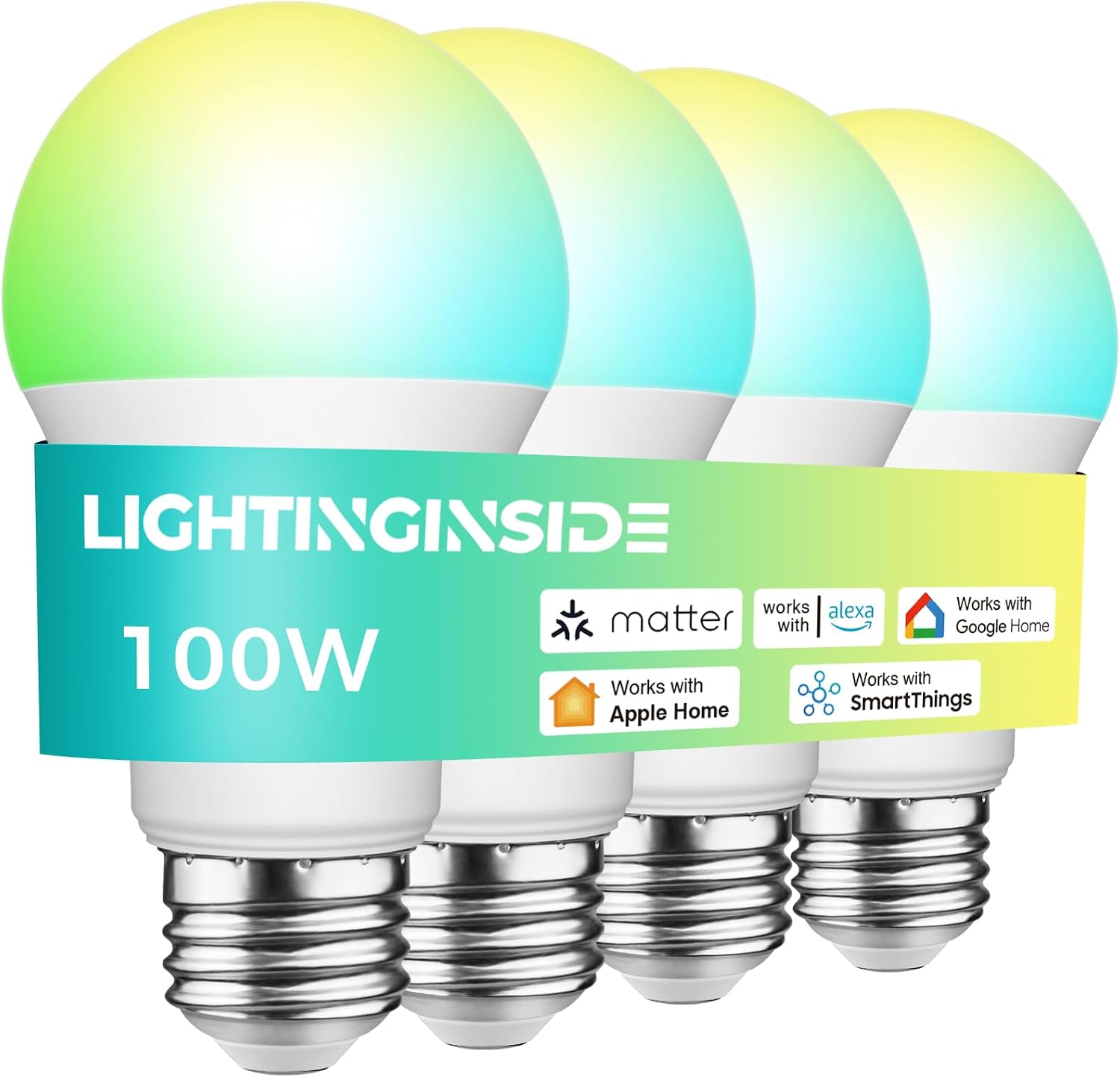
| Wattage | 11 watts |
|---|---|
| Light Output Maximum | 1350 lumens |
| Bulb Base | E26 |
| Light Source Operating Life | 25000 hours |
| Control Method | App, Voice |
These Lightinginside Matter A19 bulbs are full-featured smart LEDs meant to replace 100W incandescent lamps while adding color and automation. They install like any E26 A19 bulb and connect over 2.4 GHz WiFi using a Matter-certified setup, which lets you control them from Apple Home, Alexa, Google Home, or SmartThings once an initial speaker or hub registers them. In practice they produce a high 1350-lumen output for larger rooms, offer RGB color plus tunable warm-to-cool white, and support grouping, schedules, and voice dimming via the platform you choose. The bulbs are rated 25,000 hours and carry ETL/FCC/RoHS certifications, so they feel like a reliable everyday replacement. Important limits to note: initial setup requires a Matter-capable hub or speaker, and they are not compatible with legacy wall dimmer switches which can cause flicker or buzzing. For buyers who want bright, interoperable smart bulbs without proprietary apps, these are a practical, dependable choice.
Best for: Buyers who prioritize dependable, standards-based smart lighting that integrates with major smart home platforms and provides high, consistent brightness for everyday rooms.
Less Ideal for: People who need bulbs that work directly with legacy wall dimmer switches or who want standalone bulbs controlled only by a proprietary app without a Matter hub.
- Matter certification enables direct control from Apple Home, Alexa, Google Home, and SmartThings without a third-party app
- High 1350-lumen output replaces a 100W incandescent for larger rooms
- RGB color plus tunable white gives flexible mood and task lighting
- Works over 2.4 GHz WiFi and supports group control, schedules, and voice commands
- Requires a Matter-capable speaker or hub for initial setup
- Not compatible with conventional wall dimmer switches which may cause flicker
Verdict: A bright, Matter-certified 100W-equivalent smart bulb pack for buyers who want reliable, platform-agnostic smart lighting.
Lightinginside A19 Smart Bulb 100W

| Wattage | 11 watts |
|---|---|
| Light Output Maximum | 1350 lumens |
| Color Temperature | 2700–6500K (tunable white) |
| Light Source Operating Life | 25000 hours |
| Connectivity Protocol | Wi‑Fi, BLE |
These Lightinginside A19 smart bulbs offer bright, full‑color lighting for rooms that need a strong 100W‑equivalent output while staying energy efficient at 11W. They pair with the SmartLife app over 2.4 GHz Wi‑Fi and BLE for local and remote control, support voice assistants like Alexa and Google Assistant, and include group control, scheduling, scenes, and a music sync mode for parties. The bulbs claim faster, more reliable setup thanks to a dual‑channel BLE+Wi‑Fi chip and retain local BLE control if the Wi‑Fi drops. Tunable white (2700–6500K) and more than 16 million RGB colors make them flexible for task lighting or mood scenes, and a 25,000‑hour life plus ETL/FCC/RoHS certifications add confidence. Expect to set brightness and color from the app or voice rather than traditional dimmer switches, and note they require initial BLE pairing and a 2.4 GHz network for full Wi‑Fi setup. For users who prioritize straightforward app and voice control with high brightness and color options, these bulbs deliver a lot of functionality in a standard E26 A19 form factor.
Best for: Buyers who want a bright, color‑capable smart bulb with proven certifications and easy voice/app automation for living rooms, kitchens, or parties, and who value reliable setup and local control when networks fail.
Less Ideal for: People who need bulbs controlled by traditional wall dimmer switches or those who only have 5 GHz‑only Wi‑Fi networks and cannot use BLE during setup.
- High brightness at 1350 lumens for true 100W equivalence in larger rooms
- Wide color range plus tunable white (2700–6500K) for versatile scenes
- Dual BLE and 2.4 GHz Wi‑Fi connectivity for faster setup and local control when Wi‑Fi is down
- Works with SmartLife app and voice assistants for hands‑free control and automation
- ETL, FCC, and RoHS certifications and a 25,000‑hour rated life provide safety and longevity assurances
- Requires 2.4 GHz Wi‑Fi and initial BLE pairing for Wi‑Fi setup rather than pure Wi‑Fi-only pairing
- Not compatible with dimmer switches; must be dimmed from app or voice
Verdict: A high‑brightness, fully featured A19 smart bulb that gives reliable app and voice control plus wide color and tunable white options for buyers who want 100W‑equivalent light with proven certifications.
Sengled Alexa Smart A19 100W Eq

| Light Output Maximum | 1500 lumens |
|---|---|
| Color Temperature | 2700 Kelvin |
| Light Source Wattage | 12 watts |
| Connectivity Protocol | Bluetooth Mesh |
| Light Source Operating Life | 25000 hours |
The Sengled Alexa Smart A19 is a 100-watt-equivalent LED that uses Bluetooth mesh and Sengled auto-pairing to connect directly to supported Alexa devices for voice and app control without a hub. It delivers bright soft-white light at 1500 lumens and a 2700K color temperature with a CRI of 90, and its dimming range (about 5 to 100 percent) makes it useful for living rooms, kitchens, and workspaces. Setup is straightforward when you have a compatible Echo device that supports the Sengled mesh gateway, and the bulb supports localized offline mesh control for added privacy. Practical benefits include long rated life (25,000 hours), group control through the app or Alexa, and a high lumen output that replaces 100W incandescent bulbs while using about 12W of LED power. Limitations are that it depends on supported Alexa Bluetooth gateway devices to use the auto-pairing feature and it is intended for indoor use only, so buyers who need full Wi-Fi integration, third-party voice assistants, or outdoor-rated bulbs should look elsewhere.
Best for: Buyers who want a bright, straightforward smart bulb that pairs directly with an Echo device and favors simple, privacy-minded local control over cloud-dependent ecosystems.
Less Ideal for: People who need bulbs that integrate with non-Alexa ecosystems, require Wi-Fi native bulbs, or need outdoor-rated smart lighting.
- High brightness at 1500 lumens suitable as a 100W incandescent replacement
- Auto-pairing with compatible Alexa devices eliminates a separate hub
- Bluetooth mesh enables group control and local mesh networking
- Rated 25,000-hour operating life for long-term use
- High color rendering index (CRI 90) for accurate color appearance
- Requires an Alexa device that supports Sengled Bluetooth gateway to auto-pair
- Not designed for outdoor use or for direct Wi-Fi control with non-Alexa assistants
Verdict: A very bright, easy-to-setup Alexa-first smart bulb for buyers who prefer hub-free, local Bluetooth mesh control and strong indoor illumination.
Choosing the Right 100-Watt Smart Light Bulb: Key Factors to Consider
Lumen Output and Real-World Brightness
High-wattage smart bulbs are chosen primarily for the light they put out. Look beyond the equivalent-wattage claim and check the lumen rating to confirm the bulb will illuminate a larger room or high ceiling. Pay attention to stated output at full power and any notes about sustained brightness, because some bulbs list peak lumens that drop under prolonged use.
How the bulb performs in everyday fixtures matters too. Enclosed fixtures or recessed cans can reduce effective output and raise operating temperature, which may throttle brightness on poorly cooled bulbs. Match the lumen rating to room size and fixture type to avoid underwhelming illumination.
Color Rendering and Temperature Flexibility
Color rendering index (CRI) and available color temperatures determine how natural colors look and how versatile the bulb is across tasks. A higher CRI gives truer colors for kitchens, living spaces, and work areas. Tunable white bulbs that cover warm to cool temperatures let you shift from cozy evenings to bright task lighting without changing fixtures.
If you need accent lighting or mood scenes, check whether the bulb supports full RGB color in addition to tunable white. Note that some high-output bulbs trade top-end lumens for limited color options, so choose based on whether precise color or raw brightness is the priority.
Connectivity Protocol and Ecosystem Compatibility
Smart-bulb value depends on reliable wireless control. Check the communication protocol used, such as Wi-Fi or a common mesh standard, and confirm it matches your existing hub or voice assistant setup. Protocol choice affects latency, range, and how many bulbs you can run before congestion causes problems.
Also consider whether the bulb requires a vendor cloud or supports local control. Local control reduces latency and keeps basic functions working during internet outages. If you plan to integrate bulbs into automated scenes, verify the level of third-party ecosystem access provided.
Dimming Range and Control Responsiveness
A usable dimming range is important for ambiance and energy savings. Some smart bulbs only dim effectively between a limited band, leaving very low light levels uneven or flickery. Check reports on minimum dimming levels and whether dimming is smooth at low settings.
Control responsiveness also matters. Faster on/off and dim transitions feel more natural, especially when using motion sensors or voice commands. Evaluate whether the bulb supports gradual fades and whether it recovers gracefully after power interruptions.
Heat Management and Expected Lifespan
High-output bulbs generate more heat. Good thermal design prevents premature lumen depreciation and component failures. Look for bulbs with explicit heat-dissipation features or longer rated lifespans that suggest robust internal components.
Consider how the bulb will be used: fully enclosed fixtures and downlights trap heat and can shorten life. Prefer bulbs with conservative operating temperature ranges or ones specifically rated for enclosed fixtures if needed. A longer rated lifespan reduces the hassle and frequency of replacements.
Form Factor and Fixture Fit
A 100-watt equivalent smart bulb can be larger than standard bulbs. Check physical dimensions and base type to ensure it fits pendant shades, recessed housings, and multi-bulb fixtures. Oversized bulbs can block airflow in enclosed fixtures and may create glare in shallow shades.
Also consider beam angle. Wide-angle bulbs work better for general room lighting while narrower beams suit task-focused fixtures. Confirm the bulb clears the socket and does not conflict with nearby fixtures or shades.
When to Choose a 100-Watt Equivalent Smart Bulb
Select a high-output smart bulb when you need a single point source to light large rooms, high ceilings, or deep pendant fixtures. These bulbs reduce the number of fixtures required and simplify smart control of whole-room lighting.
They are particularly useful in open-plan living areas, kitchens with large work surfaces, and rooms where upgrading existing wiring or adding extra fixtures would be difficult. If you need both bright task lighting and connected scene control from one lamp, a 100-watt equivalent is a practical choice.
- Ideal for rooms 200 square feet or larger depending on layout
- Good for single-lamp solutions in floor or pendant fixtures
- Reduces number of smart devices needed for whole-room scenes
Installing High-Output Smart Bulbs Safely
Before installing, verify the fixture is rated for the bulb size and heat output. Avoid using high-output bulbs in fixtures marked only for lower wattage equivalents or in enclosed housings unless the bulb is explicitly rated for that environment.
Turn off power to the fixture and replace bulbs using a stable ladder for ceiling fixtures. After installation, test dimming and connectivity in the fixture to confirm there is no flicker or unexpected behavior under normal use.
- Check fixture labeling for maximum bulb size and enclosed-rated notes
- Allow a short burn-in period and watch for unusual heat buildup
- Update the bulb firmware if the manufacturer provides local update tools
Integrating Into Smart-Home Scenes and Automations
High-output bulbs can be grouped for synchronized room control or used individually for task areas. Plan automations that use both brightness and color temperature adjustments to optimize comfort throughout the day. For example, cooler temperatures and higher lumen levels for daytime chores, warmer and dimmer settings for evenings.
If your setup uses motion sensors or ambient light triggers, configure minimum dim levels and delay timers to prevent rapid on/off cycles that can shorten bulb life.
- Group bulbs by room or fixture for simple scene recall
- Use gradual fades to make transitions less jarring
- Avoid too many rapid state changes in automations
Troubleshooting Common Connectivity and Dimming Issues
Network congestion, weak signal, or incompatible mesh settings are common causes of unreliable smart-bulb behavior. Start by checking the bulb is within recommended range of your router or hub and that firmware is up to date. If a bulb frequently drops offline, try moving the hub or adding a compatible repeater.
Dimming problems often stem from using the wrong dimmer switch or preexisting wiring. If you have a physical dimmer, ensure it is compatible with smart LED loads or set wall dimmers to full on and control dimming via the smart app instead.
- Verify signal strength and reduce Wi-Fi congestion when possible
- Disable legacy dimmers or replace with neutral-compatible units
- Perform a factory reset on a misbehaving bulb before replacing hardware
Energy Use and Heat Considerations for High-Output Bulbs
Although labeled as 100-watt equivalents, actual power draw for LED smart bulbs is far lower, but high-lumen models still consume more energy than small bulbs. Track runtime and use schedules or occupancy sensors to minimize unnecessary on time.
Monitor fixture and surrounding surfaces for excessive heat during initial operation. Consistent overheating indicates poor ventilation or a bulb unsuited to the fixture type, which can shorten lifespan and reduce light output over time.
- Use schedules and motion sensors to reduce total run time
- Prefer bulbs with conservative operating temperatures in enclosed fixtures
- Regularly check for firmware updates that may improve thermal behavior
How We Chose the Best 100-Watt Smart Light Bulb
We focused on characteristics that matter for high-output connected lighting. First, lumen output and sustained brightness were primary filters to ensure a true 100-watt equivalent output in real-world conditions. Second, color performance and temperature range were required so bulbs can serve both task and ambient lighting roles. Third, connectivity and protocol compatibility were evaluated to ensure dependable wireless control and integration with common smart-home ecosystems. Fourth, long-term reliability factors such as heat management, rated lifespan, and firmware update support were considered to reduce early failures and connectivity regressions. We also checked dimming range and startup behavior to avoid bulbs that flicker or drop brightness when controlled. Exclusions included bulbs that did not meet the high-lumen threshold, products lacking standard bulb bases for household fixtures, or those with consistently poor connectivity reports. The outcome is a set of seven bulbs that balance output, color fidelity, reliable networking, and durability.
Our full evaluation process is outlined in our review methodology.
FAQ
Will a 100-watt equivalent smart bulb fit standard household fixtures?
Most high-output bulbs use a standard base, but they can be larger in diameter and length. Check the bulb dimensions and fixture clearance, especially for enclosed or shallow shades, before buying.
Do these bulbs work with physical dimmer switches?
Many smart bulbs are not compatible with legacy wall dimmers. For reliable dimming, set wall switches to full on and use the bulb's app or smart-home automations, or use a dimmer specifically rated for LED smart loads.
How important is the communication protocol for daily use?
Protocol affects responsiveness, range, and how many bulbs you can deploy. Wi-Fi bulbs are easy to set up but can congest a network, while mesh protocols may offer better scalability and lower latency for large installations.
Can I use high-output smart bulbs in enclosed fixtures?
Only if the bulb is explicitly rated for enclosed fixtures. Enclosed housings trap heat and can accelerate lumen depreciation or cause early failure in bulbs not designed for that environment.
What maintenance do smart bulbs require?
Smart bulbs need minimal maintenance. Occasionally check for firmware updates, ensure they remain cool and free of dust, and verify connectivity. Replace bulbs that show persistent flicker, color shifts, or frequent disconnects.
Final Verdict
Prioritize lumen output, color fidelity, and reliable connectivity when choosing a 100-watt equivalent smart light bulb. Balance raw brightness against fixture fit and thermal performance to ensure long-term reliability in your specific installation. If you need broad, consistent room lighting, focus first on lumen rating and heat management; if flexible ambiance is more important, emphasize color range and dimming behavior. With those tradeoffs in mind, you can select a high-output smart bulb that meets both lighting needs and smart-home control expectations.