
Note: This article contains affiliate links. If you click on these links and make a purchase, we may earn a small commission at no extra cost to you. This helps support our research and content. Read our full affiliate disclosure here.
If you grind meat at home for burgers, sausages, or large-batch meal prep, picking the right #22 meat grinder matters. The wrong unit wastes time, clogs often, or struggles with tougher cuts. This guide covers seven shortlisted #22 meat grinders that suit home and hobbyist use, focusing on power delivery, feeding capacity, and cleanup. You will find picks selected for real-world tasks like cold grinding, sausage stuffing, and intermittent heavy use. Below we explain the criteria used to choose options and what to prioritize so you can match a model to your workload and kitchen setup.
Top Picks at a Glance
| Best Overall The best all-around choice for most situations | Zica #22 Meat Grinder HFM-22 |  |
| Best Quality Built to a higher standard if you want something more solid | Weston Pro Series #22 Meat Grinder |  |
| Best Value The sweet spot between price and what you get | ARINOO Commercial Meat Grinder #22C |  |
| Best Budget The cheapest option that still gets the job done reliably | Weston #22 Manual Meat Grinder |  |
| Top Rated A top-rated pick with lots of positive feedback | LEM BigBite #22 Meat Grinder |  |
| Most Popular A crowd favorite that many people choose with confidence | Aiheal Electric Meat Grinder MG-2430RB |  |
| Best Seller A high-volume bestseller chosen again and again | VEVOR Commercial Meat Grinder |  |
Zica #22 Meat Grinder HFM-22

| Power | 1100 W (1.5 HP) |
|---|---|
| Capacity | 485 pounds per hour |
| Voltage | 110 volts |
| Material | Stainless Steel |
The Zica #22 HFM-22 is a heavy-duty, commercial-style electric meat grinder built for frequent use. It pairs a 1.5 HP (1100W) copper motor with a stainless steel, gear-driven head and large feeding pan to grind up to roughly 485 pounds of meat per hour, and includes coarse and fine plates and a stainless steel knife. Typical use is continuous or batch grinding in small commercial kitchens, butcher shops, or serious home setups where large volumes are processed; the large pan and enlarged throat make feeding bulk cuts easier and the overturn/reset controls help clear jams without disassembly. Practical features include an overload protection reset, a waterproof switch and a storage drawer under the grind head for small accessories. Expect a solid, noisy industrial feel and a sizeable footprint; while built for durability, setup and cleaning require time and a sturdy work surface. The unit is ETL certified and priced and configured for buyers who need factory-quality performance rather than occasional household trimming.
Best for: Buyers who need reliable, factory-quality grinding capacity for regular large batches, such as small commercial kitchens, food stands, or serious home charcuterie makers.
Less Ideal for: Casual cooks who only grind small amounts occasionally or those who need a compact, lightweight countertop grinder.
- Powerful 1.5 HP (1100W) copper motor for high throughput.
- Stainless steel head, auger and housing for durability and rust resistance.
- Large meat pan and enlarged throat simplify feeding larger cuts.
- Includes fine and coarse grinding plates and stainless steel knife.
- Safety features include micro switch, overload protection and reset.
- Industrial size and weight make it less convenient for small kitchens.
- Cleaning and maintenance require effort due to heavy stainless-steel parts.
Verdict: Choose the Zica #22 HFM-22 if you want a rugged, factory-quality #22 grinder built to handle frequent high-volume meat processing.
Weston Pro Series #22 Meat Grinder

| Motor power | 1120 watts (1.5 HP) |
|---|---|
| Capacity | 14 pounds per minute |
| Voltage | 120 volts |
| Plates included | Coarse 7 mm and fine 4.5 mm |
The Weston Pro Series #22 is built for heavy-duty home or small‑shop use, driven by a permanently lubricated, air‑cooled 1.5 HP (1120 W) motor and a rifled-head, tapered throat that lets you feed meat quickly for continuous grinding. It grinds up to about 14 pounds per minute and includes coarse and fine stainless steel plates, a grinder knife, a sausage stuffer kit with four funnel sizes, a patented auger‑grabbing stomper, and a storage tray with cover. The unit also has a forward/reverse function for dealing with tougher cuts and connective tissue and a built‑in knife sharpener for prep. Its stainless steel construction and precision steel gears aim for durability and relatively quiet performance while processing hundreds of pounds. Downsides are its substantial weight and footprint, which make it less convenient to move or store in small kitchens, and its scale and power are overkill for occasional, light household use.
Best for: Buyers who prioritize robust, continuous performance and need a grinder that can handle large batches, such as serious home cooks, hunters, or small butcher shops.
Less Ideal for: Casual or occasional users with limited space who only need small, infrequent grinds should consider a lighter, more compact model instead.
- Powerful 1.5 HP (1120 W) motor for continuous, high‑volume grinding
- Rifled head and tapered throat enable fast feed rate (about 14 lb/min)
- Includes multiple accessories: coarse and fine plates, knife, sausage stuffer kit, and storage tray
- Forward/reverse function and built‑in knife sharpener improve versatility and prep convenience
- Stainless steel construction and precision steel gears for durable, quieter operation
- Heavy and bulky, which limits portability and countertop storage
- Designed for frequent or commercial use so it may be more capacity and power than casual users need
Verdict: If you need a rugged, high‑throughput #22 grinder that can run continuously and handle heavy workloads, the Weston Pro Series is a top performance pick.
ARINOO Commercial Meat Grinder #22C
| Wattage | 750 watts |
|---|---|
| Voltage | 110 volts |
| Capacity | 550 pounds |
| Material Type | Stainless Steel |
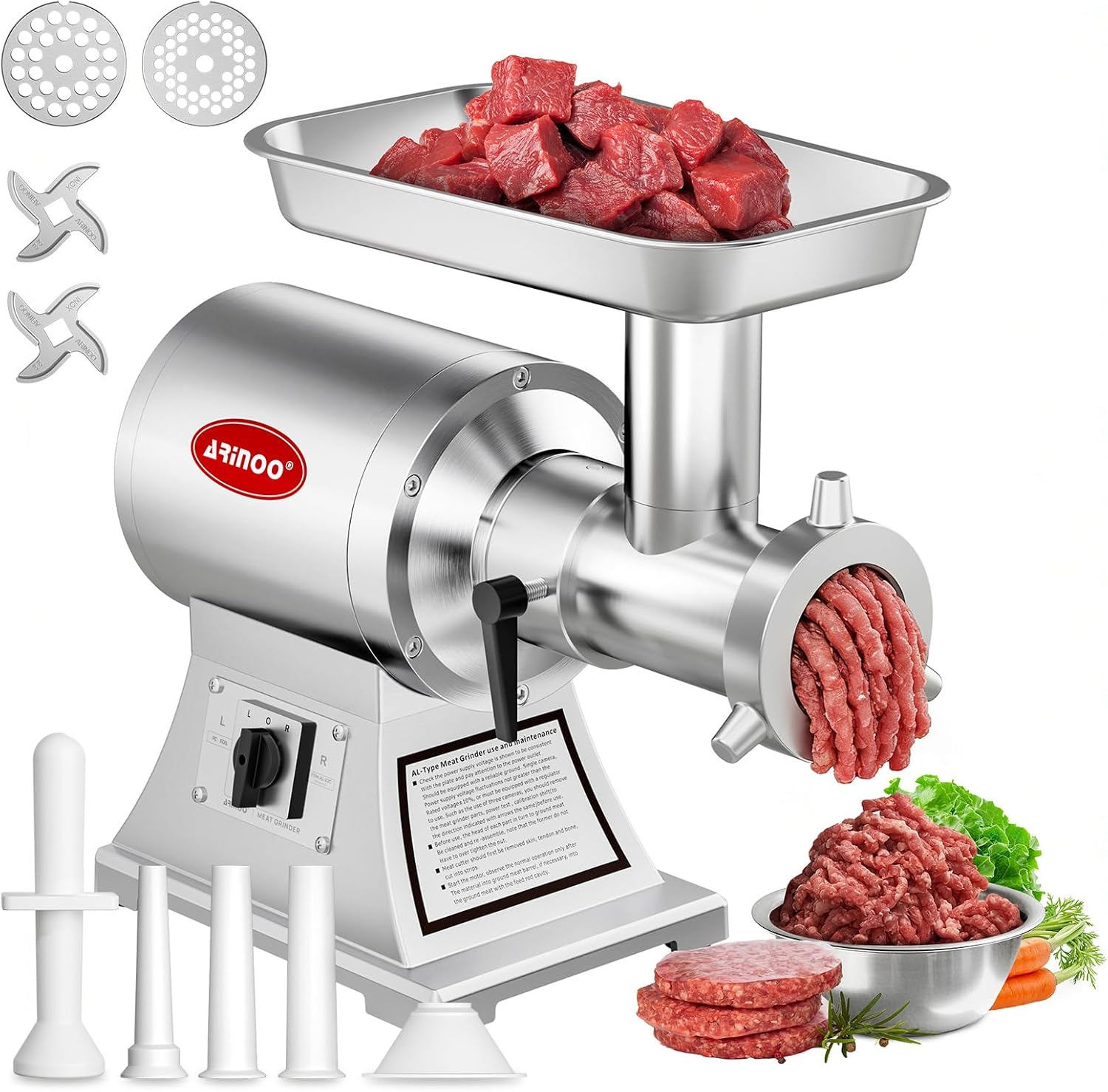
The ARINOO #22C commercial meat grinder is a stainless steel electric mincer built for high-volume use at home or on small farms. It pairs a powerful motor (listed as 750 watts in specs and described as 1 HP in marketing) with a #22 feed size to process large batches of beef, pork, lamb, venison and poultry, and the manufacturer claims up to 550 pounds per hour and continuous runs of several hours. The unit ships with two grinding plates (6mm and 8mm), two blades, three sausage stuffing tubes and a pusher, which makes it useful for burgers, baby food, sausages and general mincing without pre-chopping. Most contact parts are 304 stainless steel for corrosion resistance and easier cleaning, and the detachable design simplifies rinsing after use. Important realities to note are the grinder's substantial weight and footprint, which mean it suits a dedicated prep area rather than occasional countertop use, and the power draw and noise typical of commercial machines. For buyers who need robust, repeatable grinding and included sausage tooling, this model delivers a lot of capability for the category.
Best for: Buyers who process large quantities of meat regularly—home butchers, hunters, or small-scale producers—looking for a durable, high-throughput #22 grinder with sausage-making accessories.
Less Ideal for: Casual cooks who grind meat infrequently or need a compact, lightweight countertop grinder should consider smaller, lighter models instead.
- High claimed throughput up to 550 pounds per hour for large batches
- 304 stainless steel construction for food-contact durability and easier cleaning
- Includes useful accessories: two grinding plates, two blades, three stuffing tubes and a pusher
- Designed for continuous multi-hour operation suitable for small farm or heavy home use
- Heavy and bulky, requiring a dedicated workspace and not ideal for occasional countertop use
- Power and noise levels typical of commercial grinders may be overkill for light home tasks
Verdict: If you need a heavy-duty #22 grinder that can handle large batches and includes sausage-making accessories, this ARINOO stainless steel unit is a practical, high-capacity choice.
Weston #22 Manual Meat Grinder

| Included components | Hand crank, flange, medium (4.5 mm) & coarse (10 mm) plates, knife, stuffing star, three funnels (14/19/24 mm) |
|---|---|
| Hopper size | 4" x 5" |
| Material type | Cast Iron |
| Power source | manual winding |
The Weston #22 Manual Meat Grinder is a simple, heavy-duty cast iron grinder and sausage stuffer meant for home or field use where electricity is not available. You load meat into the 4" x 5" hopper and turn the large wooden crank to force meat through a precision steel knife and either a medium (4.5 mm) or coarse (10 mm) plate; the unit also includes a stuffing star and three funnel sizes for making sausages. It clamps to a table or work surface for stability and its tin coating helps resist wear. Setup and cleaning are straightforward since it disassembles into a few chunky parts, and the hand-crank design makes it portable and inexpensive to operate. Limitations are that a manual grinder requires physical effort for large batches and the included plates restrict you to two grind sizes without buying extra plates, and cast-iron parts need thorough drying to avoid rust despite the tin coating.
Best for: Buyers who want a low-cost, durable manual grinder for occasional home grinding or sausage making and value portability and simple maintenance.
Less Ideal for: People who need to grind large volumes regularly, want electric convenience, or require multiple grind textures out of the box should consider powered alternatives.
- Sturdy cast iron construction for durability
- Large 4" x 5" hopper speeds processing of whole cuts or bulk meat
- Includes knife, medium and coarse plates, stuffing star, and three sausage funnels
- Table clamp and wooden crank make it usable without power and portable
- Manual operation requires significant effort for high-volume grinding
- Only two grinding plate sizes included; additional plates sold separately
Verdict: A rugged, no-frills manual #22 grinder that delivers reliable home grinding and sausage stuffing at a budget-friendly price.
LEM BigBite #22 Meat Grinder
| Horsepower | 1.0 HP |
|---|---|
| Capacity | 13 pounds per minute |
| Material Type | Stainless Steel |
| Power Source | Corded Electric |
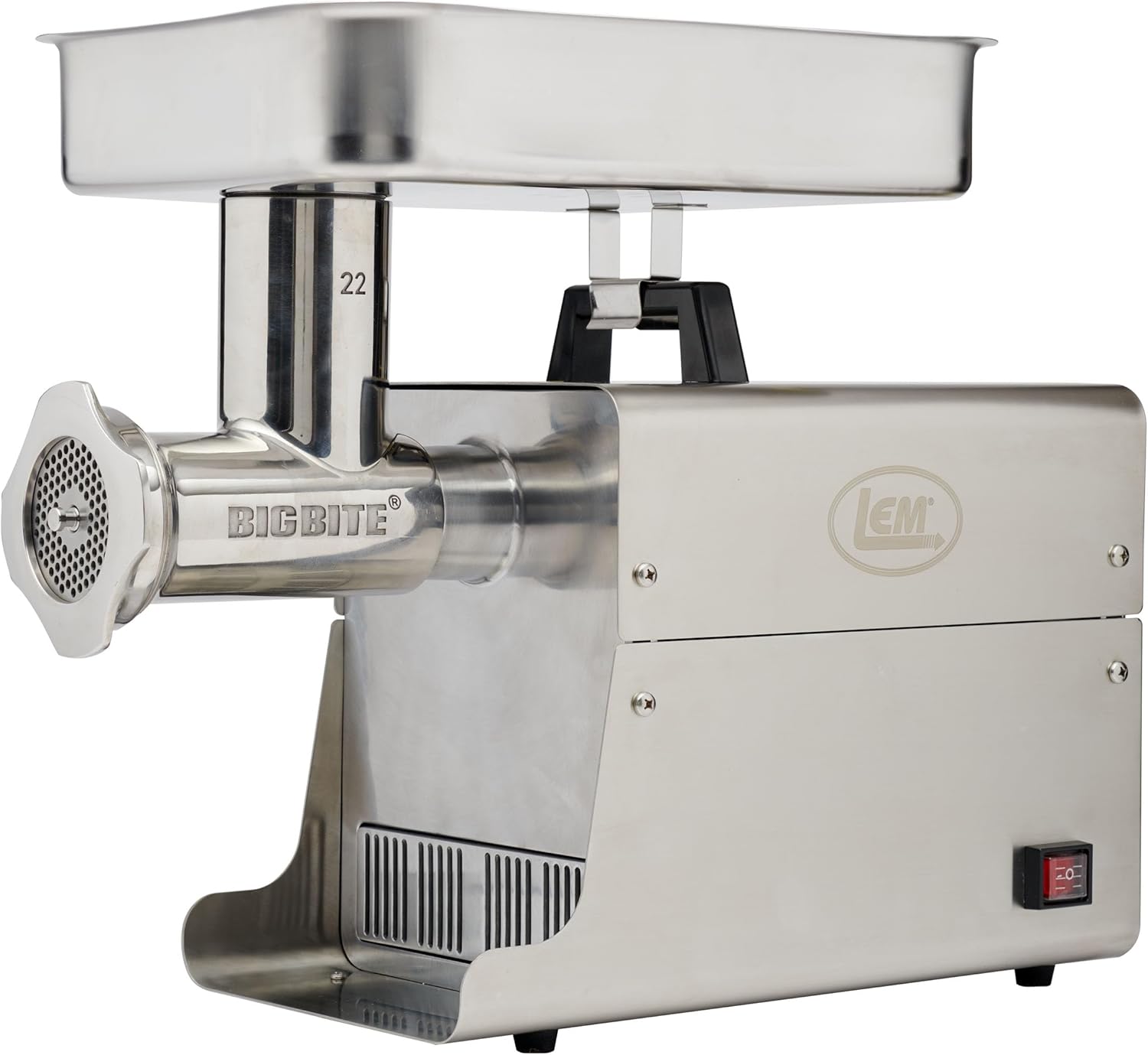
The LEM BigBite #22 is a heavy-duty electric meat grinder built for frequent, demanding use at home or in small commercial settings. Its 1.0 HP motor and large-diameter BigBite throat pull sizeable portions of meat through the auger, letting you grind up to 13 pounds per minute and even process raw chicken bones. The stainless steel head, knife, auger, and included coarse and fine plates make it straightforward to switch between burger, sausage, and fine grind tasks, and the package includes stuffing tubes, a stomper, and a storage drawer for plates. Permanently lubricated motor bearings and a noise-dampening design keep operation smooth and quieter than typical consumer grinders, and the unit disassembles for cleaning. Because it is a robust, pro-grade machine you should expect a substantial footprint and weight, and it is overkill for occasional single-family use. For anyone who grinds frequently or processes game and large batches, this grinder delivers consistent, reliable performance; casual users may prefer a smaller, lighter model.
Best for: Buyers who need a dependable, professional-grade grinder for regular large-batch processing, game butchering, or frequent sausage making and prioritize durable, long-lived equipment.
Less Ideal for: Those who grind only occasionally or who need a lightweight, compact countertop unit for small household batches should consider smaller consumer models instead.
- 1.0 HP motor and BigBite throat for high throughput up to 13 pounds per minute
- Stainless steel head, knife, auger, and plates for durable, food-safe construction
- Includes coarse and fine plates plus stuffing tubes and a stomper for versatile grinding and sausage making
- Noise-dampening design and permanently lubricated motor for smoother, low-maintenance operation
- Built-in storage drawer keeps plates and small accessories organized
- Large, heavy unit that requires a dedicated counter or prep space
- Designed for frequent heavy use so it is more than most casual users need
Verdict: Choose the LEM BigBite #22 when you need a rugged, high-throughput grinder that reliably handles frequent large batches and game processing.
Aiheal Electric Meat Grinder MG-2430RB

| Capacity | 44 pounds |
|---|---|
| Material Type | Stainless Steel |
| Power Source | Electric |
| Included Components | 2 Blades, 3 Plates, 3 Sausage Tubes, 1 Pusher |
This Aiheal electric meat grinder is a heavy-duty home unit designed to handle batches of meat quickly. It uses a copper-wound motor listed at 300W with a 3200W max locked power rating and includes three cutting plates (2mm, 5mm, 7mm), two stainless blades, and three sausage-stuffer tubes so you can grind fine to coarse and make several sizes of sausage. Typical use is preparing ground beef, pork, chicken, venison or fish for burgers, meatballs, sauces, and homemade sausages; the push rod and an unclogging "R" release button speed common tasks. The grinder's stainless-steel construction makes it feel stable and easier to clean because the cutting attachments detach, though the maker advises hand-drying rather than dishwasher use. Safety features include overload protection and a locking knob. Expect a robust, kitchen-focused appliance that excels at larger batches, but note it is a countertop appliance that requires some disassembly and cleaning after use and is not intended as a continuous industrial machine.
Best for: Buyers who want a sturdy home meat grinder for regular batch processing and homemade sausages and who prioritize proven customer feedback and built-in safety features.
Less Ideal for: Not a good choice for users needing an industrial continuous-run grinder or those who want fully dishwasher-safe attachments for minimal cleanup.
- Includes three grinding plates and three sausage tubes for versatile grind sizes and sausage making
- Stainless-steel build and removable cutting attachments for durability and easier cleaning
- Copper motor with overload protection and a locking knob for safer, reliable operation
- Comes with two blades and a pusher to streamline grinding and reduce clogging
- Manufacturer recommends hand-drying parts and warns against dishwasher use which adds cleanup time
- High "max locked" power rating may be marketing; continuous power listed is lower so heavy continuous use could overheat
Verdict: Aiheal’s grinder is a solid, safety-minded home workhorse for anyone who regularly makes ground meat and sausages and values durable stainless-steel construction and versatile plates.
VEVOR Commercial Meat Grinder

| Wattage | 1100 watts |
|---|---|
| Voltage | 110 volts |
| Capacity | 150 kg |
This VEVOR commercial meat grinder is a heavy-duty, stainless steel countertop mincer built for high-volume use in restaurants, butcher shops, or busy home kitchens. It houses a 1100W motor and a low-speed gear train that the manufacturer rates at roughly 250 kg (550 lbs) per hour, so it handles continuous batches without the fuss of pre-cutting. Operation is straightforward with a single on/off control and a wide 54 mm feed throat; the unit ships with two grinding plates (6 mm and 8 mm), two blades, and a plastic pusher for sausage or coarse/fine grind options. The stainless construction and detachable plates make cleanup and corrosion resistance easier, and vents plus anti-slip feet support steadier, cooler running during long jobs. Limitations to note are the unit size and weight that suit countertop installation rather than portable use, and the throat is not removable which can make deep cleaning slower than some modular designs. For buyers seeking a rugged, no-frills commercial grinder that emphasizes throughput and durability, this model delivers practical performance.
Best for: Buyers who prioritize a durable, high-capacity grinder for regular commercial or heavy home use and want straightforward, reliable operation with minimal learning curve.
Less Ideal for: People who need a lightweight, portable grinder for occasional use or those who prefer fully modular units with removable throats for faster deep cleaning.
- 1100W motor rated for high throughput (about 250 kg/550 lbs per hour)
- Food-grade stainless steel construction for durability and corrosion resistance
- Includes two grinding plates (6 mm and 8 mm) and two blades for coarse or fine grinding
- Wide 54 mm feed throat reduces the need for pre-cutting and speeds processing
- Throat is not detachable which can complicate thorough cleaning
- Large, heavy countertop unit that is not well suited to frequent relocation
Verdict: Choose this VEVOR grinder when you need a rugged, high-throughput stainless steel machine that handles continuous commercial-style grinding with simple operation.
Choosing the Right #22 Meat Grinder: Key Factors to Consider
Motor Power and Torque
Stronger motors and higher torque let a #22 meat grinder process dense, cold cuts without frequent stalls. Look beyond peak watt ratings and consider torque performance at low speeds because grinding resistance spikes when fat and sinew are present.
Insufficient torque forces you to rework batches, pre-cut meat more aggressively, or run the unit in short bursts. For home use, a motor that sustains consistent rotation under load reduces heat buildup in the meat and improves throughput, which matters when you are processing several pounds at once.
Throughput and Feed Capacity
Throughput determines how quickly you can process quantities of meat. Throat size, auger diameter, and gearbox gearing determine feed rate as much as motor power. A larger feed capacity reduces pre-cutting time and makes the task less hands-on for large batches.
Consider realistic home workloads when judging throughput. A high-capacity configuration is useful for occasional bulk grinding but may add weight and storage complexity. If you routinely grind for gatherings or preserve meat, prioritize models with faster feed rates and robust gearing.
Construction Materials and Serviceability
Materials that contact meat should resist corrosion and be easy to sanitize. Stainless-steel grinding heads, plates, and cutting blades last longer and avoid flavor transfer. Gear housings and drive components made from durable metals or high-strength composites withstand heavier use.
Serviceability matters because parts wear over time. Look for grinders with replaceable plates, bearings, and augers and straightforward access to wear components. Units with sealed, non-serviceable drives may be quieter but can force a full replacement if a failure occurs.
Ease of Cleaning and Food Safety
Regular cleaning prevents bacterial buildup and keeps ground meat safe. Designs that disassemble quickly and have smooth, accessible surfaces speed sanitation. Removable heads, simple fasteners, and dishwasher-safe plates or trays reduce cleaning time and lower the risk of missed spots.
Avoid complex assemblies with tiny crevices that trap residue. Also consider how easy it is to dry parts thoroughly after washing since trapped moisture can promote corrosion or microbial growth in the long run.
Sausage Stuffing and Accessory Support
If you plan to make sausages, verify whether the grinder supports stuffing attachments and a range of funnel sizes. Compatibility with standard stuffing tubes and secure coupling minimizes mess and gives better control over casing fill.
Accessory availability influences versatility. Units that accept multiple plate sizes, coarse-to-fine options, and dedicated sausage gear let you adjust texture and portion size without needing additional equipment.
Noise, Stability, and Kitchen Fit
Noise matters for home comfort, especially during longer sessions. Motors with quieter operation and damped mounts are easier to run in a kitchen setting. Stability is also key: heavier bases and secure suction or clamp mounts reduce walking and vibration when the grinder is under load.
Consider the unit footprint and storage demands. A bulky grinder may offer better throughput but require more counter space and packing. Balance performance expectations with the physical constraints of your kitchen.
Preparing Meat for Best Results
Proper preparation improves grind consistency and extends blade life. Trim excessive sinew and silver skin and cut meat into uniform strips that fit the throat comfortably.
Chill meat and equipment before grinding. Cold meat reduces smear and helps the cutter and plates make clean cuts. For best texture, keep fat and lean meat cold separately until just before grinding.
Use the correct plate size for the intended recipe. Start with a coarser plate for initial passes, then regrind through a finer plate if you want a smoother texture.
- Partially freeze meat for easier slicing and cleaner grinds
- Cut pieces to match the grinder throat to avoid overloading
- Alternate lean and fat for even distribution when hand-mixing for sausages
Maintaining and Storing Grinder Parts
Routine maintenance extends the life of grinding components. Clean parts immediately after use, dry them thoroughly, and apply a light food-grade oil to steel parts to prevent rusting.
Store plates and blades in a dry, separated container to avoid contact damage. Keep small accessories together so you do not lose stuffing tubes or screws between uses.
Inspect wear parts periodically and replace dull blades or scored plates. Sharp cutters improve efficiency and reduce motor stress.
- Wash removable items promptly with hot, soapy water
- Air-dry parts completely before storage
- Keep spare plates and a replacement blade on hand
Sausage Making Workflow
When stuffing sausage, prepare casings, seasoning mixes, and a receptive workspace in advance. Work methodically: feed meat steadily, monitor casing tension, and avoid overfilling sections.
Consider using a stuffer-specific attachment or an external stuffer for large batches to reduce strain on the grinder. Practice on small runs to dial in fill density and casing handling.
After stuffing, twist links consistently and use chilled trays to keep sausages firm before cooking or curing.
- Soak natural casings and rinse before use
- Keep meat cold throughout the process to prevent smearing
- Use a funnel or tube size matched to casing diameter for cleaner fills
Troubleshooting Common Issues
If the unit clogs, stop and reverse or disassemble to remove the blockage rather than forcing it. Overloading or long strands of sinew often cause jams.
Persistent vibration or unusual noises can indicate a misaligned auger, loose fasteners, or worn bearings. Power down and inspect mechanical couplings before continuing.
If ground meat comes out warm and pasty, slow your feed rate and chill the meat and plates. Adjusting plate size or sharpening blades will also improve texture.
- Address jams by removing the head and clearing the auger
- Tighten mounting hardware to reduce vibration
- Replace dull knives and plates to restore clean cutting action
Countertop Vs. Built-In Use Considerations
Most home users operate #22 meat grinders as countertop appliances. Ensure the unit has a stable base and a compact footprint if you lack permanent counter space.
If you intend to install a grinder into a butcher block or dedicated station, confirm the mounting method and service access. Built-in configurations can save space but require planning for cleaning access and ventilation.
Evaluate cord length and power access for where you plan to operate. Position the grinder near a work surface that supports the weight and provides room for trays and prep.
- Measure clearance and storage space before acquiring a large unit
- Plan for easy access during teardown when choosing an installation spot
- Keep a dedicated cutting board or tray near the grinder to streamline workflow
How We Chose the Best #22 Meat Grinder
We prioritized traits that determine how well a #22 meat grinder performs in a home or hobbyist kitchen. First, motor power and torque were assessed to ensure units can handle cold, dense cuts without stalling. Feeding capacity and throat size were considered to estimate how much meat each model processes with minimal pre-cutting. Build quality and construction materials were used to judge longevity and food safety, favoring grinders with stainless-steel meat paths and durable gearing. Ease of cleaning and disassembly was a core filter because frequent use requires straightforward teardown and sanitation. Noise and vibration levels were evaluated for home comfort during longer grinding sessions. Finally, accessory compatibility and stuffing capability were included to support sausage making and flexible use. We excluded commercial-only, heavy-industrial machines that are impractical for typical home kitchens. Models lacking basic safety features or with non-serviceable drive systems were not considered. The resulting shortlist balances practical throughput, durability, and user-focused features.
Our full evaluation process is outlined in our review methodology.
FAQ
How often should I sharpen or replace the cutting blade?
Sharpening or replacement frequency depends on use. For moderate home use, check blade sharpness every few months and replace when cuts become ragged. Heavy or frequent grinding may require more frequent attention.
Can I grind frozen meat in a #22 grinder?
You can grind partially frozen meat, and it often yields cleaner cuts, but fully frozen blocks will stress the motor and auger. Aim for firm, not rock-solid, consistency for best results.
Is it safe to wash grinder parts in the dishwasher?
Some plates and trays are dishwasher-safe, but repeated dishwasher exposure can dull cutting edges and promote corrosion on non-stainless parts. Hand washing and thorough drying is the safest routine.
What causes meat to become smeared or pasty after grinding?
Warm meat, dull blades, or grinding too fast can smear meat proteins, producing a pasty texture. Chill meat and components, and run smaller batches through at a controlled pace to avoid smearing.
How do I know when a replacement part is necessary?
Replace parts that show visible wear such as scored plates, bent augers, or chipped blades. Also swap parts if performance declines despite proper technique and maintenance.
Final Verdict
Selecting the right #22 meat grinder is a balance between motor capability, throughput needs, and how much time you want to spend on cleaning and maintenance. Prioritize torque and durable construction if you regularly process dense cuts or larger batches. If you value quick turnaround and easy sanitation, give greater weight to simple disassembly and dishwasher-friendly components. Decide based on the tasks you do most often: occasional burger grinding needs a different compromise than frequent sausage making or large-batch processing. With the right priorities you can pick a grinder that fits your kitchen, workload, and long-term maintenance preferences.