
Note: This article contains affiliate links. If you click on these links and make a purchase, we may earn a small commission at no extra cost to you. This helps support our research and content. Read our full affiliate disclosure here.
If you plan to grind your own meats at home, picking the right meat grinder matters for texture, food safety, and daily workflow. A good grinder saves time, reduces waste, and produces a consistent grind for burgers, sausages, and pet food. This guide covers the top five meat grinders under $300 we shortlisted for home cooks who want dependable motor power, easy cleaning, and flexible grinding options. Read on to see the evaluation criteria we used and the practical tradeoffs to weigh before choosing the right unit for your kitchen.
Top Picks at a Glance
| Best Quality Built to a higher standard if you want something more solid | STX Turboforce 3500 HD Meat Grinder |  |
| Best Value The sweet spot between price and what you get | Aiheal Meat Grinder MG-2430RB |  |
| Best Budget The cheapest option that still gets the job done reliably | LHS Manual Meat Grinder JRJ-2 |  |
| Most Popular A crowd favorite that many people choose with confidence | STX Turboforce II 4000 |  |
| Best Seller A high-volume bestseller chosen again and again | Ganiza Food Processor GC10 |  |
STX Turboforce 3500 HD Meat Grinder

| Wattage | 3500 watts |
|---|---|
| Capacity | 3 pounds |
| Voltage | 120 volts |
The STX Turboforce 3500 HD is built for high-volume home grinding, combining a locked 3500-watt motor with a size #12 grinding head and a wide 2.5-inch output to process large batches quickly. It is typically used for grinding beef, pork, and making sausages, kubbe, and burger mixes; the included high-capacity tray, metal grinding head, five plates, sausage tubes, kubbe attachment, foot pedal, and meat claws make those tasks straightforward. In practical use the grinder can push 260 to 300 pounds per hour depending on plate size and meat type, so it shortens prep time for large projects and family meals. The stainless steel housing looks durable and is easy to wipe down, but the unit is explicitly not for grinding bones, tendons, produce, or nuts and is intended for heavy domestic use rather than commercial continuous operation. The foot pedal and palm pusher improve control during long runs, though the machine's size and power mean it needs a dedicated counter spot and careful cleaning of multiple metal parts after use.
Best for: Buyers who prioritize high throughput and a robust motor for frequent large-batch home grinding and sausage making will appreciate this grinder.
Less Ideal for: Casual users who only grind small amounts occasionally or those who need a compact, lightweight countertop model should consider simpler, smaller grinders instead.
- Very high locked motor wattage (3500W) for fast, large-batch grinding
- Size #12 grinding head with 2.5-inch output to handle higher volumes than typical home grinders
- Comes with multiple plates, sausage tubes, kubbe attachment, foot pedal, and other useful accessories
- Brushed stainless steel housing and polished grinding head for durability and easier cleaning
- Not intended to grind bones, tendons, vegetables, fruits, or nuts
- Large and powerful unit requires a dedicated counter area and careful cleaning of many metal parts
Verdict: If you want a powerful, heavy-duty home grinder that handles large batches and includes sausage and kubbe accessories, the Turboforce 3500 HD delivers the performance you need.
Aiheal Meat Grinder MG-2430RB

| Included Components | 2 Stainless Steel Blades & 3 Stainless Steel Plates, 3 Sausage Stuffer Tubes, 1 Pusher |
|---|---|
| Capacity | 44 pounds |
| Material Type | Stainless Steel |
| Power Source | ELECTRIC |
The Aiheal MG-2430RB is a heavy-duty electric meat grinder for home kitchens that tackles bulk batches with a claimed 300W running motor and 3200W peak locked power. It ships with three grinding plates (2mm, 5mm, 7mm), two stainless blades, three sausage tubes, and a pusher so you can grind fine to coarse, form sausages, and make traditional dishes like kibbeh. The unit's stainless steel build and removable cutting attachments make it straightforward to dismantle and wipe clean after use, and the included reverse/unclog button plus overload protection add a layer of safety during heavy jobs. Practical features like a pusher and multiple tube sizes help when processing different cuts or stuffing casings, but buyers should follow the manufacturer guidance on cutting meat to size first and avoid putting parts in the dishwasher. For someone who grinds regularly, the capacity and accessory set make it a capable home workhorse, while occasional users will appreciate the versatility without a steep learning curve.
Best for: Buyers who want a practical, feature-rich grinder for regular home use and sausage making, prioritizing versatility, safety features, and easy disassembly for cleaning.
Less Ideal for: Users seeking a compact occasional-use appliance who prefer fully dishwasher-safe parts or who need a model specified for commercial heavy continuous operation.
- Includes three grinding plates and three sausage stuffer tubes for versatile grind sizes and sausage making.
- Stainless steel construction and removable cutting attachments simplify cleaning and hygiene.
- Built-in overload protection and reverse/unclog function improve safety and reduce jams.
- Supplied components (blades, plates, pusher) let you start grinding without buying extras.
- Manufacturer lists a high peak locked power figure that can be confusing compared with the running motor rating.
- Some parts should not be dishwasher cleaned which adds manual drying and care.
Verdict: Aiheal MG-2430RB is a practical, well-equipped home meat grinder that gives reliable multi-size grinding and sausage-making capability for cooks who grind meat regularly.
LHS Manual Meat Grinder JRJ-2

| Material Type | Stainless Steel |
|---|---|
| Power Source | Manual |
| Included Components | Lid |
| Specific Uses For Product | Meat Grinder |
This manual meat grinder lets you grind small batches of meat without electricity by feeding pieces into the hopper and turning the hand crank. It uses stainless steel blades and a heavy duty plastic body, and the enlarged hopper speeds up repetitive tasks like making meatballs, burgers, or baby food. The suction base with a turn-down knob keeps the unit stable on smooth, dry counters and the enclosed blades plus an ergonomic handle make operation reasonably safe and comfortable. Because it is manual, it is quiet and portable, and replacement parts such as blades and sausage tubes are available. Expect slower throughput compared with electric grinders and more wrist effort for larger batches, and the suction base requires a clean, flat edge to reach full hold. For a budget-focused buyer who only grinds occasionally or prefers a compact non-electric option, this model covers core needs with a simple, durable design.
Best for: Buyers on a budget who need an inexpensive, non-electric grinder for occasional home use like burgers, meatballs, or baby food and who value portability and low noise.
Less Ideal for: People who regularly grind large volumes of meat or who need high-speed, hands-free operation should choose an electric grinder instead.
- No electricity required so it works anywhere and stays quiet
- Stainless steel blades for effective cutting and easier cleaning
- Suction base improves stability on smooth, dry counters
- Enlarged hopper reduces refilling frequency for small batch jobs
- Manual crank limits throughput and requires physical effort for large quantities
- Suction base performance depends on a clean, smooth counter edge
Verdict: A compact, no-frills manual grinder that delivers effective small-batch grinding for budget-conscious home cooks.
STX Turboforce II 4000
| Wattage | 2000 watts |
|---|---|
| Capacity | 3 pounds |
| Voltage | 120 volts |
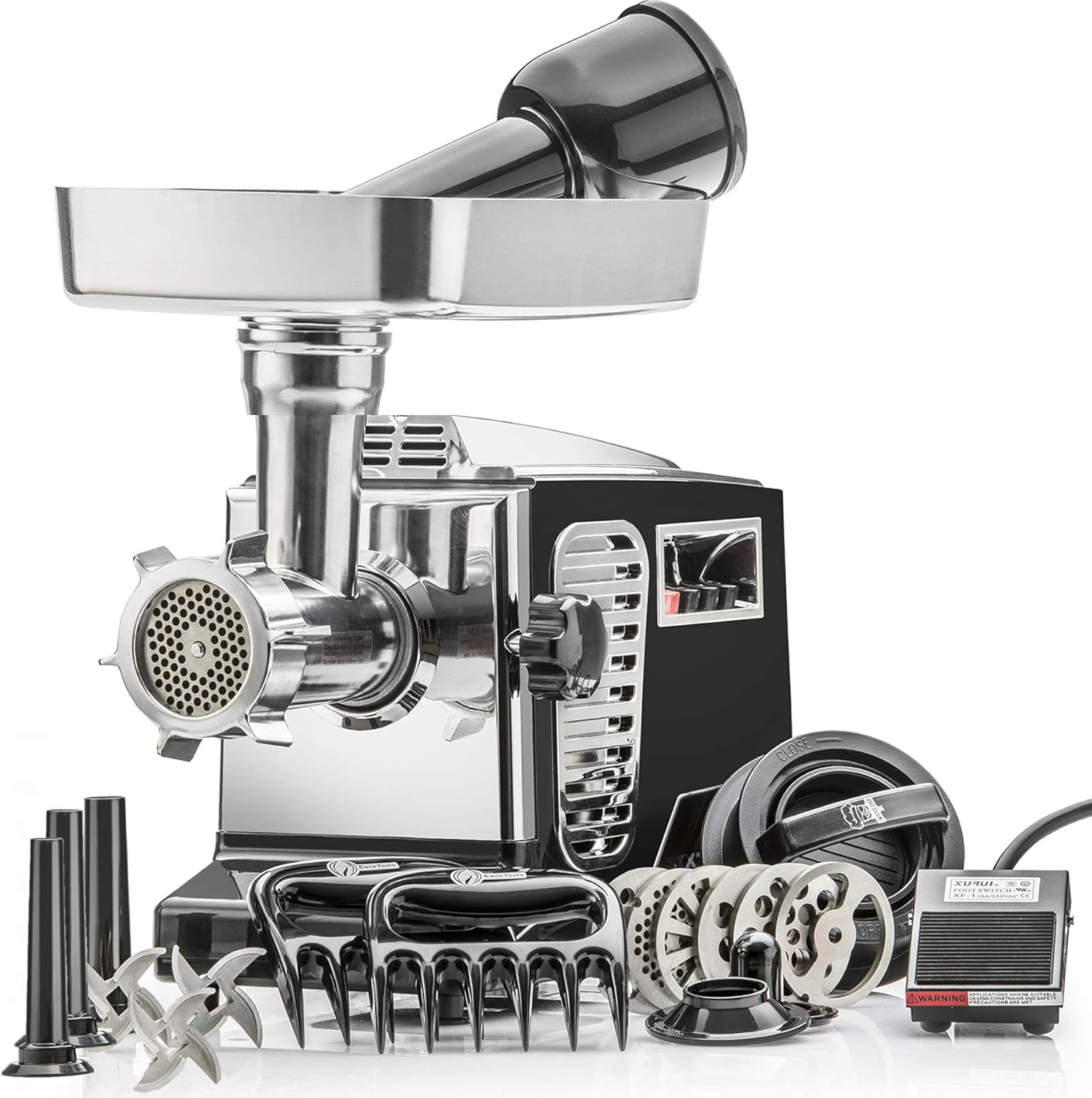
| Included Components | Grinding head, meat pusher, 6 plates, 3 blades, sausage tubes, kubbe attachment, foot pedal |
The STX Turboforce II 4000 is a high‑capacity electric meat grinder designed for serious home use and small-batch commercial tasks. It uses a 2000W motor and an air‑cooled design to push through whole muscle and soft bone while a large feeder tray and 2‑inch feed tube speed up processing. The unit comes with multiple cutting blades and grinding plates, sausage tubes, a kubbe attachment, meat claws, a patty press, and a foot pedal for convenient operation. Practical benefits include a fast throughput (the listing cites roughly 220–260 lb per hour depending on plate and meat), the ability to handle soft bones, and a heavy cast/aluminum grinding head that stands up to repeated use. Downsides are the grinder's bulk and weight for storage and the 3 lb tray capacity that requires frequent refilling during larger runs; it also relies on a sizable motor that can be loud during extended sessions. For buyers who want a durable, full‑feature grinder under $300 that matches light commercial capability, this model delivers strong performance and accessory value.
Best for: Buyers who want near‑commercial grinding performance at home and prioritize proven features and included accessories over compact size.
Less Ideal for: People who need a small, lightweight grinder for occasional use or who lack storage space for a bulky machine should consider simpler models.
- Powerful 2000W motor with air‑cooled design for extended grinding sessions
- Includes multiple grinding plates, cutting blades, sausage tubes and kubbe attachment for versatile preparation
- Foot pedal control enables hands‑free operation and better workflow
- Polished aluminum grinding head and stainless parts for durability and food contact safety
- Large and relatively heavy for countertop storage or transport
- 3‑pound tray means frequent refills when processing larger batches
Verdict: Choose the STX Turboforce II 4000 if you want a rugged, feature‑packed grinder that brings high throughput and soft‑bone capability to home kitchens under $300.
Ganiza Food Processor GC10

| Wattage | 450 watts |
|---|---|
| Capacity | 0.95 gallons |
| Voltage | 120 volts |
| Material Type | Stainless Steel, Glass |
The Ganiza GC10 is a compact 450W food processor designed for everyday sauce making, chopping, and light grinding. It comes with two 8-cup bowls—one glass and one stainless steel—so you can keep ingredients separate for savory sauces or meat-based blends, and it includes two sets of S-shaped stainless blades for different textures. The two-speed motor handles softer ingredients and tougher items like cooked meats or nuts, and built-in overheating protection helps prevent motor damage during repeated use. Setup and cleaning are straightforward thanks to removable blades and simple controls, and the glass bowl gives good visibility when puréeing sauces. Limitations to note are the modest 450W power and thermal cutoff, which mean it is best for small to medium batches rather than heavy-duty continuous grinding, and the unit's compact capacity may require multiple batches for larger sauce volumes. For cooks who want a safe, easy-to-use processor for everyday sauce prep and occasional meat grinding, the Ganiza GC10 is a practical choice.
Best for: Home cooks who prioritize reliable, safe operation and want a versatile small processor for daily sauce making and light grinding without professional-level power.
Less Ideal for: Users who need to process very large batches, run long continuous grinding sessions, or require industrial-strength motor performance.
- Two bowls (8-cup glass and 8-cup stainless steel) let you separate ingredients for different sauces and uses
- 450W full-copper motor with two speeds handles a range of textures from soft purées to light grinding
- Overheating protection and spring-loaded blade safety reduce risk during frequent kitchen use
- Removable blades and simple controls make cleanup and everyday operation easy
- Modest power and thermal cutoff limit continuous heavy-duty grinding
- Capacity may require multiple batches for large sauce volumes
Verdict: A safe, easy-to-use two-bowl processor that reliably handles everyday sauce prep and light grinding for risk-averse home cooks.
Choosing the Right Meat Grinder: Key Factors to Consider
Motor Power and Torque
A grinder's motor rating and how it delivers torque are the primary determinants of what you can grind reliably. Higher continuous power and strong low-end torque help the machine process tougher cuts, bones-free connective tissue, and larger batches without stalling. For home use, look for motors that handle intermittent heavy loads and include thermal protection to prevent overheating.
Insufficient torque forces you to pre-cut meat into smaller pieces, chill the meat more, or work in smaller batches, which increases prep time. Conversely, too much power in a small, lightweight unit can cause excessive vibration unless the housing is solidly built.
Throughput and Feed Efficiency
Throughput measures how much meat a grinder moves through in a given time and matters if you frequently process multiple pounds. Feed efficiency covers how smoothly the auger pulls meat toward the cutting plates without jamming. A well-matched auger, throat size, and plate selection will reduce the need to stop and clear jams.
If you plan to make large batches for freezing or sausage stuffing, choose a unit with a larger feed throat and efficient auger geometry. For occasional use, a slower but reliable throughput with easy clearing may be preferable to a faster system that requires frequent troubleshooting.
Ease of Cleaning and Food Safety
Meat grinders interact with raw proteins, so cleaning accessibility directly affects food safety. Parts that disassemble quickly, have smooth surfaces, and are dishwasher-safe or simple to hand-wash reduce the chance of bacterial buildup. Avoid designs with hard-to-reach crevices or sealed compartments where residue can hide.
Consider how easy it is to dry and reassemble components too, since lingering moisture promotes corrosion and bacterial growth. Stainless steel contact parts and removable plates make routine sanitation much easier.
Build Materials and Durability
The durability of internal gears, the auger, and the cutting plates determines long-term reliability. Metal gears and stainless steel plates resist wear and maintain performance, while plastic components can deform under heat or heavy load. A stout housing and a secure mounting system reduce vibration and extend the life of moving parts.
Durable construction also factors into repairability. Look for machines with replaceable blades and plates and straightforward access to the gearbox if service is ever required.
Accessory Options and Versatility
Accessories expand what a grinder can do, from coarse and fine plates to sausage funnels and kibbe attachments. If you want multi-purpose capability, check the availability and ease of swapping attachments. Versatility matters when you plan to use the grinder for items beyond basic ground meat, such as making sausages or grinding for pet food.
However, accessories add complexity to cleaning and storage. Prioritize the attachments you will actually use and ensure they are easy to install and sanitize.
Sizing Your Grinder to Your Workflow
Match grinder size to how much meat you process at once. If you only grind a few pounds occasionally, a compact unit with moderate throughput and simple cleanup is typically the most practical choice. For regular batch processing, choose a model with a larger feed throat and a more powerful motor to reduce cycle time.
Consider where you will store and operate the unit. Smaller grinders are easier to tuck away, while larger units may need a stable countertop space and can be heavier to move. Balance capacity with convenience to fit your kitchen routine.
- Small batches: prioritize easy cleaning and storage.
- Frequent large batches: prioritize throat size and sustained torque.
- Counter space: account for footprint and weight when planning placement.
Sausage Making and Specialized Uses
If you plan to make sausages, check that the grinder supports sausage funnels and that the drive system can push seasoned meat mixes without frequent stalling. Look for smooth auger action and a comfortable method for attaching casings to funnels.
Beyond sausage, some users grind vegetables, cooked meat, or pet food. Ensure the plates and blades are appropriate for the intended use, and that the unit's cleaning process prevents cross-contamination between raw and cooked ingredients.
- Sausage funnels vary in diameter; choose based on casing types you use.
- Consider whether extra plates are available for different grind textures.
- Confirm the cleaning routine supports switching between raw and cooked foods.
Noise, Vibration, and Installation Tips
Noise and vibration levels affect how comfortable the grinder is to run, especially during longer sessions. Machines with solid metal housings and rubber feet typically transmit less vibration to counters. If noise is a concern, look for units with quieter motor designs and balanced augers.
For steady operation, place the grinder on a stable, level surface. Secure the unit and avoid operating on soft or unstable countertops. This reduces movement and wear on components, and it helps maintain consistent grind quality.
- Rubber feet or clamps reduce movement during use.
- Place near a sink for easier cleanup but keep electrical safety in mind.
- Allow adequate ventilation around the motor to avoid heat buildup.
Maintenance and Replacement Parts
Routine maintenance keeps a grinder performing well. Sharpening or replacing blades and plates will restore crisp cuts and reduce strain on the motor. Periodically inspect the auger and gear housing for wear, and replace seals or gaskets if they begin to degrade.
Availability of replacement plates, blades, and seals matters for long-term ownership. Favor designs with standard-sized parts or widely available spares to simplify repairs and reduce downtime.
- Clean and dry metal parts to prevent rust.
- Keep a spare blade and a couple of plates on hand for quick swaps.
- Follow the manufacturer's lubrication recommendations for gearbox components if applicable.
Safety Features to Look For
Safety matters when working with powerful motors and sharp blades. Look for units with built-in overload protection, secure locking mechanisms for the feed tray and head assembly, and non-slip feet. A well-designed food pusher helps keep fingers away from the throat while feeding meat.
Electrical safety is equally important. Ensure the grinder has proper grounding, a robust cord, and a reliable on/off switch placement that keeps hands clear of moving parts.
- Overload or thermal cutoffs prevent motor damage from jams.
- Detachable power cords simplify storage and replacement.
- A sturdy food pusher improves safe feeding and reduces accidental contact.
How We Chose the Best Meat Grinder
We focused on real-world performance and owner experience when selecting meat grinders for this list. Important evaluation criteria included motor power and torque, which determine how well a unit handles coarse cuts and fatty or connective tissue; throughput and feeding efficiency, which reflect how quickly a grinder processes typical home batches; and build materials and durability, because long-lasting metal parts and sturdy housings reduce failures and improve longevity. Cleaning and maintenance were weighed heavily, with preference for designs that break down easily without hidden crevices where meat can trap. Sausage-making and accessory flexibility were considered for buyers who want multi-use capability. Noise and vibration were also part of the selection because a calmer motor matters for frequent use. We excluded hobby or commercial-only units that require special electrical wiring or are larger than typical home countertop equipment. Units were filtered out if they lacked basic safety features or if cleaning was impractical for regular use. The final picks reflect a balance of power, throughput, ease of cleaning, durability, and accessory versatility.
Our full evaluation process is outlined in our review methodology.
FAQ
How much meat can a typical home meat grinder handle at once?
It depends on throat size and motor torque. Small home grinders comfortably handle a few pounds per session, while larger home units with bigger throats can process several pounds continuously. For frequent large batches, choose a grinder rated for sustained throughput.
Can I grind frozen meat in a home meat grinder?
Partially frozen, firm but not rock-solid meat grinds best because it reduces smearing and helps the auger grip. Fully frozen blocks can damage blades or strain the motor. Cut meat into smaller, chilled pieces and freeze briefly if you need firmer texture for grinding.
How do I keep my grinder blades sharp?
Regularly remove and inspect blades and plates, then sharpen or replace them when cuts start tearing instead of slicing. Avoid grinding bones or very hard items unless the unit is rated for it, since these accelerate wear. Storing blades dry and lightly oiled prevents rust between uses.
Are metal parts dishwasher-safe?
Some stainless steel plates and blades tolerate dishwasher cleaning, but many manufacturers recommend hand-washing to protect sharp edges and prevent corrosion. Always dry metal parts immediately and follow any care guidance specific to the materials used.
What causes a grinder to jam and how can I prevent it?
Jams often result from overly warm or fatty meat, too-large chunks, or dull blades. Prevent jams by chilling meat, cutting it into small pieces, trimming sinew, and feeding meat steadily. If a jam occurs, power off and clear the throat rather than forcing the motor.
Final Verdict
Choose a meat grinder by balancing motor torque, throughput, and cleaning practicality against the tasks you plan to perform. Prioritize a unit with sufficient low-end torque if you frequently grind tougher cuts or large batches, and favor stainless contact parts and simple disassembly for food safety and maintenance. Weigh the tradeoff between capacity and footprint to fit your kitchen and storage. With attention to these criteria, you can confidently pick a grinder that meets your throughput needs and stays reliable with routine care.