
Note: This article contains affiliate links. If you click on these links and make a purchase, we may earn a small commission at no extra cost to you. This helps support our research and content. Read our full affiliate disclosure here.
Outdoor 360° cameras change how you secure a property by replacing multiple static cameras with a single unit that watches an entire yard or driveway. Picking the right 360° outdoor security camera matters because field of view, night performance, and weather resistance directly affect how much area you actually protect and how useful the footage is when an incident occurs. This guide covers six shortlisted 360° outdoor security cameras that meet common homeowner needs. We evaluated options on image clarity, durability, and how straightforward they are to set up and maintain. Read on for a practical look at the features that matter and which type of camera suits different installation scenarios.
Top Picks at a Glance
| Best Overall The best all-around choice for most situations | eufy SoloCam E30 |  |
| Best Quality Built to a higher standard if you want something more solid | eufy SoloCam S340 |  |
| Best Value The sweet spot between price and what you get | Tapo C615F KIT Floodlight Camera |  |
| Best Budget The cheapest option that still gets the job done reliably | TOAIOHO QB321 3MP Outdoor Dome Camera |  |
| Top Rated A top-rated pick with lots of positive feedback | Tapo C500 Outdoor Pan/Tilt Camera | 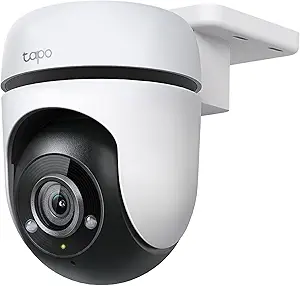 |
| Best Seller A high-volume bestseller chosen again and again | Wyze Cam Pan v3 |  |
eufy SoloCam E30

| Video Capture Resolution | 2k |
|---|---|
| Effective Video Resolution | 1080 |
| Viewing Angle | 360 degrees |
| Power Source | Battery Powered |
| Battery Power | 24.12 watt-hours |
The eufy SoloCam E30 is a wire-free outdoor camera that combines a removable solar panel, 360-degree pan, and onboard AI tracking to keep wide areas under continuous surveillance. It records at 2K capture with an f/1.6 aperture and uses BionicMind AI to detect and auto-track people, vehicles, and pets while minimizing false alerts, and it supports two-way audio and app control for live viewing. SolarPlus charging and a battery-rated life of roughly three months under moderate use reduce the need for manual recharges, and local recording options include a microSD card or pairing with a HomeBase for added storage. Practical benefits include broad coverage with pan capability so fewer cameras are needed for large yards, clear day/night imaging, and no mandatory cloud subscription. Limitations to expect are reliance on 2.4 GHz Wi-Fi, the need for a microSD card or HomeBase for independent recording, and battery life that will vary with motion frequency and recording duration.
Best for: Buyers who want a single outdoor camera that delivers wide 360-degree coverage, clear imaging, and solar-assisted, low-maintenance operation without committing to cloud subscriptions.
Less Ideal for: Users who need dual-band Wi-Fi support, built-in large-capacity internal storage, or those who prefer continuous wired power instead of battery/solar setups.
- 360-degree pan and AI auto-tracking reduce blind spots and can cover large areas with a single unit
- Removable solar panel and battery support long run times with minimal manual charging
- 2K capture and f/1.6 aperture deliver clearer daytime and improved low-light detail
- Local storage options with microSD or HomeBase allow recording without recurring subscription fees
- Requires 2.4 GHz Wi-Fi which may limit placement compared with dual-band support
- Independent operation needs a microSD card for recording or pairing with a HomeBase for full features
Verdict: Choose the SoloCam E30 if you want a solar-assisted, 360-degree outdoor camera that combines AI tracking and local storage to cover large areas without subscription fees.
eufy SoloCam S340

| Video Capture Resolution | 3K |
|---|---|
| Effective Video Resolution | 2160 |
| Field Of View | 135 degrees |
| Power Source | Solar Powered, battery powered |
| Memory Storage Capacity | 128 GB |
The eufy SoloCam S340 is a battery-first outdoor dome camera designed to deliver wide coverage and high-resolution detail without a monthly subscription. It pairs a 3K dual-lens sensor and hybrid 8× zoom with a pan-and-tilt mechanism to provide full 360° coverage and active motion tracking, which helps eliminate blind spots and follow moving subjects. Solar charging and a 10,000 mAh battery mean extended runtimes and the vendor's claim of up to three months on battery under moderate use, and built-in 8GB storage lets you keep footage locally. The camera connects over Wi-Fi and supports remote control, Alexa, two-way audio, and color night vision with spotlights for clearer night images. Trade-offs are typical for solar/battery cameras: it cannot do continuous 24/7 recording on its own, performance depends on sunlight for charging, and advanced AI features expand when paired with eufy HomeBase devices. For buyers who prioritize image clarity and seamless 360° coverage without ongoing fees, the S340 is a strong performance-oriented option.
Best for: Buyers who want high-resolution, performance-focused outdoor coverage and active tracking without committing to subscription services and who are willing to optimize placement for solar charging.
Less Ideal for: Users who require continuous 24/7 recording out of the box or who cannot install the camera where it will receive reliable sunlight.
- High-resolution 3K dual-lens capture with hybrid 8× zoom for detailed distant views
- 360° pan and tilt with active motion tracking to remove blind spots
- Solar-powered with large 10,000 mAh battery for extended runtime and reduced maintenance
- Built-in 8GB local storage and no monthly fee for recordings
- Color night vision and two-way audio for clearer low-light monitoring and interaction
- Cannot record 24/7 on battery power without additional HomeBase hardware
- Solar charging effectiveness depends on placement and sun exposure
Verdict: If you need high-detail, full 360° outdoor coverage with active tracking and solar-powered runtime without monthly fees, the SoloCam S340 delivers strong performance.
Tapo C615F KIT Floodlight Camera

| Video Capture Resolution | 2K 3MP |
|---|---|
| Power Source | Solar/Battery Powered |
| Battery Power | 10400 milliamp_hours |
| Waterproof Rating | IP65 |
| Night Vision Range | 32.8 feet |
The Tapo C615F KIT combines a 2K pan/tilt security camera with an integrated 800‑lumen floodlight and an included solar panel so you can mount it where wiring is inconvenient. It is typically installed on a wall to monitor driveways, porches, and yards and uses the Tapo app for setup, motion scheduling, and custom activity zones. Pan/tilt mechanics offer near‑full horizontal and extended vertical coverage with automatic 360° AI tracking that follows detected people, pets, or vehicles, and two‑way audio plus a 97 dB siren provide active deterrence. The camera supports subscription‑free AI alerts and recording to a microSD card, or optional cloud backup via Tapo Care, and offers color night vision with an IR fallback. Practical limits include reliance on 2.4 GHz Wi‑Fi and variable solar charging in cold or low‑sunlight conditions, and battery life depends heavily on how often the camera wakes and records. For someone who wants wide coverage without running power cables, the kit delivers strong features and flexible storage choices.
Best for: Buyers who want broad, maintenance‑light outdoor coverage without running power cables and who prioritize practical, app‑driven detection and local storage options.
Less Ideal for: Users who need hardwired continuous power in areas with poor Wi‑Fi or limited sunlight exposure, or who require enterprise‑grade camera systems and centralized NVR setups.
- Integrated 800‑lumen floodlight for bright, color night viewing and motion‑activated illumination
- Pan/tilt mechanics with 360° AI tracking provide near‑complete horizontal coverage and follow moving subjects
- Solar panel included to reduce or eliminate the need for wired power and extend battery life
- Subscription‑free AI detection with local microSD recording plus optional cloud backup
- Depends on 2.4 GHz Wi‑Fi which may limit placement or require a strong signal
- Battery life and solar charging performance vary with usage patterns and local sunlight
Verdict: A practical solar‑assist pan/tilt floodlight camera that delivers wide 360° monitoring and convenient local storage for homeowners who want powerful coverage without wiring.
TOAIOHO QB321 3MP Outdoor Dome Camera

| Video Capture Resolution | 3 MP |
|---|---|
| Night Vision Range | 10 meters |
| Waterproof Rating | IP66 |
| Storage | Micro SDHC, up to 128 GB |
| Power Source | Corded Electric (12 volts) |
The TOAIOHO QB321 is a cost-focused outdoor PTZ dome camera that delivers 3MP (2K) video, pan/tilt control and automatic horizontal tracking to follow movement across a wide area. It is typically wall-mounted and runs on a 12V corded connection while connecting to your network via Wi‑Fi for live viewing in the CloudEdge/Cloudplus app or local recording to a microSD card. Notable features include 355° pan and 108° tilt for near full-circle coverage, color night vision aided by a white LED and a night siren, PIR motion detection with adjustable sensitivity, and support for dual-band Wi‑Fi and cloud backup. Practical benefits for budget buyers are the clear daytime and color night footage, continuous 24/7 recording options, and the ability to share access with family through the app. Limitations include the need for a wired power supply, a small number of IR LEDs which may affect long-range night performance, and reliance on the vendor app for advanced functions and cloud services rather than standardized third-party integrations.
Best for: Buyers who want an affordable full‑coverage outdoor camera that records in higher-than-1080p and can automatically follow motion for perimeter monitoring.
Less Ideal for: Those who need a completely wireless or PoE installation, enterprise-grade integrations, or long-range infrared night coverage should consider other options.
- 2K (3MP) resolution for clearer daytime and zoomed views
- Wide PTZ coverage with 355° pan and 108° tilt for near 360° monitoring
- Color night vision with white LED for more identifiable nighttime footage
- PIR motion detection with adjustable sensitivity and auto-tracking to reduce missed events
- Supports local microSD storage up to 128 GB plus optional cloud backup
- Requires a 12V corded power connection so no battery or PoE out of the box
- Only three IR LEDs and a 10 m night range may limit detail in very dark or long-distance scenes
- Advanced features and cloud services depend on the vendor app rather than open third-party platforms
Verdict: A budget-friendly 2K PTZ outdoor dome that gives near 360° coverage, color night footage and auto-tracking for homeowners who want high-resolution perimeter monitoring without a big spend.
Tapo C500 Outdoor Pan/Tilt Camera

| Video Capture Resolution | 1080p |
|---|---|
| Frame Rate | 15 frames_per_second |
| Night Vision Range | 30 meters |
| Waterproof Rating | IP65 |
| Memory Storage Capacity | 512 GB |
The Tapo C500 is a corded outdoor pan/tilt security camera designed to eliminate blind spots with 360° horizontal and 130° vertical coverage and remote control from the Tapo app. It records 1080p video at up to 15 fps, supports person detection and smart motion tracking that rotates the housing to follow activity, and offers two‑way audio with a customizable sound alarm for deterrence. Night vision extends to about 98 feet, and the camera supports local microSD storage up to 512 GB as well as optional cloud backups. Installation is typical wall‑mount hardware and the IP65 rating makes it weather resistant for outdoor mounting. Practical limitations include a 15 fps frame rate that is adequate for general monitoring but not ideal for very fast action, and the camera requires constant power so you must place it near a power source. The camera works on 2.4 GHz Wi‑Fi and integrates with Alexa and Google Assistant for voice streaming to compatible displays.
Best for: Buyers who prioritize dependable, continuous outdoor coverage and want a pan/tilt camera that automatically tracks people and stores footage locally for long‑term reliability.
Less Ideal for: People who need battery‑powered or completely wireless installations or users who require very high frame‑rate footage for fast action analysis should look elsewhere.
- True 360° horizontal plus wide vertical pan/tilt coverage eliminates blind spots.
- Smart person detection and motion tracking that follows moving subjects automatically.
- Clear 1080p daytime video with IR night vision up to about 98 ft for overnight monitoring.
- Flexible storage: local microSD support up to 512 GB plus optional cloud service.
- Two‑way audio and customizable alarm sounds for remote communication and deterrence.
- Requires wired power so placement is limited by proximity to an outlet.
- Frame rate is 15 fps which can show motion blur during very fast movement.
Verdict: Choose the Tapo C500 when you want a weather‑resistant wired camera that provides full 360° coverage and reliable person‑tracking with flexible local storage.
Wyze Cam Pan v3

| Video Capture Resolution | 1080p |
|---|---|
| Waterproof Rating | IP65 |
| Field Of View | 120 degrees |
| Zoom Ratio | 8x |
| Power Source | Corded Electric |
The Wyze Cam Pan v3 is a versatile indoor/outdoor security camera that pans 360° and tilts 180° to cover large rooms, porches or yards. It records 1080p video at up to 20 fps in daylight and 15 fps at night and includes color night vision so you can pick up more detail after dark. The camera supports automatic motion tracking and custom pan scan waypoints so it can follow pets or people and cycle through preset views while you are away. It connects to 2.4 GHz Wi‑Fi and is controlled through the Wyze mobile app, with two-way audio for talking to visitors and push alerts for motion events. For storage you can use a microSD card for local recording or opt for cloud clips; the unit requires continuous power and is IP65 weather resistant for sheltered outdoor use. Practical limits include digital zoom only and modest frame rates at night, so very distant faces or license plates may not be reliably legible, and it needs a strong 2.4 GHz signal where it is mounted.
Best for: Buyers who want an affordable, easy-to-use outdoor-capable camera that covers large areas and prioritizes reliable, always-on monitoring and simple app control.
Less Ideal for: Users who need high-resolution identification of distant faces or license plates or who require battery-powered, wireless placement away from mains power.
- 360° horizontal pan and 180° tilt for wide coverage and settable patrol waypoints
- Color night vision for more usable low-light footage than typical IR-only cameras
- Automatic motion tracking that follows the largest moving object
- IP65 weather resistance suitable for porches, garages and yards
- Local microSD storage option so continuous recording is possible without a subscription
- Connects only to 2.4 GHz Wi‑Fi and requires continuous power, limiting placement options
- Digital zoom and 1080p resolution limit readable detail at long distances
Verdict: Choose the Wyze Cam Pan v3 if you want a weather-resistant 360° pan/tilt camera with color night vision and local recording for dependable whole-room outdoor monitoring.
Choosing the Right 360° Outdoor Security Camera: Key Factors to Consider
Image Resolution and Low-Light Performance
Higher resolution sensors capture more detail, which makes it easier to identify faces, license plates, and small movements from a distance. For 360° cameras, resolution matters even more because the camera covers a wide area and the same pixel count is distributed across the full scene. A 4K sensor will typically produce clearer zoomed-in sections than a 1080p sensor when dewarped.
Low-light performance and infrared illumination determine how useful nighttime footage will be. Look for cameras with good-night mode noise reduction and adjustable IR ranges. Motion-activated exposure control and color night vision options can also improve the readability of footage in dim conditions.
Field of View, Panoramic Stitching, and Dewarping
Not all 360° cameras present the captured panorama in the same way. Some use software to dewarp and stitch fisheye images into a usable panoramic or split-screen view. The effectiveness of that processing affects how intuitive it is to review events and whether automated tracking can follow a subject across the scene.
Consider whether the camera offers multiple viewing modes, such as full panorama, single-direction crop, or digital PTZ. If you plan to monitor specific zones within the 360° view, check for user-adjustable virtual zones and seamless panning without excessive artifacting.
Weather Resistance and Long-Term Durability
Outdoor cameras face rain, wind, dust, and temperature swings. An appropriate IP rating and corrosion-resistant housing are essential to avoid water ingress and rust over time. Materials, seal design, and sun shielding also influence how long the camera maintains optical clarity and mechanical function.
Pay attention to manufacturer-specified operating temperature ranges if you live in areas with extreme heat or cold. Durable mounting hardware and cable-gland protection for power or Ethernet runs reduce the likelihood of failures and pest-related damage.
Power, Connectivity, and Installation Complexity
Decide whether you need a PoE, wired, or battery-powered 360° camera. Power choice affects placement flexibility and ongoing maintenance. PoE gives reliable power and network over a single cable, while battery models offer easier placement at the cost of periodic recharging or swapping.
Connectivity options matter for reliability and video quality. Hardwired Ethernet typically provides more consistent bandwidth than Wi-Fi. For wireless installs, check supported Wi-Fi bands and signal requirements. Also consider whether the camera supports local storage, cloud backup, or both, and whether setup requires professional tools or simple DIY mounting and app pairing.
Motion Detection, Smart Alerts, and Privacy Controls
Effective motion detection reduces false alerts and ensures important events trigger recordings. Look for adjustable sensitivity, zone-based detection, and object classification if available. Reliable notification options include push alerts, email clips, and on-device sirens.
Privacy features such as scheduling, geofencing, and the ability to mask portions of the view help you comply with local privacy expectations and avoid recording neighbors or public walkways unintentionally. These controls can minimize unnecessary storage and alert fatigue.
Storage Options and Data Management
Consider how the camera stores footage: local microSD, network attached storage, or cloud service. Local storage avoids subscription fees and reduces external data dependency, but it can be lost if the camera is stolen or damaged. Cloud storage typically preserves footage off-site and may include event indexing, but it often involves recurring costs.
Also evaluate retention periods, clip length limits, and whether the system allows easy export of video for evidence. Support for scheduled overwrites and selective archiving can help keep storage manageable without losing important events.
Mounting Locations and Coverage Planning
Choosing the right mounting spot determines how effective a 360° camera will be. Aim for a high, central vantage point such as under roof eaves, a porch overhang, or the peak of a sidelight to minimize blind spots and reduce obstructions in the field of view.
Consider nearby foliage, reflective surfaces, and direct sunlight paths that can create glare or false motion triggers. Sketch a coverage map that shows the camera footprint and overlap with entrances to ensure you capture likely approach routes without wasted redundancy.
- Mount between 8 and 12 feet high for a balance of field of view and identification clarity.
- Avoid pointing directly into the sun or toward reflective glass where possible.
- Factor in cable routing and whether a junction box or weatherproof conduit is needed.
Power Choices: Battery, Wired, and Power Over Ethernet
Battery-powered 360° cameras offer flexible placement and quick installs but require periodic battery maintenance and may limit continuous recording. They are a good choice for temporary surveillance or for locations without easy access to power.
Wired cameras provide continuous power and often support higher data rates for better image quality. Power over Ethernet combines power and data on one cable, simplifying installations in new or retrofit setups with network switches or PoE injectors.
- Use PoE for long-term, high-reliability installations when running cable is feasible.
- Choose battery models with solar charging options if you want lower maintenance.
- For wired power, plan for weatherproof cable entry and strain relief at the mounting point.
Balancing Resolution and Bandwidth
Higher resolution improves identification but increases network load and storage demands. If you rely on Wi-Fi, test expected throughput before committing to a 4K camera or ensure the camera can lower bitrate during busy times.
Many 360° cameras support adaptive streaming and event-only recording to conserve bandwidth. Use on-camera motion-based recording and scheduled recording windows to limit continuous uploads while preserving key events.
- Enable adaptive bitrate or H.265 codec support to reduce storage without sacrificing clarity.
- Use local recording for high-resolution continuous capture where bandwidth is limited.
- Limit high-resolution streams to on-demand viewing or event clips when using cloud backup.
Legal and Privacy Considerations for Outdoor Surveillance
Laws around outdoor video surveillance vary by jurisdiction, especially when cameras capture public sidewalks or neighboring property. Familiarize yourself with local regulations and respect reasonable privacy expectations by angling cameras away from private windows and neighbor yards where possible.
Use built-in privacy masks and recording schedules to avoid continuous capture of nonessential areas. Posting a visible notice about surveillance in public-facing spaces can also be a legal or community-minded step depending on local rules.
- Check local ordinances for restrictions on audio recording, as audio capture can be regulated differently than video.
- Document your camera locations and why you placed them to help address neighbor concerns.
- Prefer on-device masking features to cropping footage after the fact.
Maintaining Clear Optics and Reliable Performance
Outdoor lenses and housings collect dust, pollen, and water spots that degrade image quality. Regularly clean the dome or lens with manufacturer-recommended materials and check seals for wear to maintain weather resistance.
Schedule periodic firmware updates to keep detection algorithms and network security current. Account for winter or summer maintenance needs, such as de-icing or sunshade checks, to prevent seasonal performance dips.
- Inspect mounts and seals once or twice a year and after severe weather.
- Test motion detection and notification functions monthly to confirm proper operation.
- Keep a spare set of mounting screws and a basic tool kit near the installation location.
How We Chose the Best 360° Outdoor Security Camera
We focused on criteria that reflect real-world use for outdoor 360° cameras and weeded out options that do not meet essential performance or reliability standards. Key factors we examined include image resolution and low-light performance because clear, usable footage is the primary purpose of a security camera. We also prioritized field of view and tracking or dewarping quality since 360-degree capture only helps if the software presents it as actionable video. Durability and weather resistance were mandatory filters. Cameras that lacked IP-rated housings or did not list outdoor operating temperature ranges were excluded. Installation and connectivity were scored to reflect how easily a typical homeowner can mount, power, and connect the camera to Wi-Fi or wired networks. Additional considerations included motion detection accuracy, local recording options, and privacy features. We excluded indoor-only models and novelty gadgets without sustained firmware support. Final selections balance image performance, build quality, and user-facing features like app controls and storage options. The scoring reflects these same dimensions so readers can compare tradeoffs relevant to everyday outdoor monitoring.
Our full evaluation process is outlined in our review methodology.
FAQ
Do 360° outdoor security cameras replace multiple fixed cameras?
Often they can cover areas that would otherwise require two or more fixed cameras, especially for open yards or single-entry drives. The effectiveness depends on image resolution, dewarping quality, and whether you need close-up identification at multiple distant points simultaneously.
Are 360° outdoor cameras easy to install yourself?
Many models are designed for DIY installation, particularly battery and Wi-Fi variants. Hardwired or PoE installations require basic network and electrical routing skills and may benefit from a professional if you are uncomfortable running cables or working at heights.
How does a dome or bubble housing affect image quality?
A protective dome shields the optics from weather and tampering but can introduce reflections or smudges that reduce contrast. Proper sunshades and routine cleaning minimize those issues, and higher-quality domes are coated to resist glare and water beading.
Can 360° outdoor cameras work with local NVR systems?
Many 360° cameras support standard ONVIF or RTSP streams that make them compatible with network video recorders. Check the camera's supported protocols and the NVR's compatibility before assuming full feature parity, especially for dewarped panoramic streams.
What should I do if I get too many false motion alerts?
Reduce sensitivity, create smaller motion zones, and enable object-based filtering when available. Also evaluate placement to avoid busy roads, trees, or heat sources that trigger frequent alerts.
Final Verdict
Choosing the right 360° outdoor security camera comes down to balancing coverage and identification needs against installation complexity and maintenance. Prioritize image resolution and night performance if you need usable evidence at a distance. If ease of setup and flexible placement matter more, favor battery or wireless options with robust app controls. Ultimately, match the camera power and connectivity to your site conditions, and use detection zones and privacy masks to reduce false alerts and legal risks. Focus on durable weatherproofing and clear storage plans so the system remains reliable over time.