
Note: This article contains affiliate links. If you click on these links and make a purchase, we may earn a small commission at no extra cost to you. This helps support our research and content. Read our full affiliate disclosure here.
If you make costumes or props, the right 3D printer can turn design ideas into wearable, durable pieces. With cosplay parts you need strong materials, fine surface detail, and a build area large enough for helmets, armor panels, or multi-part props. This guide covers seven top choices for cosplay-focused 3D printing and explains why each type of machine suits different workflows and skill levels. We evaluated machines for print detail, usable build volume, material compatibility, and reliability so you can pick a printer that fits your fabrication process. Read on for shortlists of printers that excel at producing wearable parts and an explanation of the technical tradeoffs to consider before you buy.
Top Picks at a Glance
| Best Overall The best all-around choice for most situations | Bambu Lab P1S 3D Printer |  |
| Best Quality Built to a higher standard if you want something more solid | FLASHFORGE Creator 5 Pro |  |
| Best Value The sweet spot between price and what you get | Anycubic Kobra X |  |
| Best Budget The cheapest option that still gets the job done reliably | ELEGOO Neptune 3 Pro |  |
| Top Rated A top-rated pick with lots of positive feedback | phrozen Sonic Mini 8K S |  |
| Most Popular A crowd favorite that many people choose with confidence | Creality K1C 3D Printer |  |
| Best Seller A high-volume bestseller chosen again and again | FLASHFORGE Adventurer 5M |  |
Bambu Lab P1S 3D Printer
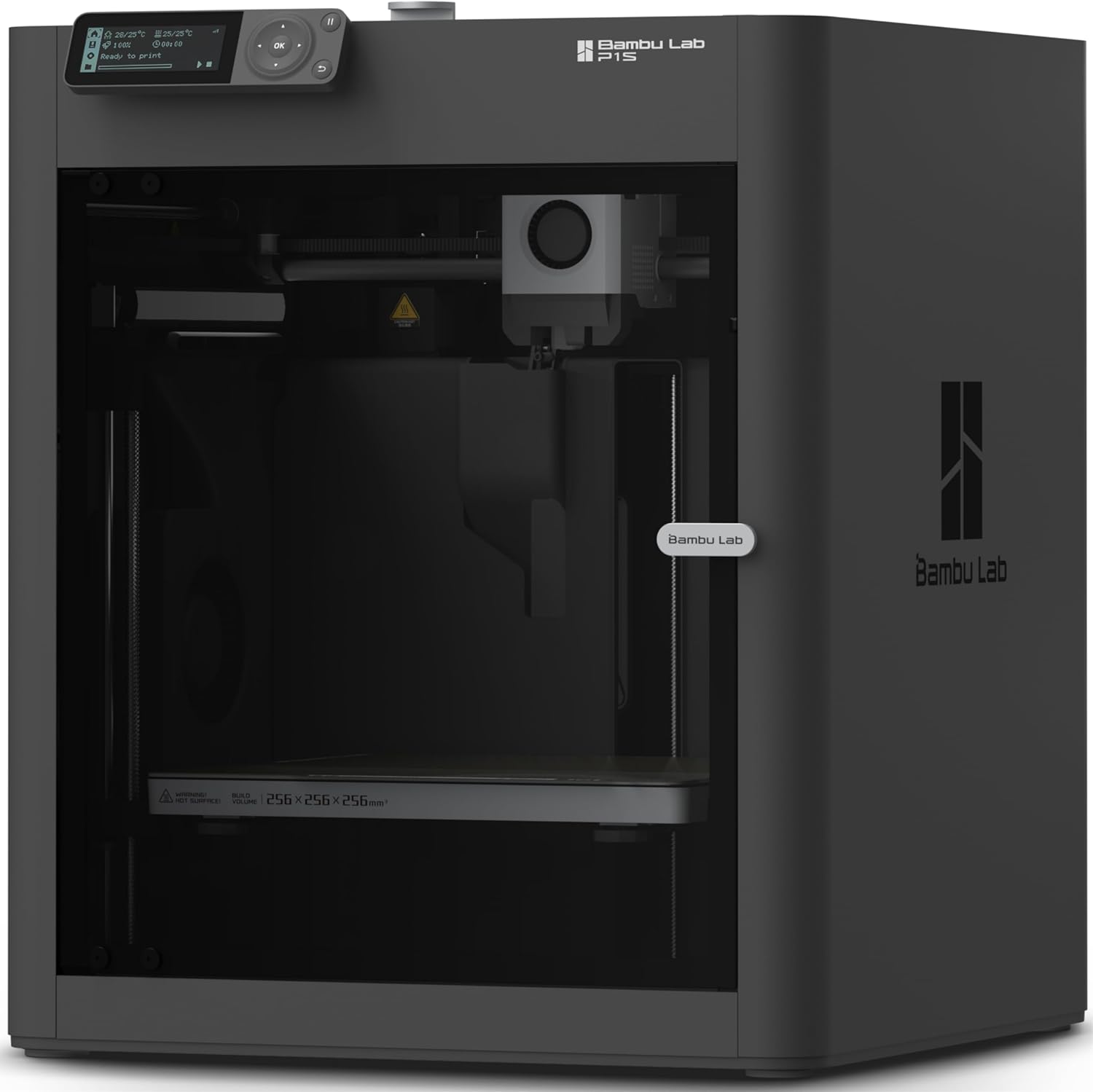
| Build Volume | 256×256×256 mm |
|---|---|
| Max Speed | 500 mm/s |
| Max Acceleration | 20000 mm/s² |
| Supported Filaments | PLA, PETG, TPU, PVA, PET, ABS, ASA, PA, PC |
The Bambu Lab P1S is an enclosed CoreXY FDM printer that targets users who want a fast, dependable machine with minimal fuss. It prints at very high speeds (up to 500 mm/s) with strong acceleration and a direct-drive extruder that expands the range of usable filaments to include TPU and ABS-level materials. The enclosed body and automatic bed leveling help with consistent results on larger parts, and the 256×256×256 mm build volume is large enough for many cosplay components. Setup is straightforward and the onboard camera and MakerWorld library make it easier to manage prints and find ready models. Important limits are that the printer requires the Bambu Lab AMS accessory for multi-color/multi-material workflows and it is not recommended for carbon or glass fiber reinforced filaments, so heavy-duty composite parts are out. For costume builds where speed, reliable first layers, and support for flexible filaments matter, the P1S is a capable, easy-to-use option.
Best for: Cosplayers who want a fast, reliable printer that delivers large, consistent parts with minimal setup time and supports flexible and engineering filaments for wearable props.
Less Ideal for: Users who need factory-quality printing with fiber-reinforced composites or built-in multi-material color printing without buying additional hardware.
- Very high top speed and acceleration for faster print turnaround
- Enclosed CoreXY design improves temperature stability for advanced filaments
- Direct-drive extruder expands material compatibility to flexible filaments
- Automatic bed leveling and user-friendly setup reduces time to first successful print
- Onboard camera and MakerWorld library simplify monitoring and finding models
- Multi-color or multi-material printing requires the separate AMS accessory
- Not recommended for carbon or glass fiber reinforced filaments
Verdict: The P1S is a fast, easy-to-use enclosed CoreXY printer that gets cosplay parts printed quickly and reliably with support for flexible and engineering filaments.
FLASHFORGE Creator 5 Pro

| Build Volume | 256 x 256 x 256 mm |
|---|---|
| Travel Speed | 600mm/s |
| Extruder Type | Max.320°C Direct Drive, Hardened |
| Circulatory System | Active Carbon+Hepa 13 |
| Chamber Temperature | 65°C Heating Chamber |
The Creator 5 Pro is built for fast, multi-material production and handles advanced engineering filaments reliably. Its four independent toolheads and a 7-second FlashSwap changer let you switch nozzles and colors with near-zero purge waste, which both speeds multi-color prints and reduces filament cost. The enclosed design with an active heated chamber (up to 65°C) and dual HEPA13 plus activated carbon filtration makes printing ABS, PC, and nylon-type materials far more stable and safer for indoor use. A CoreXY motion system, precision linear rails, and high-torque timing belts support travel speeds up to 600mm/s while automated offset calibration, vibration compensation, and dynamic flow tuning help deliver clean first layers and crisp details. The built-in HD camera and remote control via Flash Studio add convenience for long cosplay part runs. Downsides are the printer's industrial focus and weight, which make it less portable and add setup complexity compared with simpler hobby machines, and mastering multi-head workflows requires a learning curve to optimize slicing and color transitions.
Best for: Cosplayers and prop makers who prioritize speed, multi-color/multi-material capability, and durable engineering materials when producing large or detailed costume parts.
Less Ideal for: Casual hobbyists seeking a compact, plug-and-play desktop printer or users who need a lightweight portable machine for occasional small prints.
- Four independent toolheads with 7-second FlashSwap minimizes purge waste for efficient multi-color prints
- Enclosed heated chamber up to 65°C enables reliable printing with ABS, PC, and nylon-grade filaments
- CoreXY structure, precision linear rails, and high-torque belts support high-speed printing up to 600mm/s
- Dual HEPA13 and activated carbon filtration reduces ultrafine particles and fumes for safer indoor use
- Automated calibration features and built-in HD camera simplify setup and remote monitoring for long prints
- Industrial-grade size and weight reduce portability and make installation more involved
- Multi-head setup and multi-material workflows have a learning curve for slicing and tuning
Verdict: If you need fast, multi-color and multi-material prints in cosplay workflows using engineering filaments, this enclosed, high-speed Creator 5 Pro delivers industrial-level capability and safe indoor operation.
Anycubic Kobra X

| Build volume | 260 x 260 x 260 mm |
|---|---|
| Nozzle max temperature | 300℃ |
| Connectivity | 2.4G/5G Wi‑Fi and LAN |
| Auto bed leveling | LeviQ 3.0 49‑point |
The Anycubic Kobra X is an FDM desktop printer built for fast, multicolor prints and straightforward setup. It ships with four built-in ACE 2 Pro color extruders and can expand to a larger palette, letting you produce multi-hued cosplay parts without manual filament swaps. Key user-facing features include a hardened steel nozzle and vibration compensation for sharper layers, a LeviQ 3.0 49-point auto bed leveling system to simplify first-layer tuning, and AI-assisted monitoring with spaghetti and foreign-object detection for fewer failed prints. The printer targets speed through an ACE GEN 2 extruder and claims high travel speeds up to 600 mm/s, which is useful for rapid prototyping of costume pieces, though practical print speeds for high-detail parts will be lower. Connectivity options include dual-band Wi-Fi and LAN for remote monitoring and control. Limitations to note are that multi-material or multicolor setups add mechanical and tuning complexity, and achieving flawless, paint-ready surfaces may still require post-processing. For makers focused on producing colorful, quick-turn cosplay components, the Kobra X balances capability and convenience.
Best for: Makers who prioritize fast iteration and in-printer multicolor capability to quickly produce visually complex cosplay pieces while minimizing setup time.
Less Ideal for: Users who want a plug-and-play, ultra-fine-detail printer with minimal post-processing or those who prefer single-material, ultra-high-resolution resin printing for tiny jewelry-grade parts.
- Native multicolor capability with four ACE 2 Pro extruders and expandability to more colors
- LeviQ 3.0 49-point auto bed leveling for reliable first layers
- Hardened steel nozzle and vibration compensation for improved print quality
- AI monitoring features including spaghetti and foreign-object detection reduce failed prints
- Dual-band Wi-Fi and LAN for remote control and live monitoring
- High advertised travel speed does not eliminate the need for tuning to get quality on detailed cosplay parts
- Multicolor/multi-extruder setups increase mechanical complexity and may require extra maintenance
Verdict: Choose the Kobra X if you need fast, built-in multicolor FDM printing to prototype and produce colorful cosplay parts quickly.
ELEGOO Neptune 3 Pro

| Build volume | 225 × 225 × 280 mm |
|---|---|
| Noise level | ~47 dB |
| Filament diameter | 1.75 mm |
| Extruder type | Dual-gear direct drive |
The ELEGOO Neptune 3 Pro is a consumer FDM printer aimed at hobbyists who want a ready-to-run desktop machine for everyday projects and costume parts. It ships with main parts pre-assembled, a toolkit, and a PEI magnetic removable build plate so you can start printing quickly and remove finished cosplay pieces easily. The dual-gear direct-drive extruder and titanium throat plus widened heat sink help with consistent filament feeding and reduce clogs when printing flexible or abrasive filaments, while the 36-point auto bed leveling and filament runout sensor cut down on failed prints. Resume-on-power-loss and quiet stepper motors (around 47 dB) add convenience during long prints. For costume work, the 225 × 225 × 280 mm build volume handles medium-sized props and segmented prints well, and dual lead screws improve Z-axis stability for tall parts. Limitations include a modest build area for very large props and the need to tune profiles for advanced materials; shoppers wanting a fully enclosed heated chamber for heavy ABS work may prefer an enclosed model instead.
Best for: Cosplayers on a budget who need a dependable, easy-to-start printer for medium-sized props and costume parts and who value quick setup and fewer failed prints.
Less Ideal for: Artists who require very large single-piece prints or frequent printing with high-temperature filaments needing a fully enclosed heated chamber should look at larger or enclosed models.
- Quick partial assembly with toolkit and removable PEI magnetic build plate for easy part removal
- Dual-gear direct-drive extruder and improved nozzle path for more reliable filament feeding and fewer clogs
- 36-point auto bed leveling and filament detection reduce failed prints and setup time
- Resume-on-power-loss and quiet stepper motors make long prints more convenient
- Build volume is limited for very large cosplay pieces without splitting models
- Not a fully enclosed heated chamber which can limit some high-temperature filaments
Verdict: A user-friendly, budget-oriented desktop FDM printer that delivers reliable, low-fuss prints ideal for making medium-sized cosplay parts.
phrozen Sonic Mini 8K S

| Printing Volume | 6.5 x 2.8 x 6.7 Inch |
|---|---|
| XY Resolution | 22 µm |
| Connectivity | USB, Wifi |
The phrozen Sonic Mini 8K S is a tabletop resin printer aimed at hobbyists who need very fine detail in small parts. It prints using an 8K monochrome LCD and 22 micron XY resolution, which translates to crisp surfaces and sharp features useful for cosplay props, miniatures, and detailed costume components. The printer is compact but provides a modest build volume suitable for busts, masks components, and small armor pieces. It supports common open-source slicers such as Lychee and Chitubox and connects via USB or Wi‑Fi, making file transfer and workflow integration straightforward. Practical benefits include precise Z-axis calibration for consistent layer accuracy and beginner-friendly setup that shortens the learning curve. Limitations are the small print volume compared with larger resin or filament machines, which means oversized parts must be split and assembled, and post-processing (washing and curing) is required for usable, durable parts for cosplay. Power users should also budget for resin and consumables. For reliable, high-detail small-part production this printer is a solid choice, but it is not a one-step solution for large costume pieces.
Best for: A detail-focused cosplayer or prop maker who prioritizes surface fidelity and consistent, reliable small-part prints for masks, mini props, and ornamentation.
Less Ideal for: People who need to print large costume pieces in one piece or who want a low-maintenance, resin-free workflow without additional post-processing steps.
- Very high XY detail with 22 µm resolution for fine features
- 8K monochrome LCD shortens exposure times and improves throughput versus older screens
- Open-source slicer compatibility (Lychee, Chitubox, Tango) for flexible workflows
- Compact footprint fits hobby benches and small workspaces
- User-focused features like calibrated Z-axis for consistent layer accuracy
- Relatively small build volume requires splitting larger cosplay parts
- Resin workflows need washing and post-curing, adding time and equipment needs
Verdict: Choose the Sonic Mini 8K S if you need reliable, high-resolution resin prints for finely detailed cosplay parts in a compact desktop package.
Creality K1C 3D Printer

| Printer architecture | CoreXY |
|---|---|
| Max print speed | 600 mm/s |
| Extruder type | Direct extruder |
| Noise level (silent mode) | ≤45 dB |
| Filament support | Carbon fiber compatible |
The Creality K1C is a CoreXY desktop printer built around speed and practical features for hobbyists and makers who need fast, reliable prints. It claims up to 600 mm/s and high acceleration for quicker layer times while retaining quality thanks to a dynamically balanced printhead and one-tap auto calibration that simplifies bed leveling. The direct extruder and tri-metal nozzle are aimed at handling high-temperature and abrasive filaments such as carbon fiber without frequent clogs, and the enclosed filtration and activated carbon system reduces odors during extended prints. The integrated AI camera provides live monitoring and time-lapse capture, which is useful for spotting failures early on. Noise can be lowered with a silent mode (listed ≤45 dB), making long prints less intrusive. Expect the K1C to favor speed over the ultra-fine detail of slower machines, and keep in mind firmware tuning and material profiles will be important to get the best results with abrasive filaments and high-speed settings.
Best for: Cosplayers and prop makers who prioritize fast turnaround and practical features for tough materials and want built-in monitoring to reduce failed prints.
Less Ideal for: Users seeking the absolute finest surface detail for miniature-scale models or those unwilling to spend time tuning profiles for high-speed or abrasive-filament printing.
- CoreXY motion system enabling much faster print speeds and high acceleration
- Clog-resistant direct extruder plus tri-metal nozzle suited for abrasive filaments like carbon fiber
- One-tap auto calibration simplifies bed leveling and setup for repeatable prints
- Built-in AI camera for remote monitoring and time-lapse capture
- Enclosed filtration with activated carbon reduces odors and allows quieter operation modes
- Extremely high speeds may require tuning and can reduce fine detail compared with slower printers
- Handling abrasive filaments still requires proper slicer settings and consumable nozzle replacements
Verdict: If you need a fast CoreXY printer that handles abrasive cosplay filaments and offers built-in monitoring, the Creality K1C is a practical, production-oriented choice.
FLASHFORGE Adventurer 5M
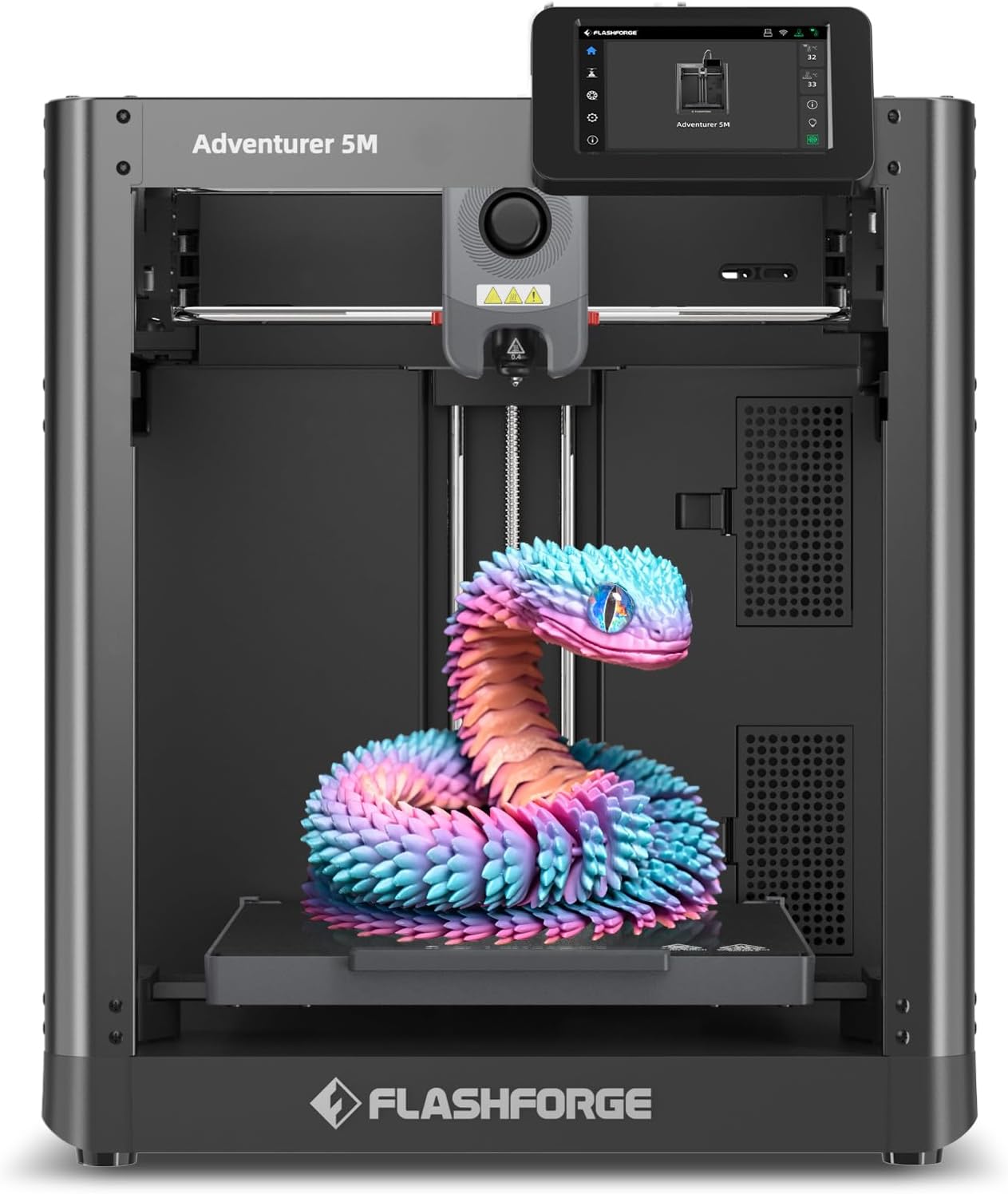
| Build Volume | 220 x 220 x 220 mm |
|---|---|
| Nozzle Max Temp | 280°C |
| Travel Speed | 600mm/s |
| Platform Type | Double‑Sided PEI Platform |
| Structure | All‑metal Core XY Structure |
The FLASHFORGE Adventurer 5M is a CoreXY desktop 3D printer built to speed up prototyping while keeping prints dependable. It uses one‑click automatic bed leveling and a 280°C direct‑drive extruder with quick, tool‑free nozzle swaps to simplify setup and maintenance, and a double‑sided PEI platform for easier part removal. The AD5M targets high throughput with up to 600mm/s travel speed and high acceleration for shorter print cycles, plus multi nozzle sizes and dual‑fan cooling to balance speed with detail. Practical benefits for cosplay makers include the ability to print tougher filaments like PETG and ABS, fast warmup, and remote monitoring through a mobile app for unattended long prints. Important limitations are that high speed settings demand careful tuning to avoid ringing on delicate props and that advanced multi‑material or multi‑color workflows are limited on this base model. Regular maintenance such as nozzle cleaning and occasional calibration checks still matters to keep consistent results at higher speeds.
Best for: Cosplayers who want a reliable, faster desktop printer for printing strong, functional costume parts and props while minimizing hands‑on leveling and monitoring.
Less Ideal for: Those who need built‑in multi‑color or multi‑material printing workflows out of the box or who prefer a plug‑and‑play hobby printer with minimal tuning for ultra‑fine decorative pieces.
- One‑button automatic bed leveling for reliable first layers
- CoreXY, high travel speed and acceleration for faster prints
- 280°C direct‑drive extruder with quick nozzle changes for flexible materials
- Double‑sided PEI platform makes part removal and adhesion easier
- Mobile app and camera options enable remote monitoring of long prints
- High‑speed printing requires careful tuning to avoid print artifacts
- Base model lacks built‑in multi‑material color capabilities
Verdict: Choose the Adventurer 5M if you want a faster CoreXY printer that balances speed, material flexibility, and hands‑off leveling for dependable cosplay part production.
Choosing the Right 3D Printer for Cosplay: Key Factors to Consider
Print Resolution and Surface Finish
Higher resolution matters for cosplay because small decorative details, facial features on masks, and crisp edges on props show up under paint and weathering. Layer height, nozzle diameter, and the machine's motion system determine the base surface finish, and finer settings let you capture sculpted textures and engraved patterns.
Keep in mind that the finest resolution increases print time and may require more careful tuning. For cosplay, aim for settings that balance visible detail with practical print durations so you can produce multiple components without excessive delays.
Build Volume and Modular Printing
The available build volume limits the size of parts you can print in a single piece. Larger beds make helmets, chest plates, and full-face masks easier to produce without seams, while smaller printers require splitting models into sections and joining them later.
Modular printing strategies matter when a machine's volume is smaller than your largest props. Good slicing practices, reliable bed adhesion, and repeatable part alignment are essential for multi-part prints that must fit together cleanly after sanding and bonding.
Material Options and Strength
Cosplay parts need to survive handling, wearing, and sometimes outdoor use, so material choice affects flexibility, impact resistance, and paint adhesion. Common filaments and resins vary from flexible and impact-resistant to stiff and easy to sand. Consider materials that accept primers and paints well and that match the mechanical demands of the piece—rigid armor benefits from stiffer filaments, while wearable masks may need some give.
Also consider temperature resistance if you plan to wear pieces in warm environments or use heat-forming processes during finishing.
Reliability for Long Prints
Large or detailed cosplay parts often require long print times. A reliable machine reduces failed prints and wasted material by maintaining consistent extrusion, stable temperature control, and secure bed adhesion throughout multihour runs. Features like filament runout detection, power recovery after outages, and a well-supported firmware ecosystem improve the chance of a clean finish on lengthy jobs.
Reliability also includes the physical robustness of the machine so it retains calibration and alignment after repeated use and transport to shows or workshops.
Ease of Post-Processing and Finishing
After printing, most cosplay parts need sanding, filling, primer, and paint. Some materials sand and fill more easily than others, and certain print methods produce smoother surfaces that require less prep. Consider how straightforward it will be to achieve a paint-ready surface from a given material and machine type.
Accessibility of spare parts, compatibility with common finishing supplies, and straightforward disassembly of support structures all reduce the time from print to finished costume.
Software Workflow and Community Support
Slicing software and firmware affect how easily you can optimize prints for detail, strength, and speed. Machines that work with well-documented slicers and have active user communities make it faster to find presets, troubleshoot issues, and adapt settings for specific cosplay materials and part geometries.
Community resources also supply model-splitting strategies, finishing tips, and safety advice that are particularly valuable for makers building complex wearable pieces.
Choosing Between FDM and Resin for Cosplay
Fused deposition modeling and vat photopolymerization each have advantages for costume work. FDM printers typically use tougher thermoplastics that resist impact and can be sanded and painted easily. They are well suited for larger structural parts and pieces that must tolerate bending and knocks.
Resin printers produce much finer surface detail and sharper edges, which reduces prep work for ornate masks and small jewelry-like decorations. However, many common resins are more brittle than engineering filaments and require post-cure and careful handling to avoid fractures. Decide based on the balance of detail versus toughness you need for the specific part.
- FDM: better for large, impact-resistant pieces and easy sanding
- Resin: superior detail for small ornaments and intricate surfaces
- Consider using both processes for different parts of a complex costume
Preparing Files and Splitting Large Models
Large props often exceed a printer's build volume and must be split into sections. Plan seams in unobtrusive locations or along natural design lines to simplify assembly and hide joins. Use alignment features like registration pins or keyed joints to ensure parts fit together accurately after finishing.
Optimize wall thickness, infill patterns, and print orientation before slicing to balance strength and print time. Thicker walls and higher infill can reduce the need for internal supports and create more durable wearable pieces.
- Plan seams where they are least visible or easiest to disguise
- Add alignment features to models for consistent assembly
- Adjust infill and wall settings to reinforce stress points
Finishing Techniques for a Professional Look
Sanding, filling, and priming are essential to achieve a smooth, paint-ready surface. Start with coarse sanding to remove layer steps, then progress to finer grits. Use lightweight filler for small gaps and a high-build primer spray to reveal remaining imperfections before final paint.
Sealing and clear-coating protect painted surfaces from abrasion and sweat. For flexible parts, choose flexible coatings and paints that move with the substrate to prevent cracking. Practice on test pieces to dial in the right sequence of sanding and priming for your chosen material.
- Sand progressively from coarse to fine grit
- Use registration marks and fillers to hide seams
- Select paints and clear coats compatible with the material
Safety and Workspace Setup
Printing and finishing cosplay parts involves dust, fumes, and potentially hazardous chemicals. Ensure adequate ventilation, especially when curing resins or spraying primers and paints. Use appropriate PPE such as respirators, gloves, and eye protection when handling uncured resins or solvent-based products.
Organize a dedicated workspace that separates printing from finishing tasks. Keep sanding and painting areas distinct from the printing zone to limit contamination and maintain a clean environment for successful prints.
- Ventilate resin curing and spray-painting areas
- Use PPE for sanding dust and chemical exposure
- Separate printing and finishing stations
Maintaining Your Printer for Consistent Results
Regular maintenance preserves print quality and reduces failures. Clean the build surface, check and tighten belts and rods, and replace consumables like nozzles and build tapes as needed. Calibrate bed leveling and extrusion steps periodically, particularly before long or critical prints.
Keep a simple log of filament batches and printing settings that worked well for specific materials. This record speeds troubleshooting and helps reproduce successful prints when preparing for a convention or event.
- Perform routine mechanical checks and bed calibration
- Replace worn parts proactively
- Document successful settings for repeatable results
How We Chose the Best 3D Printer for Cosplay
We prioritized attributes that directly affect how well a printer handles cosplay parts and wearable props. Key evaluation criteria included print resolution and surface finish, since fine detail matters for facades and ornamentation; build volume, because larger helmets and armor pieces often require a roomy bed or a practical strategy for multi-part prints; material compatibility, focusing on filaments and resins that yield durable, impact-resistant parts; and mechanical reliability, which affects print success rates for long, complex jobs. We also considered ease of post-processing and finishing, since sanding, filling, and painting are essential steps for costume quality. Workflow factors such as slicing software usability and community support were included because they shorten the learning curve for new builders. Finally, we filtered out machines that lack adequate safety features or cannot reliably print common cosplay materials. Products that failed basic durability, material, or usable-volume thresholds were excluded from consideration.
Our full evaluation process is outlined in our review methodology.
FAQ
What build volume do I need for helmets and full-face masks?
It depends on the helmet size and whether you plan to print in one piece. Many full-face helmets fit within a mid-size build volume, but larger styles may require splitting into sections. Measure the largest dimension of your design and plan for seams if it exceeds your printer's bed.
Which filament is best for wearable armor that needs to resist impacts?
Tougher filaments with higher impact resistance and some ductility are preferable for wearable armor. Materials formulated for strength and good layer adhesion reduce the chance of cracks from knocks or bending. Also consider wall thickness and infill to reinforce high-stress areas.
Can resin-printed parts be used for wearable props?
Yes, resin prints offer fine detail and smooth surfaces, but many standard resins are brittle. If you plan to wear resin pieces, choose tougher formulations or design parts with reinforcing geometry, and be mindful of the extra post-cure and safety requirements for handling uncured resin.
How do I join large printed sections so seams are not visible?
Use alignment features such as pins, keys, or overlap joints built into the model to ensure accurate mating. After bonding, sand seams flush, apply filler where necessary, and prime before painting to hide transitions and create a continuous surface.
How much post-processing time should I expect for a detailed helmet?
Post-processing time varies but can take as long as or longer than printing, especially for complex pieces. Expect hours of sanding, filling, priming, and painting for a high-quality finished helmet, with additional curing time if resin parts are used.
Final Verdict
For cosplay builders the right priorities are print detail, adequate build volume, and materials that meet the mechanical needs of wearable parts. Smaller printers can excel on ornate pieces while larger beds reduce the need for seams. Factor in how much time you will spend on finishing and whether you need tougher filaments or high-detail resins. Balance these tradeoffs against your typical project scale and workflow. Prioritize the dimensions and material compatibility that match the costumes you intend to make, and choose a machine that offers reliable long-print performance so you can produce consistent, wearable results.