
Note: This article contains affiliate links. If you click on these links and make a purchase, we may earn a small commission at no extra cost to you. This helps support our research and content. Read our full affiliate disclosure here.
Picking the right enclosed 3D printer matters when you need repeatable results, fewer failed prints, and cleaner, safer printing in a home or small workshop. Enclosed machines stabilize internal temperatures, reduce drafts, and help contain fumes and particulates for materials that benefit from steady heat. This guide covers seven shortlisted enclosed 3D printers that represent a range of build volumes, features, and user-focused controls. We evaluated models for real-world printing concerns like chamber temperature stability and usable build area so you can match a printer to your projects. Read on to see the top picks and the criteria we used to compare them.
Top Picks at a Glance
| Best Overall The best all-around choice for most situations | FLASHFORGE AD5M Pro 3D Printer |  |
| Best Quality Built to a higher standard if you want something more solid | QIDI Max4 Combo |  |
| Best Value The sweet spot between price and what you get | QIDI Q2 3D Printer |  |
| Best Budget The cheapest option that still gets the job done reliably | Monoprice Voxel 3D Printer |  |
| Top Rated A top-rated pick with lots of positive feedback | Original Prusa CORE One+ kit |  |
| Most Popular A crowd favorite that many people choose with confidence | FLASHFORGE Adventurer 5M |  |
| Best Seller A high-volume bestseller chosen again and again | Bambu Lab P1S Combo |  |
FLASHFORGE AD5M Pro 3D Printer

| Build volume | 220×220×220 mm |
|---|---|
| Max print speed | 600 mm/s |
| Nozzle temperature | 280°C |
| Supported materials | PLA, ABS, PETG, ASA, TPU, carbon-fiber filaments |
The FLASHFORGE AD5M Pro is an enclosed CoreXY desktop 3D printer that aims to combine high speed with reliable detail. It uses a rigid CoreXY motion system and vibration compensation to print at speeds up to 600 mm/s while retaining layer quality, supported by a 50W quick-heating nozzle and a high-flow extrusion rate for faster part production. Setup is straightforward with a 10-minute quick-start routine and one-click auto leveling, and the direct-drive extruder handles flexible materials like TPU as well as PLA, ABS, PETG, ASA and carbon-fiber blends. The fully enclosed chamber plus dual-layer filtration stabilizes build temperatures and reduces odors and particulates, which suits classrooms and small studios. Smart features such as a built-in camera, app control, filament runout detection, power-loss recovery and auto-shutdown make long prints easier to manage. Trade-offs: the 220 mm cube workspace keeps it in the small-to-medium desktop class, and achieving top speeds will demand tuned settings and suitable filament choices to avoid quality loss on complex geometries.
Best for: Buyers who want an enclosed, easy-to-use desktop printer that balances speed and material versatility for prototyping, classroom use, or a small studio workflow.
Less Ideal for: Users needing very large build volumes or plug-and-play ultra-fine detail at maximum speed without investing time in calibration should look elsewhere.
- CoreXY motion with vibration compensation for faster prints without excessive artifacting
- Quick-heating 50W nozzle and 3s quick-swap nozzle system for rapid tool changes
- Fully enclosed chamber with dual-layer filtration for more stable temperatures and reduced emissions
- Direct-drive extruder that handles flexible filaments and multiple common engineering materials
- Built-in camera and app control plus filament runout and power-loss recovery for hands-off monitoring
- Build volume is limited to 220×220×220 mm, which may be small for larger prototypes
- Reaching advertised top speeds requires careful tuning and appropriate filament to preserve fine detail
Verdict: Choose the AD5M Pro if you need a compact, enclosed CoreXY printer that prioritizes fast, reliable prints and material versatility for education or small-studio prototyping.
QIDI Max4 Combo

| Build volume | 390×390×340 mm |
|---|---|
| Chamber temperature | ≤65℃ |
| Hotend max temperature | ≤370°C |
| Max toolhead speed | ≤800 mm/s |
The QIDI Max4 Combo is an enclosed 3D printer aimed at professional and serious hobbyist use, offering a 390×390×340 mm build volume and systems tuned for engineering materials. It combines a 65°C active heated chamber, a 370°C high-temperature hotend with a hardened steel nozzle, and a full-surface silicone heated bed to reduce warping when printing ABS, PC, Nylon and carbon-fiber composites. Motion hardware including closed-loop X/Y motors, dual Z lead screws with anti-backlash nuts, and CoreXY-style drive components deliver stable, high-precision motion and allow very high toolhead speeds up to 800 mm/s for suitable profiles. Practical features such as an HD AI camera for print-failure detection, a large touchscreen, multiple network options (Wi-Fi, Ethernet, cloud, USB) and compatibility with a multi-color QIDI BOX expand workflow flexibility. The printer is sized and specified for demanding parts and composite filaments, but the Polar Cooler for cleaner airflow and optional high-flow nozzles are sold separately, so plan for a few add-ons if you need those extras.
Best for: Engineers, small-batch manufacturers, and advanced hobbyists who prioritize enclosure-based temperature control and high-speed, high-temperature capability for printing demanding engineering filaments.
Less Ideal for: Casual or first-time users who want a plug-and-play desktop printer with minimal setup and no additional accessory purchases.
- Very large 390×390×340 mm build volume for printing large parts in one piece
- Heated chamber up to 65°C and 370°C hotend support engineering materials like PC and carbon-fiber composites
- Closed-loop X/Y motors and dual Z lead screws improve stability and dimensional accuracy at high speeds
- Built-in AI camera and large touchscreen simplify monitoring and operation
- Multiple connectivity options including 2.4/5 GHz Wi‑Fi, Ethernet, cloud control and USB
- Polar Cooler and some high-flow nozzle upgrades are optional extras and not included
- Large footprint and heavy weight require a dedicated workspace and handling
Verdict: Buy this if you need a large enclosed printer engineered for high-temperature materials and fast, stable prints for professional prototyping and composite work.
QIDI Q2 3D Printer

| Build Volume | 270×270×256 mm |
|---|---|
| Max Print Speed | ≤600 mm/s |
| Chamber Temperature | ≤65°C |
| Print Head Temperature | ≤370°C |
| Filament Diameter | 1.75 mm |
The QIDI Q2 is an enclosed CoreXY desktop 3D printer designed to bridge beginner usability and more advanced materials work. You load prints via Wi‑Fi, Ethernet, the QIDI Cloud, or a USB drive and the machine handles core tasks like full auto leveling, filament run‑out detection, power‑loss recovery and AI camera monitoring. Key hardware includes a metal CoreXY frame with precision linear rails for stable, high‑speed motion up to 600 mm/s, a 370°C nozzle for engineering filaments, and a 65°C active heated chamber to reduce warping on ABS and composites. Practical extras such as a triple filtration system (G3 pre‑filter, H12 HEPA and activated carbon) make indoor use cleaner, and the QIDI Box accessory adds multi‑color/multi‑material capability with dry‑while‑print handling. The result is a reliable machine that prints faster and supports tougher materials, though its size and weight mean it is a dedicated benchtop tool and advanced material printing still requires attention to profiles and ventilation. Setup is largely plug‑and‑play but expecting some tuning with exotic composites is realistic.
Best for: Buyers who want an enclosed, reliable printer that can grow from hobby projects into engineering and multi‑material work and prioritize stable, faster prints and cleaner indoor operation.
Less Ideal for: People who need an ultra‑compact or highly portable printer for occasional toy‑grade prints or those unwilling to invest time in material tuning and setup.
- Enclosed CoreXY metal frame with linear rails for stable, high‑speed printing
- 65°C active heated chamber reduces warping for ABS and composite materials
- 370°C high‑temperature nozzle unlocks engineering filaments like PA, PC and carbon‑filled blends
- Built‑in triple filtration (G3 pre‑filter, H12 HEPA, activated carbon) for cleaner indoor use
- Convenient features: auto‑leveling, filament run‑out/tangle detection, power‑loss recovery and AI camera monitoring
- Relatively heavy and large, so it requires a dedicated bench or sturdy surface
- Advanced materials still need tuned profiles and careful handling despite high‑temp capability
Verdict: Choose the QIDI Q2 if you want an enclosed, factory‑style desktop printer that delivers faster, warp‑resistant prints and supports high‑temperature engineering filaments.
Monoprice Voxel 3D Printer

| Build volume | 150 x 150 x 150 mm |
|---|---|
| Heated bed max temperature | 60°C |
| Onboard storage | 8GB |
| Connectivity | Wi-Fi |
The Monoprice Voxel is a small enclosed desktop 3D printer aimed at straightforward, hobbyist printing. It ships calibrated and ready to print, uses a color touchscreen for job control, and has an auto-feeding system plus a filament sensor that pauses prints when filament runs low, which reduces failed prints. The heated, flexible, removable build plate heats to about 60°C and makes part removal far easier than fixed glass beds, and the tool-free quick-change nozzle speeds nozzle swaps for maintenance or different nozzle sizes. The enclosure helps with temperature stability and prints of ABS-like materials compared with open-frame machines, and Wi-Fi plus an 8GB onboard storage option simplify file transfer. Limitations to expect are the modest 150 x 150 x 150 mm build volume, which constrains larger projects, and the printer is relatively heavy for its footprint which can make moving it inconvenient. Still, for users who want a ready-to-run, enclosed printer that minimizes setup fuss, the Voxel delivers practical convenience and reliable basics.
Best for: Buyers seeking an affordable, turn-key enclosed desktop printer that minimizes setup and failed prints and who prioritize ease of use over large build capacity.
Less Ideal for: Users who need to print large parts or who frequently move a printer between workspaces should consider a larger or lighter alternative.
- Fully enclosed design improves temperature stability for ABS and similar materials
- Quick-change nozzle allows tool-free nozzle swaps in seconds
- Heated, flexible, removable build plate simplifies part removal
- Built-in filament sensor and auto-feeding reduce failed prints from runout
- Color touchscreen and Wi-Fi make setup and file transfer straightforward
- Small 150 x 150 x 150 mm build volume limits larger prints
- Relatively heavy for its compact footprint, making it less portable
Verdict: Choose the Voxel if you want an affordable, easy-to-use enclosed printer that reduces setup hassle and failed prints for small to medium hobby projects.
Original Prusa CORE One+ kit

| Build Volume | 250 x 220 x 270 mm |
|---|---|
| Filament diameter | 1.75 mm |
| Layer height | 0.05-0.30 mm |
| Max nozzle temperature | 290 °C / 554 °F |
| Max chamber temperature | 55 °C / 131 °F |
The Prusa CORE One+ is a DIY-enclosed CoreXY printer kit built around a steel exoskeleton and factory-tuned profiles to deliver fast, consistent prints. It ships as a kit with detailed photographic instructions intended to teach you the machine during assembly, and once built it runs with a direct-drive Nextruder, high-flow 0.4 mm nozzle, and active 360° cooling for clean overhangs. The enclosed chamber and active temperature control let you print PLA, PETG and advanced materials such as ASA, ABS, nylon and PC blends with reduced warping, while the printer's Input Shaper and tuned PrusaSlicer profiles aim to boost speed without losing dimensional accuracy. Practical benefits include a compact footprint for its build volume, two filament sensors, an easy-flex loading system and offline operation for secure environments. Limits to expect are the time investment to assemble and tune the kit and the need to source mains-compatible power and routine maintenance parts over the long term, though Prusa's long-term parts support mitigates that concern.
Best for: Buyers who prioritize long-term reliability and repeatable, production-ready prints and are comfortable building and maintaining a machine themselves.
Less Ideal for: Users who want a turnkey printer that works immediately out of the box or who prefer minimal setup and maintenance responsibilities.
- Fully enclosed steel frame for rigidity and stable temperature control
- Factory-tuned PrusaSlicer profiles and Input Shaper for faster prints with maintained accuracy
- Nextruder direct-drive with 360° cooling enables reliable overhangs and advanced materials
- Chamber heats to 55°C and automatic ventilation supports ABS, ASA, nylon and PC blends
- Offline-capable operation and removable Wi-Fi for secure, private use
- Requires a significant hands-on build time as a DIY kit
- Higher machine complexity compared with plug-and-play desktop printers
Verdict: Choose the CORE One+ if you want a rugged, enclosed CoreXY kit that delivers factory-tuned profiles and industrial-grade thermal control for reliable prints of advanced materials.
FLASHFORGE Adventurer 5M
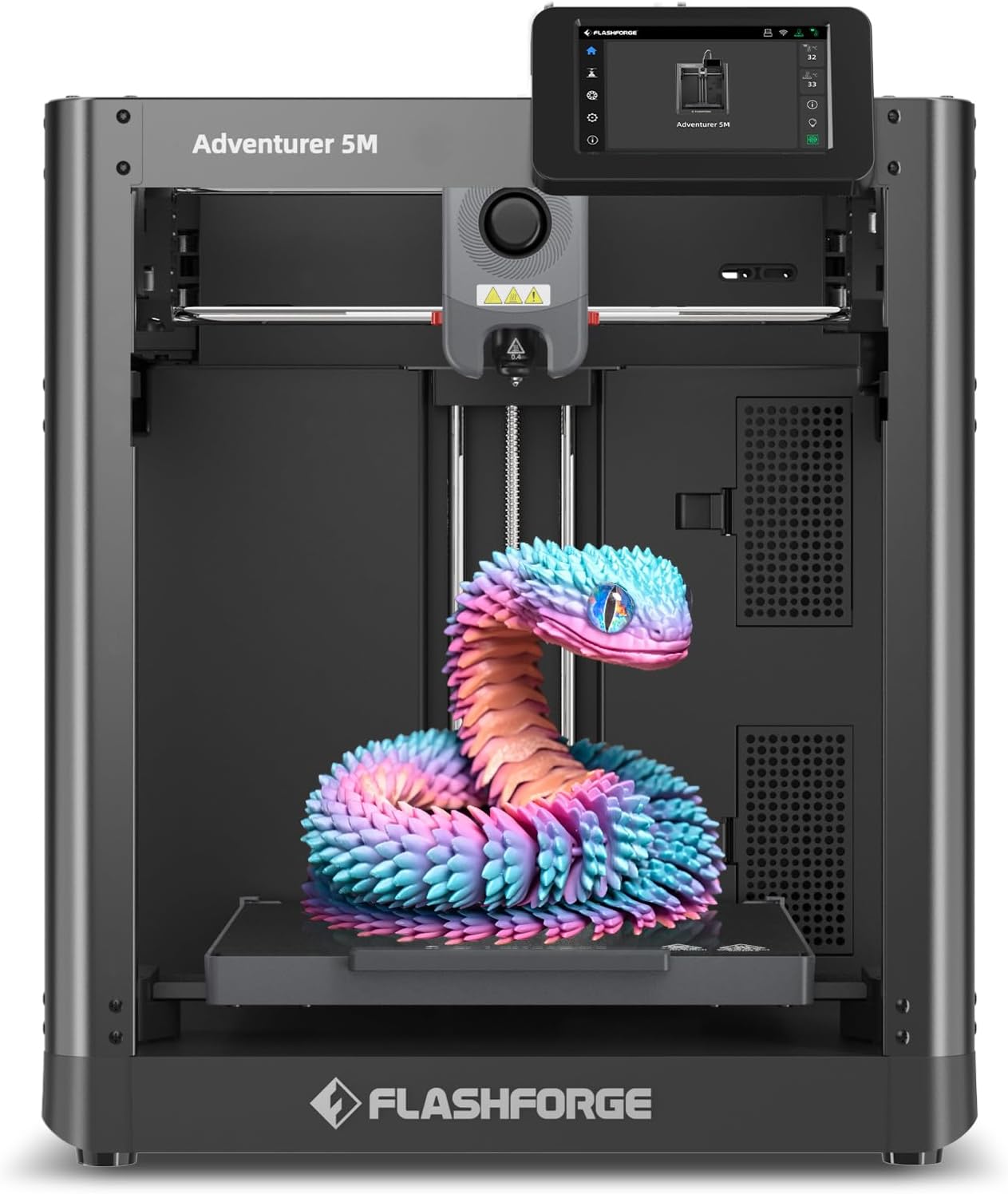
| Build Volume | 220 x 220 x 220 mm |
|---|---|
| Max Nozzle Temp | 280°C |
| Travel Speed | 600 mm/s |
| Platform | Double-sided PEI Platform |
| Structure | All-metal Core XY Structure |
The FLASHFORGE Adventurer 5M is an enclosed CoreXY desktop printer built for faster iteration and reliable prints. It uses one-click automatic bed leveling and a double-sided PEI platform to make first-layer adhesion and part removal straightforward, and the 280°C direct-drive extruder plus multiple nozzle sizes support a wide range of filaments from PLA to engineering materials. The AD5M emphasizes speed with a 600 mm/s travel rate and high acceleration, plus a high-flow nozzle and quick warm-up that shorten cycle times for prototypes or small production runs. Practical touches include a detachable 3-second nozzle, dual-fan cooling and vibration compensation for cleaner surfaces, and a mobile app for remote monitoring. The enclosed design helps with temperature stability for higher-temp filaments, though achieving the fastest listed speeds will require careful tuning and suitable slicer profiles. This model balances usability and performance, making it a solid pick when you need an enclosed printer that can scale from hobby projects to faster prototype work.
Best for: Buyers who want an enclosed desktop printer that prioritizes faster prototyping and reliable first layers while still supporting engineering filaments and remote monitoring.
Less Ideal for: Users who need plug-and-play maximum speeds without calibration or those who require built-in multi-color/multi-material capability from the start.
- One-button automatic bed leveling simplifies first-layer setup
- Enclosed CoreXY structure and PEI bed improve temperature stability and part removal
- 280°C direct-drive extruder and multiple nozzle sizes support a wide range of filaments
- High travel speed (600 mm/s) and rapid warm-up reduce print cycle time
- Mobile app and remote monitoring for oversight during long prints
- Top speeds require careful tuning and may not be realized out of the box
- No integrated multi-color head on this model, limiting native multi-material prints
Verdict: A reliable enclosed CoreXY printer geared toward faster prototyping and engineering-material capability with user-friendly leveling and remote monitoring.
Bambu Lab P1S Combo

| Build Volume | 256×256×256 mm³ |
|---|---|
| Max Speed | 500 mm/s |
| Max Acceleration | 20 m/s² |
| Supported Filaments | PLA, PETG, TPU, PVA, PET, ABS, ASA; capable: PA, PC |
The Bambu Lab P1S Combo combines a fast CoreXY motion system with an enclosed build chamber and an AMS attachment to deliver multi-color and multi-material prints without complex workarounds. It is intended for users who want quick turnarounds: the machine is spec'd for up to 500 mm/s travel and very high acceleration, and the enclosed body helps with printing temperature-sensitive filaments. Built-in features such as a direct-drive extruder, automatic bed leveling, and an integrated camera for timelapses make setup and monitoring straightforward, and the larger 256×256×256 mm build volume handles most hobby and small-prototyping projects. Practical limits include the need to connect and use the AMS for full multi-color capability and that highly abrasive fiber-filled filaments are not recommended. For buyers who prefer a near-ready, factory-quality enclosure and fast output, the P1S Combo shortens the path from unboxing to reliable prints, though advanced users needing extreme specialty filaments may look elsewhere.
Best for: Buyers who want a mostly turn-key enclosed printer that prioritizes speed and reliable single- and multi-color output with minimal manual tuning.
Less Ideal for: People who need to print highly abrasive, fiber-reinforced materials or those who require a bare-bones, hackable open-frame setup should consider other options.
- Very high top speed and acceleration for faster prints
- Enclosed design improves temperature stability for advanced filaments
- Automatic bed leveling and direct-drive extruder simplify reliable prints
- Supports up to 16-color/multi-material printing when paired with the AMS
- Integrated camera for timelapse and remote monitoring
- Multi-color capability requires the AMS accessory to be connected
- Manufacturer notes some reinforced or abrasive filaments are not recommended
Verdict: Choose the P1S Combo if you want an enclosed, factory-ready 3D printer that delivers very fast, multi-color prints with minimal setup.
Choosing the Right Enclosed 3D Printer: Key Factors to Consider
Chamber Temperature Control
An enclosed printer's ability to hold a steady internal temperature is critical for printing materials that are prone to warping. A stable chamber reduces thermal gradients across a part, which lowers the risk of layer separation and curling. Controlled temperature also improves interlayer adhesion and can enable successful printing of engineering filaments without extensive modifications.
When evaluating this factor, consider whether the enclosure is actively heated or passively insulated, how the firmware handles temperature compensation, and whether the printer maintains consistent temps across long prints. Good temperature control shortens tuning time and raises the odds of first-run success.
Build Volume And Access
Build volume determines the largest single part you can print and affects how you plan assemblies and toolpaths. A printer with an efficient internal layout offers more usable space than raw cubic volume numbers suggest. Door placement, access panels, and bed clearance matter for part removal and maintenance.
Think about the typical items you print and whether you need a tall, wide, or deep envelope. Oversized chambers increase footprint and warm-up time, while too-small chambers force you to split models or use more post-processing. Choose a volume that matches your project sizes without excessive excess.
Filtration And Fume Management
Enclosures help contain odors and particles, but effective filtration and airflow design determine how well a printer manages emissions. Printers intended for workshops or home environments should route air through filters or controlled exhaust paths to reduce ultrafine particle concentration and smell.
Review whether the unit includes active filtration, replaceable filter elements, and how the air is circulated. Filtration matters most when printing ABS, nylon, or other materials that release noticeable fumes. Good fume management improves comfort and safety for prolonged use.
Mechanical Stability And Precision
Rigid frames, well-secured axes, and precise motion components reduce layer-to-layer shifting and ringing artifacts. Mechanical stability affects dimensional accuracy and surface finish, especially on taller prints where small deflections accumulate.
Inspect design features such as reinforced frames, dual Z leadscrews or synchronized guides, quality linear rails or rods, and secure bed mounting. Better mechanical stability typically reduces the need for frequent recalibration and leads to more reliable long-duration prints.
Bed Adhesion And Build Surface
Successful first layers start with good adhesion. Enclosed printers often use a combination of heated beds and specialized build surfaces to keep parts anchored during printing. A consistent bed surface that resists warping and is easy to clean will improve throughput.
Consider whether the bed offers removable or flexible plates for easier part removal, the maximum bed temperature, and compatibility with common adhesives or surface treatments. A good adhesion strategy minimizes part damage during removal and reduces failed prints.
User Interface And Software Compatibility
A clear control interface and wide slicer compatibility shorten the learning curve and reduce setup mistakes. Built-in touchscreens, remote print monitoring, and robust firmware features like power-loss recovery all contribute to smoother operation.
Also consider whether the printer supports common file formats and integrates with popular slicers. Easy-to-navigate menus and accessible documentation reduce troubleshooting time and make the machine friendlier for beginners and experienced users alike.
Why An Enclosure Matters
An enclosure transforms how a printer manages the environment around the part. It reduces drafts, holds heat, and isolates the print area, which is particularly beneficial when printing temperature-sensitive filaments. The resulting improvements include fewer warps, better layer adhesion, and more consistent dimensional accuracy.
Beyond print quality, enclosures can enhance safety and cleanliness by containing fumes and particles. For many home workshops and education spaces, that containment plus a quality filtration approach makes using higher-temperature materials more practical.
- Stabilizes chamber temperature for better adhesion
- Reduces draft-induced print defects
- Contains particulates for a cleaner workspace
Matching Printer Size To Your Projects
Selecting the right build volume is a balance between capability and footprint. If you routinely print large prototypes or functional parts, prioritize a larger usable envelope. If most of your work is small parts or miniatures, a compact enclosed printer with fast warm-up and a smaller footprint may be a better fit.
Also assess whether the printer's shape favors the dimensions you need. Taller machines allow long vertical parts without splitting, while wider beds let you batch-print multiple smaller items in one run.
- Consider typical part dimensions before choosing volume
- Account for assembly plans that might require printing multiple pieces
Material Options And Temperature Requirements
Different filament families have distinct chamber needs. PLA generally tolerates open printing, but ABS, polycarbonate, and nylon benefit from a warm, stable environment. If you plan to work with engineering plastics, choose an enclosed printer that maintains higher ambient chamber temperatures reliably.
Also check maximum recommended nozzle and bed temperatures for the machine, since some advanced materials need elevated settings to print well even with an enclosure.
- PLA is forgiving; ABS, nylon, and polycarbonate require more control
- Verify the printer's max nozzle and bed temperatures for your chosen filaments
Maintenance And Consumables
Enclosed printers reduce dust exposure to sensitive components but still require routine maintenance such as belt tensioning, lead screw lubrication, and filter replacement. Consider how easy it is to access the interior for maintenance tasks without compromising the enclosure.
Consumables like filters, build surfaces, and nozzles should be straightforward to source and replace. Machines designed with modular parts and accessible service points reduce downtime and make long-term ownership less of a chore.
- Check access panels and door clearances for maintenance
- Confirm availability of replaceable filters and build plates
Safety Considerations For Enclosed Printers
While enclosures help contain fumes and reduce touch risk, they also concentrate heat and can trap vapors if ventilation or filtration is inadequate. Ensure your chosen unit has a sensible airflow design and clear guidance on filament choices in confined spaces.
If you will run prints unattended, look for safety features like power-loss recovery and thermal cutoffs, and make sure filters are replaced on schedule to keep circulation effective.
- Confirm active or passive ventilation strategy
- Use thermal safety features and monitor filter life
How We Chose the Best Enclosed 3D Printer
We focused on capabilities that materially affect print success with enclosed machines. Core evaluation criteria included chamber temperature control and stability, since many engineering and composite filaments need consistent heat to avoid warping. We measured usable build volume and form factor to ensure printers can handle typical part sizes without wasting workshop space. Thermal management and filtration were reviewed to assess safety and suitability for materials that emit odors or ultrafine particles. Reliability factors such as mechanical rigidity, axis alignment features, and platen adhesion options were considered because they reduce failed prints and maintenance time. Ease of use and software compatibility were included to gauge how quickly users can get from first setup to consistent results. We excluded open-frame and non-enclosed systems, single-purpose resin printers, and DIY kits that require extensive modification to achieve an enclosed, temperature-stable chamber. Our shortlists favor machines that deliver out-of-box enclosure benefits and have documentation or features that support consistent printing with temperature-sensitive materials.
Our full evaluation process is outlined in our review methodology.
FAQ
Do enclosed 3D printers print every material better than open-frame printers?
Not every material benefits equally. Enclosures are most helpful for filaments that warp or delaminate from temperature swings, such as ABS, nylon, and polycarbonate. Materials like PLA are already forgiving and may not need an enclosure for good results.
How important is an active heated chamber versus passive insulation?
Active heated chambers provide more consistent, controllable internal temperatures and are preferable for demanding engineering filaments. Passive insulation helps reduce drafts and slow heat loss but may not reach the higher stable temps required for some materials.
Will an enclosure eliminate all odors and ultrafine particles?
An enclosure limits dispersion, but effective odor and particle reduction depends on filtration and airflow design. Machines with dedicated filters and controlled exhaust paths reduce emissions more reliably than sealed chambers without filtration.
Can I upgrade an open-frame printer with an enclosure instead of buying a new unit?
You can add aftermarket enclosures to many open-frame printers, and that can improve temperature stability. However, integrated enclosed designs often include thermal management and safety features not present on retrofit enclosures, so evaluate whether upgrades meet your material and safety needs.
How often do filters and build surfaces need replacement?
Filter replacement interval depends on printing frequency and the materials used; heavy use with odorous filaments will need more frequent changes. Build surfaces wear with use and part removal; expect to replace or refresh surfaces when adhesion degrades or damage appears.
Final Verdict
Choose an enclosed 3D printer based on the materials and part sizes you plan to print. Prioritize chamber temperature stability and adequate build volume if you use engineering filaments or need larger parts. Balance thermal management and filtration against mechanical stability and ease of maintenance to find a machine that fits your workflow. If you want reliable, repeatable results with fewer failed prints, focus on enclosures that provide consistent internal temperatures, sensible airflow, and a rigid frame. Those tradeoffs will help you select a dependable printer for long-term use.