
Note: This article contains affiliate links. If you click on these links and make a purchase, we may earn a small commission at no extra cost to you. This helps support our research and content. Read our full affiliate disclosure here.
A 50-pint dehumidifier with pump is a practical choice when you need steady moisture removal for basements, large laundry rooms, or finished lower levels. The built-in pump removes the hassle of manual emptying and lets you route water up and out to a sink or drain, which matters when the unit sits below drain level. This guide shortlists six top-performing units and explains why each type made the cut. We focus on extraction capacity, continuous drainage reliability, energy use, and user-friendly controls so you can pick a unit that fits the space and maintenance routine. Read on for concise buying guidance and the criteria we used to evaluate these dehumidifiers.
Top Picks at a Glance
| Best Overall The best all-around choice for most situations | Frigidaire 50 Pint Dehumidifier FHDD5034Y1 |  |
| Best Quality Built to a higher standard if you want something more solid | AprilAire E050 50-Pint Dehumidifier |  |
| Best Budget The cheapest option that still gets the job done reliably | Midea 50-Pint Dehumidifier with Pump |  |
| Top Rated A top-rated pick with lots of positive feedback | DuraComfort DH50PWM 50-Pint Dehumidifier | 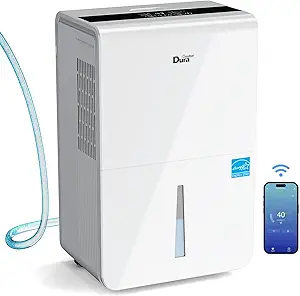 |
| Most Popular A crowd favorite that many people choose with confidence | hOmeLabs 50 Pint Dehumidifier HME1004 |  |
| Best Seller A high-volume bestseller chosen again and again | Midea 50 Pint Dehumidifier |  |
Frigidaire 50 Pint Dehumidifier FHDD5034Y1

| Capacity | 50 pints |
|---|---|
| Tank Volume | 2.7 gallons |
| Air Flow Capacity | 235 cfm |
| Wattage | 470 watts |
| Voltage | 115 volts |
This Frigidaire 50 Pint Dehumidifier is a residential-focused unit that removes up to 50 pints of moisture per day and offers features aimed at easy, hands-on use. It includes a washable filter for dust capture, three fan speeds, custom humidity control, front-loading tank with a carrying handle and splash guard, and continuous draining for unattended operation. The built-in Wi‑Fi enables remote adjustments and monitoring, while a 2.7 gallon tank and 235 cfm airflow provide steady performance in large rooms, basements, or garages. At 470 watts it is reasonably energy efficient for this capacity, though it is a fairly heavy, floor-standing unit so it is best left in a fixed space rather than moved frequently. The unit does not list a built-in pump, so continuous drain requires gravity or a condensate hose to a low drain point. Practical benefits include simple maintenance from the washable filter, programmable humidity setpoints, and useful remote control; limitations are the weight and the lack of an integrated condensate pump for pumping water uphill.
Best for: Buyers who want a powerful, easy-to-maintain dehumidifier for large residential spaces and value remote control and programmable humidity settings.
Less Ideal for: People who need a lightweight, highly portable unit or require a built-in condensate pump to push water uphill should consider other models.
- 50 pints per day capacity suitable for large rooms and basements
- Washable, easy-to-clean air filter that captures dust and reduces maintenance cost
- Wi‑Fi connectivity for remote monitoring and control
- Continuous drain option for extended unattended operation
- No built-in condensate pump listed so gravity drain or separate pump may be required
- Relatively heavy unit better suited to a fixed location than frequent moving
Verdict: Choose this Frigidaire when you need a robust 50‑pint dehumidifier with easy maintenance and Wi‑Fi control for large residential spaces, but plan for external pumping if you cannot rely on gravity drainage.
AprilAire E050 50-Pint Dehumidifier

| Capacity | 50 pints per day |
|---|---|
| Coverage | Up to 1,600 square feet |
| Air Flow | 145 cfm |
| Wattage | 504 watts |
| Voltage | 120 volts AC |
The AprilAire E050 is a performance-focused whole-house dehumidifier that removes up to 50 pints of moisture per day and is intended for basements, crawl spaces, and homes up to about 1,600 square feet. It mounts or hangs close to ductwork and circulates air while maintaining a set relative humidity using the front-mounted digital control or the included S86WMUPR Wi‑Fi thermostat for remote scheduling. Practical additions in this bundle — a quiet condensate pump and 10-foot drain tubing — let you run continuous drainage even where a floor drain is not available, and the washable MERV 8 filter helps keep intake air cleaner. The unit runs on 120 VAC at roughly 504 watts and moves air at about 145 CFM, so it balances strong moisture removal with reasonable energy use for a whole-house unit. Build quality is robust with metal housing and corrosion-resistant coils, but the 46-pound chassis and duct collars mean installation may require basic tools or pro assistance in tight crawl spaces. If you need reliable, continuous dehumidification with remote control and pump-out capability, this AprilAire kit covers those needs well.
Best for: Buyers who prioritize dependable, continuous moisture removal for a whole-home or crawl space application and want built-in remote control and pump-out capability for hands-off operation.
Less Ideal for: Shoppers who need variable-speed, ultra-quiet operation or a compact portable unit for spot dehumidifying in multiple rooms should consider different models.
- Removes up to 50 pints per day, suitable for homes up to 1,600 sq. ft.
- Includes Wi‑Fi thermostat for scheduling and remote control
- Bundle contains a quiet condensate pump and drain tubing for continuous drainage
- Washable MERV 8 filter and corrosion-resistant coils improve durability and air cleanliness
- Front-mounted digital control and automatic on/off based on %RH set point for set-and-forget operation
- Single fan speed limits fine control over airflow and noise levels
- At 46 pounds, may be awkward to install alone in confined crawl spaces
Verdict: Choose the AprilAire E050 bundle if you want a robust 50‑pint whole‑house dehumidifier with remote Wi‑Fi control and a built-in pump for reliable continuous drainage.
Midea 50-Pint Dehumidifier with Pump

| Dehumidification Capacity | 50 pints_per_day |
|---|---|
| Floor Area | 4500 square_feet |
| Tank Volume | 1.6 gallons |
| Other Special Features of the Product | Quiet Operation, Built-In Pump, Continuous Draining, Timer, Portable |
The Midea 50‑pint dehumidifier with pump is a floor‑standing unit built for large spaces and continuous drainage. It removes up to 50 pints per day and offers an automatic operation mode with adjustable humidity settings, a timer, and a 1.6‑gallon tank for normal bucket use. The factory‑installed pump lets you route water out continuously so you do not need to empty the tank manually, which is useful in basements or utility rooms. Four caster wheels make it easy to move between rooms and the unit is relatively quiet in typical operation. For users who want remote control, the model supports Wi‑Fi control via the manufacturer app and voice assistants. Keep in mind this listing is for a renewed unit and the product description mentions included filters but does not specify replacement intervals, so budget buyers should plan for possible filter and maintenance costs over time.
Best for: Buyers on a budget who need a high‑capacity dehumidifier for basements, large rooms, or whole lower levels and value hands‑free continuous drainage and portability.
Less Ideal for: Small apartments or users who need ultra‑compact, lightweight units or those who prefer brand‑new, unopened appliances with full original packaging.
- Removes up to 50 pints per day suitable for large rooms and basements.
- Built‑in pump enables continuous automatic drainage without manual bucket emptying.
- Portable four‑wheel design for easy relocation between spaces.
- Quiet operation around typical dehumidifier noise levels and adjustable timer.
- Renewed item condition may result in shorter remaining life or unknown previous use.
- Replacement filter life and costs are not clearly specified in the listing.
Verdict: If you need an affordable, high‑capacity dehumidifier that can drain itself and move easily between large rooms, this Midea 50‑pint with pump is a practical choice.
DuraComfort DH50PWM 50-Pint Dehumidifier

| Capacity | 50 pints |
|---|---|
| Floor Area | 4500 square_feet |
| Tank Volume | 12 pints |
| Wattage | 510 watts |
| Air Flow Capacity | 150 cfm |
The DuraComfort DH50PWM is a 50-pint dehumidifier aimed at large basements, garages, and laundry rooms and combines a built-in condensate pump with smart controls for continuous, low-effort operation. It removes up to 50 pints per day and can serve rooms up to 4,500 square feet while offering gravity or pumped drainage via the included hoses, which keeps long-run use hands-off. You can control humidity remotely over 2.4 GHz Wi-Fi using the app, set timers, choose from multiple modes including a dedicated laundry-dry mode, and change fan speeds to balance sound and performance. Practical touches include an accessible 12-pint tank, washable filter with a reminder, child lock, wheels and handles for portability, and an Energy Star rating that helps with steady power use. Trade-offs are its mid-500 watt power draw and typical operating noise in the mid-40 dB range, so it is not the quietest or lowest-energy option, and its size means it is best for larger areas rather than small rooms.
Best for: Buyers who prioritize a dependable, low-maintenance dehumidifier for large basements or utility spaces and want pump drainage plus remote control for hands-off operation.
Less Ideal for: People seeking an ultra-quiet or very low-power unit for small bedrooms or tight living spaces should consider smaller or quieter models instead.
- Built-in pump supports pumped drainage up to 16.4 ft plus gravity drain options for unattended, long-run operation
- App control over 2.4 GHz Wi-Fi lets you set humidity, timers, and modes remotely
- 50-pint daily capacity suitable for large spaces up to 4,500 sq ft
- Energy Star certified and includes washable filter with reminder for lower ongoing operating cost and maintenance
- Convenience features such as wheels, handles, child lock, and multiple modes including laundry dry
- Consumes 510 watts which is higher than smaller, lower-capacity models
- Operating noise around 44–48 dB may be noticeable in quiet living areas
Verdict: Choose the DH50PWM if you want a robust 50-pint dehumidifier with a built-in pump and smart controls for reliable, unattended moisture management in large spaces.
hOmeLabs 50 Pint Dehumidifier HME1004

| Dehumidification Capacity | 50 pints/day |
|---|---|
| Max Capacity | 120 pints |
| Floor Area | 7500 square_feet |
| Air Flow Capacity | 135 cfm |
| Number of Speeds | 3 |
This hOmeLabs 50 pint dehumidifier is built for heavy-duty home use and includes a built-in pump and Wi‑Fi for remote control. It removes up to 50 pints per day (and up to 120 pints under hotter, more humid conditions) and offers preset Comfort, Turbo, and Continuous modes plus a digital display and timer for easy operation. The unit supports continuous drainage via the internal pump or a removable bucket, and maintenance is straightforward thanks to a washable filter and a check-filter indicator. Mobility is simple with swiveling wheels and tidy cable storage for seasonal stowage. Practical benefits include strong moisture removal for basements, laundry rooms, and large living areas and the convenience of app control for remote monitoring. Limitations are typical for a powerful dehumidifier: it is relatively heavy to lift and sized for larger spaces rather than small rooms, and turbo airflow will increase noise and energy draw compared with lower settings.
Best for: Buyers who prioritize proven performance and convenience for large, moisture-prone spaces and who want remote control and automatic drainage to reduce hands-on maintenance.
Less Ideal for: People needing a lightweight, ultra-quiet dehumidifier for a single small room or those who do not need app connectivity or a pump.
- Built-in pump enables continuous drainage without manual bucket emptying
- Wi‑Fi connectivity allows remote control and monitoring
- Multiple modes (Comfort, Turbo, Continuous) and digital display for precise humidity management
- Washable, removable filter and check-filter indicator simplify maintenance
- Swiveling wheels and cable storage make the unit easier to move and store
- Relatively heavy for moving between floors without help
- Turbo mode increases noise and energy consumption
Verdict: Choose this model if you want a powerful 50‑pint dehumidifier with a factory-quality pump and Wi‑Fi for hands-off moisture control in large residential spaces.
Midea 50 Pint Dehumidifier

| Capacity | 50 pints per day |
|---|---|
| Coverage | 4,500 square feet |
| Tank Volume | 1.6 gallons |
| Wattage | 470 watts |
| Air Flow | 223.7 cfm |
The Midea 50 Pint Dehumidifier is a heavy‑duty residential unit built to remove up to 50 pints of moisture per day and cover spaces up to about 4,500 square feet. It offers three fan speeds, an adjustable humidity setpoint (35%–85%), and a 1.6‑gallon tank while including a built‑in pump for automatic vertical or horizontal drainage so you can run continuous dehumidification without emptying the bucket. Mobility is practical thanks to four wheels and a handle, and the washable air filter helps cut running costs. Smart features include Wi‑Fi control via an app and voice commands through Alexa or Google Assistant, letting you check and change settings remotely. In use it is relatively quiet on low (about 49 dBA), making it workable in finished basements or living areas. Tradeoffs are typical for a 50‑pint unit: it is fairly large and heavier than smaller models, and effective pump drainage requires a proper hose route or drain location. For buyers who want dependable, hands‑off moisture removal and remote control, this model delivers.
Best for: Buyers who prioritize low‑maintenance, reliable moisture removal for large rooms or basements and want remote monitoring and automatic drainage for peace of mind.
Less Ideal for: People who need a compact, lightweight dehumidifier for small rooms or occasional use should consider smaller-capacity portable models instead.
- Built‑in pump enables continuous vertical or horizontal drainage without frequent bucket emptying
- Wi‑Fi and voice control let you monitor and change settings remotely
- Reusable washable air filter reduces ongoing filter replacement costs
- Four casters and a handle make the unit reasonably portable for its class
- Quiet low‑speed operation (around 49 dBA) suitable for living spaces and bedrooms
- Larger and heavier than small home units, so it requires space and occasional moving effort
- Requires a drain route for the pump to avoid relying on bucket capacity
Verdict: Choose this unit if you want a 50‑pint dehumidifier with a built‑in pump and smart controls for hands‑off moisture management in large basements and rooms.
Choosing the Right 50-Pint Dehumidifier with Pump: Key Factors to Consider
Actual Extraction Capacity
Rated pints per day is a starting point, but real-world extraction varies with temperature and humidity. Basements are typically cooler than living spaces, and compressors lose efficiency at lower ambient temperatures. Look for performance specs that include extraction at lower temperatures or mention low-temp operation.
Choosing a unit with conservative real-world capacity means the dehumidifier will meet expectations during cooler months and in colder basement corners. Overestimating capacity based solely on a standard-room rating can leave you under-dehumidified when it matters most.
Pump Lift Height and Discharge Options
An integrated pump is only useful if it can move condensate to where you need it. Pump lift height tells you how far vertically the unit can push water; ensure that value exceeds the height from the dehumidifier to your drain or sink outlet.
Also check discharge hose diameter and compatibility. Some pumps require specific hose sizes or fittings to avoid backpressure. Consider whether you need flexible routing or a short, straight run to the drain because longer runs and uphill sections increase resistance and can reduce pump reliability.
Continuous Drain Vs. Reservoir Management
Continuous drain with a pump reduces manual emptying, but not all continuous-drain setups are equal. A reliable pump with automatic shutoff during faults prevents overflow. Conversely, reservoir-only models require regular checking and can be inconvenient for long-term or unattended operation.
If you plan to run the dehumidifier in a remote or seldom-visited area, prefer models whose continuous-drain systems are robust, include clear fault indicators, and offer easy access to the reservoir for cleaning if needed.
Energy Use and Operating Cost
A high-capacity dehumidifier running continuously can add noticeable energy consumption. Look at energy efficiency ratings, power draw at expected operating conditions, and whether the unit offers modes like auto or economy that reduce run time.
Lower energy use matters when the unit runs many hours per day. Balance upfront efficiency with the need for reliable extraction; a slightly higher draw may be warranted if it maintains lower humidity in cold conditions where more efficient models falter.
Controls, Timers, and Humidistat Accuracy
Easy-to-use controls and a dependable humidistat make operation simple and prevent overdehumidifying. Digital controls with programmable targets and timers let you tailor operation to occupancy patterns, laundry cycles, or seasonal needs.
Humidistat accuracy affects how often the unit cycles on and off. An errant sensor can cause short cycling or prolonged runtime; prefer units with clearly described calibration or simple sensor reset procedures.
Serviceability and Filter Access
Routine maintenance keeps performance consistent. Filters should be easy to remove and clean without tools, and access to coils or service panels should not require extensive disassembly.
Consider how easy it is to clear drain lines, replace a worn hose, or inspect the pump. In basement installations where dust and pet hair accumulate, accessible filters and cleaning paths reduce long-term maintenance time.
Where a 50-Pint Unit Makes Sense
A 50-pint dehumidifier with pump suits medium to large basements, finished lower levels, and utility rooms that experience persistent dampness. These units balance removal capacity with manageable size and are typically sufficient for spaces up to several hundred square feet, depending on moisture load and temperature.
They are particularly useful where gravity drain is not possible. If the floor drain or laundry sink sits higher than the dehumidifier, an integrated pump enables reliable continuous drainage without frequent emptying of a bucket.
- Best for basements, large laundry rooms, and finished lower-level spaces
- Ideal when automatic, unattended operation is required
- Helps prevent mold, musty odors, and moisture damage in stored items
Installation Tips for Pump-Equipped Units
Position the dehumidifier on a level surface and allow clearance for airflow and drainage routing. Keep the intake clear of stored items, and avoid placing the unit directly against finished walls to reduce noise transmission and allow service access.
Run the discharge hose with gradual bends and avoid high-friction sections. If the drain outlet must pass through a wall, seal the penetration to prevent air leaks. Test the pump and run a few minutes of operation after installation to confirm flow and that the pump can achieve the required lift.
- Allow several inches of clearance on all sides for airflow
- Use smooth-bore hose if recommended to minimize clogging
- Secure the hose to prevent kinks and accidental disconnection
Managing Noise and Placement
Dehumidifiers with pumps can be noisier when the pump runs or when the compressor cycles. Consider placement in a closet or utility corner that is structurally isolated from main living areas if noise is a concern. Anti-vibration pads or a small raised platform can reduce transmitted noise into concrete floors.
Check manufacturer documentation for operating decibel levels and factor that into placement decisions. If the unit must be near living space, prioritize quieter models and install with vibration isolation in mind.
- Place away from bedrooms and media rooms when possible
- Use anti-vibration pads on concrete floors to reduce noise transfer
- Route pump discharge so water exits quietly without splashing
Seasonal Use and Cold-Basement Performance
Basements often get colder in winter, which can reduce dehumidifier extraction efficiency and cause frost on coils if units are not designed for low temperatures. Look for low-temperature operation features or defrost modes that allow continued operation as ambient temperature drops.
For seasonal use, set a slightly higher target humidity in colder months to avoid overworking the compressor. In very cold, seldom-used spaces, intermittent run schedules can limit energy use while still controlling mold risk.
- Prefer models with low-temp operation or automatic defrost for year-round reliability
- Adjust humidity setpoints seasonally to balance extraction and compressor health
- Inspect for frost build-up regularly in colder conditions
Maintaining Your Pump and Drain System
Keep the drain hose free of obstructions and inspect it periodically for mineral buildup or kinks. Some installations benefit from routing the hose through a small trap or filter to catch debris and protect the pump.
If the unit includes a float-switch or fault indicator, test it during routine maintenance so you recognize a blockage or pump failure quickly. Cleaning the reservoir and filter at regular intervals preserves flow and reduces the chance of odors or bacterial growth.
- Check hose routing and clear blockages at least monthly in heavy-use situations
- Flush lines if mineral buildup is suspected or if water flow slows
- Test float switches and fault alarms during scheduled maintenance
How We Chose the Best 50-Pint Dehumidifier with Pump
We prioritized features and specifications that directly affect day-to-day performance in damp basement or lower-level environments. Key evaluation criteria included extraction capacity at typical basement temperatures, pump lift height and discharge reliability, continuous drainage options and hose compatibility, energy efficiency and running cost estimates, and practical usability like control layout, hose routing, and service access. We also considered build quality and durability indicators such as compressor type and condensate management design. Products were excluded if they lacked an integrated condensate pump, if rated capacity fell substantially below 50 pints at standard conditions, or if continuous-drain options required frequent manual intervention. We favored units whose specs matched real-world basement conditions rather than only ideal-lab numbers. Finally, we validated the selection against common user concerns: easy setup, stable performance at lower temperatures, manageable noise levels for occupied spaces, and clear maintenance paths for filters and coils. The result is a concise list focused on reliable, low-effort moisture control for large, below-grade rooms.
Our full evaluation process is outlined in our review methodology.
FAQ
How far can the built-in pump push condensate?
Pump lift varies by model, but specifications list maximum vertical distance. Measure from the dehumidifier's drain outlet up to the discharge point and choose a unit whose pump lift rating exceeds that height to ensure reliable flow.
Can I run a 50-pint dehumidifier with pump continuously?
Yes, these units are designed for continuous operation. Still, factor in energy use and ensure the pump and drain remain clear. Using auto modes with a humidistat helps prevent unnecessary runtime.
Will the pump work if the discharge hose runs horizontally for a long distance?
Horizontal runs add friction and resistance. Keep the hose as short and straight as practical and follow manufacturer guidance on maximum horizontal lengths and hose diameter to avoid reduced flow or frequent cycling.
How often should I clean the filter and reservoir?
Clean accessible filters every one to three months depending on dust levels, and inspect the reservoir and drain lines at similar intervals. More frequent checks are warranted in dusty basements or homes with pets.
Do pump-equipped dehumidifiers require special electrical circuits?
Most residential 50-pint units run on standard household circuits. Check the unit's power requirements and avoid sharing the circuit with heavy-load appliances to reduce nuisance tripping.
Final Verdict
When choosing a 50-pint dehumidifier with pump, prioritize the combination of dependable extraction at lower temperatures and a pump that can reach your intended drain point. Balance energy use against the need for continuous moisture control and favor units that offer clear maintenance access and reliable drain fault indicators. Decide based on the height and routing of your discharge, expected seasonal temperatures in the installation area, and how much hands-off operation you want. Focusing on those tradeoffs will help you pick a unit that keeps your basement dry with minimal upkeep.