
Note: This article contains affiliate links. If you click on these links and make a purchase, we may earn a small commission at no extra cost to you. This helps support our research and content. Read our full affiliate disclosure here.
Keeping indoor humidity in check matters for comfort, health, and the longevity of your home. A properly sized dehumidifier removes excess moisture that can cause mold, musty odors, and damage to wood and fabrics. This guide spotlights seven top dehumidifiers for home use, shortlisted for everyday rooms, basements, and moisture-prone areas. We evaluated capacity, energy use, and ease of upkeep to help you pick a model that fits your room size and routine. Below are our top picks and the decision criteria we used to narrow the field.
Top Picks at a Glance
| Best Overall The best all-around choice for most situations | Gasbye DryPrime-50 Dehumidifier |  |
| Best Quality Built to a higher standard if you want something more solid | AEOCKY RHEA 80-Pint Dehumidifier |  |
| Best Value The sweet spot between price and what you get | AIRVIP 34 Pints Dehumidifier |  |
| Best Budget The cheapest option that still gets the job done reliably | TABYIK 35oz Dehumidifier DH-CS01 |  |
| Top Rated A top-rated pick with lots of positive feedback | hOmeLabs 32-Pint Dehumidifier |  |
| Most Popular A crowd favorite that many people choose with confidence | BEDRED CT11 Dehumidifier |  |
| Best Seller A high-volume bestseller chosen again and again | ToLife Dehumidifier TZ-C2 |  |
Gasbye DryPrime-50 Dehumidifier
| Capacity | 115 pints |
|---|---|
| Tank Volume | 1.72 gallons |
| Wattage | 500 watts |
| Operation Mode | Normal, Turbo, Comfort, Continuous |
| Air Flow Capacity | 12600 cubic_feet_per_hour |
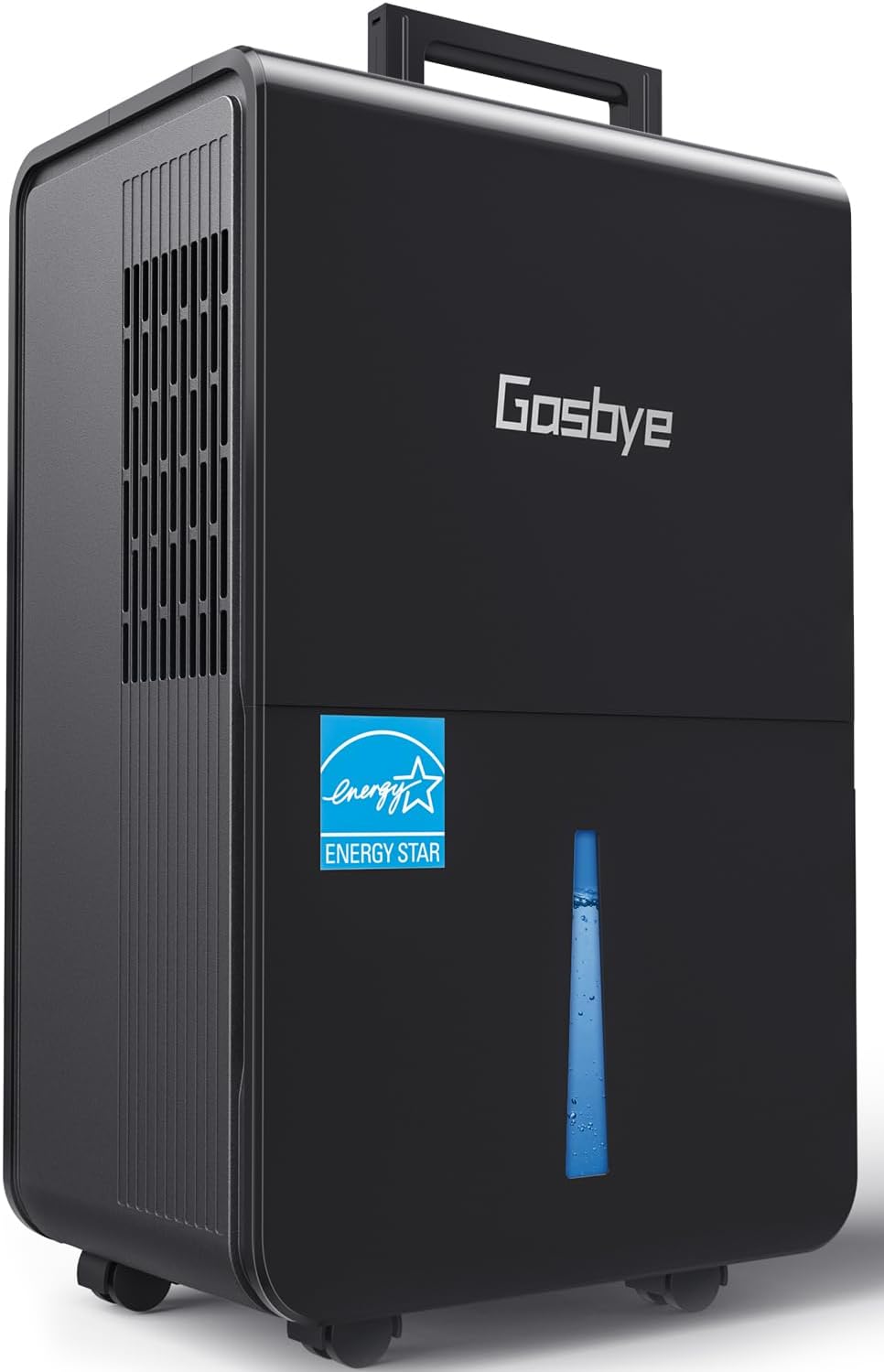
The Gasbye DryPrime-50 is a heavy-duty compressor dehumidifier intended for basements, garages, and large living areas where strong moisture removal is needed. It uses a 5-tier copper coil and a compressor to deliver up to 115 pints/day under 86°F/80%RH conditions with lower published capacities at cooler, more typical indoor temperatures. Key conveniences include a 1.7 gallon removable tank, an included drain hose and garden-hose threaded outlet for continuous drain, auto shut-off and auto-restart after power loss, and a washable filter. The unit runs around 45 dB, so it is reasonably quiet for open spaces but may be noticeable in small rooms. Energy Star 2026 certification and a 500 W compressor promise better efficiency than many non-certified compressor models, though actual energy use will depend on local conditions. At about 43 pounds the DryPrime-50 is built sturdily but less portable than smaller consumer models. If you need robust, reliable humidity control for large, damp areas and prefer multiple drainage choices, this model covers those needs well, with the caveat that the top-rated pint/day figure applies to hot, very humid test conditions rather than typical home environments.
Best for: Buyers who want a robust, energy-efficient compressor dehumidifier for large, damp spaces and value durability, reliable drainage options, and quiet-enough operation for open rooms.
Less Ideal for: People seeking a lightweight, ultra-quiet bedroom unit or a small-room portable dehumidifier should look at lower-capacity, lower-weight models instead.
- High dehumidification capacity with lab-tested figures at several temperature/humidity points
- Energy Star 2026 certified for improved energy efficiency compared with non-certified compressor models
- Three drainage options: 1.7 gal tank, included short drain hose, and threaded garden-hose outlet for long runs
- Sturdy construction with thicker copper tubing aimed at longer service life
- Auto shut-off and auto-restart for set-and-forget operation after power interruptions
- Top-capacity 115 pints/day rating is measured at very warm, very humid conditions and will be lower in typical home environments
- Single fan speed limits finer airflow control
- At around 43 pounds it is heavier and less convenient to move than smaller models
Verdict: A durable, Energy Star certified compressor dehumidifier built to remove large volumes of moisture from basements and big rooms while offering flexible drainage and reliable long-term performance.
AEOCKY RHEA 80-Pint Dehumidifier
| Capacity | 80 pints |
|---|---|
| Tank Volume | 1.45 gallons |
| Wattage | 280 watts |
| Operation Mode | Auto, Constant Humidity, Continuous, Smart Drying, Sleep |
| Air Flow Capacity | 9006 cubic_feet_per_hour |
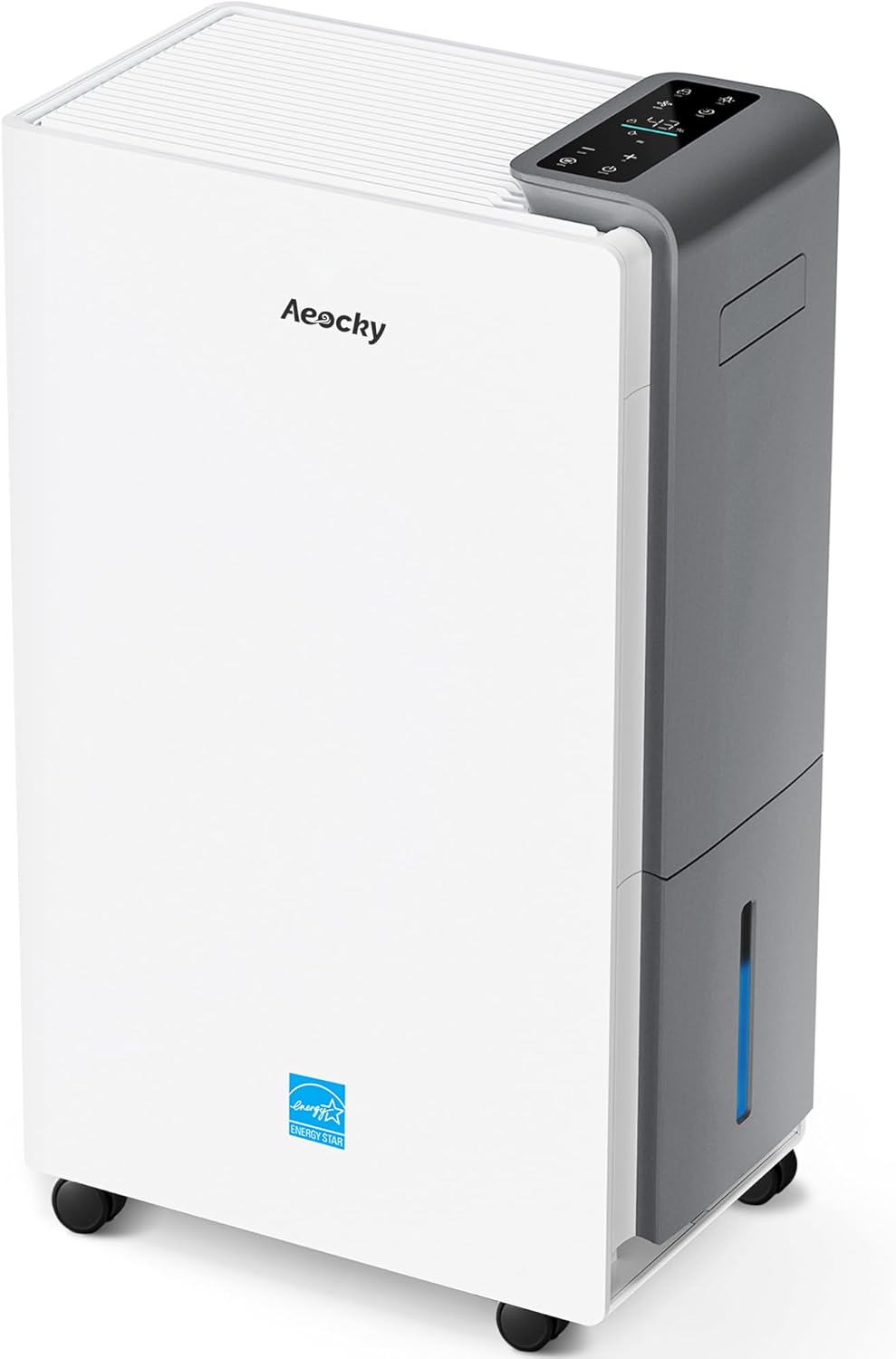
The AEOCKY RHEA is a performance-focused compressor dehumidifier built to dry large spaces while minimizing energy use. It is designed for continuous household operation with an 80 pint/day dehumidification capacity and a 1.45 gallon tank, and it supports modes like Auto, Constant Humidity, Continuous, Smart Drying, and Sleep. The unit emphasizes efficiency and durability with a multi-row evaporator/condenser layout, a high-efficiency rotary compressor, copper tubing, and defrost sensors for reliable low-temperature operation. Practical touches include a drain hose and garden-hose adapter for continuous drainage, an adjustable humidistat for precise control, child lock and timer functions, and relatively quiet operation reported around the mid-40 dB range. Trade-offs are typical for high-capacity compressor units: it is sized for large rooms or basements and will be heavier and bulkier than small-room options, and emptying the tank is still required unless you set up continuous drainage. For buyers who prioritize fast drying and electricity savings, the RHEA delivers strong real-world performance backed by ENERGY STAR Most Efficient certification.
Best for: Buyers who need fast, reliable moisture removal across large rooms or basements and who prioritize long-term energy savings and robust core components.
Less Ideal for: Those seeking a lightweight or travel-friendly dehumidifier for a small bedroom or occasional use should consider compact or desiccant models instead.
- High dehumidification capacity rated at 80 pints per day for large spaces
- ENERGY STAR Most Efficient 2025 certification for strong energy savings
- Multiple operation modes and adjustable humidistat for precise humidity control
- Includes drain hose and garden-hose adapter for continuous drainage
- Designed with copper tubing and multi-row heat exchangers for improved durability and efficiency
- Large-capacity compressor units are heavier and less portable than small-room models
- Requires periodic tank emptying unless continuous drainage is installed
Verdict: Choose the RHEA if you want a high-capacity, energy-efficient dehumidifier built for fast drying and lower running costs in large home spaces.
AIRVIP 34 Pints Dehumidifier

| Dehumidification Capacity | 34 pints_per_day |
|---|---|
| Tank Volume | 2.5 liters |
| Wattage | 130 watts |
| Air Flow Capacity | 6700 cubic_feet_per_hour |
| Upper Temperature Rating | 95 °F |
This AIRVIP 34-pint dehumidifier is built for small-to-medium rooms where persistent humidity is a problem, such as basements, bedrooms, bathrooms, and RVs. It uses a high-efficiency compressor to remove up to 34 pints per day (measured at high temperature and humidity) and offers adjustable humidity control with continuous, comfort, and manual modes so you can target specific RH levels. Practical touches include a 6.56 ft drain hose for gravity-fed continuous drainage, a 2.5 L removable water tank with auto shutoff, a one-minute auto defrost feature for cold conditions, and caster wheels plus a handle for easy moving. The unit claims quiet operation and an LED display for straightforward control. Trade-offs are the modest tank capacity that requires emptying if not using the drain hose and that the listed airflow and pint rating reflect peak conditions, so real-world removal will vary with room temperature and humidity. For buyers prioritizing compact footprint and flexible drain options, this model covers the essentials without extra smart features.
Best for: Buyers who want a compact, efficient dehumidifier that delivers reliable moisture removal and flexible drainage options for basements, bedrooms, laundry rooms, or RVs while keeping setup and operation simple.
Less Ideal for: Large open-plan homes or whole-house dehumidification needs where higher daily removal and larger tanks or hard‑plumbed systems are required.
- High-efficiency compressor rated up to 34 pints per day for strong moisture removal in small spaces
- Includes 6.56 ft drain hose for continuous gravity drainage to avoid frequent tank emptying
- Multiple operating modes (continuous, comfort, manual) for precise humidity control
- Frost-free auto defrost and auto shutoff protect the unit and make year-round use easier
- Compact design with handle and 360° wheels for easy relocation between rooms
- 2.5 L (0.67 gal) tank is relatively small when not using continuous drainage
- Performance specs are peak values and will be lower in cooler or less humid conditions
Verdict: A compact, mobility-focused 34-pint unit that delivers practical, energy-efficient moisture control and easy continuous drainage for small residential spaces.
TABYIK 35oz Dehumidifier DH-CS01

| Water Tank Capacity | 1000 ml |
|---|---|
| Wattage | 40 watts |
| Dehumidification Capacity | 0.45 liters_per_day |
| Floor Area | 280 square_feet |
| Number of Speeds | 1 |
This TABYIK 35 oz dehumidifier is a small, Peltier-style unit intended to remove modest amounts of moisture from confined spaces like bedrooms, bathrooms, closets and RVs. It runs continuously on a single fan speed and claims up to about 16 oz (450 ml) per day under warm, very humid conditions, while drawing roughly 40 watts so daily energy use stays low. The clear 1000 ml tank is easy to remove and has an auto shutoff that stops the unit and flashes a light when the reservoir approaches full. Operation is very quiet at around 28 dB and a seven-color night light provides an ambient option for bedrooms. Practical limits are its low daily extraction rate and single-speed operation, so it is best for dampening small spaces rather than tackling basements or large rooms. Maintenance is straightforward with a removable tank and a simple back intake filter that should be cleaned regularly to sustain performance.
Best for: Buyers who prioritize a low-cost, low-energy dehumidifier for occasional use in small, enclosed spaces and want a quiet, portable unit that is simple to operate.
Less Ideal for: People needing fast moisture removal in basements, large living areas, or persistently wet rooms should choose a higher-capacity compressor dehumidifier instead.
- Compact, lightweight design easy to move and place in small spaces
- Low power draw (40 watts) for inexpensive daily operation
- Quiet operation around 28 dB suitable for bedrooms
- Transparent 1000 ml tank with auto shutoff for safe unattended use
- Very low dehumidification capacity (about 0.45 liters/24 hrs) makes it unsuitable for large or very damp areas
- Single fan speed limits control over drying rate and noise
- Peltier-style units generally perform worse in cool rooms compared with compressor models
Verdict: A budget-friendly, energy-efficient portable dehumidifier built for quiet, occasional moisture control in small rooms.
hOmeLabs 32-Pint Dehumidifier

| Dehumidification Capacity | 35 pints_per_day |
|---|---|
| Capacity | 1.8 gallons |
| Tank Volume | 1.6 gallons |
| Number of Speeds | 2 |
| Floor Area | 4500 square_feet |
This hOmeLabs unit is a straightforward, room‑scale dehumidifier built for large spaces like basements and open living areas. It removes up to 32 pints per day under typical conditions (and higher at very warm, humid extremes), and offers both a removable 1.6 gallon water tank with auto shutoff and a continuous drain outlet for hands‑free operation. The machine includes washable filter media, two fan speeds plus a TURBO mode for faster moisture removal, and smart features such as Wi‑Fi control and voice assistant compatibility so you can monitor and change humidity from your phone. Mobility is simple thanks to built‑in casters and a handle, and safety conveniences include automatic defrost and auto restart after power interruptions. Expect practical, reliable performance for basement humidity control, though it is a single‑hose portable unit so performance will vary with room layout and extreme cold conditions can reduce extraction rates. For buyers who want easy setup, remote control, and reliable daily dehumidification, this model covers the essentials without complex installation.
Best for: Buyers who want a reliable, easy‑to‑use dehumidifier for a basement or large room and value remote control, straightforward maintenance, and portability.
Less Ideal for: People seeking a hard‑plumbed or whole‑house solution or those who need maximum extraction in consistently cold spaces should consider other types of systems.
- Removes up to 32 pints per day with higher capacity at very high temperature and humidity
- Wi‑Fi control and compatibility with Alexa and Google Assistant for remote monitoring and adjustments
- Continuous drain option plus a removable tank with auto shutoff reduces manual emptying
- Washable air filter and caster wheels make maintenance and relocation simple
- Performance drops in cold environments since rated capacity is specified at warmer test conditions
- Only two fan speeds may limit fine control of noise versus extraction rate
Verdict: A portable, Wi‑Fi enabled dehumidifier that delivers dependable moisture removal and easy maintenance for large basements and open rooms.
BEDRED CT11 Dehumidifier

| Floor Area | 1000 square_feet |
|---|---|
| Tank Volume | 95 fluid ounces |
| Capacity | 5.9 pounds |
| Operation Mode | Intermittent |
| Other Special Features of the Product | 7 Color Ambient Light, Automatic Shutoff, Sleep Mode |
The BEDRED CT11 is a compact thermoelectric dehumidifier intended to reduce humidity in small spaces such as bedrooms, bathrooms, and modest basements up to about 1000 sq ft. It uses semiconductor cooling rather than a compressor, so it runs quietly and is simple to operate with an intermittent operation mode and an automatic shutoff when the 95 oz tank fills. Sleep Mode turns off the lights and lowers noise for overnight use, and the seven-color ambient light gives an optional mood-lighting feature. Practical benefits include easy emptying from the included tank, portability thanks to a lightweight design, and low sound levels that suit living spaces. Important limitations are inherent to semiconductor units: lower capacity compared with compressor dehumidifiers, reduced performance in very cold or very damp basements, and a smaller tank that requires more frequent emptying in high-humidity conditions.
Best for: Buyers who prioritize quiet, low-maintenance dehumidification and want a compact unit that is easy to move and run in living spaces or small basements without frequent intervention.
Less Ideal for: People needing heavy-duty moisture control for large, cold, or very damp basements should choose a higher-capacity compressor dehumidifier instead.
- Quiet thermoelectric operation suitable for bedrooms and living rooms
- Automatic shutoff protects against overfill and simplifies unattended use
- 95 oz removable tank for straightforward water removal
- Sleep Mode and ambient light options for low‑noise nighttime use
- Compact and lightweight for easy placement or moving between rooms
- Semiconductor cooling gives lower moisture removal capacity than compressor models
- Performance drops in cold basement conditions and very high humidity areas
Verdict: Choose the BEDRED CT11 if you want a quiet, portable dehumidifier with auto‑shutoff and sleep‑friendly operation for small basements or living spaces.
ToLife Dehumidifier TZ-C2
| Floor Area | 1000 |
|---|---|
| Tank Volume | 95 fluid ounces |
| Number of Speeds | 2 |
| Wattage | 93 watts |
| Voltage | 220 volts |
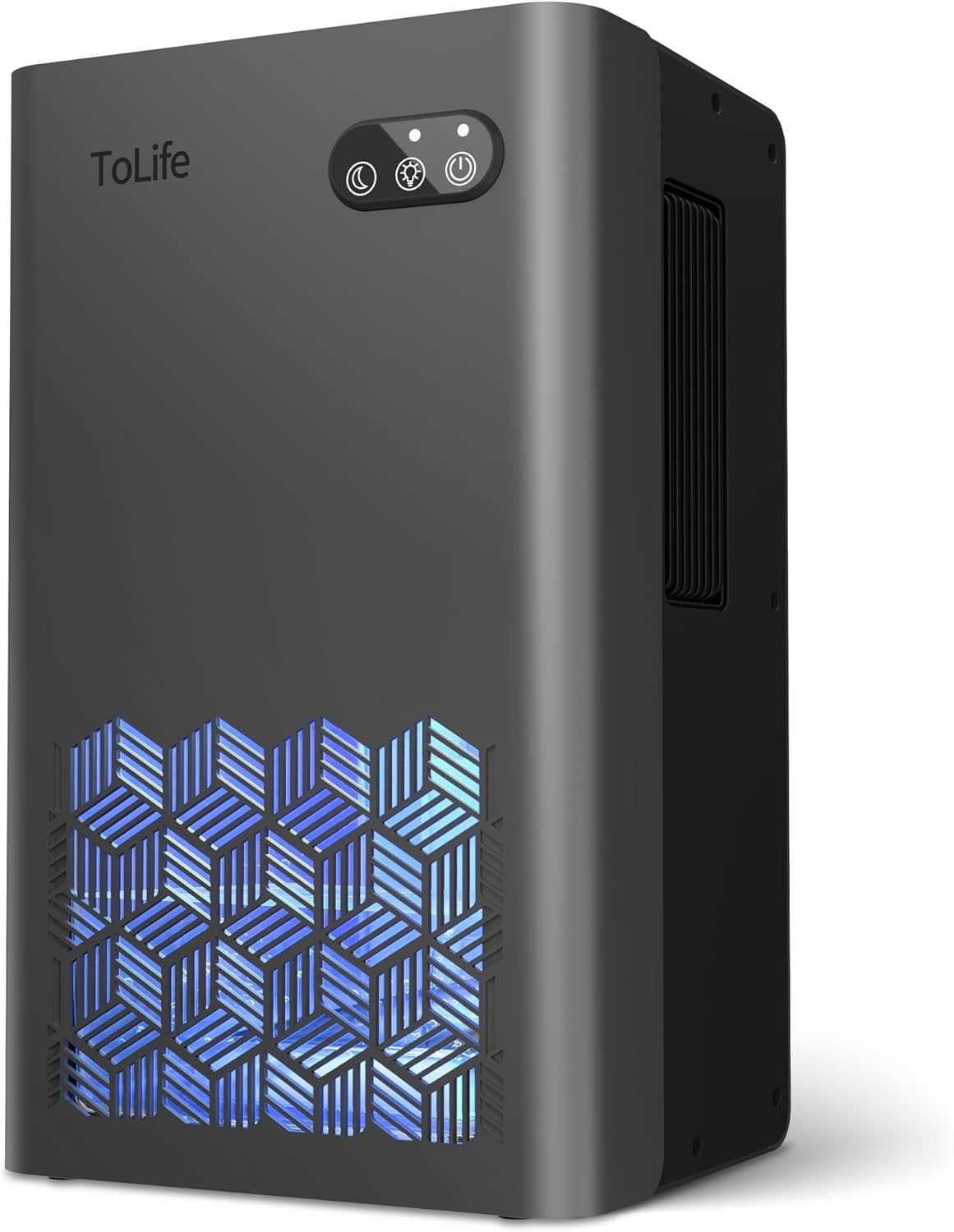
The ToLife TZ-C2 uses semiconductor condensation technology to quietly pull moisture from the air and deposit it into a removable 95 oz tank, making it a straightforward option for damp rooms. It offers two operating modes: a higher-power setting for faster moisture removal and a low-speed sleep mode that runs under 30 dB for overnight use. A seven-color LED can act as a night light and the unit includes automatic shutoff when the tank is full or removed, plus handles for easy moving between rooms. Practical benefits include simple setup, low noise, and a compact footprint that fits in basements, bathrooms, or bedrooms. Limitations are its modest rated dehumidification capacity and stated coverage, which means it will be most effective in smaller basement zones or for spot treatments rather than drying a large, very damp basement quickly. Also this model runs on 220 volts, so electrical compatibility should be confirmed for your location.
Best for: Buyers who need an affordable, portable dehumidifier for spot dehumidifying small basement areas, bathrooms, or bedrooms and who prioritize low noise and easy portability.
Less Ideal for: People looking to dry large, very damp basements or whole-house coverage should consider a higher-capacity compressor dehumidifier instead.
- Large removable 95 oz water tank reduces how often you need to empty it
- Quiet sleep mode under 30 dB suitable for nighttime operation
- Portable design with handles for moving between rooms
- Automatic shutoff prevents overflow when the tank is full
- Dehumidification capacity is modest and may be slow in very damp or large basements
- Requires 220 volt power which may not match all household outlets
Verdict: A compact, budget-friendly portable dehumidifier that is best for quiet, small-area moisture control and occasional basement spot treatments.
Choosing the Right Dehumidifier for Home: Key Factors to Consider
Capacity and Room Size
Capacity determines how much moisture a unit can remove in 24 hours and directly affects how well it controls humidity in a space. Choose a capacity that matches the square footage and typical humidity load of the room. A small unit in a large damp basement will run continuously without achieving target humidity, while an oversized unit may cycle too frequently in a small bedroom.
Think about peak humidity periods too. Areas with recurring moisture problems or seasonal humidity spikes need higher capacity to recover quickly. Also consider ceiling height and open floorplans, which increase the volume the dehumidifier must condition.
Energy Use and Operating Cost
A dehumidifier will run for many hours during humid weather, so energy efficiency directly impacts monthly operating costs. Look at power draw at typical operating points rather than only the maximum input rating. Some units advertise energy-saving modes or built-in humidistats that prevent unnecessary runtime.
Consider features that lower ongoing costs, such as variable-speed compressors or fans, programmable timers, and accurate humidity sensors that let the machine cycle only when needed. Over the long run, a slightly more efficient unit can save meaningful energy in a humid climate.
Drainage Options and Continuous Run
How a unit handles collected water matters for convenience and for installing the dehumidifier in different areas. Portable units with a removable tank are simple to set up but require regular emptying. Models that support continuous drain via gravity or a pump eliminate daily emptying and are better for basements or long unattended runs.
When using continuous drain, check hose compatibility and placement requirements. If a pump is needed to lift water up and out, verify pump capacity and reliability. Drainage design also affects how you can position the unit relative to floor drains or sinks.
Noise Levels and Placement
Noise can limit where a dehumidifier can be installed comfortably. Living rooms, bedrooms, or open-plan areas benefit from quieter models or those with multiple fan speeds so you can run louder, faster drying modes only when the room is unoccupied.
Manufacturers may list decibel figures, but real-world noise depends on fan speed and placement. Consider vibration isolation feet and the impact of placing the unit on hard surfaces. If you plan to run the dehumidifier near living spaces overnight, prioritize low-noise performance.
Ease Of Maintenance and Filter Care
Regular cleaning and filter maintenance keep a dehumidifier operating efficiently and help avoid odor or microbial buildup. Choose units with accessible filters, clear service panels, and tank designs that are easy to rinse and dry. Removable, reusable filters reduce consumable costs compared with models that require frequent replacements.
Evaluate how easy it is to access internal coils for occasional cleaning and whether the design prevents standing water in crevices. Simpler maintenance translates to more reliable, hygienic operation over years of service.
Controls, Sensors, and Automation
Accurate humidity sensing and intuitive controls affect both comfort and energy use. A digital humidistat with programmable targets helps maintain setpoints without wasting energy. Advanced features such as auto-defrost for cool basements, automatic restart after power loss, and timed schedules increase reliability and convenience.
Connectivity options can be useful but are not essential. Focus first on the accuracy and repeatability of humidity control and whether the machine will maintain setpoints under typical room conditions.
Sizing a Dehumidifier for Different Rooms
Calculate the volume of the room and match it to the unit's rated removal capacity. For typical living spaces and bedrooms, lower-capacity units may suffice; for basements, laundry rooms, or areas with chronic dampness, choose higher-capacity machines.
Also factor in how often doors or windows are opened, occupancy, and activities that produce moisture such as cooking or showering. When in doubt, opt for the next size up rather than running a unit at continuous high load.
- Living room or bedroom: low to medium capacity
- Bathroom or laundry room: medium capacity with quick recovery
- Basement or crawlspace: high capacity and continuous drain option
Where to Place Your Dehumidifier
Position the unit centrally in the humid area for best air circulation, and keep it away from walls and furniture to allow unobstructed airflow. Elevate small units off very cold floors to reduce frost buildup in cooler environments.
Avoid placing the dehumidifier where exhaust air will be recirculated immediately back into the intake, such as tight corners, and ensure the unit is level to prevent spillage from the tank or improper drainage.
- Allow several inches of clearance on all sides
- Use continuous drain for unattended locations
- Avoid enclosed cabinets or closets unless ventilation is provided
Managing Condensate and Preventing Leaks
Inspect tank seals and drain connections regularly. Even with continuous drainage, occasional blockages can cause overflow, so plan for safe routing of condensate and check hose fittings after installation.
If using gravity drain, ensure the outlet is lower than the dehumidifier's drain port. For pump-assisted units, confirm pump lift capability and test the pump under load. Place a small drip tray or moisture detector as a precaution in locations where a leak would cause damage.
- Secure hose fittings to prevent disconnection
- Check strainers and screens that can trap debris
- Test pump cycles and check float switches periodically
Running and Maintaining Efficient Operation
Set realistic humidity targets. For most homes, keeping relative humidity between 45 and 55 percent reduces mold risk while avoiding overly dry air. Use the unit's humidistat and avoid setting it excessively low, which increases runtime and energy draw.
Clean filters on a regular schedule and clear lint or dust from air inlets. Inspect coils and auto-defrost functions if your unit is used in cool spaces. Regular maintenance preserves efficiency and extends the life of the machine.
- Avoid needless continuous operation by using timers or smart controls
- Run at higher fan speeds for quick recovery after wet events
- Perform seasonal checks before humid months
Safety and Electrical Considerations
Use a dedicated circuit if the dehumidifier draws substantial power, and avoid long extension cords. Ensure the outlet and plug are rated for the unit's current draw. Keep the unit upright and on a stable surface to prevent spills and electrical hazards.
For basement installations, consider elevated mounting to protect the unit from minor flooding, and follow local codes for condensate disposal if connecting to building drains.
- Check cord integrity and avoid daisy-chaining plugs
- Follow manufacturer guidance for placement near water sources
- Unplug before servicing or relocating the unit
How We Chose the Best Dehumidifier for Home
We focused on real-world performance and practical features that matter in home settings. Selection began by screening units designed for residential spaces rather than commercial or industrial use. From that pool we prioritized machines with clear stated capacity ratings and reliable humidity control systems. Key evaluation criteria included moisture removal capacity at typical indoor temperatures, energy efficiency expressed via power draw or efficiency ratings, and tank or drainage options that affect everyday convenience. We also weighed noise levels for placement in living areas, build quality and durability for long-term use, and maintenance factors such as filter access and ease of cleaning. We excluded units that lacked clear specification data, were intended solely for specialized commercial tasks, or had inadequate drainage options for continuous operation. The final shortlist balances drying speed, running cost, and homeowner convenience to reflect the most practical choices for typical household environments.
Our full evaluation process is outlined in our review methodology.
FAQ
How do I know what capacity dehumidifier I need for a room?
Estimate the room volume and consider how damp the space is. Smaller bedrooms usually need lower-capacity units, while basements or rooms with persistent moisture require higher-capacity models that remove more pints per day.
Can a dehumidifier run 24/7 safely?
Many home models are designed for continuous operation when drained properly. Use a continuous drain setup for unattended runs and verify that the unit's components are rated for prolonged use.
Will a dehumidifier make a room colder?
A dehumidifier emits some heat from the compressor and fans, so it typically does not significantly cool a room. In cool conditions, frost protection features may cycle the unit differently to prevent coil freezing.
How often should I clean the filter and tank?
Clean the tank and rinse removable filters every few weeks under heavy use and at least monthly during humid seasons. More frequent cleaning is advisable in dusty environments or if you notice odors.
Is it better to use a pump or gravity drain?
Gravity drain is simple and reliable when a lower sink or drain is available nearby. A pump is useful when the condensate must be lifted to a higher drain or routed horizontally over a distance. Choose based on the installation layout and convenience.
Final Verdict
Prioritize matching capacity to the space and choosing a drainage method that fits how you plan to use the unit. Energy efficiency, noise levels, and maintenance access are the next most important tradeoffs because they influence running cost and daily convenience. Consider where you will place the dehumidifier and how often you want to empty a tank versus using continuous drainage. By focusing on capacity, energy use, and practical features like pump-assisted drainage or easy-to-clean filters, you can pick a dehumidifier that reliably controls humidity without excess noise or maintenance burden.