
Note: This article contains affiliate links. If you click on these links and make a purchase, we may earn a small commission at no extra cost to you. This helps support our research and content. Read our full affiliate disclosure here.
When you need targeted cooling for a small bedroom, office, or dorm, a 5,000-BTU portable air conditioner can be the simplest, most flexible solution. These compact units are designed to cool limited square footage without permanent installation, which makes them ideal if you rent, move seasonally, or only need supplemental comfort in one room. This guide shortlists the top 7 options in the 5,000-BTU portable category and explains the practical tradeoffs to expect. We focus on how well each unit cools small spaces, how loud and convenient it is to operate, and what setup and maintenance will be like. Read on to find a compact, quiet unit that fits your space and routine.
Top Picks at a Glance
| Best Overall The best all-around choice for most situations | GE 5,000 BTU Portable Air Conditioner |  |
| Best Quality Built to a higher standard if you want something more solid | DREO Portable Air Conditioner 318S |  |
| Best Value The sweet spot between price and what you get | TURBRO Finnmark 8,000 BTU Portable AC |  |
| Best Budget The cheapest option that still gets the job done reliably | Antarctic Star Portable Air Conditioner |  |
| Top Rated A top-rated pick with lots of positive feedback | Vissani 5,000 BTU Portable Air Conditioner |  |
| Most Popular A crowd favorite that many people choose with confidence | Hisense Portable Air Conditioner AP0522CR1W |  |
| Best Seller A high-volume bestseller chosen again and again | Midea Smart Portable Air Conditioner MAP05S1AWT-A |  |
GE 5,000 BTU Portable Air Conditioner
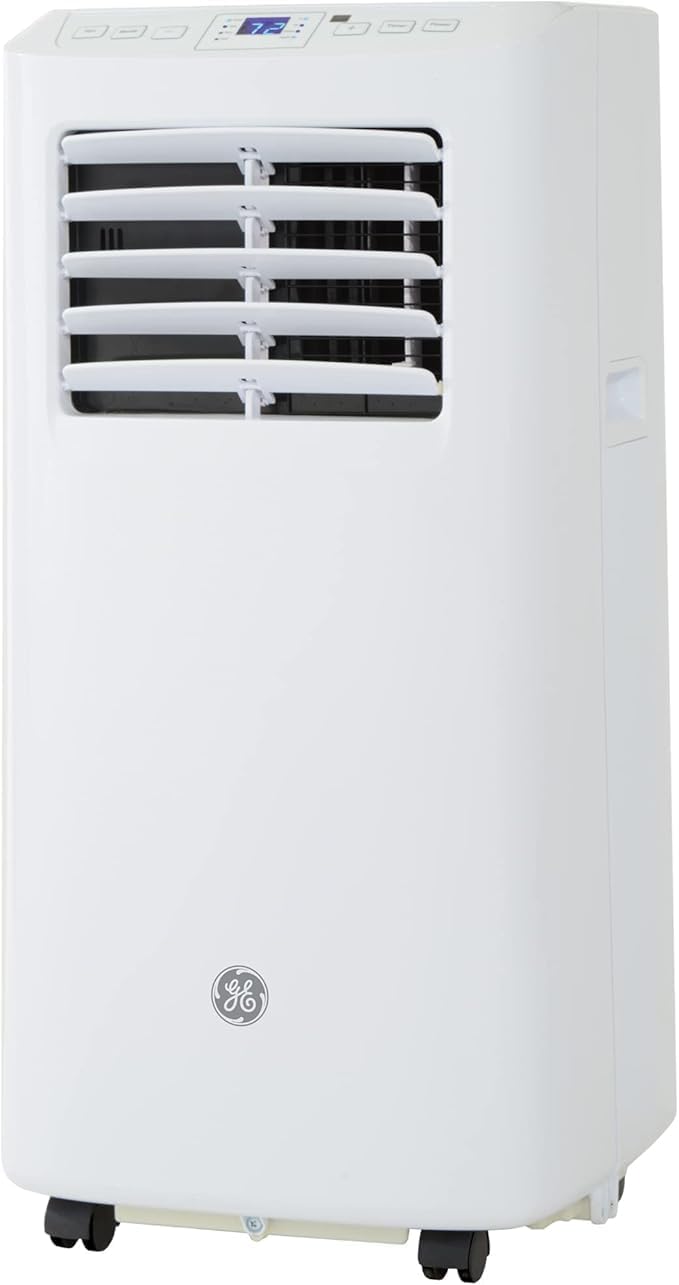
| Cooling Power | 5000 BTU |
|---|---|
| Floor Area | 150 square_feet |
| Wattage | 770 watts |
| Noise | 55 db |
| Refrigerant | R-32 |
This GE 5,000 BTU portable air conditioner is designed to cool single rooms up to about 150 sq ft while also acting as a dehumidifier and fan. It installs with the included EZ window kit, rolls on casters for easy relocation, and is controlled via an LED panel or the supplied remote. The unit uses auto-evaporation under typical conditions to avoid frequent draining, and a washable filter helps maintain air quality. Practical features include a 24-hour timer, sleep mode, auto-restart after power outages, and three fan speeds for finer comfort control. Expect reasonably quiet operation for a portable AC and typical energy use for a 5,000 BTU unit. Limitations are inherent to the size: it is best for small bedrooms or offices and will struggle in larger or poorly insulated spaces, and in very humid climates manual draining can still be necessary during heavy use. The unit runs on standard 115V power and does not include smart/home voice connectivity on this model.
Best for: Buyers who want a straightforward, easy-to-install portable cooling solution for a small bedroom, office, or studio and value simple controls plus low-maintenance operation.
Less Ideal for: Homes needing to cool large rooms, whole-apartment solutions, or users who require smart/Wi-Fi integrated climate control features.
- Compact footprint fits small rooms and moves easily on casters.
- 3-in-1 functionality: cooling, dehumidifying, and fan modes in one unit.
- Auto-evaporation reduces the need for manual drain maintenance in normal conditions.
- Included EZ install window kit requires no cutting and works with common window types.
- Washable filter and remote control simplify upkeep and daily operation.
- Limited cooling capacity suitable only for rooms up to about 150 sq ft.
- May require manual draining in very humid conditions or during extended heavy use.
- No smart home or Wi-Fi connectivity on this model.
Verdict: A compact, easy-to-install 5,000 BTU unit that delivers dependable cooling and dehumidifying for small rooms with minimal day-to-day maintenance.
DREO Portable Air Conditioner 318S

| Cooling Power | 8000 BTU (ASHRAE) / 5000 BTU (DOE) |
|---|---|
| Noise | 45 db |
| Wattage | 1040 watts |
| Controls | App, Remote, Touch, Voice |
| Modes | Cool / Dry / Fan |
The DREO 318S is a compact, smart portable air conditioner aimed at cooling single rooms while offering dehumidify and fan modes. It uses an 8000 BTU ASHRAE compressor (5000 BTU SACC) to cool spaces up to roughly 100 sq ft and includes an auto self-evaporating drainage system that avoids manual draining in most conditions. Controls include a touch display, remote, app with temperature and humidity monitoring, and voice control for Alexa and Google Assistant, which makes scheduling and adjustments convenient. The unit runs at about 45 dB on low and has a four-speed blower and a sleep curve feature to tailor comfort overnight. Practical benefits include easy installation with the supplied window kit, a drain hose for very humid situations, and an included remote. Important limitations are its SACC rating (5000 BTU) which limits effective cooling to smaller rooms, and the absence of inverter technology which can reduce sustained energy efficiency compared with inverter models. For buyers focused on straightforward, app-enabled performance in a bedroom or small living area, the 318S is a capable choice.
Best for: Buyers who prioritize strong real-world cooling performance in a small bedroom or office and want smart controls and convenient, low-maintenance operation.
Less Ideal for: People needing to cool larger rooms or open-plan spaces where higher SACC/DOE capacity or inverter efficiency is required.
- Smart controls via app, remote, touchpad, and voice for flexible operation and scheduling
- Self-evaporating drainage system reduces the need to empty water in normal humidity levels
- Compact portable form with included window mount kit for easy setup
- Multiple modes (cool/dry/fan) and four fan speeds let you tailor performance and comfort
- SACC (DOE) cooling rating of 5000 BTU limits effective cooling to small rooms
- No inverter compressor, so it may use more power during sustained operation
Verdict: A compact, app-enabled portable AC that delivers reliable cooling and low-maintenance operation for performance-focused users in small rooms.
TURBRO Finnmark 8,000 BTU Portable AC

| Cooling Power | 8000 BTU (5,000 BTU DOE) |
|---|---|
| Coverage Area | Up to 300 ft² |
| Wattage | 800 watts |
| Dehumidity Volume | 43 Pints/day |
| Noise Level | <54 dB |
The TURBRO Finnmark is a compact portable air conditioner designed for spot cooling in rooms up to roughly 300 square feet. It combines cooling, dehumidifying and a two-speed fan in a single floor unit with caster wheels and an adjustable window vent kit for quick setup. Notable features include an 8,000 BTU cooling rating (5,000 BTU DOE), an R32 refrigerant, a washable reusable filter, a self-evaporative system with a drain hose for high-humidity situations, and a remote plus timer and sleep mode to reduce interruptions at night. In practice it delivers usable cooling for small to medium rooms and removes a significant amount of moisture when run in dehumidify mode, though it has only two fan speeds and a modest SEER rating. The unit produces noticeable noise at higher output and lacks inverter-driven efficiency, so expect higher energy draw during hot, continuous operation. For someone who needs a portable, all-in-one unit to cool and dehumidify a single room, this model is straightforward and feature-complete, but it is not optimized for whisper-quiet or highest efficiency performance over long periods.
Best for: Buyers who want a straightforward, moveable solution to cool and dehumidify a single room without fuss and who prioritize practical features and easy installation.
Less Ideal for: People seeking the quietest operation, the highest seasonal efficiency, or precise multi-speed airflow control should consider higher-end inverter or multi-speed models instead.
- Combines cooling, dehumidifying and fan functions in one portable unit
- Adjustable window vent kit fits horizontal or vertical windows and is easy to install
- Washable reusable filter helps reduce dust and pet hair buildup
- Self-evaporative design with included drain hose reduces the need to empty a tank
- Remote, timer and sleep mode add convenient control and quieter night operation
- Only two fan/power levels limit fine-grained airflow control
- No inverter compressor so sustained running is less energy efficient than inverter models
- Noise can reach mid-50 dB at higher settings
Verdict: A practical, easy-to-install portable AC that pairs basic cooling and dehumidifying capabilities for single rooms where convenience and versatility matter most.
Antarctic Star Portable Air Conditioner

| Cooling Power | 8500 british thermal units |
|---|---|
| Noise | 46 db |
| Refrigerant | R-600A |
| Voltage | 110 volts |
| Wattage | 780 watts |
This Antarctic Star portable air conditioner combines cooling, fan and dehumidifying in one compact unit aimed at small rooms. It delivers 8500 BTU of cooling power, a 24-hour timer, sleep mode and an LED display with remote control for convenient daily use. The unit includes a dehumidifier mode to remove excess moisture and a 4-way swing to spread air across a room, and it reports a noise level around 46 dB which is reasonable for bedroom use. Setup uses the included installation kit and the refrigerant is R-600A; it runs on standard 110V power and lists annual energy consumption so buyers can estimate operating cost. Trade-offs are its modest water capacity and the typical limitations of portable ACs: it requires venting and takes floor space, and it is heavier than small fans or window units. For someone prioritizing an affordable, no-permanent-install cooling option that also reduces humidity, this unit covers the basics well.
Best for: Buyers seeking an affordable, all-in-one portable cooling solution for small rooms who want simple controls and occasional dehumidifying without permanent installation.
Less Ideal for: People needing silent operation, very large-room cooling, or a lightweight personal cooler for frequent moving between locations should consider other options.
- Combines air conditioner, fan and dehumidifier in one compact unit
- Remote control plus LED display and 24-hour timer for easy operation
- Sleep mode and reasonable noise level suitable for bedrooms
- Includes installation kit for straightforward venting setup
- Requires venting and occupies floor space like other portable ACs
- Relatively heavy compared with smaller personal coolers
- Water tank capacity is small so may need frequent emptying in very humid conditions
Verdict: A budget-friendly, compact portable AC that gives reliable 8500 BTU cooling plus dehumidifying and simple remote operation for small rooms.
Vissani 5,000 BTU Portable Air Conditioner

| Cooling capacity | 5,000 BTU (DOE) |
|---|---|
| Voltage | 115-Volt |
| Recommended coverage | Up to 150 sq. ft. |
This Vissani 5,000 BTU portable air conditioner is a compact unit intended for single rooms or small spaces. It offers basic cooling, an integrated dehumidifier mode, and comes with a remote for convenient control from across the room. Typical use cases are bedrooms, home offices, or small living areas where spot cooling is needed rather than whole-house climate control. The unit claims cooling coverage up to 150 square feet and runs on standard 115-volt power, so it plugs into a typical household outlet. Practical benefits include simple operation, built-in dehumidification to help reduce sticky humidity, and portability for moving between rooms. Expect straightforward setup with the included components and no advanced smart features. Important limitations are its modest cooling capacity, which is best suited to small rooms and will struggle in larger or poorly insulated spaces, and the lack of advanced controls or connectivity for remote scheduling or app integration.
Best for: Buyers who prioritize a simple, dependable room cooler and dehumidifier for a bedroom, office, or small living area and want an appliance that is easy to move and operate.
Less Ideal for: People who need to cool large rooms, open-plan areas, or who want connected features and advanced programming should consider higher-capacity or smart models.
- Compact 5,000 BTU size suited to small rooms
- Includes dehumidifier mode to reduce indoor humidity
- Remote control for convenient adjustments from across the room
- Runs on standard 115-volt household power
- Limited cooling capacity not suitable for larger or poorly insulated rooms
- No smart home connectivity or advanced scheduling features
Verdict: Choose this unit if you want a straightforward, reliable 5,000 BTU portable air conditioner and dehumidifier for cooling single small rooms.
Hisense Portable Air Conditioner AP0522CR1W

| Cooling Power | 5000 BTU |
|---|---|
| Floor Area | 150 square_feet |
| Modes | Cooling, Fan, Dehumidifier |
| Noise | 47 db |
| Power Source | Corded Electric |
The Hisense AP0522CR1W is a compact portable air conditioner designed for small rooms up to about 150 sq ft. It delivers 5,000 BTU of cooling power and includes three operating modes — cooling, fan, and dehumidifier — so you can switch between temperature control, improved air circulation, or moisture removal. The unit uses a drain-free, self-evaporating design and a washable PP filter, which reduces maintenance chores, and it rolls on caster wheels for easy placement. Controls are available via a touch panel or the included remote, and an auto-restart and 24-hour timer add convenience. Expect typical portable-AC trade-offs: it runs at up to about 47 dB so it is noticeable in very quiet rooms, and its SEER rating and airflow efficiency indicate modest energy efficiency compared with larger or inverter models. The corded 115V design is straightforward to set up, but it lacks inverter technology and smart home connectivity. For buyers who want a small, easy-to-use cooler for bedrooms or apartments, this unit covers the basics without complicated setup.
Best for: Buyers who prioritize a simple, low‑maintenance portable cooler for a small bedroom or apartment and want straightforward controls and mobility.
Less Ideal for: People who need highly efficient, whisper‑quiet performance or smart/integrated home control features should consider higher‑end or inverter-equipped alternatives.
- Compact footprint suitable for tight spaces
- 3-in-1 operation: cooling, fan, and dehumidifier modes
- Drain-free, self-evaporating design reduces need for manual draining
- Included remote and touch controls for convenient operation
- Washable removable filter for simple maintenance
- No inverter technology so energy efficiency is moderate
- Operating noise around 47 dB can be noticeable during quiet use
Verdict: A compact, easy-to-use 5,000-BTU portable AC that reliably cools small rooms with low maintenance and simple controls.
Midea Smart Portable Air Conditioner MAP05S1AWT-A

| Cooling Power (ASHRAE) | 8,500 BTU |
|---|---|
| SACC Cooling | 5,000 BTU SACC |
| Coverage | Up to 150 sq. ft. |
| Power | 830 watts |
| Controls | App, Remote, Voice |
The Midea Smart Portable Air Conditioner is a compact 3-in-1 unit that cools, dehumidifies, and circulates air in small rooms up to about 150 square feet. It ships with a window installation kit and a 5 ft exhaust hose so you can roll it into place, attach the hose and adjustable brackets, and begin cooling without special tools. Controls include an LED panel, a compact remote, and Wi‑Fi with app and voice assistant support for scheduling and remote operation. The washable reusable filter is easy to pull out and clean, helping maintain airflow and indoor air quality. Performance is appropriate for bedrooms, small offices, or cabins, and the unit lists a roomside airflow of up to 330 CFM on high. Noise is noticeable at higher settings and the unit is not an inverter design, so expect typical portable AC power draw and steady compressor cycles rather than variable-speed efficiency. Energy ratings and annual consumption are provided for buyers who prioritize running costs. For someone seeking straightforward installation, smart controls, and reliable small-room cooling, this Midea fits the bill; buyers expecting whisper-quiet operation or inverter-level efficiency should consider alternatives.
Best for: Buyers who want a low-risk, easy-to-install portable AC with smart controls and predictable, room-sized cooling for bedrooms or small offices.
Less Ideal for: People who need the quietest possible unit or the highest energy efficiency from an inverter portable air conditioner.
- Includes adjustable window kit and 5 ft exhaust hose for tool-free installation
- Wi‑Fi, app and voice control plus a physical remote for flexible operation
- Washable reusable air filter that is easy to remove and clean
- Compact, rollable portable form factor suited to small rooms up to 150 sq. ft.
- Not an inverter model so compressor runs at fixed speed, which can mean higher energy use during heavy cooling
- Noise level is moderate at higher fan settings and can be noticeable in quiet rooms
Verdict: A dependable, easy-to-install smart portable AC that delivers reliable 5,000 BTU SACC cooling for small rooms with simple app and remote control.
Choosing the Right 5,000-BTU Portable Air Conditioner: Key Factors to Consider
Room Size and Placement
Match a 5,000-BTU portable air conditioner to the square footage you actually need to cool. These units are best for very small rooms—typically compact bedrooms, small home offices, or studio spaces. Placing the unit centrally with an unobstructed airflow path improves comfort and reduces runtime.
Consider doorways, high ceilings, and direct sun exposure when estimating required capacity. A 5,000-BTU unit can struggle if used in open-concept areas or rooms with poor insulation, so measure the space and aim for a realistic expectation of single-room cooling.
Noise and Where You'll Use It
Portable air conditioners produce fan and compressor noise that can be distracting in quiet environments. If you plan to run the unit in a bedroom or study, pay close attention to rated sound levels and whether the unit has distinct low- or sleep-mode settings.
Noise matters more when the unit sits close to your head or work area. Consider distance from the bed or desk and whether you will tolerate fan-only noise overnight. Some units trade extra airflow for higher noise; decide which is more important for your routine.
Installation and Exhaust Options
Most portable units require an exhaust hose and a window kit to vent hot air. The ease of installing that kit—how adjustable the window panel is, how well it seals, and whether the exhaust hose locks on securely—affects both performance and leakage of warm air back into the room.
Also check whether a unit supports vertical and horizontal window orientations, and whether a condensate drain or self-evaporation mode is available. Simpler installation reduces the chance of drafts and improves overall cooling efficiency.
Energy Use and Operating Cost
Even small air conditioners can add to your utility bill if they run continuously. Look at the power draw and any energy-saving features such as programmable timers, eco modes, or thermostatic controls that cycle the compressor effectively.
Higher efficiency reduces runtime and operating cost, which is especially important if you plan to run the unit during the hottest parts of the day or overnight.
Maintenance and Longevity
Maintenance determines how well a portable air conditioner performs season after season. Easy-to-access, washable filters and straightforward condensate management cut the effort required to keep the unit running at peak efficiency.
Consider how often filters need cleaning, whether the unit requires manual draining, and how easy it is to reach serviceable parts. Units with clear maintenance paths will last longer and provide more reliable cooling.
Size, Weight, and Storage
Portability matters when you plan to move the unit between rooms or store it during off seasons. Check the unit dimensions and weight, and whether it includes quality casters or handles that make relocation manageable.
Also think about winter storage. A bulky unit that is difficult to stow will add friction to seasonal use. Compact footprint and detachable hoses simplify storage and keep the unit usable over multiple years.
How 5,000-BTU Portable Units Compare to Other Small Cooling Options
A 5,000-BTU portable air conditioner offers a middle ground between fan-based cooling and larger portable or window units. Unlike a fan, it actively removes heat and lowers room temperature, but it is not intended for large spaces. Compared to fixed window units, portable models prioritize flexibility and easy removal over peak efficiency.
Think about your priorities: if you move frequently or cannot modify windows permanently, a portable unit can provide immediate cooling without changes to your home. If you need to cool more than one small room at once, consider whether moving a single portable unit will meet your needs or if multiple smaller solutions would be better.
- Better than fans for actual temperature reduction
- More flexible than fixed window units
- Works best in single-room or zoned cooling scenarios
Setting Up a Portable AC for Best Performance
Correct exhaust setup is the single most important installation step. Ensure the hose is as short and straight as possible and that the window seal is tight to prevent warm air from leaking back in. Use the included kit and follow any special mounting instructions for sliding or casement windows.
Position the unit away from direct sunlight and obstructing furniture. Elevating it slightly on a stable surface can improve air spread in some rooms. Use fan-only modes to circulate air without cooling when temperatures are moderate.
- Keep exhaust hose short and straight
- Seal the window kit to prevent drafts
- Avoid direct sunlight and obstructions
Dealing With Condensate: Drain, Dump, or Evaporate
Portable units handle condensate in several ways. Some use internal tanks that require periodic manual emptying, while others offer drain ports that let you route water to a nearby sink or floor drain. A few designs use self-evaporation to minimize manual draining, but performance varies with humidity.
If you live in a humid climate or plan extended use, favor units with straightforward drain options or larger tanks. Check how easy the drain access is and whether the fill indicator is visible so you are not surprised by shutdowns.
- Manual tank: simple but requires regular emptying
- Drain port: ideal for longer runtimes
- Self-evaporation: low maintenance in dry climates
Energy Tips to Lower Running Costs
Use programmable timers and thermostats to avoid unnecessary runtime. Setting the unit to maintain a steady temperature is usually more efficient than letting it cycle constantly. Also, pair the unit with basic room-sealing measures such as closing blinds during peak sun and sealing gaps around windows.
Run the unit on lower fan speeds overnight and during cooler parts of the day. If the unit has an eco or economy setting, try it first to see if comfort remains acceptable while consuming less power.
- Program timers to match occupancy patterns
- Seal windows and close blinds to reduce heat gain
- Prefer lower fan speeds when possible
Storage and Off-Season Care
Before storing a portable air conditioner for the off-season, clean or replace filters and fully drain any condensate from the tank and hoses. Allow the unit to dry completely to prevent mold or mildew during storage.
Store hoses and window kits together in a labeled box so reinstallation is quick. Keep the unit in a dry, sheltered spot where it will not be exposed to freezing temperatures or heavy dust accumulation.
- Clean filters and dry all components
- Store accessories together for easy reinstall
- Avoid freezing conditions during storage
How We Chose the Best 5,000-BTU Portable Air Conditioner
We prioritized criteria that matter most for buyers who need a compact, portable cooling solution for small rooms. First, cooling effectiveness at the 5,000-BTU rating was assessed by how well units maintain comfortable temperatures in typical small-room conditions, including airflow design and distribution. Second, noise performance was a major filter because these units are often used in bedrooms and offices where quiet operation matters. Third, installation and portability factors were weighed, including exhaust hookup simplicity, included window kits, caster/wheel quality, and overall unit weight for moving between rooms. Energy efficiency and runtime were included as measurable criteria, focusing on how much power the unit draws relative to its cooling output and how controls support economical operation. Durability and maintenance needs were also considered, emphasizing drain options, filter access, and build quality. We excluded larger-capacity or non-portable air conditioners, and units that require professional installation. Products that lacked clear specification data for cooling area, noise levels, or power consumption were omitted from consideration. The result is a compact shortlist aimed at buyers who need reliable small-room cooling with minimal setup.
Our full evaluation process is outlined in our review methodology.
FAQ
Can a 5,000-BTU portable air conditioner cool a bedroom?
Often, yes. A 5,000-BTU unit typically cools very small bedrooms or single-occupant rooms effectively. Cooling performance depends on room insulation, ceiling height, sun exposure, and device placement, so expect best results in well-insulated, compact spaces.
How loud are these units when running overnight?
Noise varies by model, but many 5,000-BTU portable units feature lower-speed or sleep modes that reduce sound. If quiet operation is a priority, look for units with explicit low-noise ratings or dedicated quiet modes and plan to position the unit farther from the bed.
Do portable air conditioners need to be drained manually?
It depends. Some models collect condensate in an internal tank that requires periodic emptying, while others provide a drain port or use partial self-evaporation. In humid conditions you may need to drain more frequently, so check the unit's drainage options before buying.
Can I run a portable unit in a windowless room?
You can, but you still need to vent the exhaust hose to expel hot air outside. Windowless rooms require a creative venting solution such as a through-the-wall kit or a sealed opening to another vented space. Without proper exhaust, the unit will struggle to remove heat.
Will a 5,000-BTU unit raise my electricity bill significantly?
It may increase usage, but runtime and energy features determine the impact. Using timers, eco modes, and good sealing to reduce heat gain will limit consumption. Because these units are intended for small spaces, they typically draw less power than larger-capacity models.
Final Verdict
For small rooms where portability and simple installation matter most, a 5,000-BTU portable air conditioner is a practical choice. Prioritize models that balance effective small-room cooling with low noise, easy exhaust installation, and straightforward maintenance. Weigh the tradeoffs between quieter operation and faster airflow, and consider how you will install and drain the unit. If you match the unit to your room size and commit to basic sealing and upkeep, you can get reliable, comfortable cooling without a permanent installation.