
Note: This article contains affiliate links. If you click on these links and make a purchase, we may earn a small commission at no extra cost to you. This helps support our research and content. Read our full affiliate disclosure here.
If you have a vertical sliding window, finding an air conditioner that fits, seals, and cools effectively matters more than bargain hunting. The wrong unit can be noisy, leak air, or fail to distribute cool air across the room. This guide collects seven shortlisted air conditioners suited to vertical sliding windows, focusing on units that prioritize secure mounting, effective airflow, and low operational noise. Below you will find the top picks along with the criteria we used to evaluate them, plus practical advice on installation, ventilation, and maintenance. Use this guide to narrow options quickly and pick a model that matches your room size and installation constraints.
Top Picks at a Glance
| Best Overall The best all-around choice for most situations | PerfectAire 10,000 BTU Casement Window AC |  |
| Best Quality Built to a higher standard if you want something more solid | Whynter ARC-14S 14,000 BTU Portable AC |  |
| Best Value The sweet spot between price and what you get | Midea EasyCool 5,000 BTU |  |
| Best Budget The cheapest option that still gets the job done reliably | GE 6,000 BTU Window Air Conditioner |  |
| Top Rated A top-rated pick with lots of positive feedback | Midea U-Shaped 12,000 BTU Window AC |  |
| Most Popular A crowd favorite that many people choose with confidence | Frigidaire 5,000 BTU Window Air Conditioner |  |
| Best Seller A high-volume bestseller chosen again and again | Frigidaire 6,000 BTU Window Air Conditioner |  |
PerfectAire 10,000 BTU Casement Window AC

| Cooling Power | 10000 British thermal units |
|---|---|
| Floor Area | 450 square_feet |
| Refrigerant | R-32 |
| Filter Type | Reusable Filter |
| Control Method | Remote |
This PerfectAire unit is a vertical-chassis 10,000 BTU window air conditioner built to fit narrow sliding or crank-out casement windows without major modifications. It is typically used in medium rooms such as bedrooms, living rooms, or home offices and includes an installation kit, support bracket, and foam seal to simplify mounting. Controls are handled via a soft-touch LED display and a Follow-Me remote that acts as a portable thermostat, while three cooling and fan speeds plus adjustable vents let you direct airflow where you need it. The unit uses R-32 refrigerant and a reciprocating compressor, and it lists a SEER of 12 and about 961 watts power draw, so you get straightforward cooling performance rather than high-efficiency inverter operation. Noise is moderate around 61 dB, and the filter is reusable for easier upkeep. The main compromises are the lack of inverter technology and the unit weight and size that require two people to install, but for a buyer needing a factory-style window solution for vertical openings this model delivers practical, no-frills cooling with useful controls and a follow-me remote.
Best for: Buyers who need a factory-style window AC that fits vertical sliding or crank-out casement windows and want straightforward, room-sized cooling with simple controls and a remote thermostat.
Less Ideal for: People prioritizing the quietest operation or maximum energy efficiency should consider inverter-style or quieter models instead.
- Vertical chassis fits narrow sliding and casement windows without special modifications
- Includes complete installation kit and support bracket for simpler setup
- Follow-Me remote acts as a portable thermostat for more accurate room comfort
- Three cooling and fan speeds with adjustable vents let you direct airflow
- No inverter compressor, so efficiency and variable-speed performance are limited
- Relatively noisy at about 61 dB compared with quieter models
Verdict: If you need a practical 10,000 BTU window AC that installs in narrow vertical sliding or casement openings and offers a portable thermostat, this unit is a solid, ready-to-install choice.
Whynter ARC-14S 14,000 BTU Portable AC

| Cooling Power | 14000 BTU |
|---|---|
| Wattage | 1300 watts |
| Noise | 51 db |
| Floor Area | 500 square_feet |
| Capacity | 71 pints |
The Whynter ARC-14S is a heavy-duty dual-hose portable air conditioner designed for large rooms up to about 500 square feet. Its 14,000 BTU cooling (SACC lower) and dual-hose design deliver stronger, more consistent cooling than single-hose units, while the built-in dehumidifier and patented auto-drain help manage moisture without frequent emptying. It offers three modes—cool, dehumidify, and fan—with full thermostat control and a remote for convenient operation. The unit includes an activated carbon filter and washable pre-filter to improve indoor air quality. Practical benefits include a high dehumidifying capacity and relatively quiet low-speed operation at around 51 dB, plus a solid accessory kit for window installation and storage. Expect a large, heavy unit that needs a proper window vent and a dedicated circuit given its 1300 W draw, and its energy efficiency is moderate rather than top-tier. Setup and mobility are straightforward for a freestanding unit of this size, but it is bulkier than compact portable ACs and consumes notable power under sustained use.
Best for: Buyers who prioritize a dependable, high-capacity portable AC for cooling and moisture control in large rooms and want a unit built for continuous, low-maintenance operation.
Less Ideal for: People who need a lightweight, highly energy-efficient, or purely budget portable AC for small rooms or occasional spot cooling should consider smaller or inverter-based alternatives.
- Dual-hose design for more consistent cooling in large rooms
- Built-in dehumidifier with auto-drain reduces maintenance
- High cooling capacity suitable for ~500 sq ft spaces
- Includes activated carbon and washable pre-filter for better air quality
- Remote and panel controls with three fan speeds for easy operation
- Relatively high power consumption compared with smaller units
- Large and heavy, requires adequate space and a proper window vent
- Not ENERGY STAR rated, so long-term operating costs may be higher
Verdict: A robust, reliability-focused portable AC that pairs strong dual-hose cooling with a high-capacity dehumidifier, making it a sensible choice for cooling and moisture control in large rooms.
Midea EasyCool 5,000 BTU
| Cooling Power | 5000 BTU |
|---|---|
| Floor Area | 150 square_feet |
| Refrigerant | R-32 |
| Filter Type | Washable Filter |
| Control Method | Push Button |
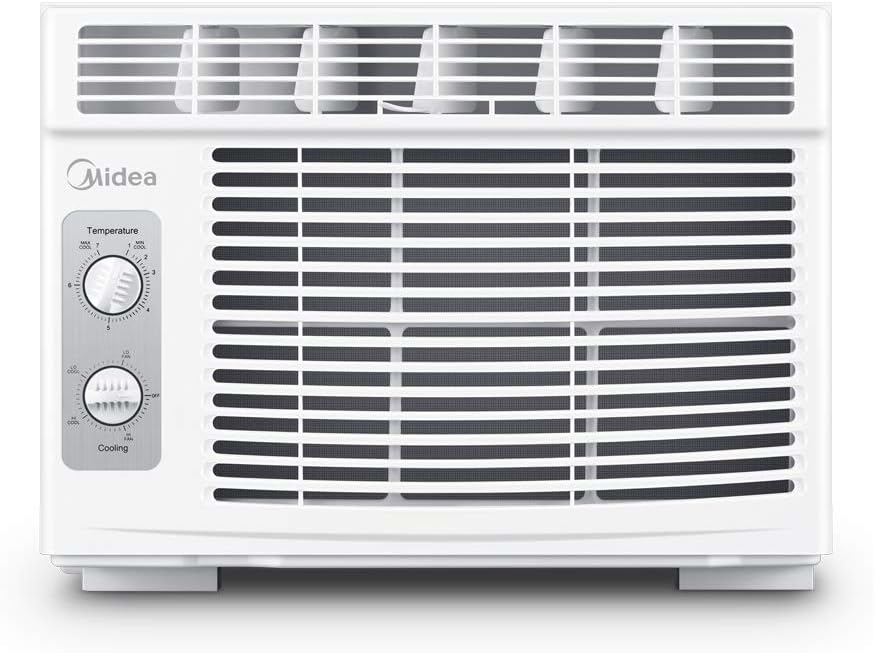
The Midea EasyCool 5,000 BTU is a basic vertical-sliding window air conditioner aimed at cooling small rooms. It uses a rotary compressor with R-32 refrigerant and mechanical push-button controls that let you choose from multiple temperature and fan settings; the unit offers two cooling speeds, two fan-only speeds, and a two-way air outlet for simple directional control. Installation is standard for sliding windows and the package includes a window bracket and mounting hardware. Practical touches include a removable washable filter for easy upkeep and a relatively quiet operation compared with noisy units. Energy performance is average with a CEER/SEER equivalent of 11 and a reported wattage of 450W. Limitations are the lack of inverter technology and no remote or smart controls, so adjustments must be made at the unit, and it is sized only for small rooms up to about 150 square feet. If you want a straightforward, no-frills window AC that is easy to install and maintain for a single room, this model delivers predictable cooling without extra connectivity features.
Best for: Buyers who prioritize straightforward, easy-to-install cooling for a single small room and prefer a low-maintenance, manually controlled unit.
Less Ideal for: People who need smart features, remote operation, or higher capacity cooling for larger rooms or open-plan spaces.
- Compact, fits standard vertical sliding windows and includes mounting bracket
- Washable, removable filter for easy regular maintenance
- Simple mechanical controls that are easy to use without a remote
- Relatively quiet operation for a window unit
- No inverter compressor or smart/remote controls
- Rated for small rooms only (up to ~150 sq. ft.)
Verdict: A simple, easy-to-install window AC that reliably cools a small vertical-sliding window room without smart features.
GE 6,000 BTU Window Air Conditioner

| Cooling Power | 6000 BTU |
|---|---|
| Floor Area | 250 square_feet |
| Wattage | 530 watts |
| Noise | 56 db |
| Refrigerant | R-32 |
This GE 6,000 BTU window air conditioner is a compact, straightforward unit for cooling single rooms such as bedrooms, home offices, or small apartments. It uses an electronic thermostat and LED display to set temperatures from 64°F to 86°F and includes a full-function remote so you can change mode, fan speed, and timer from across the room. Two-way air direction and multiple fan speeds let you shape airflow, and an Energy Saver Eco Mode cycles the compressor to reduce power draw. The unit fits vertical sliding (double-hung) windows 27.125" to 36" wide and installs with the included EZ Mount kit and expandable side panels for a quick DIY setup. Maintenance is simple thanks to a washable reusable filter and a filter reminder. Expect typical window-ac noise at 52 to 56 dBA and a rotary compressor that is reliable but not inverter-quiet, and note there is no Wi‑Fi or smart-home control. For buyers focused on basic, energy-conscious cooling in a vertical sliding window, this unit delivers dependable performance without extra complexity.
Best for: Buyers who want an affordable, no-frills window AC for a vertical sliding window and prioritize straightforward temperature control, easy DIY installation, and lower running costs.
Less Ideal for: People who need smart home integration, ultra-quiet inverter operation, or cooling for larger multiroom spaces should consider other options.
- Effective for small rooms up to 250 sq ft with 6,000 BTU capacity
- Digital thermostat and LED display provide precise temperature control
- Full-function remote and 24-hour timer for convenient operation
- Energy Saver Eco Mode reduces runtime and power use
- Washable reusable filter and EZ Mount kit simplify maintenance and installation
- No Wi‑Fi or smart-home connectivity
- Operates at noticeable sound levels (around 52–56 dBA)
- Not an inverter model, so compressor cycles rather than modulates continuously
Verdict: A simple, budget-friendly window AC that reliably cools single rooms in vertical sliding windows while keeping energy use modest.
Midea U-Shaped 12,000 BTU Window AC

| Cooling Power | 12000 BTU |
|---|---|
| Floor Area | 550 square_feet |
| Refrigerant | R-32 |
| Wattage | 1140 watts |
| Control Method | App, Remote, Touch, Voice |
The Midea U-Shaped 12,000 BTU window air conditioner is built for vertical sliding windows and aims to combine quiet operation, efficient cooling, and smart control. Its U-shaped form lets the sash remain partially open so you keep a view and fresh air while the unit sits in the window, and the included quick-snap bracket and sidearms simplify installation on single- or double-hung windows. The inverter rotary compressor and DC inverter system deliver steady cooling for rooms up to about 550 square feet while running at low noise levels reported around 32 dBA. Wi-Fi, app control, voice commands and a remote give flexible control from anywhere, and the unit lists a CEER/SEER-level efficiency that cuts energy use compared with older designs. Limitations to consider are its weight and bulk typical of high-BTU window units, and the product focuses on cooling and air circulation without integrated heating features on this model. It also requires a compatible vertical sliding window and the specified minimum opening dimensions for proper fit.
Best for: Buyers who prioritize dependable, energy-efficient cooling for vertical sliding windows and value quiet operation and smart remote control.
Less Ideal for: People who need a lightweight portable solution, who require integrated heating, or who do not have a vertical sliding window with the required opening dimensions.
- U-shaped design lets the window remain partly open for fresh air and improved sightlines
- Inverter compressor provides steady cooling and improved energy efficiency
- Multiple control options including app, remote, touch, and voice for convenient operation
- Advertised ultra-quiet operation around 32 dBA for bedroom or living-room use
- Large and heavy typical of 12,000 BTU window units which can make handling and installation awkward
- No built-in heating function on this model
Verdict: For reliable, energy-efficient cooling in vertical sliding windows, this U-shaped 12,000 BTU inverter unit delivers quiet performance and convenient smart controls.
Frigidaire 5,000 BTU Window Air Conditioner

| Cooling Power | 5000 BTU |
|---|---|
| Floor Area | 150 square_feet |
| Wattage | 450 |
| Noise | 52 db |
| Filter Type | Washable |
The Frigidaire FFRA051WAE is a compact window-mounted air conditioner aimed at cooling small rooms such as bedrooms and home offices. It delivers 5,000 BTU of cooling while drawing roughly 450W at 115V, and offers two fan speeds plus effortless temperature control for straightforward daily use. Installation is typical for a vertical sliding window unit: adjustable side panels help fit the opening and the long three-prong cord reduces the need for an extension. The washable filter and simple button/touch controls make upkeep easy, and the unit runs at a listed 52 dBA which is reasonably quiet for overnight use. Energy efficiency is moderate with an SEER/Efficiency rating of 11. Practical limits include the modest cooling capacity — it is best for spaces around 150 sq. ft. — and a rotary scroll compressor rather than an inverter, so it cycles rather than modulates which can affect efficiency in variable loads. For buyers prioritizing straightforward installation, low maintenance, and quiet operation in a small room, this is a sensible choice.
Best for: Buyers who want a proven, easy-to-install window AC for a single small room and who value straightforward controls, low maintenance, and quiet overnight performance.
Less Ideal for: People needing to cool multiple rooms or larger open-plan spaces or those seeking the highest seasonal efficiency and variable-speed inverter performance.
- Compact 5,000 BTU unit suitable for small rooms up to ~150 sq. ft.
- Adjustable side panels and long power cord simplify installation in vertical sliding windows.
- Washable filter reduces replacement cost and is easy to clean.
- Two fan speeds and touch/button controls make operation simple.
- Relatively quiet operation at about 52 dBA for bedroom use.
- Not inverter-equipped so compressor cycles on/off rather than modulating for finer temperature control.
- Limited cooling capacity not suitable for medium or large rooms.
Verdict: A compact, low-maintenance window AC that reliably cools a single small room and installs easily in vertical sliding windows.
Frigidaire 6,000 BTU Window Air Conditioner

| Cooling Power | 6000 BTU |
|---|---|
| Floor Area | 250 square_feet |
| Wattage | 545 watts |
| SEER | 11 |
| Control Method | Remote |
The Frigidaire 6,000 BTU window air conditioner is a straightforward unit for cooling small rooms and bedrooms. It installs in a window and delivers cooling, dehumidifying, and Dry/Eco/Sleep modes with three fan speeds and multi-directional airflow to help spread cool air across a space. The unit includes a washable dust filter with a clean-filter reminder, a 24-hour timer and a handheld remote for convenient adjustments from across the room. It runs on standard 115V power, uses R-32 refrigerant, and reports a moderate noise level around 51 to 52 dB, so it is usable in sleeping areas. Energy performance is modest with an 11 SEER rating and a listed annual consumption figure. The design is simple and serviceable but not inverter-based, so it uses a conventional scroll compressor which can mean steadier energy draw during operation. For buyers who prioritize predictable performance and basic comfort features, this model covers the essentials without complicated setup or smart integrations to manage.
Best for: Buyers who want a reliable, no-frills window unit that is easy to operate and maintain and who prefer predictable, established technology over newer smart or inverter systems.
Less Ideal for: People seeking the highest energy efficiency, ultra-quiet operation for very noise-sensitive rooms, or integrated smart home controls should consider other options.
- Cools rooms up to about 250 sq. ft., suitable for small bedrooms or offices
- Remote control and 24-hour timer for convenient, hands-off operation
- Washable dust filter with filter-clean reminder simplifies maintenance
- Multiple modes including Eco and Sleep help reduce runtime and boost nighttime comfort
- Uses R-32 refrigerant and standard 115V power for typical household compatibility
- Not an inverter model so it cycles on a conventional compressor rather than modulating speed
- SEER and annual energy numbers are average rather than high-efficiency
- Window installation requires a vertical sliding window kit and basic installation work
Verdict: A dependable, easy-to-use window air conditioner that delivers straightforward cooling and simple maintenance for small rooms.
Choosing the Right Air Conditioner for Vertical Sliding Window: Key Factors to Consider
Window Fit and Mounting Hardware
Vertical sliding windows differ from horizontal sash and casement types, so fitment matters. A unit that offers adjustable brackets or a vertical-sash kit reduces the need for custom carpentry and provides a secure mount that prevents sagging.
Look for models with clear instructions for sash sealing, sturdy support brackets, and adjustable side panels or foam inserts sized for vertical openings. Proper fit prevents drafts, water intrusion, and vibration that causes noise. If the window has an unusual sill depth or an angled frame, confirm the unit's compatibility before purchase.
Correct Cooling Capacity
Cooling capacity, typically measured in BTUs, dictates how well an air conditioner can lower and maintain room temperature. Undersized units will run constantly and fail to reach set temperatures, while oversized units will short-cycle, leading to uneven dehumidification and higher wear.
Estimate the room square footage and match it to recommended capacity ranges, accounting for high ceilings, direct sun exposure, or poor insulation. For vertical-window installs, consider that partial obstruction of the cabinet by the sash can slightly reduce effective airflow, so err on the side of proper sizing rather than a marginally smaller unit.
Noise and Fan Control
Because vertical sash installations can place the unit nearer to living areas, noise is an important comfort factor. Look for manufacturer noise ratings and multiple fan speeds so you can choose a quieter setting overnight and a higher setting for rapid cooldown.
Also consider whether the unit has a sleep mode or variable-speed fan; these features reduce audible noise and power draw during light-use periods. Vibration isolation features and firm mounting both reduce perceived noise compared with loosely mounted units.
Energy Efficiency and Controls
Higher efficiency means lower operating costs and less waste heat discharged outside the window. Check available efficiency indicators and the presence of programmable thermostats, timers, or remote controls that allow precise scheduling and temperature management.
Units with better efficiency ratings and smart controls can save energy over a season, particularly in climates requiring extended cooling. Also evaluate whether the unit supports multiple modes (cool, fan-only, dehumidify) to improve comfort without unnecessary compressor cycling.
Installation Complexity and Maintenance
Installation complexity affects total cost and longevity. Some vertical-window kits are truly tool-free, while others need brackets, foam trimming, or minor sash modification. Choose a unit whose installation steps match your skill level or confirm whether professional installation is reasonable for your situation.
Maintenance is equally important. Easy-access filters, clear drainage paths for condensation, and straightforward panel removal for cleaning reduce upkeep time and help the unit run efficiently. Consider how often filters must be cleaned or replaced and whether replacement parts are easy to source.
Durability and Weather Sealing
Vertical-window air conditioners are exposed to weather and temperature swings at the installation point, so corrosion resistance and good sealing matter. A well-sealed unit prevents warm air infiltration, pests, and moisture that can damage the window frame or interior trim.
Inspect fascia and cabinet materials in product specifications for corrosion-resistant finishes and a robust gasket system. Long-term durability also depends on fan motor quality and condenser coil protection, which together affect service life in humid or coastal environments.
Measuring Your Vertical Sliding Window
Before selecting a unit, measure the window opening width and the vertical clearance available with the sash in the down and up positions. Two measurements matter: the interior sill depth and the vertical gap the unit will occupy when the lower sash is closed against it.
Also measure the distance to nearby obstructions like trim, screens, or railings that might limit bracket placement. These dimensions determine whether a model with a screw-in support or a clamp-style bracket will work without modifications.
- Measure inside frame width and height at multiple points for irregular frames
- Note sill depth to ensure the unit's rear cabinet clears the outer trim
- Account for any window hardware that might block a vertical kit
Installation Tips for Secure Mounting
Use the manufacturer-supplied vertical-sash kit when available; it is designed for secure weight distribution and to maintain a tight seal. If the kit is not included, select universal brackets rated for the unit weight and the sash type.
Seal gaps with foam strips or adjustable side panels to prevent air and water infiltration. Ensure the unit tilts slightly downward to the outside so condensate drains away rather than into the window.
- Fasten brackets to solid portions of the window frame, not just the sash
- Check for level and correct outward tilt during installation
- Double-check seal integrity after the first rain or humid day
Ventilation and Airflow Considerations
Proper airflow requires that the unit's louvers and ducting face the main room unobstructed. Furniture, curtains, or blinds can block airflow and reduce effective cooling. Position the unit to aim airflow toward the room's occupants rather than against a wall.
If the vertical opening partially covers the unit, expect some directional changes in airflow. Using the unit's oscillation or adjustable louvers can help distribute air more evenly across the space.
- Avoid covering the front grill with fabrics or obstructive décor
- Use fan speed variation to even out temperature differences
- Consider supplemental fans for tall rooms or irregular layouts
Dealing with Condensation and Drainage
Vertical-window units still produce condensate that must drain properly. Confirm the unit's built-in drainage path and ensure the external side allows water to escape freely. Inadequate drainage can lead to leaks around the sash and potential wood damage.
When mounting, maintain the slight exterior tilt recommended by the manufacturer to assist gravity drainage. For high-humidity environments, inspect the drain path more often and clear blockages promptly.
- Check exterior clearance to ensure water can fall away from the building
- Inspect drain holes seasonally and remove debris
- If a condensate pump is required, plan for power access and routing
Seasonal Removal and Off-Season Storage
If you live in a climate with cold winters, plan for a safe removal and offseason storage process. Store the unit in a dry area and cover it to prevent dust buildup. Empty internal water reservoirs and clean filters before storing.
When reinstalling, inspect seals and foam inserts for compression set and replace them if they no longer form a tight barrier. Reusing degraded seals often causes drafts and reduces seasonal efficiency.
- Label any mounting hardware to simplify reinstallation
- Clean and dry the unit thoroughly before storage
- Replace adhesive foam inserts yearly if they lose resiliency
How We Chose the Best Air Conditioner for Vertical Sliding Window
We evaluated candidate air conditioners for vertical sliding windows using concrete, user-focused filters to ensure practical fit and performance. First, we required clear fitment options and mounting hardware designed for vertical sash windows, because a mismatch here quickly causes leaks and instability. Second, cooling capacity and coverage were assessed against typical room sizes to ensure a unit could reach and maintain comfortable temperatures without constant cycling. Third, noise levels and fan settings were reviewed since vertical window installations often place the unit closer to occupied space. Fourth, we prioritized energy efficiency metrics and available fan/thermostat controls to estimate operating cost and comfort flexibility. Fifth, build quality and ease of installation were considered, including how straightforward the sash sealing and support brackets are. We excluded any units that lack explicit vertical-window mounting guidance or require major window modification. Portable units without secure sash attachments were not considered. Products were selected for practical installability, verified cooling capacity appropriate to room size, reasonable noise ratings, and clear instructions and hardware for safe vertical-sash mounting.
Our full evaluation process is outlined in our review methodology.
FAQ
Can any window air conditioner be installed in a vertical sliding window?
Not always. Units must either include vertical-sash mounting hardware or be compatible with a universal vertical kit. Installing a unit designed solely for horizontal sash windows can create gaps, poor support, and leaks.
How do I know what BTU rating I need for my room?
Estimate required BTUs based on room square footage and adjust for high ceilings, direct sun, or poor insulation. Many manufacturers provide a coverage chart; pick a unit rated for your calculated area rather than undersizing.
Will a vertical-window unit be noisier than other installation types?
Noise depends more on the unit design and mounting quality than strictly on window orientation. However, because these units can sit closer to living space, vibration isolation and secure mounting reduce perceived noise compared with loose installs.
Do vertical-window air conditioners need special maintenance?
Maintenance is similar to other window units: regular filter cleaning, periodic coil inspection, and ensuring drains are clear. Pay special attention to seals and mounting brackets since sash motion and weather exposure can accelerate wear.
Can I install a vertical-window unit myself?
Many people can install these units using the included vertical-sash kit and proper bracing, but complexity varies by window condition and unit weight. If the window frame is weak or the unit is heavy, professional installation is safer.
Final Verdict
Selecting an air conditioner for a vertical sliding window means balancing fit, cooling capacity, and installation practicality. Prioritize models with explicit vertical-sash mounting solutions, appropriate BTU capacity for your room, and good noise control features. Consider installation complexity, drainage, and seasonal storage when making your choice. Ultimately, pick the option that matches your window dimensions and comfort priorities. A properly sized and securely mounted unit will provide reliable, quiet cooling with minimal maintenance and fewer drafts over its service life.