
Note: This article contains affiliate links. If you click on these links and make a purchase, we may earn a small commission at no extra cost to you. This helps support our research and content. Read our full affiliate disclosure here.
If you need reliable cooling for a roughly 500-square-foot room, choosing the right air conditioner matters for comfort, humidity control, and monthly energy use. The wrong unit can run constantly, struggle to reach your set temperature, or waste electricity. This guide shortlists the top five air conditioners for 500 sq ft and explains the practical tradeoffs you should weigh. We evaluate cooling capacity, energy efficiency, noise, and installation practicality so you can pick a unit that fits your room and daily routine.
Top Picks at a Glance
| Best Overall The best all-around choice for most situations | ZAFRO Inverter Portable AC 16000 BTU |  |
| Best Quality Built to a higher standard if you want something more solid | Midea U-Shaped 12,000 BTU AC |  |
| Best Value The sweet spot between price and what you get | DOMANKI Portable Air Conditioner DAC-08CPD-B1 |  |
| Top Rated A top-rated pick with lots of positive feedback | Whynter ARC-14S 14,000 BTU Portable AC |  |
| Most Popular A crowd favorite that many people choose with confidence | Frigidaire 12,000 BTU Window Air Conditioner |  |
ZAFRO Inverter Portable AC 16000 BTU

| Cooling Power | 16000 british thermal units |
|---|---|
| Floor Area | 800 square_feet |
| Noise | 42 db |
| Refrigerant | R-32 |
| Control Method | App, Remote, Touch |
The ZAFRO 16000 BTU inverter portable AC is built to deliver fast, even cooling in large spaces using a dual-hose design and a high airflow rate. It uses an inverter compressor to hold temperature precisely and reduce cycling, and an Extra Mode can push the unit to its lowest setpoint for quick relief during heat spikes. Smart features include app, touch, and remote control plus a 24-hour timer, filter reminders, and sleep mode that reduces noise to about 42 dB. The self-evaporating condensate system lets the unit run drainage-free for up to 72 hours in typical humidity levels, and a drain hose is included for very humid conditions. Energy efficiency is strong for the class with a listed SEER/CEER of 12.8, but expect a heavy, bulky cabinet and the usual portability compromises for a high-capacity unit. Installation requires routing the exhaust and using the included multi-piece window panel, so plan for a short setup and clear window access. For large rooms this model provides robust, smart-controlled cooling but takes up floor space and needs a dedicated window opening for the exhaust setup.
Best for: Buyers who prioritize strong, responsive cooling for large rooms and want smart controls and energy-efficient inverter performance to maintain steady comfort.
Less Ideal for: People who need a compact, lightweight cooler for small rooms or frequent moves between locations should consider smaller, lighter models instead.
- Dual-hose design and high airflow for faster, more even cooling in large rooms.
- Inverter compressor for stable temperature control and improved energy efficiency (SEER/CEER 12.8).
- Smart controls: app, remote, and touch with 24-hour timer and scheduling.
- Self-evaporating system provides up to 72 hours drainage-free operation in normal humidity.
- Multiple modes including Extra and Sleep for rapid cooling or quiet overnight use.
- Large and heavy for a portable unit, requiring dedicated floor space and window access.
- May need active draining in very humid environments despite the self-evaporating feature.
Verdict: Choose this unit if you need powerful, energy-efficient inverter cooling and smart remote control for reliably cooling large rooms.
Midea U-Shaped 12,000 BTU AC

| Cooling Power | 12000 BTU |
|---|---|
| Floor Area | 550 square_feet |
| Wattage | 1140 watts |
| Refrigerant | R-32 |
| Controls | App, Remote, Touch, Voice |
This Midea U-shaped 12,000 BTU window air conditioner uses an inverter rotary compressor and U-shaped chassis to deliver powerful, quiet cooling for large rooms. It is designed for residential windows and cools areas up to about 550 square feet while allowing the window to remain partly open for ventilation. The unit supports app, remote, touch, and voice controls and includes Wi-Fi so you can adjust temperature and fan settings from the SmartHome app or with Alexa and Google Assistant. Notable features include a claimed noise level as low as 32 dBA, DC inverter technology for improved efficiency, and a quick-snap bracket intended to simplify installation. Practical benefits are strong cooling capacity for large spaces, lower operating noise for bedrooms or living rooms, and potential energy savings from the inverter-driven compressor. Important limitations are the need to confirm your window opening dimensions for fit and the lack of a listed built-in heating mode on this model, so it only serves cooling and air circulation functions.
Best for: Buyers prioritizing strong, efficient cooling performance for large rooms who want quiet operation and smart controls for remote or voice operation.
Less Ideal for: People who need a combined heat and cooling window unit or those with unconventional window sizes that may not match the required opening dimensions.
- High cooling capacity suitable for rooms up to ~550 sq ft
- Inverter rotary compressor for quieter operation and improved efficiency
- Multiple control options including app, remote, touch, and voice
- U-shaped design lets the window stay open for fresh air and reduced exterior noise
- No integrated heat function, so it cannot provide warmth in colder months
- Requires verification of window opening dimensions for proper fit
Verdict: Choose this unit if you need quiet, energy-efficient inverter cooling with smart controls for a ~500 sq ft room.
DOMANKI Portable Air Conditioner DAC-08CPD-B1
| Cooling Power | 12000 british thermal units |
|---|---|
| Noise | 48 db |
| Wattage | 1300 watts |
| Floor Area | 500 square_feet |
| Operating Mode | Cooling, Dehumidifying, Air Circulation |
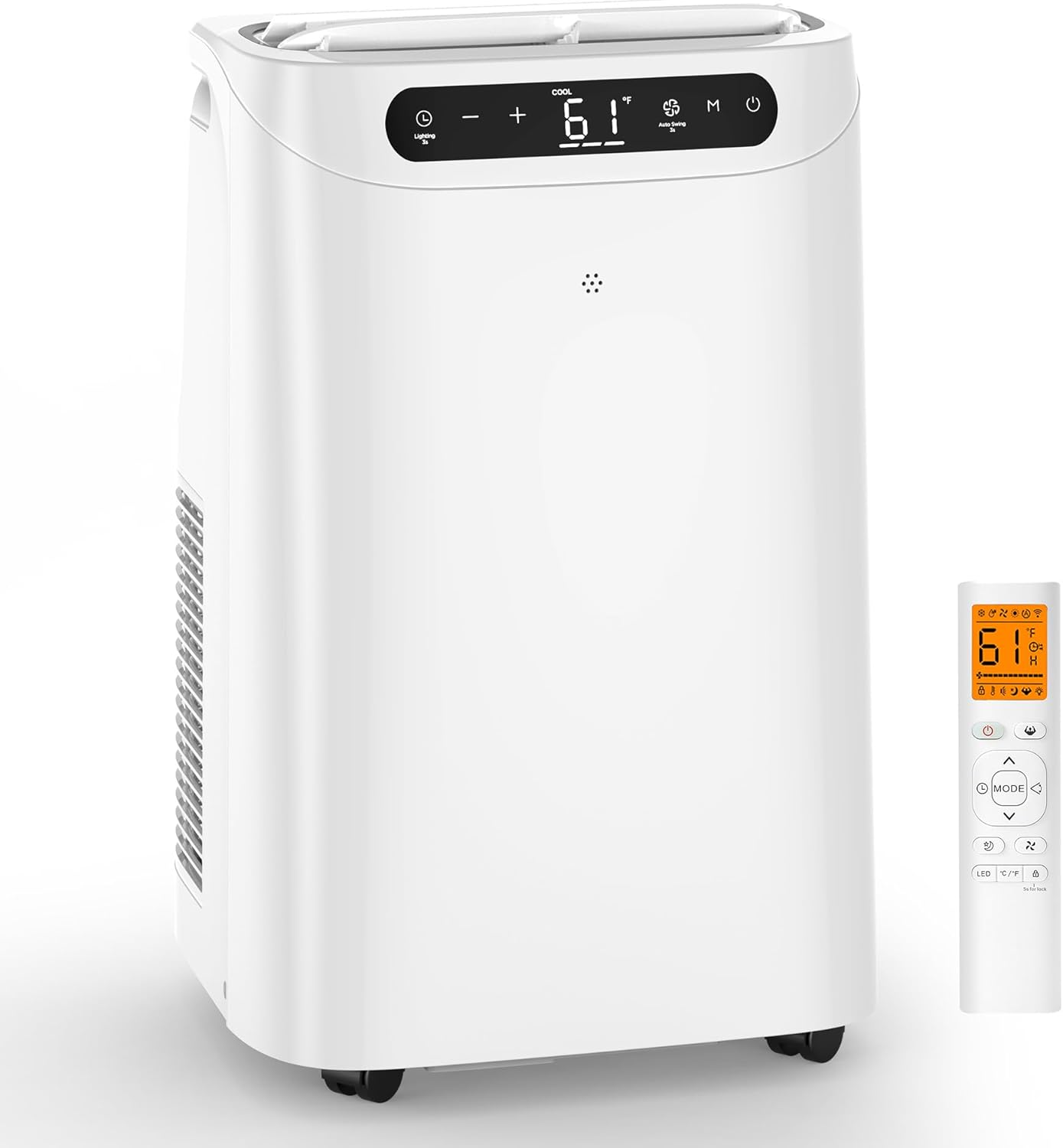
This DOMANKI portable air conditioner is a 3-in-1 freestanding unit that provides cooling, dehumidifying, and air circulation for spaces up to about 500 square feet. It uses a 12,000 BTU (ASHRAE) compressor with a Turbo mode and up to 224 CFM airflow to reach room corners quickly, and it includes a 24-hour timer, sleep mode, auto-swing vents, and child lock for everyday convenience. The unit has a self-evaporating system that reduces the need to empty condensate during normal cooling and a washable reusable filter to avoid frequent replacements. Setup is straightforward with the included window installation kit and exhaust hose, and built-in handles plus 360° caster wheels make it easy to move between rooms. Expect typical portable AC compromises: it is relatively heavy and produces noticeable noise (around 48 dB in sleep mode), and it requires an exhaust connection to the window during cooling which reduces placement flexibility. For buyers prioritizing easy installation, multi-function control, and effective cooling for medium rooms, it is a practical choice.
Best for: Buyers who want a practical, easy-to-install portable AC that cools medium-size rooms efficiently and minimizes ongoing maintenance work.
Less Ideal for: People who need a near-silent solution for small bedrooms or who cannot install an exhaust hose to a window should consider alternate cooling options.
- Designed for rooms up to 500 sq ft with 12,000 BTU (ASHRAE) capacity and Turbo mode for rapid cooling
- Built-in self-evaporation system and washable filter reduce maintenance and running hassles
- Includes full window installation kit, exhaust and drain hoses for quick, tool-free setup
- Multiple modes and controls including 24-hour timer, sleep mode, auto-swing and remote control for convenient use
- Hidden handles and 360° caster wheels make relocating the unit straightforward
- Noticeable noise level around 48 dB which may be audible in quiet bedrooms
- Requires an exhaust hose and window installation during cooling, limiting placement options
Verdict: A reliable, low-maintenance portable AC that delivers strong cooling for 500 sq ft rooms with easy setup and practical controls.
Whynter ARC-14S 14,000 BTU Portable AC

| Cooling Power | 14000 BTU |
|---|---|
| Wattage | 1300 watts |
| Noise | 51 db |
| Floor Area | 500 square_feet |
| Capacity | 71 pints |
The Whynter ARC-14S is a heavy-duty dual-hose portable air conditioner designed for large rooms up to about 500 square feet. Its 14,000 BTU cooling (SACC lower) and dual-hose design deliver stronger, more consistent cooling than single-hose units, while the built-in dehumidifier and patented auto-drain help manage moisture without frequent emptying. It offers three modes—cool, dehumidify, and fan—with full thermostat control and a remote for convenient operation. The unit includes an activated carbon filter and washable pre-filter to improve indoor air quality. Practical benefits include a high dehumidifying capacity and relatively quiet low-speed operation at around 51 dB, plus a solid accessory kit for window installation and storage. Expect a large, heavy unit that needs a proper window vent and a dedicated circuit given its 1300 W draw, and its energy efficiency is moderate rather than top-tier. Setup and mobility are straightforward for a freestanding unit of this size, but it is bulkier than compact portable ACs and consumes notable power under sustained use.
Best for: Buyers who prioritize a dependable, high-capacity portable AC for cooling and moisture control in large rooms and want a unit built for continuous, low-maintenance operation.
Less Ideal for: People who need a lightweight, highly energy-efficient, or purely budget portable AC for small rooms or occasional spot cooling should consider smaller or inverter-based alternatives.
- Dual-hose design for more consistent cooling in large rooms
- Built-in dehumidifier with auto-drain reduces maintenance
- High cooling capacity suitable for ~500 sq ft spaces
- Includes activated carbon and washable pre-filter for better air quality
- Remote and panel controls with three fan speeds for easy operation
- Relatively high power consumption compared with smaller units
- Large and heavy, requires adequate space and a proper window vent
- Not ENERGY STAR rated, so long-term operating costs may be higher
Verdict: A robust, reliability-focused portable AC that pairs strong dual-hose cooling with a high-capacity dehumidifier, making it a sensible choice for cooling and moisture control in large rooms.
Frigidaire 12,000 BTU Window Air Conditioner

| Cooling Power | 12000 BTU |
|---|---|
| Floor Area | 550 square_feet |
| Wattage | 1100 watts |
| Refrigerant | R-32 |
| Control Method | Remote |
This Frigidaire 12,000 BTU window air conditioner delivers straightforward cooling for larger rooms and open-plan spaces. It provides adjustable fan speeds, multi-directional airflow, and a 24-hour timer controlled by a full-function remote, making it easy to tailor comfort without getting up. Built-in modes such as Eco, Sleep, and Dry help reduce energy use and manage overnight comfort or humidity, while a washable dust filter with a filter-clean indicator keeps maintenance simple. The unit uses R-32 refrigerant and a rotary compressor, and Frigidaire rates it for roughly 550 square feet; in practice it cools rapidly in medium-large rooms but can feel less efficient in very tall or poorly insulated spaces. Noise is moderate for the size class and the SEER value is modest, so operating costs may be higher than inverter-style models. Overall, it is a capable, user-friendly window AC if you need reliable cooling for a single large room and prefer simple controls and easy upkeep.
Best for: Buyers who prioritize proven, easy-to-use cooling for a single large room and want a product with clear feature set and service history to reduce purchase risk.
Less Ideal for: Those chasing the lowest possible operating costs, the quietest inverter operation, or multi-room smart HVAC integration should look at alternative technologies.
- Rated to cool up to 550 sq. ft., suitable for large rooms or open areas
- Remote control and 24-hour timer for convenient, hands-off operation
- Eco, Sleep, and Dry modes help manage energy use and overnight comfort
- Washable dust filter with a filter-clean reminder simplifies maintenance
- Uses R-32 refrigerant which is more efficient and has lower global warming potential than older refrigerants
- Non-inverter rotary compressor means less precise temperature control and lower efficiency than inverter models
- Moderate SEER (10.9) and reported annual consumption indicate higher running costs than high-efficiency units
Verdict: A reliable, feature-ready window AC that delivers strong cooling for ~500 sq ft rooms with easy maintenance and straightforward controls.
Choosing the Right Air Conditioner for 500 Sq Ft: Key Factors to Consider
Cooling Capacity and Room Match
Getting the right sized unit is the single most important factor for effective cooling. A system rated for roughly 500 square feet should deliver enough BTUs to quickly reach and maintain target temperatures without running continuously. Oversized units cycle on and off too frequently, which can increase wear and leave humidity uncontrolled. Undersized units run constantly and may never reach set temperatures.
Also consider ceiling height, sun exposure, and open floor plans. Higher ceilings or strong sunlight increase the cooling load and can require a unit with slightly higher capacity to perform well in practice.
Energy Efficiency and Operating Cost
Energy efficiency ratings directly affect how much it costs to run the air conditioner over a season. Units with higher efficiency use less electricity to deliver the same cooling output, which matters if the unit will run for long stretches during hot months. Look for clear efficiency metrics and consider typical daily run times to estimate seasonal cost.
Efficiency also interacts with capacity. A slightly more efficient unit with the correct capacity will usually cost less to operate than an oversized, less efficient model that cycles frequently. Consider features like variable-speed compressors or eco modes that reduce power draw under lighter loads.
Noise Level and Comfort
Noise matters when the conditioned room is a bedroom, home office, or living space where quiet matters. Specified decibel levels give a baseline for comparison, but real-world noise depends on installation and room acoustics. Look for units with multiple fan speeds and quiet modes so you can trade some cooling power for lower sound when needed.
Pay attention to both indoor and outdoor noise sources when selecting a through-the-wall or window-mounted unit. Portable units may produce more noise at ear height, while installed units can isolate much of the compressor noise outside the room.
Installation Type and Practical Fit
How the unit installs will affect performance and convenience. Window or through-the-wall models often provide better efficiency and quieter indoor operation than portable units, but they require a suitable opening and may need professional installation. Portable units are easier to move and require only a single exhaust point, but they typically cost more to run and take up floor space.
Check the required clearance, exhaust routing, and whether your room layout supports the recommended airflow patterns. Easy access for seasonal maintenance is important, especially if the unit will be used heavily.
Controls, Features, and Usability
User controls determine how convenient it is to operate the unit day to day. Programmable thermostats, timers, remote controls, and smartphone integration make it easier to match run times to occupancy and reduce wasted energy. Variable fan speeds and adjustable louvers improve comfort by letting you fine-tune airflow direction and intensity.
Features like washable filters, auto-restart after power loss, and simple diagnostic indicators reduce maintenance friction and speed troubleshooting, contributing to a better ownership experience over time.
Serviceability and Warranty
Durability and ease of service affect long-term value. Units with accessible filters, clear service panels, and common replacement parts are easier and less costly to keep running. Warranty terms offer insight into expected longevity and manufacturer confidence, but the real-world availability of parts and local service options also matters.
Consider how easily a technician can access the compressor, condenser, and electrical components for routine maintenance or repairs. For permanently installed units, factor in installation quality because poor initial setup can shorten useful life.
Sizing Tips for a 500-Square-Foot Room
Estimating the right cooling capacity starts with the room area but should also include factors like ceiling height, sunlight exposure, and how many occupants use the space. For an average-height room with typical sun exposure, choose a unit rated to cover about 500 square feet. If the room gets heavy sun or has high ceilings, round up to the next reasonable capacity step.
Placement matters. Position the unit so it can distribute air across the room rather than blowing directly into a corner. Ensure there is adequate clearance for intake and exhaust to avoid airflow restrictions that reduce effective capacity.
- Account for ceiling height above 8 feet by increasing capacity proportionally
- Add capacity for rooms with large south- or west-facing windows
- Factor in frequent occupancy or heat-generating equipment
Comparing Installation Types
Window and through-the-wall models generally deliver better cooling efficiency and quieter indoor operation because the compressor or condenser is placed outside. These types are a good choice when you need steady, quiet performance and the room has a compatible opening.
Portable units offer flexibility and minimal modification to the room but usually have lower efficiency and higher noise. They are useful for renters or for temporary cooling needs where permanent installation is not possible.
- Window units: good balance of performance and cost, require suitable window and proper sealing
- Through-the-wall units: cleaner look and permanent solution, may require professional install
- Portable units: easy setup, exhaust hose reduces efficiency and occupies floor space
Managing Humidity and Air Quality
Properly sized air conditioners also help control humidity, which improves perceived comfort even at higher temperatures. Units with dehumidification modes or dedicated dehumidify settings remove excess moisture more effectively than continuous cooling cycles alone.
Consider models with effective filtration for dust and pollen if the room is used by allergy sufferers. Removable and washable filters simplify maintenance and help maintain airflow and cooling efficiency over time.
- Dehumidify mode reduces on-off cycling in muggy conditions
- High-efficiency particulate filters improve indoor air quality
- Regular filter cleaning maintains performance and prevents odor buildup
Estimating Operating Costs
Operating cost depends on energy efficiency, local electricity rates, and how many hours per day the unit runs. Use the seasonal efficiency rating and expected daily run time to approximate monthly energy use. Even modest efficiency improvements can add up over a cooling season in a mid-size room.
Programming the unit to run only when needed, using thermostatic control, and maintaining airflow paths reduces runtime and saves energy. Consider supplemental shading and ventilation strategies to lower the cooling load before investing in a higher-capacity unit.
- Calculate cost by multiplying unit power draw by daily run hours and local rate
- Use timers and programmable controls to limit unnecessary run time
- Improve insulation and window coverings to reduce overall cooling demand
Maintenance Basics to Preserve Performance
Routine maintenance keeps an air conditioner operating effectively. Cleaning or replacing filters regularly improves airflow and efficiency. External condenser coils should be kept free of debris, and indoor grilles cleaned to ensure even airflow.
Schedule periodic checks for refrigerant levels and electrical connections if the unit shows reduced performance. Addressing small issues early prevents larger failures and keeps operating costs predictable.
- Clean washable filters monthly during heavy use
- Keep outdoor condenser area clear of leaves and obstructions
- Listen for unusual noises and inspect seals to prevent air leakage
How We Chose the Best Air Conditioner for 500 Sq Ft
We focused on criteria that predict real-world performance in a 500-square-foot space. First, rated cooling capacity was a primary filter: units with appropriate British Thermal Unit (BTU) ratings for the size were considered to avoid underpowered or grossly oversized options. Next, energy efficiency ratings and seasonal performance metrics were prioritized to estimate operating cost and environmental impact in everyday use. Noise levels under typical operating conditions were evaluated because mid-size rooms often double as living or sleeping spaces. Installation and mounting flexibility mattered for usability, including window, through-the-wall, and portable options that fit common room setups. Reliability indicators such as manufacturer-reported durability features, warranty terms, and common-user serviceability were also weighed. We excluded units with ambiguous capacity claims or inadequate ventilation requirements for a 500-square-foot footprint. The final selection balances capacity, running cost, noise, and practical installation to reflect how each unit will behave in normal household conditions.
Our full evaluation process is outlined in our review methodology.
FAQ
How many BTUs do I need for a 500-square-foot room?
You typically want a unit rated to cool roughly that area based on standard conditions, but the exact BTU depends on ceiling height, sun exposure, and occupancy. For rooms with higher heat load, choose a unit with somewhat higher capacity to maintain comfort.
Are portable units effective for cooling 500 sq ft?
Portable units can cool a 500-square-foot room but are often less efficient and louder than installed options. They are most useful for temporary or flexible needs where permanent installation is not possible.
Will a more efficient unit significantly reduce my electricity bill?
Higher efficiency reduces energy consumption per unit of cooling, so it can lower operating costs over time, especially with heavy use. Savings depend on local rates and how many hours the system runs daily.
What maintenance keeps an air conditioner running well in a mid-size room?
Regular filter cleaning or replacement, keeping intake and exhaust areas clear, and periodic checks of refrigerant and electrical connections help maintain performance. Addressing airflow obstructions and cleaning coils extends lifespan and efficiency.
How loud will an air conditioner be in a living or sleeping space?
Noise varies by type and installation. Window and through-the-wall units tend to be quieter inside than portable units because the compressor is outside. Look at published decibel ratings and choose models with quiet or low-speed modes for restful environments.
Final Verdict
For a roughly 500-square-foot room, prioritize a unit with the right cooling capacity, good energy efficiency, and reasonable noise levels. Installation type affects both performance and convenience, so choose the form factor that fits your space and willingness to modify the room. Balance upfront fit with ongoing running costs and maintenance needs. If you focus on matching BTU capacity to your room conditions and selecting efficient, serviceable equipment, you can achieve comfortable, cost-effective cooling for a mid-size space.