
Note: This article contains affiliate links. If you click on these links and make a purchase, we may earn a small commission at no extra cost to you. This helps support our research and content. Read our full affiliate disclosure here.
A through-the-wall air conditioner with heat brings year-round temperature control to rooms without ductwork or space for a PTAC. If you need consistent cooling in summer and efficient electric heat in winter, picking the right unit matters for comfort, energy use, and noise levels. This guide shortlists the top options for durability, heating performance, and straightforward installation so you can find a unit that suits your room size and budget. Below we cover the leading picks and the evaluation criteria used, including heating capacity, energy efficiency, installation demands, and user-facing controls. Use the shortlist to compare features that matter for your space and climate.
Top Picks at a Glance
| Best Overall The best all-around choice for most situations | Durastar DRTHC122XNA1 12,000 BTU |  |
| Best Quality Built to a higher standard if you want something more solid | Cooper & Hunter PTAC 15,000 BTU |  |
| Best Value The sweet spot between price and what you get | OLMO 8,000 BTU Through-the-Wall AC |  |
| Best Budget The cheapest option that still gets the job done reliably | OLMO Through-The-Wall 8,000 BTU |  |
| Top Rated A top-rated pick with lots of positive feedback | Distinctions by Amana PTAC DHP153J35BA |  |
| Most Popular A crowd favorite that many people choose with confidence | TCL 10,000 BTU Through-the-Wall AC Heater |  |
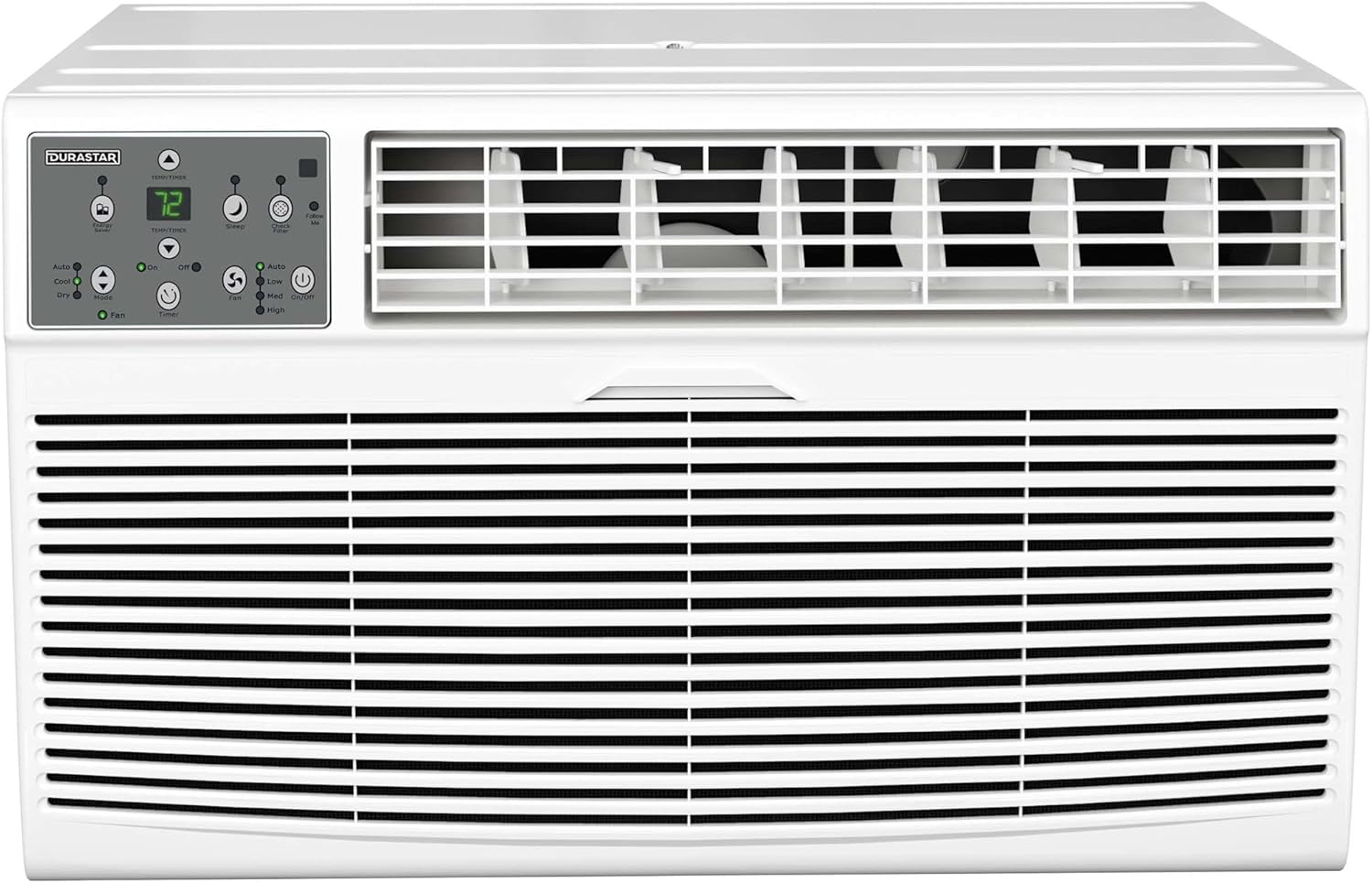
Durastar DRTHC122XNA1 12,000 BTU
| Cooling Power | 12000 british thermal units |
|---|---|
| Heating Power | 10600 BTU |
| Voltage | 230 volts |
| Wattage | 1495 watts |
| Noise | 65.4 db |
The Durastar DRTHC122XNA1 is a through-the-wall HVAC unit that provides 12,000 BTU cooling and 10,600 BTU supplemental heating for year-round use in homes. It is typically mounted through an exterior wall sleeve and controlled via the included remote or the touch control panel, making day-to-day operation straightforward. Notable features include a NEMA 6-20P compatible power design for 208/230V installations, a digital display, timer and multiple fan speeds for tailored comfort, and a two-year manufacturer warranty. In practice the unit cools and heats spaces in the roughly 450 to 550 square foot range, and it removes moisture while running to help reduce indoor humidity. Expect moderate running noise at higher fan settings and a need for a proper through-wall sleeve for secure installation. The unit is a practical choice when you want an integrated heating option alongside cooling without adding a separate heater, but it requires a compatible 230V circuit and professional or confident DIY installation for the through-wall fit.
Best for: Buyers who want a single, space-saving wall-mounted unit that provides both reliable cooling and supplemental heat for medium to large rooms and who are comfortable arranging the required electrical and sleeve installation.
Less Ideal for: People without access to a 208/230V circuit or those who need a very quiet or portable solution should consider other HVAC options.
- Provides both cooling (12,000 BTU) and supplemental heating (10,600 BTU) for year-round use
- Includes remote control and touch controller for easy, convenient operation
- Designed for through-the-wall installation to save window space and provide a more finished look
- Supports 208/230V NEMA 6-20P power for stable, higher-voltage operation
- Higher noise level on maximum fan settings compared with quieter split systems
- Requires a compatible 230V circuit and proper through-wall sleeve for installation
Verdict: Choose this through-the-wall unit if you need a compact, year-round heater-and-cooler that fits a medium-to-large room and can be hardwired to 230V power.
Cooper & Hunter PTAC 15,000 BTU

| Cooling Power | 15000 british thermal units |
|---|---|
| Capacity | 1.25 tons |
| Floor Area | 800 square_feet |
| Seasonal Energy Efficiency Ratio (SEER) | 20 |
| Power Source | Corded Electric |
This Cooper & Hunter PTAC is a high-capacity through-the-wall unit designed to cool or heat a single room efficiently. It combines a 15,000 BTU heat pump with a 3.5 kW electric heater and R‑32 refrigerant so the unit handles warm-season cooling and cold-weather backup heat. Typical installs are in hotel rooms, suites, apartments, dorms, or small commercial spaces where wall-mounted, all-in-one climate control is required. Notable features include app and remote control via the included wireless smart kit, an inverter compressor for more consistent performance, and a pre-filter for basic air protection. The unit claims a SEER of 20 for good seasonal efficiency and is engineered for 230/208V with a 20A plug. Practical benefits are strong single-room capacity, remote management for preconditioning or property management, and multi-mode operation (cooling, heating, fan, dehumidify). Limitations are the need for a compatible wall sleeve and exterior grille for new installs, a relatively high noise figure around 56 dB, and the physical weight and freight delivery considerations that make DIY installation difficult for many owners.
Best for: Buyers who prioritize strong single-room performance and year-round climate control for rentals, suites, or multi-unit properties and who want smart remote management for convenience and property-level control.
Less Ideal for: People needing a silent system for a bedroom or users without an existing wall sleeve or access to professional installation; it is not suited to whole-house cooling.
- Powerful 15,000 BTU cooling with integrated heat pump and 3.5 kW electric heater for year-round use
- WiFi-enabled smart kit plus remote allows app control and remote preconditioning
- Inverter compressor and 20 SEER rating for improved efficiency and steadier temperature control
- Designed for packaged through-the-wall installation suited to hotels, apartments, and similar spaces
- Requires a wall sleeve and exterior grille for new installations which are not included
- Noise level around 56 dB may be noticeable in quiet rooms
- Heavy unit and freight delivery make installation and placement more complex
Verdict: Choose this PTAC when you need a high-capacity, smart-controlled through-the-wall unit that delivers reliable heating and cooling for single rooms or rental units.
OLMO 8,000 BTU Through-the-Wall AC

| Cooling Power | 8000 british thermal units |
|---|---|
| Heating Capacity | 4,200 BTU/h |
| Refrigerant | R-32 |
| Voltage | 115 volts |
| Installation Type | Through The Wall |
The OLMO 8,000 BTU Through-the-Wall unit is a compact heating and cooling system designed to install directly through an exterior wall and serve single rooms like apartments, bedrooms, or small offices. It cools at 8,000 BTU and offers a 4,200 BTU heat mode, with multiple fan speeds, sleep mode, timer, and a remote for basic daily control. Built-in smart connectivity and voice/app control let you adjust settings remotely, and the included wall sleeve simplifies a clean installation. The unit uses R-32 refrigerant and a rotary scroll compressor for standard reliability, and noise is listed around 52 dB which is typical for through-the-wall designs. Expect straightforward operation and decent temperature control for modest spaces, though it is not an inverter model so efficiency and quieter variable-speed operation are limited. The package includes a remote and a built-in smart kit but buyers should confirm the 115V circuit compatibility before installation and plan for professional mounting if they lack wall-cutting experience.
Best for: Buyers who want a practical, space-saving heating and cooling solution for a single room and value included smart control and a wall sleeve for easier installation.
Less Ideal for: Those seeking the quietest or most energy-efficient variable-speed system for larger spaces or continuous operation should consider inverter-style or larger-capacity alternatives.
- Combined cooling and electric heat in one through-the-wall unit for year-round use
- Built-in smart kit with app and voice control plus traditional remote and buttons
- Includes wall sleeve for a neater, more secure installation
- Multiple fan speeds, sleep mode, and timer for flexible comfort settings
- Not an inverter model, so it runs at fixed compressor speeds which can reduce efficiency and increase noise compared with variable-speed units
- Noise level around 52 dB may be noticeable in very quiet rooms
Verdict: A practical through-the-wall heater and air conditioner that delivers year-round comfort with smart controls and an included sleeve for buyers who need a straightforward room solution.
OLMO Through-The-Wall 8,000 BTU

| Cooling Power | 8000 BTU |
|---|---|
| Heating Capacity | 4200 BTU |
| Voltage | 115 volts |
| Refrigerant | R-32 |
| SEER | 9.6 |
The OLMO through-the-wall unit combines cooling and supplemental heat in a compact packaged design intended for apartments, small offices, or hotel rooms. It offers 8,000 BTU cooling and 4,200 BTU heating, basic push-button controls with LED display, an included remote, and smartphone/voice control via the built-in smart kit. The unit uses R-32 refrigerant and a rotary scroll compressor and is intended for 115V circuits. Typical use scenarios are cooling a single room or providing spot heat during shoulder seasons; the self-evaporating system and timer/sleep modes make overnight operation straightforward. Practical benefits include remote and app control for convenience, an included remote for immediate use, and a relatively small footprint for through-the-wall installation. Important limitations are modest SEER (9.6) compared with high-efficiency heat pumps, a noticeable noise figure listed at 52 dB, and the wall sleeve is sold separately which adds to installation cost and effort. This is a functional, budget-minded through-the-wall option when you need combined cooling and basic heating without the complexity of a split system.
Best for: Buyers who need an affordable, all-in-one through-the-wall unit for a single room and value simple smart control and a basic heat function without wanting a more complex split system.
Less Ideal for: People seeking the quietest operation or highest seasonal efficiency for long-run heating and cooling should consider higher-efficiency heat pump options instead.
- Combined cooling (8,000 BTU) and heating (4,200 BTU) in one packaged unit
- WiFi, app, voice, and remote control for convenient operation
- Uses lower-GWP R-32 refrigerant
- Includes remote control and features like timer, sleep mode, and auto restart
- Modest seasonal efficiency (SEER 9.6) compared with higher-efficiency alternatives
- Listed noise level around 52 dB may be noticeable in quiet rooms
- Wall sleeve is not included and must be purchased separately
Verdict: A budget-friendly through-the-wall unit that delivers simple WiFi-enabled cooling plus basic heat for single rooms without requiring a separate outdoor split system.
Distinctions by Amana PTAC DHP153J35BA

| Cooling Power | 14,500 BTU (listed cooling range up to 14,700) |
|---|---|
| Heating Capacity | 13,200/13,500 BTU (heat pump) + 3.5 kW electric |
| Refrigerant | R-32 |
| Voltage | 230 volts |
| SEER | 10.6 |
This Distinctions by Amana PTAC combines a heat-pump with electric backup to deliver year-round comfort in hotel rooms, apartments, or similar spaces. It cools with up to about 14,500 BTU and offers heat-pump heating plus a 3.5 kW electric strip for emergency heat, so it keeps a room warm even in colder conditions. Practical controls include three fan speeds, fan-only mode, remote and app control, and a push-button interface for straightforward operation, while washable front-access filters simplify maintenance. The unit uses R-32 refrigerant and reports solid efficiency numbers (EERs up to 13.1 and SEER 10.6), which helps lower operating costs compared with older refrigerants. Installation fits a standard 42 inch PTAC sleeve and includes a 20 A power cord and mounting hardware, but note that the sleeve and rear grille are sold separately and professional mounting is often required. Noise is relatively low and the condensate dispersion and freeze protection add reliability for continuous use. This is a robust, serviceable choice when dependable, year-round HVAC is the priority.
Best for: Buyers who prioritize a dependable, serviceable through-the-wall unit that delivers continuous heating and cooling with straightforward controls and easy maintenance.
Less Ideal for: Customers seeking the quietest, most energy-optimized inverter PTAC or those who need a complete sleeve-and-grille installation kit included.
- Provides both heat-pump heating and 3.5 kW electric emergency heat for true year-round operation
- Uses lower-GWP R-32 refrigerant and reports higher EER/SEER efficiency than many older PTACs
- Includes remote and app control plus simple push-button interface for easy operation
- Washable, front-access filter and condensate dispersion reduce maintenance and downtime
- Ships with power cord and mounting hardware for faster installation into a standard PTAC sleeve
- Sleeve and rear grille are not included so additional parts or professional installation may be required
- No inverter compressor; unit uses a reciprocating compressor which can be less efficient and noisier than inverter-driven designs
Verdict: Choose this Amana Distinctions PTAC when you need a reliable, low-maintenance through-the-wall unit that provides consistent heating and cooling year-round.
TCL 10,000 BTU Through-the-Wall AC Heater

| Cooling Power | 10000 BTU |
|---|---|
| Voltage | 230 volts |
| Wattage | 980 watts |
| Seasonal Energy Efficiency Ratio (SEER) | 9.7 |
| Filter Type | washable and reusable filter |
The TCL 10,000 BTU through-the-wall unit combines cooling, heating, and dehumidifying in a single wall-mounted package intended for rooms up to roughly 350–450 sq ft. It works with the TCL Home app and voice assistants for remote scheduling and adjustments, and the included remote and LED display make everyday control straightforward. The unit offers multiple fan speeds, 4-way ventilation with multidirectional louvers for more even airflow, and an Eco and Sleep mode to reduce energy draw during light-load periods. A washable reusable filter helps capture dust and pet hair and is simple to maintain. Practical downsides are its reported noise level around 57 dB and a modest SEER rating, so it is not the quietest or the most efficient option for continuous heavy cooling; installation requires a compatible sleeve and through-the-wall mount which is more permanent than a window unit. For buyers focused on a single, year-round wall solution with smart controls, this model is a capable choice with typical through-the-wall trade-offs.
Best for: Buyers seeking a single through-the-wall unit that provides heating, cooling, and smart remote control for year-round comfort and who value documented real-world features and setup guidance.
Less Ideal for: People who need the quietest possible operation or the highest seasonal efficiency, or those who prefer non-permanent window installations.
- Provides both cooling (10,000 BTU) and heating (9,800 BTU) for year-round use
- Wi‑Fi, app control, and Alexa/Google Assistant compatibility for remote and voice control
- Built-in dehumidifier/dry mode improves comfort and indoor air quality
- Washable reusable filter reduces maintenance cost and catches large particles
- Multiple fan speeds and 4-way ventilation promote more even air distribution
- Listed SEER (9.7) is modest compared with higher-efficiency units
- Noise stated around 57 dB which may be noticeable in quiet rooms
- Requires a through-the-wall sleeve and more permanent installation than a window unit
Verdict: A versatile through-the-wall AC/heater with smart controls and dehumidifying that delivers year-round comfort for medium to large rooms.
Choosing the Right Through-the-Wall Air Conditioner with Heat: Key Factors to Consider
Heating Capacity and Room Size
Heating capacity determines whether a through-the-wall unit can maintain comfortable temperatures in your space. Look at the unit's rated heat output in BTU or kilowatts and match it to your room's square footage while accounting for ceiling height, insulation quality, and window area.
Undersized units will struggle to cycle on and off rapidly and leave rooms cold during extended outdoor lows. Oversizing increases upfront cost and can cause short cycling that reduces comfort and may increase wear. Consider climate severity and whether the unit will be the primary heat source or a supplemental one when choosing capacity.
Energy Efficiency and Operating Cost
Efficiency affects both monthly bills and comfort during extended use. Compare published efficiency metrics for cooling and any seasonal metrics available for heat mode. For electric-resistance heat, examine estimated operating wattage and typical runtime to gauge likely energy use.
Higher-efficiency components, programmable thermostats, and multi-stage fans can reduce cycling and lower overall consumption. Keep in mind that efficiency numbers are most useful when paired with your local electricity rates and expected hours of operation.
Installation Requirements and Wall Cutout
Through-the-wall units require a proper opening, sleeve, and adequate structural support. Check the required wall thickness range, sleeve dimensions, and clearances for service access before buying. Some units are designed for thinner walls and come with adjustable sleeves, while others need thicker masonry or stud framing.
Simple mechanical and electrical hookups reduce installation time and cost. If you plan to DIY, confirm you have the tools and skills to create the cutout, install the sleeve securely, and make the electrical connection to a dedicated circuit if required.
Noise Levels in Heating and Cooling Modes
Noise matters especially in bedrooms, home offices, and living spaces. Look for published decibel ratings for both heating and cooling operations and note the fan speed settings and any quiet or sleep modes. A lower-rated unit may still be obtrusive at high fan speeds, so pay attention to how manufacturers specify sound at different settings.
Also consider vibration isolation and cabinet build quality, which influence perceived sound. If silence is a priority, search for models with proven quiet operation and adjustable fan stages to balance comfort with background noise.
Controls, Thermostat Accuracy, and Features
Good controls let you maintain steady comfort and avoid wasted runtime. Evaluate whether the unit has a digital thermostat, programmable schedules, remote control, or Wi-Fi connectivity. Thermostat accuracy is important for heat mode because simple on/off thermostats can produce temperature swings.
Additional practical features include auto-restart after power loss, frost protection in heat mode, and straightforward filter access. Choose a control suite that matches how you plan to use the unit daily.
Sizing the Right Unit for Your Climate
Selecting the correct capacity requires balancing room heat loss with the unit's rated output. In mild climates a slightly smaller unit can suffice, while colder regions need higher heating capacity to maintain comfort during low outdoor temperatures.
Account for insulation, number and size of windows, and whether the room is exposed to wind or sun. When in doubt, err on the side of slightly higher heat capacity if the unit will serve as primary heating. Also consider whether you need supplemental heating for short cold spells rather than continuous deep-winter performance.
- Measure room square footage and ceiling height for an accurate load estimate
- Factor in insulation and window area to adjust required BTU
- Consider supplemental heat sources if you expect severe cold
Electrical and Circuit Considerations
Through-the-wall units with integrated heat often require a dedicated circuit and specific amperage. Review the electrical requirements listed by the manufacturer before purchase. If the unit needs direct wiring rather than a plug, plan for professional electrical installation.
Confirm the location of your electrical panel and whether additional wiring or a new circuit breaker is needed. Proper wiring avoids nuisance tripping and ensures the heater can run at full capacity when required.
- Verify voltage and amperage requirements
- Plan for a dedicated circuit if mandated
- Check whether the unit offers a plug-in option or requires hardwiring
Maintaining Performance Over Time
Routine maintenance keeps both heating and cooling performance stable. Clean or replace air filters regularly to maintain airflow and efficiency. Inspect the cabinet and sleeve annually for seal integrity and moisture intrusion.
Schedule professional servicing if you notice reduced heating output or unusual noises. Promptly addressing minor issues lengthens equipment life and keeps operating costs predictable.
- Clean filters every 1 to 3 months depending on use
- Check seals around the sleeve to prevent drafts
- Look for corrosion or debris on external coils during seasonal checks
Noise Control and Placement Tips
Placement affects both perceived noise and heating effectiveness. Mount the unit so the indoor discharge is directed away from sleeping or working areas when possible. Use available sleep or low-noise modes during nighttime operation.
Consider sound-dampening measures in the room, such as rugs, curtains, and upholstered furniture, to reduce reverberation. Properly securing the sleeve and using vibration isolation can reduce rattles and structure-borne noise.
- Aim airflow away from beds and desks for quieter nights
- Use vibration pads or properly torque mounting bolts to reduce rattles
- Employ soft furnishings to absorb ambient sound
When to Choose a Unit With Advanced Controls
Advanced control options like programmable schedules, adaptive thermostats, or Wi-Fi can improve comfort and reduce runtime. If the unit will heat living areas or be operated remotely, these features make it easier to preheat or maintain setpoints without manual intervention.
However, advanced controls add complexity. For users who prefer simple, reliable operation, a straightforward digital thermostat and remote may be sufficient.
- Programmable schedules reduce unnecessary runtime
- Wi-Fi access enables remote adjustment but requires secure setup
- Consider user interface simplicity for household members
How We Chose the Best Through-the-Wall Air Conditioner with Heat
We focused on through-the-wall air conditioners with built-in electric heat that deliver genuine year-round climate control for individual rooms. Our editorial filters prioritized units that provide measurable heating capacity alongside reliable cooling, using specifications that matter to buyers rather than marketing claims. Key evaluation criteria included declared heating output relative to room size, integrated thermostat accuracy and control modes, energy efficiency ratings and estimated operating cost, noise levels in both heating and cooling modes, and the practicalities of through-the-wall installation and service access. We also assessed durability indicators such as robust cabinet construction and accessible filters for routine maintenance. We excluded units that require substantial ductwork, external heat sources, or conversion kits to provide heat because those do not meet the single-unit through-the-wall scope. Heavy emphasis was placed on documented heating performance, ease of installation, and user controls, since those drive real-world usability for owners seeking both cooling and electric heating in one compact package.
Our full evaluation process is outlined in our review methodology.
FAQ
Can a through-the-wall air conditioner with heat replace a central heating system?
Often it depends on the room and climate. These units can heat individual rooms effectively but are usually not designed to replace a whole-house central heating system in cold climates. They work best as primary heat for single rooms or as supplemental heat in milder regions.
Do through-the-wall units with heat need a dedicated electrical circuit?
Many models do require a dedicated circuit or specific amperage, especially those with higher heating output. Check the electrical specifications before installation and plan for professional wiring if hardwiring is required.
How noisy are these units when running in heat mode?
Noise varies by model and fan speed. Manufacturers usually publish decibel ratings for different modes. Choosing a unit with a low-noise or sleep setting and using vibration isolation can significantly reduce perceived sound.
Are through-the-wall units hard to install?
Installation difficulty depends on wall construction and whether a sleeve is already present. Straightforward installs in framed walls with an appropriate sleeve are manageable for competent DIYers, but masonry or structural alterations and electrical hookups often require professional help.
What maintenance keeps heat performance consistent?
Regular filter cleaning or replacement, checking seals around the sleeve, and seasonal inspections of the cabinet and coils maintain performance. Address reduced heat output or odd noises promptly to avoid larger failures.
Final Verdict
Choose a through-the-wall air conditioner with heat by prioritizing the capacity that matches your room and climate, the electrical setup you can support, and the level of control you want for daily use. Balance heating output against noise and installation complexity to find the best fit for long-term comfort. Focus on units with clear performance specifications, simple maintenance access, and the control features you will use most. That approach helps you pick a dependable through-the-wall solution that delivers year-round comfort with predictable operating costs.