
Note: This article contains affiliate links. If you click on these links and make a purchase, we may earn a small commission at no extra cost to you. This helps support our research and content. Read our full affiliate disclosure here.
When you spend nights outdoors or in an RV, the right air conditioner for camping can make hot evenings comfortable and keep humidity manageable. You want gear that cools effectively, runs quietly, and fits into limited campsite space or vehicle venting. This guide shortlists the seven best portable and vehicle-compatible air conditioners for camping. We evaluated units on cooling capacity, energy use, noise, and setup practicality so you can choose the option that works best for your tent, camper, or rooftop setup. Read on for concise buying guidance and the features that matter most.
Top Picks at a Glance
| Best Overall The best all-around choice for most situations | Somokg 11,000 BTU RV Air Conditioner |  |
| Best Quality Built to a higher standard if you want something more solid | Whynter ARC-14S 14,000 BTU Portable AC |  |
| Best Value The sweet spot between price and what you get | GarveeLife 8,000 BTU Portable AC |  |
| Best Budget The cheapest option that still gets the job done reliably | Poweel ZF06 Portable AC |  |
| Top Rated A top-rated pick with lots of positive feedback | KoolSiln HAC-902WF 14,000 BTU Portable AC |  |
| Most Popular A crowd favorite that many people choose with confidence | BLACK+DECKER Portable Air Conditioner BPACT08WT |  |
| Best Seller A high-volume bestseller chosen again and again | Frigidaire FFRA051WAE 5,000 BTU AC |  |
Somokg 11,000 BTU RV Air Conditioner

| Cooling Power | 11000 BTU |
|---|---|
| Heating Power | 4500 BTU |
| Voltage | 12 volts |
| Power Source | Battery Powered |
| Noise | 35 db |
This 12V rooftop RV air conditioner is built for off-grid camping and small camper vans, delivering 11,000 BTU of cooling and a 4,500 BTU heating option from a battery-powered system. It installs through a standard 14" x 14" roof opening and is compact and lightweight for a rooftop unit, which helps reduce wind drag and makes DIY install easier with the included hardware kit. The unit emphasizes low startup surge with a soft-start function and offers an Eco mode that stretches runtime on a large lithium battery bank; the manufacturer suggests a 300Ah+ battery for several hours of cooling. Controls include a digital LED panel and full-function remote with multiple fan speeds and modes for sleep or eco operation. At about 35 dB reported noise it aims for quiet operation suitable for camping. Important limits are its high continuous current draw and dependence on a properly sized battery system for meaningful runtime, and the quoted cooling area is best for medium-sized vans and trailers rather than large RVs.
Best for: Campers who prioritize true off-grid cooling and want a rooftop unit that runs directly from a 12V battery setup and is sized for medium vans, truck campers, and travel trailers.
Less Ideal for: Travelers without a substantial battery or solar charging system or those who need full-time cooling for very large RVs should consider alternative shore-power or higher-capacity solutions.
- Runs directly from 12V battery systems without an inverter
- Soft-start reduces startup surge for gentler battery demand
- Compact, lightweight rooftop design fits standard 14" x 14" openings
- Quiet operation rated around 35 dB for low disturbance while camping
- Requires a large battery bank to reach the multi-hour runtimes quoted
- High rated current means frequent charging or large battery/inverter support for extended use
Verdict: A practical choice for off-grid campers who need a quiet, rooftop 12V air conditioner that runs directly from batteries and balances cooling power with portable installation.
Whynter ARC-14S 14,000 BTU Portable AC

| Cooling Power | 14000 BTU |
|---|---|
| Wattage | 1300 watts |
| Noise | 51 db |
| Floor Area | 500 square_feet |
| Capacity | 71 pints |
The Whynter ARC-14S is a heavy-duty dual-hose portable air conditioner designed for large rooms up to about 500 square feet. Its 14,000 BTU cooling (SACC lower) and dual-hose design deliver stronger, more consistent cooling than single-hose units, while the built-in dehumidifier and patented auto-drain help manage moisture without frequent emptying. It offers three modes—cool, dehumidify, and fan—with full thermostat control and a remote for convenient operation. The unit includes an activated carbon filter and washable pre-filter to improve indoor air quality. Practical benefits include a high dehumidifying capacity and relatively quiet low-speed operation at around 51 dB, plus a solid accessory kit for window installation and storage. Expect a large, heavy unit that needs a proper window vent and a dedicated circuit given its 1300 W draw, and its energy efficiency is moderate rather than top-tier. Setup and mobility are straightforward for a freestanding unit of this size, but it is bulkier than compact portable ACs and consumes notable power under sustained use.
Best for: Buyers who prioritize a dependable, high-capacity portable AC for cooling and moisture control in large rooms and want a unit built for continuous, low-maintenance operation.
Less Ideal for: People who need a lightweight, highly energy-efficient, or purely budget portable AC for small rooms or occasional spot cooling should consider smaller or inverter-based alternatives.
- Dual-hose design for more consistent cooling in large rooms
- Built-in dehumidifier with auto-drain reduces maintenance
- High cooling capacity suitable for ~500 sq ft spaces
- Includes activated carbon and washable pre-filter for better air quality
- Remote and panel controls with three fan speeds for easy operation
- Relatively high power consumption compared with smaller units
- Large and heavy, requires adequate space and a proper window vent
- Not ENERGY STAR rated, so long-term operating costs may be higher
Verdict: A robust, reliability-focused portable AC that pairs strong dual-hose cooling with a high-capacity dehumidifier, making it a sensible choice for cooling and moisture control in large rooms.
GarveeLife 8,000 BTU Portable AC

| Cooling Power | 8000 british thermal units |
|---|---|
| Noise | 55 db |
| Control Method | App, Remote |
| Power Source | Corded Electric |
| Floor Area | 350 square_feet |
This GarveeLife unit is a 3-in-1 portable air conditioner that cools, dehumidifies, and circulates air in mid-size spaces. It is typically used in bedrooms, apartments, or temporary setups where a window unit or central AC is not available; setup requires connecting the exhaust hose and power cord and it includes a basic installation kit. Notable features include app and remote control, a 24-hour timer, inverter-style operation for steadier output, and washable reusable filters for low-maintenance upkeep. In practice the 8,000 BTU output and 350 sq ft rating deliver quick temperature relief in moderately sized tents with solid ventilation or in small RVs and cabins, while the dehumidifier mode helps reduce stickiness in humid conditions. Expect noticeable noise under load — the spec sheet lists up to about 55 dB — and the unit is relatively heavy and bulky for frequent moves. It runs on standard 115 V corded power so you will need shore power or a sufficiently sized inverter for off-grid use. For campers seeking a plug-and-run cooling solution that also manages humidity, this unit is a practical choice when electrical supply and space permit.
Best for: A practical buyer who prioritizes multi-function cooling and easy maintenance for occasional outdoor overnight stays where reliable 115 V power is available, such as RV camping, cabins, or campsites with electrical hookups.
Less Ideal for: People who need an ultra-light, battery- or propane-powered camping cooler for true backcountry or tent camping without shore power should look for specialized portable camping units instead.
- Three modes: cooling, dehumidifying, and fan for flexible climate control.
- Remote and app control plus 24-hour timer for convenient operation.
- Washable reusable filters and simple installation for low maintenance.
- Inverter-style operation and energy consumption listed for more efficient steady performance.
- Relatively loud and heavy compared with lightweight camping-specific coolers.
- Requires standard 115 V power so not suitable for camping without adequate shore power or inverter capacity.
Verdict: A capable 3-in-1 portable AC that suits campers with reliable 115 V hookups who want straightforward cooling and dehumidifying without complex maintenance.
Poweel ZF06 Portable AC

| Cooling Power | 1 KW |
|---|---|
| Noise | 55 db |
| Voltage | 12 |
| Wattage | 7 watts |
| Capacity | 1600 ml |
The Poweel ZF06 is a compact portable air conditioner that combines a fan, evaporative cooling tank, and two mist sprayers to deliver extra cooling for personal spaces and outdoor uses like camping. You fill the 1600 ml reservoir (or add ice) for active cooling that runs about 6 to 8 hours per fill, and when water is depleted the unit reverts to a natural breeze fan so it keeps operating. Controls are on the top panel and via a small remote, and you can pick between three speeds, set a 1/3/6 hour timer, and choose from decorative RGB lighting. Practical benefits include very low power draw and portability for tents, campers, or small rooms, relatively quiet operation under 55 dB, and simple refill maintenance. Limitations are its modest cooling capacity appropriate only for single-person areas rather than whole rooms, reliance on water/evaporation instead of refrigerated cooling, and basic build and features compared with full portable ACs.
Best for: Someone who needs low-power, portable personal cooling for camping, tents, or a small bedroom and prioritizes run time and convenience on a budget.
Less Ideal for: People who need to cool larger rooms, require air-conditioning-level temperature drops, or want rugged, weatherproof equipment for heavy outdoor use.
- 1600 ml tank gives 6–8 hours of continuous cooling per fill
- Three fan speeds plus mist sprayers for adjustable personal comfort
- Remote and top-panel controls plus timer for convenient operation
- Low power consumption suitable for battery packs or vehicle 12V setups
- Operates under 55 dB for quiet use while sleeping or camping
- Not a true refrigerated air conditioner so it cannot cool large spaces or lower room temperature significantly
- Small physical footprint limits airflow reach to immediate personal area
Verdict: An affordable, low-power personal cooler that delivers hours of evaporative cooling and fan comfort for solo campers or small sleeping areas.
KoolSiln HAC-902WF 14,000 BTU Portable AC
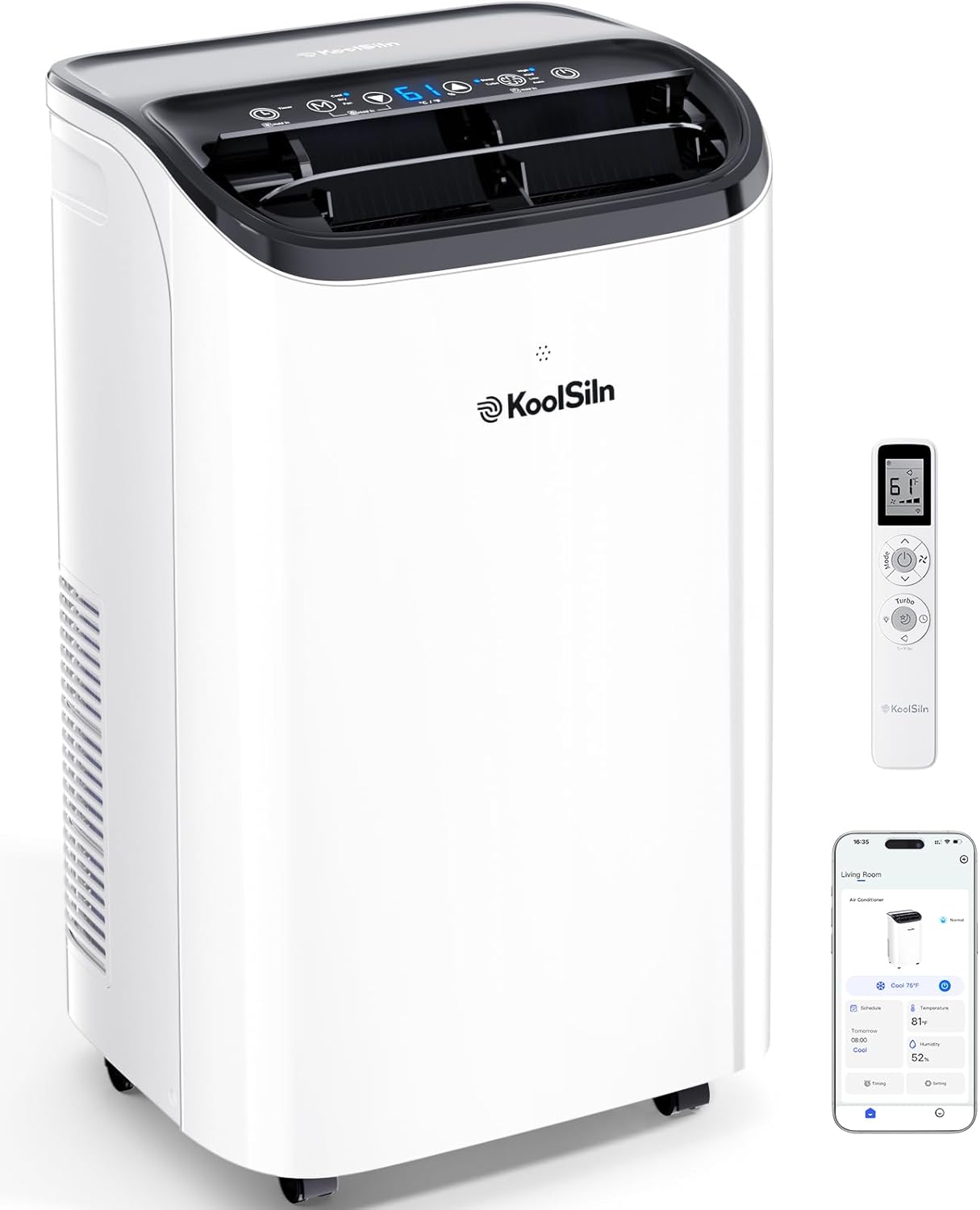
| Cooling Power | 14000 british thermal units |
|---|---|
| Noise | 44 db |
| Wattage | 1200 watts |
| Capacity | 76 pints |
The KoolSiln HAC-902WF is a high-capacity portable air conditioner intended to deliver fast cooling and basic smart controls for large indoor spaces. It operates as a 3-in-1 unit: cooling, fan, and dehumidifier, and includes an exhaust hose and window installation kit for tool-free setup. Notable features are Wi‑Fi and remote control for scheduling and voice commands, a claimed auto-evaporation system that reduces the need for manual draining, and a sleep mode that lowers fan noise and dims the display. In practice the 14,000 BTU output can bring down temperature quickly in a sizable room and the dehumidifier function reduces humidity while running. The unit is relatively heavy and bulky compared with camping-focused cooling options and needs a window or vent for the exhaust hose, so it is best suited to semi-permanent setups rather than mobile tent use. Energy consumption and noise levels are moderate for the class, so expect useful cooling with some impact on transportability and battery-free operation.
Best for: Buyers who prioritize reliable, fast cooling and want a durable, feature-rich portable unit for use at campsites with cabin or RV-style power and window venting, where consistent performance matters more than lightweight portability.
Less Ideal for: People needing an ultralight or battery-powered cooler for tent camping or those who require truly mobile, vehicle-free cooling solutions.
- Powerful 14,000 BTU cooling suitable for large rooms
- Built-in dehumidifier function to reduce indoor humidity while cooling
- Wi‑Fi and remote control for scheduling and voice control
- Auto-evaporation design reduces the need to manually empty condensate
- Includes installation kit and remote for quick setup in a windowed space
- Requires a window or vent for the exhaust hose so not suited for open-air camping
- Relatively heavy and bulky, limiting portability and transport
- Runs on standard AC power so it cannot operate off batteries or small generators without appropriate power source
Verdict: Choose this unit if you need dependable, high-capacity portable cooling with smart controls for semi-permanent campsite setups where reliable performance is the priority.
BLACK+DECKER Portable Air Conditioner BPACT08WT

| Cooling Power | 9000 BTU (5,300 BTU SACC) |
|---|---|
| Power Source | Corded Electric |
| Wattage | 935 watts |
| Refrigerant | R-32 |
| Filter Type | Washable filter |
This BLACK+DECKER portable air conditioner is a self-contained 9,000 BTU (5,300 BTU SACC) unit designed to cool, dehumidify, or circulate air in small to medium rooms. It is typically used in bedrooms, home offices, or other spaces where a temporary cooling solution is needed and comes with casters, side handles, and a window exhaust kit for straightforward setup and seasonal storage. Notable features include a full-function remote with Follow Me thermostat, three fan speeds, washable filter, self-evaporating operation to reduce draining, and R‑32 refrigerant. Practical benefits are easy mobility between rooms, simple installation into horizontal or vertical windows, and built-in dehumidification for muggy conditions. Important limitations are modest real-world cooling capacity relative to the BTU rating (the SACC figure is 5,300 BTU), a reported noise level in the low- to mid-50 dB range, and single power level control for compressor operation which can limit fine energy management. This unit suits temporary or seasonal cooling needs where portability and quick setup matter more than quiet, long-run efficiency.
Best for: Buyers who prioritize proven, easy-to-install portable cooling with clear user feedback and want a unit they can move between rooms or store seasonally.
Less Ideal for: People who need whisper-quiet operation, the highest possible running efficiency for continuous use, or permanent through-wall cooling solutions.
- Three-in-one function: cools, dehumidifies, and fans without extra gear
- Includes window installation kit and casters for easy setup and room-to-room mobility
- Follow Me remote lets the remote act as a local thermostat for more precise control
- Washable filter and self-evaporating design reduce maintenance and the need to empty water tanks
- Real-world cooling (5,300 BTU SACC) is lower than the nominal 9,000 BTU rating
- Noise around 50+ dB may be noticeable in quiet bedrooms or camps where silence is preferred
Verdict: A straightforward, easy-to-install portable AC that delivers flexible 3‑in‑1 cooling and mobility for seasonal or temporary cooling needs.
Frigidaire FFRA051WAE 5,000 BTU AC

| Cooling Power | 5000 BTU |
|---|---|
| Floor Area | 150 square_feet |
| Noise | 52 db |
| Wattage | 450 |
| Refrigerant | R-32 |
The Frigidaire FFRA051WAE is a straightforward window-mounted 5,000 BTU air conditioner aimed at cooling single small rooms such as bedrooms or living rooms. It uses a rotary scroll compressor on standard 115V power and runs at about 450W, with two fan speeds and touch button controls for simple operation. The washable filter and adjustable side panels make maintenance and installation easy, and the long three-prong cord avoids needing an extension. Noise is listed at 52 dBA, so it is reasonably quiet for overnight use. Energy performance is moderate with a SEER/Efficiency rating of 11 and an annual consumption figure provided, so operating costs are typical for this class. Important limits are its small cooling area rating (150 sq. ft.) and lack of inverter technology, so it will struggle in larger, poorly insulated spaces and will cycle more than a variable-speed model. For someone seeking a no-frills, reliable window unit for a compact room, this is a sensible choice; it is not intended as a portable or off-grid camping unit and requires a compatible window and standard household power to run.
Best for: Buyers who prioritize a predictable, low-risk cooling solution for a small indoor room and want something easy to install and maintain without advanced features.
Less Ideal for: People needing a portable cooling solution for camping, RV use, or cooling multiple or larger rooms should look for purpose-built portable or higher-capacity units instead.
- Compact 5,000 BTU capacity suitable for small rooms up to ~150 sq. ft.
- Washable filter simplifies maintenance and helps trap dust.
- Adjustable side panels and long power cord make installation in standard windows easier.
- Two fan speeds and touch controls provide simple, predictable operation.
- Not inverter-equipped so it cycles on/off rather than modulating speed.
- Limited cooling area makes it unsuitable for medium or large rooms.
- Designed for window installation and requires household AC power, so not practical for camping without shore power.
Verdict: Choose this Frigidaire if you want a simple, dependable window AC to quietly cool a single small room with low setup risk.
Choosing the Right Air Conditioner for Camping: Key Factors to Consider
Cooling Capacity
Cooling capacity determines how effectively an air conditioner will lower temperature in your tent, camper, or vehicle. For camping you need to match capacity to the enclosed volume rather than square footage alone because ceiling height and insulation affect cooling load.
Undersized units struggle to reach comfortable temperatures in high heat, while oversized units cycle frequently and may not remove humidity well. Consider peak daytime temperatures at your typical campsite and choose a capacity that can handle those conditions with some margin for load from sun exposure.
Energy Source and Consumption
Power availability is often the limiting factor for camping air conditioners. Assess whether you will run the unit from campground electrical hookups, a generator, or vehicle power. Each source imposes constraints on continuous draw and runtime.
Look at amps or watts and compare against your generator or battery system capacity, including any inverters. Higher efficiency units extend runtime and reduce generator fuel use. Also plan for startup surge current, which can be significantly higher than running draw and may trip small generators or fuses.
Noise and Sleep Comfort
Noise matters when you are sleeping or relaxing at a campsite. Air conditioners produce noise from compressors, fans, and airflow through vents. A quieter unit improves sleep quality and reduces disturbance to neighbors.
Check published noise ratings and pay attention to the sound profile. Some units run a quieter eco or sleep mode at the cost of slower temperature change. Consider physical placement and whether you can muffle sound with insulation or strategic orientation.
Portability and Storage
Portability affects how easily you transport, set up, and store the unit between trips. Camping-focused air conditioners should be light enough to handle on your own or compact enough to stow in a vehicle without reducing essential gear space.
Design features like integrated handles, wheels, collapsible vents, and compact footprints make packing simpler. Also consider the time and tools required for installation; models that need minor assembly are preferable to those requiring extensive modifications.
Venting and Installation Options
Camping setups vary. Some campers use tents or soft-sided pop-ups, others use hard-sided RVs with rooftop vents. The unit you choose must match your venting and mounting constraints.
Options include through-the-wall kits, window adapters for camper windows, roof-mounted configurations, and portable units with exhaust hoses. Evaluate how the unit interfaces with your shelter so you can seal openings against insects and avoid heat recirculation.
Durability and Weather Resistance
Outdoor use exposes equipment to dust, humidity, and occasional rain. Durability and weather resistance influence how long a unit remains reliable across seasons.
Look for corrosion-resistant materials, protective grilles, and straightforward maintenance access. Units that allow easy cleaning of filters and condensate management reduce long-term failure risk when exposed to outdoor conditions.
Portable Vs. Fixed Camping Air Conditioners
There are two broad approaches to cooling while camping: portable standalone units and fixed or semi-fixed installations for vehicles and rigs. Portable units are flexible and can move between tents and campers, while fixed systems are integrated into a vehicle and typically offer better sealing and airflow.
Choose portable if you value flexibility or expect to use the unit in different shelters. Choose a fixed-style option if you want quieter operation and better efficiency for a dedicated RV or camper.
- Portable: easy to move, may require more power, flexible placement
- Fixed/semi-fixed: better sealing, often quieter, requires installation
Managing Power: Generators, Batteries, and Shore Power
Match your air conditioner's power needs to the sources you will use. Campground shore power removes many constraints but is not always available. Generators provide portable power but vary in continuous and surge capacity, and battery-based systems require careful planning to avoid deep discharge.
Plan for startup surge when selecting a generator or inverter. In many situations, running an efficient unit at a lower setting or using a thermostat-controlled cycle extends runtime significantly.
- Check both running watts and startup surge watts
- Consider energy-saving modes or thermostatic control to reduce runtime
- Pair with shade, ventilation, and reflective covers to reduce cooling load
Ventilation, Condensate, and Humidity Control
Air conditioners cool by removing heat and moisture. In camping contexts, condensate handling and ventilation are practical concerns. Some units require a simple drain, others evaporate condensate into the exhaust, and a few use internal reservoirs that must be emptied.
Humidity control matters as much as temperature for comfort. A unit that can dehumidify effectively will make sleeping conditions more pleasant even if the thermostat setting remains moderate.
- Confirm how condensate is managed and whether you need a drain hose
- Look for explicit dehumidification performance when humidity is a concern
- Ensure exhaust placement does not blow hot air back into the living area
Noise Mitigation Strategies
Even quieter units generate some sound. You can reduce perceived noise by placing the unit on vibration-damping material, orienting exhaust away from sleeping areas, or positioning the unit so the compressor is outside the sleeping zone when possible.
Using acoustic wraps or enclosures designed for camping power equipment can help, but avoid blocking airflow. Sometimes operating at a slightly higher temperature setpoint at night yields a much quieter sleep environment with minimal comfort tradeoff.
- Use a soft pad to cut vibration transfer
- Angle exhaust away from people and reflective surfaces
- Prefer units with a low-noise mode for overnight use
Maintenance and Seasonal Storage
Regular maintenance keeps a camping air conditioner reliable. Clean or replace filters after dusty trips, inspect seals and vents for insect ingress, and drain or dry internal condensate trays before storage to prevent mold.
For seasonal storage, protect the unit from prolonged exposure to moisture and extreme temperatures. A clean, dry storage routine extends the service life and reduces the chance of mechanical issues on the next trip.
- Clean filters and external coils after use in dusty environments
- Dry reservoir and internal compartments before storage
- Store in a ventilated, sheltered location away from rodents and moisture
How We Chose the Best Air Conditioner for Camping
We focused on features that directly affect camping use and on-road practicality. Primary evaluation criteria included cooling capacity relative to compact footprints, measured as cooling output per unit size; runtime and energy efficiency to estimate battery, generator, or vehicle alternator draw; noise levels during operation since quiet sleep is essential at campsites; and installation flexibility for tents, pop-up campers, and small RVs. We also considered durability and weather tolerance for outdoor exposure, the simplicity of setup and teardown, and how easily the unit integrates with common campsite power sources and ventilation options. Units that required complex permanent installation or that were clearly designed only for full-house HVAC systems were excluded. We prioritized solutions that balance cooling performance, portability, and manageable power needs for real camping scenarios.
Our full evaluation process is outlined in our review methodology.
FAQ
Can I run a camping air conditioner from a vehicle battery?
Often you can, but it depends on the unit's power draw and your battery system. Higher-capacity compressors need substantial current and may require an inverter and deep-cycle batteries sized for the expected runtime. For short runs, a large battery bank or jump-starting from the vehicle alternator may be adequate, but prolonged use typically needs a generator or campground power.
What size air conditioner do I need for a small tent or pop-up camper?
Size depends on interior volume, insulation, and peak outdoor temperatures. For small tents or soft-sided pop-ups, look for units sized to handle modest cubic footage rather than full-room BTU ratings used indoors. Aim for a unit with some extra capacity to handle sun-exposed situations without short-cycling.
How noisy are portable camping air conditioners at night?
Noise varies by design and mode. Portable systems typically generate fan and compressor noise that can be noticeable in quiet campsites. Many models offer lower-noise or sleep modes that trade cooling speed for quieter operation, which is usually sufficient overnight.
Do I need to worry about condensate when using an air conditioner outdoors?
Yes. Some units evaporate condensate through the exhaust, others require a drain line or periodic emptying of a reservoir. Proper condensate management prevents water buildup, reduces humidity, and prevents dripping in sleeping areas.
Is installation difficult for camper or rooftop units?
Installation difficulty ranges from simple window or vent adapters to units that require cutting or modifying a rooftop vent. Some camping-specific systems are designed for minimal tools and quick mounts, while others need professional installation for safe, weatherproof long-term use.
Final Verdict
Choosing the right air conditioner for camping comes down to balancing cooling performance with available power and portability. Prioritize a unit that matches your shelter volume and power source, offers manageable noise levels for overnight comfort, and provides straightforward venting and condensate handling. Accept tradeoffs between raw cooling power and runtime or noise. If you need mobility and flexibility, favor compact portable units with easy setup. If you camp from a dedicated vehicle often, a semi-fixed installation that improves sealing and airflow may be the better long-term choice.