
Note: This article contains affiliate links. If you click on these links and make a purchase, we may earn a small commission at no extra cost to you. This helps support our research and content. Read our full affiliate disclosure here.
When summer trips push temperatures into the uncomfortable range, the right portable air conditioner for camping can turn sticky, restless nights into comfortable sleep. You want a unit that moves enough cool air for your tent or small camper, runs quietly so it does not disrupt sleep, and survives rougher outdoor handling without fuss. This guide shortlists the top portable air conditioners for camping based on practical criteria like cooling capacity, airflow, noise, battery or low-power options, and ease of setup. Below you will find compact picks that suit different campsite sizes and power situations, plus the decision factors we used to evaluate them.
Top Picks at a Glance
| Best Overall The best all-around choice for most situations | Midea 8,500 BTU Portable Air Conditioner |  |
| Best Quality Built to a higher standard if you want something more solid | Cybertake S2 Pro Portable Air Conditioner |  |
| Best Value The sweet spot between price and what you get | outohome Portable 5200 BTU AC |  |
| Best Budget The cheapest option that still gets the job done reliably | Pavrxeo Portable Air Conditioner |  |
| Top Rated A top-rated pick with lots of positive feedback | BLACK+DECKER Portable Air Conditioner BPACT08WT |  |
| Most Popular A crowd favorite that many people choose with confidence | BougeRV PC35 Portable AC |  |
| Best Seller A high-volume bestseller chosen again and again | PeakPursuit 8,000 BTU Portable AC |  |
Midea 8,500 BTU Portable Air Conditioner

| Cooling Power (ASHRAE) | 8500 BTU |
|---|---|
| SACC Cooling Power | 5000 BTU SACC |
| Floor Area | 150 sq. ft. |
| Wattage | 830 watts |
| Control Method | App, Remote, Voice |
The Midea 8,500 BTU portable air conditioner is a small, rollable unit designed to cool single rooms or small offices and also offers dehumidifier and fan-only modes. It is typically used near a window or vented opening using the included 5 ft exhaust hose and adjustable window kit, and can be controlled with the LED panel, included remote, or the SmartHome app and voice assistants. Notable features include washable reusable filter, three operating modes, a 24-hour timer, and app/voice control for remote scheduling. In practice it delivers quick spot cooling for spaces around 150 sq. ft., and the washable filter helps reduce dust and pet hair buildup. The unit is fairly plug-and-play with no tools required for installation, but it is not inverter-based so it runs at steady power and can be noticeable at higher fan speeds. Expect moderate noise and regular filter maintenance; its cooling capacity and power draw make it best for short-term or seasonal use rather than whole-house cooling. For portable spot cooling where smart controls and easy setup matter, this model is a practical choice.
Best for: Buyers who want a compact, smart-controlled portable AC that is easy to install and use for targeted cooling in small indoor spaces or enclosed camping shelters.
Less Ideal for: Those needing quiet, highly efficient cooling for larger spaces or for continuous off-grid use where low power draw is critical should look elsewhere.
- Smartphone and voice control plus included remote for flexible scheduling and operation.
- Includes exhaust hose and adjustable window kit for tool-free installation.
- Washable reusable air filter to catch dust and pet hair and reduce replacement costs.
- Three modes (cooling, dehumidifying, fan) and a 24-hour timer for versatile room comfort control.
- Designed for small rooms up to about 150 sq. ft., not powerful enough for larger tents or wide-open camping spaces.
- Not an inverter model so it runs at steady wattage and can be less efficient under variable loads.
- Noise level is moderate and can be noticeable at higher fan settings.
Verdict: A compact, easy-to-install smart portable AC that delivers effective spot cooling and convenient remote control for small enclosed camping shelters or rooms.
Cybertake S2 Pro Portable Air Conditioner

| Cooling Power | 5100 british thermal units |
|---|---|
| Heating Power | 6100 BTU |
| Floor Area | 130 square_feet |
| Noise | 40 db |
| Refrigerant | R-290 |
The Cybertake S2 Pro is a rugged portable climate unit built for camping, tents, RVs and similar small spaces up to about 130 sq ft, delivering 5100 BTU cooling and 6100 BTU heating. It offers four modes—cool, heat, dehumidify and Eco+—plus three fan speeds, a 0–12 hour timer and Bluetooth app, remote and button control for on-the-go convenience. Setup is installation-free and includes an accessory kit and exhaust hose options so you can get it running in short order, and an IPX4 water-resistant shell with waterproof controls makes it usable in damp outdoor conditions. The unit is relatively quiet at around 40 dB and uses R-290 refrigerant for improved efficiency, while Eco+ mode can run on roughly 1 kWh per 8 hours. Expect solid performance in compact spaces, but note its stated annual energy consumption and SEER indicate it is not ultra-high-efficiency for continuous home use, and a boost converter is sold separately for some DC setups.
Best for: Buyers who prioritize robust, portable climate control for camping, tents or RV trips and want a unit that starts fast, handles both cooling and heating, and survives damp outdoor conditions.
Less Ideal for: People seeking the most energy-efficient solution for continuous indoor home cooling or those needing a unit sized for larger rooms above 130 sq ft.
- Dual cooling and heating (5100 BTU cooling, 6100 BTU heating) for year-round comfort
- IPX4 water-resistant housing and waterproof buttons suited for outdoor use
- Multiple control options including Bluetooth app, remote and onboard buttons
- Quiet operation around 40 dB, suitable for tents and RV interiors
- Includes installation kit and accessories for fast, installation-free setup
- Annual energy and SEER figures suggest moderate energy use during extended operation
- Some DC power configurations may require an additional boost converter purchase
Verdict: A hardy, dual-mode portable AC built for campers and RV users who need dependable cooling and heating in small spaces, even in damp conditions.
outohome Portable 5200 BTU AC

| Cooling Power | 5200 BTU |
|---|---|
| Wattage | 400 watts |
| Voltage | 120 volts |
| Noise | 46 db |
| Refrigerant | R-134A |
This compact 5200 BTU portable air conditioner is built for mobile and small-space cooling like tents, RVs, trucks, and studio rooms. It uses a GMCC compressor and R-134A refrigerant to deliver quick cooling while drawing about 400 watts, and it claims a rapid temperature drop and an adjustable setpoint range from 16C to 30C. The unit includes a remote and push-button controls, a 24-hour timer, and four operating modes: cooling, dehumidify, fan, and sleep; below about 70% humidity it runs drain-free, and a drain hose is supplied for wetter conditions. Practical benefits for camping and RV use include its relatively low power consumption for active cooling, a carry grip for transport, and a claimed noise level around 46 dB in sleep mode. Trade-offs are its limited 5200 BTU capacity and 31.9 lb weight, which mean it suits small enclosures rather than large cabins, and it requires venting and power infrastructure that may limit off-grid use.
Best for: Buyers who prioritize energy-conscious, compressor-based cooling for small enclosures and need a rugged portable unit that can move between tent, RV, and vehicle setups.
Less Ideal for: People planning to cool large rooms, multi-room setups, or extended off-grid campsites without reliable AC power should consider alternatives like higher-capacity units or passive cooling solutions.
- Relatively low 400W power draw for active compressor cooling.
- Multiple modes (cooling, dehumidify, fan, sleep) and a 24-hour timer for flexible use.
- Includes remote control and push-button panel for convenient operation.
- Drain-free operation under moderate humidity with supplied drain hose for higher humidity conditions.
- 5200 BTU output is best for small tents, RVs, or single rooms and will not cool larger spaces effectively.
- At about 32 pounds it is portable but heavier than fan-only or evaporative camping units, making long carries more strenuous.
Verdict: Choose this unit when you need a compressor-based, energy-conscious portable AC that can give fast, reliable cooling in tents, RVs, and other small spaces.
Pavrxeo Portable Air Conditioner

| Cooling Power | 4000 british thermal units |
|---|---|
| Wattage | 400 watts |
| Refrigerant | R-290 |
| Floor Area | 86 square_feet |
This Pavrxeo portable air conditioner is a lightweight, low-power 4000 BTU unit built for small rooms and mobile use like camping, RVs, and tents. It runs on about 400 watts and uses a rotary compressor with R-290 refrigerant to deliver fast cooling that the manufacturer says can drop temperatures by up to 18°F, while auto-evaporation reduces the need to drain in lower-humidity conditions. Controls include a remote, 24-hour timer, and multiple modes (Cool, Dry, Fan, Sleep) so you can tailor comfort while minimizing noise; sleep mode is advertised around 46 to 50 dB. The unit is designed to be portable with a carry handle and a compact footprint suited to countertop or tent setups, and it can be run from a standard 110V AC source or a power inverter/portable power station. Trade-offs are the limited coverage area—intended for small spaces up to about 86 sq ft—and the need for venting the exhaust hose when used in vehicles or enclosed tents, plus typical compressor weight despite being labeled portable.
Best for: Campers and RV travelers seeking an affordable, energy-efficient compressor air conditioner for small tents, vans, or compact rooms who prioritize portability and low power consumption.
Less Ideal for: People who need to cool larger rooms or who require a fully cordless unit without an inverter or external power source.
- Low power draw (~400W) suitable for use with inverters or portable power stations
- Auto-evaporation system reduces manual draining under 70% humidity
- Multiple modes and remote control with a 24-hour timer for flexible operation
- Compact, carry-friendly design intended for camping and small-space use
- Rated cooling area is small (about 86 sq ft), so not suitable for larger spaces
- Requires 110V AC and proper exhaust venting; not battery-powered for standalone cordless use
Verdict: A budget-friendly, low-wattage compressor AC built to give campers and small-vehicle sleepers effective, energy-efficient cooling on the go.
BLACK+DECKER Portable Air Conditioner BPACT08WT

| Cooling Power | 9000 BTU |
|---|---|
| SACC Cooling | 5,300 BTU |
| Wattage | 935 watts |
| Refrigerant | R-32 |
| Capacity | 19.2 liters |
This BLACK+DECKER portable air conditioner is a compact 3-in-1 unit that provides cooling, dehumidifying, and fan-only operation for small indoor spaces. It is typically used in bedrooms, home offices, or temporary spaces where a non-permanent cooling solution is needed; setup uses the included window kit or can be vented through a wall opening. Notable features include a full-function remote with Follow Me thermostat, self-evaporating operation to reduce manual draining, washable filter, and three fan speeds for basic airflow control. In practice the unit delivers reliable, straightforward cooling for up to about 300 to 400 sq. ft. and is easy to move on its built-in casters and side handles. Important limitations are that it requires a 115V corded outlet and window or wall venting so it is not suitable for off-grid tent camping, and noise is noticeable at higher fan settings. For users who need dependable, plug-in cooling with simple controls and an included installation kit, this model is a practical choice.
Best for: Buyers who prioritize a dependable, easy-to-install plug-in cooling solution for temporary indoor spaces and want simple, maintenance-light operation.
Less Ideal for: People seeking a truly portable, off-grid cooling unit for tent or remote camping trips or those needing ultra-quiet operation for bedrooms during sleep.
- 3-in-1 functionality: cools, dehumidifies, and functions as a fan
- Includes window kit and exhaust hose for straightforward installation
- Self-evaporating design reduces the need to empty water during normal cooling
- Full-function remote with Follow Me thermostat for convenient control
- Built-in casters and side handles make moving the unit between rooms easy
- Requires standard 115V outlet and a window or wall vent, so not suitable for off-grid or tent camping
- Can be relatively loud on higher fan settings
- Single compressor/power level limits advanced temperature control compared with multi-speed inverter units
Verdict: Choose this unit if you need a reliable, plug-in portable air conditioner with easy installation and simple controls for temporary indoor cooling.
BougeRV PC35 Portable AC
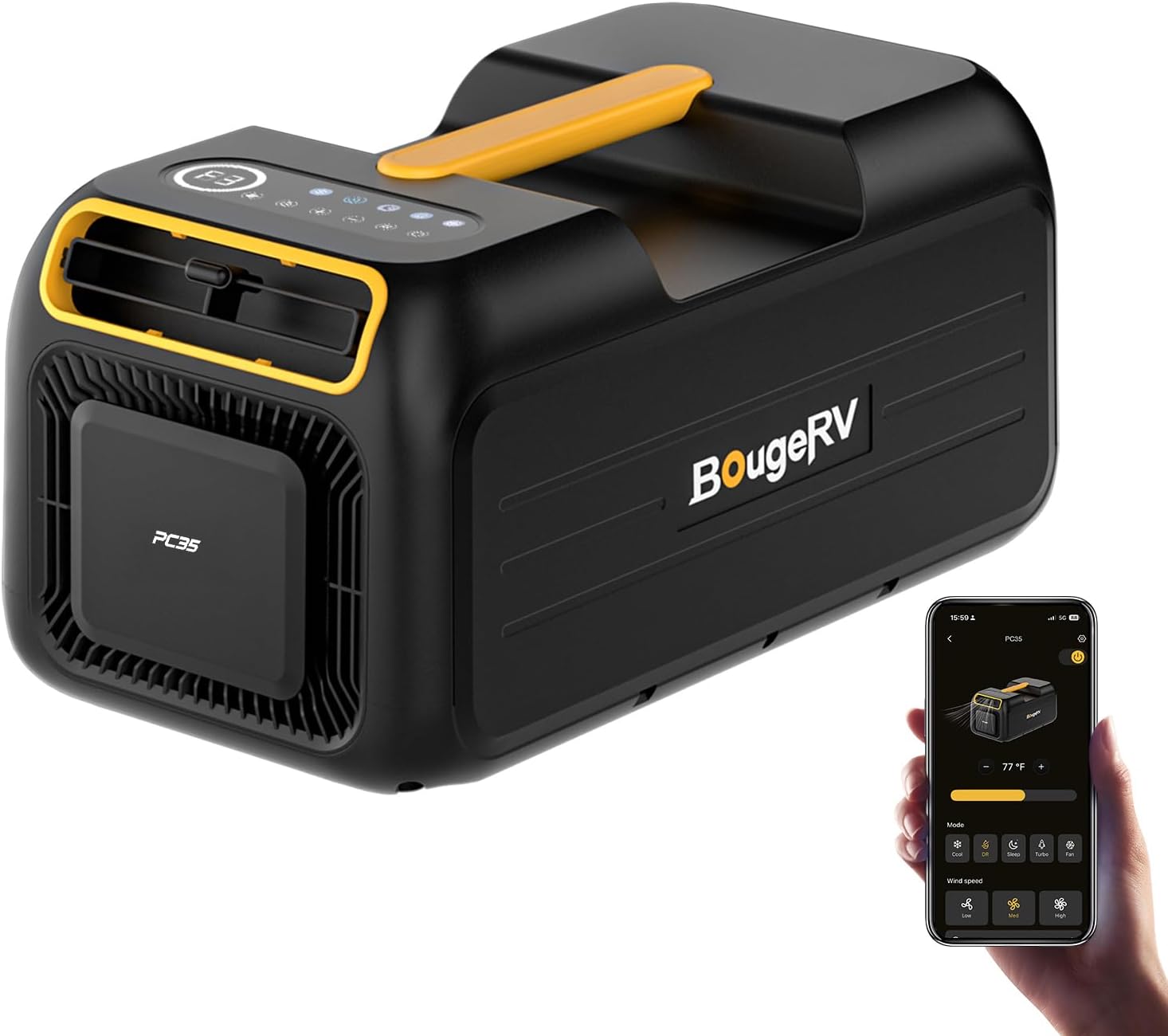
| Cooling Power | 3500 british thermal units |
|---|---|
| Wattage | 2000 watts |
| Floor Area | 35 square_feet |
| Operating Mode | Cooling, Dehumidifying |
The BougeRV PC35 is a compact 3500 BTU portable air conditioner aimed at cooling small tents, RVs, and other temporary spaces. It offers app and push-button control, five modes including cooling, dehumidifying, fan, strong (high power) and sleep, plus a 24-hour timer for scheduled use. In lab conditions the company says it can lower temperature by about 18°F in 15 minutes and it is rated for roughly 35 sq ft, which matches typical small tent and single-person RV setups. The unit is built for portability with an ergonomic handle and includes exhaust ducts, a drain pipe and a power adapter so it is ready for field use. Practical caveats: it draws significant startup power (compressor peak near 2 kW) so you need a robust inverter or generator for off-grid use, and reported noise around 55 dB may be noticeable in quiet camp setups. Build and real-world cooling can vary with tent size, insulation and outside heat, so temper expectations for larger or poorly ventilated spaces.
Best for: Campers and RV users who prioritize a portable, app-controlled AC that can cool a small tent or temporary space quickly and who plan power sources accordingly.
Less Ideal for: People needing to cool larger tents or multi-person rooms, or those who cannot supply a high-startup-power inverter or generator for the compressor.
- Smart app control and push-button interface for remote adjustments
- Five operating modes including dehumidify, sleep, and a high-power strong mode
- Includes exhaust ducts, drain pipe and adapter for immediate setup
- Compact, portable form with an ergonomic handle suited to camping and RV use
- High compressor startup power requirement means you need a powerful inverter or generator for off-grid use
- Noise level around 55 dB can be intrusive in very quiet camping situations
Verdict: A portable, app-controlled camping AC that actually targets small tents and RVs but requires a strong power source for reliable operation.
PeakPursuit 8,000 BTU Portable AC

| Cooling Power | 8000 british thermal units |
|---|---|
| Noise | 50 db |
| Wattage | 860 |
| Capacity | 45 pints |
| Floor Area | 150 square_feet |
This PeakPursuit 8,000 BTU portable air conditioner is a four-in-one unit that provides spot cooling, air circulation and dehumidification for small indoor spaces. It is typically used in bedrooms, apartments, or temporary spaces where a window unit is impractical; the included window installation kit and rolling casters make short setup and room-to-room moves straightforward. Notable features include a remote control, a 24-hour timer, sleep mode for quieter overnight operation and a dehumidifier function that collects moisture while cooling. In practical use it delivers quick, localized cooling and helps reduce humidity in damp environments, though its 8,000 BTU rating is best suited to compact spaces rather than open campsites or large tents. Expect moderate noise around 50 dB and typical portable AC power draw around 860 W, so it needs stable household power or a substantial portable generator for off-grid use. For buyers seeking a reliable, easy-to-install indoor cooler with dehumidification and simple controls, this unit is a sensible choice; those wanting lightweight, battery-operated camping-specific cooling should consider alternatives designed for outdoor tent use.
Best for: Buyers who prioritize a proven, easy-to-install indoor cooling solution for small enclosed spaces and who want simple controls and dehumidification without experimental or battery-powered gear.
Less Ideal for: People planning lightweight, off-grid tent camping or relying on battery power should look for camping-specific, low-power or battery-cooled options instead.
- 4-in-1 functionality: cooling, fan, dehumidifier and sleep mode in one compact unit
- Includes window installation kit and rolling casters for easy setup and relocation
- Remote control and 24-hour timer for convenient, hands-off operation
- Dehumidifier capability helps improve comfort in humid, enclosed spaces
- 8,000 BTU capacity is intended for small rooms and not for cooling large tents or open-air camping
- Operates at about 50 dB which may be noticeable in very quiet sleeping situations
- Requires standard AC power and draws around 860 W, limiting true off-grid camping use
Verdict: A reliable, easy-to-use indoor portable AC that offers cooling plus dehumidification for small enclosed spaces when you need straightforward, low-risk comfort.
Choosing the Right Portable Air Conditioner for Camping: Key Factors to Consider
Cooling Capacity and Coverage
Cooling capacity determines how effectively a portable air conditioner lowers temperature in a tent or small camper. Look for clear BTU-equivalent ratings or manufacturer guidance indicating the square footage or cubic meters each unit can handle. A unit undersized for your enclosed space will run continuously without reaching comfortable temperatures, while an oversized unit can short-cycle and waste power.
Consider the effective coverage in the specific camping environment. Tents and campers are often less insulated, so a slightly larger-rated unit than you would use indoors may be necessary. Also factor in height and airflow patterns; tall tepee-style tents may need higher airflow to mix cooled air evenly.
Portability, Weight, and Form Factor
Portability matters more for camping than for home use. Weight, overall footprint, and whether the unit has durable handles or wheels affect how easy it is to move between vehicles, campsites, and storage. Compact, cube-like designs are easier to stow in a trunk, while units with fragile knobs or exposed vents can be damaged during transport.
Think about how you will carry the unit over short distances from car to campsite. Lightweight models reduce strain but may sacrifice capacity. Durable construction and water-resistant casings help units tolerate outdoor conditions and the occasional splash or dew.
Power Requirements and Flexibility
Power is the limiting factor for many campers. Check the unit's input wattage, starting surge, and suggested power sources. Some portable air conditioners are designed to run on standard AC camp hookups, while others work with low-wattage or inverter-generator setups. Units that offer variable power modes or energy-saving settings let you manage battery or generator load more effectively.
If you rely on battery systems or small generators, verify starting-current needs since compressors can draw a higher surge when kicking on. Models that support staged compressors or soft-start technology are easier to run from portable power.
Noise Level and Sleep Comfort
Noise can make the difference between restful sleep and a noisy, uncomfortable night. Check published decibel ratings for both fan and compressor operation, and pay attention to marketing claims about quiet modes. Lower RPM fans, insulated cabinets, and vibration-dampening mounts reduce perceived noise.
Also consider the frequency of noise: constant low-level white noise may be easier to tolerate than intermittent mechanical clanks. If you plan to sleep inside a tent adjacent to the unit, prioritize lower dB ratings and a dedicated quiet or sleep mode.
Condensate Handling and Drainage
When cooling humid air, portable air conditioners generate condensate. For camping, where you may not have easy access to drains, look for units with auto-evaporation systems or internal reservoirs with accessible drain points. Some designs evaporate condensate through the exhaust, reducing the need to empty a bucket during operation.
Understand reservoir capacity and how often you will need to empty it during a typical evening. If the unit requires a continuous drain line, plan how you will route or secure that line at the campsite.
Setup, Venting, and Integration With Tents or Campers
Successful cooling depends on correct venting and placement. Many portable systems need a short exhaust hose to expel hot air; you should know how that hose can be routed out of a tent or through a camper vent. Look for units that include flexible hoses and simple window or fabric venting adapters.
Consider how the unit will be positioned relative to sleeping areas and whether its intake will draw hot outside air. Ease of setup reduces frustration after a long day of travel and makes it more likely you will actually use the unit as intended.
Power Options for Remote Campsites
Not all campsites supply reliable shore power so plan for how you will run a portable air conditioner. The three main approaches are campground AC hookups, inverter-equipped vehicle battery systems, and portable generators. Each approach has tradeoffs in runtime, noise, and complexity.
If you use an inverter or battery bank, confirm both continuous wattage capability and the compressor's starting surge. For generator use, consider quieter inverter generators designed to reduce cabin noise and fuel consumption. In any case, keep an eye on fuel or battery capacity so the unit does not stop mid-use.
- AC hookup: simplest but limited to sites with power
- Inverter/battery: quietest operation but requires sufficient capacity
- Generator: reliable runtime but adds noise and fuel needs
Venting Strategies for Tents and Small Campers
Venting a portable air conditioner in a tent is different from a house window. Use short, insulated hoses and position exhaust ports where they will not blow directly into living or sleeping zones. Fabric panels, tent windows, or specially made vent adapters can provide a reasonably sealed path for hot exhaust.
For small campers, use an existing vent or hatch and create a tight seal to prevent hot air re-entering the cooled space. Proper venting improves efficiency and prevents the unit from working harder to compensate for recirculated heat.
- Use the shortest feasible hose to reduce backpressure
- Seal gaps around vent points to keep hot air out
- Angle exhaust away from tent openings and neighboring campsites
Placement and Airflow Within the Campsite
Placement influences both comfort and safety. Set the unit on a level, stable surface away from puddles and direct contact with dirt. Aim the cooled-air outlet so it circulates across the sleeping area rather than pointing at bare ground where it quickly dissipates.
Manage intake clearance to ensure the unit pulls in ambient air rather than warm, stagnant pockets. In multi-zone tent setups, moving the unit or using simple fans to distribute air can significantly improve perceived cooling.
- Keep the intake and exhaust clear of obstructions
- Elevate small units slightly to avoid dust ingestion
- Use auxiliary fans to improve air mixing in larger tents
Maintenance and Care on the Road
Regular maintenance extends service life and reduces failures while camping. Clean or replace washable filters between trips to maintain airflow and efficiency. Wipe down exterior surfaces and inspect hoses and seals for wear after transporting the unit.
Before each trip, run a brief test to confirm normal operation. Empty condensate reservoirs and pack any venting adapters and hoses in an organized manner so setup at the campsite is quick and straightforward.
- Clean filters after dusty or sandy trips
- Store hoses rolled and protected to prevent kinks
- Test power hookups and any inverter compatibility at home
Safety Considerations in Campsites
Camping presents specific safety concerns for electrically powered cooling. Ensure all electrical connections are protected from moisture and secured against accidental disconnection. Use appropriately rated extension cords and keep cords out of walkways to prevent trips.
If you run a generator, place it well away from sleeping areas and follow recommended clearances for exhaust. Watch for signs of overheating or unusual noises and shut down the unit if you suspect a mechanical issue.
- Protect connections from rain and condensation
- Avoid running cords through damp areas
- Monitor ventilation when operating inside semi-enclosed spaces
How We Chose the Best Portable Air Conditioner for Camping
We focused on attributes that matter when using a portable air conditioner in outdoor and semi-outdoor settings. Cooling capacity and coverage were primary filters because many camping situations require efficient heat removal in small, poorly insulated spaces. We prioritized units with clear BTU-equivalent cooling ratings and measurable airflow to estimate real-world performance. Portability and durability were next: we included machines with manageable weight, built-in handles or caster systems, and robust enclosures suited to campground use. Power flexibility was essential, so we assessed compatibility with lower-voltage sources, inverter-friendly operation, or low-watt standby modes. Noise level was evaluated using manufacturer noise ratings and design features that reduce fan and compressor hum. Other selection filters included condensate management (drain or auto-evaporation), simple setup and venting options for tents and small RVs, and straightforward controls for quick adjustments. We excluded heavy, permanently installed, or permanently wired systems that are impractical for camping. Units that lacked clear cooling specs or provided only vague outdoor usage claims were not considered.
Our full evaluation process is outlined in our review methodology.
FAQ
Can a portable air conditioner actually cool a tent?
Often yes, but effectiveness depends on tent size, insulation, and ambient temperature. Small tents in hot, humid conditions may need a higher-capacity unit or supplemental airflow. Good sealing and correct venting improve results.
How do I power a portable AC at a campsite without shore power?
You can use a sufficiently sized inverter and battery bank or a portable generator. Check the unit's running and starting wattage and confirm your power source can handle the compressor surge. Energy-efficient modes reduce the required capacity.
Will the condensate bucket need emptying during the night?
That depends on humidity and the unit's condensate management. Some units auto-evaporate moisture through the exhaust; others collect water in a reservoir that may need periodic emptying. Choose based on how accessible draining will be at your campsite.
Are portable air conditioners safe to use inside a tent?
They can be used with proper ventilation and stable placement, but you must ensure exhaust is routed away and electrical connections are protected from moisture. Avoid operating in wet conditions and follow manufacturer safety guidelines.
How noisy are these units while running at night?
Noise varies by model and operating mode. Many units offer a quiet or sleep setting that reduces fan speed and compressor output to lower decibel levels. If campsite quiet is critical, prioritize models with published low-dB ratings.
Final Verdict
Choosing the right portable air conditioner for camping comes down to balancing cooling capacity, portability, and power constraints. Prioritize a unit with enough BTU-equivalent cooling for your tent or camper, manageable weight and durable construction for transport, and flexible power options that match how you camp. Accept tradeoffs between runtime and noise: quieter setups often require more sophisticated power solutions. Focus on condensate handling and easy venting so setup is straightforward at the campsite. With those priorities in mind, you can pick a compact unit that reliably improves comfort on hot nights.