
Note: This article contains affiliate links. If you click on these links and make a purchase, we may earn a small commission at no extra cost to you. This helps support our research and content. Read our full affiliate disclosure here.
Picking the right air conditioner for a caravan affects comfort, battery life, and usable space on every trip. You need a unit that cools efficiently, fits available mounting locations, and works within your caravan electrical system without frequent power compromises. This guide shortlists seven top options that are well suited to caravan use and explains the factors that matter most when you are outfitting a mobile living space. We evaluate cooling capacity, energy use, installation fit, and noise so you can choose the best unit for your travel style and power setup. Read on for practical guidance to match an air conditioner to your caravan layout and power constraints, plus the criteria we used to pick these caravan-ready solutions.
Top Picks at a Glance
| Best Overall The best all-around choice for most situations | Gidrox RX55 10000 BTU Rooftop AC |  |
| Best Quality Built to a higher standard if you want something more solid | Furrion Chill Cube 18K |  |
| Best Value The sweet spot between price and what you get | Ivation Caravan Air Conditioner IVARVAC10 |  |
| Best Budget The cheapest option that still gets the job done reliably | Garvee 8000 BTU Portable Air Conditioner | 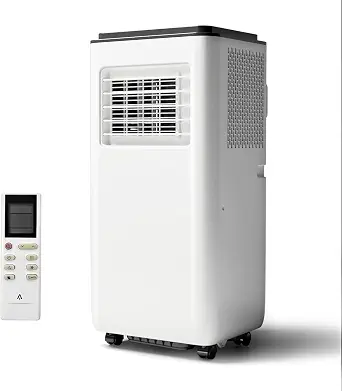 |
| Top Rated A top-rated pick with lots of positive feedback | BLACK+DECKER Portable Air Conditioner BPACT08WT |  |
| Most Popular A crowd favorite that many people choose with confidence | BLACK+DECKER Smart Portable Air Conditioner |  |
| Best Seller A high-volume bestseller chosen again and again | Frigidaire 6,000 BTU Window Air Conditioner |  |
Gidrox RX55 10000 BTU Rooftop AC

| Cooling Power | 10000 BTU |
|---|---|
| Voltage | 12 volts |
| Power Source | Battery Powered |
| Noise | 40 db |
| Filter Type | HEPA Filter |
The Gidrox RX55 is a 12V DC rooftop air conditioner made for caravan and camper use, offering 10,000 BTU cooling with inverter technology for quick temperature control. It installs into a common 14"x14" roof cutout and runs directly from an RV battery without a separate inverter, which makes it handy for off-grid or boondocking trips. Users can choose Turbo, ECO, or Sleep modes to prioritize fast cooling, energy savings, or quiet operation, and the unit is controllable via an app, infrared remote, or onboard touch buttons. Practical benefits include a HEPA filter and dehumidifier function, relatively low noise (about 40 dB in Sleep), and included mounting hardware and power cord for straightforward fitting. Expect under-voltage protection below about 10.5V and runtime tied to battery capacity, so long overnight operation requires a sufficiently sized LiFePO4 battery or supplemental power. The unit is cooling-only and does not provide heating, and its stable voltage window means integration planning with battery and solar systems is important for reliable performance.
Best for: Buyers who want a capable rooftop AC that balances strong cooling, low-noise overnight use, and efficient battery-powered operation for caravan and off-grid travel.
Less Ideal for: Those who need both heating and cooling from one appliance or who lack a high-capacity battery or power setup for extended off-grid runtime should consider other options.
- Runs directly from 12V battery for off-grid use without separate inverter
- Inverter compressor with Turbo/ECO/Sleep modes for flexible cooling and energy savings
- Multiple control methods including app, remote, and touch panel for convenient operation
- HEPA filter and dehumidifier function improve cabin air quality and comfort
- Includes installation kit and long power cable for common 14"x14" roof cutouts
- Cooling-only unit with no heating capability
- Requires careful battery and voltage planning because under-voltage protection will shut the unit below ~10.5V
Verdict: Choose the RX55 if you want a battery-driven rooftop AC that delivers rapid 10,000 BTU cooling with quiet, energy-conscious modes for caravan and off-grid trips.
Furrion Chill Cube 18K

| Cooling Power | 18000 BTU |
|---|---|
| Noise | 50 db |
| Inverter Type | Has Inverter |
| Seasonal Energy Efficiency Ratio (SEER) | 14 |
| Power Source | Powered by electric power |
The Furrion Chill Cube 18K is a rooftop RV air conditioner designed to deliver strong, efficient cooling in hot conditions while running quietly. It uses a variable-speed compressor and inverter so the unit changes speed instead of cycling on and off, which improves energy use, reduces noise, and provides continuous dehumidification. Typical use is bolt-on rooftop installation for campervans and travel trailers where compact, high-capacity cooling is needed; the head unit is non-ducted and pairs with a separately sold air distribution box if you need ducted airflow. Notable features include turbo cool mode, a battery-saver mode that helps extend off-grid runtime, and 2,000W generator/inverter readiness for camp power setups. Practical benefits are faster cool-downs in very hot weather, quieter operation during long runs, and better efficiency that can lower electrical draw compared with single-speed RV ACs. Important limitations: this listing is the head unit only and requires a compatible ADB/outdoor unit for full installation, and installation requires rooftop compatibility and correct electrical capacity.
Best for: Buyers who prioritize strong, efficient cooling performance and quieter continuous operation for hot-weather touring and off-grid trips will appreciate this unit.
Less Ideal for: Those seeking a plug-and-play packaged rooftop system or a complete ducted kit out of the box should look for units that include the ADB and full installation hardware.
- Variable-speed compressor with inverter for smoother, more efficient cooling
- High 18,000 BTU capacity suitable for larger RV interiors
- Turbo cool and battery-saver modes for fast cool-downs and extended off-grid runtime
- Designed for quiet operation to reduce cabin noise during use
- Air distribution box sold separately so ducted installation needs extra purchase
- Requires a new outdoor unit or compatible rooftop setup for full system replacement
Verdict: Choose the Chill Cube 18K when you need high-capacity, energy-conscious cooling and quiet continuous operation for performance-focused caravan trips.
Ivation Caravan Air Conditioner IVARVAC10

| Cooling Power | 6500 BTU |
|---|---|
| Wattage | 650 watts |
| Voltage | 115 volts |
| SEER | 14.5 |
This Ivation caravan air conditioner is a split-style, portable unit that installs over the window sill to keep the compressor outside while the main body delivers cooled air inside an RV, camper, or similar small vehicle. It provides 6,500 BTU cooling along with fan and dehumidify modes, a built-in thermostat and temperature control from 60 to 86°F, multi-speed fan, swing circulation, timer and a sleep mode for quieter overnight operation. The unit ships with mounting brackets, hose and vibration-dampening hardware to reduce noise and stabilize the install, and the washable filter is easy to remove for routine maintenance. Practical buyers will appreciate the relatively compact form factor, the digital display and programmable timer for scheduled operation, and a reported SEER of 14.5 for reasonable efficiency. Expect some noise—listed at about 52 dB—and the need to handle the compressor section during placement, but for travelers who want a portable, non-roof solution that preserves window function, it delivers flexible, all-season climate control without permanent rooftop work.
Best for: Buyers who value a portable, no-roof-install air conditioner for caravans and camper vans and want a practical, programmable unit that preserves window function and offers year-round use.
Less Ideal for: Owners looking for a near-silent solution or those who prefer a permanently roof-mounted RV air conditioner should consider other options.
- Over-the-sill split design keeps compressor outside to save interior space and retain the window view
- 3-in-1 functionality: cooling, dehumidifying, and fan modes with multi-speed settings
- Digital display, built-in thermostat and programmable timer for precise temperature and scheduled use
- Includes mounting hardware, hose, and vibration-dampers to simplify installation and reduce vibration
- Noise level around 52 dB may be noticeable in very small or quiet interiors
- Requires handling and placement of the compressor section during installation
Verdict: A flexible, over-the-sill 6,500 BTU caravan AC that gives travelers programmable, all-season comfort without a rooftop installation.
Garvee 8000 BTU Portable Air Conditioner
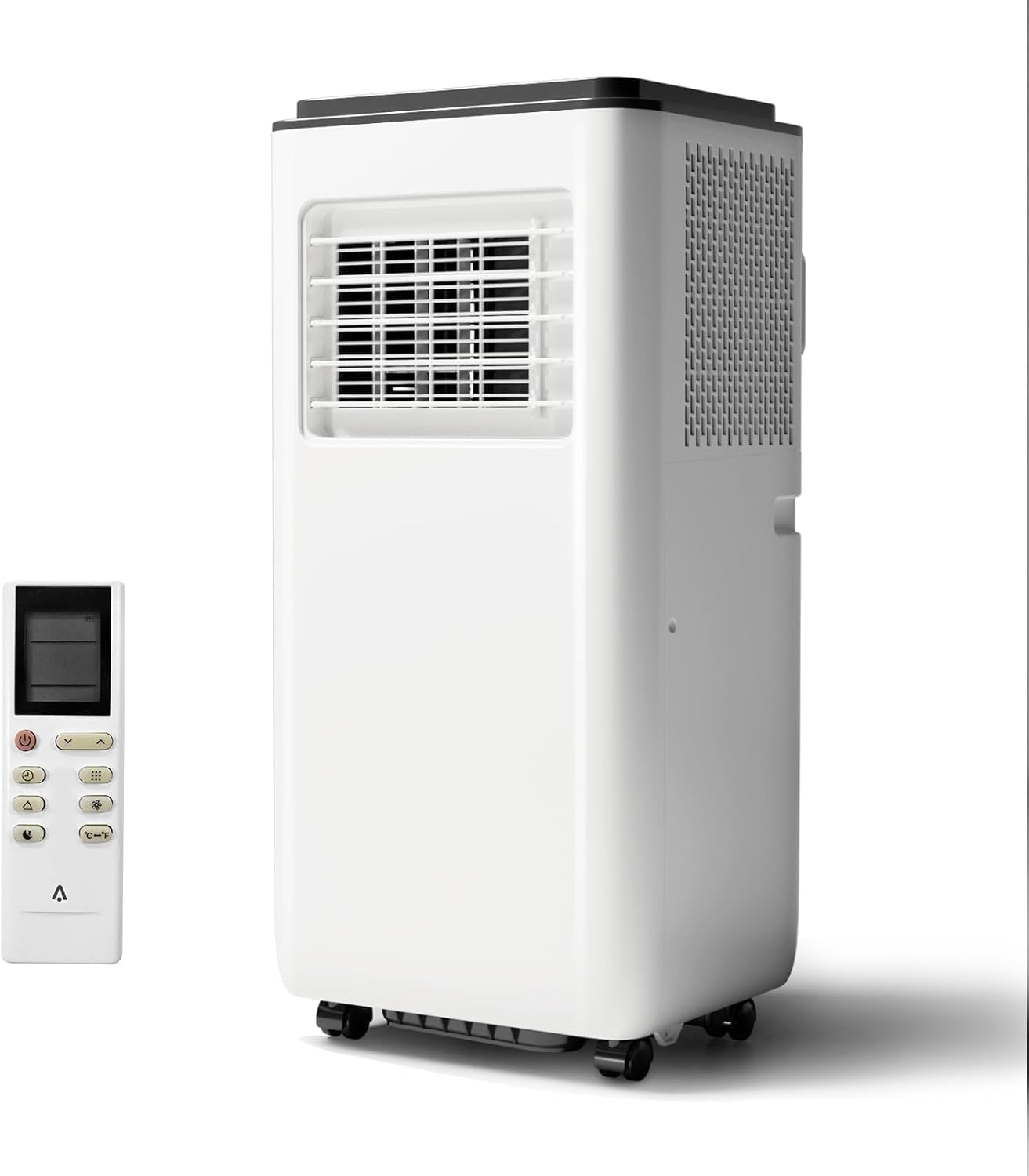
| Cooling Power | 8000 BTU |
|---|---|
| Noise | 53 db |
| Wattage | 1000 |
| Capacity | 450 cubic feet |
| Controller Type | Remote Control |
The Garvee 8000 BTU portable air conditioner is a compact 3-in-1 unit that provides cooling, dehumidifying, and fan modes for spot cooling or small rooms. It is typically set near a window using the included adjustable window kit and exhaust hose, and moves easily on built-in caster wheels for temporary cooling in bedrooms, small living areas, or a caravan when vented properly. Notable features include an 8,000 BTU cooling capacity, remote control, 24-hour timer, sleep mode for quieter night operation, and a washable filter for lower maintenance. In practice it cools modest spaces reasonably well and reduces humidity automatically with optional manual draining in very humid conditions. Trade-offs are its moderate noise (around 50 to 53 dB) and that 8,000 BTU is best suited to small spaces rather than large open areas; it also draws roughly 1000 watts during operation. For someone looking for a budget-friendly, portable cooling solution that is simple to install and move, this model delivers predictable performance with easy upkeep, but expect modest cooling power and noticeable operating noise compared with larger or split systems.
Best for: Buyers on a tight budget who need a simple, portable cooling and dehumidifying solution for small enclosed spaces like a caravan or compact room and value easy installation and mobility.
Less Ideal for: People needing to cool large open areas, very hot climates, or those who require whisper-quiet operation and maximum energy efficiency should consider more powerful or dedicated systems.
- Three-in-one functionality: cooling, dehumidifying, and fan modes in one unit
- Includes adjustable window kit, exhaust and drain hoses for straightforward installation
- Built-in caster wheels and side handles make the unit easy to move between spaces
- Remote control, 24-hour timer, and sleep mode for convenient, scheduled operation
- Noise level around 50–53 dB can be noticeable in very quiet caravan interiors
- 8,000 BTU is limited to small enclosed spaces and may struggle in hot, poorly insulated areas
Verdict: A budget-friendly, portable 3-in-1 air conditioner that is easy to install and move, making it a practical cooling choice for small caravans and compact spaces.
BLACK+DECKER Portable Air Conditioner BPACT08WT

| Cooling Power | 9000 BTU (5,300 BTU SACC) |
|---|---|
| Refrigerant | R-32 |
| Wattage | 935 watts |
| Control Method | Remote |
| Capacity | 19.2 liters |
This BLACK+DECKER portable air conditioner is a compact 9,000 BTU (5,300 BTU SACC) unit designed to cool, dehumidify, and act as a fan in rooms up to about 300–400 sq ft. It includes a full-function remote with a follow-me thermostat, a top-mounted control panel with an LED display, and a window installation kit for venting through horizontal or vertical windows. Practical touches include casters and side handles for moving the unit, a reusable washable filter, self-evaporating operation to reduce manual draining, and a small 0.45L collection tank for dehumidifying. The unit runs on standard 115V power and lists around 935 watts consumption, so it will need a stable power source. Expect typical portable AC noise and footprint for this class; it is not an inverter model and relies on a rotary scroll compressor, which may run steadily rather than variably. For stationary cooling in temporary setups it delivers convenient, easy-to-install cooling, but it requires proper venting and enough clearance to perform at rated capacity.
Best for: Buyers who prioritize a dependable, easy-to-install portable air solution for temporary living spaces and want simple, straightforward cooling with minimal setup fuss.
Less Ideal for: People seeking ultra-quiet, inverter-based temperature control or systems specifically engineered for mobile vehicle power setups should consider alternatives designed for caravan electrical constraints.
- Three-in-one functionality: cooling, dehumidifying, and fan modes in one portable unit.
- Includes full window installation kit and remote with follow-me thermostat for flexible placement and easy control.
- Mobility features such as casters and side handles make it simple to move between rooms.
- Reusable washable filter and self-evaporating design reduce maintenance and draining chores.
- Not an inverter unit, so compressor cycles can be louder and less energy-variable than inverter models.
- Requires proper venting and a stable 115V supply, which may limit placement in very small or unusual caravan openings.
Verdict: A reliable, easy-to-install portable AC that provides straightforward cooling and dehumidifying for temporary living spaces where dependable performance matters.
BLACK+DECKER Smart Portable Air Conditioner
| Cooling Power | 12000 BTU |
|---|---|
| SACC Cooling | 8,350 BTU |
| Coverage | Up to 550 sq. ft. |
| Power | 115 volts, 3516 watts |
| Refrigerant | R410a |
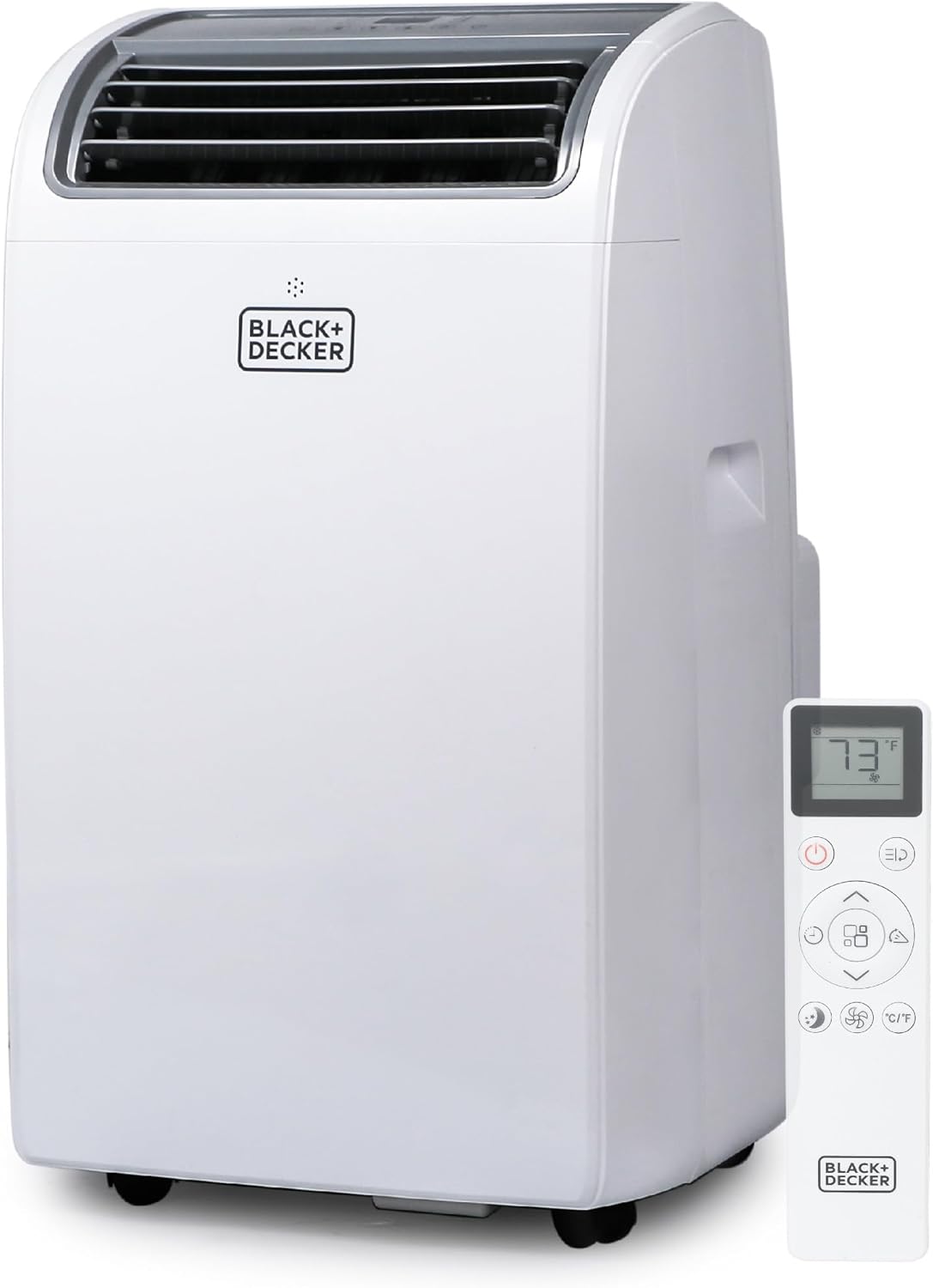
This BLACK+DECKER Smart Portable Air Conditioner is a Wi‑Fi enabled 3‑in‑1 unit that cools, dehumidifies, and circulates air for medium to large rooms. It is typically used as a temporary or seasonal cooling solution where a permanent installation is not desirable, and it ships with a window installation kit, exhaust hose, and remote for straightforward setup and operation. Notable features include app and voice control compatibility, a follow‑me remote thermostat function, sleep mode, four fan speeds, and a washable filter for lower maintenance. In practical use it delivers strong cooling power (12,000 BTU ASHRAE; 8,350 BTU SACC) and offers mobility via casters and side handles so you can move it between bedroom, office, or living areas. Important limitations are its weight and physical footprint which make it less suitable where space and lightness are critical, and typical portable AC noise and energy draw compared with fixed systems means higher running cost in prolonged use. The included window kit and drain options make seasonal removal and storage easy.
Best for: Buyers who prioritize proven performance and verifiable features and want a smart, movable cooling solution for seasonal use in rooms where a window venting kit is acceptable.
Less Ideal for: People needing an ultra‑lightweight or permanently mounted caravan cooling solution, or those who must minimize continuous energy use and noise on long trips.
- Smart Wi‑Fi control with app and voice assistant compatibility for remote operation
- Three functions in one: cooling, dehumidifying, and fan modes
- Includes full window installation kit and exhaust hose for easy setup
- Follow‑me remote thermostat and multiple fan speeds for targeted comfort
- Washable filter reduces ongoing replacement costs
- Relatively heavy and bulky for use in very small or weight‑sensitive spaces
- Portable units typically run louder and draw more power than permanent installations
Verdict: Choose this unit when you want a smart, well‑equipped portable AC that reliably cools and dehumidifies larger rooms and offers easy seasonal installation and app control.
Frigidaire 6,000 BTU Window Air Conditioner

| Cooling Power | 6000 BTU |
|---|---|
| Floor Area | 250 square_feet |
| Wattage | 545 watts |
| Noise | 51 db |
| Refrigerant | R-32 |
The Frigidaire FHWC063TC1 is a compact 6,000 BTU window air conditioner intended to cool small rooms up to roughly 250 square feet. It offers three fan speeds, multi-directional airflow, a 24-hour timer, and a remote for simple, familiar operation. Practical features include a washable dust pre-filter with a clean-filter reminder, Eco and Sleep modes for reduced energy use, and a Dry mode to help control humidity. It runs on standard 115V household power and lists a relatively low noise level in the low 50 dBA range, which helps for overnight use. Limitations for caravan use are the unit's window installation design and its corded 115V power requirement, which mean it is best suited to caravans with compatible window openings and reliable shore power or an adequate inverter; it is not a ducted or rooftop RV-specific system. For someone who prioritizes straightforward, proven cooling with easy maintenance and remote control, this unit delivers familiar functionality, but buyers should confirm installation fit and power compatibility before ordering.
Best for: A cautious buyer who wants a reliable, easy-to-use room air conditioner with simple controls and low maintenance for occasional caravan trips where shore power and a suitable window opening are available.
Less Ideal for: People who need an RV-specific rooftop or DC-compatible caravan air conditioner or those without consistent 115V power access during travel should consider purpose-built alternatives.
- Compact 6,000 BTU capacity suitable for cooling small spaces up to about 250 sq. ft.
- Remote control, 24-hour timer, and three fan speeds for easy, familiar operation.
- Washable pre-filter with a clean-filter alert simplifies maintenance.
- Energy-saving Eco and Sleep modes help reduce runtime and noise for overnight use.
- Designed for standard window installation so it requires a compatible opening and mounting hardware.
- Needs 115V corded power which may require shore power or a suitable inverter in a caravan.
- Not built as an RV-specific rooftop or ducted unit, so fitment and ventilation may be challenging in some caravan layouts.
Verdict: A straightforward, low-maintenance 6,000 BTU window AC that suits cautious buyers looking for familiar, reliable cooling when a caravan has compatible window mounting and 115V power.
Choosing the Right Air Conditioner for Caravan: Key Factors to Consider
Cooling Capacity Relative to Caravan Size
Cooling capacity determines how quickly and effectively an air conditioner lowers interior temperature. In a caravan, usable interior volume is much smaller than a house room, so oversized systems can cycle inefficiently while undersized units will struggle in high ambient temperatures. Match BTU or kilowatt ratings to your caravan's volume and consider insulation quality and typical climate.
Also consider peak versus continuous cooling needs. A unit that reports high peak BTU may still underperform if its sustained cooling and airflow are limited. Look for capacity specs that align with the caravan's specific floorplan and exposure to sun.
Electrical Demand and Energy Efficiency
Energy draw is critical for caravans because onboard power sources are limited. Check running wattage and starting surge requirements to ensure your caravan wiring, inverter, or shore connection can handle the load. Lower energy consumption extends battery life and reduces the need to run a generator or shore power continuously.
Energy efficiency ratings and features like variable-speed compressors or eco modes help reduce draw during steady-state operation. Evaluate whether the unit can run on available circuit amperage and how it performs on battery-plus-inverter setups to prevent nuisance trips or premature battery depletion.
Physical Size and Mounting Options
Caravan installations impose strict size and mounting constraints. Consider whether the unit is roof-mounted, through-wall, or portable and whether existing cutouts can be used. Roof-mounted systems must match roof camp spacing and load limits; through-wall or window-style units need appropriate wall thickness and sealing.
Measure clearance above and below the chosen location and factor in venting, duct routing, and access for service. Units that offer multiple mounting kits or low-profile housings increase your chances of a straightforward fit.
Noise and Vibration
Noise from the compressor and fans is more noticeable in a compact caravan. Excessive noise can interfere with sleep and conversation, and vibration can loosen fixtures over time. Review decibel ratings where available and consider models with soft-start compressors or vibration-damping mounts.
Think about reported noise at different fan speeds since low-speed operation is commonly used at night. Placement relative to sleeping areas will also influence perceived noise; exterior compressors may reduce interior sound compared with all-in-one interior units.
Durability and Weather Resistance
Caravan units face road vibration, temperature swings, and exposure to water and salt in some environments. Materials, sealing, and corrosion-resistant coatings matter for long-term reliability. Choose units designed with gaskets, robust housings, and serviceable components.
Consider warranty terms for mobile use and whether spare parts or service access are feasible in your region. A slightly heavier-duty unit can cost more initially but reduce repair headaches over years of travel.
Controls, Features, and Usability
Control options affect daily convenience. Remote controls, programmable timers, and thermostatic control help maintain comfort without constant adjustment. Some units offer multi-speed fans, sleep modes, or smart features that optimize runtime for limited power systems.
Ease of filter access and basic maintenance tasks also matter. A design that simplifies cleaning and routine checks reduces downtime and keeps the unit running efficiently on long trips.
Types of Caravan Air Conditioners
Caravan air conditioners typically come as roof-mounted domes, through-wall units, or portable systems. Roof-mounted systems save interior space and often provide the most even airflow, while through-wall units can offer a lower profile and easier access for service. Portable units can be useful where permanent installation is not possible but usually sacrifice efficiency and cooling power.
Each type has tradeoffs in installation complexity, airflow patterns, and energy use. Think about how you want air distributed in the caravan and whether you need a fixed install for winter travel or a removable option for off-season storage.
- Roof-mounted: good airflow, saves interior space, requires roof cutout.
- Through-wall: compact profile, easier servicing, needs wall reinforcements.
- Portable: flexible placement, lower efficiency, may need venting panels.
Sizing an AC to Your Caravan
Sizing is more than BTU per square meter. Account for ceiling height, insulation level, number of occupants, and typical ambient temperature at your destinations. A well-insulated caravan in temperate climates will need less capacity than one used in hot, humid regions.
When in doubt, choose a unit that provides adequate continuous cooling rather than a high peak rating. Also consider combined heating and cooling functions if you travel in variable climates, because dual-mode units can increase year-round value.
- Calculate interior volume not just floor area.
- Factor in solar load from windows and roof color.
- Consider occupancy and heat-producing appliances when sizing.
Power Systems and Running an AC Off-Grid
Running an air conditioner off-grid requires planning for inverter capacity, battery bank size, and generator or shore power availability. Many caravan owners use a combination of shore power when available and generator or high-capacity inverters for off-grid cooling sessions. Match the AC's starting surge and running wattage to your power system to avoid trips and battery drain.
Consider energy-saving features like variable-speed compressors and eco modes to reduce runtime. Proper insulation and reflective window covers can also lower cooling load and extend off-grid runtime without needing a larger power system.
- Check starting surge versus continuous draw before installation.
- Use smart thermostats or timers to reduce unnecessary runtime.
- Pre-cool the caravan while connected to shore power when possible.
Installation Basics and Venting
Correct installation ensures performance and prevents leaks. Roof-mounted units need secure fastening, proper sealing, and consideration of roof load. Through-wall units require accurate wall cutting, sealants, and support for the external cabinet. Improper venting or gaps can let moisture and pests into living areas.
Hire a qualified technician if you are unsure about electrical connections or structural modifications. Follow manufacturer guidelines for clearances and support to avoid structural or warranty issues.
- Always use appropriate sealants and flashing for roof mounts.
- Verify electrical feed ampacity and circuit protection.
- Plan for service access and filter replacement when siting the unit.
Maintaining Your Caravan Air Conditioner
Regular maintenance preserves efficiency and prevents breakdowns. Clean or replace filters seasonally, inspect drain lines for blockages, and check seals and fastenings after long trips. Corrosion-prone areas should be inspected and treated to prevent rust.
Store removable units in a dry place during off-season and perform a system check before the travel season to identify leaks or worn components early.
- Clean filters and evaporator coils regularly.
- Check drain pans and condensate lines for clogs.
- Inspect exterior casings and seals for damage after winter storage.
How We Chose the Best Air Conditioner for Caravan
We prioritized criteria that directly affect performance and usability in caravan environments. Cooling capacity was assessed for how well a unit brings down interior temperature in confined, insulated spaces. Energy efficiency and real-world power draw were central because caravan electrical resources are limited and many owners run on camper batteries, leisure circuits, or shore power with restricted amperage. Installation flexibility and physical footprint mattered because caravan roofs and interiors have specific space and mounting constraints. Noise level was included since sleep and conversation are often impacted in small living areas. Durability and weather resistance were considered for units exposed to highway vibration and outdoor elements. We excluded products intended solely for full-size home installation or heavy commercial HVAC that exceed typical caravan power and size limits. We also filtered out models lacking clear electrical specifications or without mounting options suitable for recreational vehicles. The final selection favors units that document cooling output, energy consumption, installation requirements, and noise ratings so buyers can compare like for like.
Our full evaluation process is outlined in our review methodology.
FAQ
Can a caravan air conditioner run from a typical onboard leisure battery?
Often it depends on battery capacity and inverter size. Small leisure batteries and modest inverters will struggle with the starting surge and continuous draw. Many owners use shore power, a larger battery bank, or a generator for reliable operation.
Is roof mounting better than through-wall for a caravan?
Roof mounting saves interior space and can provide more even airflow, while through-wall units can be easier to service and may have lower exterior height. The best choice depends on your caravan layout, roof strength, and preference for interior space.
How much noise should I expect from a caravan AC at night?
Noise varies by unit and placement. Look for decibel ratings and models with low-speed modes or soft-start compressors for quieter night operation. Exterior compressor placement generally reduces interior noise compared with all-in-one interior units.
Do caravan air conditioners need special corrosion protection?
Yes, units exposed to road salt, coastal air, or frequent moisture benefit from corrosion-resistant coatings and robust seals. Regular inspections and cleaning help prevent premature rust and maintain performance.
Can I install an air conditioner myself in my caravan?
Basic installation may be possible for experienced DIYers, but electrical connections, structural modifications, and proper sealing can be complex. Hiring a qualified technician is recommended if you are not confident with electrical work or roof/wall modifications.
Final Verdict
Choosing an air conditioner for a caravan is a balance between cooling capacity, electrical constraints, installation fit, and noise tolerance. Prioritize a unit that matches your caravan's interior volume and electrical system while offering efficient runtime and serviceable design. Consider how you travel most often—short trips with shore power, extended off-grid stays, or varied climates—and pick features that support that usage. Focus on realistic power requirements and installation feasibility rather than maximum advertised capacity. With careful matching of size, energy use, and mounting style, you can find a caravan air conditioner that keeps your living space comfortable without overwhelming your electrical setup.