
Note: This article contains affiliate links. If you click on these links and make a purchase, we may earn a small commission at no extra cost to you. This helps support our research and content. Read our full affiliate disclosure here.
Picking the right air conditioner for a 200 square foot room matters because an undersized unit will struggle to reach set temperatures while an oversized one cycles inefficiently. You want dependable cooling that keeps temperature, humidity, and running costs under control in living rooms, bedrooms, or small home offices. This guide shortlists the top options for a 200 sq ft footprint and evaluates each by practical criteria like cooling capacity, energy efficiency, noise, and ease of installation and upkeep. Read on to see the units that best balance performance and operating cost, with clear notes on what type of setup each suits best.
Top Picks at a Glance
| Best Overall The best all-around choice for most situations | LG LW6017R 6,000 BTU Window AC |  |
| Best Quality Built to a higher standard if you want something more solid | Midea EasyCool 6,000 BTU Window AC |  |
| Best Value The sweet spot between price and what you get | GarveeLife 6000 BTU Window Air Conditioner |  |
| Best Budget The cheapest option that still gets the job done reliably | GarveeHome 6000 BTU Window AC | |
| Best Seller A high-volume bestseller chosen again and again | BLACK+DECKER Portable Air Conditioner BPACT08WT |  |
LG LW6017R 6,000 BTU Window AC

| Cooling Power | 6000 BTU |
|---|---|
| Floor Area | 250 square_feet |
| Wattage | 520 watts |
| Noise | 52 db |
| Control Method | Remote |
The LG LW6017R is a compact window air conditioner built to cool medium rooms and home offices. It delivers 6,000 BTU of cooling and is typically installed in a standard window using the included installation kit. Controls are straightforward: a digital panel plus remote control and three cooling/fan speeds let you dial in comfort, while two-way air deflection helps direct airflow across the room. The unit includes a removable washable filter and a filter reminder light, simplifying routine maintenance, and auto restart restores operation after power interruptions. Noise levels are relatively low at about 52 dB on low, so it is unobtrusive in bedrooms. Efficiency is reasonable for its class with an SEER of 11.5 and a listed 520 watts of power draw. Limitations are the fixed non-inverter compressor and modest dehumidification capacity, so it may run longer on very hot days and will not match the energy savings or temperature hold of inverter models. For straightforward cooling of a single medium room this unit is a practical, easy-to-use choice.
Best for: Buyers seeking a simple, reliable window air conditioner to cool a single medium-sized room with minimal setup and straightforward controls.
Less Ideal for: People who prioritize the highest energy savings or need strong dehumidification or variable-speed inverter performance for large or multiple rooms.
- Appropriate cooling capacity for medium rooms up to ~250 sq ft
- Simple digital controls with included remote for easy adjustments
- Washable slide-out filter and filter reminder for low maintenance
- Auto restart restores settings after power outages
- Relatively quiet operation at 52 dB on low setting
- Non-inverter rotary compressor so it may consume more energy under heavy load
- Limited dehumidification capacity compared with dedicated dehumidifiers
Verdict: A practical, easy-to-install 6,000 BTU window AC that reliably cools a single medium room with simple controls and low maintenance.
Midea EasyCool 6,000 BTU Window AC

| Cooling Power | 6000 BTU |
|---|---|
| Floor Area | 250 square_feet |
| Wattage | 545 watts |
| Efficiency | 12.1 CEER |
| Noise | 52 db |
The Midea EasyCool 6,000 BTU window air conditioner is built to cool small to medium rooms quickly while also offering dehumidifier and fan-only modes for year-round use. Installation uses expandable side panels and common window mounting hardware so it fits typical single-window openings; the LED display and included remote let you change temperature, fan speed, and modes from across the room. Notable features include EcoSave and SleepWell modes, a washable reusable filter with a clean-filter indicator, and auto-restart after power loss so settings are retained. At 52 dB on low the unit is on the quieter side for a window AC, and its 12.1 CEER rating indicates reasonable energy performance for a non-inverter rotary compressor design. Expect straightforward cooling for bedrooms, offices, or studios up to roughly 250 sq ft, but be aware this is a basic non-inverter unit so it cycles more under heavy load and lacks variable-speed compressor efficiency found in inverter models.
Best for: Buyers who prioritize steady, reliable cooling for a bedroom or small living space and want simple, programmable controls and basic energy-saving modes.
Less Ideal for: People seeking the highest possible energy efficiency and the quietest operation available should consider inverter-style units instead.
- Cools rooms up to about 250 sq ft with a 6,000 BTU capacity
- Includes remote, LED display, EcoSave and SleepWell modes for convenient controls
- Washable reusable filter with a clean-filter indicator for simple maintenance
- Auto-restart restores settings after power outages
- Non-inverter rotary compressor means less efficient load matching compared with inverter units
- Noise up to 52 dB may be noticeable on higher fan settings
Verdict: A straightforward, performance-focused 6,000 BTU window AC that reliably cools rooms around 200–250 sq ft with convenient controls and basic energy modes.
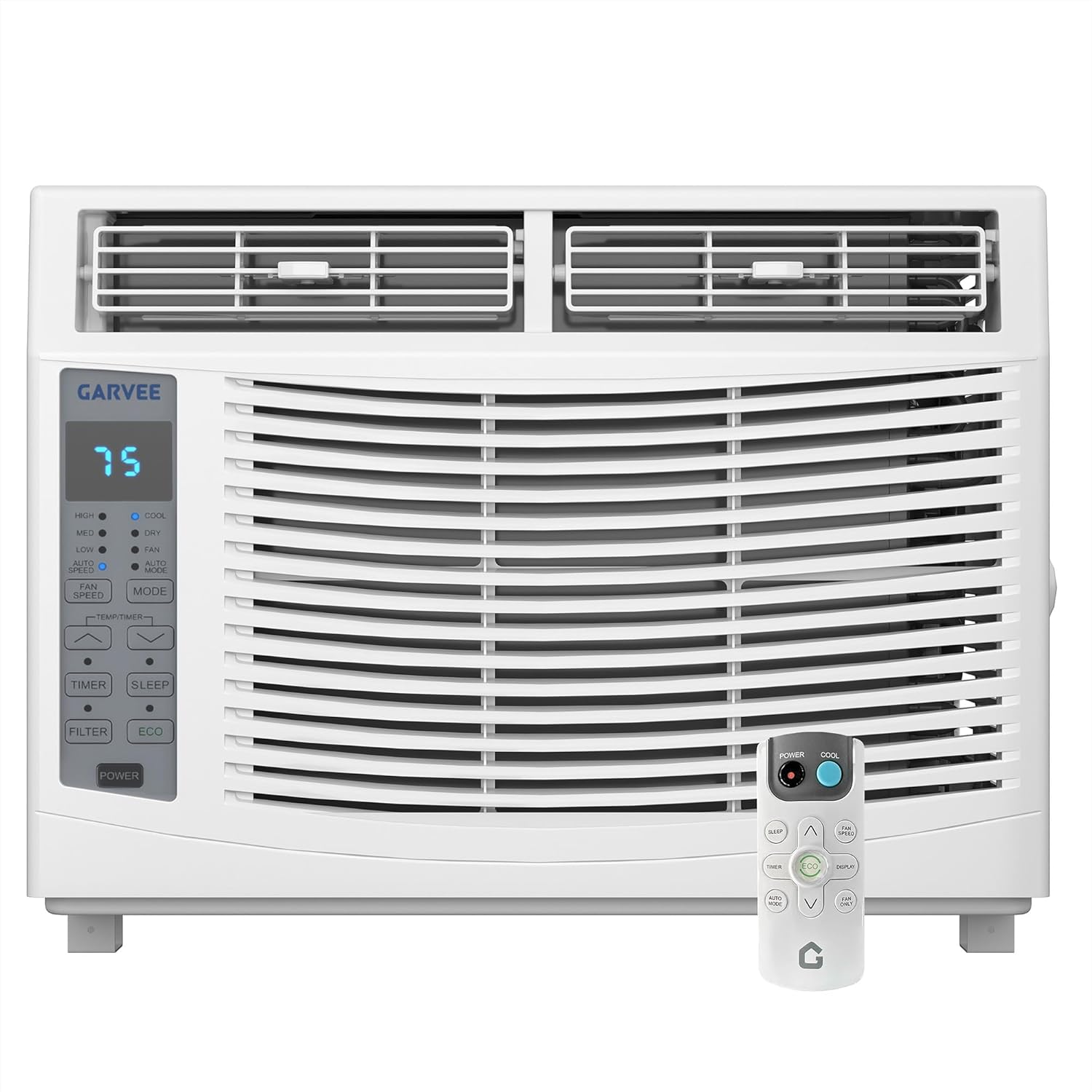
GarveeLife 6000 BTU Window Air Conditioner
| Cooling Power | 6000 BTU |
|---|---|
| Floor Area | 250 square_feet |
| Wattage | 550 |
| SEER | 14 |
| Control Method | Remote |
This GarveeLife 6000 BTU window unit is a straightforward cooling solution for small rooms such as bedrooms or home offices. It provides three fan speeds, a 24-hour timer, and a sleep mode so you can set temperature and runtime without fuss, and the included remote makes daily adjustments easy. The unit uses a rotary scroll compressor and lists a SEER of 14, so it balances modest efficiency with 550 watts of power draw. Installation is typical for a window AC and the package includes expandable side panels and a mounting kit; the washable filter and water self-evaporation feature reduce how often you need to empty condensate. Expect audible operation around the low-50 dB range, which is noticeable but acceptable for most sleeping or working situations. Limitations are its non-inverter design and relatively small 6000 BTU capacity, so it is not suitable for larger open-plan rooms or for households seeking variable-speed energy savings. For a compact, no-frills cooling option for a single room, it delivers the essentials with simple maintenance.
Best for: Buyers who prioritize reliable, low-maintenance cooling for a single small room and want straightforward controls and remote operation.
Less Ideal for: People needing cooling for larger or open-plan areas or those who want inverter-driven, variable-speed efficiency and the quietest possible operation.
- Adequate 6000 BTU cooling for small rooms up to ~250 sq ft
- Remote control plus 3 fan speeds, 24-hour timer and sleep mode for easy comfort adjustments
- Washable filter and water self-evaporation lower maintenance needs
- Includes mounting kit and expandable side panels for standard window installation
- SEER 14 rating offers reasonable seasonal efficiency for the class
- Non-inverter compressor means less efficient part-load performance and no variable-speed operation
- Noise around 52 dB can be noticeable in very quiet bedrooms
Verdict: A practical, easy-to-install window AC that reliably cools a single small room with simple controls and low maintenance.
GarveeHome 6000 BTU Window AC
| Cooling Power | 6000 BTU |
|---|---|
| Floor Area | 250 square_feet |
| Wattage | 850 |
| Voltage | 115 |
| Control Method | Remote |
This GarveeHome 6000 BTU window air conditioner is a compact window‑mounted unit intended for medium rooms such as bedrooms, small living areas, or home offices. It provides three cooling and fan speeds plus Auto‑Cool to adjust fan speed automatically based on room temperature, and an LED digital display with remote control for convenient operation from across the room. The unit advertises relatively quiet operation and fast cooling driven by a rotary compressor, and includes side panels and mounting hardware for standard double‑hung windows plus an auto‑restart feature to restore settings after power loss. Practical benefits include straightforward installation, simple electronic controls, and energy-conscious operation for steady cooling without excessive power draw. Important limitations are its modest 6000 BTU capacity, which is best suited to roughly 200–250 sq ft spaces and will struggle in larger or poorly insulated rooms, and the lack of inverter technology which can mean less efficient part‑load performance compared with inverter models.
Best for: A buyer who needs an inexpensive, no‑frills window AC to cool a single medium room and values simple controls and easy installation over advanced efficiency features.
Less Ideal for: People who need the most energy‑efficient long‑run operation or who plan to cool larger, poorly insulated rooms should consider higher‑capacity or inverter models instead.
- 6000 BTU rating cools medium rooms up to about 250 sq ft
- Includes remote control and LED digital display for easy adjustments
- Auto‑restart restores prior settings after power outages
- Multiple fan and cooling speeds including Auto‑Cool for basic automatic control
- Comes with side panels and mounting hardware for standard double‑hung windows
- Non‑inverter rotary compressor so less efficient at variable loads compared with inverter units
- No detailed noise spec beyond a general dB listing which may vary by operating mode
Verdict: A budget‑minded, easy‑to‑install 6000 BTU window AC that reliably cools a single medium room with simple controls and remote convenience.
BLACK+DECKER Portable Air Conditioner BPACT08WT

| Cooling Power | 9000 BTU (5,300 BTU SACC) |
|---|---|
| Power Source | Corded Electric |
| Wattage | 935 watts |
| Refrigerant | R-32 |
| Floor Area | 300 |
This BLACK+DECKER portable air conditioner is a compact, movable unit designed to cool bedrooms, home offices, and similar spaces. It delivers 9,000 BTU (5,300 BTU SACC) cooling and includes a full-function remote with a Follow Me thermostat, a top-mounted LED control panel, and casters and side handles for easy relocation. Installation is straightforward using the included window kit and exhaust hose, and the unit can run as an air conditioner, a dehumidifier, or a fan. Practical benefits include self-evaporating operation to reduce emptying, a reusable washable filter, and a 24-hour timer and sleep mode for quieter overnight use. Expect moderate noise levels and typical portable-AC power draw. Limitations are the modest effective SACC rating compared with the nameplate BTU, and like most portable units it requires venting and takes up some floor space; it will not match the efficiency or quietness of a split or central system. For steady cooling in a single room around 200 sq ft it provides convenient, no-permanent-installation comfort with familiar controls and basic energy-efficiency features.
Best for: Buyers who prioritize a low-risk, easy-to-install cooling solution for a single room and want straightforward controls, predictable performance, and familiar safety features.
Less Ideal for: Those seeking the quietest or most energy-efficient whole-home solution or a permanently installed system should consider wall‑mounted or ducted options instead.
- 3-in-1 operation: cools, dehumidifies, and functions as a fan for seasonal versatility
- Follow Me remote lets the remote act as a localized thermostat for more accurate comfort
- Included window kit and casters make installation and moving between rooms easy
- Self-evaporating design and washable filter reduce maintenance and running hassles
- Nameplate BTU is higher than the SACC cooling capacity, so usable cooling is closer to the lower SACC number
- Portable units require a venting setup and occupy floor space where a wall system would not
- Noise and efficiency are typical for portable ACs and not as quiet or efficient as split systems
Verdict: A reliable, easy-to-install portable air conditioner that provides practical, no-fuss cooling and dehumidification for a single room around 200 sq ft.
Choosing the Right Air Conditioner for 200 Sq Ft: Key Factors to Consider
Correct Cooling Capacity
Matching the air conditioner's BTU output to a 200 sq ft room is the single most important decision factor. A unit with too little cooling capacity will run continuously, struggle to reach set temperatures, and fail to control humidity effectively. Conversely, an oversized unit will short-cycle, which increases wear and can leave the room feeling clammy because it cools quickly but does not run long enough to dehumidify.
When estimating capacity, consider typical ceiling heights, sunlight exposure, and how many people regularly occupy the room. These factors can shift the ideal BTU up or down by a modest amount, so choose a unit whose stated coverage aligns with those real conditions rather than relying on rounded marketing numbers.
Energy Efficiency and Running Cost
Energy efficiency directly affects monthly operating expenses, especially during hot months when the unit runs for extended periods. Look for units with higher efficiency ratings and features that reduce duty cycle, such as variable-speed compressors or smart thermostatic control.
Efficiency matters more in climates with long cooling seasons, while in places with short summers you may prioritize upfront simplicity. Still, even for occasional use, lower idle power draw and good standby efficiency reduce wasted electricity and can improve the unit's cost-effectiveness over its lifetime.
Noise and Indoor Comfort
Noise level is crucial for bedrooms and home offices where low-volume operation is a priority. Measured sound levels and user-reported in-room decibels give a realistic sense of how intrusive a unit will be during sleep or work.
Compressor speed, fan design, and installation choices all affect perceived noise. If quiet is important, prioritize multi-speed or inverter-driven models and pay attention to installation methods that reduce vibration and radiated noise.
Installation Type and Flexibility
How and where you install the air conditioner governs both performance and cost. Window units, through-the-wall models, and portable conditioners each have strengths and constraints for a 200 sq ft space. Window installations are simple if you have a suitable opening. Through-wall models provide a cleaner look but require a sleeve and wall modification. Portable units need an exhaust path and typically use a window kit.
Consider how permanent you want the installation to be, whether you can modify the wall or window opening, and whether the chosen installation will obstruct natural light, ventilation, or furniture placement.
Maintenance and Filter Access
Routine maintenance affects long-term performance and indoor air quality. Easy access to washable or replaceable filters reduces the likelihood that debris and dust will degrade efficiency. Units with straightforward drain management and serviceable panels make seasonal upkeep less of a chore.
Also evaluate how often the condenser and coils will need cleaning and whether common homeowner tools and skills are sufficient. Simpler maintenance lowers total cost of ownership and helps preserve cooling efficiency over years of use.
Controls and Smart Features
Control options range from basic mechanical dials to fully networked smart thermostats. For a 200 sq ft room, useful controls include accurate temperature sensors, programmable schedules, and remote operation for convenience. Smart features can offer energy-saving schedules and remote diagnostics that help you manage runtime and comfort while away from the room.
Balance feature complexity against actual need. Advanced connectivity is valuable if you want schedule automation or voice control, but it can add setup time. Ensure the control scheme is intuitive and that essential functions like fan speed and temperature hold are easily accessible.
Sizing Tips for a 200 Sq Ft Room
A practical rule of thumb starts with a baseline BTU recommendation scaled to 200 square feet, then adjusts for ceiling height, sunlight, and occupancy. For typical 8-foot ceilings and average insulation, select a unit whose coverage range explicitly includes a 200 sq ft space rather than simply choosing the smallest available model.
If the room receives heavy direct sun, add capacity to compensate. If the room is shaded, has high insulation, or is used infrequently, you can lean toward the lower end of the suggested capacity range.
- Account for ceiling height and add 10% capacity for high ceilings
- Add extra capacity for rooms with lots of windows or heavy sun exposure
- Reduce recommended capacity slightly for well-shaded, insulated spaces
Installation Options: Window, Wall, or Portable
Window units are often the simplest option where an appropriate window is available. They generally require a sill or framed opening and can be removed seasonally without structural changes.
Through-wall units provide a more permanent solution that frees the window and keeps the room layout cleaner, but they require a sleeve and a wall opening which may not be possible in some rental situations.
Portable units deliver flexibility and no permanent modification, but they typically need a window exhaust kit and can be less efficient. Consider the visible footprint and the need to route exhaust when choosing this type.
- Window: easy seasonal removal, minimal installation
- Through-wall: cleaner look, permanent placement
- Portable: flexible placement, requires exhaust routing
Noise Management Strategies
To minimize disruptive sound, choose units with lower advertised decibel levels and designs that limit vibration. Placement also matters: locate the unit so that noise is not directed toward a bed or desk and ensure it is mounted securely to reduce rattles.
Consider features like multi-speed fans or inverter compressors, which can run more quietly during light loads. Using soft pads or isolators in the mounting can further reduce transmitted vibration to the framing or window.
- Place unit away from sleeping or working positions when possible
- Use vibration isolation to cut structure-borne noise
- Prefer variable-speed components for quieter low-load operation
Humidity Control and Comfort Beyond Temperature
Cooling a room is also about managing humidity. Units that run long enough to dehumidify will produce a more comfortable environment than ones that simply lower air temperature quickly. For rooms prone to high humidity, prioritize models or settings that promote longer cycles at lower fan speeds to remove moisture effectively.
If humidity is a recurring issue, look for units with specific dehumidify modes or reliable drainage options to prevent water buildup and maintain indoor comfort.
- Use lower fan speeds and longer cycles for better dehumidification
- Check for dedicated dehumidify modes if humidity control is critical
- Ensure proper drainage or condensate handling in permanent installs
Energy Use and Seasonal Operation
Think about how often and how long the unit will run across the cooling season and size efficiency needs accordingly. Units with higher efficiency ratings or inverter-driven compressors reduce energy use during sustained operation, which matters for long summers.
Also consider features like programmable timers and sleep modes that reduce runtime without sacrificing comfort. For intermittent use, low standby power consumption becomes a larger share of total energy and should be considered in comparisons.
- Look for variable-speed compressors for better seasonal efficiency
- Use timers and schedules to limit unnecessary runtimes
- Consider standby and idle power draw for intermittent use cases
How We Chose the Best Air Conditioner for 200 Sq Ft
We narrowed candidate air conditioners for 200 sq ft rooms using criteria that reflect real-world use and operating cost. First, we focused on appropriate cooling capacity measured in BTU and how it matches a 200 sq ft envelope considering typical ceiling height and insulation. Next, we emphasized energy efficiency ratings and estimated seasonal energy consumption so buyers can compare running costs over time. Noise output and usable sound levels were included because many installations are for bedrooms or home offices where quiet operation matters. We also assessed installation flexibility and whether the unit supports common room setups without major modifications. Ease of ongoing maintenance, including filter access and cleaning, was considered to reflect lifetime convenience. Excluded from consideration were units intended for much larger or much smaller rooms, specialty commercial systems, and complex multi-zone ducted solutions that do not suit a single 200 sq ft space. The final list balances cooling power, efficiency, installation practicality, noise, and maintenance requirements.
Our full evaluation process is outlined in our review methodology.
FAQ
What BTU rating do I need for a 200 sq ft room?
Generally, choose an air conditioner whose BTU range explicitly covers a 200 sq ft room after accounting for ceiling height and insulation. Adjust upward for heavy sun exposure or frequent occupancy, and slightly downward for shaded, well-insulated rooms.
Are portable air conditioners a good choice for 200 sq ft?
Portable units can work for a 200 sq ft room and offer installation flexibility, but they are often less efficient than window or through-wall options and require an exhaust path. They are a practical choice when permanent installation is not possible.
How much noise should I expect from a unit in a bedroom?
Bedroom-appropriate units typically run in a lower decibel range and use multi-speed fans or inverter compressors for quieter operation. Look for models with lower listed dB values and read user feedback about in-room sound for a realistic expectation.
How often should I clean the filter?
Filter cleaning frequency depends on usage and local air quality but is often recommended every one to three months during heavy use. Regular cleaning preserves airflow and efficiency and helps maintain indoor air quality.
Will a higher BTU unit cool faster?
A higher BTU unit may lower temperature faster but can cause short-cycling if oversized for the room. Short cycles reduce dehumidification and can increase wear, so matching capacity to room size is preferable to over-sizing for speed.
Final Verdict
For a 200 sq ft room, prioritize a unit with a BTU rating that closely matches the room's characteristics and a good energy-efficiency profile. Balance noise and installation type against how and where you will use the unit, and consider maintenance needs to keep performance steady over time. Focus on the tradeoffs between upfront simplicity and long-term running cost: choose a model that provides adequate dehumidification, quiet operation, and straightforward installation for your space to ensure comfortable, economical cooling.