
Note: This article contains affiliate links. If you click on these links and make a purchase, we may earn a small commission at no extra cost to you. This helps support our research and content. Read our full affiliate disclosure here.
Choosing the right air conditioner for heating matters when you need dependable warmth, efficient energy use, and low noise in living spaces. The wrong unit can run inefficiently, struggle to maintain temperature, or cost more to operate through a long season. This guide shortlists the top options so you can focus on features that affect real-world performance. We evaluated units across heating capacity, energy use, installation flexibility, and noise to assemble a concise set of picks. Read on for practical guidance and the criteria that helped shape our selections.
Top Picks at a Glance
| Best Overall The best all-around choice for most situations | Midea 12000 BTU Window AC with Heat |  |
| Best Quality Built to a higher standard if you want something more solid | Daikin Entra 18,000 BTU Mini-Split |  |
| Best Value The sweet spot between price and what you get | Rellytech Mini Split 9000 BTU |  |
| Best Budget The cheapest option that still gets the job done reliably | GE 5,000 BTU Window Air Conditioner |  |
| Top Rated A top-rated pick with lots of positive feedback | Senville LETO 12000 BTU Mini Split |  |
| Most Popular A crowd favorite that many people choose with confidence | Frigidaire 5,000 BTU Window AC |  |
| Best Seller A high-volume bestseller chosen again and again | BLACK+DECKER Portable Air Conditioner BPACT14HWT |  |
Midea 12000 BTU Window AC with Heat

| Cooling Power | 12000 BTU |
|---|---|
| Floor Area | 550 square_feet |
| Controls | App, Remote, Touch, Voice |
| SEER / CEER | 13.3 |
| Refrigerant | R-32 |
The Midea 12,000 BTU window unit combines cooling, dehumidifying and a supplemental heat pump into one package aimed at large rooms or open living spaces. It uses variable-speed inverter technology to reach set temperatures more efficiently and quietly than basic window units, and the unit includes modes for Heat, Cool, Dry, Auto and Fan plus a 24-hour timer and ECO setting. You can operate it from the control panel, the included remote, the MSmartHome app, or with Alexa and Google Assistant, which makes nightly temperature and schedule adjustments convenient. Practical benefits include a washable front filter for easy maintenance, defrost and auto-shutoff protections, and a reported noise floor near 45 dBA that keeps operation unobtrusive. Important limits are that the heat pump will not function below about 41°F outside, so it is not a full cold-climate heater, and window fit requires a double-hung opening that meets the stated sash and width measurements. Installation and clearance requirements mean it is best for homeowners or renters with compatible windows who want a single unit for seasonal cooling and mild heating support.
Best for: Buyers who want an all-in-one window unit that handles year-round comfort with remote and voice control, and who prioritize energy efficiency and quiet operation for large rooms.
Less Ideal for: People living in cold climates who need a primary heating source during freezing weather or households without compatible double-hung windows should consider other solutions.
- Inverter-driven compressor for quicker, more efficient temperature control
- Built-in heat pump adds supplemental heating for cool seasons
- Multiple control options including app and voice assistants for remote scheduling
- Energy Star certified with washable front filter for lower running costs and easy upkeep
- Quiet operation around 45 dBA suitable for bedrooms and living rooms
- Heat pump stops working when outdoor temperature falls below about 41°F so it cannot replace a primary cold-weather furnace
- Requires compatible double-hung window and specific sash opening which limits placement options
Verdict: Choose this Midea 12,000 BTU window unit when you want an energy-efficient, quiet system that provides strong cooling plus mild supplemental heat and modern remote control features.
Daikin Entra 18,000 BTU Mini-Split

| Cooling Power | 18000 british thermal units |
|---|---|
| Heating Capacity | 18,000 BTU |
| SEER | 18 |
| Refrigerant | R-32 |
| Voltage | 230 volts |
The Daikin Entra 18,000 BTU mini-split is a single-zone heat pump designed to provide year-round heating and cooling for spaces up to roughly 1,000 sq ft. It uses DC inverter technology and an 18 SEER2 rating to modulate compressor speed for efficient operation and steady temperature control, and the system arrives pre-charged with R-32 refrigerant alongside a 15 ft installation kit and wall bracket for quicker installation. Notable features include a titanium apatite photocatalytic filter for improved air quality, multiple operation modes (auto, dry, fan, sleep) and a quiet indoor noise level around 37 dB. For performance-focused buyers the unit offers wide operating temperature ranges for both heating and cooling, strong heating capacity down to single-digit outdoor temperatures, and a 10-year manufacturer warranty. Limitations are typical of single-zone splits: it only conditions one room or zone and requires professional mounting and piping for full performance, and the stated 1.5-ton capacity means it may be oversized or undersized depending on specific home load calculations.
Best for: Buyers who prioritize efficient, high-performance heating in a single room or addition and want a factory-quality heat pump with inverter modulation for steady comfort.
Less Ideal for: People seeking whole-house heating or multi-room zoning should consider multi-zone systems or ducted alternatives instead.
- High-efficiency inverter compressor with 18 SEER2 for lower running costs
- Provides both heating and cooling across a wide outdoor temperature range
- Includes pre-charged outdoor unit, 15 ft installation kit, remote, and wall bracket for faster setup
- Quiet indoor operation around 37 dB and adjustable airflow to avoid direct drafts
- Built-in photocatalytic filter improves indoor air quality
- Single-zone unit only conditions one room or zone
- Requires professional installation for refrigerant piping and mounting
- Physical sizing may not match every room without a site-specific load calculation
Verdict: Choose this Daikin Entra mini-split when you need efficient, high-performance heating for a single room backed by inverter technology and factory-quality components.
Rellytech Mini Split 9000 BTU
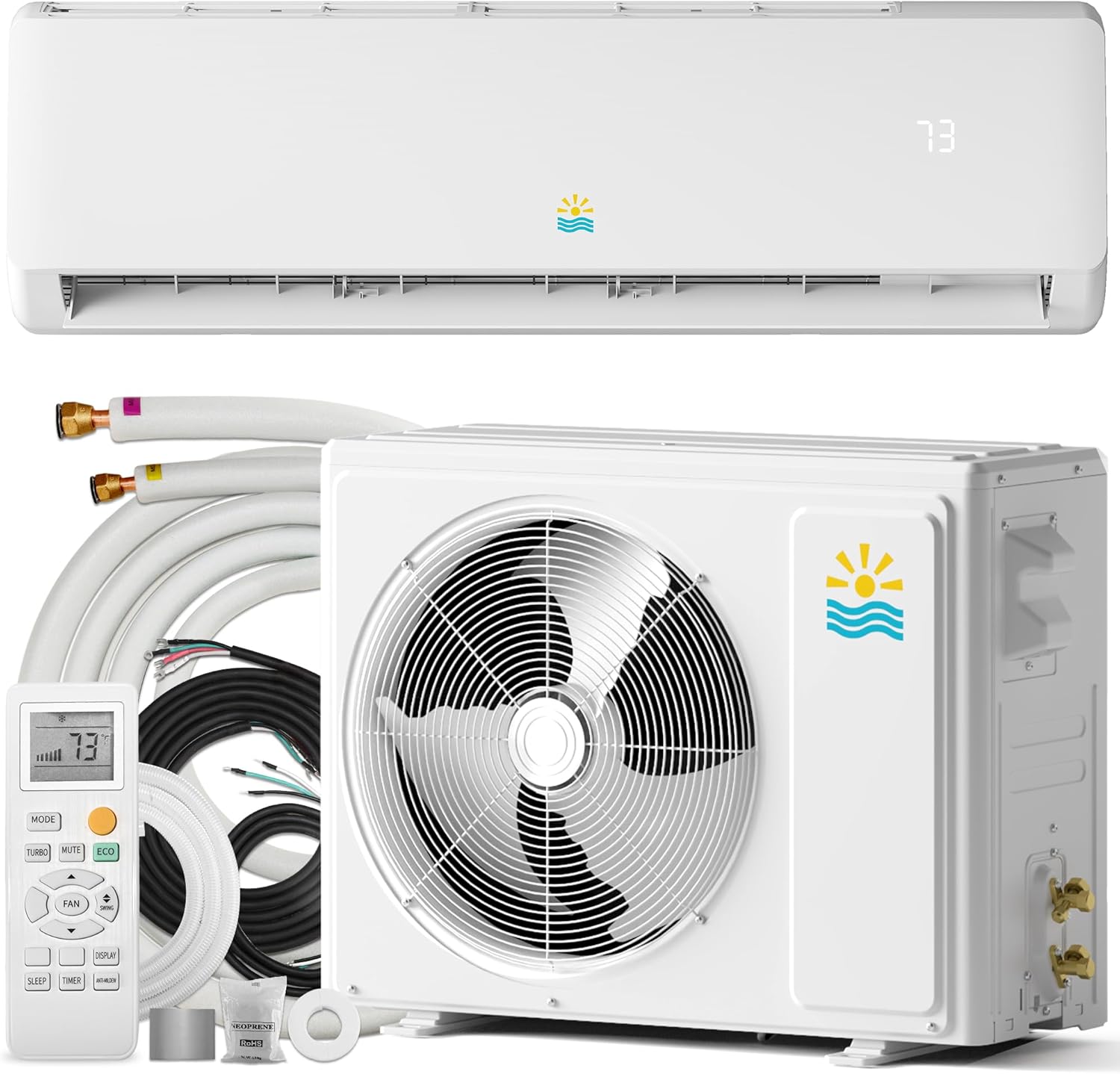
| Cooling Power | 9000 BTU |
|---|---|
| SEER2 | 19 |
| Refrigerant | R-32 |
| Voltage | 115 volts |
| Floor Area | 450 square_feet |
The Rellytech 9,000 BTU mini split is a ductless inverter heat pump designed to cool and heat single rooms up to roughly 450–550 sq ft. It includes indoor and outdoor units plus an installation kit and is controlled by a handheld remote with a 24-hour timer and multiple fan speeds. The inverter compressor and R-32 refrigerant give a 19 SEER2 rating and HSPF2 8.5, so it runs more efficiently than non-inverter options and can reduce energy use during steady operation. Practical features include cooling/heating/fan/dry modes, an ECO setting to conserve power, a sleep mode and a quiet 42 dB indoor noise level for nighttime use. The package provides basic installation hardware but professional installation is recommended because correct refrigerant handling and mounting affect performance. Buyers should also plan for a dedicated installation window and expect the outdoor temperature limits to constrain heat-pump heating performance in very cold climates. For a compact, energy-conscious heating option for a single room, this unit balances efficiency and quiet operation.
Best for: Buyers who prioritize energy efficiency and quiet, year-round comfort in a single room and are willing to arrange professional installation for a permanent, ductless solution.
Less Ideal for: People needing whole-house heating or reliable heat in subfreezing outdoor conditions should consider larger multi-zone systems or alternative heating sources.
- Combined heating and cooling in one ductless unit suitable for year-round use
- Inverter compressor with 19 SEER2 and HSPF2 8.5 for improved energy efficiency
- Includes indoor and outdoor units plus an installation kit and remote control for immediate setup planning
- Multiple modes (cooling, heating, fan, dry), ECO and sleep modes for quieter, lower-consumption operation
- Low indoor noise around 42 dB for bedroom or living room use
- Professional installation recommended because refrigerant handling and mounting are required
- Heating performance is limited by the outdoor operating temperature range and may not suffice in very cold climates
Verdict: A quiet, energy-efficient 9,000 BTU ductless heat pump that delivers practical year-round heating and cooling for a single room when professionally installed.
GE 5,000 BTU Window Air Conditioner

| Cooling Power | 5000 BTU |
|---|---|
| Floor Area | 150 square_feet |
| Power Source | Corded Electric |
| Wattage | 440 watts |
| Refrigerant | R-32 |
This GE 5,000 BTU window air conditioner delivers straightforward, budget-friendly cooling for small rooms like bedrooms, dorms, and home offices. It uses a rotary compressor and two cooling modes with two fan speeds so you can choose quieter low airflow for sleeping or higher output for faster cooling. Mechanical push-button dials and 10 temperature settings keep operation simple and familiar, and the washable filter reduces ongoing costs. The unit draws about 440 watts and uses R-32 refrigerant, so it runs with modest energy use compared with older models. Installation is DIY-friendly with the included EZ mount kit and side panels for narrow windows, and auto-restart preserves settings after power outages. Limitations include a fairly modest 5,000 BTU capacity that is only appropriate for spaces up to about 150 square feet and a reported noise level around 52 to 56 dB that may be noticeable in very quiet rooms. There is no inverter or smart controls, so users wanting variable-speed efficiency or remote/Wi-Fi control will need a different model.
Best for: Buyers prioritizing a low-cost, easy-to-install cooling solution for a single small room who want simple mechanical controls and low ongoing filter costs.
Less Ideal for: Those who need cooling for medium or large rooms, want smart/Wi‑Fi features, or prefer inverter-driven variable-speed operation for higher efficiency.
- Compact footprint fits narrow windows and small rooms
- Simple mechanical controls are easy to use without setup
- Washable filter lowers maintenance cost
- Included installation kit makes DIY mounting straightforward
- Low 440W power draw for energy-conscious operation
- 5,000 BTU capacity only suitable for small spaces up to ~150 sq ft
- No inverter or smart/Wi‑Fi controls for advanced efficiency or remote operation
Verdict: A straightforward, wallet-friendly window AC that provides dependable, low-cost cooling for a single small room.
Senville LETO 12000 BTU Mini Split

| Cooling Power | 12000 british thermal units |
|---|---|
| Capacity | 1 tons |
| Floor Area | 700 square_feet |
| SEER | 20.8 |
| Voltage | 110 volts |
The Senville LETO 12,000 BTU mini split is a wall-mounted ductless heat pump designed to heat and cool single rooms or open living spaces up to about 700 sq ft. It uses a DC inverter compressor to modulate output for steadier temperatures and improved efficiency, and its 4-in-1 functionality covers cooling, heating down to about 5F, dehumidifying, and fan-only modes. The unit is voice and app enabled for remote control and routines and comes with an indoor air handler, outdoor condenser, a remote, and a 16 ft line set precharged for shorter runs. Practical benefits include quiet operation at low noise levels, an above-20 SEER rating for good seasonal efficiency, and a variable-speed inverter that reduces cycling and startup strain on the compressor. Important limitations are that professional installation is required, the included refrigerant only covers runs up to 25 ft, and it requires 110/120V supply which may limit placement compared with higher-voltage commercial systems. For buyers seeking reliable, efficient space heating that also provides cooling, the LETO balances performance and smart controls.
Best for: Buyers who prioritize dependable, year-round climate control and want an efficient, quiet heat pump with smart controls for heating smaller to mid-size rooms.
Less Ideal for: Large homes needing whole-house HVAC or DIY installers who want a plug-and-play portable heater without professional installation.
- Inverter-driven compressor for steady temperature control and improved efficiency
- Works with Alexa and app control for remote operation and automation
- Quiet operation suitable for bedrooms and living areas
- Covers heating, cooling, dehumidifying, and fan modes in one unit
- Requires professional installation and may need additional refrigerant for longer line runs
- Limited to 110/120V electrical supply which can restrict placement in some homes
Verdict: Choose the Senville LETO 12,000 BTU if you want a reliable, efficient mini-split heat pump that delivers quiet, smart-controlled heating for a single room or open area.
Frigidaire 5,000 BTU Window AC

| Cooling Power | 5000 BTU |
|---|---|
| Floor Area | 150 square_feet |
| Wattage | 450 |
| Control Method | Touch |
| Filter Type | Washable |
The Frigidaire 5,000 BTU Window AC is a compact window-mounted unit intended for small rooms and bedrooms. It cools spaces up to about 150 square feet using a rotary scroll compressor and offers two fan speeds plus effortless temperature control via touch/button controls. The washable filter simplifies maintenance and helps reduce dust buildup, while an extra-long three-prong power cord and adjustable side panels make installation in typical windows straightforward. Noise is moderate at about 52 dBA, so it is usable in sleeping areas but not whisper-quiet. Energy efficiency figures (SEER 11) and a 450W draw mean running costs are reasonable for this capacity. Important limitations: this model does not include inverter technology or built-in heating, so it will not provide efficient year-round heat; its small BTU rating restricts it to single rooms rather than open-plan living areas. For buyers focused on reliable, simple cooling in a bedroom or small living space, it is a practical, easy-to-install choice.
Best for: Buyers who prioritize a proven, straightforward cooling solution for a single bedroom or small living space and want a unit with easy installation and low maintenance.
Less Ideal for: People seeking an air conditioner that provides heating or highly efficient variable-speed operation for year-round climate control should consider other options.
- Compact for small-room installation and easy window fit with adjustable side panels
- Washable filter for low-cost, simple maintenance
- Extra-long power cord reduces need for extension cords
- Touch/button controls and two fan speeds for straightforward operation
- Reasonable energy efficiency for a non-inverter 5,000 BTU unit
- No heating function so it cannot replace a space heater for winter use
- Not an inverter model, so it cycles on/off rather than modulating for maximized efficiency
- Moderate noise level around 52 dBA may be noticeable in very quiet rooms
Verdict: Choose this unit if you need a reliable, easy-to-install window air conditioner to cool a single small room with minimal upkeep.
BLACK+DECKER Portable Air Conditioner BPACT14HWT

| Cooling Power | 14000 BTU |
|---|---|
| Cooling SACC | 10,200 BTU |
| Power Source | Corded Electric, 115 volts |
| Refrigerant | R-32 |
| Filter Type | Washable filter |
This BLACK+DECKER portable unit functions as an air conditioner, heater, dehumidifier and fan, making it a flexible year-round option for a single room. It offers 14,000 BTU ASHRAE (10,200 BTU SACC) cooling and a heating mode advertised for up to 700 sq. ft., and ships with a window installation kit, exhaust hose and full-function remote. Smart features include Wi-Fi control via the brand app and voice compatibility with Alexa and Google Assistant, while casters and side handles make it simple to move between rooms. Practical benefits include a washable filter, a 24-hour timer, sleep mode and a follow-me remote thermostat for localized temperature sensing. Important limitations are modest measured efficiency and typical portable-AC noise levels, plus the need to vent through a window or wall and occasional condensate management in dehumidify mode. For buyers who want an easy-to-install, multi-function room heater and cooler with smart controls, this is a competent, mainstream choice.
Best for: Buyers who prefer a low-risk, easy-to-install room-level heating and cooling solution that works year-round and includes smart controls for convenient operation.
Less Ideal for: People seeking the highest seasonal efficiency, the quietest operation, or whole-home heating and cooling should consider larger dedicated systems instead.
- Heats and cools in one unit with 4-in-1 functionality (AC, heat, dehumidifier, fan)
- Wi-Fi and voice control support for remote operation
- Includes window installation kit and full-function remote with follow-me thermostat
- Portable design with casters and handles for easy room-to-room movement
- Washable filter and timer/sleep modes for simple maintenance and energy management
- Not Energy Star rated and has only moderate measured efficiency
- Portable units require window or wall venting and produce noticeable operational noise
- May need periodic condensate draining or management in dehumidifier mode
Verdict: A straightforward, moveable heater-and-cooler with smart controls that lets risk-averse buyers add year-round climate control to a room without permanent installation.
Choosing the Right Air Conditioner for Heating: Key Factors to Consider
Heating Capacity and Sizing
Correct sizing is essential because an undersized air conditioner will run continuously and still fail to reach comfortable temperatures, while an oversized unit can short-cycle and reduce humidity control. Calculate required capacity using room area, ceiling height, insulation quality, window exposure, and local climate. Consider zoning large homes so each area has an appropriately sized unit rather than relying on a single oversized system.
Also factor in startup requirements and how quickly you need a room to recover temperature after a setback. Units rated with higher BTU or kW output will recover faster but may use more energy if not matched to the space.
Cold-Weather Performance and Defrosting
Not all air conditioners designed for heating maintain rated output at low outdoor temperatures. Heat pumps that perform well in winter include features like enhanced vapor injection, variable-speed compressors, or specialized refrigerants that preserve heat transfer when ambient temperatures drop. Reliable defrost cycles are critical because outdoor coils can frost up in cold, humid conditions; good defrost management prevents lengthy interruptions to heating.
Check manufacturer guidance on minimum operating temperature and professional assessments of how units handle sustained cold. If you live in a region with prolonged subfreezing temperatures, favor units explicitly rated for low-temperature heating.
Energy Efficiency and Operating Cost
Efficiency ratings indicate how much heat you get for each unit of electricity. Higher-efficiency equipment reduces operating costs, which is especially important during extended heating seasons. Look for documented COP or seasonal heating efficiency figures that reflect real-world operation, not just peak conditions.
Consider variable-speed compressors or inverter-driven designs because they modulate output to match demand and avoid wasteful start-stop cycles. Also account for how thermostat strategy, setpoint selection, and supplemental heating sources affect overall energy use.
Noise and Indoor Comfort
Many heating sessions happen overnight or while occupants are present, so noise matters. Indoor fan noise and outdoor compressor noise both affect comfort and neighbor considerations. Units with multi-speed fans, quiet indoor cassettes, or sound-dampening housings are preferable where low noise is a priority.
Noise intersects with comfort in other ways: airflow distribution, draft control, and thermostat placement all influence perceived warmth. Evaluate both dBA ratings when possible and user reports of real-world sound levels.
Installation, Ducting, and Placement
Installation choices determine how effectively a unit heats a space. Wall-mounted, floor-mounted, or ceiling cassette units each have different airflow patterns and clearances. Some installations require minor ducting or refrigerant line runs that a qualified technician must handle. Consider the availability of electrical service, mounting options, and whether you need a system that supports multi-zone operation.
Accessibility for maintenance and filter changes also matters. Easier maintenance lowers long-term upkeep costs and helps preserve heating efficiency over the unit's life.
How Low-Temperature Ratings Affect Real-World Heat
A unit's low-temperature rating tells you how much of its rated heat output it can sustain as outdoor temperatures fall. Some designs lose a significant percentage of capacity below certain thresholds, while others keep output steadier through technology and refrigerant choices. Look for published performance curves or installer guidance that show capacity at real-world low temperatures.
In practice, units that maintain a higher percentage of rated heat in the cold reduce dependence on supplemental electric resistance heating, which can be costly. When cold snaps are common, favor systems with proven low-temp performance.
- Check published capacity curves by outdoor temperature
- Ask installers about expected performance during typical cold snaps
- Plan for supplemental heat only if necessary for extreme lows
Matching Controls and Thermostats to Heating Needs
Controls influence comfort and efficiency. A thermostat capable of stage control, setback scheduling, and remote monitoring helps manage runtime and keeps operating costs down. Smart scheduling reduces unnecessary heating during unoccupied periods while restoring comfort before occupants return.
Some units offer onboard adaptive algorithms that learn runtime patterns and adjust output. When combining units in multiple rooms, coordinated controls prevent conflicting setpoints and reduce short-cycling.
- Use setback schedules to limit run time during absent hours
- Consider thermostats that support multi-stage or demand-based control
- Ensure controls are compatible with installer wiring and any home automation hubs
Installation Tips to Maximize Heating Performance
Placement affects airflow and how evenly a room warms. Mount indoor units where airflow clears seating and sleeping areas rather than blowing directly across occupants. Avoid blocking intake or discharge with furniture. Outdoor unit placement should allow unobstructed airflow and be elevated if snow accumulation is possible.
Work with a qualified installer to confirm refrigerant line lengths and electrical service meet manufacturer limits. Proper commissioning, including refrigerant charge verification and airflow balancing, is essential for the unit to meet rated heating output.
- Position indoor unit to promote even distribution
- Elevate outdoor unit in snowy areas and provide clearance for snow melt
- Have installers verify charge and airflow during commissioning
When to Consider Multi-Zone Vs Single-Zone Systems
Single-zone systems serve one room or open area and are often simpler and less invasive to install. Multi-zone systems allow a single outdoor unit to supply multiple indoor units, which can be more efficient for whole-home heating when spaces are used differently throughout the day.
Multi-zone setups introduce controls complexity and require careful capacity planning so one area is not starved of heat. If you plan to add zones later, choose outdoor equipment and line sets that support future expansion to avoid costly replacements.
- Use single-zone for focused heating in regularly used rooms
- Choose multi-zone for whole-home comfort with per-room control
- Plan capacity with a professional to avoid undersizing zones
Maintenance Practices That Preserve Winter Performance
Regular maintenance keeps heating performance close to design. Clean or replace filters on schedule to preserve airflow and efficiency. Outdoor coils should remain free of debris and heavy ice buildup; some systems include defrost management but still require periodic inspection.
Annual professional service that inspects electrical components, checks refrigerant charge, and verifies controls reduces the chance of mid-season failures and maintains steady output across the heating season.
- Replace or clean filters every one to three months depending on use
- Inspect outdoor unit for debris and clear snow around the base
- Schedule annual professional checks before the heating season
How We Chose the Best Air Conditioner for Heating
We prioritized criteria that directly affect how well an air conditioner performs as a heating source in homes and small commercial spaces. Heating capacity and COP/SEER-equivalent efficiency were core filters because they determine whether a unit can maintain comfortable indoor temperatures without excessive run time. We also assessed low-temperature performance and defrost reliability to ensure models remain effective in colder conditions. Installation flexibility and compatibility with common home layouts mattered for real-world fit and ease of setup. Noise levels were measured against typical living-room and bedroom expectations to favor units that stay unobtrusive during extended heating cycles. Durability and build quality were considered by evaluating component robustness and maintenance needs. We excluded units intended solely for cooling or designs with poor documented cold-weather performance. Off-grid or highly specialized commercial HVAC systems were not considered. Our final list emphasizes balanced heating capability, energy efficiency, quiet operation, and user-friendly installation so readers get options that work reliably through a heating season.
Our full evaluation process is outlined in our review methodology.
FAQ
Can an air conditioner be the primary heat source in cold climates?
Often it depends on the specific unit's low-temperature rating and the severity of the climate. Some heat-pump-style air conditioners can handle moderate winter conditions as a primary heat source, but in areas with prolonged subfreezing temperatures you may still need supplemental heating.
How do I size an air conditioner for reliable winter heating?
Base sizing on room area, insulation level, window exposure, and typical winter lows. Factor in occupancy and heat gains from appliances. When in doubt, consult a professional who can perform a heat-loss calculation to recommend capacity.
Will a heating-capable air conditioner work efficiently at night?
Yes, units with variable-speed compressors and good controls can run quietly and efficiently at night. Pay attention to the dBA ratings and choose settings that minimize high fan speeds during sleeping hours.
Do I need a special defrost setting for winter use?
Most heating-capable systems include automatic defrost cycles that engage when outdoor coils frost. Confirm the system's defrost strategy and its effectiveness at your typical winter temperatures as poor defrosting can interrupt heating.
How often should I schedule maintenance for winter-ready units?
Perform basic filter checks monthly during heavy use and arrange professional maintenance annually before the heating season. More frequent checks may be needed in dusty environments or where pets are present.
Final Verdict
Prioritize heating capacity that matches your space, verified low-temperature performance, and efficiency features that reduce operating cost. Noise, installation details, and maintenance accessibility are important secondary considerations because they affect daily comfort and long-term reliability. By focusing on capacity, cold-weather capability, and efficient controls, you can choose an air conditioner that provides dependable heat with predictable operating costs. Assess your climate and installation constraints, then pick the unit whose documented performance and installation fit your home.