
Note: This article contains affiliate links. If you click on these links and make a purchase, we may earn a small commission at no extra cost to you. This helps support our research and content. Read our full affiliate disclosure here.
If you have a tall, narrow window or a sliding vertical sash, choosing an air conditioner designed for vertical windows makes a big difference in comfort and fit. The wrong unit can be noisy, hard to install, or simply not seal correctly, which reduces cooling effectiveness and raises energy use. This guide covers seven shortlisted air conditioners built to work with vertical-window openings and evaluates each on the practical features buyers care about. We focus on cooling capacity, installation type and hardware, airflow and noise, and durability. Read on to see how the options stack up and which features matter most for your room and window configuration.
Top Picks at a Glance
| Best Overall The best all-around choice for most situations | Whynter ARC-14S 14,000 BTU Portable AC |  |
| Best Quality Built to a higher standard if you want something more solid | PerfectAire 10,000 BTU Casement Window AC |  |
| Best Value The sweet spot between price and what you get | EUHOMY Portable Air Conditioner 8,000 BTU |  |
| Best Budget The cheapest option that still gets the job done reliably | GarveeHome 6000 BTU Window AC |  |
| Top Rated A top-rated pick with lots of positive feedback | Midea EasyCool 5,000 BTU Window AC |  |
| Most Popular A crowd favorite that many people choose with confidence | Frigidaire 5,000 BTU Window AC |  |
| Best Seller A high-volume bestseller chosen again and again | BLACK+DECKER Portable Air Conditioner BPACT08WT |  |
Whynter ARC-14S 14,000 BTU Portable AC

| Cooling Power | 14000 BTU |
|---|---|
| Wattage | 1300 watts |
| Noise | 51 db |
| Floor Area | 500 square_feet |
| Capacity | 71 pints |
The Whynter ARC-14S is a heavy-duty dual-hose portable air conditioner designed for large rooms up to about 500 square feet. Its 14,000 BTU cooling (SACC lower) and dual-hose design deliver stronger, more consistent cooling than single-hose units, while the built-in dehumidifier and patented auto-drain help manage moisture without frequent emptying. It offers three modes—cool, dehumidify, and fan—with full thermostat control and a remote for convenient operation. The unit includes an activated carbon filter and washable pre-filter to improve indoor air quality. Practical benefits include a high dehumidifying capacity and relatively quiet low-speed operation at around 51 dB, plus a solid accessory kit for window installation and storage. Expect a large, heavy unit that needs a proper window vent and a dedicated circuit given its 1300 W draw, and its energy efficiency is moderate rather than top-tier. Setup and mobility are straightforward for a freestanding unit of this size, but it is bulkier than compact portable ACs and consumes notable power under sustained use.
Best for: Buyers who prioritize a dependable, high-capacity portable AC for cooling and moisture control in large rooms and want a unit built for continuous, low-maintenance operation.
Less Ideal for: People who need a lightweight, highly energy-efficient, or purely budget portable AC for small rooms or occasional spot cooling should consider smaller or inverter-based alternatives.
- Dual-hose design for more consistent cooling in large rooms
- Built-in dehumidifier with auto-drain reduces maintenance
- High cooling capacity suitable for ~500 sq ft spaces
- Includes activated carbon and washable pre-filter for better air quality
- Remote and panel controls with three fan speeds for easy operation
- Relatively high power consumption compared with smaller units
- Large and heavy, requires adequate space and a proper window vent
- Not ENERGY STAR rated, so long-term operating costs may be higher
Verdict: A robust, reliability-focused portable AC that pairs strong dual-hose cooling with a high-capacity dehumidifier, making it a sensible choice for cooling and moisture control in large rooms.
PerfectAire 10,000 BTU Casement Window AC

| Cooling Power | 10000 BTU |
|---|---|
| Floor Area | 450 square_feet |
| Refrigerant | R-32 |
| Wattage | 961 watts |
| SEER | 12 |
This PerfectAire unit is built to cool medium rooms where standard horizontal window ACs will not fit. The vertical chassis and included mounting kit let it install in narrow casement or side‑by‑side slider openings without major modification. It offers 10,000 BTU cooling, three cooling and fan speeds, adjustable vents for directional airflow, a soft‑touch LED display, and a Follow‑Me remote that senses temperature where you are. Setups such as bedrooms, home offices, and living rooms benefit from the 24‑hour timer and sleep mode for automatic comfort control. Practical downsides are its reciprocating compressor and noninverter design, which help keep cost down but mean higher noise and less efficient steady‑state operation compared with inverter models, and the unit lists a rated noise around 61 dB. The package includes an installation kit, support bracket, and foam seal, and the manufacturer recommends allowing the unit to stand upright for 24 hours before first use to protect the compressor.
Best for: Buyers who need a high‑performing window air conditioner that fits narrow vertical or casement openings and prioritize strong cooling capacity and direct airflow control.
Less Ideal for: Those seeking the quietest or most energy‑efficient option should consider inverter wall or through‑the‑wall units instead of this reciprocating compressor model.
- Vertical chassis fits narrow casement or sliding windows without custom work
- 10,000 BTU rating suitable for rooms up to ~450 sq ft
- Follow‑Me remote acts as a portable thermostat for localized comfort
- Includes full installation kit with bracket and seals for straightforward setup
- Soft‑touch LED controls with 24‑hour timer and sleep mode for convenient scheduling
- Noninverter reciprocating compressor is less efficient and louder than inverter units
- Rated noise level around 61 dB may be noticeable in quiet bedrooms
Verdict: If you need powerful, ready‑to‑install cooling for a narrow casement or sliding window, this 10,000 BTU vertical unit delivers strong room coverage and convenient controls.
EUHOMY Portable Air Conditioner 8,000 BTU

| Cooling Power | 8000 british thermal units |
|---|---|
| Floor Area | 350 square_feet |
| Noise | 50 db |
| Wattage | 760 watts |
| Refrigerant | R-32 |
This EUHOMY portable air conditioner delivers 8,000 BTU of cooling and 350 CFM airflow for single-room use, aimed at bedrooms, dorms, and small living spaces. It operates in four modes—cool, dry, fan, and sleep—and includes a washable filter, 24-hour timer, and an LED remote plus touch panel for easy control. The unit uses an R-32 refrigerant and a reciprocating compressor without an inverter, so it provides straightforward cooling but will not match the efficiency or quieter operation of inverter models. Installation is simple for vertical or double-hung windows using the included 20–50 inch window kit and exhaust hose, making it a convenient temporary or seasonal option. Noise is rated near 50 dB, which is acceptable for daytime use and reasonable for sleep mode. Expect moderate energy use given the listed SEER and annual consumption figures, and plan for periodic draining or filter cleaning as part of normal maintenance. For practical, no-fuss cooling of a single room with quick setup, this unit performs reliably.
Best for: Buyers who want a practical, easy-to-install portable AC for a single room with straightforward controls and predictable performance for vertical windows.
Less Ideal for: People seeking the quietest, most energy-efficient solution for continuous all-day use or whole-home climate control should consider higher-capacity or inverter-based systems instead.
- Quick window installation kit compatible with 20–50 inch vertical or double-hung windows
- Four operating modes (cool, dry, fan, sleep) plus 24-hour timer for scheduled use
- Includes remote and touch controls and a removable washable filter for easy maintenance
- Compact portable form factor with 8,000 BTU and 350 CFM suitable for rooms up to 350 sq. ft.
- Non-inverter reciprocating compressor is less energy efficient and may be noisier than inverter designs
- SEER and annual energy figures indicate moderate electricity use compared with higher-efficiency units
Verdict: A practical, easy-to-install 8,000 BTU portable AC that fits vertical windows and reliably cools single rooms without complicated setup.
GarveeHome 6000 BTU Window AC
| Cooling Power | 6000 BTU |
|---|---|
| Ideal Room Size | Up to 250 sq. ft. |
| Wattage | 850 |
| Control Method | Remote |
| Installation Type | Window |
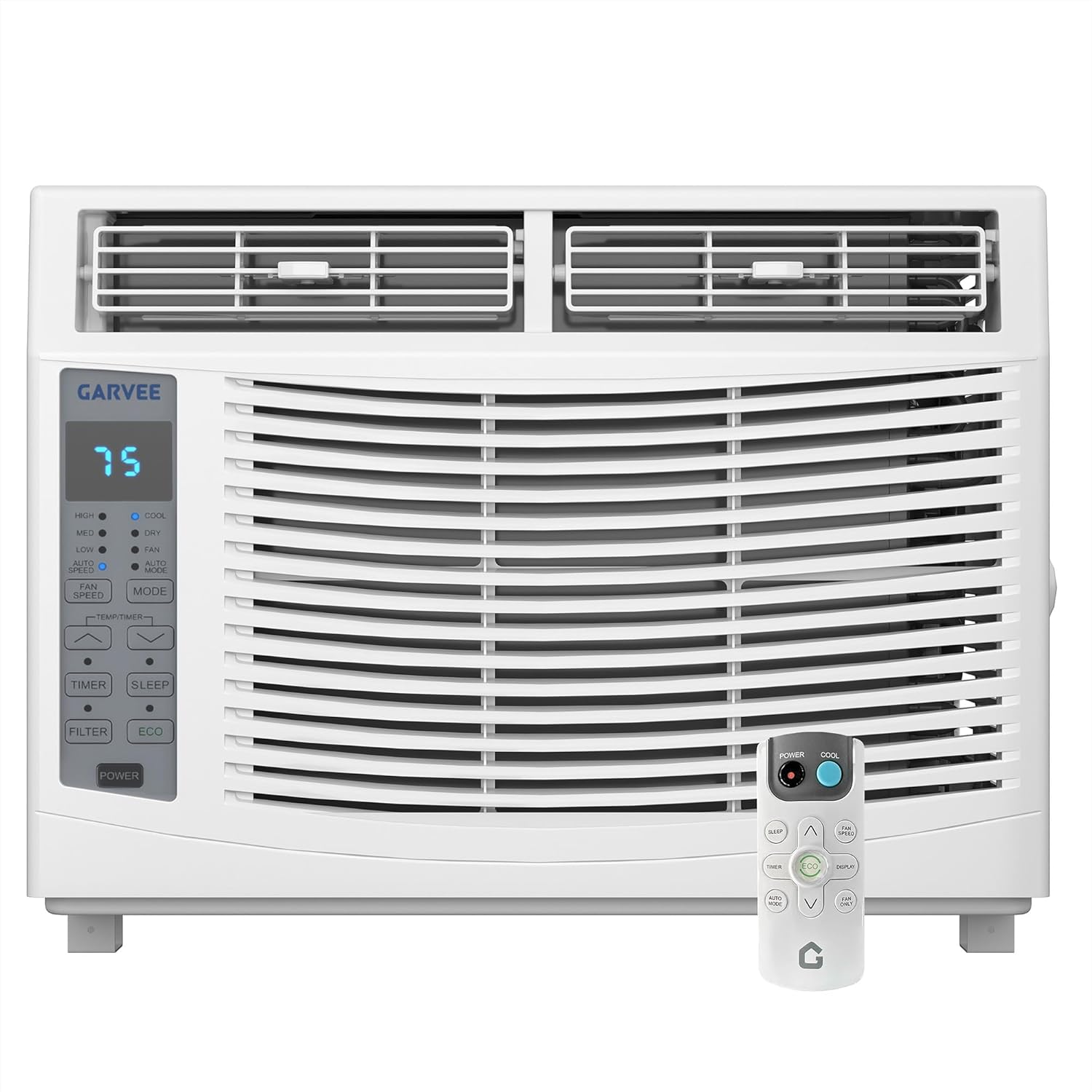
This GarveeHome 6000 BTU window air conditioner is a compact, budget-minded unit for cooling medium rooms such as bedrooms, small living rooms, or home offices. It offers three cooling and fan speeds, an Auto‑Cool mode that adjusts fan speed to room temperature, and an LED digital display with a remote for convenient adjustments from across the room. The unit ships with side panels and mounting hardware for standard vertical (double‑hung) windows and includes an auto‑restart feature to restore settings after a power loss. Practical benefits include relatively low power draw for its class and straightforward installation without special wiring. Limitations are typical for budget window units: it uses a standard rotary compressor rather than inverter technology, noise is moderate at the listed level, and its cooling capacity is sized for single rooms rather than open-plan spaces. Expect adequate, economical cooling when matched to the recommended room area but avoid oversizing expectations for larger or poorly insulated rooms.
Best for: Buyers prioritizing a low-cost, straightforward window AC for a single bedroom or home office in a vertical double‑hung window who want simple controls and easy installation.
Less Ideal for: People needing whole‑home cooling, very quiet operation, or the higher efficiency of inverter units should consider other options.
- Sized for medium rooms up to ~250 sq ft, suitable for typical bedrooms or offices
- Remote control plus LED display for easy temperature and mode adjustments
- Auto‑restart restores settings after power outages
- Includes side panels and mounting hardware for standard vertical windows
- Relatively low wattage for its capacity (850 W) which helps limit energy use
- Not an inverter model so it lacks the variable-speed efficiency and quieter operation of inverter units
- Moderate noise level that may be noticeable in very quiet rooms
- Intended for single-room cooling and will struggle in large or poorly insulated spaces
Verdict: A practical, budget-friendly 6000 BTU window AC that delivers economical, single-room cooling and easy vertical window installation.
Midea EasyCool 5,000 BTU Window AC
| Cooling Power | 5000 BTU |
|---|---|
| Floor Area | 150 square_feet |
| Refrigerant | R-32 |
| Control Method | Push Button |
| Wattage | 450 watts |
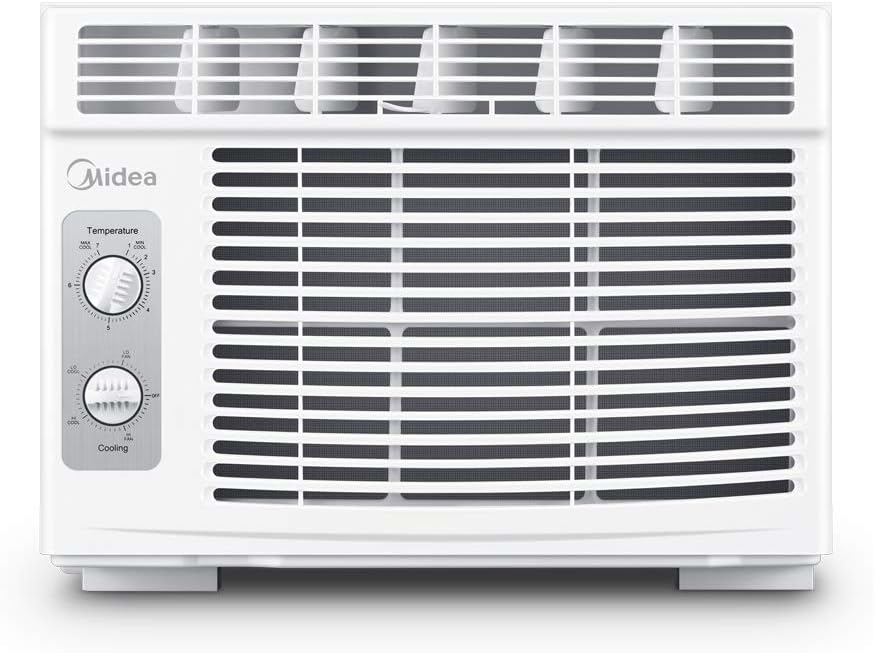
The Midea EasyCool 5,000 BTU window air conditioner is a straightforward cooling unit built for small rooms and vertical windows. It uses rotary compressor technology with R-32 refrigerant to deliver cooling for spaces up to about 150 square feet, and basic push-button mechanical controls make operation simple without remote apps or connectivity. The unit offers three power levels, two fan-only speeds, seven temperature settings and a two-way air outlet for basic directional control. A washable reusable filter reduces ongoing replacement costs and is easy to access for routine cleaning. Installation fits common vertical window openings and includes a mounting bracket, though a screwdriver and occasional pilot holes are typically needed. Expect refrigerator-level noise under normal operation and a CEER/SEER rating around 11 for average energy use. This model favors reliability and ease of maintenance over advanced features like smart controls or inverter-driven variable speed, so it performs well where dependable, no-frills cooling is the priority.
Best for: Buyers who prioritize a simple, dependable window AC for a small room and value easy maintenance and straightforward controls over smart features.
Less Ideal for: People who want app control, voice assistants, or the higher efficiency and quieter operation of inverter-equipped units should consider alternatives.
- Compact footprint fits standard vertical windows and includes mounting bracket
- Simple mechanical push-button controls that are easy to operate
- Washable reusable filter for low-cost, straightforward maintenance
- Uses R-32 refrigerant and a rotary compressor for conventional, proven cooling
- No smart features or remote control for remote operation
- Not inverter-based so it runs at fixed speeds which can be less efficient in variable loads
Verdict: If you need a reliable, easy-to-use window AC for a small vertical window, this Midea 5,000 BTU unit delivers dependable cooling with low-maintenance upkeep.
Frigidaire 5,000 BTU Window AC

| Cooling Power | 5000 BTU |
|---|---|
| Floor Area | 150 square_feet |
| Noise | 52 db |
| Wattage | 450 |
| Filter Type | Washable |
The Frigidaire FFRA051WAE is a simple, no-frills 5,000 BTU window air conditioner intended for small rooms such as bedrooms or compact living spaces. It cools up to about 150 square feet using a rotary scroll compressor and offers two fan speeds plus effortless temperature control via touch buttons. Practical features include adjustable side panels for fitting vertical windows, a washable dust filter for easy maintenance, an extra-long three-prong power cord, and auto-restart to restore settings after power loss. At 52 dB it runs quietly enough for most sleeping areas, and its 115V/450W power draw keeps energy use modest given the capacity. Limitations are its basic control set with no smart connectivity or advanced modes, and a SEER/Efficiency rating that reflects budget-focused performance rather than top-tier efficiency. For buyers seeking straightforward cooling for a single small room, this unit delivers reliable, easy-to-install operation; buyers wanting Wi-Fi, multi-mode controls, or higher efficiency should look at higher-end models.
Best for: Buyers who prioritize a proven, uncomplicated window AC that installs easily in vertical windows and provides quiet, dependable cooling for a single small room backed by broad customer adoption.
Less Ideal for: People who want smart features, advanced modes, or the highest energy efficiency for frequent heavy-duty cooling needs.
- Compact 5,000 BTU capacity cools rooms up to 150 sq. ft.
- Adjustable side panels and long power cord simplify installation in vertical windows
- Washable filter reduces maintenance cost and captures dust
- Quiet operation at about 52 dB suitable for bedrooms
- Auto-restart restores settings after power interruptions
- No smart/Wi-Fi controls or advanced operating modes
- Moderate efficiency compared with higher-end units
Verdict: A straightforward, easy-to-install window air conditioner that reliably cools small vertical-window rooms with quiet, low-maintenance operation.
BLACK+DECKER Portable Air Conditioner BPACT08WT

| Cooling Power | 9000 BTU |
|---|---|
| SACC Cooling | 5,300 BTU SACC |
| Power Source | Corded Electric (115 volts) |
| Wattage | 935 watts |
| Refrigerant | R-32 |
This BLACK+DECKER portable air conditioner is a compact 9,000 BTU unit (5,300 BTU SACC) designed to cool rooms up to about 400 sq. ft. It installs with the included window kit for vertical or horizontal openings and is easy to move on casters or with side handles. The unit doubles as a dehumidifier and fan, offers three fan speeds, a 24-hour timer, sleep mode, and a Follow Me remote that can act as a thermostat. Practical features include a washable reusable filter, self-evaporating operation so you typically do not need to empty drain trays, and a full-function remote for convenient control. Expect moderate noise levels typical of portable ACs and single-zone cooling rather than whole-home performance; efficiency ratings are midrange with a CEER/SEER around the listed values. For someone wanting a simple, removable cooling solution that fits vertical windows and does not require permanent installation, this unit covers the essentials with straightforward setup and day-to-day operation.
Best for: Buyers who want a low-commitment, easy-to-install cooling solution for a single room with vertical windows and prefer a product that is straightforward to set up and operate.
Less Ideal for: People seeking quiet, whole-home cooling or the highest possible efficiency for very large or open-plan spaces should consider other solutions.
- Includes window installation kit that fits vertical and horizontal openings
- 3-in-1 functionality: cooling, dehumidifying, and fan modes
- Full-function remote with Follow Me thermostat for convenient control
- Washable reusable filter and self-evaporating operation reduce maintenance
- Single-zone portable unit with moderate noise typical of similar portable ACs
- Listed cooling capacity (SACC) is lower than the marketed BTU number, so peak performance suits medium-sized rooms rather than large open spaces
Verdict: A practical, easy-to-install portable AC for cooling single rooms with vertical windows while offering dehumidifier and fan functions.
Choosing the Right Air Conditioner for Vertical Windows: Key Factors to Consider
Cooling Capacity and Room Size
Cooling capacity, usually expressed in BTUs, determines how effectively an air conditioner will lower temperature in a given room. Choose a unit whose rated capacity matches the square footage and ceiling height of the space you plan to cool. Undersized units run continuously without reaching the set temperature, which increases wear and energy use. Oversized units cycle on and off too frequently, reducing humidity control and wasting energy.
Also account for heat sources like direct sun, many occupants, or heat-generating equipment. For vertical-window installations, confirm the rating applies to the intended room layout since tall, narrow windows may affect airflow patterns compared with a standard window location.
Installation Type and Window Kit Compatibility
Vertical-window installations need either a unit designed for vertical sash openings or a secure adapter kit that provides a weather-tight fit. Evaluate how the manufacturer supports vertical sash mounting: look for adjustable side panels, vertical window brackets, or extension hardware that seals gaps and prevents air leakage. Simpler installations reduce the likelihood of poor sealing, water ingress, and wind noise.
Consider whether the unit requires additional framing, vertical mounting brackets, or special brackets for weight support. Also check drainage needs and whether the installation allows a slight tilt or internal drainage provision so condensate does not leak back into the room.
Noise and Vibration
Noise levels matter much more when the AC is in a bedroom or home office. Look at measured operating decibels at low, medium, and high fan settings. Units with better sound control typically employ insulated cabinets, balanced fans, and vibration-dampening mounts. Vibration transmitted to a narrow window frame can amplify noise, so secure mounting and rubberized gaskets help reduce buzzing or rattling.
Also consider variable fan speeds and sleep modes that lower noise at night. Real-world noise depends on installation quality, so properly sealing and supporting the unit will reduce perceived sound levels.
Energy Efficiency and Controls
Higher efficiency reduces operating cost and can provide steadier temperature control. Look for units with favorable energy ratings and multiple fan speeds or automatic climate control. Programmable timers, thermostatic control, and a remote or app interface increase convenience and let you avoid running the AC when it is not needed.
If you live in an area with high cooling demand, energy efficiency influences long-term running costs more than initial convenience features. For vertical-window setups, efficient airflow distribution is also important because constrained openings can limit how well cold air circulates through the room.
Durability, Serviceability, and Maintenance
A durable unit minimizes downtime and maintenance expense. Check the ease of cleaning or replacing filters, access to condensate drains, and whether common service tasks are user-accessible. In vertical installations, the ability to reach controls and filters without removing the entire unit is particularly important.
Consider the construction of seals and gaskets used for the vertical kit because weather exposure and vibration can degrade these parts. Replaceable parts and readily accessible service panels make long-term ownership less burdensome.
Sizing a Unit for Tall, Narrow Rooms
Vertical windows are common in rooms with higher ceilings or narrow wall openings. When sizing an air conditioner, account for volume, not just floor area. A tall room with lots of vertical space holds more warm air, so you may need a slightly higher BTU rating than a low-ceiling room of the same square footage.
Also think about airflow patterns. Units mounted in a vertical sash may deliver cool air in a more focused beam. Position furniture and consider using a circulation fan to distribute cooled air evenly across the room rather than relying solely on the air conditioner.
- Calculate room volume when ceilings exceed 8 feet
- Adjust BTU selection for strong sun exposure or multiple occupants
- Plan airflow paths to avoid cold pockets or layering
Installation Tips for Vertical Sash Windows
Prepare the opening by measuring both the sash width and the interior reveal depth. Vertical sash kits often include adjustable panels or brackets; read the installation guide to ensure you can achieve a snug, weather-resistant seal. Use shims or foam weatherstripping where the frame does not meet flush.
Support is critical. Vertical installations can place different loads on the window frame than horizontal mounts. Use the recommended brackets and, when necessary, reinforce the sill or add helper brackets to carry the unit weight. Check that the installation permits proper drainage and maintains a slight exterior tilt if the unit relies on gravity for condensate removal.
- Measure twice and confirm the sash travel and lock positions
- Use corrosion-resistant brackets and hardware for longevity
- Seal gaps with weatherstripping and backer foam to prevent drafts
Managing Condensate and Drainage
Condensate handling differs by design. Some units evaporate condensate internally, while others require an external drain. For vertical-window installations, confirm where the drain exits and whether it can be routed safely outside the sash area. Improper drainage can lead to water intrusion into the window frame or room.
If the unit needs an external drain, plan a discreet route that does not compromise the seal or allow pests entry. Ensure the drain path avoids freeze hazards if you live in a cold climate where water could freeze at the exit point.
- Verify internal vs external condensate handling before installation
- Slope the unit slightly toward the exterior if recommended
- Inspect seals after a few days of operation to ensure no leaks
Noise Mitigation and Nighttime Use
If the unit will operate in a bedroom, prioritize models with low decibel ratings and a quiet night mode. Proper mounting and solid window sealing reduce resonance that can magnify noise. Consider additional acoustic weatherstripping around the sash to tighten the seal.
Placement and fan speed also affect perceived noise. Running the fan at a lower speed overnight and using the unit's timer or programmable thermostat can reduce both noise and energy consumption.
- Choose units with sleep mode or low RPM fan settings
- Install vibration-dampening pads between unit and sill
- Re-seal after the first season to fix any settling gaps
Practical Control Features to Look For
User-friendly controls make daily use easier. Look for clear thermostats, multiple fan speeds, and timer functions. Remote control or app connectivity can be useful when the unit is mounted in a tall sash, making it easier to change settings without reaching the unit physically.
Automatic features like an ECO mode or humidity-aware settings can improve comfort while reducing runtime. Prioritize controls that match how you intend to use the space rather than chasing advanced features you will rarely use.
- Remote or app control for hard-to-reach installations
- Multiple fan speeds and programmable timers
- Simple filter-access design for regular maintenance
How We Chose the Best Air Conditioner for Vertical Windows
We selected units that are specifically engineered or adapted to fit vertical-window openings and that offer installation options and hardware suitable for tall, narrow sashes. Our editorial filters prioritized measurable performance and real-world installation convenience over marketing claims. Key evaluation criteria included rated cooling capacity relative to room size, installation hardware and adjustable window kits for vertical sashes, operating noise at typical settings, and energy efficiency and controls for everyday use. We excluded units that cannot be adapted to vertical sash windows or that require major custom carpentry. We also filtered out models lacking clear ventilation and drainage provisions suitable for vertical installations. Final picks balance ease of installation, reliable cooling under real-room loads, manageable sound levels, and long-term serviceability. Each shortlisted entry meets those thresholds and offers a clear tradeoff profile for buyers.
Our full evaluation process is outlined in our review methodology.
FAQ
Can a standard window air conditioner be adapted to vertical windows?
Some standard window air conditioners can be adapted with a compatible vertical sash installation kit, but not all units are suitable. Check the manufacturer's guidance for vertical mounting, confirm the kit seals properly, and ensure the unit's weight and drainage requirements are met.
How much clearance do I need around a vertical-window air conditioner?
Allow the manufacturer-recommended clearance for airflow on all sides and above the unit. Vertical installations often require secure side seals and adequate exterior clearance for ventilation, so measure both the sash opening and the outside overhang before installing.
Will a vertical-window air conditioner drain properly without modification?
That depends on the model. Some units have internal condensate management that does not require external drains, while others need an external drain line. Confirm the condensate method before installation and plan for routing if external drainage is required.
Are vertical-window air conditioners noisier than traditional window units?
Not necessarily. Noise depends on the unit's design, fan speeds, and installation. A well-secured vertical installation with vibration-dampening mounts and good sealing can be as quiet as a horizontal install, especially if the unit offers low-noise or sleep modes.
Do I need to reinforce the window frame for a vertical installation?
Often reinforcement is recommended, especially for older or lightweight frames. Vertical mounting can change how weight is distributed, so using the specified support brackets or adding reinforcement reduces stress on the sash and helps maintain a tight seal.
Final Verdict
Choosing the right air conditioner for a vertical window means balancing cooling capacity, installation fit, noise control, and long-term serviceability. Prioritize a unit with the correct BTU rating for your room volume, clear vertical-sash installation hardware, and features that make everyday use and maintenance easier. Accept tradeoffs such as a slightly higher BTU rating for tall ceilings or choosing a model with better seals and brackets over one with marginally higher efficiency. With attention to proper sizing and secure mounting, you can get efficient, quiet cooling from an air conditioner tailored to vertical-window openings.