
Note: This article contains affiliate links. If you click on these links and make a purchase, we may earn a small commission at no extra cost to you. This helps support our research and content. Read our full affiliate disclosure here.
If you live in a 1500 square-foot home, one well-matched air purifier can make a big difference in indoor comfort and health. The right unit removes particles, reduces odors, and limits airborne allergens across open floor plans and multiple rooms. You want a model with enough clean-air delivery for the space, long-lasting filters that are easy to maintain, and noise levels that suit daily life. This guide shortlists seven top air purifiers for 1500 sq ft homes and explains the practical tradeoffs between coverage, filtration efficiency, upkeep, and sound. Below you will find our picks along with the criteria we used to evaluate them and guidance to help you pick the best fit for your layout and lifestyle.
Top Picks at a Glance
| Best Overall The best all-around choice for most situations | Winix 5510 Air Purifier |  |
| Best Quality Built to a higher standard if you want something more solid | Coway Mighty AP-1512HH |  |
| Best Value The sweet spot between price and what you get | WESTHEY H13 HEPA Air Purifier AP02 |  |
| Best Budget The cheapest option that still gets the job done reliably | ECOSELF HAP604 Air Purifier |  |
| Top Rated A top-rated pick with lots of positive feedback | KNKA APH4000 Air Purifier |  |
| Most Popular A crowd favorite that many people choose with confidence | Afloia KILO Air Purifier |  |
| Best Seller A high-volume bestseller chosen again and again | Levoit Vital 200S-P |  |
Winix 5510 Air Purifier

| Model | 5510 |
|---|---|
| Filtration stages | 4-Stage |
| AHAM verified coverage | 1,882 ft² in 1 hr |
| Noise (lowest speed) | 23.5 dB |
| Smart features | WiFi / Alexa / Google Home |
The Winix 5510 is a tower-style air purifier built for larger rooms and whole living spaces, using a four-stage system that combines a washable pre-filter, True HEPA, advanced carbon deodorization and Winix PlasmaWave technology. It is typically placed in a central room or open-plan area and run on Auto Mode so the built-in sensors adjust fan speed based on detected air quality; the unit also shows real-time air quality via an LED indicator and supports remote control through the Winix Smart App and voice assistants. Practical benefits include AHAM-verified coverage for large areas, strong particle capture down to 0.01 microns for allergens and smoke, and an odor-targeting carbon filter that helps with cooking and pet smells. Sleep Mode and a quiet low-speed operation make it unobtrusive at night. Important limitations are that the PlasmaWave feature is an add-on rather than a replacement for filtration, and replacement filters and operating noise on higher fan speeds should be considered for continuous heavy-use environments.
Best for: Buyers who want a capable, feature-rich purifier that reliably cleans large open spaces and balances smart controls, quiet night operation, and strong odor removal.
Less Ideal for: People who only need a small bedroom or personal-room purifier or those seeking the absolute quietest unit regardless of room size should consider smaller, lower-power models instead.
- AHAM-verified coverage for large rooms with high CADR performance
- True HEPA filtration captures very small particles including smoke and allergens
- Advanced carbon filter reduces VOCs and household odors
- Built-in air quality sensor with Auto Mode and LED indicator for real-time adjustments
- Winix Smart App and voice assistant compatibility for remote control
- PlasmaWave is supplemental and not a substitute for filter maintenance
- Higher fan speeds are noticeably louder and use more energy
Verdict: A versatile large-room purifier that pairs proven True HEPA filtration and strong odor control with smart sensors and app control, making it a balanced choice for cleaning whole living spaces.
Coway Mighty AP-1512HH

| Coverage | Up to 1,748 sq. ft. in 60 minutes |
|---|---|
| Filtration stages | Washable pre-filter, deodorization filter, bipolar ionizer, HEPA |
| HEPA efficiency | 99.97% of 0.3μm particles |
| Filter lifespan | Up to 1 year |
The Coway Mighty AP-1512HH is built to move a lot of air quietly and reliably in medium-to-large spaces, using a washable pre-filter, deodorization stage, bipolar ionizer, and a true HEPA filter that captures 99.97% of 0.3 micron particles. It is typically used in living rooms, open-plan areas, or bedrooms where automatic adjustment and continuous monitoring matter; the built-in air quality sensor and colored LED give immediate feedback and Auto Mode ramps fan speed when pollutants rise. Practical benefits include strong CADR-style coverage (advertised for up to 1,748 sq ft per hour), an easy-to-clean washable pre-filter, and useful indicators for filter replacement and timer function. Eco Mode and a quiet operation setting make it suitable for night use without constant noise. Limitations: it is a freestanding unit that requires periodic HEPA and deodorization filter replacements and takes up floor space, and peak airflow on high speed can be louder and more power-hungry than at low speeds. The unit focuses on steady long-term filtration rather than smart-home integration or remote app control.
Best for: Buyers who prioritize strong, proven particulate removal and continuous automatic adjustment for large or open living spaces and want a reliable standalone purifier that runs quietly most of the time.
Less Ideal for: People seeking built-in smart-home connectivity, app control, or an ultra-compact unit for very small rooms should consider other options.
- Four-stage filtration including true HEPA for 99.97% capture of 0.3 μm particles
- Air quality sensor with visible LED and Auto Mode that adjusts fan speed in real time
- Washable pre-filter reduces maintenance cost and extends main filter life
- Eco and quiet modes allow low-noise, energy-efficient overnight operation
- Requires periodic replacement of HEPA and deodorization filters
- Large footprint for some rooms and louder on highest fan setting
Verdict: Choose the Coway Mighty AP-1512HH when you need robust, automatic HEPA-grade filtration and real-time air quality response for medium to large homes.
WESTHEY H13 HEPA Air Purifier AP02

| Coverage | Up to 1,650 sq ft |
|---|---|
| HEPA grade | H13 |
| Air changes | 6 ACH (275 sq ft) |
| Noise (sleep mode) | 15 dB |
The WESTHEY AP02 is a tabletop air purifier built around an H13 true HEPA filter and a 360 degree intake to move air across a room efficiently. It is designed for larger spaces and claims coverage up to about 1,650 sq ft with the ability to cycle air faster in smaller rooms (about six air changes per hour at 275 sq ft). Day-to-day use is straightforward: the unit reads PM2.5 on a digital color display, runs in auto mode to adjust fan speed, or can be set to one of three manual speeds, timers, and a near-silent sleep mode. Practical extras include an aromatherapy pad and a night light with selectable colors, plus a visible filter-life indicator and reminder. Limitations to note are the small physical size relative to high-capacity freestanding purifiers and the need to replace filters every few months for best performance, which adds ongoing cost; ambitious coverage claims will depend on room layout and placement. For buyers focused on improving whole-house air in open plans, it offers a feature-rich, easy-to-use package for everyday air cleaning.
Best for: Buyers who want a practical, feature-packed purifier that balances automated air-quality control, quiet night operation, and extras like scent pads for larger open rooms.
Less Ideal for: Those seeking a heavy-duty, whole-house HVAC solution or a very large freestanding unit for multiple closed rooms should consider larger professional-grade purifiers instead.
- H13 true HEPA filter captures up to 99.98% of 0.3 micron particles
- 360 degree air intake for broader circulation in open rooms
- PM2.5 digital display and auto mode that adjusts fan speed by air quality
- Sleep mode with very low noise (around 15 dB) and timer options
- Aromatherapy pad and adjustable night light for added ambiance
- Compact chassis means real-world coverage will vary and may be less effective in complex floorplans
- Regular filter replacements (recommended every 3–6 months) create ongoing maintenance cost
Verdict: A compact, easy-to-use H13 HEPA purifier with smart auto control and quiet operation that targets large open rooms and everyday indoor air improvement.
ECOSELF HAP604 Air Purifier

| Coverage | up to 1500 ft² per hour |
|---|---|
| Filtration | H13 True HEPA 3-stage |
| Noise level | as low as 20 dB (sleep mode) |
| Fan speeds | 4 speeds |
| Power consumption | ~0.35 kWh per day |
The ECOSELF HAP604 is a small, practical air purifier built to move air efficiently through a three-stage H13 True HEPA filter and capture particles down to 0.3 μm. Its 360° intake and streamlined outlet are intended to speed whole-room circulation, making it suitable for bedrooms, living rooms, or pet areas where steady cleaning is needed. The unit includes four fan speeds, a 2/4/6/8 hour timer, a 7-color ambient light that can be disabled, child lock, and a filter-change indicator for straightforward day-to-day use. A brushless motor promises quieter, more energy-efficient operation and the sleep mode can run as low as about 20 dB, which helps at night. Practical considerations: the purifier is compact and lightweight so it is easy to move but will require periodic genuine replacement filters every 3 to 6 months to keep performance high, and replacement costs add to long-term ownership. For buyers prioritizing a simple, quiet purifier for a ~1500 ft² coverage target, this unit balances performance and operating cost effectively.
Best for: Buyers looking for an affordable, quiet purifier that reliably reduces dust, pollen, pet dander, and smoke in bedrooms or living spaces up to roughly 1500 ft² and who prioritize easy controls and low operating noise.
Less Ideal for: Homes needing industrial-strength airflow or continuous heavy-smoke mitigation should consider larger commercial-grade systems with higher CADR and longer filter life.
- H13 True HEPA 3-stage filtration captures particles down to 0.3 μm
- 360° air intake and focused outlet for faster room circulation
- Very quiet sleep mode down to about 20 dB for night use
- Brushless motor for improved energy efficiency and reduced noise
- Simple controls plus timer, child lock, and filter indicator for easy maintenance
- Requires periodic replacement of proprietary genuine filters every 3–6 months
- Small, lightweight design may limit raw airflow compared with larger, heavier commercial units
Verdict: A quiet, energy-efficient HEPA purifier that delivers practical whole-room cleaning for budget-minded buyers furnishing rooms up to about 1500 ft².
KNKA APH4000 Air Purifier

| CADR (Smoke/Dust/PM2.5) | 226 CFM (384 m³/h) |
|---|---|
| CADR (Pollen) | 244 CFM (415 m³/h) |
| Room coverage (1 ACH) | Up to 1,695 ft² |
| Filtration stages | Washable pre-filter + HEPA + activated carbon |
| Noise (Sleep mode) | 22–24 dB |
The KNKA APH4000 is a large-room HEPA air purifier built for sustained everyday use across open living areas and bedrooms. It pairs an AHAM-verified CADR (226 CFM smoke/dust/PM2.5 and 244 CFM pollen) with dual front-and-back cartridges and a three-stage filter stack (washable pre-filter, high-efficiency HEPA layer, activated carbon) to remove particles, pet hair, and odors. The unit's dual intake and side outlets improve circulation so it can refresh air nearly five times per hour in rooms around 350 sq ft and still provide measurable cleaning in spaces up to roughly 1,695 sq ft. Practical features include PET mode for heavy hair and odor, ECO mode to reduce power use and extend filter life, a sleep mode that drops noise to the low 20 dB range, an AQI color display for instant feedback, and a filter replacement indicator for maintenance. The main compromises are ongoing filter replacement every 3–6 months for optimal performance and the fact that maximum efficiency is reached in smaller rooms rather than at the top advertised square footage. For reliability-focused buyers who want certified performance and sensible maintenance cues, this model is straightforward to operate and maintain.
Best for: Buyers who prioritize consistent, certified purification and straightforward maintenance for larger homes and open living spaces will appreciate this unit’s measurable performance and easy controls.
Less Ideal for: People seeking a maintenance-free or filterless purifier or those who need peak CADR performance in very large, open-plan houses without adding multiple units should consider other options.
- AHAM-verified CADR ratings for smoke/dust/PM2.5 and pollen ensuring measurable performance
- Dual intake and dual-outlet design that increases circulation for faster air exchanges
- Three-stage filtration with washable pre-filter plus HEPA and activated carbon for particles and odors
- Multiple modes including PET, ECO, Auto and a very quiet Sleep mode for night use
- Built-in AQI display and filter indicator simplify monitoring and maintenance
- Filters need replacement every 3–6 months for best results
- Top efficiency is reached in smaller rooms; performance in very large open spaces is reduced compared with stated max area
Verdict: Choose the KNKA APH4000 when you want AHAM-verified, reliable large-room cleaning with simple maintenance and quiet night operation.
Afloia KILO Air Purifier
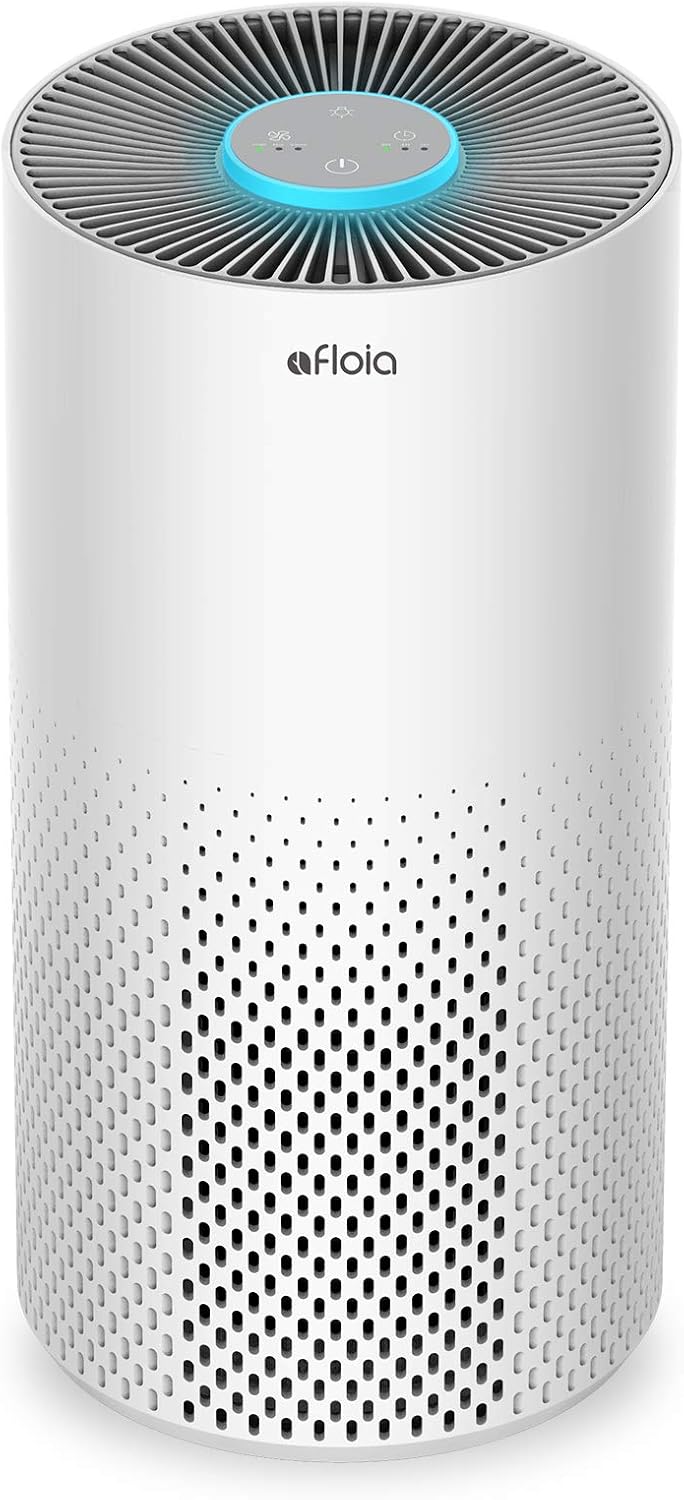
| Power Source | ac |
|---|---|
| Noise Level | 22 db |
| Particle Retention Size | 0.3 micron |
| Wattage | 23 watts |
| Contaminant Filtration Capability | Dust, Odors, Pet Dander, Pet Hair, Pollen, Wildfire Smoke |
The Afloia KILO is a small upright air purifier that uses a multi-stage filtration system with a washable pre-filter and additional layers to capture dust, pet hair, pollen, odors and fine particles down to 0.3 micron. It is intended for continuous room use and offers adjustable fan speeds, a 2/4/8/16-hour timer and a near-silent 22 dB sleep mode for bedrooms. The unit also includes a seven-color night light that can create atmosphere while auto-dimming, and the removable pre-filter makes maintenance easier for homes with pets. Practical strengths include low power draw and CARB certification, which support safe indoor operation, plus replacement filter options for pet or antibacterial needs. Limitations are its small footprint and specified floor area value, which means you should verify coverage for very large open-plan spaces despite the marketing area claims, and replacement filters will be a recurring cost every few months depending on use and local air quality.
Best for: Buyers who prioritize a quiet, low-power purifier with washable pre-filter and clear user feedback from other owners, especially in bedrooms or smaller living areas where quiet operation matters.
Less Ideal for: Large open-plan homes or buyers wanting a single unit to cover very wide spaces without confirming effective coverage.
- Multi-stage filtration with washable pre-filter captures pet hair and larger debris before finer filters
- Very quiet 22 dB sleep mode suitable for bedrooms
- Adjustable timer and fan speeds for scheduled and continuous use
- CARB certified and low 23-watt power draw for efficient operation
- Specified coverage and marketing claims differ; verify actual room coverage for large or open spaces
- Replacement filters need periodic purchase and maintenance every 4–6 months
Verdict: Pick the Afloia KILO when you want a quiet, low-power bedroom or small-room purifier with a washable pre-filter and multiple replacement filter options.
Levoit Vital 200S-P

| Floor Area | 1875 square_feet |
|---|---|
| Filter Type | 3-Stage Filter |
| Noise Level | 27 db |
| Particle Retention Size | 0.1 micrometer |
| Power Source | Corded Electric |
The Levoit Vital 200S-P is a smart air purifier built to handle large spaces and homes with pets or allergy sufferers. It uses a three-stage filtration system with a washable pre-filter plus activated carbon to capture pet hair, dander, dust, smoke and common odors while retaining particles down to 0.1 micrometer. The unit is AHAM-verified and rated with high CADR numbers for smoke, dust, and pollen, and it connects to an app for remote control and monitoring of air quality. At typical use it runs quietly in sleep mode (around 27 dB) and can move air fast enough to cover large open areas, making it suitable for living rooms or open-concept homes. Practical benefits include smart scheduling, an onboard air quality monitor, and easy filter changes; limitations to consider are its desktop/travel-size positioning despite high room coverage claims and the need to buy specialty replacement filters for targeted problems like wildfire smoke or heavy VOCs. The purifier is straightforward to operate and well suited to buyers prioritizing certified performance and low-noise operation.
Best for: Homeowners who want a certified, low-noise purifier that can handle large rooms and pet/allergy problems while giving smart controls and monitored air-quality feedback.
Less Ideal for: People who need an ultra-compact, truly portable purifier for frequent travel or those who prefer a basic non-smart unit without app integration.
- AHAM-verified performance with strong CADR ratings for smoke, dust, and pollen
- Three-stage filtration with washable pre-filter plus activated carbon for odors and pet hair
- Smart app control and onboard air quality monitor for remote scheduling and status
- Very quiet sleep mode at about 27 dB for bedrooms or night use
- Replacement filters are specialized and may add ongoing cost for targeted filters
- Unit dimensions and weight make it less compact than some travel-size purifiers despite category labeling
Verdict: Choose the Vital 200S-P when you want AHAM-verified, smart-controlled purification that quietly covers large rooms and tackles pet and allergy particles.
Choosing the Right Air Purifier for 1500 Sq Ft Home: Key Factors to Consider
Clean Air Delivery Rate (CADR) and Coverage
CADR measures how quickly a purifier removes smoke, dust, and pollen from the air and is a primary indicator of whether a unit can handle a 1500 sq ft home. Look for CADR numbers that support multiple air changes per hour at your home's ceiling height and layout. Open-plan floor plans need higher CADR to move and filter air across larger volumes. If a purifier lists coverage in square feet, verify whether that figure assumes multiple air changes per hour or a single pass; for whole-home effectiveness aim for equipment rated to cover at least the full area with two or more air changes per hour.
Placement also affects effective coverage. A single high-CADR unit performs best in central, unobstructed locations, while multiple lower-CADR units placed in adjacent rooms may better address compartmentalized layouts. Consider how often you want the unit to cycle the air when choosing a CADR target.
Filtration Stages and Particle Capture
True HEPA filtration is important for capturing fine particles like smoke, pet dander, and pollen that commonly trigger allergies. Check that a purifier specifies true HEPA or HEPA-equivalent filtration and the particle size it captures. Additional stages such as activated carbon help remove odors, cooking smoke, and certain VOCs; prefilters trap large particles and extend main filter life.
For homes with specific concerns such as wildfire smoke or chemical odors, a combination of high-efficiency particle filtration and a significant carbon stage matters. If infection-control or virus mitigation is a priority, also consider the unit's calculated air changes per hour at higher fan speeds rather than filter labels alone.
Noise Levels and Day-to-Day Use
Noise determines how comfortably you can run a purifier in living spaces, open-plan areas, and bedrooms. Manufacturers typically list decibel levels for different fan speeds; compare the low and medium settings since many users run units continuously at quieter speeds. Fans that provide strong CADR only at loud boost modes are less useful for continuous background operation.
Think about when the unit will run the most. If you plan to run it overnight, prioritize quieter units with reasonably high low-speed CADR. For daytime use in living rooms, you may accept higher noise for faster cycling. Also consider whether the unit has features like timer modes, sleep modes, or adjustable fan curves to balance sound and performance.
Filter Life, Accessibility, and Replacement Cost
Long filter life reduces ongoing maintenance costs and hassle, but initial and replacement filter prices vary widely. Check manufacturers' estimated filter lifespans, how often prefilters need washing or replacing, and whether replacement filters are widely available. Easy access to filters and simple replacement procedures are helpful for busy homes.
A purifier with slightly higher upfront cost but longer-lasting filters can be cheaper over several years. Also consider how visible filter-change indicators are and whether the unit supports incremental cleaning like washable prefilters to extend main filter life.
Energy Use and Continuous Operation
Many purifiers run continuously, so energy efficiency affects monthly operating cost and environmental impact. Look for units with efficient brushless motors or EC fans and check watts at normal running speeds. Some purifiers include eco or auto modes that adjust fan speed based on indoor air quality sensors to save power.
If you plan multiple units for a 1500 sq ft home, total energy draw becomes more important. Compare typical watts per hour at low and medium settings rather than only peak power. Energy-efficient models may cost more initially but save on electricity if used 24/7.
Placement Options and Room Layout
How you can position a purifier affects circulation and aesthetic fit. Consider units that can be wall-mounted, floor-standing, or placed on tables depending on your home's layout. Taller units with 360-degree air intake can suit central placement in an open plan, while directional airflow designs work better near pollutant sources like kitchens or entryways.
Also think about footprint and weight for moving between rooms, and whether the purifier's intake and exhaust require clearance from walls or furniture. Ease of mobility matters when you need to address different rooms at different times of day.
Sizing for Open Plans Versus Compartmentalized Homes
Open floor plans let air move freely, which helps a single high-capacity purifier serve a larger footprint. For an open 1500 sq ft layout, a unit with higher CADR and 360-degree intake will produce more uniform air cleaning across the space.
In contrast, compartmentalized homes with multiple closed rooms may see limited airflow between spaces. In those cases, consider either placing a purifier in the most-used room or using two smaller units to ensure effective local air changes where occupants spend the most time.
- Open-plan: prioritize high CADR and central placement
- Compartmentalized: consider multiple units or focused placement
- Check manufacturer coverage vs. real-world placement constraints
Sensor Types and Auto Modes
Air quality sensors influence how a purifier responds to changing conditions. Optical particle sensors detect fine particles and allow auto modes to ramp fan speed when particulate levels rise. Some units also include gas sensors for VOCs that trigger carbon stage activation.
Auto modes simplify operation for continuous use but vary in sensitivity. Look for adjustable thresholds so the purifier does not run at high speed for brief, minor spikes like cooking smoke.
- Optical sensors for particulate response
- Gas sensors for odors and VOCs
- Adjustable auto-mode thresholds improve comfort
Maintenance Tips to Extend Filter Life
Regularly vacuuming or rinsing washable prefilters reduces load on the main HEPA element and can significantly extend its life. Follow recommended schedules but also use visual checks; heavy dust loads or pet hair will require more frequent upkeep.
Keep the area around the purifier free of dust and avoid placing it next to vents that blow unfiltered outdoor air. Replace carbon and HEPA elements at the intervals suggested by the manufacturer or sooner if odor control or particulate capture declines.
- Clean prefilters monthly in high-dust homes
- Inspect HEPA elements every 6 to 12 months
- Log filter changes to track replacement intervals
Balancing Odor Control with Particle Filtration
For many homes, a combination of particle filtration and activated carbon is the best compromise. HEPA stages remove particles while carbon stages adsorb odors, cooking fumes, and some VOCs. The quantity and quality of carbon media vary widely, so look for units that specify carbon weight or dedicated odor stages when smell removal is important.
Keep in mind that carbon does not last forever and can become saturated, at which point odors return. If odor control is a priority, expect more frequent carbon replacements compared with particle-only systems.
- HEPA for particles, carbon for odors
- Look for explicit carbon staging details
- Expect shorter service life for carbon media
Using Multiple Units Versus One High-Capacity Unit
A single, high-capacity purifier can be efficient for open spaces and simplifies maintenance. However, it may struggle to reach closed bedrooms or small rooms. Multiple modest-capacity units allow targeted cleaning where people sleep or spend most time, and they can be turned off when not needed to save energy.
Consider noise, filter replacement logistics, and total energy use when deciding between one larger unit or several smaller ones. Multiple units add flexibility but increase the number of filters to manage.
- Single unit: centralized cleaning, simpler upkeep
- Multiple units: targeted room-by-room control
- Compare total energy use and filter maintenance needs
How We Chose the Best Air Purifier for 1500 Sq Ft Home
We focused on real-world performance and ownership experience for homes around 1500 square feet. First, we prioritized clean air delivery rate and stated coverage so each unit can cycle the full volume of air in a 1500 sq ft footprint at a useful rate. Next, filtration effectiveness was considered, emphasizing true HEPA capture of fine particles, plus the presence of prefilters or activated carbon stages for odors and VOCs. Noise output at typical running speeds and at boosted modes was assessed because many owners run purifiers in living spaces and bedrooms. Maintenance factors such as filter lifespan, replacement cost, and ease of access determined long-term usability. Energy consumption and fan efficiency were examined to estimate operating cost and suitability for continuous use. We excluded units designed only for small rooms or single-room desktop use and any products without clear filtration specifications or CADR/coverage data. The final selection represents models that balance adequate whole-home coverage with manageable upkeep and acceptable sound levels for everyday living.
Our full evaluation process is outlined in our review methodology.
FAQ
How many air changes per hour should I aim for in a 1500 sq ft home?
Aim for at least two air changes per hour for general comfort and allergy control. For high-pollution events like wildfire smoke or during illness, increase to four or more air changes per hour by running higher fan speeds or using additional units.
Can one purifier really cover a 1500 sq ft home?
One purifier can cover a 1500 sq ft open plan if it has a sufficiently high CADR and is placed centrally. In homes with many closed rooms, one unit may not reach all spaces effectively and additional units or targeted placement may be better.
How often should filters be changed in continuous use?
Filter replacement depends on air quality and usage but expect HEPA elements to last 6 to 12 months with continuous use, and carbon stages often need replacing more frequently. Check filter indicators and visually inspect elements for heavy soiling.
Do air purifiers remove VOCs and odors effectively?
Air purifiers with substantial activated carbon or other adsorbent media can reduce many odors and some VOCs, but performance varies by media type and amount. For specific chemical odors, source control and ventilation are also important.
Are quieter purifiers less effective?
Not necessarily. Some units provide good low-speed CADR through efficient fans and aerodynamic design. However, some purifiers only reach peak CADR at high, noisier settings, so compare low- and medium-speed CADR figures if quiet continuous operation is important.
Final Verdict
Choosing the right air purifier for a 1500 sq ft home comes down to matching CADR and coverage to your floor plan, prioritizing filtration stages you need, and balancing noise with continuous operation. Consider whether a single high-capacity unit or multiple targeted units best suits your layout and lifestyle. Prioritize reliable particle filtration, adequate carbon staging if odor control is important, and reasonable filter life to keep maintenance simple. With those tradeoffs in mind, you can confidently select a purifier that fits your home, runs affordably, and keeps indoor air noticeably cleaner.