
Note: This article contains affiliate links. If you click on these links and make a purchase, we may earn a small commission at no extra cost to you. This helps support our research and content. Read our full affiliate disclosure here.
If you need whole-room air cleaning for a 1,500-square-foot space, picking the right air purifier makes a noticeable difference in comfort and health. The wrong unit can be underpowered, noisy, or expensive to run, while the right one keeps dust, pollen, smoke, and airborne particles moving through high-efficiency filters at a rate that actually clears the room. This guide shortlists seven top air purifiers suited to roughly 1,500 sq ft spaces and explains the practical tradeoffs buyers face. We focus on real-world performance factors like filtration effectiveness, airflow capacity, noise, and operating cost to help you find the right fit for living rooms, open-plan areas, or combined bedrooms and dens. Read on to see the criteria we used to select these top picks and what matters most when installing one in a large space.
Top Picks at a Glance
| Best Overall The best all-around choice for most situations | Coway Mighty AP-1512HH |  |
| Best Quality Built to a higher standard if you want something more solid | BLUEAIR Blue Pure 211i Max |  |
| Best Value The sweet spot between price and what you get | Afloia KILO Air Purifier |  |
| Best Budget The cheapest option that still gets the job done reliably | YARIKI P280 Air Purifier |  |
| Top Rated A top-rated pick with lots of positive feedback | ECOSELF HAP603 Air Purifier |  |
| Most Popular A crowd favorite that many people choose with confidence | WINIX 5510 Air Purifier |  |
| Best Seller A high-volume bestseller chosen again and again | Levoit Vital 200S-P |  |
Coway Mighty AP-1512HH

| Coverage | Up to 1,748 sq ft in 60 minutes |
|---|---|
| HEPA efficiency | 99.97% at 0.3 μm |
| Filtration stages | Pre‑filter, Deodorization, Bipolar, HEPA |
| Controls | Auto, Eco, Timer, Filter indicator |
The Coway Mighty AP-1512HH is a compact but powerful air purifier built for medium to large rooms; it uses a four‑stage system—washable pre-filter, deodorization filter, bipolar ionizer, and a True HEPA—to capture fine particles, allergens, smoke, and odors. In everyday use you set it on Auto and the built‑in sensor adjusts fan speed based on detected pollution while an LED AQI ring gives real‑time feedback; Eco and timer modes help reduce energy use when air is clean. Practical benefits include reliable 99.97% HEPA filtration at 0.3 micron, an easy‑to‑clean prefilter, and a filter indicator that times replacement by actual usage. It is rated to handle up to about 1,748 sq ft in an hour, so it clears large living rooms, open plans, and home offices efficiently. Trade‑offs are typical for high‑flow purifiers: replacement filters and occasional cleaning add maintenance cost, and the unit is more audible at higher fan speeds compared with its quietest setting. The Coway is a strong choice when you want automated performance and proven filtration for a single large space.
Best for: Buyers who want an automated, high‑capacity purifier that quietly monitors air and can service a whole large room or open plan without constant intervention.
Less Ideal for: People who need an ultra‑quiet bedroom unit for small rooms or those unwilling to budget for replacement filters and routine maintenance.
- Four‑stage filtration including True HEPA for 99.97% removal of 0.3μm particles
- Auto mode with real‑time air quality sensor and LED indicator
- Washable pre‑filter reduces dust buildup and extends filter life
- Rated coverage for large rooms up to about 1,748 sq ft in 60 minutes
- Higher fan speeds produce noticeable noise compared with the lowest setting
- Requires periodic filter replacements and occasional cleaning to maintain peak performance
Verdict: A reliable, sensor‑driven purifier that delivers proven HEPA performance and enough airflow to clean a 1,500+ sq ft space effectively.
BLUEAIR Blue Pure 211i Max

| Room coverage (1 hr) | Up to 3,235 sq ft |
|---|---|
| Particle capture | 99.97% down to 0.1 microns |
| Filtration technology | HEPASilent (mechanical + electrostatic) |
| Noise range | 23–53 dB |
The Blue Pure 211i Max is built to move large volumes of air and remove fine particles across open floor plans and large rooms. It combines mechanical and electrostatic filtration (HEPASilent) to capture 99.97% of particles down to 0.1 microns while a 360° intake and powerful fan refresh air in very large spaces quickly. Smart sensors continuously monitor indoor air quality and adjust fan speeds, and the Blueair app lets you check air quality, change settings, schedule runs, and get filter reminders. Noise ranges from quiet bedroom levels on low to noticeable but acceptable levels at high speed, and the unit is relatively heavy and bulky compared with smaller purifiers. The modern minimalist design and energy-efficient operation make it suitable for continuous use in living rooms, open-plan areas, and shared family spaces. For a performance-oriented buyer focused on cleaning large areas, it delivers strong CADR and real-world effectiveness, though filter replacement cost and physical footprint are considerations for tighter spaces.
Best for: Buyers who prioritize fast, proven particle removal across large open areas and want smart controls to maintain air quality with minimal daily effort.
Less Ideal for: People living in small bedrooms, tight apartments, or who need an ultra-compact, lightweight purifier for frequent relocation.
- Designed for very large rooms with high air-exchange capability
- HEPASilent dual filtration captures fine particles including smoke and pet dander
- Built-in sensors with Auto Mode dynamically adjust fan speed
- App control for remote monitoring, scheduling, and filter reminders
- Quiet operation at low speeds with energy-efficient performance
- Large and relatively heavy footprint limits placement options in small rooms
- High fan speeds can be noticeably loud in quiet settings
- Replacement filters add ongoing operating cost
Verdict: If you need a high-capacity, smart purifier that clears very large rooms quickly, the Blue Pure 211i Max delivers the performance and controls to do the job.
Afloia KILO Air Purifier
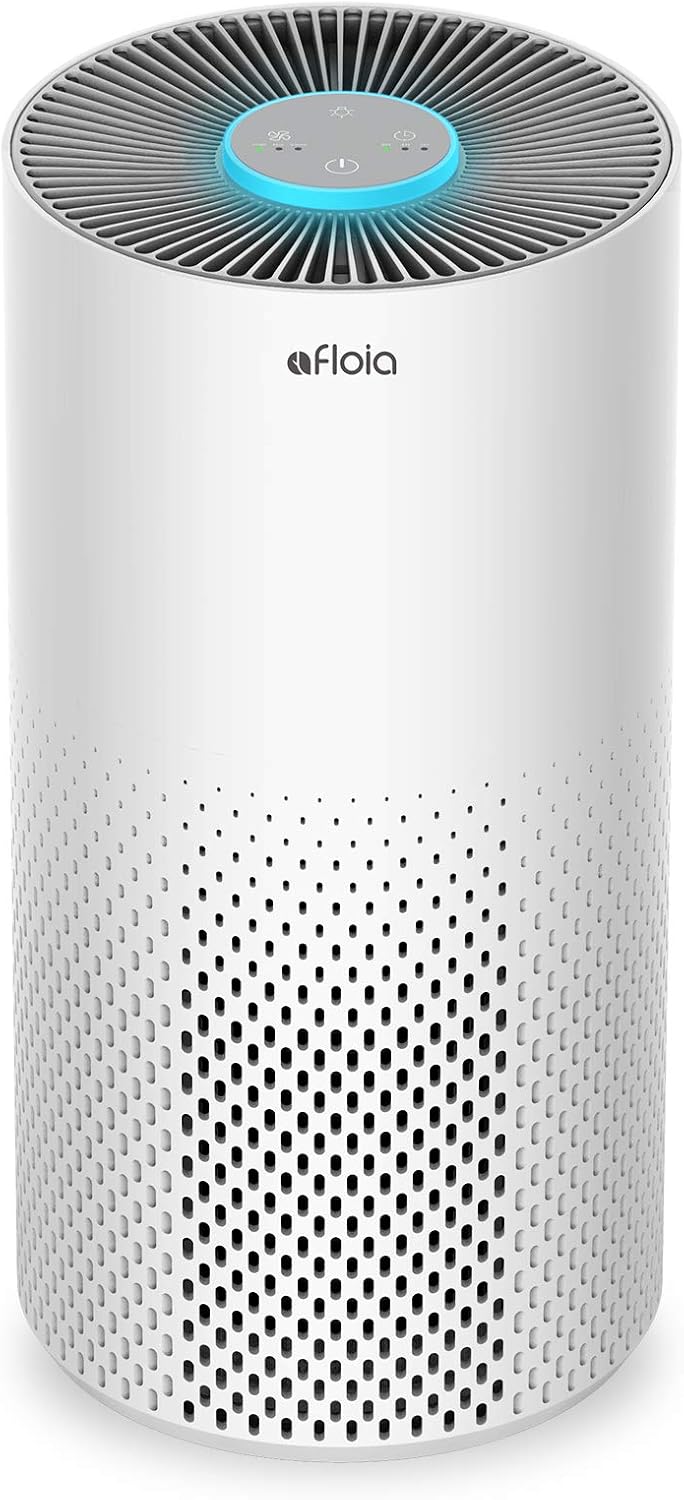
| Floor Area | 60.84 square_feet |
|---|---|
| Noise Level | 22 db |
| Particle Retention Size | 0.3 micron |
| Wattage | 23 watts |
| Contaminant Filtration Capability | Dust, Odors, Pet Dander, Pet Hair, Pollen, Wildfire Smoke |
The Afloia KILO is a compact tower-style air purifier aimed at large rooms and open spaces, using a 4-stage filtration system that combines a washable pre-filter with activated carbon and finer filter layers to trap dust, pet hair, pollen, odors and smoke. It is typically placed on the floor in a living room, bedroom, or office and run continuously or on a timer; the unit offers adjustable fan speeds, 2/4/8/16-hour timers and a very quiet 22 dB sleep mode for overnight use. Notable features include a washable pre-filter that reduces replacement frequency, a color-changing night light with auto-dim, and a low 23-watt draw that keeps operating costs modest. The purifier claims rapid air changes suitable for large areas and lists a 0.3 micron particle retention spec, which supports removal of fine particulates including some wildfire and pet-related particles. Limitations are typical for compact standalone purifiers: filtration effectiveness depends on room layout and placement, filters still require periodic replacement for peak performance, and the decorative lighting may be unnecessary for buyers focused strictly on function.
Best for: Buyers who want an efficient, low-energy purifier they can run continuously in large rooms while minimizing routine upkeep and nighttime disturbance.
Less Ideal for: People needing whole-house HVAC integration or purifiers sized for open-plan spaces larger than what a single portable unit can cover should consider larger or multi-unit solutions.
- Multi-stage filtration with a washable pre-filter reduces visible dust and pet hair maintenance.
- Very quiet 22 dB sleep mode suitable for bedrooms and night use.
- Low power consumption at 23 watts for continuous operation.
- Multiple timer options and adjustable fan speeds let you balance air cleaning and energy use.
- Effectiveness depends on correct placement in large open areas and will vary by room layout.
- Filters need periodic replacement to maintain peak performance despite the washable pre-filter.
Verdict: A quiet, energy-efficient purifier with washable pre-filter and multi-stage filtration that fits buyers who want reliable, low-maintenance air cleaning for large rooms.
YARIKI P280 Air Purifier

| CADR | 280 m3 |
|---|---|
| Filter type | H13 HEPA + activated carbon + washable pre-filter |
| Noise level | 22 dB (sleep mode) |
| Coverage | Up to 1500 sq ft |
The YARIKI P280 is a tower air purifier designed for large open spaces, claiming effective coverage up to 1,500 sq ft and a CADR of 280 m3. It uses a three-layer filtration system—washable pre-filter, H13 HEPA filter, and activated carbon—to capture particles down to 0.3 microns and reduce odors and smoke, which makes it well suited for pet owners and allergy-prone households. The unit emphasizes quiet operation with a brushless motor and a stated 22 dB sleep mode, and it includes practical touches like a child lock and low power consumption for continuous use. Expect noticeable air quality improvements within minutes in typical living rooms or large bedrooms, though maintaining performance requires periodic HEPA replacements every 3–6 months depending on use. The purifier is ETL/CE/FCC/ROHS/CARB certified and does not produce ozone. For buyers who want strong large-room performance on a budget, the P280 delivers a lot of filtration per dollar, but filter replacement costs and the need to size placement for optimal circulation are important to plan for.
Best for: Buyers who need an affordable, high-capacity purifier for large living spaces or open-plan homes and prioritize quiet, continuous operation and pet/allergen reduction.
Less Ideal for: People who need a compact purifier for small rooms, travel, or those who prefer models with smart-home connectivity and app controls.
- High claimed coverage up to 1,500 sq ft with a CADR of 280 m3 for large rooms
- H13 HEPA plus activated carbon and washable pre-filter for particle and odor removal
- Very quiet operation (22 dB mode) suitable for bedrooms and sleep use
- Brushless motor and low power draw for energy-efficient continuous operation
- Child lock and safety certifications including ETL/CE/FCC/ROHS/CARB
- Requires HEPA filter replacements every 3–6 months depending on use
- Coverage claims assume good room airflow and ideal placement for best results
Verdict: If you want a budget-friendly purifier that can handle large rooms and pet allergens while staying quiet, the YARIKI P280 is a strong value pick.
ECOSELF HAP603 Air Purifier

| Coverage | Up to 2400 ft² |
|---|---|
| Noise level | 22 dB Sleep Mode |
| Filter efficiency | Captures 99.97% of airborne particles |
| Air quality sensor | PM2.5 display with infrared sensor |
| Modes | Auto, Sleep, Timer, Fan Speeds |
The ECOSELF HAP603 is a large-room air purifier built to run continuously for homes dealing with smoke, pet dander, and general allergens. It uses a 2X-power filtration layout with a True HEPA stage that the vendor says captures 99.97% of particles and a PM2.5 sensor with an AQI display that adjusts fan speed automatically in Auto or Smart mode. Practical features include a very quiet 22 dB sleep mode, timer, child lock, filter change indicator, and an aromatherapy option for light scenting. The unit is sold with guidance to use official replacement filters to maintain performance. Strengths are the wide coverage claim and the low-noise night mode, which make it suitable for living rooms and bedrooms; limitations are the reliance on proprietary filters and that real-world coverage will depend on room layout and pollutant load, so expect more frequent fan activity in heavy-smoke situations. Setup appears straightforward and daily operation is largely automated by the air-quality sensor.
Best for: Buyers prioritizing a dependable, sensor-driven purifier that can run day and night with minimal fuss and low noise in larger open-plan living spaces.
Less Ideal for: People who need a compact purifier for small rooms or who want to avoid manufacturer-specific replacement filters and prefer wide third-party filter compatibility.
- True HEPA filtration claiming 99.97% particle capture
- Built-in PM2.5 sensor and AQI display for automatic fan-speed adjustment
- Very quiet 22 dB sleep mode suitable for bedrooms
- Filter indicator and simple controls for low-maintenance operation
- Manufacturer recommends official replacement filters which can limit third-party options
- Coverage claims (up to 2400 ft²) will vary with room layout and pollution levels
Verdict: If you want a low-noise, sensor-driven purifier that can manage air quality across large living areas, the ECOSELF HAP603 delivers automated performance with HEPA-grade filtration.
WINIX 5510 Air Purifier

| Item model number | 5510 |
|---|---|
| AHAM Verified coverage | 1,882 Ft² in 1 Hr |
| Filtration stages | 4-Stage |
| Noise (lowest speed) | 23.5 dB |
| Smart features | WiFi / Alexa / Google Home |
The Winix 5510 is a four-stage air purifier intended to clean large rooms quickly using a True HEPA filter plus an advanced odor-control carbon stage and washable pre-filter. It runs with smart sensors and an AQI indicator that display room air quality in real time and can automatically adjust fan speed in Auto Mode; the unit also links to the Winix Smart App and supports voice assistants for remote control. Practical features include a nearly silent Sleep Mode that activates in the dark and a PlasmaWave option that aims to reduce airborne impurities. The purifier is AHAM verified for large-room coverage and includes a filter replacement indicator to simplify maintenance. Expect strong particle and odor removal for living rooms or open-plan spaces, but plan for periodic filter replacements and the usual background noise when running at higher speeds. The unit is feature-rich for connected homes, though users who do not want app control can still use manual settings and Auto Mode for hands-off operation.
Best for: Buyers who prioritize verified large-room performance and want smart features plus visible air-quality feedback to confidently reduce allergens, smoke, and odors in shared living spaces.
Less Ideal for: People looking for an ultra-quiet bedroom-only purifier or those who prefer a strictly passive, non-connected device without app or smart integrations.
- True HEPA filtration capturing very small particles down to 0.01 microns
- Advanced carbon filter for VOCs and household odors
- Smart sensors with Auto Mode and visual AQI indicator for hands-off operation
- Winix Smart App and voice assistant support for remote control
- Washable pre-filter and filter replacement indicator simplify upkeep
- PlasmaWave is an active technology some users may choose to disable
- Higher fan speeds produce noticeable noise compared with Sleep Mode
- Replacement filters add ongoing operating cost
Verdict: Choose the Winix 5510 when you need AHAM-verified large-room cleaning with smart controls and strong odor and particle filtration.
Levoit Vital 200S-P

| Filter Type | 3-Stage Filter |
|---|---|
| Floor Area | 1875 square_feet |
| Noise Level | 27 db |
| Particle Retention Size | 0.09 micrometer |
| Wattage | 51 |
The Levoit Vital 200S-P is a smart air purifier designed to clean large rooms quickly using a three-stage filtration system and built-in air quality feedback. It is typically used in living rooms or bedrooms where allergens, pet hair, smoke, and odors are a concern; the unit includes a washable pre-filter plus an activated carbon/middle filter and supports app control and button control for local use. Notable features include AHAM verification with strong CADR figures for smoke, dust, and pollen, a low noise sleep mode rated around 27 dB, and a washable pre-filter that reduces replacement frequency. Practical benefits are fast room turnover for spaces up to roughly 1,875 sq ft in an hour, a useful air quality monitor that helps you see real-time conditions, and smart connectivity for remote control. Important limitations are its physical footprint and weight compared with smaller travel models, and ongoing costs for replacement specialty filters when targeting smoke, VOCs, or pet-specific needs.
Best for: Buyers who prioritize proven, verified air-cleaning performance and want a connected unit that runs quietly in bedrooms or large living areas.
Less Ideal for: People who need an ultra-compact or ultra-light travel purifier or who do not want to budget for periodic specialty filter replacements.
- AHAM-verified performance with high CADR for smoke, dust, and pollen
- Three-stage filtration including washable pre-filter and activated carbon for odors
- Smart app control plus local button controls and an onboard air quality monitor
- Low-noise sleep mode around 27 dB for bedroom use
- Relatively heavy and larger than compact travel purifiers
- Specialty replacement filters for smoke, toxins, or pet allergies add ongoing cost
Verdict: Choose the Vital 200S-P if you want an AHAM-verified, smart air purifier that quietly cleans large rooms and gives real-time air-quality feedback.
Choosing the Right Air Purifier for 1,500 Sq Ft: Key Factors to Consider
Airflow Capacity and CADR
Airflow capacity, often expressed as CADR or equivalent clean-air throughput, determines how quickly an air purifier can replace the air in a 1,500 sq ft space. Higher airflow means faster removal of particles and better performance in open-plan or multi-zone rooms. When evaluating units, look for verified airflow figures and consider whether the rating applies to the larger room configuration rather than just a small test chamber.
Insufficient airflow leads to long dwell times for pollutants and makes even a high-efficiency filter ineffective in practice. For a large area, prioritize models with strong circulated volume at mid-to-high fan speeds, since real-world living spaces often have obstacles and furniture that reduce effective flow.
Filtration Stages and Particle Capture
Filtration stages matter because they determine what the purifier actually removes. A true HEPA-stage filter or equivalent should capture fine particulate matter like PM2.5, dust, and many allergens. Additional stages, such as pre-filters, activated carbon, or specialized chemical/odor media, address larger debris and gaseous pollutants like VOCs or cooking smoke.
Assess the specification for particle-size capture and whether the system uses genuine HEPA media. Multiple stages provide redundancy and extend primary filter life, but each stage should have a clear purpose for your indoor air concerns, whether that is allergen control, smoke mitigation, or odor reduction.
Noise Performance at Typical Settings
Noise is a practical constraint because many large-area purifiers must run continuously. Look at decibel ratings across low, medium, and high speeds to understand tolerability during daytime and overnight use. Manufacturers sometimes quote different standards, so prioritize measured or third-party numbers when available.
A unit that is quiet at its mid-speed can be run more often without disrupting conversation or sleep. Conversely, a very loud high setting may be useful for rapid clearing but impractical for regular use. Consider where the unit will sit relative to living and sleeping areas and factor noise into placement decisions.
Operating Cost and Energy Efficiency
Operating cost includes electricity consumption and replacement filter expenses over time. High airflow motors can increase power draw, especially on higher fan settings, so energy-efficient designs and low-power sleep or eco modes reduce lifetime costs. Also, check the expected filter replacement intervals and the relative cost of consumables.
For continuous operation in a 1,500 sq ft area, small differences in wattage or filter longevity compound into meaningful annual costs. A slightly higher upfront cost for a more efficient unit can be offset by lower electricity use and fewer filter changes.
Room Layout and Placement Flexibility
How you position an air purifier affects performance. In a large, irregularly shaped 1,500 sq ft space, a centrally located unit with unobstructed intake and exhaust will perform best. Some purifiers are engineered for corner placement or wall clearance, while others need clear floor space on all sides to circulate air properly.
Consider whether you need portability to move between rooms or a larger, fixed unit for continuous whole-area cleaning. Placement flexibility also affects noise exposure and whether the unit can be tucked away without compromising airflow.
Maintenance, Warranties, and Long-Term Reliability
Routine filter changes, sensor recalibrations, and occasional cleaning determine the total effort of ownership. Check how easy it is to access and replace filters, whether indicator lights or apps accurately report filter status, and the expected service interval. A straightforward maintenance routine encourages continuous use, which is crucial for large-space air quality.
Warranty coverage and support options protect against premature motor or electronic failure. Prefer units with clear maintenance guidance and accessible parts so you can keep the purifier operating at rated effectiveness over several years.
Sizing Strategies for Open Plans and Multiple Rooms
Estimating coverage for a 1,500 sq ft area requires more than a simple square-foot number. Consider ceiling height, open-plan flow, and barriers such as partial walls that interrupt circulation. The effective cleaned volume is height times area, so a 1,500 sq ft room with taller ceilings needs greater airflow than the same footprint with standard ceilings.
When a single unit is expected to cover multiple adjacent zones, choose a purifier with higher CADR and place it near the main living area where people spend most time. Alternatively, using two smaller units can create overlapping circulation and reduce dead zones, but that option increases maintenance tasks and operating cost.
- Account for ceiling height when calculating cleaned cubic feet per minute.
- Place units so intake and exhaust are unobstructed by furniture.
- Consider multiple units for separated but connected rooms.
Dealing with Smoke, Cooking Odors, and VOCs
Particle filtration alone does not neutralize gases and volatile organic compounds. If smoke or odors are frequent concerns in a large space, prioritize models that include significant activated carbon or other gas-adsorbing media. The mass and contact time of the carbon stage influence how effectively odors are reduced.
For recurring smoke events, run the purifier on a higher fan setting briefly to reduce airborne particulates, then return to a quieter continuous mode to maintain baseline air quality.
- Look for substantial carbon beds or replaceable odor filters.
- Use high-speed bursts for rapid smoke clearing, then resume quiet operation.
Placement, Airflow Patterns, and Obstacles
Observe airflow patterns in your space before final placement. A purifier that vents in one direction should not be tucked into a corner that blocks exhaust. Place the unit where it can draw from a good cross-section of the room and push clean air toward inhabited areas.
Furniture, rugs, and open doorways affect how air moves. Test a couple of positions for particulate reduction and noise impact before settling on a permanent spot. If you notice lingering pockets of dust, try relocating the unit or adding a second device for balanced circulation.
- Avoid placing units directly against walls unless designed for it.
- Keep at least several inches of clearance around intake and exhaust.
- Test alternate positions to identify optimal airflow for your layout.
Filter Replacement Best Practices
Follow manufacturer guidance on replacement intervals, but also monitor actual conditions. High pollutant loads from pets, cooking, or nearby traffic will shorten filter life. Visually inspect pre-filters regularly and replace primary filters when performance or airflow drops noticeably.
If your unit has a filter-life indicator, use it as a guideline rather than an absolute. Regular maintenance, such as vacuuming pre-filters and keeping intake grilles clear, extends filter life and maintains throughput in a large area.
- Check pre-filters monthly in dusty environments.
- Budget for periodic replacement of primary HEPA and carbon media.
- Keep intake grilles and surrounding floor space clean to prevent premature clogging.
Monitoring Air Quality and Using Auto Modes
Many large-area purifiers include sensors and auto modes that adjust fan speed based on measured particulates. These features can save energy and reduce noise by running only as fast as necessary. However, sensor placement matters; sensors near a kitchen or window can produce fluctuating readings that do not reflect the whole-room average.
Use auto modes as a baseline for continuous operation, but validate performance with an independent air-quality monitor if precise control is important. Timed high-speed runs or manual overrides are useful when short-term events spike pollution levels.
- Auto modes are convenient but validate sensor readings in your main living area.
- Use manual boosts after transient pollution events for faster clearance.
- Consider pairing a purifier with a separate air-quality monitor for critical needs.
How We Chose the Best Air Purifier for 1,500 Sq Ft
We evaluated units that can reliably handle open areas near 1,500 square feet using concrete, measurable attributes. Key criteria included certified clean air delivery rate (CADR) or equivalent airflow coverage, multi-stage filtration effectiveness against particles and odors, and sustained performance over typical filter lifespans. Noise output at typical operating speeds and power draw were assessed because owners must balance round-the-clock use with comfort and utility costs. Usability factors such as filter replacement simplicity, control options, and placement flexibility were included to reflect real-world daily use. Durability and warranty support rounded out the evaluation to capture long-term ownership risk. Models that were clearly undersized for the target area or lacked true HEPA-grade particle filtration were excluded. We did not consider novelty features that do not affect cleaning performance, such as decorative lighting, unless they meaningfully influenced ease of use. The picks emphasize measurable airflow and filtration metrics, quiet continuous operation, and reasonable ongoing costs.
Our full evaluation process is outlined in our review methodology.
FAQ
How do I know if a unit can handle a true 1,500 sq ft area?
Check the clean-air delivery rate or manufacturer-stated coverage and compare it to the room volume, not just floor area. For open spaces, choose a unit rated for equal or larger cubic footage, and verify performance at realistic fan settings rather than a theoretical maximum.
Is a single large purifier better than multiple smaller ones?
It depends. One high-capacity unit can simplify maintenance and may be more energy efficient, but multiple smaller units can reduce dead zones and distribute quieter operation. Consider layout, noise tolerance, and total operating cost when deciding.
How often should filters be replaced in a large space?
Replacement intervals depend on pollutant load and filter type. Typical HEPA filters last several months to a year under normal use, but heavy dust, pet dander, or smoke will shorten service life. Inspect pre-filters monthly and primary filters according to the manufacturer or observed performance decline.
Will an air purifier remove household odors and VOCs?
Particle filters remove particulates but not gases. For odors and VOCs, choose a unit with substantial activated carbon or specialized chemical media. The effectiveness depends on the amount of adsorbent and airflow contact time.
How loud will a purifier be when clearing a large room quickly?
High fan speeds needed for rapid clearing typically produce noticeable noise, often louder than normal conversation. Look for decibel ratings at each speed and prioritize units that are relatively quiet at their mid-range settings for regular use.
Can I run a purifier 24/7 in a 1,500 sq ft area?
Yes. Continuous operation is common and often recommended for consistent air quality. Choose an energy-efficient model, use lower-speed continuous modes to conserve power, and maintain filters to prevent reduced airflow and higher energy draw.
Final Verdict
For a 1,500 sq ft area, prioritize measured airflow capacity and real HEPA-grade filtration first, then balance noise and operating cost. Consider layout and placement to avoid dead zones, and factor in filter lifespan and maintenance effort when choosing between a single large unit or multiple smaller purifiers. Your final choice should reflect how often the space is occupied, whether gases or odors are a recurring problem, and how much noise you will tolerate. Emphasize verified CADR or equivalent coverage, reasonable energy use, and easy maintenance to find an option that reliably keeps a large living area clean over the long term.