
Note: This article contains affiliate links. If you click on these links and make a purchase, we may earn a small commission at no extra cost to you. This helps support our research and content. Read our full affiliate disclosure here.
If dust triggers sneezing, congestion, or itchy eyes, the right air purifier can make living spaces noticeably more comfortable. You want a unit that actually captures fine dust and common indoor allergens without creating too much noise or requiring constant maintenance. This guide gathers seven shortlisted air purifiers selected for real-world dust control, assessing how effectively they remove particles, how much room they can cover, and how simple they are to keep running. Below you will find the top picks that meet those goals plus clear evaluation criteria to help you match a model to the size of the room, your noise tolerance, and the level of maintenance you prefer.
Top Picks at a Glance
| Best Overall The best all-around choice for most situations | Winix 5510 Air Purifier |  |
| Best Quality Built to a higher standard if you want something more solid | Coway Airmega 250 |  |
| Best Value The sweet spot between price and what you get | MOOKA B-D02L Air Purifier |  |
| Best Budget The cheapest option that still gets the job done reliably | FULMINARE H13 True HEPA Air Purifier |  |
| Top Rated A top-rated pick with lots of positive feedback | ECOSELF HAP609 Air Purifier |  |
| Most Popular A crowd favorite that many people choose with confidence | Levoit Core 300-P |  |
| Best Seller A high-volume bestseller chosen again and again | Levoit Vital 200S-P Air Purifier |  |
Winix 5510 Air Purifier

| Max room coverage | 1,882 ft² in 1 hr |
|---|---|
| Filtration | 4-stage (pre-filter, True HEPA, carbon, PlasmaWave) |
| App compatibility | Winix Smart App |
| Noise (low) | 23.5 dB |
| Certifications | AHAM Verified, UL Certified |
The Winix 5510 is a four-stage air purifier built for large rooms and persistent indoor pollutants. It combines a washable pre-filter, True HEPA that captures particles down to 0.01 microns, an advanced carbon deodorization filter, and Winix PlasmaWave technology to reduce airborne contaminants and odors. Smart sensors and an LED air quality indicator let the unit run in Auto Mode, adjusting fan speeds for real-world conditions, while Sleep Mode cuts noise when the room is dark. App compatibility and voice integrations give remote control and monitoring, and the unit is AHAM verified for room coverage and UL certified. Practical benefits include strong particulate removal useful for dust and pet dander, lower odor and VOC capture from the carbon stage, and lower running noise on the lowest setting. Important limitations are the need to replace filters periodically and that PlasmaWave is an add-on technology rather than a substitute for HEPA filtration.
Best for: Buyers who want a capable, app-enabled air purifier that balances strong particulate removal, odor control, and quiet operation for regular whole-room use.
Less Ideal for: Someone seeking the absolute cheapest option or a purifier focused only on minimal compact spaces should consider smaller, lower-capacity models instead.
- True HEPA filtration captures very fine particles down to 0.01 microns
- Advanced carbon filter reduces household odors and some VOCs
- Smart sensors with Auto Mode and LED air quality indicator for hands-off operation
- App and voice control allow remote monitoring and adjustments
- Ultra-quiet operation on low speeds suitable for bedrooms
- Requires periodic replacement of HEPA and carbon filters
- PlasmaWave is supplemental and not a replacement for filtration
Verdict: A balanced, smart-capable air purifier that delivers high-performance HEPA filtration and odor control for large rooms and everyday dust allergy relief.
Coway Airmega 250

| Filter Type | HEPA, Carbon, Washable Pre-Filter |
|---|---|
| Floor Area | 1860 square_feet |
| Noise Level | 22 db |
| Wattage | 64 watts |
| Particle Retention Size | 0.3 micron |
The Coway Airmega 250 is a performance-focused air purifier built to move a lot of air and capture fine allergens across large spaces. It uses a washable pre-filter, activated carbon layer, and a HEPA-rated filter that the brand reports captures 99.97% of 0.3 micron particles and reduces many VOCs and odors; an onboard air quality sensor and smart mode adjust fan speed automatically while rapid mode gives a fast boost when pollution spikes. Typical use is continuous operation in living rooms, open-plan areas, or bedrooms where dust, pollen, pet dander, and smoke are problems; the unit is sized to clean up to 930 sq ft in 30 minutes or 1,860 sq ft in 60 minutes. Practical benefits include strong particle removal, a filter life indicator, and straightforward touch controls, plus a relatively quiet low setting. Trade-offs are its physical footprint and weight for a home device and higher power draw at max fan speeds, which are expected for a purifier aimed at high coverage rather than ultra-compact or ultra-quiet operation.
Best for: Buyers who prioritize fast, reliable removal of dust and airborne allergens across large rooms and want automatic sensing that adjusts performance without constant intervention.
Less Ideal for: People seeking a very compact, lightweight purifier for small bedrooms or those who need the absolute quietest ultra-low-power option for overnight use.
- HEPA plus activated carbon and washable pre-filter for multi-pollutant capture
- Smart air quality sensor and automatic mode adjust fan speeds to real-time conditions
- High coverage rate capable of cleaning up to 1,860 sq ft in 60 minutes
- Rapid mode for temporary high-output cleaning when air quality deteriorates
- Large and relatively heavy compared with smaller room purifiers
- Higher power consumption at top speeds compared with compact units
Verdict: Choose the Airmega 250 if you need a high-capacity, sensor-driven purifier that quickly reduces dust and allergen levels across large rooms.
MOOKA B-D02L Air Purifier
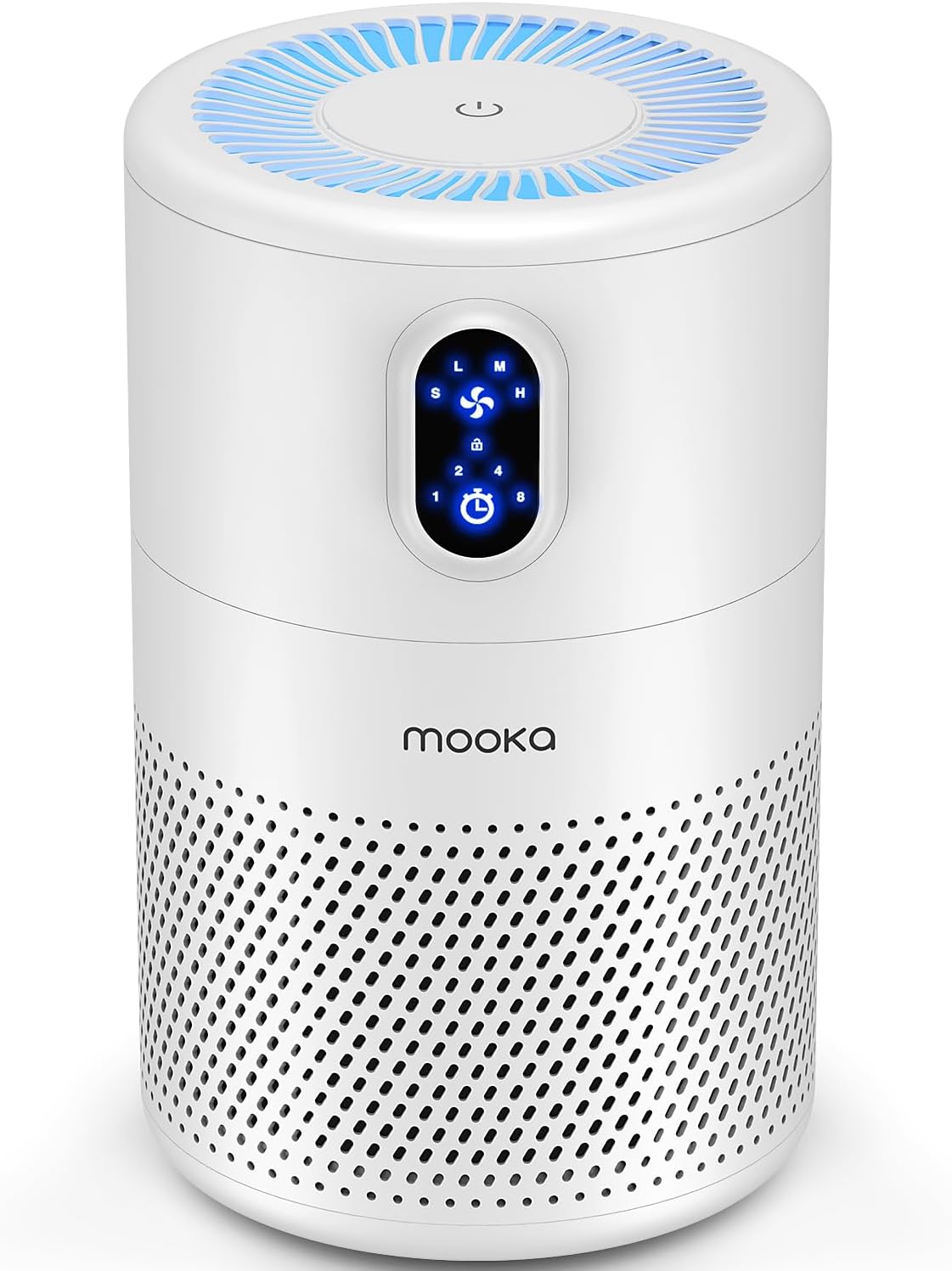
| Effective Area | 1076 sq ft |
|---|---|
| Filter Type | H13 True HEPA + activated carbon + pre-filter |
| Fan Modes | 4 speeds (Sleep/Low/Med/High) |
| Timer | 1/2/4/8 hours |
The MOOKA B-D02L is a compact tower-style air purifier built around an H13 true HEPA filter plus an activated carbon layer and a pre-filter, which together capture dust, pollen, pet dander, smoke and odors down to 0.3 microns. It is typically placed in bedrooms, living rooms or home offices and offers four fan speeds, four timer settings and a night light that can be turned off. The unit emphasizes quiet operation thanks to a brushless motor with a reported low-noise Sleep mode, and it has a child lock and a filter-replacement reminder to simplify maintenance. In practice it works well as a continuous background cleaner for allergy-prone spaces and can complete multiple air changes in smaller rooms or run slower to save energy overnight. Expect to replace the filter every 3 to 6 months depending on pollution levels, and note that coverage figures assume ideal conditions so performance will vary with room layout and sources of dust. For buyers who want straightforward controls, low noise, and proven HEPA filtration, this model is a practical choice for reducing airborne allergy triggers.
Best for: Buyers who prioritize dependable particle removal and low-noise continuous operation to reduce dust and allergy triggers in bedrooms or living areas while keeping controls simple and maintenance predictable.
Less Ideal for: Those who need tracked app control, smart-home integration, or industrial-grade purification for very large open-plan spaces should consider higher-end models with advanced monitoring and connectivity.
- H13 true HEPA plus activated carbon and pre-filter for particle and odor removal
- Covers large stated area up to 1,076 sq ft with multiple fan speeds for different room sizes
- Very quiet Sleep mode suitable for night use
- Child lock and filter reminder simplify safe operation and upkeep
- Filter needs replacement every 3–6 months which adds ongoing cost
- Coverage claims depend on room layout and may be optimistic in real-world conditions
Verdict: A quiet, easy-to-use HEPA purifier that efficiently reduces dust and common airborne allergens for buyers who want practical, low-maintenance performance.
FULMINARE H13 True HEPA Air Purifier

| Filter type | H13 HEPA |
|---|---|
| Recommended room size | Up to 215 ft² / 20 m² |
| Air changes | Refreshes air 5x per hour (room size specified) |
| Noise level | Around 24 dB on low fan speed |
The FULMINARE H13 is a small, budget-focused air purifier that uses an H13 true HEPA filter and 360 degree outlet to capture particles in a single room. It is intended for bedrooms, offices, or living rooms and is sized to refresh air up to roughly 215 ft² about five times per hour, which helps reduce dust, pet hair and common allergens. Controls include a near-silent sleep mode that can drop to around 24 dB, plus a soft night light and five timer settings for hands-off use. Practical benefits are straightforward: easy placement, quiet overnight operation, and a replaceable filter system. Limitations are typical for compact units — it is meant for one-room use rather than whole-house filtration, and replacement filters need periodic purchase and timely swapping to maintain performance. The unit is plug-in powered and requires removing filter packaging before use, so expect simple setup but ongoing filter maintenance for best results.
Best for: Buyers who prioritize an affordable, quiet purifier to reduce dust and allergens in a single bedroom or small living area and want simple plug-and-play operation with timers and a night light.
Less Ideal for: People needing whole-house air cleaning or high CADR performance for large open rooms should choose a larger, higher-capacity unit instead.
- H13 true HEPA filtration captures fine dust and common allergens.
- 360° outlet and dual-channel design provide room-wide circulation.
- Very quiet low-speed operation suitable for bedrooms (around 24 dB).
- Includes night light and multiple timers for convenient overnight or scheduled use.
- Designed for single-room coverage up to about 215 ft², not for larger open-plan spaces.
- Requires regular filter replacements to maintain performance.
Verdict: A wallet-friendly, quiet H13 HEPA purifier that effectively reduces dust and allergens in a single bedroom or small room.
ECOSELF HAP609 Air Purifier

| Model | HAP609 |
|---|---|
| Noise level (Sleep Mode) | 20 dB |
| Timer | 1–24 hours |
| Air intake | 360° |
The ECOSELF HAP609 is a compact HEPA air purifier designed to clean bedroom and small-to-medium living spaces with a 360 degree air intake and real-time PM2.5 monitoring. It typically sits on a nightstand or table and runs continuously in auto mode, increasing fan speed when the built-in sensor detects smoke, dust, pollen, or pet dander and slowing back down when the air clears. The visible PM2.5 readout and color ring make it easy to see air quality at a glance, and a 1–24 hour timer lets you schedule operation around sleep or work. Sleep Mode turns off indicator lights and drops noise to about 20 dB, making it suitable for overnight use. Practical benefits include responsive automatic control, small footprint for tight spaces, and pet/dust-focused filtration. Limitations are typical for compact purifiers: it is best for single rooms rather than whole-house coverage and replacement filters will be a recurring cost.
Best for: Buyers who prioritize dependable, sensor-driven cleaning for bedrooms or small living areas and want an unobtrusive, quiet unit that responds automatically to dust and pet dander.
Less Ideal for: Those seeking whole-house coverage or a high-CADR unit for very large rooms should consider larger models instead.
- 360° air intake increases airflow and speeds room purification
- PM2.5 sensor and color ring provide clear, real-time air quality feedback
- Auto mode adjusts fan speed automatically for hands-off operation
- Very quiet Sleep Mode (~20 dB) and lights-off option for night use
- Designed for single rooms so it may be insufficient for large open-plan spaces
- Will require periodic replacement filters, adding to operating cost
Verdict: Choose the ECOSELF HAP609 if you want a compact, sensor-driven HEPA purifier that reliably keeps a bedroom or small living room free of dust and allergens while staying whisper quiet at night.
Levoit Core 300-P

| Filter Type | 3 in 1 Filtration |
|---|---|
| Floor Area | 1073 square_feet |
| Noise Level | 24 db |
| Particle Retention Size | 0.3 micron |
| Wattage | 56 watts |
The Levoit Core 300-P is a small, room-focused air purifier that uses a three-stage original filter with HEPA-grade performance to capture particles as small as 0.3 micron and claims 99.97% efficiency for 0.1–0.3 µm particulates. It is intended for bedrooms, offices, or living rooms and delivers a measured CADR for smoke, dust, and pollen that refreshes a typical medium room several times per hour. The unit runs on a 56W motor with touch controls, a timer, and a near-silent Sleep Mode that drops noise to about 24 dB for overnight use. Practical benefits include portable placement, a check-filter indicator, and certification by AHAM, CARB, and ETL for verified performance and safety. Limitations are that it lacks smart connectivity and Auto Mode (the Core 300S-P offers that), so you must change fan speeds manually, and consistent peak performance depends on using Levoit original replacement filters and replacing them every 6 to 8 months. The Core 300-P is an effective, low-noise choice when you want proven filtration in a compact package without smart features.
Best for: Buyers who prioritize independently verified filtration performance and quiet operation for bedrooms or medium rooms and value social proof from certifications and large user feedback.
Less Ideal for: Users who want smart-home integration, automated air-quality sensing, or whole-house coverage should consider models with Auto Mode or larger CADR specs.
- True HEPA-grade three-stage filtration that captures particles down to 0.3 micron with lab-tested 99.97% efficiency for fine particulates.
- AHAM verified CADR ratings for smoke, dust, and pollen that support measurable room air changes.
- Very quiet Sleep Mode at about 24 dB suitable for overnight bedroom use.
- Compact and portable design with touch controls, timer, and check-filter indicator for easy everyday use.
- No smart connectivity or automatic Auto Mode; fan speed must be adjusted manually.
- Best performance depends on using official Levoit replacement filters and regular filter changes every 6–8 months.
Verdict: Choose the Core 300-P when you want a compact, AHAM-verified HEPA purifier with quiet overnight operation and proven filtration for dust and allergy particles.
Levoit Vital 200S-P Air Purifier

| Floor Area | 1875 square_feet |
|---|---|
| Filter Type | 3-Stage Filter |
| Particle Retention Size | 0.1 micrometer |
| Noise Level | 27 db |
| Power Source | Corded Electric |
The Levoit Vital 200S-P is a smart air purifier built for whole-room cleaning in larger spaces. It uses a three-stage filtration system with a washable pre-filter plus activated carbon and HEPA-class media to capture dust, pet hair, dander, smoke, and odors, and Levoit reports independent AHAM CADR numbers for smoke, dust, and pollen. Typical use is placement in living rooms or bedrooms where it runs quietly—Levoit lists a low noise level down to 27 dB—and can be monitored and controlled via an app or buttons on the unit. Practical benefits include rapid air turnover for rooms up to the stated coverage, targeted filter options (pet, smoke, toxin) depending on needs, and a U-shaped inlet design intended to reduce clogging from pet hair. Trade-offs are that it is a larger, heavier desktop/tower unit that requires regular filter maintenance and eventual replacement, and smart features add setup steps for users who prefer a simple plug-and-play appliance.
Best for: Buyers who prioritize proven allergy performance and quiet, whole-room cleaning and want a reliable unit with smart controls and selectable filter options for specific contaminants.
Less Ideal for: People seeking a tiny portable purifier for single-person desks or travel or buyers who want a completely maintenance-free, filterless device.
- Three-stage filtration including washable pre-filter and activated carbon for odors
- AHAM-verified CADR performance for smoke, dust, and pollen
- App and button controls for remote monitoring and scheduling
- Low reported noise level suitable for bedrooms at 27 dB
- Filter options tailored for pets, smoke, or toxins
- Requires periodic filter replacements and pre-filter cleaning
- Relatively large and heavier than compact travel purifiers
- Smart setup may be unnecessary for buyers who want only basic operation
Verdict: Choose the Vital 200S-P when you want an AHAM-verified, quiet smart purifier that reliably removes dust and allergy triggers across large rooms.
Choosing the Right Air Purifier for Dust Allergies: Key Factors to Consider
Filtration Efficiency and Filter Type
How well an air purifier captures fine dust depends primarily on its filter media and how tightly the unit seals airflow through that media. True HEPA filters capture at least 99.97 percent of particles 0.3 microns in diameter and are the standard choice for removing dust, pet dander, and many common allergenic particles.
Consider whether a purifier uses a genuine HEPA filter or a lower-efficiency substitute. Also note whether the design includes prefilters to trap larger debris; prefilters extend main filter life and keep dust buildup from reducing peak efficiency.
Room Size and Coverage (CADR and Air Changes)
Match the purifier's rated coverage to the room where you will use it. CADR (Clean Air Delivery Rate) and recommended room area or number of air changes per hour give realistic expectations of how quickly a unit will reduce airborne dust. A unit that is undersized for the space will run continuously without delivering meaningful improvement.
Think about where you spend the most time: bedrooms benefit from quieter units with adequate overnight coverage, while living rooms often need higher airflow to keep dust low across a larger area.
Noise Output and Night Use
Noise matters because people are more likely to run purifiers continuously when they are unobtrusive. Manufacturers report decibel levels at various fan speeds; compare those figures to your tolerance for background noise. Some units have a lower 'sleep' mode that reduces fan speed and sound while still providing some filtration.
Remember that perceived noise depends on room acoustics and placement. A purifier one person finds quiet in a living room may be disruptive at bedside if it lacks a true low-noise setting.
Maintenance, Filter Life, and Running Costs
Filter replacement frequency and ease influence total ownership cost and whether the purifier stays effective over time. Check expected filter life in hours or months and whether replacement filters are easy to swap without exposing settled dust. Units with accessible prefilters that can be vacuumed or rinsed reduce waste and ongoing expense.
Also consider whether the unit offers filter-life indicators and how straightforward routine tasks are, such as cleaning intake grills or resetting counters after replacements.
Operational Efficiency and Energy Use
Because air purifiers often run for many hours each day, energy consumption affects both electricity bills and environmental impact. Look for units with efficient motors and variable-speed fans that can provide needed airflow without excessive power draw. Some purifiers include eco or auto modes that reduce fan speed when air quality is good, which conserves energy.
Assess whether continuous use is realistic for your household and choose models that balance steady performance with low standby or low-speed energy use.
Placement, Portability, and Aesthetics
Practical placement affects performance. Purifiers need unobstructed intake and exhaust to achieve rated coverage, so measure available clearance and choose a size that fits the intended room without blocking foot traffic. Portable units with handles or casters make it easy to move a single device between bedroom and living areas.
Aesthetics matter for long-term use because an attractive, compact design is more likely to remain in everyday circulation rather than being stored away.
Understanding Dust Particle Sizes and Why HEPA Matters
Household dust is a mix of skin flakes, textile fibers, pollen fragments, and tiny particles from cooking and outdoor air. Many of these components are in the submicron to a few micron range. Filters rated as true HEPA are designed to capture these small particles efficiently, which is why they are recommended for dust allergy control.
Even when a purifier uses HEPA media, the overall design must prevent bypass where unfiltered air leaks around the filter. Look for sealed filter chambers and gasketed interfaces to ensure the HEPA media actually filters the air passing through the unit.
- Particles around 0.3 microns are the most challenging to capture; HEPA standards target this size.
- Pre-filters trap larger fibers and extend HEPA filter life.
- Sealed airflow paths improve real-world performance versus loose filter fits.
Where to Place a Purifier for Best Dust Reduction
Place the purifier centrally in the room where you spend the most time or toward the source of dust generation, such as near a bed, pet resting area, or a high-traffic doorway. Avoid tucking a unit behind furniture or against walls that block intake or exhaust.
For whole-room effectiveness, elevate smaller units off the floor on a stable surface if recommended by the manufacturer. In bedrooms, position the unit so clean air flows toward the sleeping area while minimizing direct airflow onto the pillow if that causes discomfort.
- Keep at least a foot of clearance on intake and exhaust sides when possible.
- Use one adequately sized unit per frequently used room rather than a small unit for multiple rooms.
- Avoid placing purifiers near obstructions that can reduce airflow and CADR.
Balancing Filtration Speed with Quiet Operation
High fan speeds increase particle removal but also raise noise. If you need rapid dust clearance for a short time, run the purifier on a higher setting, then drop to a lower sleep or eco mode for continuous background cleaning. Many modern units offer an automatic mode that adjusts fan speed based on detected particulate levels.
For overnight use, prioritize units that maintain respectable CADR at low decibel levels. Real-world testing by owners often reveals which models are more tolerable at night than manufacturer-reported figures alone.
- Use higher speeds for quick cleanups after dust-generating activities.
- Select a unit with a true low-noise mode for bedrooms.
- Auto modes can reduce the need for manual speed adjustments.
Maintaining Filters and Reducing Indoor Dust Sources
Routine maintenance includes replacing HEPA filters as recommended and cleaning washable prefilters or intake grills. Regular vacuuming with a HEPA-equipped vacuum and minimizing indoor dust sources, such as open windows on windy days or high-pile textiles, complement a purifier's work.
Record filter replacement dates and inspect filters visually for heavy dust loading. Neglecting replacements allows buildup that reduces airflow and filtration efficiency, which undermines the device's effectiveness against dust allergies.
- Vacuum and dust with a damp cloth to remove settled dust before purification.
- Wash or vacuum prefilters as directed to extend main filter life.
- Keep pets groomed and restrict dusty items in bedrooms to lower airborne dust.
Sensors, Auto Modes, and Real-World Performance Signals
Some purifiers include particle sensors that adjust fan speed based on measured air quality. While useful, sensors vary in sensitivity and placement; an on-board sensor may not reflect particle levels in other parts of the room. Treat sensor readings as a guide rather than an absolute indicator.
Look for units that provide straightforward feedback like numerical PM2.5 readouts or color-coded indicators so you can judge whether the unit is actively reducing particulate levels in your environment.
- Sensor-driven auto modes help conserve energy and reduce noise when air is clean.
- PM2.5 readouts can show progress during dust reduction efforts.
- Understand that sensor location affects responsiveness to local dust sources.
How We Chose the Best Air Purifier for Dust Allergies
We prioritized devices that demonstrably reduce airborne dust and associated allergy triggers using objective performance indicators. Key filters included verified high-efficiency particulate filtration, realistic room coverage claims based on CADR or equivalent airflow metrics, and documented filtration of the particle sizes most relevant to household dust and mite fragments. We also considered operational factors that affect daily use: noise levels at typical settings, energy draw for continuous operation, and the availability and cost of replacement filters as part of long-term upkeep. Safety and ease of maintenance were additional gatekeepers. Units with sealed filtration paths and clear service intervals scored higher because leakage or confusing maintenance increases real-world exposure to dust. We excluded devices that rely solely on ionization without adequate particle capture, since those approaches do not provide consistent particulate removal. Final selections balance measured filtration performance with practical attributes like noise, energy use, and filter accessibility to reflect typical home scenarios.
Our full evaluation process is outlined in our review methodology.
FAQ
How often should I run an air purifier for dust allergies?
Running the purifier continuously is recommended for people with dust allergies, since dust accumulates over time. Use a higher setting during periods of heavy activity and a quieter mode at night.
Do I need a true HEPA filter to control dust?
Yes. True HEPA filters are the most reliable option for capturing the small particles that make up household dust. Lower-efficiency or electrostatic-only approaches may reduce some particles but do not offer the same consistent capture rate.
Will an air purifier remove dust that has already settled on surfaces?
No. Purifiers reduce airborne particles and help prevent further settling, but they do not remove dust from floors, furniture, or textiles. Regular cleaning and vacuuming are necessary to remove settled dust.
How do I pick the right size unit for my room?
Match the unit's CADR or recommended room area to the square footage and ceiling height of the room. Aim for enough air changes per hour to meaningfully reduce airborne dust in the time frame you need.
Are ionizers or ozone generators effective for dust allergies?
Devices that rely on ionization alone or produce ozone are not recommended as primary solutions for dust allergies because they do not consistently remove particulate matter and can introduce health risks if ozone is generated.
Final Verdict
Choosing the right air purifier for dust allergies means balancing filtration efficiency, adequate room coverage, and practical everyday factors like noise and maintenance. Prioritize a unit with true HEPA filtration, a CADR or coverage rating that matches your room, and manageable filter-replacement intervals. Weigh tradeoffs: higher fan speeds clear dust faster but increase noise and energy use, while low-noise, energy-efficient settings are better for continuous overnight operation. Focus on matching features to how you live and where you spend time to choose a purifier that consistently reduces airborne dust and eases allergy symptoms.