
Note: This article contains affiliate links. If you click on these links and make a purchase, we may earn a small commission at no extra cost to you. This helps support our research and content. Read our full affiliate disclosure here.
Buying the right air purifier during a deals period can save money upfront while still improving indoor air quality for your home. You want a unit that removes the particles you care about, fits the rooms you use most, and does not become expensive to operate. This guide shortlists the top air purifier deals so you can see which models balance filtration, coverage, and running costs. Below we outline the shortlist and the reasons each option earned a place. Read the evaluation criteria to understand how we measured filtration performance, coverage, and long-term cost before the product list.
Top Picks at a Glance
| Best Overall The best all-around choice for most situations | Winix 5510 Air Purifier |  |
| Best Quality Built to a higher standard if you want something more solid | Nuwave OxyPure Ultra Air Purifier |  |
| Best Value The sweet spot between price and what you get | MOOKA KJ190H Air Purifier |  |
| Best Budget The cheapest option that still gets the job done reliably | VOOPNU HEPA Air Purifier DH-JH12 |  |
| Top Rated A top-rated pick with lots of positive feedback | ECOSELF HAP609 Air Purifier |  |
| Most Popular A crowd favorite that many people choose with confidence | Levoit Core 300-P Air Purifier |  |
| Best Seller A high-volume bestseller chosen again and again | Levoit Core Mini-P |  |
Winix 5510 Air Purifier

| Model | 5510 |
|---|---|
| Filtration | 4-Stage (Pre-filter, True HEPA, Carbon, PlasmaWave) |
| Coverage (AHAM verified) | Up to 1,882 sq ft in 1 hour |
| App support | Winix Smart App / WiFi / Alexa / Google Home |
| Certifications | AHAM Verified, UL Certified |
The Winix 5510 is a four-stage air purifier built for whole-room cleaning and everyday household use. It combines a washable pre-filter, True HEPA filter that captures particles down to 0.01 microns, and a high-deodorization carbon layer to reduce cooking smells, pet odors, and VOCs, while Winix's PlasmaWave technology further targets airborne impurities. Smart sensors feed an on-unit LED air quality indicator and Auto Mode so the fan speed adjusts to conditions, and the unit pairs with the Winix Smart App as well as voice assistants for remote monitoring and control. Sleep Mode automatically quiets the unit in the dark for overnight use, and the purifier is AHAM verified and UL certified for performance and safety. Trade-offs to consider are its floor-standing size and need for periodic HEPA/carbon filter replacement, and while fan noise is very low on the slowest setting it will be more noticeable at higher speeds when tackling heavy smoke or odors.
Best for: Buyers who want a confident, all-purpose purifier for living rooms or open-plan spaces that balances strong filtration, odor control, and smart home convenience.
Less Ideal for: Those seeking an ultra-compact or travel-friendly purifier for small bedrooms or travel use should consider smaller, more portable models instead.
- True HEPA filtration capturing very small particles (down to 0.01 microns) for allergy and smoke reduction.
- Advanced carbon filter for improved odor and VOC control compared with basic HEPA-only units.
- Smart sensors with Auto Mode and an LED air quality indicator for hands-off operation.
- Winix Smart App and voice assistant compatibility for remote monitoring and control.
- Sleep Mode and low-noise operation on the slowest setting for nighttime use.
- Requires periodic replacement of HEPA and carbon filters, adding ongoing cost.
- Larger floor-standing footprint that may be less suitable for small bedside tables.
- Higher fan speeds can be noticeably louder when cleaning heavily polluted air.
Verdict: A feature-rich, smart-capable purifier that delivers strong HEPA filtration and odor control for large living spaces, making it a versatile choice for balanced buyers.
Nuwave OxyPure Ultra Air Purifier

| CADR | 664.6 m3/h |
|---|---|
| Coverage | Up to 2,934 sq ft (60 minutes) |
| Filtration stages | 5-stage system |
| Wi‑Fi | Yes |
The Nuwave OxyPure Ultra is built to move lots of air and tackle particles, odors, and ozone in large open spaces. It uses a five-stage system—stainless-steel pre-filter, ozone emission removal filter, HEPA/carbon combo, and a washable Bio-Guard layer—to capture big debris, fine particles and reduce odors while offering reusable filters that cut replacement costs. CADR performance is rated to purify up to about 2,934 sq ft in 60 minutes (664.6 m3/h), which makes it useful for open-plan living areas, offices, or rooms with high ceilings where strong airflow is needed. The unit is Wi‑Fi capable for remote monitoring and control via an app, and practical washable/reusable elements simplify maintenance. Trade-offs include its large physical footprint and heavier weight compared with compact purifiers, and it may be more power and noise intensive on high airflow settings. Its filter approach reduces ongoing filter spend but some specialized replacement parts are still recommended for peak performance.
Best for: Buyers who prioritize top-tier airborne particle removal and fast circulation in large or open areas and want a unit that minimizes recurring filter purchases through washable components.
Less Ideal for: People seeking a compact, lightweight bedroom purifier or an ultra-quiet nightstand unit should consider smaller, lower-output options instead.
- High CADR and airflow suitable for very large rooms and open floor plans
- Five-stage filtration that targets large particles, fine particulates, odors, and ozone
- Washable stainless-steel pre-filter and Bio-Guard filter reduce recurring filter costs
- Wi‑Fi connectivity for remote monitoring and control via mobile app
- Large and heavy unit takes significant floor space and is less portable
- Likely louder and more power-hungry at top fan speeds compared with smaller models
Verdict: Choose the OxyPure Ultra when you need powerful, fast air cleaning for very large spaces plus washable filters to lower ongoing costs.
MOOKA KJ190H Air Purifier

| Coverage | 2200 ft² per hour |
|---|---|
| Filter type | H13 HEPA with activated carbon |
| Pre-filter | Washable |
| Noise (Sleep Mode) | 20 dB |
| Timer | 2/4/6/8 hours |
The MOOKA KJ190H is a home air purifier built around a three-stage filtration system with an H13 HEPA filter, washable pre-filter, and activated carbon to tackle dust, pet dander, smoke, and odors. It is typically placed in living areas or bedrooms where continuous air monitoring and automatic adjustments are useful; the built-in PM2.5 sensor and auto mode change fan speed to match measured air quality. Practical features include a washable pre-filter to extend HEPA life, a filter indicator that reminds you after about 2000 hours, a sleep mode rated near 20 dB for night use, and timers for 2/4/6/8 hour auto-off. The unit advertises wide dual-side air intakes intended to capture pet hair more effectively and has an essential oil tray for light aromatherapy. Expect straightforward operation and lower running costs thanks to energy-efficient design, though replacement HEPA filters are still a recurring expense and the aromatherapy feature is basic. The purifier is best for continuous daily use in occupied rooms rather than occasional spot cleaning of very smoky or industrial environments.
Best for: Buyers who want a practical, energy-conscious purifier that runs continuously and adjusts automatically to indoor air quality while keeping operating costs down.
Less Ideal for: Homes needing industrial-strength or rapid cleanup for heavy wildfire smoke or construction dust should consider higher-capacity or commercial-grade units instead.
- H13 True HEPA removes fine particles including pollen, pet dander, and smoke
- Washable pre-filter extends HEPA life and reduces replacement frequency
- PM2.5 air quality display with auto mode adjusts fan speed automatically
- Very quiet sleep mode (~20 dB) and programmable timers for night use
- Replacement HEPA filters are a recurring maintenance cost
- Aromatherapy tray is simple and not suitable for continuous heavy scenting
Verdict: A cost-conscious, room-scale purifier with H13 HEPA, washable pre-filter, and smart auto mode that fits buyers wanting efficient daily air cleaning.
VOOPNU HEPA Air Purifier DH-JH12

| Coverage | Up to 1,076 ft² per hour (lab-tested) |
|---|---|
| Filter | H13 True HEPA multi-layer |
| Noise | 22 dB (low) |
| Intake | 360° surround intake |
The VOOPNU DH-JH12 is a small, easy-to-use HEPA air purifier intended for removing common household pollutants such as pet hair, pollen, smoke, and odors. It uses a 360 degree intake and an H13 true HEPA multi-layer filter to capture fine particles and the manufacturer states it can clean roughly 250 ft² every 15 minutes, covering up to 1,076 ft² per hour in laboratory conditions. Controls are simple and the unit runs quietly down to about 22 dB, making it suitable for bedrooms or workspaces, and it includes a small essential oil tray if you want light scenting. The purifier is compact and portable so it is simple to place on a desk or corner, and it is certified to several safety and emissions standards. Expect to replace filters on a regular cadence and remember that continuous use gives the best air-quality results; in larger or heavily polluted spaces you may need to run it on higher speeds more often which increases noise and filter load.
Best for: Buyers on a tight budget who want a compact, straightforward air purifier for bedrooms, home offices, or apartment living that emphasizes quiet operation and simple controls.
Less Ideal for: People needing a heavy-duty purifier for very large open-plan homes or persistent wildfire smoke events should consider higher-capacity units designed for continuous heavy loads.
- H13 true HEPA filtration captures 99.97% of fine airborne particles
- Compact, lightweight design that fits on desks or in corners
- Very quiet operation down to about 22 dB for overnight use
- 360° intake and lab-tested coverage claims for up to 1,076 ft² per hour
- Built-in essential oil tray for optional scenting
- Filter replacement is required on a regular schedule which adds ongoing cost
- Coverage figures are lab-tested and real-world results will vary in larger or heavily polluted rooms
Verdict: A budget-friendly, quiet HEPA purifier that offers true HEPA filtration and compact portability for bedrooms and small to medium rooms.
ECOSELF HAP609 Air Purifier

| Item model number | HAP609 |
|---|---|
| Customer Reviews | 4.9 out of 5 stars (194) |
| Date First Available | June 1, 2026 |
The ECOSELF HAP609 is a small, user-friendly HEPA air purifier meant to clean indoor air in bedrooms and living spaces. It draws air from all directions via a 360° intake and runs through a multi-stage filtration system to reduce dust, pollen, smoke, and pet dander. A built-in PM2.5 sensor and color ring provide at-a-glance air-quality feedback while Auto Mode adjusts fan speed automatically when particle levels rise. Sleep Mode silences lights and drops noise to about 20 dB for minimal disturbance overnight, and a 1–24 hour timer makes scheduled use simple. Practically, the unit is easy to place on a bedside table or shelf and useful for people who want continuous, automated air cleaning without fiddling with controls. The HAP609's strengths are its real-time monitoring, quiet night performance, and compact footprint; its limitations are the smaller physical size and likely lower coverage compared with larger, more powerful purifiers, so it may need multiple units for large open plans or whole-home coverage.
Best for: Buyers who prioritize a reliable, low-maintenance purifier that monitors air quality and runs quietly at night for bedrooms or smaller rooms.
Less Ideal for: Customers seeking a single purifier to clean large open-plan areas or whole homes should consider higher-capacity models instead.
- 360° air intake for more even room circulation
- Built-in PM2.5 sensor with color ring gives immediate air-quality feedback
- Auto Mode adjusts fan speed in response to pollution spikes
- Very quiet Sleep Mode at about 20 dB and lights off for overnight use
- Programmable 1–24 hour timer for convenient scheduled operation
- Smaller unit so coverage may be limited for large open spaces
- Product details do not list CADR or exact filtration stages, limiting direct performance comparisons
Verdict: Choose the ECOSELF HAP609 when you want an easy-to-use, quietly running HEPA purifier with real-time PM2.5 monitoring for dependable bedroom or small-room air cleaning.
Levoit Core 300-P Air Purifier

| Power Source | Corded Electric |
|---|---|
| Filter Type | 3 in 1 Filtration |
| Floor Area | 1073 square_feet |
| Noise Level | 24 db |
| Wattage | 56 watts |
The Levoit Core 300-P is a small, user-friendly air purifier built around a three-stage filter that captures 99.97% of particles down to 0.3 microns and targets smoke, pollen, dust, pet dander, and VOCs. It uses a 56W motor with a CADR suited for bedrooms and medium rooms and offers manual fan speeds plus a near-silent Sleep Mode that drops noise to about 24 dB. Controls are touch-based and the unit includes a timer and a filter check indicator, while lights can be turned off for undisturbed nights. Practical benefits include genuine factory replacement filters and AHAM verification for measured cleaning performance. Limits to consider are the lack of smart or auto modes on this variant, so it requires you to set fan speeds manually, and its coverage claims rely on Levoit original filters and testing conditions. For people who prioritize quiet nighttime operation and proven filtration without connected features, the Core 300-P performs reliably in home and bedroom settings.
Best for: Buyers who want a proven, quiet bedroom or medium-room purifier with verified cleaning performance and clear user feedback from many other owners.
Less Ideal for: If you need smart features, automatic air-quality sensing, or hands-off scheduling, choose a model with Auto Mode or Wi-Fi control instead.
- HEPA-grade 3-stage filter captures 99.97% of particles as small as 0.3 micron
- AHAM verified CADR and independent lab testing for filtration performance
- Very quiet Sleep Mode (around 24 dB) suitable for bedrooms
- Touch controls, timer, and filter check indicator for straightforward operation
- Uses factory replacement filters designed for optimal fit and performance
- Core 300-P does not include Auto Mode or smart connectivity, requiring manual speed control
- Coverage and CADR figures are tied to Levoit original filters and test conditions
Verdict: A compact, AHAM-verified HEPA purifier that delivers quiet, reliable particle removal for bedrooms and medium rooms when you want proven performance over smart features.
Levoit Core Mini-P
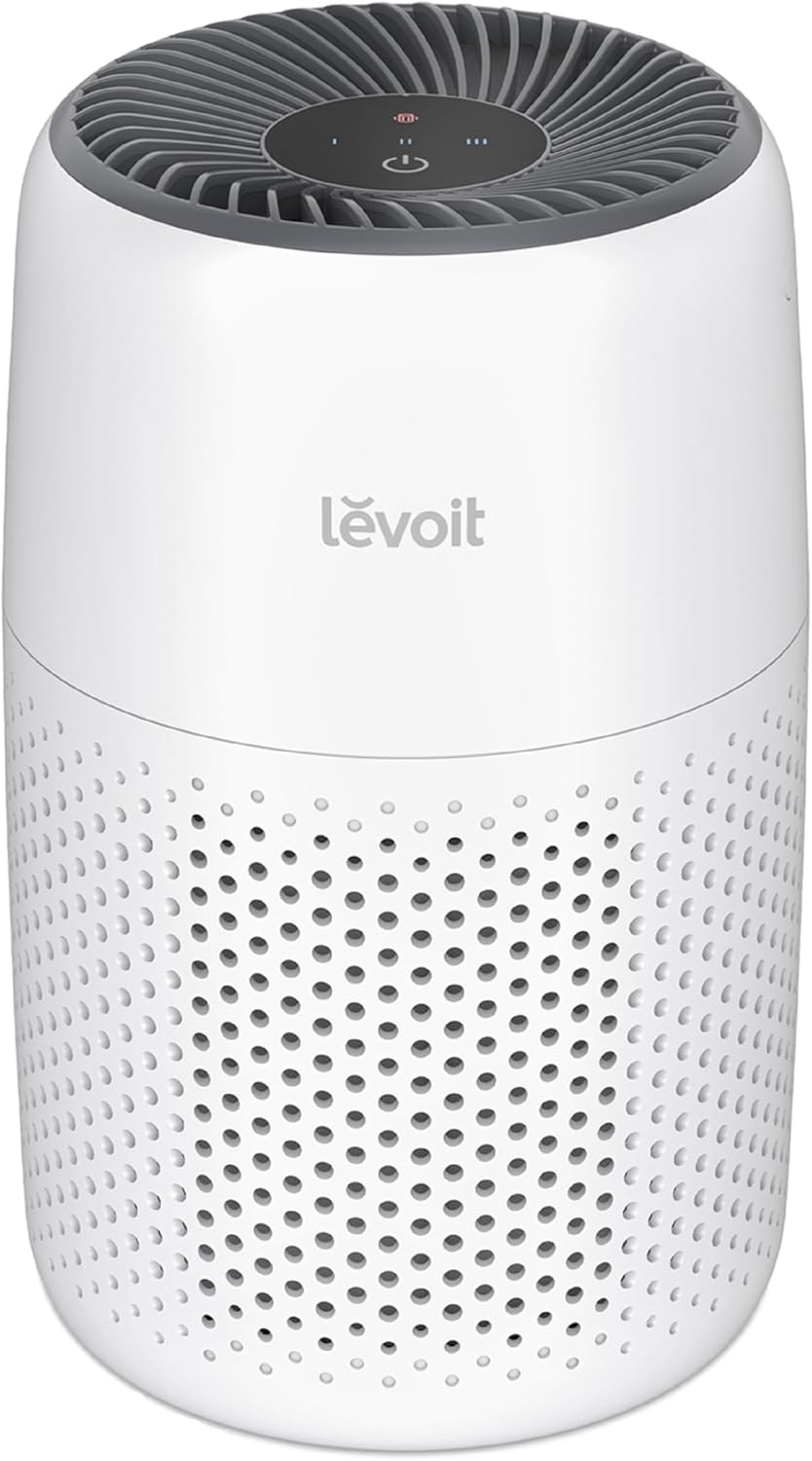
| Rated Power | 7W |
|---|---|
| Noise Level | 27-45dB |
| Particle Retention Size | 0.3 micron |
The Levoit Core Mini-P is a small desktop air purifier aimed at improving air quality in bedrooms, offices, and other compact rooms. It uses a pre-filter and main filter to capture lint, pet hair, dander, dust and smoke-sized particles, and includes a fragrance sponge for light aromatherapy. The unit is quiet enough for sleep mode with a reported noise range below conversational levels, and it has an auto-off display to reduce disturbances. Rated power is low at 7W so it runs efficiently and the adapter stores inside the unit for tidy placement. Practical benefits include simple setup, portability around the home, and the ability to reduce common household odors and airborne irritants without a large footprint. Limitations are inherent to its size: it is built for small areas and will not match the coverage or CADR of larger room purifiers, and the aromatherapy feature requires care to avoid overfilling which can damage parts.
Best for: Buyers who prioritize a quiet, fuss-free purifier for a bedroom, dorm, or home office and want reliable pollutant and odor reduction without complicated setup or high running costs.
Less Ideal for: People looking to clean the air in large living rooms or whole apartments should choose a higher-capacity purifier with larger coverage and CADR ratings.
- Compact tabletop size fits small rooms and desks
- Pre-filter plus main filter captures pet dander, lint, dust and smoke particles
- Very low power draw (7W) for energy-efficient continuous use
- Sleep mode and auto-off display minimize disruption during night use
- Intended coverage limited to small rooms so not suitable for whole-home purification
- Aromatherapy sponge must be used sparingly to avoid damaging internal plastics
Verdict: A compact, energy-efficient purifier that quietly reduces common household pollutants and odors in small rooms.
Choosing the Right Air Purifier Deals: Key Factors to Consider
Filtration Efficiency and Filter Type
Filtration efficiency determines what the purifier actually removes from your air. True HEPA filters capture at least 99.97% of particles 0.3 microns in size and are essential for reducing dust, pollen, and many airborne allergens. Carbon or activated-charcoal prefilters address odors and volatile organic compounds, which HEPA alone does not eliminate.
When evaluating deals, check whether the listing specifies "true HEPA" and provides capture rates or test data. Filters with multiple stages tend to perform better at both particles and odors, but they can raise replacement costs, so factor that into your total ownership expense.
Room Size and CADR Ratings
Room size is a primary determinant of which purifier will work for you. CADR, or Clean Air Delivery Rate, quantifies how quickly a unit reduces pollutants in a space and should be matched to your room square footage and typical ceiling height. A higher CADR means faster cleaning for the same room size.
When shopping deals, compare the CADR numbers to manufacturer-recommended room sizes rather than relying solely on vague category labels like "medium room." If a deal pairs a lower sticker price with a machine undersized for your space, you may end up running it constantly on high, reducing filter life and comfort.
Operating Costs and Filter Replacement
Initial deal prices can be attractive, but ongoing costs matter. Replacement HEPA and carbon filters are consumables that vary widely in price and recommended replacement interval. Some designs use multi-stage filters you replace as a single unit, while others let you change only the carbon or prefilter separately.
Estimate annual filter costs based on the vendor's recommended intervals and your expected runtime. Also consider energy consumption, especially if you plan to run the purifier continuously. Units with programmable schedules or auto modes can reduce runtime and lower long-term expenses.
Noise Levels and Fan Control
Noise affects where and how you use a purifier. Bedrooms require low-noise operation to avoid sleep disruption, while living rooms may tolerate higher fan speeds. Look for measured decibel ratings at different fan speeds and whether the unit has a true quiet or night mode that reduces fan speed and indicator brightness.
Fan control granularity matters too. Units with infinite or several stepped speeds let you fine-tune the tradeoff between noise and cleaning speed. In deals, a slightly higher price for a quieter model can be worth it if you need 24/7 operation in sleeping areas.
Maintenance, Usability, and Filter Access
Easy access to filters reduces the friction of regular maintenance. Top-loading or front-panel access with clear filter indicators simplifies replacements. Check whether replacement filters are easy to find and whether the purifier has a built-in indicator for filter life versus a timer-based reminder.
Usability also includes control methods: tactile buttons, remote control, smartphone apps, and auto modes. If you plan to place the purifier out of the way, a reliable remote or app control can make daily operation easier. During deal hunting, ensure the savings do not come with hard-to-find replacement parts or inconvenient maintenance design.
Safety and Build Quality
Safety matters for continuous-use appliances. Ensure the unit has basic safety certifications and a stable design that resists tipping. Materials and construction quality affect both longevity and how the unit sounds in operation.
Deal-priced units with flimsy plastics or poor fit can wear faster and produce rattles or reduced sealing that undermines filtration. Favor options with straightforward warranty terms and clear safety markings.
How to Match a Purifier to Specific Room Layouts
Room layout influences how air moves and how quickly a purifier can cycle the air. Open-plan living areas benefit from a single high-CADR unit placed centrally, while long narrow rooms or multiple connected spaces may require two smaller units positioned to encourage crossflow.
For bedrooms, place the purifier near the area where you breathe most while sleeping but not obstructed by furniture. In kitchens or entryways where odors and particles enter directly, consider a unit with a strong carbon stage and higher air changes per hour.
- Central placement improves overall circulation.
- Avoid tight corners or behind large furniture that blocks airflow.
- Use multiple smaller units for zoned control and quieter operation at night.
Understanding Filter Lifespan and Replacement Tips
Filter lifespan depends on pollutant load and runtime. Heavily polluted environments or continuous operation will shorten filter life. Check the manufacturer's guidelines but treat them as estimates; monitor indicators and replace early if you notice odors or reduced airflow.
Keep a small supply of replacement prefilters if the model uses washable prefilters. For carbon and HEPA elements, buy genuine replacements when possible and note whether filters are sold individually or as combined cartridges to plan your budget.
- Rotate stock of filters to avoid expiration in storage.
- Clean washable prefilters monthly for best performance.
- Record filter change dates to track actual lifespan under your conditions.
Using Auto Modes and Smart Features Effectively
Auto modes that adjust fan speed based on particle sensors can balance air quality and energy use. However, sensor quality varies. Use auto mode as a baseline and occasionally run manual high-speed cycles after events like cleaning, cooking, or bringing in lots of outdoor air.
Smart app integrations and scheduling are helpful for routine control. If you often forget to turn units on, set schedules tied to occupancy patterns. For bedrooms, set lower night schedules with a timed morning boost to clear overnight buildup.
- Verify the unit's particle sensor responsiveness when possible.
- Combine scheduling with occasional manual boosts after high-pollution events.
- Disable unnecessary app features that may wake the unit and waste energy.
Buying During Deals: What to Watch For
During promotional periods, confirm the deal does not exclude necessary accessories like replacement filters or warranty registration. A low upfront price can be offset by hard-to-find or expensive consumables. Read product specs carefully to ensure true HEPA claims and CADR numbers are present.
Check return policy and warranty details before purchasing. If the deal reduces or eliminates standard support, that can increase long-term risk. Prefer units that retain clear documentation and accessible replacement parts.
- Compare CADR and filter specs even when price is lower.
- Ensure replacement filters are available and reasonably priced.
- Confirm warranty and support terms remain intact during the promotion.
Placement and Ventilation: Making Your Purifier More Effective
Even the best purifier is limited by placement. Place units where pollutant sources are most active and allow unobstructed intake and outflow. Avoid corners and floor-level obstructions that impede circulation.
Complement purifiers with sensible ventilation when outdoor air quality allows. Purifiers clean indoor air but do not remove CO2 or humidity effectively; occasional airing out is still beneficial when outdoor air is clean.
- Leave at least a foot of clearance around intake vents.
- Position near pollutant sources for faster removal.
- Use multiple units for larger homes rather than oversizing a single unit.
How We Chose the Best Air Purifier Deals
We focused on practical, buyer-relevant filters to identify the best air purifier deals. Primary criteria included verified filtration performance such as HEPA capture rates and true particle removal rather than marketing claims; room coverage and CADR ratings to ensure a unit can handle the intended space; and operating cost, including replacement filter frequency and typical energy draw. Noise levels at different fan speeds and available fan-speed control were evaluated to determine real-world comfort. Usability factors covered filter-change simplicity, control interfaces, and whether the unit offers modes useful for homes such as auto or night settings. Build quality and warranty coverage rounded out the assessment to reflect durability. Excluded from consideration were units whose specifications lacked third-party or manufacturer-backed CADR/HEPA info, devices relying only on ionization without mechanical filtration, and models with known reliability or safety issues. The final selections represent a balance of effective filtration, affordable operation, appropriate room coverage, and practical day-to-day usability.
Our full evaluation process is outlined in our review methodology.
FAQ
How do I know if an air purifier deal is for a true HEPA unit?
Look for explicit wording such as "True HEPA" and any stated particle capture rates or third-party test references. Listings that use vague terms like "HEPA-type" or "HEPA-like" usually indicate lower performance.
Will a bigger CADR always mean better results?
A higher CADR generally cleans a space faster, but it must be matched to room size. An oversized unit can be noisy and waste energy; an undersized one will run constantly without adequately improving air quality.
How often should I replace HEPA and carbon filters?
Replacement intervals vary by use and pollutant load but commonly range from six months to two years. Monitor filter indicators and watch for reduced airflow or lingering odors as signs that a change is needed.
Are ionizers a good alternative to mechanical filtration?
Ionizers can reduce certain particles but often do not remove them from the air effectively unless paired with mechanical filters. Many buyers prefer true mechanical HEPA filtration for consistent particle removal without generating byproducts.
Can I run my air purifier 24/7 during a deal season?
Running continuously is fine if the unit is rated for continuous use, but expect higher energy and filter replacement costs. Use auto modes and scheduling to reduce runtime when full-speed cleaning is not required.
How loud will a purifier be at night?
Noise depends on fan speed and unit design. Many models offer a night or quiet mode that reduces noise significantly. Look for measured decibel ratings at the lowest setting if nighttime use is important.
Final Verdict
When evaluating air purifier deals, prioritize proven filtration performance and appropriate room coverage over the lowest sticker price. Consider the total cost of ownership, including replacement filters and energy use, and weigh noise and usability to ensure the unit fits how you live. A sensible compromise between CADR, filter efficiency, and operating cost will deliver the best long-term value and healthier indoor air.