
Note: This article contains affiliate links. If you click on these links and make a purchase, we may earn a small commission at no extra cost to you. This helps support our research and content. Read our full affiliate disclosure here.
If you suffer from seasonal or indoor allergies, the right air purifier in your bedroom can make a measurable difference to sleep quality and daily comfort. A bedroom-focused unit prioritizes quiet operation, effective capture of pollen and dust, and coverage suited to typical sleeping spaces. This guide shortlists the top contenders for allergy relief in sleeping areas and explains the practical tradeoffs you should weigh. Below you will find our top picks for bedroom allergy air purifiers, followed by a breakdown of the criteria we used to evaluate them and practical advice on placement, maintenance, and operating modes.
Top Picks at a Glance
| Best Overall The best all-around choice for most situations | WINIX 5510 Air Purifier |  |
| Best Quality Built to a higher standard if you want something more solid | Coway Mighty AP-1512HH |  |
| Best Value The sweet spot between price and what you get | Afloia KILO Air Purifier |  |
| Best Budget The cheapest option that still gets the job done reliably | AromaRoom AP103-A Air Purifier |  |
| Top Rated A top-rated pick with lots of positive feedback | Levoit Core 300-P Air Purifier |  |
| Most Popular A crowd favorite that many people choose with confidence | VOOPNU HEPA Air Purifier DH-JH12 |  |
| Best Seller A high-volume bestseller chosen again and again | Levoit Core 200S-P |  |
WINIX 5510 Air Purifier

| Item model number | 5510 |
|---|---|
| AHAM verified coverage | 1,882 sq ft in 1 hour |
| Noise (lowest speed) | 23.5 dB |
| Filtration stages | 4-Stage |
| Smart features | WiFi / Alexa / Google Home |
The WINIX 5510 is a smart tower air purifier built to clean large rooms quickly using a 4-stage filtration stack that includes a washable prefilter, True HEPA rated to capture down to 0.01 microns, and an advanced deodorization carbon layer. It uses built-in air quality sensors and an LED AQI indicator to show real-time conditions and can run in Auto Mode to adjust fan speeds for efficient cleaning. The unit supports the Winix Smart App and voice assistants for remote control, and it shifts into a very quiet Sleep Mode when the room darkens. Practical benefits for allergy sufferers include high CADR coverage for dust, pollen, and smoke and a washable prefilter that reduces maintenance costs, while the carbon filter helps with odors that often accompany indoor allergens. Limitations to note are the physical footprint for small bedrooms and the need to replace HEPA and carbon filters periodically to maintain peak performance; smart features also add complexity for users who prefer a simple plug-and-play device.
Best for: Buyers who want a high‑performance, app‑connected purifier for bedrooms where allergy control and quiet night operation are priorities.
Less Ideal for: People who only need a tiny, ultra-compact purifier for a small closet or who want a completely manual, non-connected device.
- 4-stage filtration with True HEPA capture down to 0.01 microns for strong allergen removal
- Smart sensors and Auto Mode that adjust fan speed based on real-time air quality
- Winix Smart App and voice assistant compatibility for remote control and scheduling
- Washable prefilter reduces visible dust on main filter and lowers routine costs
- Sleep Mode provides very quiet operation when the room is darkened
- Requires periodic HEPA and carbon filter replacements to maintain effectiveness
- Larger footprint and output geared to big rooms may be more than needed for small bedrooms
Verdict: A strong choice for bedroom allergy control when you want fast, app-enabled HEPA performance combined with ultra-quiet sleep operation.
Coway Mighty AP-1512HH

| Coverage | Up to 1,748 sq. ft. in 60 minutes |
|---|---|
| Filtration stages | Pre-filter, deodorization filter, Bipolar Device, True HEPA |
| HEPA efficiency | 99.97% of 0.3 μm particles |
| Modes | Auto, Eco, Timer |
| Filter lifespan | Up to 1 year |
The Coway Mighty AP-1512HH is a room air purifier that uses a four-stage system — washable pre-filter, deodorization filter, bipolar ionizer, and a True HEPA filter — to remove particles, odors, and some VOCs. It is meant for continuous home use in bedrooms or living spaces and can cycle air through rooms up to the stated coverage in about an hour. The unit monitors indoor air with a pollution sensor and displays real-time air quality via an LED indicator while auto mode adjusts fan speed as needed, which reduces hands-on tweaking. Practical benefits include a washable pre-filter that lowers replacement frequency, clear filter-change alerts, and an eco mode for quieter, lower-energy operation at night. Limitations are that specialized gas and VOC removal depends on the deodorization stage and may vary with pollutant type, and the unit is a floor-standing appliance that requires periodic filter replacements and occasional pre-filter cleaning to maintain peak performance.
Best for: Buyers who prioritize measurable particle removal and automatic air-quality control for bedrooms or medium living spaces and want a proven HEPA-based purifier with easy maintenance.
Less Ideal for: People who need industrial-strength VOC or chemical gas scrubbing for workshops or garages should consider specialized gas-phase systems instead.
- True HEPA filtration captures 99.97% of 0.3 micron particles for allergy relief
- Auto mode with a real-time air quality sensor adjusts fan speed without manual control
- Washable pre-filter reduces dust load and extends main filter life
- Filter indicator and timer make maintenance and scheduled use straightforward
- Activated carbon/deodorization effectiveness can vary by specific gases and room conditions
- Larger coverage claims apply to optimal conditions and actual performance depends on room layout and pollutant levels
Verdict: Choose the Coway Mighty AP-1512HH when you want an automatic, HEPA-based purifier that reliably reduces airborne allergens in bedrooms and medium-sized rooms.
Afloia KILO Air Purifier
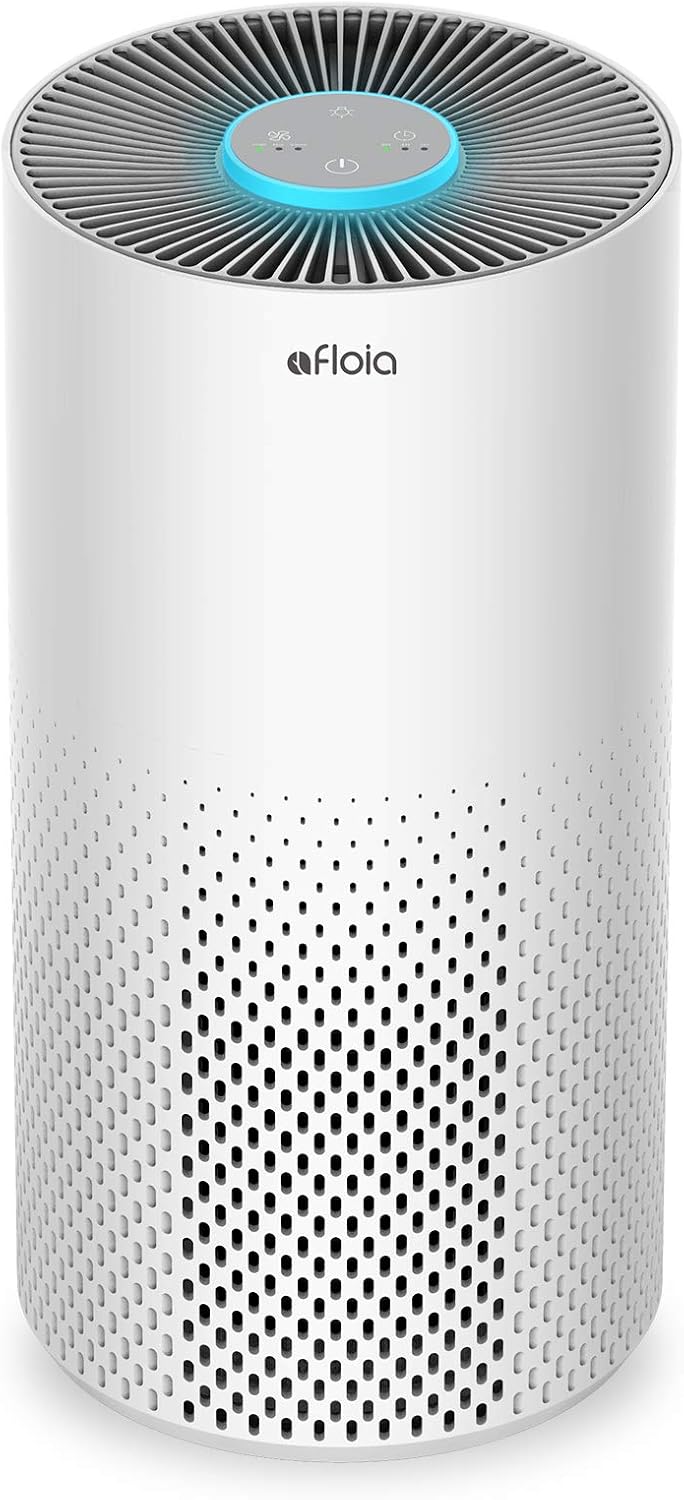
| Noise Level | 22 db |
|---|---|
| Particle Retention Size | 0.3 micron |
| Wattage | 23 watts |
| Floor Area | 60.84 square_feet |
| Filter Type | Activated Carbon |
The Afloia KILO is a small, user-friendly air purifier intended to remove common household pollutants in bedrooms and living rooms. It uses a 4-stage filtration system with a washable pre-filter plus activated carbon and HEPA-grade filtration to capture dust, pet hair, pollen, odors and smoke down to 0.3 microns. Controls are simple touch/button inputs with adjustable fan speeds, 2/4/8/16-hour timers, and a 7-color night light that auto-dims in sleep mode. Performance-wise it offers up to four air changes per hour for medium rooms, and its 22 dB noise level makes it unobtrusive for overnight use. The washable pre-filter reduces ongoing filter costs for homes with pets, while the option to buy pet- or antibacterial-specific replacement filters lets you tailor maintenance to allergy concerns. Limitations include modest coverage compared with full-size purifiers—buyers should match the unit to bedroom or medium-room sizes—and replacement filters are recommended every 4 to 6 months for best results. Overall it is a practical, quiet choice for improving bedroom air quality without complicated setup.
Best for: A buyer who prioritizes quiet, effective bedroom air cleaning and low ongoing fuss, especially someone managing seasonal allergies or pet dander in a medium-sized room.
Less Ideal for: Homes needing whole-house or very large-room air cleaning should choose a higher-capacity unit with larger CADR rather than this compact purifier.
- Multi-stage filtration including washable pre-filter and activated carbon for odors
- Quiet 22 dB sleep mode suitable for overnight use
- Adjustable timers and fan speeds for scheduled or low-night operation
- Washable pre-filter reduces maintenance cost for pet owners
- Coverage is best for bedrooms and medium rooms rather than very large open spaces
- Replacement filters need replacing every 4–6 months to maintain performance
Verdict: Choose the Afloia KILO when you want a quiet, low-maintenance bedroom purifier that handles allergens and pet hair without fuss.
AromaRoom AP103-A Air Purifier
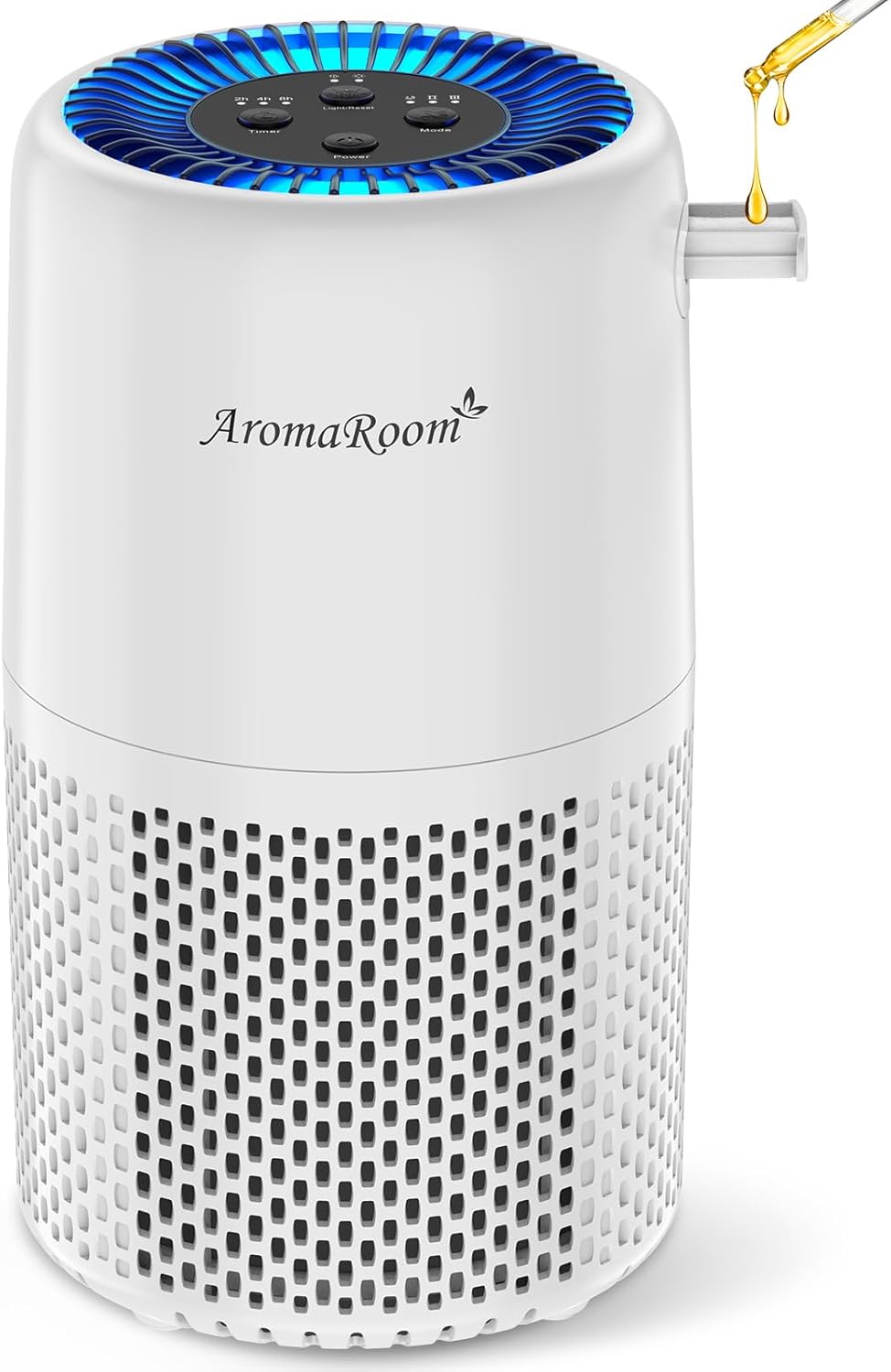
| Filter type | True H13 HEPA 3-in-1 |
|---|---|
| Coverage | Up to 323 ft² (twice per hour circulation) |
| Noise level | 22 dB (sleep mode) |
| Timer | 2/4/8 hours |
The AromaRoom AP103-A is a compact bedroom air purifier designed to remove common allergens and light smoke while staying quiet enough for nighttime use. It uses a True H13 HEPA 3-in-1 filter and a smoke-specific layer to capture particles down to 0.1–0.3 microns, and the unit claims to circulate room air twice per hour in spaces up to about 323 sq ft. Controls include sleep and timer modes (2/4/8 hours) and a low-noise setting that drops to 22 dB, making it suitable for light-sleep environments. A built-in fragrance pad lets you add essential oils for a mild scent while the purifier runs. Practical benefits include strong particulate filtration for allergy triggers, an ultra-quiet low setting, and simple timed operation, but the small footprint means it is best for bedrooms or small living areas rather than large open-plan spaces. Replacement filters are recommended every 3–6 months to maintain performance, and the manufacturer warns against placement in high-humidity areas.
Best for: Buyers who want an affordable, quiet bedroom purifier that focuses on removing airborne allergens and light smoke while adding optional fragrance.
Less Ideal for: Not a good choice for someone needing whole-house coverage or heavy smoke removal in large, open spaces.
- True H13 HEPA 3-in-1 filter captures fine particles including pollen and pet dander
- Rated to circulate air twice per hour in rooms up to ~323 ft²
- Very quiet low fan setting at about 22 dB suitable for bedroom sleep
- Timer modes (2/4/8 hours) and a fragrance pad for optional aromatherapy
- Designed for small-to-medium rooms so not ideal as a sole purifier for large open areas
- Requires regular filter replacements every 3–6 months to retain effectiveness
Verdict: A compact, budget-friendly bedroom purifier that delivers H13 HEPA-level particle removal and whisper-quiet operation for allergy-prone sleepers.
Levoit Core 300-P Air Purifier

| Filter Type | 3 in 1 Filtration |
|---|---|
| Floor Area | 1073 square_feet |
| Noise Level | 24 db |
| Particle Retention Size | 0.3 micron |
| Wattage | 56 watts |
The Levoit Core 300-P is a small, countertop air purifier designed for bedrooms and other home spaces that need consistent particle removal. It uses a three-stage original filter (pre-installed) and a 56W motor to deliver AHAM-verified CADR performance that refreshes a typical 222 ft² room multiple times per hour and can treat larger areas at a lower exchange rate. Controls are touch-based and include a near-silent Sleep Mode that drops noise to about 24 dB and turns off display lights for undisturbed nights. Practical benefits include strong capture of smoke, pollen, dust, pet dander and VOCs, ETL and CARB certifications, and a compact footprint that is easy to move between rooms. Limitations to expect are manual fan-speed control only (no Auto Mode on this model) and a recommendation to use Levoit replacement filters for best performance, which adds an ongoing cost. The unit is best when used continuously at low-to-medium speeds in a bedroom to keep airborne allergens down without disrupting sleep.
Best for: Buyers who prioritize a reliable, quietly operating bedroom purifier that consistently reduces allergens overnight and values verified performance over smart automation.
Less Ideal for: People who want built-in automatic air-quality sensing or app/smart-home integration should consider a different model with Auto Mode and connectivity.
- AHAM-verified CADR and HEPA-grade filtration for effective particle removal
- Very quiet Sleep Mode at approximately 24 dB for overnight use
- Compact and portable design suitable for bedroom or office surfaces
- Certified to CARB and ETL safety standards
- No automatic or smart Auto Mode on this model so fan speed must be set manually
- Requires periodic replacement of proprietary Levoit filters
Verdict: Choose the Core 300-P if you want a compact, AHAM-verified bedroom purifier that reliably removes fine allergens while running nearly silently.
VOOPNU HEPA Air Purifier DH-JH12

| Coverage (claim) | Up to 1,076 ft² |
|---|---|
| Measured cleaning rate | 250 ft² per 15 minutes (lab tested) |
| Noise level | 22 dB (low) |
| Filter type | H13 True HEPA triple-layer |
The VOOPNU DH-JH12 is a small, user-friendly air purifier intended to improve indoor air in bedrooms and small living spaces. It uses a 360 degree intake and an H13 true HEPA triple-layer filter to capture fine particles and claims to remove 99.97% of airborne pollutants, while laboratory testing cites cleaning 250 ft² every 15 minutes. The unit offers three fan speeds, a timer and a quiet low setting down to about 22 dB, so it can run overnight without disturbing sleep, and an essential oil tray lets you add scent. Controls are simplified for one-touch operation, and certifications such as ETL and CARB indicate industry testing. Because the purifier is compact it is easy to place on a nightstand or corner, but that size also means it is best suited to single rooms rather than whole-house use. Regular continuous operation and periodic filter replacement are recommended to maintain performance. Overall it is a practical, quiet bedroom purifier that balances filtration power with small-footprint convenience.
Best for: Buyers who prioritize quiet, easy-to-use bedroom air cleaning backed by strong customer reviews and industry certifications and who want a compact unit for a single room.
Less Ideal for: People seeking a whole-house solution or powerful high-CADR units for large open-plan spaces should consider larger purifiers instead.
- H13 true HEPA triple-layer filter rated to capture 99.97% of fine particles
- 360° intake design for even room coverage
- Very quiet operation down to 22 dB suitable for bedroom use
- Simple one-touch controls and timer for easy overnight use
- Essential oil tray adds optional fragrance without extra accessories
- Compact size limits effective coverage to single rooms rather than large open areas
- Filter replacement recommended every few months which adds ongoing cost
Verdict: A quiet, compact bedroom purifier with H13 HEPA filtration that delivers strong particle removal for single-room allergy relief backed by robust certifications and wide customer acceptance.
Levoit Core 200S-P
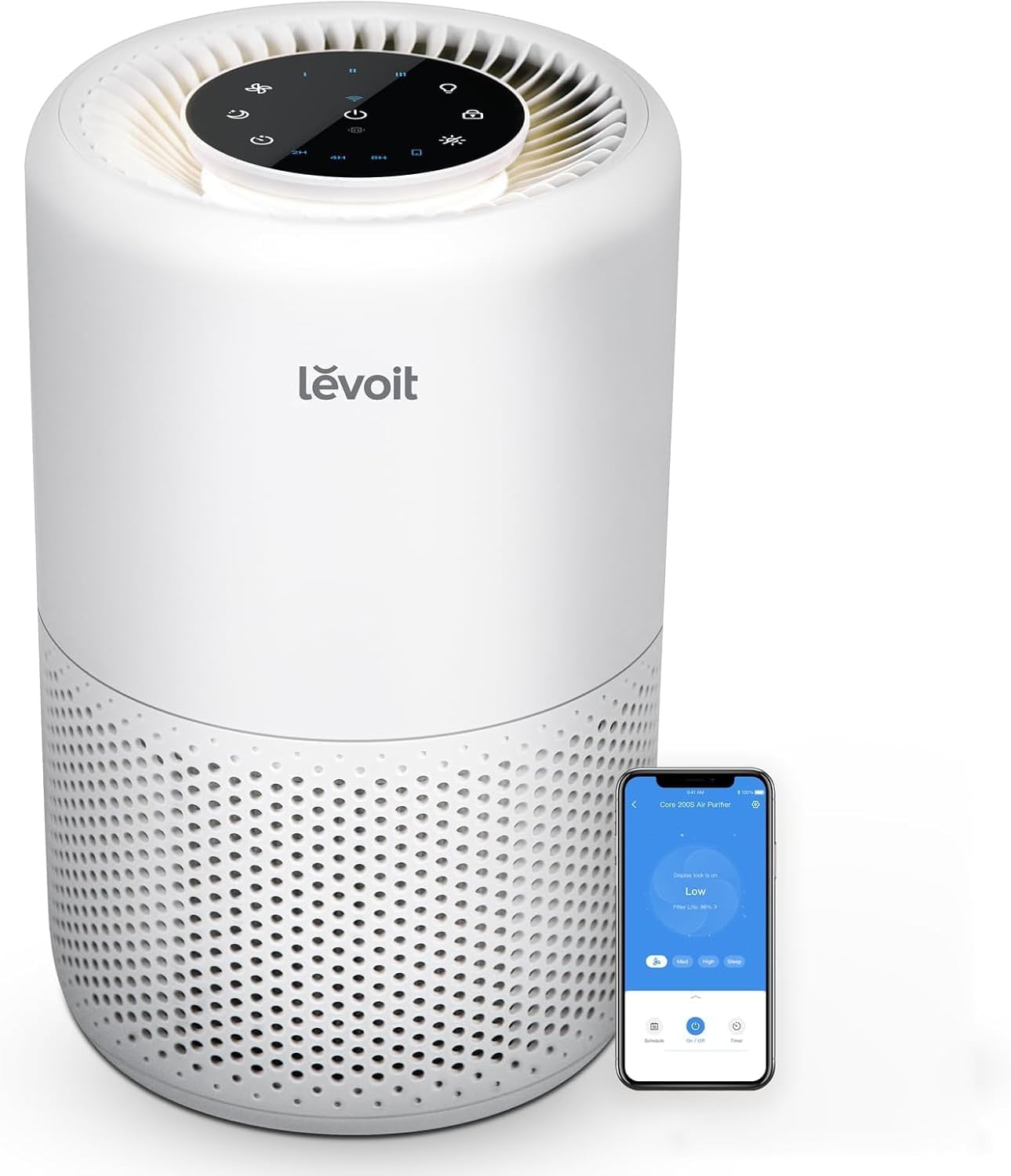
| Item model number | Core 200S |
|---|---|
| AHAM verification | Yes |
| Room coverage | 140 ft² (refreshed 4.8×/hr) |
| Noise level | As low as 27 dB |
The Levoit Core 200S-P is a compact smart air purifier designed for bedrooms, dorms, and small living spaces where allergy control and quiet operation matter. It pulls air in through a 360 degree intake and runs through a nylon pre-filter, activated carbon layer for odors, and a HEPA-grade main filter that removes 99.97% of particles down to 0.1-0.3 microns. The unit is AHAM-verified for performance and is rated to refresh the air in a 140 ft² room multiple times per hour, which makes it practical for overnight use. Smart and voice controls plus an in-app filter-life monitor simplify maintenance and let you check status without handling the unit. Noise can be as low as 27 dB in sleep mode so it will not disturb light sleepers. The trade-offs are typical for small-room purifiers: it is not sized for large open-plan areas and genuine replacement filters are recommended to maintain rated performance.
Best for: Buyers who want a reliable, low-noise purifier for a bedroom or small apartment and prefer simple smart controls and verified allergen filtration.
Less Ideal for: People who need whole-home coverage or a purifier sized for large living rooms should consider a larger unit instead.
- Three-stage filtration including HEPA-grade main filter that captures 99.97% of 0.1–0.3 micron particles
- AHAM-verified performance suitable for refreshing air in a ~140 ft² room
- Quiet sleep mode down to about 27 dB for undisturbed overnight use
- Smart app and voice controls with filter-life monitoring for easy maintenance
- Designed for small rooms so it will not provide adequate circulation for large or open-plan spaces
- Best performance depends on using genuine replacement filters
Verdict: A quiet, AHAM-verified small-room purifier with smart controls that reliably reduces allergens and pet odors in bedrooms.
Choosing the Right Air Purifier for Allergies Bedroom: Key Factors to Consider
Filtration Technology and Efficiency
A purifier's ability to remove allergy triggers hinges on the filtration method and its rated efficiency. True HEPA or HEPA-equivalent filters capture particulate allergens such as pollen, dust mite debris, and pet dander down to 0.3 microns with high efficiency. When shopping, look for documented particle-capture ratings or CADR numbers for dust and pollen so you can compare how quickly a unit will clean a typical bedroom.
Some units combine prefilters and activated carbon stages to trap larger particles and reduce common odors or volatile organic compounds that can aggravate sensitivity. While carbon does not remove particulates, it can improve perceived air quality when odors or off-gassing are a concern.
Nighttime Noise and Fan Settings
Because bedroom purifiers often run while you sleep, noise performance is a critical factor. Check the manufacturer's quoted decibel levels for the lowest fan setting and, if available, measurements taken at sleeping distances. Lower RPMs and larger, slower-moving fans tend to produce a quieter sound profile than small, high-speed blowers.
Consider how many user-selectable fan speeds or an automatic sleep mode the unit offers. A quiet low-speed setting that still provides reasonable air exchanges per hour is ideal. Also evaluate whether the unit has features that reduce disturbance at night, such as dimmable or removable lights and simple controls.
Appropriate Room Coverage
Match the purifier's recommended coverage area to your bedroom size. Manufacturers usually state a square-foot rating based on a number of air changes per hour. For effective allergy relief, choose a unit rated to clean the room at least two to four times per hour at a comfortable noise level. Oversizing slightly can allow you to run the purifier at lower, quieter settings while maintaining performance.
Keep in mind that placement affects effective coverage. Positioning the unit away from walls and obstructions and closer to where you spend most time sleeping will improve performance compared with tucking it into a corner.
Energy Consumption for Continuous Use
Bedroom purifiers are often left running all night and sometimes continuously during allergy seasons, so energy efficiency impacts operating cost and environmental footprint. Look for units with energy-saving modes or that perform well on low fan speeds without sacrificing filtration. Energy-efficient fans and brushless motors reduce electricity draw, and some models carry energy certifications that indicate better-than-average consumption.
Estimating daily runtime and checking wattage at typical sleep settings can help you compare annual energy use across models.
Filter Lifespan and Maintenance
Ongoing maintenance affects both cost and long-term performance. Understand the expected lifespan of primary filters and any prefilters, and check how easy and affordable replacements are to source. Units with simple, tool-free access to filters reduce the chance of skipped maintenance.
Also consider whether the purifier offers washable prefilters to extend the life of the main filter, and whether the unit includes intuitive filter-change indicators based on run time or actual sensor readings rather than a fixed calendar. Ease of filter purchase and replacement scheduling are practical concerns for allergy sufferers who rely on continuous performance.
Best Placement and Setup in a Bedroom
For optimal allergy relief, place the purifier where air flows freely and near where you sleep. A spot by the bedside or a short distance from the bed ensures that cleaned air reaches you first during sleep. Avoid placing the unit directly against walls, under low shelves, or behind large furniture that blocks airflow.
Consider elevating smaller models a few inches off the floor to reduce intake of floor-level dust while keeping them stable. If you use ceiling fans or HVAC systems, coordinate purifier placement so that filtered air is distributed across the room rather than pulled immediately into the central vents.
- Keep at least 6 to 12 inches of clearance on intake and exhaust sides.
- Avoid placing directly under windows or next to doors that are frequently opened.
- Aim purifier intake toward the center of the room or the bed, not the corner.
Operating Modes and Scheduling
Use an automatic or sleep mode where available to maintain overnight filtration at an acceptable noise level. During high-allergy times, run the purifier at higher speeds for a few hours before bedtime to lower particle counts, then switch to a quiet setting for the night.
If your unit lacks a true auto mode, consider using a timer to ramp up cleaning during the hour before sleep and reduce speed once particle counts are lower. Continuous low-level operation often yields better long-term indoor air quality than intermittent blasting at high speed.
- Run higher speeds for pre-sleep clearing, then switch to sleep mode.
- Use built-in timers or external smart plugs to automate schedules if needed.
- Check whether the unit reports particle counts so you can adapt settings to indoor conditions.
Common Misconceptions About Bedroom Purifiers
Some people expect immediate elimination of all allergy symptoms. While a good purifier can reduce airborne triggers, it will not address allergens already embedded in bedding, carpets, or upholstery. Combined strategies such as frequent laundering, vacuuming with HEPA vacuums, and reducing bedroom dust reservoirs are still necessary.
Another misconception is that ionizers alone are sufficient. Particle-capture filtration is the reliable method for removing allergens. If you are sensitive to ozone or similar byproducts, prioritize filters and technologies that do not rely on ozone-producing processes.
- Purifiers reduce airborne particles but do not clean surfaces; pair with cleaning routines.
- Rely on true particulate filtration rather than ionization for consistent allergen removal.
Maintenance Best Practices
Regular maintenance keeps performance predictable. Check prefilters every month and clean or replace them as recommended. Replace main HEPA or equivalent filters on the manufacturer-recommended schedule or sooner if you live in a high-dust environment.
Keep the unit exterior and vents dust-free to avoid impeding airflow. If your purifier has a washable prefilter, rinse and dry it thoroughly before reinstalling. Keep a small stock of replacement filters if you depend on the purifier during extended allergy seasons.
- Inspect prefilters monthly and main filters every 6 to 12 months depending on use.
- Follow manufacturer guidance for filter disposal and replacement to maintain efficiency.
When to Consider Supplemental Measures
If airborne purification alone does not control symptoms, consider supplementary steps focused on the bedroom microenvironment. Hypoallergenic bedding, encasements for mattresses and pillows, and reduced fabric surfaces limit where allergens accumulate. Improving ventilation and managing humidity to recommended ranges can also reduce dust mite and mold growth.
In extreme sensitivity cases, consult with a medical professional about integrated strategies that include environmental controls and medical interventions. A purifier is one element of an overall approach to reducing exposure.
- Use allergen-proof encasements for mattresses and pillows.
- Keep indoor humidity between 30 and 50 percent to limit dust mite proliferation.
How We Chose the Best Air Purifier for Allergies Bedroom
We selected units that are specifically suited to bedroom allergy relief by applying filters that emphasize real-world sleeping-room use. Primary evaluation criteria included particle filtration efficiency for common allergens, low-noise performance at night settings, and room coverage that matches typical bedroom sizes. We also considered energy consumption for continuous overnight operation and ease of filter replacement and maintenance. To narrow the field, we excluded units designed only for very large open-plan spaces, devices that rely solely on ionization without particle filtration, and purifiers with unclear or unsupported CADR or particle-removal specifications. Our process prioritized measurable performance metrics and user-focused features: verified HEPA or equivalent filter performance, documented CADR or particle-removal rates, manufacturer-provided sound-level data for sleep modes, and practical maintenance needs such as filter life and replacement accessibility. Editorial judgment balanced these objective specs with design factors that matter in bedrooms, including footprint, simple controls for overnight use, and energy efficiency for continuous operation. The result is a curated set of bedroom-appropriate air purifiers optimized for allergy reduction and nighttime comfort.
Our full evaluation process is outlined in our review methodology.
FAQ
How large should an air purifier be for a typical bedroom?
Choose a purifier rated for your bedroom square footage with at least two air changes per hour at a quiet setting. Slightly oversizing allows the unit to run more quietly while maintaining performance.
Can an air purifier remove dust mite allergens from bedding?
Air purifiers remove airborne mite fragments and dust but do not extract allergens embedded in fabrics. Regular washing, mattress encasements, and vacuuming are needed to reduce allergens in bedding and upholstery.
Are carbon filters necessary for allergy relief?
Carbon filters can help with odors and some gaseous irritants but do not capture particulate allergens. They are useful if odors or VOCs are part of the symptom triggers, but true particulate filters remain the priority for allergies.
How often should I replace the HEPA filter?
Filter replacement depends on use and environment but typically ranges from 6 to 12 months. Check the prefilter monthly and follow run-time or sensor-based indicators if available to decide when replacement is due.
Will a purifier help with pet allergies in the bedroom?
A good particulate-filtering purifier will reduce airborne pet dander, which can lower exposure while sleeping. It is most effective when combined with pet-free bedroom policies and frequent cleaning.
Final Verdict
For bedroom allergy relief, prioritize units that combine high particulate filtration with low nighttime noise and coverage matched to your room size. Expect to balance filtration speed and noise: a slightly larger unit run at lower speeds often provides the quietest effective operation. Maintenance matters: easy filter access and reasonable replacement intervals keep performance consistent. Treat the purifier as one element of a broader allergy-reduction strategy that includes bedding controls, cleaning, and humidity management. Focus on measurable specs like filtration efficiency, CADR, and sound levels to pick a bedroom purifier you can run night after night with confidence.