
Note: This article contains affiliate links. If you click on these links and make a purchase, we may earn a small commission at no extra cost to you. This helps support our research and content. Read our full affiliate disclosure here.
Basement odors can come from dampness, stale air, mold spores, or stored items, and they make lower levels of your home uncomfortable to use. Choosing an air purifier for basement smell matters because basements often have limited ventilation and different airflow patterns than living spaces, so a unit that moves air effectively and targets odor-causing compounds will make the most noticeable difference. This guide shortlists the top air purifiers suitable for treating basement smell and explains the key features we evaluated, including filtration effectiveness, airflow capacity, and operational noise. Read on for practical guidance to help you pick a unit that improves basement air quality and stays reasonable to run daily.
Top Picks at a Glance
| Best Overall The best all-around choice for most situations | Winix 5510 Air Purifier |  |
| Best Quality Built to a higher standard if you want something more solid | Medify MA-40 Air Purifier |  |
| Best Value The sweet spot between price and what you get | MOOKA B-D02L Air Purifier |  |
| Best Budget The cheapest option that still gets the job done reliably | VOOPNU H13 HEPA Air Purifier DH-JH12 |  |
| Top Rated A top-rated pick with lots of positive feedback | Levoit Core 300-P Air Purifier |  |
| Most Popular A crowd favorite that many people choose with confidence | Levoit Vital 100 Air Purifier |  |
Winix 5510 Air Purifier

| Model number | 5510 |
|---|---|
| Coverage (AHAM) | 1,882 sq ft / 1 hr |
| Filtration | 4-Stage with True HEPA and carbon |
| Noise (lowest) | 23.5 dB |
| Smart features | Winix Smart App, WiFi, Alexa, Google Home |
The Winix 5510 is a four-stage air purifier designed to clean large rooms quickly using a True HEPA filter plus an advanced deodorization carbon layer and a washable pre-filter. It uses built-in sensors and an AQI LED to monitor air quality and will automatically adjust fan speed in Auto Mode, while Sleep Mode reduces noise and power use when the room darkens. Winix includes PlasmaWave technology intended to reduce airborne pollutants and the unit supports the Winix Smart App for remote monitoring and control. Practical benefits include rapid coverage—AHAM-verified for roughly 1,882 sq ft per hour—strong removal of fine particles down to 0.01 microns, and a carbon filter aimed at odors and VOCs, which helps when tackling basement smells. Trade-offs are typical for high-CADR units: filter replacements and occasional higher fan noise on faster settings, plus PlasmaWave is an add-on that some users prefer to disable. The 5510 is a feature-rich option if you want fast, automated cleaning plus remote control and explicit odor-management features.
Best for: Buyers who need a robust, automated purifier that can tackle airborne particles and persistent odors in larger basement or open-plan spaces and who value remote control and smart features.
Less Ideal for: People looking for an ultra-quiet bedroom-only purifier for very small rooms or those who want a no-maintenance, filterless solution should consider other options.
- True HEPA filtration that captures very small particles down to 0.01 microns
- Advanced carbon deodorization filter targeted at odors and VOCs
- Smart sensors with Auto Mode and AQI indicator for hands-off operation
- Winix Smart App, Wi‑Fi and voice assistant compatibility for remote control
- Washable pre-filter extends main filter life and simplifies maintenance
- Filter replacements are required over time, adding ongoing cost
- Higher fan speeds produce noticeable noise compared with the quietest bedroom units
Verdict: Choose the Winix 5510 when you want fast large-room cleaning plus built-in odor control and smart automation to reduce basement smells quickly and conveniently.
Medify MA-40 Air Purifier

| Floor Area | 4455 |
|---|---|
| Noise Level | 46 db |
| Filter Class | HEPA H13 |
| Wattage | 95 watts |
| Particle Retention Size | 0.1 micron |
The Medify MA-40 is a high‑capacity HEPA H13 purifier built to move a lot of air for large rooms and open basements. It uses a True HEPA H13 filter tested to capture particles down to 0.1 microns and reports a CADR that covers about 1,793 sq ft in one hour, so it reduces smoke, pollen, pet dander, dust, and common odors faster than smaller units. Controls are simple with a touch panel offering three fan speeds, sleep mode, a timer and child lock, and a filter replacement indicator simplifies maintenance. Noise is moderate; the manufacturer lists a minimum around 46 dB and higher levels at max speed, so it is quieter than many industrial purifiers on low but noticeable on boost. The unit is plug‑in powered, ETL and CARB certified, and backed by lifetime support when using genuine replacement filters. Expect filter replacements every few months under heavy use and some audible fan noise when running at higher speeds in very large or damp basements.
Best for: Buyers who prioritize fast, high‑volume air cleaning in large or open basement areas and want a proven HEPA H13 system with simple programmable controls.
Less Ideal for: People who need an ultra‑quiet bedroom or home office purifier for small enclosed rooms or those who prefer completely silent operation overnight.
- High CADR and coverage suitable for large rooms or open basements
- True HEPA H13 filtration captures particles down to 0.1 microns
- Touch controls with timer, sleep mode, and child lock for easy operation
- Certified by CARB and ETL and includes filter replacement indicator
- Lowest reported noise level is around 46 dB, so it is not silent in living spaces
- Filter replacements are required every few months with heavy use
Verdict: If you need powerful, high‑coverage filtration to tackle stubborn basement smells and particulates, the MA-40 delivers proven HEPA H13 performance at scale.
MOOKA B-D02L Air Purifier
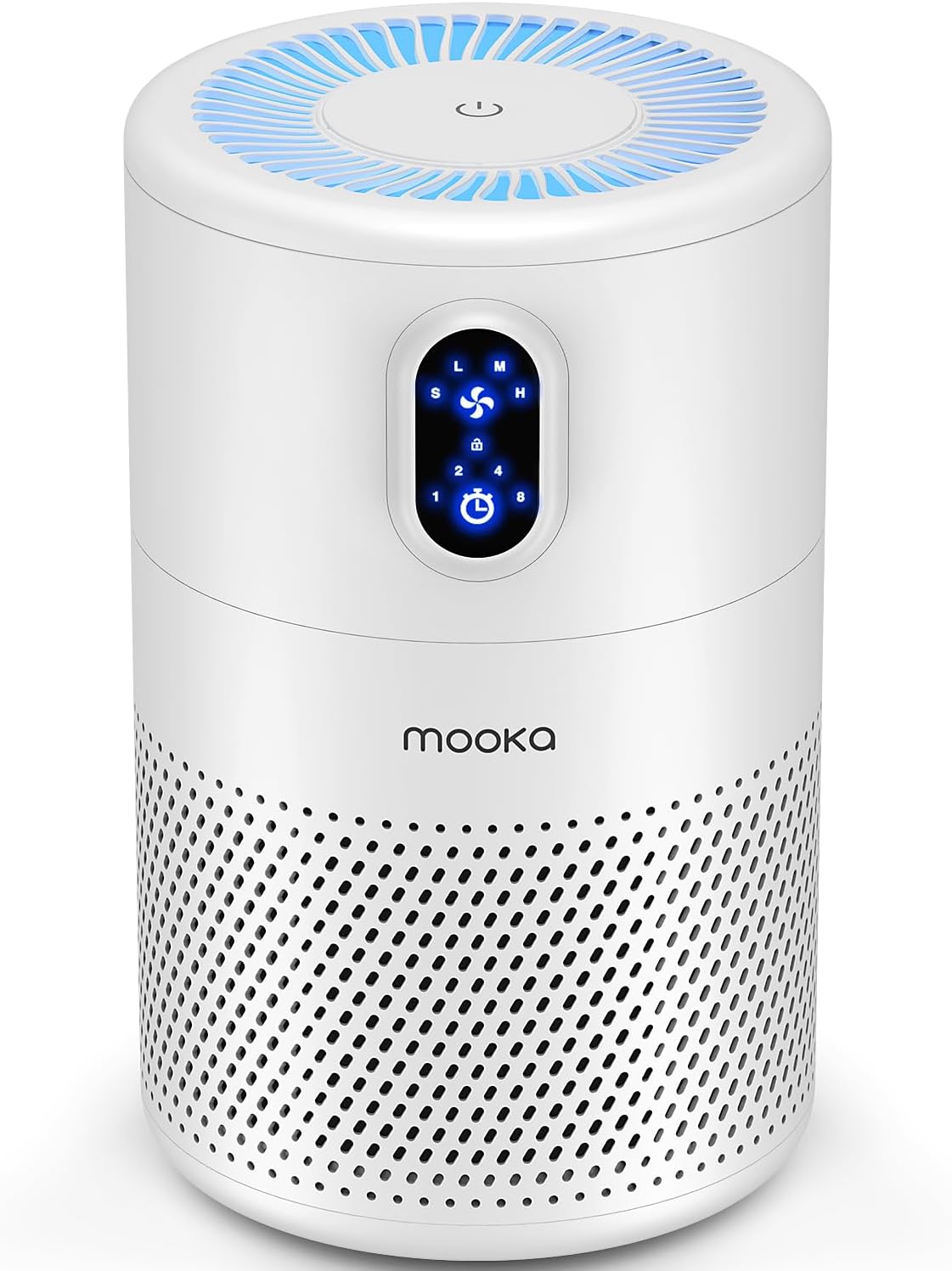
| Effective Area | 1076 sq ft |
|---|---|
| Filter Type | H13 True HEPA + Activated Carbon |
| Fan Modes | Sleep/Low/Med/High |
| Timer Options | 1H/2H/4H/8H |
The MOOKA B-D02L is a small, user-friendly air purifier built around an H13 true HEPA filter plus activated carbon to remove dust, pollen, pet dander, smoke, and household odors. It is typically placed in living rooms, bedrooms, or basements and can run on four fan speeds with timer settings (1/2/4/8 hours) and a night-light option. The unit claims coverage up to 1,076 sq ft with higher air-change rates in smaller rooms, and its brushless motor keeps noise very low so it can operate during sleep or while working. Practical features include a child lock, filter replacement reminder, and an included power adapter stored under the base. Limits to consider are the small physical size and need to replace the filter every 3 to 6 months depending on conditions, and real-world performance for heavy basement odors will depend on ventilation and source control as well as purifier placement. For routine odor reduction and particle removal in enclosed spaces this model offers a quiet, energy-sparing option with straightforward controls.
Best for: Buyers who want a quiet, easy-to-use purifier to reduce particles and light odors in enclosed rooms and prioritize energy efficiency and simple controls.
Less Ideal for: Homes with severe, persistent odor sources or very large open basements that need professional ventilation or multi-unit commercial-grade filtration.
- H13 true HEPA plus activated carbon captures particles and reduces common household odors.
- Covered fan speeds and timers let you balance purification with energy use.
- Very quiet brushless motor suitable for night use.
- Child lock and filter reminder simplify safe everyday operation.
- Filter requires replacement every 3–6 months which adds ongoing cost.
- Effectiveness against strong or persistent basement smells depends on airflow and source elimination, not just the purifier.
Verdict: A quiet, energy-efficient HEPA purifier that is a practical choice for reducing particles and moderate basement smells in enclosed residential spaces.
VOOPNU H13 HEPA Air Purifier DH-JH12

| Filtration | H13 True HEPA triple-layer |
|---|---|
| Coverage | Up to 1,076 ft² (rated) |
| Noise level | 22 dB (low) |
| Speeds | 3 fan speeds |
This VOOPNU DH-JH12 is a small but capable air purifier that uses an H13 true HEPA multi-layer filter and 360 degree intake to capture particles, pet hair, pollen, smoke, and common odors in living spaces. It is intended for plug-and-play use with a simple control panel, three fan speeds, a timer, and an essential oil tray for light fragrance. The manufacturer reports it cleans 250 sq ft every 15 minutes (up to about 1,076 sq ft per hour) and claims noise as low as 22 dB on its lowest setting, which makes it suitable for bedrooms or basements where quiet operation matters. The unit is compact and easy to place on a shelf or corner, and certifications like ETL and CARB indicate it meets common safety and emissions standards. Important limitations are its small physical size and the need to run continuously for best results in persistent odor scenarios, plus filter replacements on a 3–6 month cycle depending on use, so ongoing maintenance costs should be expected.
Best for: Buyers looking for an affordable, easy-to-use purifier to reduce particles and light odors in a basement or medium-sized room who prioritize quiet, compact units over heavy-duty odor removal.
Less Ideal for: Those needing industrial-strength odor removal for large or very damp basements, or buyers who want a maintenance-free solution without recurring filter costs.
- H13 True HEPA filtration captures 99.97% of airborne particles including pollen, smoke, and pet dander
- 360° air intake with reported CADR-style throughput cleans mid-size rooms quickly (250 ft² every 15 minutes)
- Very quiet operation down to 22 dB, suitable for overnight or low-noise environments
- Compact footprint makes placement easy in basements, bedrooms, or tight spaces
- Simple controls, timer, and essential oil tray add convenience and mild aromatherapy option
- Small physical unit means airflow and odor removal are limited compared with larger, higher-CADR models
- Requires periodic filter replacements (recommended every 3–6 months) which add to lifetime cost
Verdict: A budget-friendly, quiet H13 HEPA purifier that fits small spaces and helps reduce particles and light basement odors when run continuously.
Levoit Core 300-P Air Purifier

| Power Source | Corded Electric |
|---|---|
| Filter Type | 3 in 1 Filtration |
| Floor Area | 1073 square_feet |
| Noise Level | 24 db |
| Wattage | 56 watts |
The Levoit Core 300-P is a compact, plug-in air purifier built around a three-stage filtration system that includes a pre-filter, high-efficiency HEPA-grade filter, and activated carbon to tackle particles and odors. It is typically used in bedrooms, living spaces, or basements where dust, pet dander, smoke, and odors are a concern; the unit draws air through the filters with a 56W motor and delivers a tested CADR that refreshes medium rooms multiple times per hour. Notable features include AHAM verification, CARB and ETL safety listings, a near-silent Sleep Mode rated at about 24 dB, a touch control panel with a timer and filter check indicator, and a portable footprint that is easy to move between rooms. In practice the Core 300-P balances strong fine-particle capture (99.97% for 0.1–0.3 µm as tested) with practical odor reduction from the carbon layer, making it a reasonable choice for reducing basement smells when placed strategically. Limitations include no smart/auto mode on this variant so fan speed must be set manually, and carbon capacity limits how long heavy odors are reduced before the filter needs replacement.
Best for: Buyers who prioritize consistently reliable particle removal and certified performance and who need a portable purifier to improve air quality in enclosed rooms like basements or bedrooms.
Less Ideal for: People who want a fully automatic, Wi-Fi connected purifier with adaptive sensing or those needing heavy-duty industrial odor removal for very large or severely contaminated basements.
- True HEPA-grade filtration for fine particles down to 0.1–0.3 µm
- Activated carbon layer helps reduce odors and VOCs
- Quiet Sleep Mode suitable for overnight use
- AHAM verified CADR and multiple safety certifications
- Compact, portable design that is easy to reposition
- No built-in Auto Mode or smart connectivity on this model
- Carbon filter will saturate faster in very odor-prone spaces and requires periodic replacement
Verdict: A dependable, AHAM-verified HEPA purifier with carbon filtration that quietly reduces particles and moderate basement odors when run in the affected room.
Levoit Vital 100 Air Purifier

| CADR | 105 CFM |
|---|---|
| Coverage | 788 ft² per hour |
| Filtration | 3-stage (washable pre-filter, particle filter, activated carbon) |
| Timer | 2/4/8 hours |
The Levoit Vital 100 is a compact three-stage air purifier that pulls air through a washable pre-filter, an efficient particle filter, and an activated carbon layer to reduce dust, pollen, pet hair, odors, and common VOCs. It is typically placed in bedrooms, living rooms, or basements where you want continuous filtration without a lot of noise; the unit claims a 105 CFM CADR and can cycle the air in a medium room once per hour. Controls are simple with a timer (2/4/8 hours), a check-filter indicator, and a light-off option for nighttime use. The washable pre-filter handles larger debris and pet hair so the main filters last longer, while the carbon layer helps cut cooking smells and mildew-related odors common in basements. Trade-offs are its single-room focus and reliance on Levoit genuine replacement filters to maintain performance, so larger or heavily contaminated basement spaces may need multiple units or a higher-capacity purifier. Noise levels are low at the quietest setting, but higher fan speeds are noticeable during heavy clean-up cycles.
Best for: Buyers who prioritize proven performance and lots of user feedback and want a quiet, easy-to-use purifier to reduce odors and allergens in a single basement room or finished space.
Less Ideal for: People needing whole-basement coverage, heavy smoke remediation, or industrial-strength VOC removal should consider higher-capacity or commercial-grade systems instead.
- Three-stage filtration including washable pre-filter and activated carbon for odor reduction
- Relatively quiet operation with lights-off option for bedroom or night use
- Compact design with rear handle makes it easy to move between rooms
- Timer and filter-check indicator simplify routine use and maintenance
- Designed for single-room use so one unit may not cover large or open basements
- Manufacturer recommends genuine Levoit filters which increases ongoing operating cost
Verdict: A compact, low-noise purifier with carbon-backed odor control that is a safe, well-reviewed choice for improving air in a single basement room.
Choosing the Right Air Purifier for Basement Smell: Key Factors to Consider
Filtration Type and Odor Removal
Basement smells are often a mix of mold spores, organic particles, and volatile organic compounds. Effective odor control usually requires a combination of mechanical filtration and activated carbon or other adsorption media. HEPA filters capture fine particulates but do not remove gases or odors on their own, so a dedicated odor-targeting stage matters.
Pay attention to how the purifier stages filtration. Units that include a pre-filter, HEPA stage, and a substantial carbon layer will perform better on smell than single-filter designs. Also consider whether specialized media, such as catalytic carbon or zeolite blends, are specified for VOC reduction when addressing strong or chemically complex basement odors.
Airflow Capacity and Room Size Coverage
An air purifier that cannot move enough air will not meaningfully reduce odors or particles in a basement. Look for published Clean Air Delivery Rate (CADR) or recommended room coverage and match it to the basement's square footage and ceiling height. Basements often have higher ceilings or open plans, so calculate needed airflow conservatively.
Multiple air changes per hour are ideal for persistent smells. If your basement has separate rooms or nooks, consider a higher capacity unit or multiple smaller purifiers placed strategically near odor sources to maintain effective circulation.
Noise Output and Fan Control
Basements are frequently used for media, work, or overnight sleeping areas, so noise matters. Check decibel ratings across fan speeds and whether the purifier offers a low or sleep mode that still maintains reasonable airflow. Variable fan speeds and programmable schedules help balance odor removal with quieter operation during sensitive times.
Also consider fan design. Units with larger, slower-moving fans often deliver similar airflow at lower noise compared with small high-RPM fans. If you plan continuous operation, prioritize models with demonstrated quiet performance at medium settings.
Maintenance, Filter Life, and Ongoing Cost
Filter maintenance affects both long-term performance and ownership cost. Basements with high dust or dampness may clog pre-filters faster, reducing effectiveness. Look for units with easy access to replaceable filters, clear life indicators, and reasonable replacement intervals. Consider the availability and types of replacement media, such as thicker carbon blocks versus thin carbon layers, because thicker media often lasts longer.
Regular cleaning of pre-filters and ensuring filters stay dry will preserve performance in humid basements. Factor the expected annual cost of replacement filters into your decision to avoid surprises.
Placement, Footprint, and Installation Flexibility
Where you place an air purifier in a basement affects how well it treats odors. Choose a unit that can be positioned near odor sources without blocking airflow or interfering with activities. Slim or wall-mountable designs save floor space, while tower or tabletop units may be easier to move.
If the basement has a utility area, laundry, or frequent moisture, prioritize models with raised feet or corrosion-resistant finishes. Also think about cord length and access to power; the best-performing unit is only effective when placed optimally and run consistently.
Humidity and Mold Resistance
Basements are prone to elevated humidity, which affects both odor sources and purifier longevity. Units with materials and designs that resist moisture damage will hold up better. While air purifiers do not dehumidify, some feature antimicrobial pre-filters or coatings to limit mold growth on filter surfaces.
If humidity is a known issue, plan the purifier as one part of a strategy that includes ventilation and possible dehumidification. Choosing filters and housings designed for damp locations reduces the chance of premature failure or secondary odor issues from trapped moisture.
Where Basement Smells Usually Come From
Understanding common sources helps you pick the right purifier and placement. Typical culprits include damp building materials, condensation on concrete or masonry, stored organic materials, mold growth in hidden cavities, and occasional sewer or plumbing odors. Each source releases different compounds and particles, which affects what filtration features will be most effective.
For example, mold and dust respond well to HEPA filtration, while damp-related VOCs often need activated carbon or specialized adsorption media. Spot-cleaning identified sources and improving ventilation are complementary steps that make any air purifier more effective.
- Mold spores and dust: reduced by HEPA filters
- Musty VOCs from damp materials: need activated carbon or adsorption media
- Intermittent sewer or plumbing odors: may require targeted adsorption and source repair
- Stored items and fabric odors: improved with airflow and carbon filtration
Sizing the Unit to Your Basement
Measure the square footage and note ceiling height before choosing a purifier. Many manufacturers list coverage for standard ceilings; if your basement has higher ceilings or open areas, increase the required capacity accordingly. Aim for an air purifier that can deliver multiple air changes per hour for persistently smelly spaces.
If the basement has distinct zones, plan to place the purifier where air circulates between zones or consider multiple units. Small portable units can be effective in single rooms, but a single undersized unit will struggle to clear odors in a large open basement.
- Confirm CADR or recommended room size
- Adjust for ceiling height and open-plan areas
- Consider multiple units for separate rooms
Practical Placement Tips for Best Results
Position the purifier near the smell source when possible, not hidden behind furniture. Keep at least a foot of clearance on the intake and exhaust sides to avoid restricting airflow. Elevating a purifier slightly can help distribute cleaned air more evenly in rooms with low airflow.
Avoid placing units directly against concrete walls or in corners where stagnant air accumulates. For basements with laundry or utility areas, place the purifier downwind of the source so contaminated air passes through the unit before circulating back into the room.
- Place near odor source but allow airflow clearance
- Elevate slightly if floor airflow is poor
- Avoid corners and blocked intakes
- Use multiple units for separated spaces
Running Costs and Energy Use
Continuous operation provides the best control of persistent basement smells, so energy consumption matters. Look for units with energy-efficient motors and a sleep or eco mode that reduces power draw during low-activity periods. Some purifiers include scheduling or timers to limit high-speed operation to times when odors peak.
Also account for filter replacement frequency and cost. Heavier-duty carbon media and thicker HEPA filters often last longer but may have higher upfront replacement cost. Balancing runtime, fan speed, and maintenance will reduce total operating cost over the life of the unit.
- Prefer energy-efficient motors and eco modes
- Use timers or schedules to minimize high-speed runtime
- Factor in annual filter replacement cost
- Continuous low-speed operation often balances odor control and energy use
When to Add Dehumidification or Ventilation
Air purifiers treat airborne particles and some gases but do not remove excess moisture. If the basement smell is driven by high humidity or active water intrusion, combining an air purifier with a dehumidifier or improved ventilation is advisable. Lowering humidity reduces mold growth and the load on the purifier.
Assess humidity with a simple hygrometer. If levels regularly exceed recommended indoor ranges, prioritize fixing moisture sources and consider a dehumidifier sized for the space. Once humidity is controlled, a properly chosen air purifier will be more effective and require less frequent filter changes.
- Use a hygrometer to monitor basement humidity
- Address leaks and water intrusion before relying on purification alone
- Combine purifier with dehumidifier in damp basements
- Stable, lower humidity improves purifier longevity
How We Chose the Best Air Purifier for Basement Smell
We prioritized units that demonstrably address the two core basement challenges: persistent odors and high load of airborne particulates from damp environments. Selection began by screening for filtration systems capable of removing volatile organic compounds and particulate matter commonly associated with basement smell. We then filtered candidates by airflow capacity relative to typical basement room sizes to ensure adequate air changes per hour. Operational noise and energy use were next-level filters because basements are often used as living or work spaces where quiet and cost matter. We favored designs with clear fan-speed control and verified noise ratings. Durability and maintenance were considered: units with accessible filters, reasonable replacement intervals, and durable housings scored higher. Additional factors included coverage area versus footprint and simplicity of controls. Exclusions included units without adequate filtration for gases or those lacking published airflow or noise specifications. The result is a list focused on practical odor reduction, measurable airflow, manageable noise, and realistic upkeep expectations.
Our full evaluation process is outlined in our review methodology.
FAQ
Can an air purifier eliminate musty basement smell completely?
Often an air purifier will significantly reduce musty odors, especially when it combines HEPA and active carbon filtration. However, complete elimination usually requires addressing the underlying moisture or mold source because purifiers remove airborne compounds but do not fix structural or water issues.
How large a purifier do I need for a finished basement room?
Choose a unit whose coverage or CADR matches the room's square footage and ceiling height. For persistent smells, aim for higher air changes per hour by selecting a unit rated above the room size or using multiple units to ensure effective circulation.
Will running the purifier 24/7 damage the unit or cost too much?
Running continuously is common for basements with ongoing odors. Modern purifiers are designed for continuous use, but energy draw depends on fan speed and motor efficiency. Use lower speeds or eco modes at night and schedule high-speed runs when odors peak to balance performance and cost.
Does activated carbon always remove all basement odor compounds?
Activated carbon is effective for many common VOCs and organic odors, but its effectiveness depends on the carbon quantity, pore structure, and contact time. Some complex or very low-concentration gases may require specialized adsorbents or larger carbon beds to be fully captured.
How often should I replace filters in a basement environment?
Replacement frequency varies with pollutant load and humidity. In basements with high dust or dampness, pre-filters may need cleaning every few weeks and HEPA or carbon filters might need replacement more often than in living spaces. Monitor performance and follow the manufacturer's guidance adjusted for heavier usage.
Final Verdict
Focus on filtration that addresses both particles and gases, and size the unit for actual basement dimensions rather than a generic room. Balance airflow and noise so the purifier can run regularly without creating disruption, and account for filter maintenance and energy use when comparing options. If moisture is part of the problem, pair purification with dehumidification or source remediation to achieve lasting odor relief. Prioritize odor-targeting media, adequate airflow, and manageable upkeep to choose an air purifier that keeps your basement smelling fresher and healthier.